



Abstract
We study the recently suggested effective Wadge hierarchy in effective spaces, concentrating on the non-collapse property. Along with hierarchies of sets, we study hierarchies of k-partitions which are interesting on their own. In particular, we establish sufficient conditions for the non-collapse of the effective Wadge hierarchy and apply them to some concrete spaces, including the discrete space of natural numbers, the Baire space, and the Cantor space. While the latter two cases are obtained by easy effectivization of the corresponding topological result by T. Kihara and A. Montalban, the first case needs a different technique and is certainly the main technical result of this paper.
Keywords
Introduction
Hierarchies are basic tools for calibrating objects according to their complexity, hence the non-collapse of a natural hierarchy is fundamental for understanding the corresponding notion of complexity. A lot of papers investigate the non-collapse property in different contexts, see e.g. [29] for a survey of hierarchies relevant to those studied in this paper.
The Wadge hierarchy (WH), which is fundamental for descriptive set theory (DST), was developed for the Baire space
The non-collapse of EWH is highly non-trivial already for the discrete space
We also prove the non-collapse of EWH in
The FH (as also most of the objects related to the WH) has inherent combinatorial complexity resulting in rather technical notions and involved proofs. To make the paper more readable, we cite several known results and recall all principal definitions, often with making new observations and giving additional details. These efforts make this paper reasonably self-contained. With papers [17,27,30,35] at hand, the reader will certainly have everything to understand the remaining technical details from scratch.
In Section 2, along with routine preliminaries, we give a rather detailed treatment of the so called iterated h-preorders which serve as the notation system for the EWH of k-partitions. In Section 3 we recall necessary definitions and facts about the EWH. In Section 4 we define some versions of the non-collapse property and relate them to the preservation property. While for hierarchies of sets the non-collapse property is defined in the obvious standard way, for hierarchies of k-partitions with
In Section 5 we prove the main technical results of this paper, including the non-collapse of the EWH in
In Section 6 we establish the non-collapse of the EWH of k-partitions in the Baire space, the domain of finite and infinite strings, and some related spaces. Although proofs in this section are short (due to the possibility to refer to some notions and proofs in [17]), the formulations are new and hopefully interesting because they provide (as well as the results in Section 5) effective versions for the results in [17]. We conclude in Section 7 with a short discussion of possible future work.
Preliminaries
In this section we recall some notation, notions and facts used throughout the paper. We use standard set-theoretical notation. In particular,
Effective hierarchies
Here we briefly recall some notation and terminology about effective hierarchies in effective spaces. More details may be found e.g. in [31].
All (topological) spaces in this paper are countably based
Among effective cb0-spaces are: the discrete space
Quasi–Polish spaces (introduced in [7]) are important for DST and have several characterisations. Effectivizing one of them we obtain the following notion identified implicitly in [31] and explicitly in [8,14]: a computable quasi-Polish space is an effective cb0-space
Effective hierarchies of sets were studied by many authors, see e.g. [3–5,11,21,31]. We use standard
Levels of effective hierarchies are denoted in the same manner as levels of the corresponding classical hierarchies, using the lightface letters
In fact, any lightface notion in this paper will have a classical boldface counterpart, as is standard in DST. In particular, recall that a function
The Wadge reducibility on subsets of a space X is the many-one reducibility by continuous functions on X; it is denoted by
Preorders and semilattices
We assume the reader to be familiar with the standard terminology and notation related to partially ordered sets (posets) and preorders. Recall that a semilattice is a structure
An element x of the semilattice S is join-reducible if it can be represented as the supremum of two elements strictly below x. Element x is join-irreducible if it is not join-reducible. We denote by
To simplify notation, we often apply the terminology about posets to preorders meaning the corresponding quotient-poset. Similarly, the term “semilattice” will also be applied to structures
We associate with any poset Q the preorder
Let
In this section we recall a notation system for levels of the FH of k-partitions introduced in [30], with some additions and new facts.
Let
It is often useful to consider “abstract” trees (i.e., posets with a smallest element, in which the predecessors of any element are linearly ordered) along with the “concrete” trees defined above. Obviously, any finite abstract tree is isomorphic to a normal tree above. In some definitions below we implicitly use this obvious relation between “abstract” and “concrete” trees. This slightly abuses notation but simplifies intuitive understanding of the definitions.
For any finite tree T and any
Next we recall notation related to iterated labeled forests from [30]. Let
By Section 2.2, s induces the semilattice homomorphism
By a minimal Q-forest we mean a Q-forest not h-equivalent to a Q-forest of lesser cardinality. The next characterization of the minimal Q-forests was obtained in [30], Proposition 8.3.
Any singleton Q-forest is minimal.
A non-singleton Q-tree
A Q-forest having at least two Q-trees is minimal iff all its Q-trees are minimal and pairwise incomparable under
Minimal forests are often useful to simplify proofs. E.g., if F is minimal and consists of trees
The function min may be “computed” by induction on
Note that the labels of
Define the sequence
We collect some properties of the introduced objects in the following proposition where
For all m and
For all
All assertions follow by induction from the corresponding definitions and facts above, so we consider only the associativity of
The sets
Namely, we consider
A similar construction in the category of (pre-)semilattices yields the structure
The functions and relations defined before Proposition 3 on
For any
For any
For any
The preorder Q is a well quasiorder (WQO) if it has neither infinite descending chains nor infinite antichains. A famous Kruskal’s theorem implies that if Q is WQO then
Below we will mainly deal with the particular case
Initial segments of
I thank Anton Zhukov for the help with making the pictures.
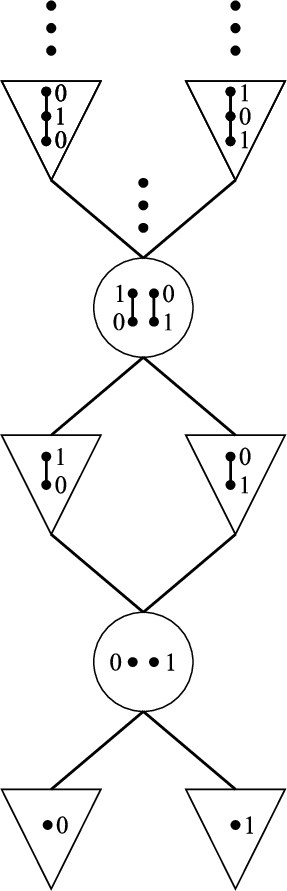
An initial segment of
Note that while
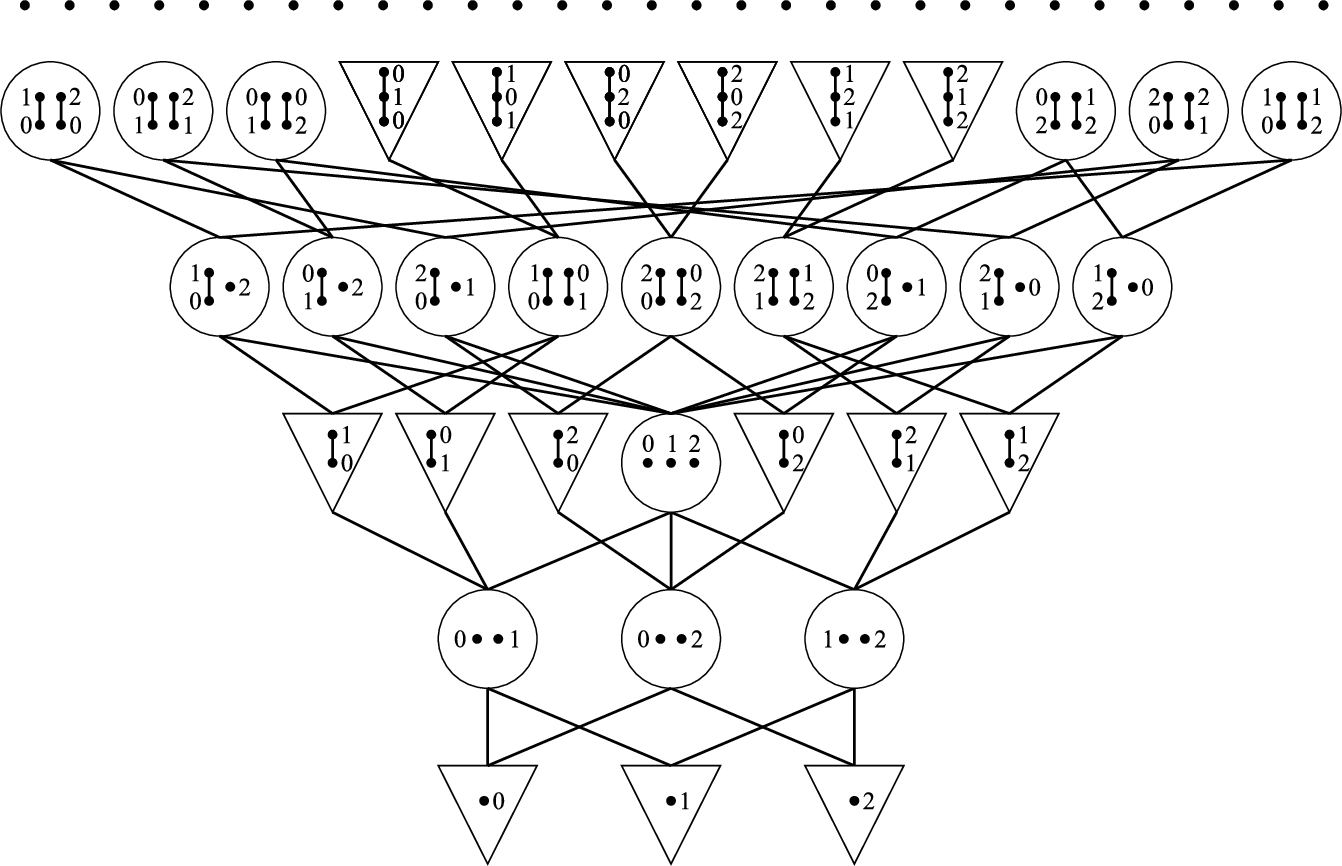
An initial segment of
We conclude this subsection by defining minimal iterated k-forests
We warn the reader that our definition of EWH (taken from [26]) below uses set operations instead of the Wadge reducibility the reader could expect to see, having in mind the definition from [39]. The Wadge reducibility (and especially the effective Wadge reducibility) leads to complex degree structures in non-zero-dimensional spaces which hide the hierarchy (see [26,35] for more detailed discussions), so it cannot be used to define the (effective) WH in a broad enough context. The set-theoretic definition of the FH of sets (which coincides with the EWH in
The complexity of the Wadge (and Weihrauch) degree was the reason why a coarser and more useful definition of Weihrauch reducibility (and of Wadge reducibility) makes essential use of admissible representations in [6,12], as well as in our approach [26,35] to (effective) Wadge hierarchy.
Since the EWH is just a special case of the FH, we first recall in this section some information about the latter from [30,35], and then specialize it to obtain the EWH.
Recall that a class
By a base in a set X we mean a sequence
With any base
We define the FH not only of subsets of X but also of k-partitions
We will use the following technical notions. The first one is the notion “F is a T-family in
As explained in [26], the T-family F that determines A provides a mind-change algorithm for computing
The FH of k-partitions over
As shown in [30],
The FH of k-partitions over the effective Borel base
The corresponding boldface FH
We collect some simple properties of the EWH which are either contained in [30,35] or easily follow from the definitions. As above, the effective Borel base
If
If
Let
Any level
In [26,35] the following preservation property for levels of the (effective) WH was established (cf. this property with Proposition 11.2 and the results in Section 11.2 of [12]).
Let
The FH of sets over an arbitrary base
The FH over the effective Borel base
Here we establish some general facts about the non-collapse property. First we carefully define natural versions of this property.
We say that EWH
Note that for the case of sets
The EWH
If the EWH in X does not collapse at level T and
If the EWH in X does not collapse and every of its levels has a complete element w.r.t. the effective Wadge reducibility then the hierarchy strongly does not collapse.
(1) Obvious from the definition.
(2) Let A be effective Wadge complete in
(3) Follows from (2). □
The non-collapse for the boldface versions are defined in the same way, and the analogue of the previous proposition holds for them with essentially the same proof, including the version for infinitary FH.
In the effective case, there are also the following uniform versions of non-collapse property which relate EWH to the corresponding WH. The EWH
The following analogue of Proposition 8 holds for the uniform version, essentially with the same proof.
If the EWH in X uniformly does not collapse at level T and
If the EWH in X uniformly does not collapse and every of its levels has an element with the properties described in (1) then the hierarchy strongly uniformly does not collapse.
The next assertion follows from the inclusions between levels.
For any effective cb
0
-space X we have: if
For cb0-spaces X and Y, let
If
If
All assertions follow from the definitions and the preservation property, so consider only the finitary version in item (1). Let
If X is quasi-Polish and
If X is computable quasi-Polish and
If X is the product of a sequence
If X is the product of a uniform sequence
(1) Follows from Proposition 11(1) since X is quasi-Polish iff
(2) Follows from Proposition 11(2) since X is computable quasi-Polish iff
(3) Follows from Proposition 11(1) since
(4) Follows from Proposition 11(2) since
Although the assertion (1) is void (because the infinitary WH in
In the remaining sections we give prominent examples of spaces with the non-collapse property. A good strategy to obtain broad classes of such spaces is to make them as low as possible w.r.t.
In this section we discuss the EWH of k-partitions in
Complete numberings
Here we recall some information on precomplete and complete numberings from [10,19], their strong relativizations introduced in [27], and prove some additional facts. The properties formulated in this subsection are crucial for proving the main results below. We apologize for using in this subsection one rather non-standard notation. Namely, following A.I. Mal’cev [19], by ϰ we denote the Kleene numbering of the computable partial (c.p.) functions. Much more standard notation for ϰ is of course φ [24]; we chose the less standard notation because it was used in the paper [27] which is often cited below.
First we fix some notation and recall some notions of computability theory (we refer the reader to [10,19,24] for additional details). In particular,
If the contrary is not specified explicitly, by a (partial) function we mean a (partial) function from ω to ω, and by a set we mean a subset of ω. For a partial function ψ, by
By a numbering we mean any function ν with
Associate with any numberings
Here
Let ϰ denote the usual computable numbering of the computable partial (c.p.) functions. Note that
For any oracle
A relativization of the known property that any precomplete numbering is join-irreducible (see e.g. [10]) shows that if
The structure
Any h-precomplete numbering
For any h-precomplete numberings
For any finite families
Items (1) and (2) are relativizations of known facts [10], item (3) is clear from the definition of h-precompleteness ν (in fact, the assertion is true for arbitrary numbering μ). For item (4), using items (1)–(3), we obtain:
The Kleene numbering ϰ and its relativization
For any
For
The function
The next proposition collects some facts from Propositions 1–3 in [27]. Item (7), formulated here in a slightly modified form, obviously remains true.
If
If
If
If
For all
If μ is
If ν is h-complete w.r.t.
If
If
The next assertion, proved by arguments close to those in [27], is formally new here. The item (4) in this assertion is an extended version of the join-irreducibility property of h-precomplete numberings.
If
If ν is
If μ (resp. ν) is
If
(1) By Proposition 15(3), it suffices to show that (2) By Proposition 15(2) and 15(3), it suffices to check that (3) Recall that a closure operator on a preorder It remains to check the assertion for ν. As above, (4) Let f be an h-computable function that reduces It suffices to show that if Let now
For
Let
Given
Define
For any
Given
Define
From now on we will work with the signature
We have:
The inclusion ⊇ follows from the proof of Fact 1. For the converse, it suffices to prove by induction on
We define the family
For
The
Now let V be singleton, then
Finally, let both T and V be non-singletons. If
Using Proposition 1, we extend the function
For all
The first and second assertions follow from Proposition 1 and Fact 4. For the third assertion, we use induction on the cardinality of F. Let first
Let now F be not a tree, then
Define a function
In the remaining part of the current subsection we show that these embeddings are even isomorphisms which is interesting on its own and may be used to describe the presentation complexity of these structures. Since some of the remaining proofs are tedious and make no influence on the main non-collapse theme of this paper, the rest of this subsection may be skipped without any damage for the main theme.
We define the unary functions s and r on
We have:
The next two facts describe relationships of operations s and r (on the labeled forests and on the terms) to the functions
For any
Since all
For all
The first equality follows from the equality
For the second equality it suffices to show that, for every tree
The assignment
For all
Let For By the first assertion, the third assertion follows from:
For all
We argue by induction on p. For
The function
By Fact 5, We show that By Fact 10, the function
Here we apply the results of the previous subsection to deduce basic facts about the EWH of k-partitions in
For any
It suffices to show that for any
If T is singleton then
We first check that
It remains to check that any
Theorem 18, Fact 4, and Proposition 8(3) immediately imply the following result.
The EWH
Since
Fact 11 and Proposition 4 imply the following interesting result:
The function
The function
The quotient-semilattices of
The next corollary would be hard to prove without the established isomorphisms.
The quotient-structure of
All the quotient-semilattices of
(1) For the signature
(2) The isomorphism follows from Fact 11 because all semilattices are isomorphic to the quotient-semilattice of
The structure
In the terminology of the present paper, it looks as
For the sake of completeness, in this subsection we briefly mention some recent results which concern two aspects of the FH of arithmetical k-partitions.
The first aspect is about possible improvements of Corollary 21. Since the structures in Corollary 21 are computably presentable, it is natural to look for easier (say, polynomial-time) presentations of these structures, or, equivalently, of the isomorphic structures of iterated k-labeled forests. This issue was first addressed in [13] and recently developed in [2]. In particular, the following fact was established. For any
([2]).
The structure
Surprisingly, the presentation in [2] uses a very natural coding and is really feasible (in fact, the structure in the latter theorem is in fact presentable in cubic time, and all the mentioned functions and relations are also computable in cubic time w.r.t. this presentation).
The next immediate corollary of the latter theorem considerably improves Corollary 21. For any
The structure
The second aspect is about possible improvements of the non-collapse property from Theorem 19. Restricted to the FH of arithmetical sets
This question remained open for many years (except the well known Turing properness of all levels
Recently the authors of [36,37] have completely characterised the Turing proper levels from
In [20], using a more involved proof, it was shown that the level
In this section we illustrate the method of Proposition 11 by proving the non-collapse of EWH and WH in some other concrete spaces.
We start with observing that Theorem 19 implies the non-collapse of EWH in some spaces, e.g.:
Let
For
In particular, Corollary 24 applies to
First we consider the domain
The WH
The EWH
(1) For notation simplicity, we only consider the finitary case, in the infinitary case the argument is the same. The Definition 3.1.4 in [17], using the induction on trees and the universal function
(2) Inspecting the proof of Proposition 2.15 (resp. Lemma 2.11) in [17] shows that
This theorem and Proposition 12 imply some new information on the EWH in Baire and Cantor spaces:
The EWHs
As δ is a computable effectively open surjection, For the second assertion, consider the Cantor domain
In this paper we suggested notions and developed tools to study the non-collapse property of the (effective) Wadge hierarchy in (computable) quasi-Polish spaces. We also established the non-collapse of this hierarchy in some concrete spaces. Since the Wadge hierarchy subsumes many other natural hierarchies, our methods and results also apply to these hierarchies.
Unfortunately, our results and methods do not directly apply to many concrete important spaces, e.g. to the Scott domain
Recently, some new interesting results about the structure of Wadge degrees in
Especially interesting and relevant to the classical computability theory is the problem of characterising the levels of the fine hierarchy of arithmetical sets which are proper w.r.t. Turing equivalence (see Section 5.4 for more details).
Footnotes
Acknowledgements
I am grateful to the anonymous referees for the careful reading and many helpful suggestions which certainly improved the text.
The work of V. Selivanov is supported by Mathematical Center in Akademgorodok under agreement No. 075-15-2022-281 with the Ministry of Science and Higher Education of the Russian Federation. This work is a journal version of the conference paper [ ] which is essentially extended by adding precise definitions, proofs of auxiliary facts, and complete proofs of the main technical results.