




Abstract
A compact set has computable type if any homeomorphic copy of the set which is semicomputable is actually computable. Miller proved that finite-dimensional spheres have computable type, Iljazović and other authors established the property for many other sets, such as manifolds. In this article we propose a theoretical study of the notion of computable type, in order to improve our general understanding of this notion and to provide tools to prove or disprove this property.
We first show that the definitions of computable type that were distinguished in the literature, involving metric spaces and Hausdorff spaces respectively, are actually equivalent. We argue that the stronger, relativized version of computable type, is better behaved and prone to topological analysis. We obtain characterizations of strong computable type, related to the descriptive complexity of topological invariants, as well as purely topological criteria. We study two families of topological invariants of low descriptive complexity, expressing the extensibility and the null-homotopy of continuous functions. We apply the theory to revisit previous results and obtain new ones.
Introduction
Computable analysis provides several notions of computability for compact subsets of Euclidean spaces and more general topological spaces. The most important ones are the notions of computable and semicomputable set. Intuitively, a subset of the Euclidean plane is computable if there exists a program that can draw the set on a screen with arbitrary resolution; it is semicomputable if there exists a program that can reject points that are outside the set. A famous example is given by the Mandelbrot set, which can easily be seen to be semicomputable from its very definition, but whose computability is an open problem, related to a conjecture in complex dynamics [17].
It turns out that for certain sets, semicomputability is actually equivalent to computability. It was discovered by Miller [32] that finite-dimensional spheres embedded in Euclidean spaces enjoy this property. This result later led Iljazović to systematically study this computabilty-theoretic property, for spheres embedded in computable metric spaces [22], manifolds [23] and many other sets in a series of articles with several authors [7,9–11,18,21–24,26]. We recently identified which finite simplicial complexes have computable type in [2]. Most of the results in the literature are not only about sets, but about pairs. A pair should be informally thought as a set together with its “boundary”, the typical example being the
The purpose of the present article is not to provide new examples, but to develop a structural understanding of the notion of computable type, with several goals in mind. The first goal is practical. Establishing that a space has computable type can be difficult and very technical, so there is a need to provide unifying and simplifying arguments for previous results as well as general tools that can be applied to establish new results with less effort.
Our general goal is to highlight the interaction between topology and computability underlying the notion of computable type. The definition of this notion combines topology and computability theory, and the arguments always gather ideas from these two fields. It would be clarifying to split the arguments into two parts, a purely topological one and a computability-theoretic one.
Having computable type is by definition a topological invariant, and its precise relationship with other topological invariants should be explored. A more explicit relationship with topology would enable one to leverage the venerable field of topology, notably algebraic topology, in the study of a computability-theoretic problem. Indeed, the main results about computable type rely on classical topological results: Miller used the homology of the complement of the sphere in [32], Iljazović used some form of Brouwer’s fixed-point theorem in [22,23].
Finally, a better theoretical understanding also has many consequences: it can give more information on previous results, give new results with little effort, clarify the role of certain assumptions in the results.
Summary of the main results
Let us present the main results of the article, stated informally.
Mainly two notions of computable type have been introduced in the literature, that consider copies of the set embedded in different classes of topological spaces, namely computable metric spaces and computably Hausdorff spaces respectively. Several results have been established on computable metric spaces [21,23] and then extended to computably Hausdorff spaces [11,26]. We first show that these two notions are actually equivalent.
(Theorem 3.4).
Computable type can be equivalently defined on the Hilbert cube, on computable metric spaces and on computably Hausdorff spaces.
The proof is based on Schröder’s effective metrization theorem [36] which implies that compact Hausdorff spaces are metrizable in an effective way.
One cannot expect interesting general characterizations of the computable type property: most spaces have computable type simply because they do not have any semicomputable copy. This issue can be fixed by introducing the notion of strong computable type: a compact space X has strong computable type if for every oracle
(Theorem 4.8).
If
The descriptive complexity is measured in the hyperspace of compact sets with the Vietoris or upper Vietoris topology. It is an open question whether Theorem 2 is an equivalence, although we do not expect so. As far as we know, being minimal for some
These structural results have many interesting consequences. We give a purely topological necessary condition, which is sufficient up to some oracle (Corollaries 5.1 and 5.3). We show that for finite simplicial complexes, computable type is equivalent to strong computable type (Corollary 5.6). We explain why for some spaces it is difficult to produce a semicomputable copy which is not computable (Theorem 5.11), contrasting with obvious examples such as the line segment or the n-dimensional ball.
When Y is a fixed compact ANR and X is a varying compact space, we show how the set
The following topological invariants are
We thoroughly study these topological invariants and revisit several results of the literature, showing how they can be obtained by identifying a suitable The pair Every closed n-manifold is
We also consider other examples from the literature such as chainable and circularly chainable sets, pseudo-cubes, and as a side result give a few new examples.
Our framework often provides simpler proofs of the results, separating the argument into a computability-theoretic part (showing that a topological invariant is
Let us finally discuss the scope of our approach. Several results in the literature establish a computable type property for non-compact spaces, for instance in [7] or [24]; in this article, we consider compact spaces only. The compactness assumption is central and it is not clear how the theory would extend beyond compact spaces. Some of the previous results used slight variations on the notion of computable type, e.g. in [22], notably defining semicomputability as effective closedness rather than effective compactness, at the price of requiring extra assumptions on the ambient space, such as effective local compactness. In this article, we use the notion of effective compactness which behaves more smoothly.
The article is organized as follows. In Section 2, we present the standard concepts of computability over topological spaces. In Section 3 we recall the definition of computable type and prove that some of the variations of this introduced in the literature are actually equivalent. In Section 4 we introduce the notion of strong computable type and develop the theory. We obtain characterizations using descriptive set theory on the hyperspace of compact subsets of the Hilbert cube. In Section 5 we exploit these characterizations and obtain several results that improve our understanding of strong computable type. In Section 6, we show how the classical notion of Absolute Neighborhood Retract (ANR) behaves well in terms of computability, and allows to define topological invariants of low descriptive complexity, expressing extensibility and null-homotopy of continuous functions to ANRs. In Section 7 we study these invariants in more details. We finally apply the whole theory in Section 8 to revisit many previous results about computable type.
We give some background about computable aspects of topological spaces: computable
First of all, let us recall enumeration reducibility, which enables one to define a notion of computable reduction between points of countably-based topological spaces.
Enumeration reducibility
We will mainly use the following notion from computability theory: a set
As we will see soon, a point of a countably-based topological space can be identified with a set of natural numbers, namely the set indices of its basic neighborhoods. Therefore, relative computability between points will be conveniently expressed using enumeration reducibility, which we recall now.
Let There is an effective procedure producing an enumeration of A from any enumeration of B. There exists a c.e. set For every oracle
In condition (2),
A
We will often denote a computable
In a computable
Let
A function
Let us recall some notions of computability of sets.
A set A in a computable
A pair
We will use the word semicomputable when talking about a subset of a space, and effectively compact when talking about the space itself.
The image of a (semi)computable set under a computable function is a (semi)computable set.
The next result is simple but very powerful and central in many arguments: closed sets are preserved by taking existential quantification over a compact set, and it holds effectively. Equivalently, open sets are preserved by taking universal quantification over a compact set, effectively so. It is a standard folklore result in computable analysis that can drastically simplify many arguments. It can be found in [34] for instance, but we include a proof for completeness.
Let X, Y be computable If If
Of course the two items are equivalent by taking complements, but we make both of them explicit as they are equally useful.
We prove the second item, the first one is obtained by taking complements. As R is effectively open, there exists a c.e. set
Descriptive set theory and its effective version provide notions of complexity for subsets of topological spaces ([33]). We have already seen the classes
A set A in a computable
Observe that one can equivalently require
Each topological separation axiom has a computable version, we recall some of them. These definitions can be found in [36] for instance.
A A computable
The following facts are standard and can be found in [34] for instance:
A computable metric space is a computable A computable metric space is computably Hausdorff. In a computably Hausdorff space which is effectively compact, a set is semicomputable (i.e., effectively compact) if and only if it is effectively closed.
The next fact is another powerful feature of effective compactness: in certain situations, if a computable function is injective, then its inverse is automatically computable. Let X be a computable It is a folklore result but we include a proof for completeness. We need to show that for a basic open set
The Hilbert cube will play a central role in this article, because every computable metric space computably embeds into it, so one can work in this space without loss of generality.
The
Here are some important facts about the Hilbert cube.
The Hilbert cube Q satisfies the following properties:
Let
The Hilbert cube is effectively compact.
Therefore, a set Every computable metric space embeds effectively into the Hilbert cube. More precisely, for every computable metric space
In particular, the fourth item implies that the semicomputable subsets of arbitrary computable metric spaces are no more general than the semicomputable subsets of Q.
The notion of computable type takes its origins in an article by Miller [32], was studied by Iljazović et al. in [7,9–11,18,21–24,26] and by the authors in [2]. The first formal definition as given in [26].
Let us present the language needed to formulate definition of computable type.
A
If
If
A compact metrizable space X has
A compact pair
Note that the notion for pairs subsumes the notion for single sets, by considering the pair
Originally, two notions of computable type were studied in [21] and [11] respectively, using other spaces than the Hilbert cube. Precisely,
A pair
A pair
In this section, we prove that the distinction between computable type on computable metric spaces and computably Hausdorff spaces is unnecessary, because they are actually equivalent. Moreover, it is sufficient to consider the Hilbert cube only, as in Definition 3.3. Therefore there is no more need to distinguish between these definitions, and the results about computable type on computable metric spaces immediately extend to computably Hausdorff spaces (for instance, the results in [21,23] imply the results in [11,26]).
For a pair
We now proceed with the proof of Theorem 3.4. The implications
A computable
Let
Let
Next,
Finally, we show that
Schröder proved the following effective Urysohn metrization theorem (Theorem 6.1 in [36]): every computably regular space X admits a computable metric, i.e. a computable function
If
The proof of Theorem 6.1 in [36] consists in building a computable sequence of functions
If K is a semicomputable set in a computably Hausdorff space
Consider the subspace
Now, we prove our theorem. We prove
The notion of computable type suffers from a severe drawback: if a compact metrizable space has no semicomputable copy in the Hilbert cube, then it vacuously has computable type. As there are only countably many semicomputable sets, most compact metrizable spaces have computable type for no good reason. In particular, there is no hope to obtain interesting characterizations of this notion.
This observation leads us to define a stronger and more robust notion: having computable type relative to any oracle. This definition solves the previous issue and has the advantage of lending itself to topological analysis, notably in terms of the topologies on the hyperspace
Definition
We first define the notion of strong computable type, which is a simple relativization of Definition 3.3.
A compact metrizable space X has
A pair
All the spaces which were proved to have computable type in the literature [2,7,9–11,18,21–24,26,32] actually have strong computable type because the proofs hold relative to any oracle.
Note that the proof that the definition of computable type reduces to the Hilbert cube (Theorem 3.4) also extends to strong computable type, so defining strong computable type on computable metric spaces or computably Hausdorff spaces would yield equivalent notions.
We will see in Section 5.2 that for finite simplicial complexes, strong computable type is equivalent to computable type (Corollary 5.6), refining the results in [2]. More generally, we expect that for natural spaces, the notion of strong computable type is actually no stronger than the notion of computable type.
Intuitively, a pair has strong computable type iff for every copy
Let The The The
These three topological spaces are computable
Each computability notion of compact set can then be seen as the notion of computable point in one of these topologies. In particular, for a compact set
The property of having strong computable type can then be rephrased as relative computability between elements of
For a pair
For every copy
The second statement is about relative computability, which is defined as enumeration reducibility between neighborhood bases of Y and
It will have interesting consequences, because it enables one to use topology and descriptive set theory on
We give a first characterization of strong computable type. This result is related to the characterization obtained by Jeandel in [27] of the sets
We first need two definitions.
A
We recall that
Let
We can now state our first characterization of strong computable type.
For a pair
For every copy
We fix an arbitrary copy of
We first show that
We now show that
In particular, this characterization immediately implies a simple sufficient condition for having strong computable type.
Let
Let
We have shown that each copy
We will see applications of this result in the sequel. Theorem 4.8 is only an implication and we will see later that the converse implication does not hold in general. However, in the next section we obtain a characterization of strong computable type using
Discussion about minimality. When applying Theorem 4.7 and Theorem 4.8 to prove that a pair has strong computable type, one needs to show that a pair
The reason is that the lower and upper Vietoris topologies interact nicely with the inclusion ordering on compact sets:
If a set
Dually, if
It gives a shortcut to prove that a pair
Let
The next result is elementary but very useful.
Let
If
We will implicitly apply this observation, notably with the following families:
The family If If A has empty interior in X, then the family
In order to prove that a pair has strong computable type using Theorem 4.7, one needs to find a
For a pair
There exists a
Note that the invariant is more than a
The idea of the proof is that one of the
We endow the space
If functions f, g are defined on
We will often use the following inequalities:
We can make
There exists a computable sequence of injective continuous functions
We first build a dense computable sequence of functions
Every continuous function
Let
Note that if f is an ϵ-function and g is a δ-function, then
The notion of ϵ-function can be defined for partial functions
Indeed, if
If a homeomorphism
Let
The key observation about When For a rational Let τ be either The function Say that two pairs If Let Let τ be either Again, the idea is that we can replace the quantification over the copies, i.e. over the injective continuous functions, by a quantification over the If Assume that Let If If Assume that Theorem 4.7 implies that for each The copy Finally, we put everything together. Let
In this section, we exploit the analysis developed so far to obtain a better structural understanding of strong computable type.
A topological necessary condition
We start with a purely topological understanding of the notion of strong computable type by identifying a topological necessary condition.
(Necessary condition).
If a pair
From Theorem 4.7 and the proof of Theorem 4.11,
As
This necessary condition is almost sufficient and captures the purely topological aspects of strong computable type, in the sense that it is equivalent to the following relativization of strong computable type.
A pair
For a pair
There exists
The proof of Corollary 5.1 holds relative to any oracle, which shows
The countrapositive of Corollary 5.1 gives a sufficient condition implying that a pair does not have strong computable type. In [3], we prove an effective version which even shows that the pair does not have computable type, as follows.
Assume that
Note that neither the ϵ-deformations nor the limit Y are required to be computable. The computability assumption is only about the function sending ϵ to δ.
This result therefore identifies a general situation when computable type is equivalent to strong computable type.
The following special case of Corollary 5.1 has a particularly simple formulation.
If
Take ϵ from Corollary 5.1. If
We do not know whether converse of Corollary 5.5 holds, although we do not expect so. As we discuss now, it holds for particular pairs.
The property from Corollary 5.5 is a slight variation, actually a strengthening, of the following property introduced in [2]. A pair
Putting all the results together, we obtain the following characterization for simplicial pairs.
For a simplicial pair
There exists There exists
The following implications hold for any pair:
As already mentioned, we do not know whether the converse of Corollary 5.5 holds. However, there is a simple example showing that the ϵ-surjection property does not imply computable type in general. Consider the pair
The pair 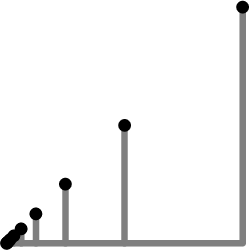
Every continuous function
It is an open question whether there is a compact space with infinitely many connected components having strong computable type. The previous results give partial answers to this question. Essentially, such a space cannot have arbitrarily small connected components.
Let X be a compact metric space.
If for every
If X contains infinitely many isolated points, then X does not have strong computable type.
We show that in both situations one can build for each Let If X contains infinitely many isolated points then by compactness, they have an accumulation point
When a set or a pair does not have computable type, it may or may not be easy to build a semicomputable copy which is not computable. For instance, it is straightforward to show that the line segment I does not have computable type (as a single set, i.e. without its boundary): if
However, for other sets such as the dunce hat [2] or the set shown in Fig. 2a below, there is no such obvious construction. We can formulate a precise statement expressing this idea, by using the results obtained so far, notably Theorem 4.7.

The set from Example 5.13 and its ϵ-deformations.
Let X, Y be compact metric spaces and
The choice of strict and non-strict inequalities is not important, but is convenient as it makes the set of functions having modulus μ a closed subset of the space
For instance, a Lipschitz function with Lipschitz constant L has a modulus of uniform continuity
Let
Let
In particular, if X does not properly contain a copy of itself, then there is no geometrical transformation (scaling, rotation, translation) yielding a semicomputable copy of X which is not computable, and more generally there is no bilipschitz transformation yielding such a copy.
We need the following result which is folklore, but does not seem to appear in the literature.
Let
Let
We now prove the result.
Let
Let
The set X shown in Fig. 2a, consisting of a disk attached to a pinched torus, does not have computable type.
It can be proved using the results in [2,3]. Indeed, the neighborhood of the pinched point is the cone of a graph consisting of two circles attached by a line segment; the line segment is not part of a cycle in the graph, implying that the set does not have computable type. Another way to prove that it does not have computable type is to use the fact that for every
As X does not contain a copy of itself, it has no simple copy which is semicomputable but not computable. It explains why the proof, given in [2,3], that such sets do not have computable type is not straightforward.
A similar analysis can be carried out for pairs.
Given a pair
For a pair
The first result holds for every pair (which may or may not have strong computable type).
Strong Weihrauch reducibility relative to some oracle is usually denoted by
Let
Instead of
Assume that
Given a non-empty finite set
We now define
In the other direction, we can prove that
Let
Let
We do not know whether
We now relate the descriptive complexity of properties of pairs in the Vietoris topology
For a property of pairs
Let If If
Therefore, whether a pair
In order to prove Proposition 5.19, we need the next result. The relation ⊆, which is the set One has It is easy to see that The second item is now easy to prove. If
We give a simple relationship between pairs, their products and their cones, w.r.t. strong computable type.
The product of two pairs
The
If
Assume that
The product
If two pairs have strong computable type, it is an open problem whether their product has strong computable type as well.
(Cone).
Let X be a topological space. The
Let
If X is embedded in Q, then a realization of Let We prove it for computable type and the proof relativizes. Suppose The following realization The other implication of the previous theorem is false. Let L be the graph consisting of two circles joined by a line segment, and Here is another example. Let L be the so-called house with two rooms, or Bing’s house, and
Theorem 4.8 gives a simple way to prove that a pair
The core concept is the notion of Absolute Neighborhood Retract (ANR). It is central in topology and it turns out that it has interesting computability-theoretic properties that we will exploit in order to define
We recall the definition of Absolute Neighborhood Retracts (ANRs) and explore their computable aspects. The results will be applied in the next section.
Absolute neighborhood retracts (ANRs)
This important notion was introduced by Borsuk [4] and plays an eminent role in algebraic topology. Moreover, it has very useful computability-theoretic consequences, which we will take advantage of. We point out that computability-theoretic aspects of compact ANRs have been studied by Collins in [12], although we do not use these results.
Let
Let X be a compact space.
X is an X is an
We recall some classical facts (see [
15
] and [
40
]).
The n-dimensional ball is an AR.
The n-dimensional sphere is an ANR.
If Y is an AR and If Y is an ANR and
The topologist’s sine curve, or the set
ANRs interact nicely with the notion of homotopy, that we recall now.
A
Homotopy between functions is an equivalence relation, whose equivalence classes are called
Let
Whether a function to an ANR has a continuous extension only depends on the homotopy class of the function. This is Borsuk’s homotopy extension theorem (Theorem 1.4.2 in [40]).
(Borsuk’s homotopy extension theorem).
Let Y be an ANR and
These results have important computability-theoretic consequences, because arbitrary functions can be replaced by computable functions that are close enough to the original ones so that they are homotopic.
Homotopy classes
If X, Y are topological spaces and
Let Y be a fixed compact ANR. Given a compact set
In order to state the results, let us discuss the consequences of Borsuk’s homotopy extension theorem (Theorem 6.6). Let
A
Let Y be a fixed compact ANR. To any compact set
Equality For any pair For any pair
where X and A are given as elements of
Note that the result holds with no computability assumption about Y. We now proceed with the proof of this result. If
Functions to Y that are α-close are homotopic.
For For The number α exists by Lemma 6.5. As Y is an ANR, there exists an open set W containing Y and a retraction Let We first show that Let now
The set
We show that If there exists such a j, then Conversely, assume that We now show (2), i.e. that equality is c.e. Let We finally show (3), i.e. the extension relation is c.e. Note that
The previous results enable us to define families of
Extension of functions
To each compact ANR Y we associate a topological invariant
(The invariant
).
Let Y be a topological space. A pair
Note that this definition is only interesting when A is non-empty, otherwise it is never satisfied.
From this definition, the obvious upper bound on the descriptive complexity of
If Y is a compact ANR, then
It is a simple application of Theorem 6.7. Indeed,
Note that although
The previous results provide another family of
(The invariant
).
Let Y be a topological space. A space X belongs to
If Y is a compact ANR, then
One has
Again,
The invariant
Theorem 4.8 provides a template to prove that a pair has strong computable type, by identifying a
The study of the descriptive complexity of topological invariants is particularly interesting because it lies at the interaction between two branches of topology, namely point-set topology and algebraic topology. Descriptive complexity belongs to point-set topology, because it is about expressing sets of points in terms of open sets; algebraic topology provides topological invariants having low descriptive complexity.
Properties of
We study the invariant
First, if A is a retract of X, then
The next result identifies a relation between pairs that preserves the invariant
Let
We assume that
Converging sequences. Now we give results showing how
Therefore in order to obtain results, we need more complicated assumptions on the way a sequence of pairs converges to a pair.
The first result can be used to prove that a pair is not in
Let For every i, For every
If
We assume that
Let
We define a continuous extension
The second result can be used to prove that a pair is in
Let Y be an ANR and
There are usually many ways of extending f to a neighborhood of X. However, any two of them are homotopic on a smaller neighborhood, which implies that the definition does not depend on the choice of an extension of f, and is intrinsic to the functions
Whether
Assume that for some U and
Let Y be an ANR,
Let
In particular, when all the involved pairs have the same second component, we obtain the following simple result. Let Y be an ANR. Let
For
(The invariant
).
For
Corollary 6.11 implies that
The simplest example of a pair which is The pair In particular, As
The dimension of a space has a strong impact on the possibility of extending functions to a sphere. First, if X has dimension at most n, then any continuous function from a closed subset to
(Theorem 3.6.3 in [40]).
Let
In particular, if
In some cases, if a pair is not in
Let
As
This result gives a simple way to prove
Let
Let
The statement is reminiscent of the discussion about minimality at the end of Section 4.2. However,
We now apply this technique.
For every
By Proposition 7.8,
Therefore, our results give an alternative proof that the pair
It was shown in [23,26] that closed manifolds and compact manifolds with boundary have computable type. In this section, we identify a
In the n-sphere
(The invariant
).
A pair
A space X is in
Now that for single spaces,
We first prove that
For a pair
Moreover, if
Let
Assume that
Conversely, assume that
Assume that
We will see below (Proposition 7.18) that under additional assumptions, the implication about minimality can be turned into an equivalence.
This characterization allows one to derive results about Given a pair
As
Let
One has
Let
Let
It is implied by Lemma 7.10, which can be applied because
Under the same assumptions, we can improve Proposition 7.14 to obtain an equivalence.
Let
Before proving this result, we need to reformulate Borsuk’s homotopy extension theorem (Theorem 6.6). The cylinder of a space X is
Let
The first statement is Borsuk’s homotopy extension theorem. The second one is a particular case for functions that are constant on X. More precisely,
Assume that
Consecutive extensions of f.
As
Applying Lemma 7.19, we can extend g to the quotient of
Finally, from the point of view of
For every pair
Let
Now, for a pair
We give a different argument for
Let
Let now
On
We conclude this section with two simple examples of pairs and sets that are
The pair
It is a direct application of Proposition 7.14: one has
We will see in the Section 8.2 that, more generally, compact n-dimensional manifolds with or without boundary are all
We end this section with a characterization of
We do not define homology and cohomology groups, but just recall the notations and some classical results. We refer to standard textbooks on algebraic topology for complete expositions of the concepts [6,16,20]. This section is not essential and may be skipped by the reader who is unfamiliar with algebraic topology.
If X is a topological space, G an abelian group and
These groups are also called the
(Theorem 1 in [31]).
If X is an ANR, then for all G and n,
The result applies to compact manifolds with and without boundary, which are ANRs (Corollary A.9 in [16]).
Partial characterization of
(Corollaries VIII.2 and VIII.3 (p. 149) in [20]).
Let
The equivalence does not hold in general. For instance, Hopf’s fibration is a continuous function
Partial characterization of
(Corollary 4 (p. 150) in [20]).
Let X be a compact space with
Again, the equivalence does not hold in general. Hopf’s fibration implies that
Lupini, Melnikov and Nies [30], and Melnikov and Downey [13] with a different proof, proved that if
Let X be a compact space. If X is minimal such that
The invariant
We also mention a stronger connection between maps to the sphere and cohomology. Theorem 7.24 is actually a particular case of Hopf’s classification theorem, which states that for a compact space of dimension at most n, there is a one-to-one correspondence between homotopy classes of maps to the n-sphere and elements of the nth Čech cohomology group. It can be found as Theorem 2.2 (p. 17) in [1], reformulated in [19]. Let X be a compact space of dimension
Examples
In this section, we illustrate our framework by revisiting previous results stating that a pair has computable type, and showing that it can be explained by their minimality w.r.t. some suitable
In particular, most of the arguments in this section are purely topological.
Examples of
-minimal pairs
In this section we show how
Chainable continuum between two points
We revisit a result due to Iljazović in [21]. Let us first recall the definitions. A continuum is a connected compact metric space.
Let X be a metric space. A finite sequence
For
Iljazović proved in [21] that if X is chainable from a to b, then the pair
If X is compact connected and is chainable from a to b, then the pair
Take
Let
The disconnection can be turned into a continuous extension
We will cover other examples from [21] in Section 8.3, using another
In [18], the authors introduce the notion of a pseudo-n-cube, which is a pair
We show how the result can be proved using the invariant
We first recall the definition of pseudo-n-cubes from [18]. Fix some
The Hausdorff distance between two non-empty compact subsets A, B of a metric space
A compact pair
We now show how the proof that pseudo-n-cubes have computable type can be simplified by showing that they are Every pseudo-n-cube is A pseudo-cube is approximated by cubes. We use Propositions 7.5 and 7.2 to derive We recall that the pair Once We now prove minimality. By definition of pseudo-n-cubes, for each ϵ there exists a copy
If
In this section we illustrate how
The
We define the
We define its boundary
It is obtained from the closed topologist’s sine curve, making it rotate around the vertical segment, see Fig. 4.
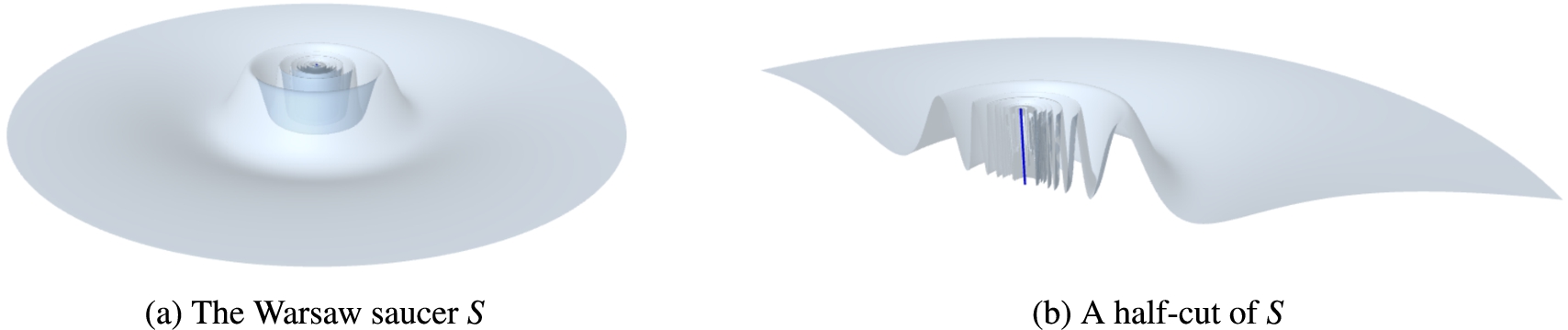
The Warsaw saucer.
The set S is compact and connected but neither locally connected nor path-connected. It is neither a manifold, nor a simplicial complex, nor a pseudo-n-cube so none of the previous results applies to
The pair
We show the
The surface S can be approximated by copies of the disk
The sets
We now prove
It was proved in [23] and [26] that compact manifolds with or without boundary have computable type, as pairs and single spaces respectively. In this section, we show how this result can be derived from classical results in algebraic topology implying that n-dimensional manifolds are
A
An n
The next result seems to be folklore but is not stated in any standard textbook on algebraic topology. However, it can be derived from classical results about homology of manifolds.
Every connected compact n-manifold M is
We give here the proof for manifolds without boundary, and put the proof for manifolds with boundary in the Appendix (it is similar but requires more technical results about pairs).
The result is a consequence of Theorem 7.24, which reduces
Let us use the abelian group
If
Therefore, Theorem 7.24 implies that
Theorem 8.8 implies the result in [23] that connected compact manifold with or without boundary have (strong) computable type. However the proof is inherently different and has new implications. For instance, it implies that
Moreover, Theorem 8.8 immediately implies that other pairs have strong computable type, as follows.
If M is a compact connected n-manifold with possibly empty boundary
All the assumptions of Proposition 7.18 are met:
The cone of a manifold M is a manifold only when M is a sphere of a ball, so this result is indeed new.
In [21], it is proved that every compact metrizable space which is circularly chainable but not chainable has computable type. The simplest examples of such sets are given by the circle and the Warsaw circle. We briefly show how the proof of this result can be reformulated in our framework by finding a suitable
We already saw the notion of chain in Definition 8.1. We recall other related notions, taken from [21]. Let A A A
Its mesh is defined by
A set
If S is connected, then S is chainable if and only if S is quasi-chainable (Lemma 30 in [21]).
Not being quasi-chainable is a
If
If S is not chainable then S is not quasi-chainable. If in addition S is circularly chainable, then every proper compact subset of S is quasi-chainable. Indeed, let
It can be shown that if a compact space is in
Theorem 4.8 states in particular that if a compact space X is minimal for some
The space X is built as follows. Let
Note that X contains a proper subset which is homeomorphic to X: indeed, X properly contains Q, which contains a copy of X. If Although X cannot be The condition that f is surjective implies that Q has empty interior in X: every The quotient space Proposition 0.17 in [16] states that if a pair We now show that if Y is a compact proper subset of X, then the restriction As a result, for a compact set We now prove that X has computable type. Let We now use the properties of the numberings We saw that a basic open set The argument holds relative to any oracle, i.e. if
Our study leaves several questions open.
We have revisited several results from the literature on computable type, identifying a
If a finite simplicial pair
The example from Section 8.4 is a space that has strong computable type and properly contains copies of itself. The argument strongly relies on the fact that it contains the Hilbert cube, which is infinite-dimensional.
Is there a finite-dimensional space that has strong computable type and properly contains copies of itself?
Theorem 5.17 assumes that the pair is minimal for some
Is it always true that if
Is there a compact space having (strong) computable type and infinitely many connected components?
We also mention a surprisingly difficult question, already raised in [9].
If two pairs
Footnotes
Acknowledgements
We thank Emmanuel Jeandel for interesting discussions on the topic, as well as the anonymous referees for their careful reading and helpful comments.