




Abstract
The analogue of Hilbert’s 10th Problem for a first-order structure
Introduction
Hilbert’s 10th Problem asks whether there exists an algorithm that given a polynomial
The analogue of Hilbert’s 10th Problem for a first-order structure
Just as concatenation becomes more expressive when we have more than one letter, the substitution operator is more expressive over a signature with function symbols of higher arity together with constant symbol. With
Although our proof of undecidability of the existential theory of Construct a Turing reduction of the existential theory of
Before proving undecidability of solvability of equations over
We investigate also what happens when we take ⊑ as primitive. Let
In Venkataraman [14], it is shown that the set of existential
In this section, we show that the fragment Is the fragment
The proofs we give depend on our ability to code finite sets of finite full binary trees of a certain form as finite full binary trees.
Let
We read
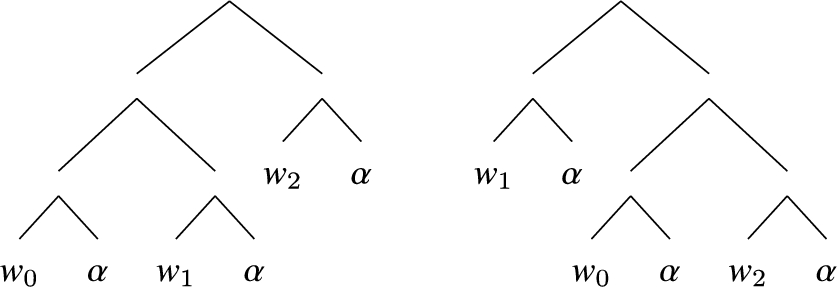
Two encodings of the finite set
We will encounter many cases where we need to associate a finite sequence of binary trees on the meta level with a term in the formal language. To improve readability, we introduce the following notation (see Fig. 2 for examples)
For example, occurrences of
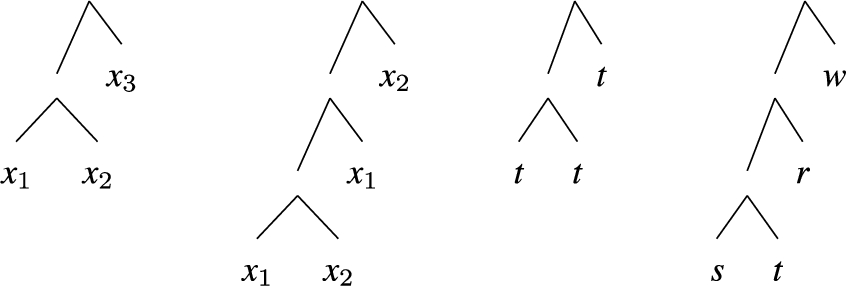
Visualization of
We show that
Let
The Post Correspondence Problem (PCP) is given by
Instance: a list of pairs (dominos) Solution: a finite nonempty sequence
Venkataraman [14] proved that the fragment
The fragment
We start by translating concatenation of finite strings. Let
Translation of the binary strings 0, 1, 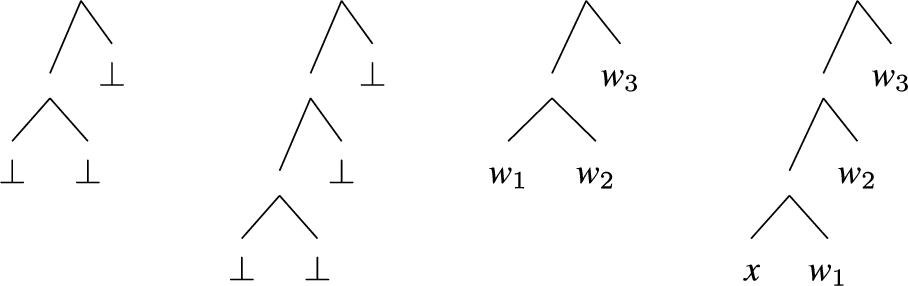
Before proceeding, we need to choose a suitable parameter α for our definition of set membership (see Definition 3). Since we want to talk about finite sets of binary strings, a representation of a binary string cannot have α as a subtree. We let
Given an instance there exists if
Given a solution
We let ϕ be the following sentence
Recall that
In the proof of Theorem 5, we showed that the instance we give a definition of we replace we replace we replace
The multivalued functions
The sentence ϕ is true in
there exist a sequence of finite binary trees
We let
The fragment
Given an instance
We capture the string operation
Figure 4 shows the subtrees of y when
Translation of the string operation 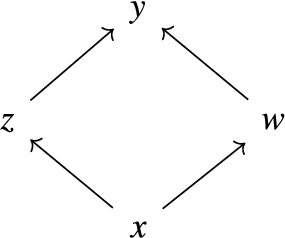
We capture the string operation
Figure 5 shows the subtrees of y when
Translation of the string operation 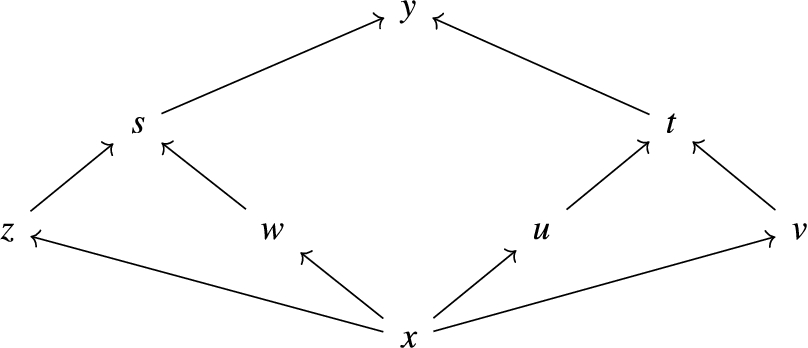
For each binary string w, we capture the string operation
What remains is to define a multivalued pairing function and a notion of set membership. We define the membership relation as follows
We define a multivalued pairing function on finite binary trees as follows (Fig. 6 shows the subtrees of z when
The multivalued pairing function 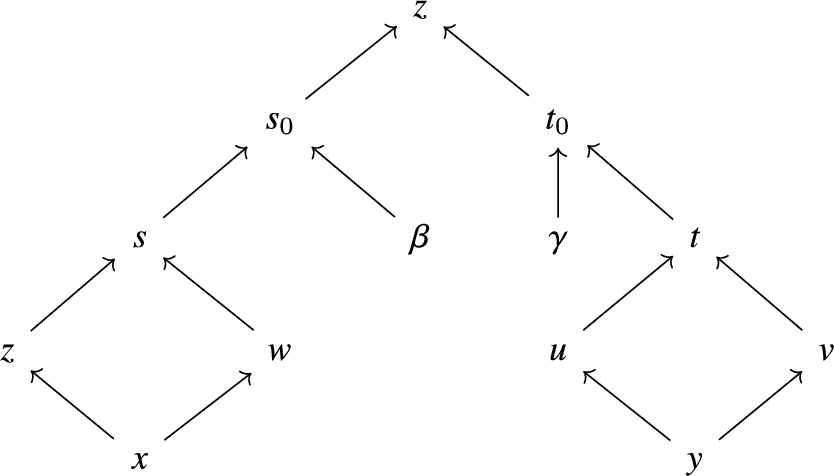
We let ψ be the following sentence
In this section, we show that the fragment
Let Instance: a list of pairs Solution: a natural number N such that
We need to show that given an instance of the Modulo Problem, we can compute a
The fragment
We continue to work with the following definition of set membership
Recall that
Translation of the natural numbers 0, 1, 2, 3 in the proof of Theorem 8.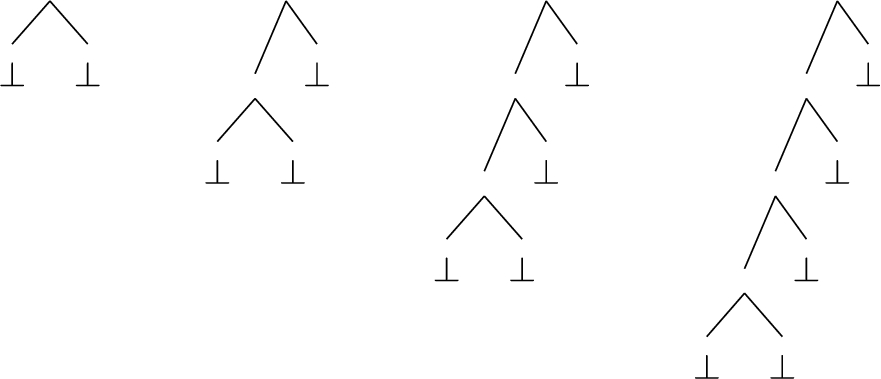
The next step is to associate linear polynomials in one variable with
Given an instance if
With this in mind, we let ψ be the following sentence
The preceding result says that we have undecidability with only one existential quantifier and one bounded universal quantifier. Clearly, it is decidable whether a Σ-sentence with no occurrence of unbounded existential quantifiers is true. Hence, the next question is whether we can have undecidability without bounded universal quantifiers. In the following section, we show that existential theory of
In this section, we show that the existential theory of
Let
we can find an existential
for each constant symbol c of
for each n-ary function symbol f of
for each n-ary relation symbol R of
(1)–(4) define a
The formulas that occur in (1)–(4) are parameter-free. That is, we display all free variables. If
The following proposition summarizes important properties of this notion. They are straightforward and the proof is therefore omitted.
Let
If If
The first step towards an existential interpretation of
Given a binary tree t, we could have associated the natural number n with the binary tree
To improve readability, it will occasionally be more convenient to represent finite binary trees using notation that is closer to their visual form.
Let
Recall that
Let
For example, the binary trees
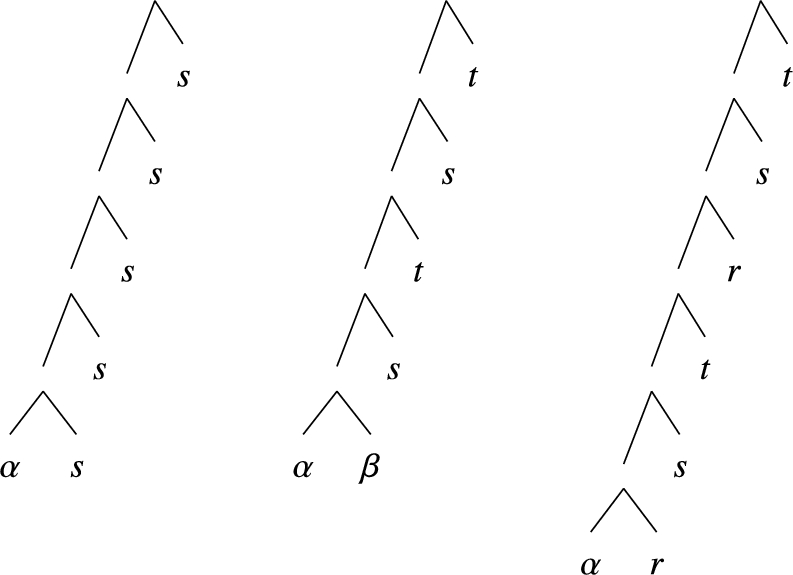
Visualization of the binary trees
Let
The left-right implication of the claim is straightforward. Let the size of a binary tree T be the number of nodes in T. We prove by induction on the size of T that
Assume T satisfies (*). We need to show that
When we existentially interpret
We are interested in describing the relation
We start by characterizing the existence of (*) in terms of finite binary trees. For technical reasons which have to do with the proof of Lemma 14, we work with two distinct representations of natural numbers. We use one representation to encode numbers in the sequence
We map the natural n to the binary tree
We map the natural n to the binary tree
We use (A) to represent the sequence
given
The next step is to associate (**) with a finite binary tree. Let γ be a finite binary tree that is such that α, β, γ are incomparable with respect to the subtree relation. Using the notation of Definition 10, we associate (**) with the finite binary tree
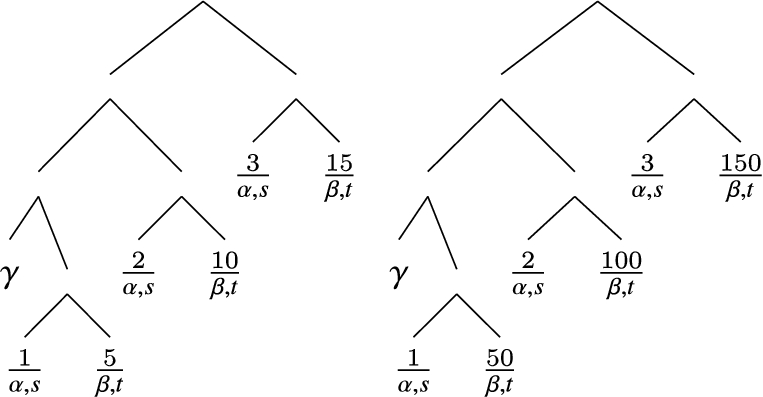
Encoding
Now that we have a way of associating
Let
if
To improve readability, we introduce the following abbreviation
Let
there exist
Before we prove the lemma, we illustrate with an example how (1)–(2) work. Assume T is the right tree in Fig. 9, which encodes the computation tree of
The only if part is obvious. We prove the if part by induction on the size of T. We need the following properties:
Since α, β, γ are incomparable with respect to the subtree relation, the binary tree Since α, β are incomparable with respect to the subtree relation and α is not a substree of t, the binary tree Since α, β are incomparable with respect to the subtree relation and β is not a substree of s, the binary tree
Assume T satisfies (1)–(2). We need to show that
Let
Assume now
Thus, by induction,
In the proof of Lemma 14, we did not use the assumption that α is not a substree of s and β is not a substree of t. With these assumptions, Lemma 12 tells us that
We are finally ready to give an existential interpretation of
Let
Since computably enumerable sets of natural numbers are Diophantine, we have the following corollary.
In this section, we show that the analogue of Hilbert’s 10th Problem for
The fragment
Since
This section is motivated by the following question: can we extend the existential interpretation in Section
3
of
The work of Matiyasevich, Robinson, Davis and Putnam not only settles Hilbert’s 10th problem but also gives a nice characterization of the subsets of Is every computably enumerable subset of
We start by showing that regular tree languages in the signature
A regular tree grammar is a system
Let
Let c be a fresh constant symbol. The following regular tree grammar generates
We introduce the key technical device. We write
A regular binary tree grammar G is a finite list of rules
We write
We proceed to prove existential definability in
Let G be a regular binary tree grammar with rules
We show that
there exists γ and
Recall that
Let G be a regular binary tree grammar with rules
there exists
there exist
The left-right implication is a straightforward. We focus on proving the right-left implication. Assume W satisfies (1)–(2). We need to show that
for all
Let X and T be binary trees that satisfy clauses (1)–(2). First, we prove by (backward) induction that if
Now, to prove that (A)–(C) hold, it suffices to prove by induction on the size of finite binary trees that if U is a subtree of W which is such that
So, assume
In particular
Thus, by induction, if U is a subtree of W which is such that
Let G be a regular binary tree grammar. Then,
Regular tree languages have an equivalent definition in terms of deterministic bottom-up finite tree recognizers (see [5] [Proposition 6.2]). Such a recognizer is a triple
Assume
Let
By Theorem 23,
We conclude this section by showing that Lemma 22 in fact gives existential definability of more than just the regular tree languages. Consider the height function
The set
We use that the set
Although we see that Consider the function
We modify regular binary tree grammars to get grammars where we can easily keep track of the rules used in a derivation. Recall that
A Term Substitution Grammar
We give an example, a representation of natural numbers different from that in Section 3.
We define a one-to-one map
As mentioned, we are interested in keeping track of the rules used in a derivation. We define the key relation and show that it is existentially definable. Let
Let G be a regular term substitution grammar. Then, the relation
Let Let
We now have everything in place to encode computations by Turing machines. We show that given a Turing machine M, we can find an existential formula
The reduction is straightforward. Given a Turing machine M, we capture computations by M with a modified version of Post‘s Correspondence Problem. First, we extend the input alphabet with fresh letters, including a special letter e. We construct a finite set of pairs (dominos) of finite strings in the extended alphabet
All that remains is to show how encode a finite sequence
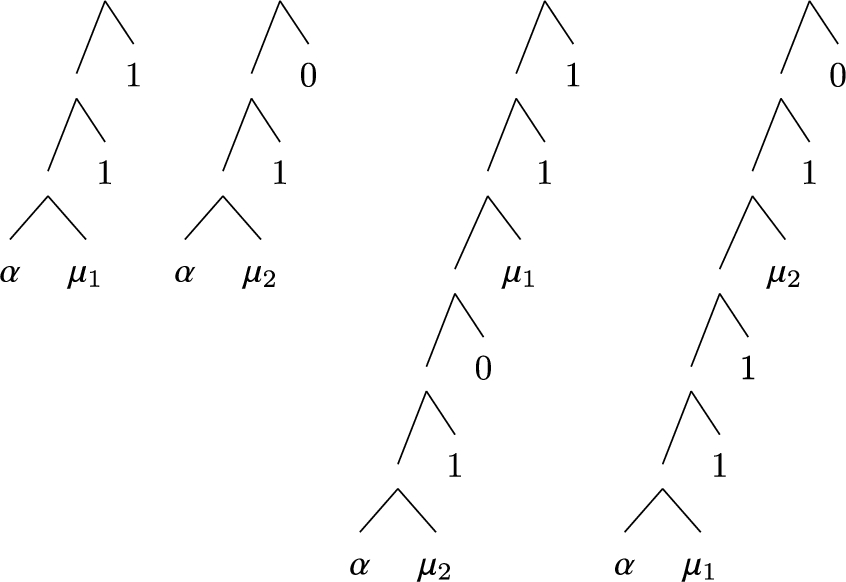
Visualization of
Everything is now in place. We associate the sequence there exist there exist
with
Clauses (I) and (II) encode two strings