Cops and robbers is a vertex pursuit game played on connected reflexive graphs. While the game is most often played with a single cop on a finite graph, we consider the variation in which n cops pursue the robber on an infinite graph. For each , we show there is a computable graph which is classically cop-win and can be won by n cops using a computable strategy, but cannot be won by cops using a computable strategy. Furthermore, we show that the index set of n-cop-win computable graphs is -complete.
The game of cops and robbers was introduced independently in Quilliot [8] and in Nowakowski and Winkler [7]. The original game is played on a graph G by two players: the cop and the robber. The game begins with the cop, followed by the robber, choosing a vertex on which to start. In subsequent rounds, the players take turns (with the cop going first) moving from their current vertex to one of the neighboring vertices. The game ends, and the cop wins, if she shares a vertex with the robber at any point in the play. The robber wins if he manages to avoid ever sharing a vertex with the cop.
There are two standard assumptions made on the graphs used in this game. First, the robber can always win when the game is played on a disconnected graph by choosing a starting node in a different component from the cop’s starting position. To avoid this triviality, we assume our graphs are connected. Second, to allow the players to choose to remain on their current vertex in any given round, we assume the edge relation is reflexive. We make the additional assumption here that our graphs are at most countable because our eventual concern is with computable graphs and strategies.
Cops and robbers is an open game, and therefore, for any fixed graph G, one of the players has a winning strategy when the game is played on G. G is called cop-win when the cop has a winning strategy and robber-win otherwise (when the robber has a winning strategy). Nowakowski and Winkler [7] gave two structural characterizations of cop-win graphs. The first characterization applies to finite graphs and shows there is a polynomial time algorithm to determine if a finite graph is cop-win. The second characterization applies to all graphs and was used by Stahl [10] to show the index set of computable cop-win graphs is -complete.
From the perspective of computability theory, we would like to understand the complexity of strategies required to win this game on computable graphs. It is not difficult to use trees to code information into robber-win strategies. For each computable ordinal α, Stahl [10] gave an example of a computable graph that is robber-win and such that every robber-win strategy computes . It is more challenging to deal with cop-win strategies. Nonetheless, Stahl [10] constructed a computable graph that is classically cop-win but not by a computable cop strategy.
In this paper, we extend these results to a variation of cops and robbers in which there are multiple cops. The version with n cops is played in rounds as before. In the initial round, the player controlling the cops chooses a starting vertex for each cop, after which the player controlling the robber chooses a starting vertex for the robber. In the subsequent rounds, each cop moves to a neighboring vertex, followed by the robber moving to a neighboring vertex. The cops win if any cop shares a vertex with the robber at any point in the play, and otherwise, the robber wins.
The game with n cops is still an open game, so for any n and G, there is either a winning strategy for the n cops (and G is n-cop-win) or there is a winning strategy for the robber (and G is robber-win or not n-cop-win to emphasize the number of cops in the game). Note that if , then G is n-cop-win because the player for the cops can place one cop on each vertex in the initial round.
The minimum number of cops required to win on a fixed graph G is called the cop-number of G, denoted . This notion is well studied for finite graphs and there are many results in the literature giving upper and lower bounds for various classes of graphs. For example, for finite planar graph G (by Aigner and Fromme [1]), while for finite outerplanar graphs (by Clarke [5]).
In Section 2, we consider the complexity of strategies in the game with n cops on computable graphs. We show that Stahl’s examples for coding information into robber strategies continue to work in this context. More interestingly, for each , we construct a computable graph G such that G is cop-win classically, G can be won by n cops following a computable strategy, but G cannot be won by cops following a computable strategy. Thus we can achieve any desired “computable cop-number” with a graph which is classically cop-win.
In Section 3, we show that for each , the index set of computable graphs that are n-cop-win is -complete. The hardness half of this result comes directly from Stahl [10], but to show that the index set is , we use a structural characterization of n-cop-win graphs by Clarke and MacGillivray [6].
Our notation for computability theory is standard and follows Soare [9] and Ash and Knight [2]. Bonato and Nowakowski [4] and Bonato [3] are excellent introductions to cops and robbers and to vertex pursuit games (and other games on graphs) more generally.
Computable strategies
We consider the game of cops and robbers with n cops on a reflexive connected graph G with vertices . For determining whether G is n-cop-win or robber-win, there is no loss of generality in requiring all the cops to start the game at . That is, suppose the cops are initially placed at , but a cop-winning strategy wants the cops to start elsewhere. Since G is connected, each cop can move along a path from to their desired starting vertex in the opening rounds of the game. Once all of the cops have reached their locations, they can follow the cop-winning strategy.
To formalize the definition of a strategy, we denote the position of the robber in round i by (indicating that the robber is on ) and the positions of the n cops by a string (indicating that the k-th cop is on ). Since we assume the cops start at , we have .
The history of the game at any point can be represented by a tuple of the form or , depending on whether the cops or the robber moved last. The sequence represents a legal play as long as and there are edges between and and between and for each . The sequence represents a cop win if there is an i and such that or .
Coding sequences by numbers, the states of the game become elements of ω. An n-cop strategy on a graph G is a function that takes (a code for) a state of the game as input and outputs an allowable cop move. More formally, if m represents a legal state of the game , then is (the code for) an n-tuple τ such that is a legal move.
We say that a (finite or infinite) play of the game follows the n-cop strategy f if and for each i. An n-cop strategy f is winning if the cops win every legal play that follows f.
Analogously, a robber strategy on G is a function that outputs an allowable robber move when it is the robber’s turn. The play follows the robber strategy f if for each i. A robber strategy f is winning if the robber wins every legal play that follows f.
Note that the set of strings representing legal plays on a computable graph G is computable. A computable n-cop strategy for G is a total computable function f that is an n-cop strategy for G.
We use known results to code information into robber strategies. We can view a tree as a graph by letting the elements of T be the nodes in the graph and putting an edge between each node and its immediate successors on T (e.g. between σ and , if both are on T). Without loss of generality, we assume is the root of the tree. If T has an infinite path, then the corresponding graph is robber-win because the robber can move along the infinite path ahead of the cop. Otherwise, T is cop-win because the cop can chase the robber to a leaf. Building on this intuition, Stahl [10] proved that any robber-win strategy on T computes an infinite path. Her argument to code hyperarithmetic sets into robber-win strategies carries over immediately to games with n-cops.
Let be a tree with an infinite path. Every robber-win strategy computes an infinite path in T.
For each computable ordinal α and, there is a robber-win graph in the game with n cops such that every robber-win strategy computes.
Let T be a computable tree with infinite paths such that every path computes . We assume without loss of generality that all the cops start at the root node. Because the graph is a tree, there is a unique shortest path between the cops and the robber and the distance-minimizing strategy of moving directly towards the robber is the optimal cop strategy. It follows that there is no advantage from having n cops and hence Lemma 2.1 (or more precisely, its proof) applies in this context as well.
Turning to cop strategies, for each , we show there is a computable graph that can be won computably by n cops but not by cops, with no limitations on the complexity of the robber strategy. Furthermore, we realize this behavior on graphs that are classically cop-win by a single cop.
For each, there is a computable graphthat is cop-win, has a computable n-cop winning strategy, but does not have a computable-cop winning strategy.
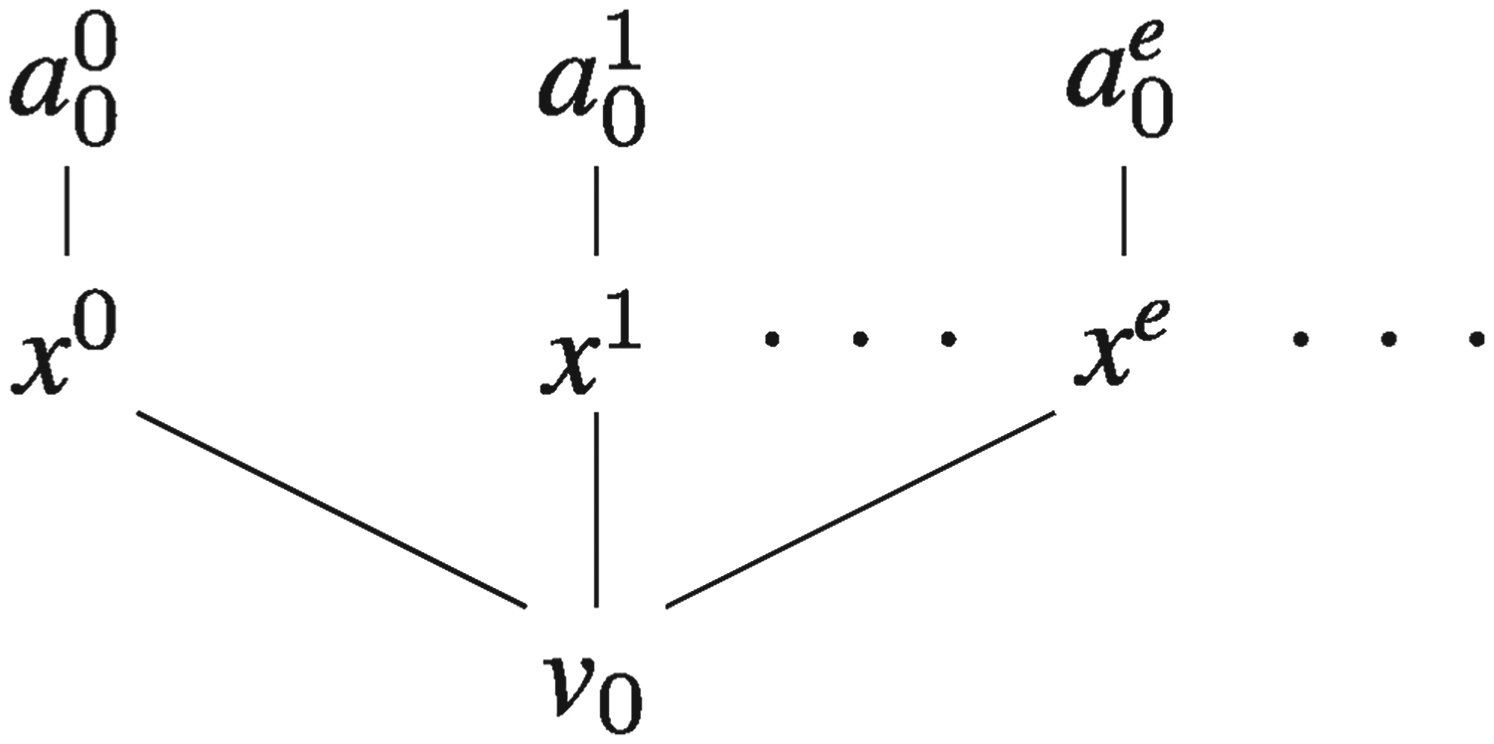
Fix . We suppress the subscript n, writing G in place of . Initially, G consists of a root node (where the cops start) attached to infinitely many nodes extended by a second node as shown in Fig. 1.
To diagonalize against the partial computable function being an -cop winning strategy, we build a subgraph called the e-section starting with the nodes and . The e-sections are disjoint and only accessible through , so we construct them independently. We assume the reflexive edges are added automatically and will not explicitly mention them or show them in diagrams.
To decide how to expand the e-section, we simulate a play of the game with cops, allowing to control cops. In the simulated game, the robber starts at . We do not add points to the e-section unless moves a cop into a position adjacent to the robber. At that stage, we expand the e-section to give the robber an escape route in a controlled way so that G remains cop-win and so that n computable cops can win on G. For ease of notation, we fix e and drop the superscripts.
Consider on the initial cop position (i.e. all start at ) and the initial robber position . At each stage s, we check if converges. If not, then we pass to the next stage and check this computation again. If , then we need to determine if one of the cops has moved into a position to threaten the robber. If x is not among the nodes in , then we leave the robber at and shift to checking whether converges at future stages. We continue this process each time converges until we see an output that places a cop at x (assuming outputs legal moves). Notice that no cop can reach without first passing through x.
More formally, suppose we have completed the j-th round without the cop positions containing the node x. If we see but x is not one of the cop positions in , then we check at future stages. We refer to this process as “watching while keeping the robber at until a cop is moved adjacent to .”
If outputs a non-legal move, then has lost already and we can stop building the e-section. Therefore, without loss of generality, we assume whenever outputs a tuple representing the cop positions, each node has already been placed in G with an edge to the node .
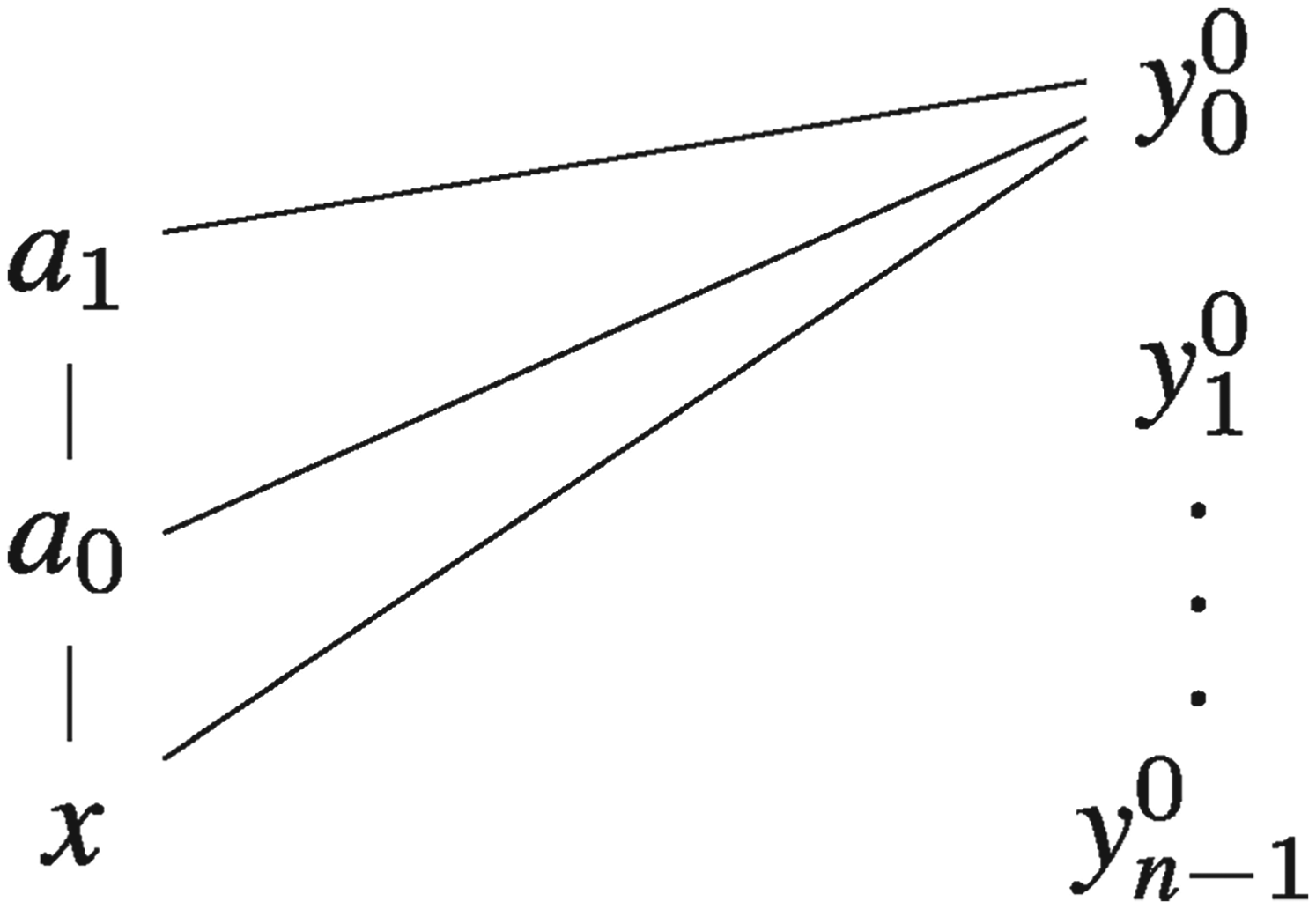
If eventually moves a cop to x, then we add vertices and , for , to the e-section with edges from to and from each to , and x. For readability, we show the connections just from in Fig. 2. (Note that the nodes are not connected to each other.)
No cop in the simulated game is currently at a neighbor of , because we just added the nodes and because no cop can be at since the first cop only just arrived at x. Therefore, in our simulated game, we can move the robber to knowing that each cop is at least two nodes away from .
We now enter the main loop of the construction of the e-section. We continue the process described above to compute the movement of the cops under , keeping the robber at unless a cop moves to a node adjacent to . If never moves a cop adjacent to , then the robber wins and is not a winning strategy.
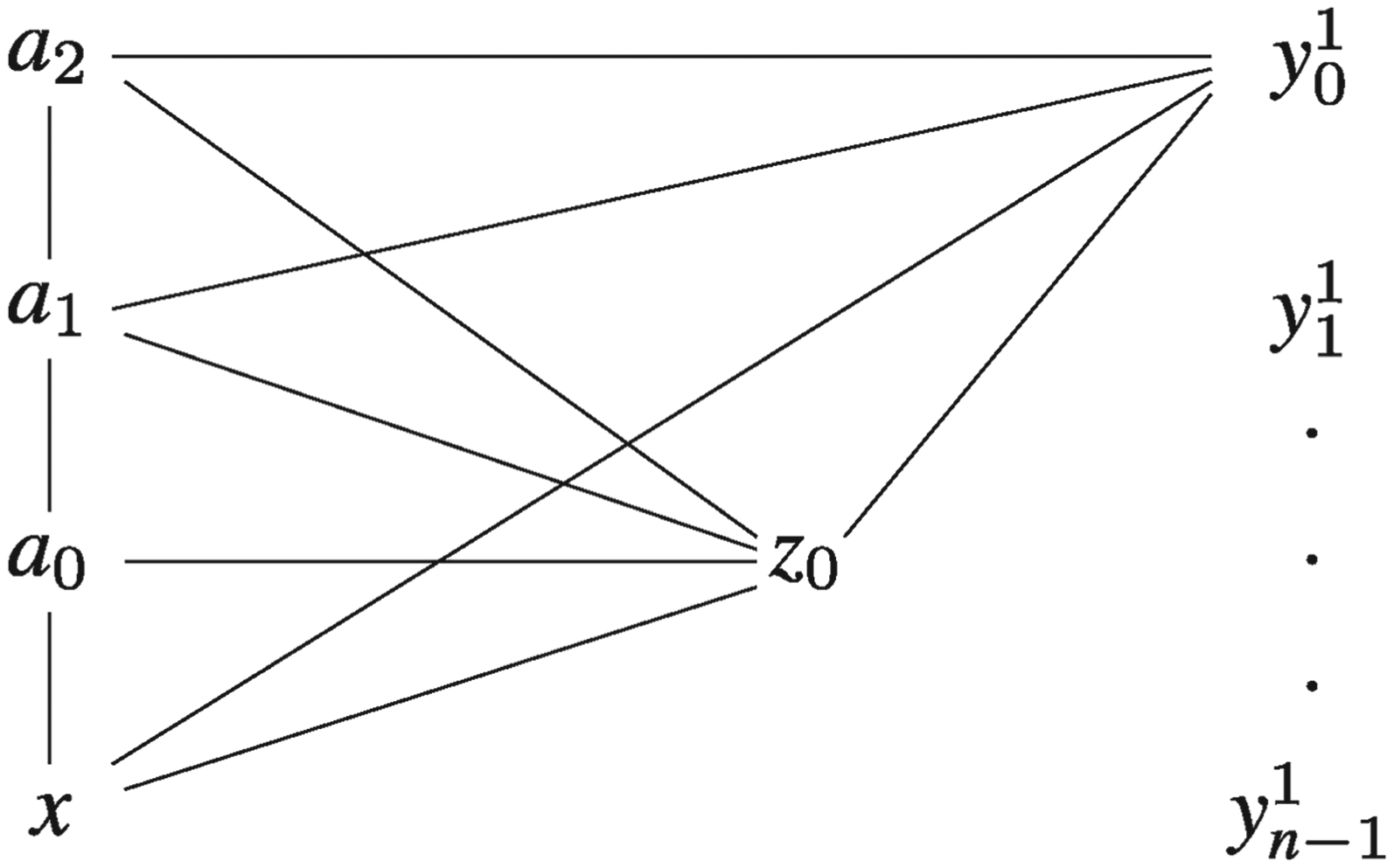
Suppose moves a cop to or some . Since only controls cops, at least one node does not contain a cop. Let denote such a node. We expand the e-section by adding vertices and for . We add edges from to and , and from each to , , and x. For readability, we only show the edges from in Fig. 3 and we don’t show the nodes other than .
We repeat this process. No cop is currently adjacent to in the simulated game, so we move the robber to and continue to compute the trajectory of the cops using , keeping the robber at unless a cop moves to an adjacent node.
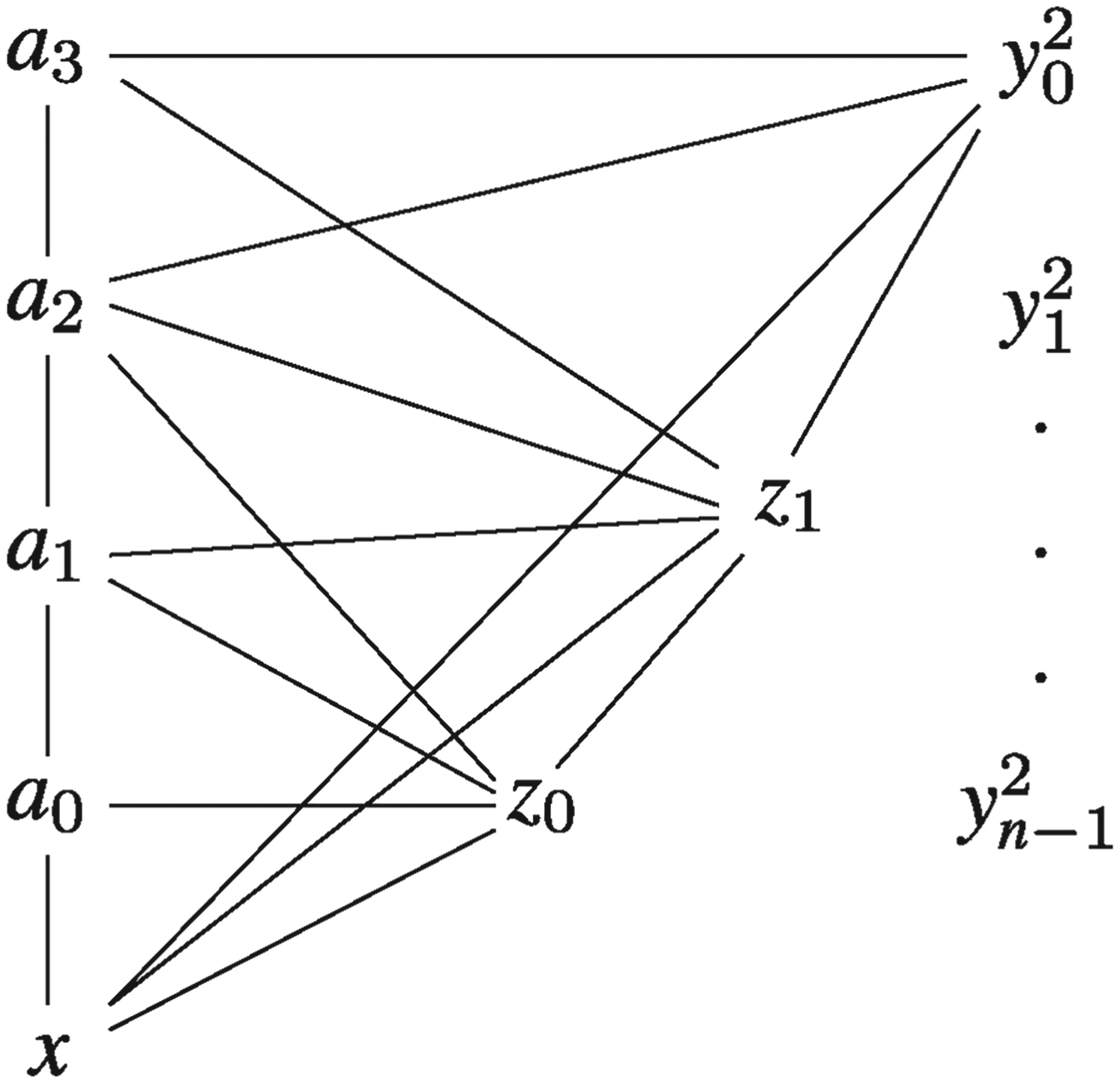
If a cop moves to , , or some , we expand the e-section by adding vertices and for . There is at least one that does not contain a cop and we let denote such a node. We add edges from to and , and from each to , , and x. In Fig. 4, we only show edges from and we don’t show the or nodes other than and .
In general, for , when is added, it is connected to , and each with . We simulate the game using with the robber at . If moves a cop to one of these neighbors of , the graph is expanded by adding and for . We set to be a node of the form that does contain have a cop. We add edges from to and , and from each to , , and x. We move the robber to and continue the simulated game.
This completes the description of the construction. Note that the e-section could be finite or infinite. The nodes are connected to x, , , , for , and (except for as there is no node ). The other nodes of the form are connected to x, , and (except for the nodes as there is no node ).
In each e-section, we refer to the set of points as the vertical segment and the set of points and as the horizontal section. Importantly, x is connected to every point in the horizontal section.
It remains to check the properties of G stated in the theorem. It is immediate that if is a computable -cop strategy, then the robber can beat by starting at the node and moving up the vertical segment of the e-section each time a new node appears (i.e. when moves a cop adjacent to the robber).
The graph G can be won with n cops following a computable strategy.
The cops start at , so we can assume the robber does not. Fix e such that the robber starts in the e-section. In the first round, all the cops move to . The remainder of the game will stay in the e-section, so we drop the superscripts. If the robber’s next move is to the horizontal segment or to , then a cop can move directly there and win. Therefore, assume the robber moves to with .
Since is in G, the nodes for are also already in G. The cops move to place one cop on each . The analysis splits into cases depending on whether or .
Suppose . The nodes connected to (if they exist in G) are , , , , and and for . There is a cop on each , so we assume the robber does not move to one of these nodes. The cop positions include , although exactly which node is might not have been specified yet. The nodes connected to (if they exist in G) are x, , , , , and for . Therefore, covers the remaining nodes that the robber could move to.
Suppose . The nodes connected to (if they exist in G) are , , , and and for (i.e. the same nodes as in the case except there is no node). There is a cop on each nodes, so we assume the robber does not move to one of these nodes. The cop positions include , which is connected to x, , , , and for (if they exist in G). Therefore, covers the remaining nodes the robber could move to.
The graph G can be won by 1 cop following a classical strategy.
The cop starts at . We assume the robber starts in the e-section of the graph and the cop moves to . As above, we assume the robber moves to with . The key difference in this lemma is that the classical cop knows the entire graph at the end of the construction rather than having to respond at a finite stage when the graph is not yet complete. The proof breaks into four cases.
Suppose the robber is at and there is no node in G. The cop moves to . The nodes connected to are , and for (see Fig. 2). All of these nodes are also connected to , so the cop wins on her next move.
Suppose the robber is at and the node exists. In this case, the nodes exist and the node is specified. The cop moves to . The only nodes connected to that are not connected to are the nodes other than (see Figs. 2 and 3). Therefore, assume the robber moves to such a node . Since , this node is only connected to x, , and itself. All of these nodes are connected to , so the cop can move to and guarantee a win on her next turn.
Suppose the robber is at for and there is no node in G. The cop moves to . The only viable option for the robber is to move to for some . Then the cop moves to which covers all the nodes connected to .
Suppose the robber is at with and exists in G. The cop moves to . As above, the only nodes connected to that are not connected to are the nodes other than . However, if the robber moves to , the cop can move to . The only nodes connected to (which, recall, is not ) are x, , , and itself. However, each of these nodes is connected to , so the cop can win on her next turn.
This completes the proof of Theorem 2.3.
Initial set-up for G.
Nodes added when a cop moves adjacent to .
Nodes added when a cop moves adjacent to .
Nodes added when a cop moves adjacent to .
Index sets
In this section, we show that for each , the index set of computable n-cop-win graphs is -complete. The proof resembles the proof in Stahl [10] that the index set of computable cop-win graphs is complete. The main difference is that we use a characterization of n-cop-win graphs by Clarke and MacGillivray [6]. Clarke and MacGillivray prove the characterization for finite graphs, although they note it can be modified for infinite graphs. For completeness, we make these modifications and give a proof that works for all graphs.
Let G be a graph with vertex set V and edge relation E. For , we let denote the set of neighbors of v. The n-th categorical product of G is the graph with vertex set and an edge between if and only if for all , holds. If G is connected and reflexive, then so is the product graph . Fixing notation, throughout this section, we use v, x and y to range over V and p and q to range over .
To keep track of the cop positions in the n-cop game, we imagine a single player moving on rather than n different cops moving on G. We define a family of relations on indexed by ordinals. The intuition for is that the cops can win in α turns when the robber is on v, the cops are on and it is the robber’s turn to move.
Formally, the relations are defined by transfinite recursion. For and , if and only if for some . That is, indicates that the cops have captured the robber. For , if and only if
In other words, no matter where the robber moves on his next turn, the cops can improve their positions relative to the robber when they move.
It follows immediately from this definition that implies . Therefore, there is an ordinal δ at which this sequence stabilizes (i.e. at which for all ). We let denote this limiting relation . We prove Clarke and MacGillivray’s theorem with no restrictions on the size of the graph.
G is n-cop-win if and only if the relationis trivial (i.e.for alland).
Suppose is trivial. Let be the cops’ fixed starting position, let be the robber’s starting position, and assume (i.e. the cops don’t move on their first turn). Since is trivial, we can fix an ordinal such that . In general, let denote the position of the robber in round k, denote the positions of the cops in round , and be the least ordinal such that . By condition (1), for any robber move , the cops can choose so that with . Therefore, in finitely many rounds, we arrive at and the cops win.
Conversely, suppose that is not trivial. Fix α such that . Consider any and such that . Since , condition (1) fails, and so there is a node y adjacent to x such that (and hence ) for all cop positions q adjacent to p. It follows that if the players are at positions such that , then the robber can move to maintain this condition and thus avoid capture forever. In particular, the robber has a strategy to win if the cops start at the positions specified by p. However, since the starting position for the cops doesn’t affect whether G is n-cop win or not, we conclude that G is robber-win in the game with n cops.
For a total computable function , we define the computable graph to have vertex set ω with giving the characteristic function of the edge relation: if , then there an edge between x and y, and if , then there is no edge. It is arithmetical (even ) to say is total and the resulting computable graph is reflexive and connected. We form the computable product graph in the obvious way by considering computations on n-tuples.
For each, the index setis-complete.
We have already noted that a tree is n-cop-win if and only if T has no infinite path. Since the relation of a computable tree having no infinite path is -hard, it follows that is -hard. Therefore, it suffices to show that has a definition.
Our definition will say that if and only if is a computable reflexive connected graph and every relation that “looks like” is trivial. The first condition is arithmetical, so we focus on the second condition.
Suppose is a computable reflexive connected graph. The relation has two fundamental properties. First, since , we have whenever for some . Second, by condition (1), if , then .
We capture these properties by arithmetic formulas with a free variable R ranging over -arity relations. In these formulas, let x and y be single variables and let p and q be n-tuples of variables and (i.e. x, y range over the vertices in and p, q range over the vertices in ). Let capture the first property
and let capture the second property
We claim that is a n-cop-win if and only if is a computable reflexive connected graph such that
Since this formula is , verifying this claim will complete the proof.
Suppose the offset formula holds for . Since and hold for the relation , it follows that for all x and p. Therefore, by Clarke and MacGillivray’s theorem, is k-cop-win.
Suppose is k-cop-win and R is a relation such that and hold. Since holds, we have . Since holds, it follows that if for all , then . Consequently, for all α, and hence . The relation is trivial by Clarke and MacGillivray’s theorem, and therefore, holds for all x and p as required.
Footnotes
Acknowledgements
The authors thank the two anonymous referees for their helpful feedback to improve the exposition of this paper.