



Abstract
The present study investigates frequency rates of sexting, and examines the associations of sexting with self-control and self-esteem as psychological correlates. The study sample included 1,818 adolescents between 12 and 17 years (Mage = 14.3, SD = 1.4) from Germany, the Netherlands, and Thailand. Across the three countries, the frequency rate for sending sexts was 8%, suggesting that sexting among adolescents is neither an epidemic nor a rarity. Both increasing self-esteem and increasing self-control decreased the likelihood of sending sexts. Additionally, self-esteem partially mediated the associations between self-control and sending of sexts and self-control partially mediated the associations between self-esteem and sending of sexts. The results indicated that education training should focus on increasing awareness of the potential challenges adolescents may face when engaged in sexting but also on intervention programs that enable adolescents to control their ICT-related behavior and empowerment training to build a positive self-view.
Today’s adolescents have grown up using information and communication technologies (ICTs) as an integral part of their everyday life (OECD, 2015). This daily exposure to ICTs profoundly impacts their sexual development (Collins, Martino, & Shaw, 2010). ICTs are used for sexual self-exploration and self-representation, to flirt with others, and to reinforce existing relationships or establish new ones (Mathews & Jayabel, 2016). Some adolescents also use ICTs, to send sexually suggestive messages and self-produced sexual images, also known as sexting (Döring, 2014). Given adolescents’ rapid uptake of digital technology, researchers have debated the implications of various technology-related behaviors, including sexting. Media coverage of sexting has portrayed this behavior as an epidemic among adolescents. Sexting has also triggered much debate among researchers. Some researchers argue that sexting might be a normal contemporary behavior used to explore sexuality if it is done consensually (i.e., Döring, 2014). Conversely, other researchers claim that sexting should be considered dysfunctional and that it interferes with healthy sexual development (i.e., Lee, Moak, & Walker, 2013; Reyns, Hanson, & Fisher, 2014). In order to help conceptualize sexting behavior among adolescents and help with the development of educational programs, the present study investigates frequency rates of sexting, and examines the associations of sexting with self-esteem and self-control.
Frequency Rates of Sexting
At present, frequency rates of sexting among adolescents is difficult to gauge because existing frequency rates found in various studies differ regarding the definition of sexting, sample characteristics (i.e., size, socio-economic characteristics, convenience vs. representative), instruments used (i.e., scales vs. single-items), reference periods (i.e., lifetime, the last twelve months, past 30 days), and analytical categorization of sexting involvement (i.e., mutually exclusive sexting groups vs. overlapping sexting groups) (Cooper, Quayle, Jonsson, & Svedin, 2016). A systematic literature review based on 12 studies conducted mostly in the U.S. revealed that 10.2% of adolescents reported engagement in sexting (Klettke, Hallford, & Mellor, 2014). In another literature review, based on ten studies on sexting among adolescents, 13.9% reported sending sexts (Döring, 2014). Nine of these ten studies were conducted in the U.S. In one study, using the EU KIDS Online data (N = 18,709; age: 11–16), Baumgartner, Sumter, Peter, Valkenburg, and Livingstone (2014) found that frequency rates of sexting varied considerably within European countries. For example, in the Netherlands 0.9%, and in Germany 2.4% of participants reported sending sexts. Less is known about sexting among Asian adolescents. Lee et al. (2013) found in a sample (N = 1,612) of middle and high school students from South Korea that 0.9% sent sexually explicit pictures of themselves to others. To the best of the authors’ knowledge, no studies have been conducted on sexting among Thai adolescents yet.
Differences in Sexting Frequency by Country of Origin, Age, and Sex
Concerning country of origin differences, Baumgartner et al. (2014) compared individual and country characteristics as possible predictors of sexting among 20 European countries. The results revealed that frequency rates were not directly influenced by country characteristics (i.e., gross-domestic product per capita, broadband internet penetration, and traditional values). The authors concluded that country characteristics might be less important in explaining sexting behavior than individual characteristics, such as sensation seeking and age.
Adolescence is a period of establishing and maintaining one’s sexual identity as a developmental task. Due to increasing age, sexual experiences, and interest in sexual topics, adolescents’ participation in sexting might steadily increase. Some research has found that sexting rises during adolescence (Baumgartner et al., 2014; Dake, Price, Maziarz, & Ward, 2012; Ybarra & Mitchell, 2014). Transitioning from childhood to adolescence might lead to changes in ICTs consumption and habits. Unlike children who mainly use ICTs for play-oriented activities, adolescents use ICTs for social activities and interactions. In addition, adolescents’ online activities are less monitored by parents and educators compared with the ICTs activities of children (Staksrud & Livingstone, 2009); and within adolescence, interest in sexual topic and self-expression increases (Mathews & Jayabel, 2016; Staksrud & Livingstone, 2009). Therefore, older adolescents might be more likely to engage in sexting compared with younger adolescents.
Sex differences in sexting are more unclear. While some research suggested that girls send more sexts (Reyns et al., 2014; Ybarra & Mitchell, 2014), other research has reported that boys are more involved in sexting (Jonsson, Priebe, Bladh, & Svedin, 2014; Van Oosten & Vandenbosch, 2017; Van Ouytsel, Van Gool, Ponnet, & Walrave, 2014) and yet other research has suggested that there are no sex differences (Baumgartner et al., 2014). Sex differences in favor to boys might be explained by sexual double standards according to which boys are often rewarded for (hetero-)sexual activities, whereas girls are reproached or stigmatized for the same behavior (Kreager & Staff, 2009). Below we review the current literature on two possible psychological correlates of sexting, specifically self-esteem and self-control.
Associations between Self-Control, Self-Esteem, and Sexting
Theoretically, Brown’s Media Practice Model (2000) can be used to explain why psychological correlates such as self-control or self-esteem influence adolescents use of ICTs for sexting behavior. Self-control refers to the ability to control emotions, behavior, and desires to conform behavior to one’s own standards and goals (Baumeister, Vohs, & Tice, 2007). Most studies that have investigated the associations between self-control and sexting used a deviant theoretical framework and focused on the consequences of non-consensual sexting. Accordingly, sexting is understood as a new form of deviant online behavior that might be explained by low self-control. For example, Reyns et al. (2014) refer to the three characteristics of low self-control described by Gottfredson and Hirschi (1990) as a theoretical framework to explain the relationship between self-control and sexting. These three characteristics of low self-control include impulsivity, lack of diligence, and risk-seeking. Impulsivity may lead to sexting without thinking of the potential negative consequences. Lack of diligence may enhance the carelessness with respect to with whom sexts are potentially shared and according to the trustworthiness of the recipient. Risk-seeking may increase the likelihood in sexting, because sexting is perceived by some adolescents as a virtual adventure or challenge that is exciting and thrilling (Reyns et al., 2014).
Empirical evidence concerning associations between self-control and sexting is mixed. Self-control was measured by three items reflecting future orientation and risk-taking. Marcum, Higgins, and Ricketts (2014) investigated the associations between self-control and sexting using a rural community sample of 1,617 9th through 12th graders in the U.S. They found that with decreasing self-control the likelihood of sending sexts increased. Sexting was measured by a single item, and self-control by a scale developed by Schreck and Miller (1999). In the same vein, Reyns and colleagues (2014) found that adolescents from the U.S. with low self-control had increased odds of sending sexts. Sending sexts was assessed by one item and self-control by a self-developed scale. However, Lee et al. (2013) found that self-control was not related to sexting. They measured sexting by a scale consisting of two subscales: sexting activities of oneself and sexting activities of others. Self-control was measured by three items that correspond to the General Theory of Crime reflecting future orientation and risk-taking (Gottfredson & Hirschi, 1990). To summarize, research has delivered incoherent results on the associations between self-control and sexting behavior. Two studies examined these relationships among adolescents, and one found associations (Marcum et al., 2014) while the other study did not (Lee et al., 2013). A third study investigated the associations in young adults and did find a significant relationship (Reyns et al., 2014).
Another individual characteristic that might predict participating in sexting is self-esteem. Self-esteem is a person’s overall subjective emotional evaluation of self-worth (Rosenberg, 1965). There are several possible explanations why adolescents with low self-esteem might show a higher sexting probability. Since low self-esteem is often associated with feelings of worthlessness, inadequacies, deficiencies, and lack of confidence, sexting might be used as a way of boosting one’s self-esteem (Břízová & Miltnerová, 2014). In addition, there is evidence that people with low self-esteem prefer ICT-related communication compared with face-to-face communication (Joinson, 2004), are more likely to exchange sexually explicit content online (Vanden Abeele, Roe, & Eggermont, 2012), and show higher sexual risk behavior (Wild, Flisher, Bhana, & Lombard, 2004). Sexting might be a way for adolescents with low self-esteem to flirt online and build relationships from a presumed safer position and can be considered one form of sexual online risk behavior which is why low self-esteem might also increase engagement in sexting.
Previous research addressing the relationship between self-esteem and sexting revealed mixed results. In a study (N = 696; age: 18–26 years) conducted by Hudson and Fetro (2015), there was no relationship found between self-esteem and sexting. Sexting was measured by a scale and self-esteem was assessed using Rosenberg’s Self-Esteem Scale (RSES) (Rosenberg, 1965). In a related study, Gordon-Messer, Bauermeister, Grodzinski, and Zimmermann (2013) reported no associations between self-esteem and sexting in a sample (N = 3,447; age: 18–24 years) in the U.S. Sending sexts was measured using one global item. Self-esteem was measured using RSES (Rosenberg, 1965). Ybarra and Mitchell (2014) found in a sample (N = 3,715; age: 13–18 years) in the U.S. that those who sent sexts reported lower self-esteem compared with adolescents who did not send sexts. Sexting was measured using one global item and self-esteem was assessed using the RSES (Rosenberg, 1965). Recent research revealed that the associations between self-esteem and sexting might depend on the nature of sexting behavior. For example, Scholes-Balog, Francke, and Hemphbill (2016) found in a study with Australian participants (N = 582; age:18–26 years) that high self-esteem reduced the odds of sending nude photos or videos, but not sexually suggestive pictures/videos and pictures/videos in underwear or lingerie. Sexting was measured by asking participants how often they had sent or showed others sexually explicit messages, photographs, or videos via a mobile phone device and self-esteem was measured with the RSES (Rosenberg, 1965).
To summarize, two studies with young adults did not find associations between self-esteem and sexting (Hudson & Fetro, 2015; Gordon-Messer et al., 2013), and a third study, also with young adults, found mixed evidence (Scholes-Balog et al., 2016). Only the one study with adolescents found a relationship between low self-esteem and sexting behavior (Ybarra & Mitchell, 2014).
Lowenstein (1983) construes self-control and self-esteem as facets of self-regulation. Therefore, both psychological constructs might be interrelated. On one hand, self-control might strengthen self-esteem which can be explained as follows. Adolescents who successfully control themselves have the willpower to do things that are good while avoiding things that are bad. These adolescents are probably more successful at solving developmental tasks compared with adolescents with low self-control. Indeed, Tangney et al. (2011) found that self-control predicted good adjustment, less pathology, better grades, and interpersonal skills. Furthermore, research by Moffitt et al. (2011) indicates that high self-control in the first decade of life predicted higher income, financial security, and physical and mental health in adulthood. These benefits associated with high self-control might also have a positive impact on one’s self-esteem. On the other hand, it can be assumed that self-esteem increases self-control. If adolescents believe in themselves and evaluate themselves as valuable they might be more likely to show higher levels of self-control and avoid things that are not good for them.
Surprisingly, little empirical work has examined the relationship between self-control and self-esteem among adolescents. Tangney, Baumeister, and Boone (2004) found a positive link between self-control and self-esteem in two samples (N = 351; N = 255) of undergraduate students between 18 and 55 (M = 20.07, SD = 4.99), respectively 18 to 49 (M = 20.10, SD = 4.23) years old. The authors state that people with high self-control were more likely to evaluate themselves as valuable, worthy individuals compared with low self-control participants. In accordance with this, Unger, Bi, Xiao, and Ybarra (2016) found in a sample of 371 Chinese students by using the Brief Self Control Scale (BSCS) (Tangney, Baumeister, & Boone, 2004) and the RSES (Rosenberg, 1961) that higher scores in self-control were correlated with higher self-esteem. To the authors’ knowledge, no longitudinal studies or experimental research has investigated the particular direction of the relationship between self-control and self-esteem. Therefore, both pathways between self-control and self-esteem need to be taken into account.
In summary, previous research has found evidence of a relationship between self-control and sexting, self-esteem and sexting, and self-control and self-esteem. Therefore, it is reasonable to investigate whether the associations between self-control and sexting are mediated through self-esteem and also whether self-control mediates the association between self-esteem and sexting.
Present Study
In order to help conceptualize sexting behavior among adolescents and provide valuable information for future educational programs on sexting, it might be helpful to understand how frequently adolescents engage in sexting and whether adolescent sexting behavior is associated with their level of impulsivity, lack of diligence, risk-seeking (self-control), and feelings of worthlessness, inadequacies, and lack of confidence (self-esteem). In addition, previous research investigated either self-control or self-esteem as correlates of adolescents’ sexting behavior but not both at the same time although both psychological correlates might be interrelated. In addition, little research has been conducted on sexting behavior in Asian adolescents, and to the authors’ knowledge, no studies have been published on sexting among Thai adolescents. Thus, the current study aims to contribute to the field of sexting research by considering both self-control and self-esteem together in one study of a cross-national sample including Western and South-East Asian adolescents. Specifically, our study had two aims: Investigate how many adolescents participate in sexting, with attention to differences by age, sex, and country of origin; Examine the associations between sexting, self-esteem, and self-control. With increasing self-control, the probability to send sexts decreases. With increasing self-esteem, the likelihood to send sexts decreases. The relationship between self-control and sending sexts is mediated by self-esteem such that self-control increases self-esteem that in turn decreases the likelihood of sending sexts. The association between self-esteem and sending sexts is mediated by self-control such that self-esteem increases self-control that in turn decreases the likelihood of sending sexts.
It was hypothesized that:
Method
Participants
Participants were 1,818 adolescents between 12 and 17 years old (Mage = 14.32, SD = 1.45). The sex distribution in the total sample was 47.5% (n = 864) boys and 52.5% (n = 954) girls. Distribution across countries was Germany 46.6% (n = 847, Mage = 14.23; SD = 1.23, 50.2% male), the Netherlands 20.4% (n = 371, Mage = 14.48, SD = 1.4, 56.3% male), and Thailand 33% (n = 600, Mage = 14.50, SD = 1.70, 38.3% male). Table 1 depicts the distribution of participants by age, sex, and country. There was also a significant effect of country on age, F(2, 1812) = 15.27, p < 0.001. Post hoc comparisons using the Tukey test indicated that the German participants (Mage = 14.12, SD = 1.21) were significantly younger than Dutch (Mage = 14.48, SD = 1.34) and Thai (Mage = 14.50, SD = 1.31). However, Dutch and Thai participants did not differ in age. More Thai participants (61.6%) compared with German (49.7%) and Dutch participants (43.7%) were female, χ2(2, N = 1818) = 56.65, p < 0.001, Cramer’s V = 0.177. In sum, the differences in age and sex distributions among the three samples warrant the need to include country of origin, age, and sex as control variables in all analyses.
Frequencies by Country, Age, and Sex
Note. N = 1,815. Discrepancy between total and sample size is due to missing data (n = 3) for age in the German sample.
Procedure
The present study was conducted in the German federal state Bremen, the Dutch region Twente, and the Thai region Pattani. Invitation letters were emailed to different public schools in the three countries. Three secondary schools from Germany, three secondary schools from the Netherlands, and one school from Thailand expressed their interest in participating in this study.
After agreeing to participate, the data protection officer and educational authority of the federal state of Lower Saxony, Germany, were asked to approve the research. After approval, the interested schools were informed how they could participate. Teachers handed out information letters for students and parents. Parents of participants under 18 years were asked to sign a written consent form allowing their children to participate in the study.
In Germany and the Netherlands, the data were collected by an online survey and, in Thailand, a paper-pencil method was implemented. 1 Research assistants collected data during regular school hours. These research assistants answered questions and ensured that students filled in answers independently. Before the survey, students were told that participating in this study was optional, questions could be skipped, and participation in the survey could be stopped at any time, without giving a reason or fear of negative consequences. Students completed the measures in the main language of their country. The sexting item was translated into all three languages and the measure for self-control was translated into Thai, using back-translation techniques. The self-esteem measure was available in all three languages.
Measurements
Sexting
Sexting was assessed with one global item, used by Hinduja and Patchin (2012). Participants were asked how often they sent sexts, ‘How often did you send naked or semi-naked pictures of yourself to others via ICTs in the last 12 months?’. We used the following answer options: 1 = ‘never’, 2 = ‘once or twice’, 3 = ‘monthly’, 4 = ‘weekly’, and 5 = ‘daily’.
Self-control
Global self-control was assessed using the BSCS, a 13-item self-report measure (Tangney et al., 2004). Participants responded to statements, such as ‘I am good at resisting temptation’. Items were answered on a five-point scale, from 1 (‘not like me at all’) to 5 (‘very much like me’). The BSCS focuses on processes that directly involve self-control (e.g., breaking a habit, working toward long-term goals). The higher participants scored on this scale the higher their self-control. A principal component analysis with varimax rotation revealed a single factor solution accounting for 39.6% of the variance and had an Eigenvalue of 3.56. Cronbach’s alphas were acceptable for the total sample (α= 0.79), and the German (α= 0.72), Dutch (α= 0.69), and Thai subsamples (α= 0.85).
Self-esteem
Global self-esteem was measured using the RSES, a 10-item scale of general self-esteem, which includes both positive and negative feelings about the self (Rosenberg, 1965). Participants rated how well statements, such as ‘On the whole, I am satisfied with myself’ described them, on a four-point Likert scale from 1 (‘strongly disagree’) to 4 (‘strongly agree’). The higher participants scored on this scale the higher their self-esteem. A principal component analysis with varimax rotation revealed a single factor solution explaining 43.3% of the total variance and had an Eigenvalue of 4.13. Reliabilities were adequate for the entire sample (α= 0.85), and the German (α= 0.89), Dutch (α= 0.82), and Thai subsamples (α= 0.76).
Demographics
Demographic variables were assessed by asking participants’ age and sex.
Data Analysis
Analyses consisted of descriptive statistics, binary logistic regressions, and mediation analyses. Descriptive statistics were used to determine general sample characteristics and the frequency rates of sexting. Chi-square test was conducted to assess the association between country of origin and sex and ANOVA was used to explore associations between country of origin and age. Principal components analyses with varimax rotation were conducted to confirm a single factor solution for the self-control and self-esteem scales.
To answer our first research question, we conducted binary logistic regression analysis with the dichotomized sexting variable (yes/no) as an outcome, and age, sex, and country of origin as independent variables. In addition, we tested whether there were country differences concerning age and sex on sexting by adding a country of origin×age and a country of origin×sex interaction term. In the logistic regression analysis, the sexting variable was coded as dichotomous with a lower-bound cutoff point of ‘once or twice’ to alleviate the non-normal data issue. Although there might be a loss of statistical power, we avoided biased parameter estimates due to the non-normality of the sexting variable (Tabachnick & Fidell, 2013). To answer our second research question, we conducted a second logistic regression to enable the identification of sexting group differences regarding self-esteem and self-control, while controlling for country of origin, age, and sex. With a first mediation analysis using PROCESS macro (Hayes, 2013) we examined whether self-control predicted a lower likelihood of sending sexts (dichotomized) via self-esteem, while controlling for age, sex and country of origin. With a second mediation analysis, we tested whether self-esteem predicted a lower likelihood of sending sexts via self-control. The significance of the indirect effect was estimated using 1,000 bootstrapped resamples and bias-corrected 95% confidence intervals (Preacher & Hayes, 2004). Correlations among independent variables were estimated before conducting the binary logistic regression analyses to test for multicollinearity (see Table 2). The results indicated that the data were suitable for consideration as independent variables together in one regression analysis since no high correlations could be detected (Tabachnick & Fidell, 2013).
Descriptive Statistics and Correlation Matrix of Independent Variables used in this Study
Note. N = 1,815. Discrepancy between total and sample size is due to missing data (n = 3) for age in the German sample. *p < 0.05, **p < 0.01.
Results
Frequency Rates of Sexting
With respect to our first research question, we investigated the frequency rates of sexting. Regarding the frequencies, 92% (n = 1,671) never sent sexts, 5.0% (n = 92) sent sexts one or two times, 0.8% (n = 14) monthly, 0.9% (n = 17) weekly, and 1.3% (n = 23) daily. That is, overall, 8% (n = 146) of participants reported that they had sent sexts at least once in the last twelve months. Then, we used the dichotomized sexting variable (yes/no) to analyze demographic differences in a regression analysis. The regression model was significant, LR χ2 = 45.10, df = 8, p < 0.001, Nagelkerke’s R2 = 0.05. With increasing age the probability to send sexts increased (OR = 2.35, 95% CI [1.35, 4.06). Girls (5.7%) showed a lower likelihood to report sending sexts compared with boys (10.7%), (OR = 0.64, 95% CI [0.41, 1.15]). Finally, compared with German participants (10.8%), Dutch participants (6.2%) and Thai participants (5.3%) showed lowed odds for sexting engagement, (OR = 0.51, 95% CI [0.32, 0.83]), and (OR = 0.49, 95% CI [0.33, 0.78]), respectively. No significant interaction between country of origin and sex or country of origin and age on sexting was found (see Table 3).
Regression Model Predicting Sending of Sexts
Note. N = 1818. Reference category: 1 = German participants; 2 = boys; OR = Odds Ratio; CI = confidence interval, LL = lower limit, UL = upper limit.
Direct and Indirect Associations between Sexting, Self-Esteem, and Self-Control
To answer our second research question, we conducted a binary regression analysis. The regression model with the binary sexting variable as an outcome, self-control, and self-esteem as independent variables, while controlling for country of origin, age, and sex was significant, LR χ2= 118.78, df = 6, p < . 001, Nagelkerke’s R2 = 0.14. Each increase of one point on the five-point self-control scale was associated with decreasing the likelihood of sending sexts (OR = 0.63, 95% CI [0.54, 0.78]) and each increase of one point on the five-point scale of self-esteem was associated with decreasing the odds of sending sexts (OR = 0.65, 95% CI [0.54, 0.78]). The regression analysis corroborated hypotheses that higher self-control (H 1) and higher self-esteem (H 2) decreased the likelihood of sending sexts.
To test H 3, whether the association between self-control and sending of sexts was mediated by self-esteem, we conducted a mediation analysis with self-control as independent variable, self-esteem as mediator and sexting as outcome, while controlling for age, sex, and country of origin. Results revealed a positive direct effect of self-control on self-esteem (B = 0.22; p < 0.001, 95% CI [0.17, 0.26]) and a negative direct effect on sending sexts (B = –0.72, p < 0.001, 95% CI [–0.93, –0.51]). Higher self-esteem decreased the likelihood of sending sexts (B = –0.70, p < 0.001, 95% CI [–0.98, –0.42]). The mediation analysis confirmed self-esteem as a partial mediator of the relationship between self-control and sexting. The negative indirect effect of self-control on sexting through self-esteem was small but significant (B = –0.15, 95% CI [–0.23, –0.09]) (see Fig. 1). 2
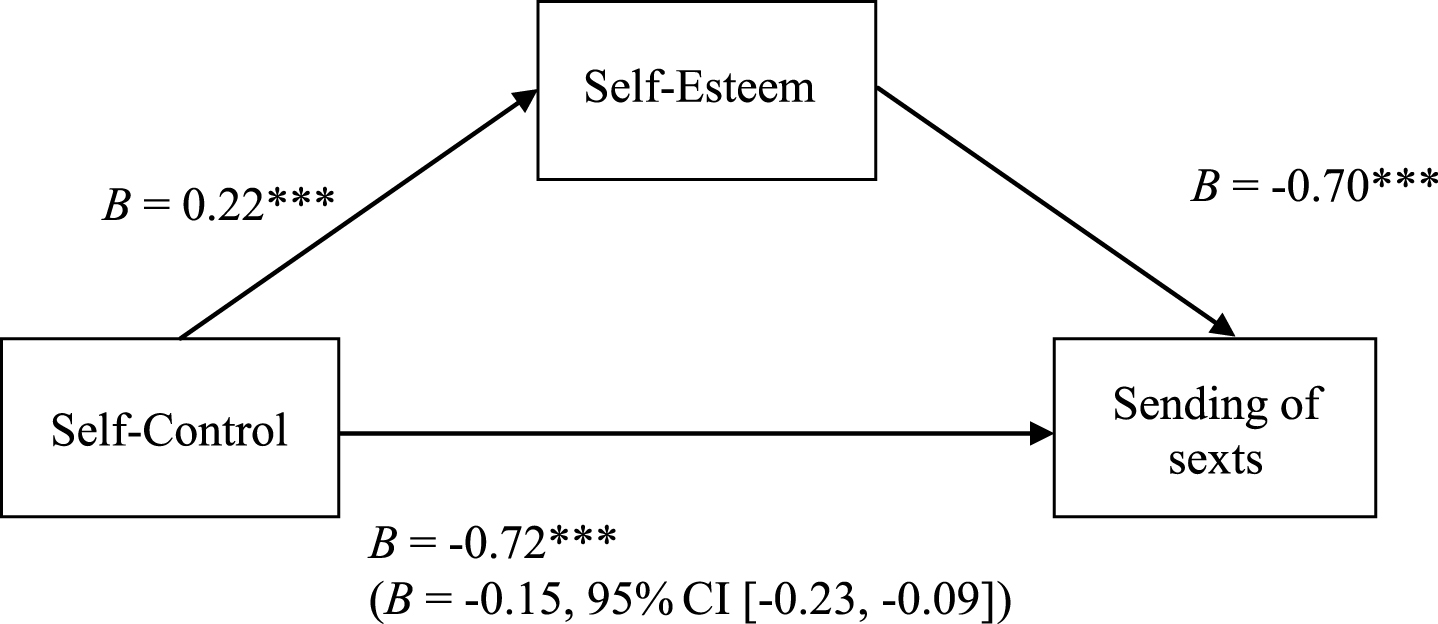
Direct and indirect effects of self-control and self-esteem on sending of sexts. The indirect effect of self-control on sexting via self-esteem is reported in parentheses with bootstrapped CI. *p < 0.05, **p < 0.01, ***p < 0.001.
To test H 4, whether the association between self-esteem and sending of sexts was mediated by self-control, we conducted a second mediation analysis with self-esteem as independent variable, self-control as mediator and sexting as outcome, while controlling for age, sex, and country of origin. Results revealed a positive direct effect of self-esteem on self-control (B = 0.21; p < 0.001, 95% CI [0.16, 0.25]) and a negative direct effect on sending sexts (B = –0.70, p < 0.001, 95% CI [–0.98, –0.42]). Higher self-control decreased the likelihood of sending sexts (B = –0.72, p < 0.001, 95% CI [–0.93, –0.51]). The mediation analysis confirmed self-control as a partial mediator of the relationship between self-esteem and sexting. The negative indirect effect of self-control on sexting through self-esteem was small, but significant (B = –0.15, 95% CI [–0.21, –0.10]) (see Fig. 2).
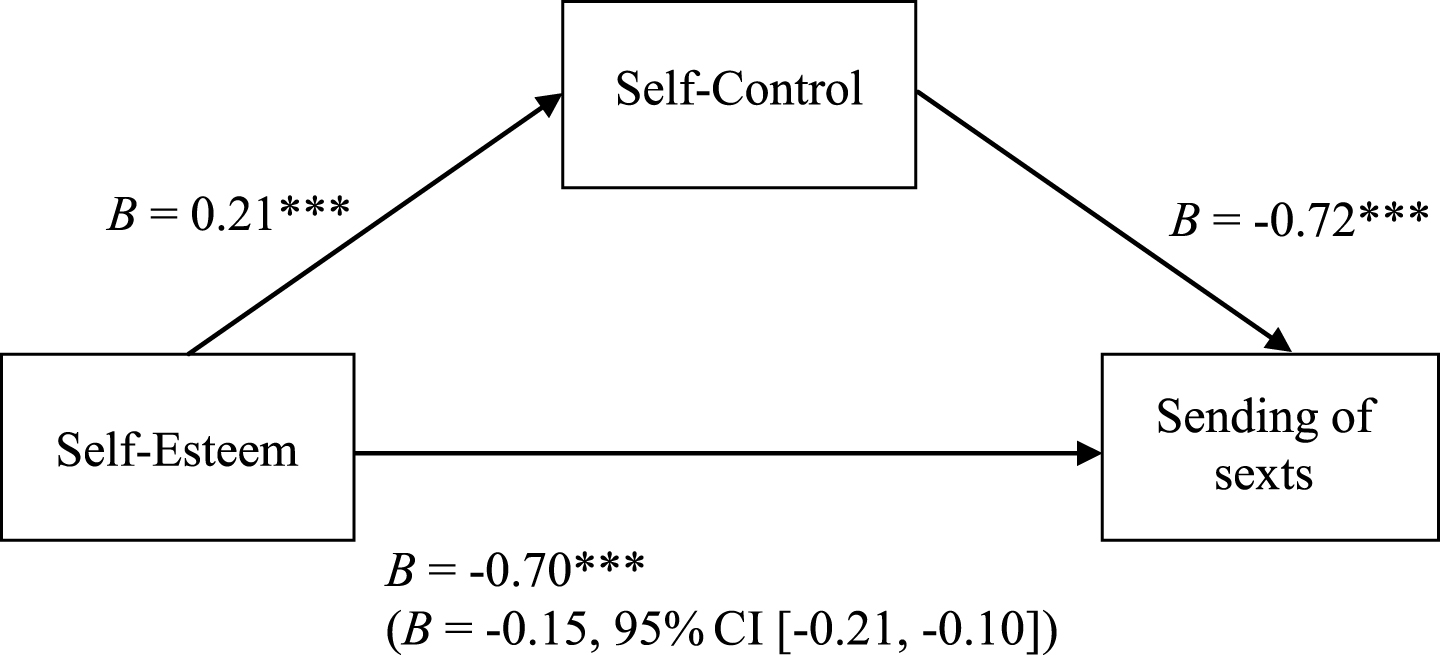
Direct and indirect effects of self-esteem and self-control on sending of sexts. The indirect effect of self-esteem on sexting via self-control is reported in parentheses with bootstrapped CI. *p < 0.05, **p < 0.01, ***p < 0.001.
Discussion
Investigating our first research question, we found that 8% of the participants sent sexts at least once in the last twelve months, suggesting that sexting among adolescents is neither an epidemic nor rarity. The present study revealed that most adolescents sent sexts once or twice (5%), whereas few reported sending nude or semi-nude pictures of themselves to others more frequently (3%). Therefore, we suggest that sexting among adolescents can be considered rather as an exploratory behavior and not as everyday normal behavior. Compared to previous research, the frequency rates in the present study (8%) appears lower than average frequency rates of 10.2% ascertained by Klettke et al. (2014) and 13.9% by Döring (2014). However, in both literature reviews, the frequency rates differed from study to study widely. For example, Döring (2014) found frequency rates varied between 2.5% and 21% in ten studies.
In the present study, German adolescents (10.8%) reported higher sexing engagement compared with Dutch (6.2%) and Thai adolescents (5.3%). Comparing the frequency rates by country with previous research, we found German and Dutch adolescents sent sexts more frequently in the current study than adolescents from these countries as examined by Baumgartner et al. (2014) who also used a reference period of the past 12 months. These differences might be explained by the data for the present study being collected three years later than the EU KIDS Online data. In addition, Baumgartner et al.’s (2014) sample included larger numbers of younger children and fewer older adolescents who probably are more engaged in sexting compared with children. An additional explanation for the lower frequency rates found by Baumgartner et al. (2014) might be that the present study’s data were not collected from participants in their home but in their schools. The home environment and one-to-one person evaluation used by EU KIDS Online study might have led to underreporting, due to social desirability and fear of consequences. In line with Baumgartner et al. (2014), German adolescents reported engaging in more sexting compared with Dutch adolescents. The findings concerning sexting among Thai adolescents are difficult to compare with the literature since no research has been conducted to our knowledge on sexting behavior among Thai adolescents or cross-national studies including both European and Asian adolescents. We add to the literature, that Dutch and Thai adolescents are less likely to report sending sexts compared with the German. Since Germany and the Netherlands are more comparable with each other regarding gross-domestic product per capita, broadband internet penetration, and traditional values than each of both countries with Thailand this finding lends support to Baumgartner et al. (2014) who found that country characteristics do not significantly influence the frequency rates of sexting.
Empirical evidence exists for and against age differences in sexting (Baumgartner et al., 2014; Gordon-Messer et al., 2013; Reyns et al., 2014; Ybarra & Mitchell, 2014). We found that with increasing age, participants reported more often to sext which is reasonable since with increasing age adolescents’ online activities are less monitored by parents and the interest in sexual topic and self-expression increase (Mathews & Jayabel, 2016; Staksrud & Livingstone, 2009).
Concerning sex differences, girls were less likely to report sending sexts compared with boys. This result is consistent with other research (Jonsson et al., 2014; Van Oosten & Vandenbosch, 2017; Van Ouytsel et al., 2014) but inconsistent with previous research that found girls were more likely to sext (Reyns et al., 2014; Ybarra & Mitchell, 2014). One possible explanation for our result might be that girls report less sexting, due to many educational campaigns on sexting targeting girls (Döring, 2014). Most news coverage on sexting concerns girls as victims of unwanted forwarding of sexts. Another explanation might be that girls’ reporting of sexting is biased due to their desire to conform to gendered stereotypes and the fear of stigmatization. Döring (2014) describes “slut shaming” as a potential risk for girls who send sexts. It refers to a common sexual double standard which blames girls for sexual activity but not boys. Further investigation on the fear of “slut shaming”, gendered stereotypes and associations with sexting among girls is strongly advised.
With respect to our second research question, we found support for our first hypothesis that with increasing self-control, the likelihood for sending sexts decreased (H 1). This result indicates that adolescents with high self-control might regulate their impulses and are more likely to consider possible negative consequences associated with sexting. These adolescents might also be less likely to perceive sexting as a virtual adventure or challenge that is exciting and thrilling. Our results are aligned with other research that showed that sexting behavior is associated with higher sensation seeking among adolescents (Baumgartner et al., 2014; Van Ouytsel et al., 2014). More specifically, we found consistent with Reyns et al. (2014) and Marcum et al. (2014) but in contrast to Lee et al. (2013) that with increasing self-control the likelihood for participating in sexting decreases. The study by Lee and colleagues (2013) is difficult to compare with our study. Lee et al. (2013) measured sexting by a scale consisting of six items, asking if adolescents took pictures of themselves and only one item asked if the adolescents sent these pictures to others. While only 0.9% reported that they sent sexts of themselves to others, around 13% of participants stated that they just took a picture of themselves. However, adolescents might take pictures of themselves to explore and develop their own sexual identity, their body, and curiosity about how they look from a different angle, or to compare themselves with others. It might be that taking pictures of oneself is less associated with low self-control compared with the sending of sexts to others.
We also found support for the hypothesis that sexting is associated with self-esteem in the way that adolescents with higher self-reported self-esteem are less likely to participate in sexting compared with adolescents with lower self-esteem (H 2). This finding indicates that adolescents with high self-esteem are less likely to show sexual online risk behavior, such as sexting, and are less likely to use ICTs to distribute sexually explicit content of themselves online. Our results contrast with Hudson and Ferot (2015) and Gordon-Messer et al. (2013) but are consistent with Ybarra and Mitchell (2014). Even though all the reviewed studies used the RSES (Rosenberg, 1965), the studies differed regarding the instrument for sexting and the sample characteristics. While in the present study and in the study by Ybarra and Mitchell (2014) adolescents participated in the other two studies (Gordon-Messer et al., 2013; Hudson & Fetro, 2015) young adults took part. Therefore, it seems justified to suggest that self-esteem might only be a correlate of adolescents’ sexting behavior but not of adults’ sexting behavior who might have made more sexual experiences. In addition, the degree of sexual explicitness might influence the association with self-esteem. For example, Scholes-Balog et al. (2016) found that high self-esteem reduced the odds of sending nude photos or videos, but not pictures in underwear or lingerie. More research is needed to clarify whether age of participants, the measurement of sexting and the degree of sexual explicitness of sexts might influence the relationship between self-esteem and sexting.
As we hypothesized the relationship between self-control and sending sexts was mediated by self-esteem such that self-control increased self-esteem that in turn decreased the likelihood of sending sexts (H 3). We found also support for the hypothesis that the relationship between self-esteem and sexting was mediated by self-control such that self-esteem increased self-control which in turn decreased the probability of sending sexts (H 4). These results facilitate a better understanding of the relationship between self-control, self-esteem and sexting by extending previous research that found direct associations (Marcum et al., 2014; Reyns et al., 2014; Scholes-Balog et al., 2016; Ybarra & Mitchell, 2014). Our findings suggest that in some adolescents, self-control might decrease sexting not only directly but also indirectly if adolescents evaluate themselves as valuable, worthy individuals. In addition, self-esteems might decrease sexting not only directly but also indirectly if adolescents can control their emotions, behavior, and desires.
Limitations
Several limitations were noted for this study. First, although our sample is large, it cannot be considered representative. Therefore, generalizing our results to the entire population of adolescents in each country is not recommended. Second, due to the cross-sectional nature of the study, directionality between sexting, self-esteem, and self-control cannot be determined. Consequently, it is unclear whether adolescents with low self-esteem are more likely to engage in sexting or whether adolescents may experience a decrease in self-esteem because of the misuse of sexts. Third, since all data relied on self-reports the correlates might be inflated through shared method variance. Fourth, we relied on a single item to assess sexting. Future studies should try to include validated scales to overcome problems with single-items measurements (i.e., degree of validity, accuracy, and reliability). Fifth, when completing the instrument for measuring sexting, there might have been issues of perceived social desirability that influenced participants’ responses. If participants were fearful to report that they sent sexts, they may have underreported their actual sexting behavior. Sixth, we did not assess the context of sexting (i.e., pressure to sext, sexting in a romantic relationship or with strangers, misuse of sexts like not wanted forwarding). These particular variables might explain psychological problems related to sexting and should be controlled for in future studies. Finally, the analyses would have benefited from including more control variables (i.e., prior sexual experiences, media activities) to exclude the impact of these variables on the investigated associations in this study.
Future Directions
Even though this study found that sexting might be associated with some psychological difficulties such as low self-control and low self-esteem, it is important to investigate these relationships further. One way would be trying to include more specific self-esteem and self-control scales and not only global measures. Using specific scales that distinguish between varying facets of self-esteem and self-control might reveal a more detailed picture. For example, it might be that adolescents who suffer from low emotional self-esteem or low self-esteem concerning physical appearance might use sexts as means to boost their self-esteem. This research should clarify whether sexting is a manifestation of sexual identity for adolescents with low self-esteem, while adolescents with higher self-esteem use other means. In addition, future studies need to distinguish between consensual and non-consensual sexting practice and the role of self-control and self-esteem in these different sexting types.
Future research could also focus more on how ICTs are used for adolescents’ sexual development. This research could clarify whether sexting is a way to explore the identity of at-risk adolescents and analyze possible positive effects of sexting among adolescents (i.e., strengthening a positive sexual identity). These examinations could also contribute to answering the question whether sexting is normal or maladaptive behavior.
Implication for Practice
Since around 8% reported having sent sexts it is imperative to educate adolescents in media literacy. Such measurements should increase awareness of the potential challenges adolescents may face when using ICTs as a forum for sexual self-expression and sharing personal material. Adolescents need to understand that if they send pictures of themselves to others, they can easily lose control over how that image is used. In the same vein, adolescents should be educated about legal and ethical aspects of sexting, possibilities for safe sexting (i.e., to whom are the sexts sent, with or without face), and possible risks of sexting (i.e., forwarding of sexts, misuse of sext to humiliate the producer).
In addition, the present study indicate that it appears to be important to support adolescents to build a positive self-control to ensure that sexting is not used without thinking of the potential negative consequences, without the carelessness regarding to whom sexts are sent and to the trustworthiness of the recipient in order to avoid serious and distressing outcomes. In the same vein, it seems to be crucial to empower adolescents to develop a positive self-esteem in order to ensure that sexting is not used as a mean of seeking approval from others, because of peer pressure or insecurity. Improving self-esteem may also help adolescents to decide whether they really want to share private pictures with others and reduce the likelihood trying to compensate feelings of worthlessness, inadequacies, and deficiencies by sexting. The present studied showed also that educational programs that enable adolescents to control their ICT-related behavior and empowerment training to build a positive self-view need to be combined to address sexting behavior among adolescents.
Conclusion
The present study investigated frequency rates of sexting and psychological correlates among adolescents. The frequency rates in this study suggest that sexting is neither an epidemic nor a rarity among adolescents. Adolescents with increasing age and male adolescents were more likely to report sexting behavior. Although sexting should not be considered problem behavior per se, our results indicate that with increasing self-control and self-esteem the likelihood for sending sexts decreased. We add to the literature that self-control and self-esteem are not only directly linked to sexting but also indirectly. Therefore, both self-control and self-esteem need to be considered in educational programs on sexting at the same time. Adolescents need to learn to be critical consumers of self-created online material and to decide whether it is appropriate to share with others. Also, adolescents need to become empowered in order to ensure that sexting is not used without thinking of the potential negative consequences, without the carelessness regarding to whom sexts are sent and to the trustworthiness of the recipient and in order to compensate feelings of worthlessness, inadequacies, and deficiencies. Further research is needed to understand how adolescents’ use ICTs for their sexual development, to analyze potential positive effects of sexting behavior and cross-cultural differences.
Footnotes
To test whether the method of data collection (paper and pencil versus online) had any undue influence on the study results, we conducted all analyses with a dichotomized variable “method of data collection” (paper and pencil versus online) added to a set of control variables. The effect of the data collection method on our dependent variable, namely sexting involvement was not statistically significant; furthermore, we did not observe any changes in the obtained results.
In order to test whether age, sex or country of origin had an influence on the mediation model we tested for moderated mediation by using PROCESS Model 59. The results were not significant. More information can be requested by the first author.