



Abstract
In the present study, the interaction between specific measures of endorsement for extremism (e.g. endorsement for religious, left-wing or far-right extremism), thrill-seeking, and active online exposure to extremism via social media with regard to the explanation of politically and/or religiously motivated aggression is investigated. While the relationship between exposure to crime-prone contexts and aggression has been studied widely, no previous study has explicitly demonstrated the conditional effects of these factors in a survey of young adults and with regards to political aggression. This study therefore extends the existing literature by testing propositions derived from the General Aggression Model, a well-established theory of aggression. The unique contribution of this study is that it is based on distinctive measures of endorsement for extremism (left-wing, nationalist/separatist and religious extremism) and that it focuses on the differential effect of exposure to extremist content online. We make use of a large-scale web survey of young adults in Belgium. 6,020 respondents completed the online questionnaire. Mean age (range, 15– 31 years) was 20.19 years, 35.3% males. The results support an amplification effect: Endorsement for extremism is related to self-reported political aggression, but the effect of endorsement increases by levels of active social media exposure. The results additionally showed that the magnitude of this interaction effect is further depending on thrill-seeking. These findings are rather stable across extremism-specific measures of endorsement for extremism.
Keywords
One highly debated issue in contemporary research on politically and/or religiously motivated aggression is the issue of differential susceptibility versus situational resistance to exposure to extremism, both in real life and through social media. The basic idea is that individuals who are susceptible will be differentially influenced to commit politically or religiously motivated aggression, depending on their level of exposure. Situationally immune individuals are hypothesized not to be affected by their levels of exposure. In criminology, the idea of differential susceptibility is acknowledged in different frameworks (see Agnew, 2016). The issue of differential susceptibility has a long tradition in developmental and social psychology. In developmental psychology, similar ideas are found in the highly influential work of Bronfenbrenner (2005).
The study of politically motivated violent crimes is interdisciplinary and has a long tradition in political sciences (e.g. social movement theories, rational choice models; for overviews see Koehler, 2017), but also in criminology, theoretical frameworks have been suggested and attempts have been made to either apply the well-established theoretical criminological traditions (e.g. LaFree & Freilich, 2017). However, the study of politically motivated violent crimes is also studied from different theoretical frameworks rooted in psychology (e.g. Bandura, 1990; Borum, 2004; Davis & Cragin, 2009). Contemporary scholars of political/religious violence discuss the importance of exposure to extremist content online (e.g. using social media). Just like the debate on the relation between exposure to aggression in playing (video) games and aggressive behavior (Anderson & Bushman, 2001), the debate on the impact of exposure to online extremist content takes different forms. Several learning theories are often used to explain the effects of exposure to aggression. One of the first influential models was the Social– Cognitive Model of Albert Bandura, who also stressed the importance of attitudes and extremist beliefs on the commitment of atrocities like acts of terrorism (Bandura, 1990). The present study will however focus on active exposure to violent extremism through social media. In this study we were partially inspired by a line of inquiries on gaming and aggression and while some scholars have provided evidence for the existence of a relationship between gaming and violence (Allen, Anderson, & Bushman, 2018; Anderson & Bushman, 2002), others scholars have been more sceptical because of the fact that effect sizes are often rather small (Ferguson & Dyck, 2012). Some scholars hypothesize that there is a strong causal relationship between exposure to extremist content and the commitment of political/religious violent crimes (Akers & Silverman, 2004), while other scholars argue that online exposure is a matter of selection effects (King & Taylor, 2011; Klausen, 2015; Pauwels & Schils, 2016). Few studies have examined interaction (i.e. amplification) effects as a viable explanation for the moderate-sized main effects of measures of exposure to extremist content through social media and self-reported acts of crime, committed to obtain political or religious goals (Schils & Pauwels, 2016). As crime is a legal construct (i.e. a summary of what is prohibited by law in a given jurisdiction in a certain time window), we have decided not to focus on this heterogeneous phenomenon of crime 1 and to connect with the social-psychological research tradition focusing on aggression, namely political aggression (Allen & Anderson, 2017). After all, it is aggression, and the most severe forms of, namely seriously violent acts which are feared most and strongly affect our (biased) perceptions of fear of crime.
The terms aggression and violence are often used as synonymous in the fields of political science and criminology, but in social psychology, violence refers to the most serious acts of aggression, i.e. behavior intended to cause harm (whether or not attempted or succeeded) (Allen & Anderson, 2017; Parrott & Giancola, 2007). Intentionality, harm and the avoidance of harm by the target is what distinguishes aggression from other behaviors that may be antisocial or may involve the breaking of conventional norms. Most scholars in the “political violence and illegal political protest” research tradition, the “violent extremism” and “terrorism” literature seem to agree on the fact that the internet and social media can function as an echo room and that social media and the internet play an important role in recruiting members of extremist groups (Amble, 2012; Awan, Hoskins, & O’Loughlin, 2011; Klausen, 2015; Roversi, 2008) 2 . Much of the debate is however not based on large-scale empirical studies but either on in-depth analyses of narratives of terrorists (Moghaddam, 2006; Speckhard, 2012) and case studies of suicide bombers (e.g. Pape, 2005). We encourage such in-depth studies as they provide very valuable information on terrorists’ motives and help to reconstruct the life histories of these individuals. However, large scale studies in general populations are somewhat lacking, although both quantitative and qualitative studies of political aggression are needed to increase our understanding of the mechanisms that are involved in the commitment of acts of political violence.
The General Aggression Model (GAM) as a Framework for the Study of Political Aggression
Many theories in the fields of sociology, psychology, and criminology have been proposed to explain violent crimes or more generally formulated human aggression. In this article we are guided by the General Aggression Model (GAM), as developed by Bushman and Anderson (2002) as an overall starting point to understand individual differences in political aggression and the specific role of exposure to extremism through social media. We submit that political aggression is a special case of aggression. In social psychological studies, aggression is very often defined as a behavior that is intended to harm another person, who is motivated to avoid that harm (DeWall, Anderson, & Bushman, 2011). Following this research tradition, political aggression can be defined as any behavior intended to harm a target, who is motivated to avoid that harm in the pursuit of political goals. The GAM has a long history and counts as one of psychology’s most comprehensive and widely used theories for understanding all kinds of aggression (see Fig. 1 for visualization).
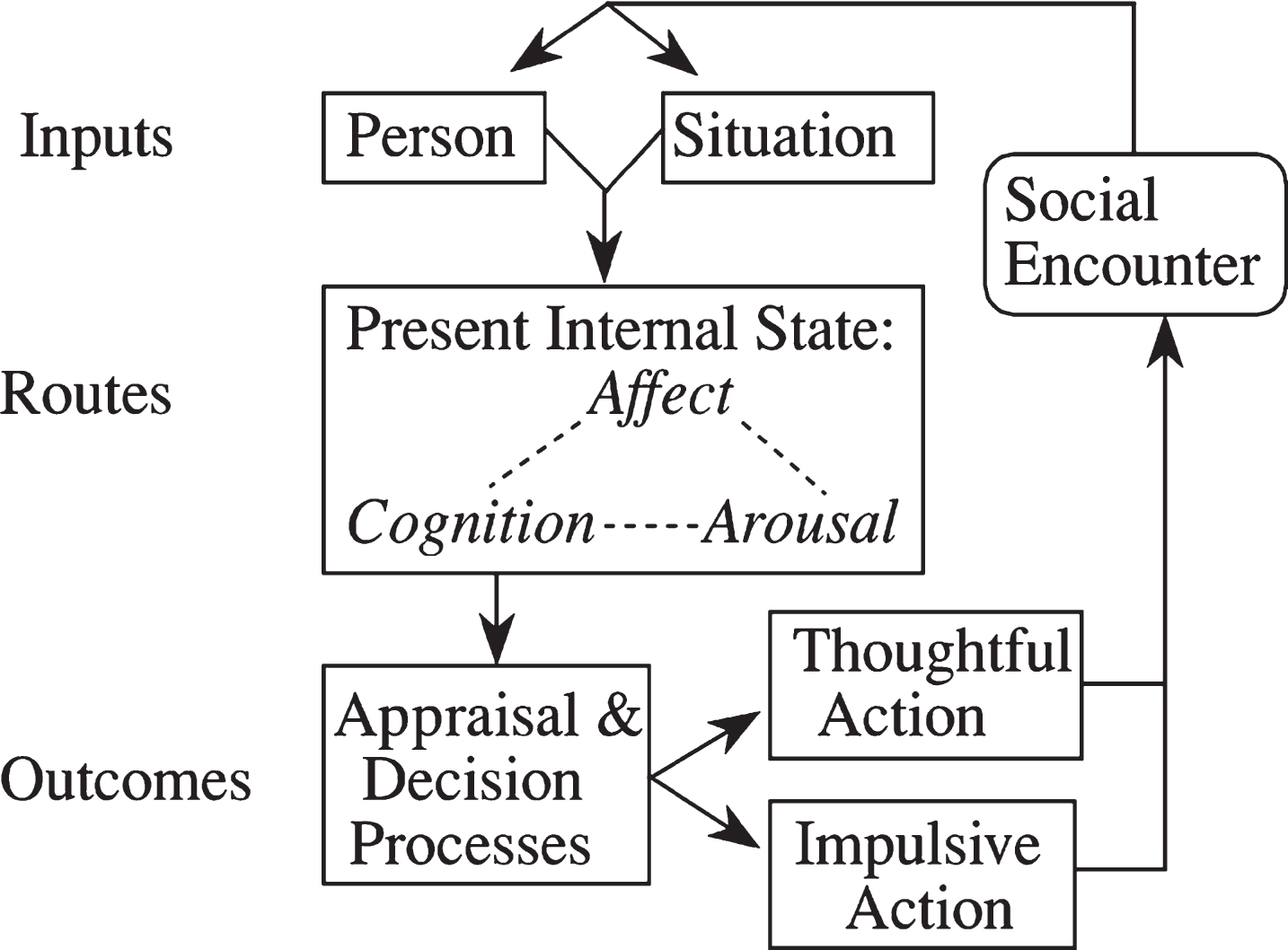
The General Aggression Model (GAM) (based on Anderson & Bushman, 2002, p. 34).
The first stage of the proximate processes outlines how person and situation factors increase or decrease the likelihood of political aggression through their influence on present internal state variables (i.e., cognition, affect, and arousal) in the second stage (see e.g. Mischel & Soda, 1999; Ross & Nisbett, 2011). Input variables that increase the likelihood of aggression are considered risk factors (e.g. perceived personal injustice, perceived group level injustice) whereas those that decrease the likelihood of aggression are considered protective factors (e.g. social ties to conventional society, positive student-teacher relationships, strong parental attachment). Person factors are any individual differences that may influence how a person responds to a situation, i.e. cues in the immediate environment in which action takes place. These factors tend to be fairly stable over time and across situations as long as the person consistently uses the same knowledge structures. In GAM, aggressive knowledge structures make aggression more likely. Many person factors have been identified as risk factors for aggression, in this study thrill-seeking and endorsement for the use of violence to obtain political defined goals are considered key elements of the present internal state. Situational factors are aspects of the situation that may influence whether aggression occurs. Many situation factors have been identified that increase the likelihood of aggression. These include, but are not limited to, provocation, frustration, and exposure to aggression. Such encounters lead to exposure to extremist content and these encounters can take place in the real world, but also in the virtual world, e.g. through the use of social media. In this study, the focus is on online exposure to extremist content. Looking through the theoretical lens of GAM, it is hypothesized that personal factors that reflect the present internal state (routes) and situational (circumstantial) factors such as encounters with extremist content interact. GAM takes into account decision-making processes, and the distinction between thoughtful action and impulsive action. Therefore, it seems likely that the frequency of self-reported aggression can be explained by endorsements for extremism, exposure to extremist content and the interaction between both variables. We expect that the effect of endorsement is amplified by exposure. As appraisal and decision-processes are hypothesized to be done in an impulsive or purposeful way (see also Loewenstein, 1996), we further expect that the interaction between endorsement and exposure to extremist content will be affected by one’s level of thrill-seeking. Numerous studies of juvenile delinquency found strong correlations between impulsivity and thrill-seeking (within the framework of theories of low self-control, see meta-analyses by Pratt & Cullen, 2000; Vazsonyi, Mikuška, & Kelley, 2017). Some authors have suggested and empirically shown that a dual system approach to understand differential susceptibility to processes of peer-influences on juvenile may reinvigorate tests of theories of crime causation (Thomas & McGloin, 2013). In their inquiries, Thomas and McGloin (2013) used measures of self-control to study differential peer effects in adolescents who had a high, medium and low score on thrill-seeking and impulsiveness. It strikes us that ideas of differential vulnerability are becoming increasingly acknowledged in different fields, while different labels are used to refer to highly similar constructs.
The Present Study
This study is based on a large scale anonymous online survey of young adults in Belgium. The study enabled us to get insight in the relationship between exposure to extremism through social media and political aggression and was especially designed to test hypotheses of different social psychological and criminological theories. The original study was designed to incorporate key concepts from (competing) theoretical frameworks and allowed us to differentiate between endorsements for right-wing (nationalist/separatist), left-wing and religious extremism, thrill-seeking and exposure to extremism (see Pauwels & Schils, 2016; Schils & Pauwels, 2014). This study allows us to get insight into the effects of attitudes (endorsements) for extremism, using different measures of endorsement, thrill-seeking and exposure to extremism through social media.
Methods
Sample and Procedure
Data are derived from a large Belgian study of young adults (Pauwels & Schils, 2016; Schils & Pauwels, 2014, 2016). Data were collected (1) through a fully anonymous paper-and-pencil survey of pupils in the third cycle of secondary education in Antwerp and Liège (aged 15 to 18) and (2) through a large-scale anonymous web survey of young adults (aged 19 to 31). The paper-and-pencil survey was restricted to the cities of Liège and Antwerp for practical reasons: Liège and Antwerp are two among Belgium’s five large cities (+100,000 inhabitants). All schools in the third cycle of the secondary education system in Antwerp and Liège were contacted and invited to participate in the study. A total of 34 schools in Antwerp and 32 schools in Liège received a request for participation. Only six schools in Antwerp allowed us to conduct the paper-and pencil survey. The schools in Liège refused the paper-and-pencil version. We were however allowed to spread the web-link to the survey through an intensive distribution of flyers and posters that were hung in the schools (also in the schools that did not want to part-take in the paper & pencil survey). The web-survey consisted of a self-administered questionnaire which could be accessed through a link to the survey’s web page on Facebook. As the web survey was meant to reach both students and non-studying young adults, posters were also hung-up visibly at different strategic places that attract a high number of the targeted population, such as popular youth clubs, pubs and bars and other hubs for youngsters. Additionally, flyers were distributed in the main buildings of virtually all faculties of universities and university colleges in Antwerp and Ghent (Flemish part of Belgium), Louvain la Neuve, and Liège (Walloon part of Belgium), and pamphlets were intensively distributed among the students. The central faculties and administrational services for students of all universities and university colleges were sent an email invitation with a request to circulate the web link to the questionnaire’s Facebook page. This method proved to be most effective. Many additional organizations, associations, and local youth clubs were contacted with a request to distribute the survey to their members, to reach adolescents who are no longer in school. This last tactic was particularly effective in Wallonia, where 32 youth clubs were contacted for this purpose.
Although the possibility of distributing the questionnaire via online platforms or mailing lists has significantly contributed to the survey response, one must still have some reservations regarding to the willingness to respond. While web surveys seem to be increasingly popular among social scientists, there are sufficient questions left in regard to the systematic bias that might result from exclusively using the World Wide Web as a sample frame. We acknowledge that the researcher cannot completely monitor the processes of response selection and we must admit that we cannot verify the conditions under which the questionnaire is completed (e.g. the presence of others). In addition, the initiative to participate in the survey is entirely left to the respondent. The impossibility of monitoring, response selection, self-selection, and under-coverage (internet availability) are important drawbacks. It should however be mentioned that these issues (preparedness to answer survey questions, willingness to report) are central to the more traditional survey modes as well. It is probably fair to state that the web survey may contribute more to explanatory research (studies of the causes and correlates) than to prevalence studies (studies that try to gain insight into the prevalence of attitudes and behavior). Still, web surveys are increasingly accepted as a valid and reliable tool of measuring self-reported delinquency with their data quality measuring up that of paper and pencil surveys (Bethlehem, 2010). The fact that the questionnaire web page was visible on Facebook meant that a high number of respondents could be reached in a very short time. The web survey was online between September 2012 and December 2012 and the response was huge, with 3,653 respondents in Flanders and 2,367 respondents in Wallonia, making a total of 6,020 respondents. Mean age (range, 15– 31 years) was 20.19 years, 35.3% males, 76.2% Belgian native background. Due to the anonymity, which was quintessential in this survey, we were unable to track the schools or departments in which students were taking classes. Therefore, taking into account the clustered nature of the data could not be taken into account.
Measurements
Political Aggression as Dependent Variable
The dependent variable refers to political aggression. We will speak of political aggression throughout this study, but the reader should read this as politically or religiously motivated aggression. Self-reported political aggression (towards persons) was measured by asking the respondents if they had ever: ‘fought with someone because of political or religious belief,’ ‘threatened someone on the Internet because of political or religious belief,’ ‘threatened someone on the streets because of political or religious belief,’ ‘hit a capitalist’, ‘hit a foreigner’. A seven-point scale was used to get insight in the frequencies of committing the different acts of political aggression. Cronbach’s Alpha for the political violence towards persons is 0.87.
Explanatory Variables: Endorsement for Extremism, Thrill-Seeking and Exposure to Extremist Content
Endorsement for Extremism
Three different scales that tap into endorsement for extremism, i.e. attitudes favorable to the use of force to political goals, have been used in this study. These measures were quintessential to be able to distinguish between different kinds of evaluations of political aggression. Domain-specific measures are of major importance if the research goal is to gain insight in similarities and differences regarding the effect of different forms of endorsement for extremism. Endorsement for religious extremism (5-point scale) was measured as follows: ‘I endorse that some religious fundamentalists use violence against the people who have the power in Belgium’, ‘I endorse religious fundamentalists who disrupt the order’, ‘I endorse religious fundamentalists who use violence against others’. Cronbach’s alpha is 0.91. Endorsement for left-wing extremism (5-point scale): ‘I endorse that some anti-globalists use violence against the people who have the power in Belgium’, ‘I endorse anti-globalists who disrupt the order’, ‘I endorse religious fundamentalists who use violence against others’. Cronbach’s alpha is 0.83. Endorsement for nationalist- separatist extremism (5-point scale): ‘I endorse that some nationalist/separatist extremists use violence against the people who have the power in Belgium’, ‘I endorse nationalist/separatist extremists who disrupt the order’, ‘I endorse nationalist/separatist extremists who use violence against others’. Cronbach’s alpha is 0.89. Inspiration for these scales was found in the work of Doosje, Loseman, and Bos (2013).
Thrill-Seeking
Thrill-seeking behavior was measured with the following items (5-point scale): ‘I sometimes find it exciting to do things that could be dangerous’, ‘I often do things without thinking of the consequences’, ‘Sometimes I will take a risk just for the fun of it’. Cronbach’s alpha is 0.73. The items reflect one subscale from the scale by Grasmick, Tittle, Bursik, and Arneklev (1993), a well-established multidimensional scale of self-control that has been widely used in criminological inquiries. While self-control is a complex and multidimensional construct, which is differentially approached in sociology, criminology, and psychology, we focus on thrill-seeking as it is one of the emerging stable correlates of political aggression and neo-Nazi gang membership (Bjørgo, 2013).
Exposure to Extremist Content
Exposure to extremist content is important because it may amplify the effects of attitudes, like endorsement for extremism. As we were not aware of any pre-existing valid scales prior to the original study, we developed a measurement instrument, inspired by how scholars of communication studies measure online activities (e.g. Den Hamer, Konijn, & Keijer, 2014). Measuring exposure to extremist content is a daunting task as exposure comes in many forms: active and passive, online and off-line. Exposure to extremist content refers to exposure that has not happened by coincidence, but was the result of an individual reaching out, actively seeking information and contact with extremists (radicalized individuals). In this study we make use of one measure that taps into cumulative active exposure to extremist content. The concept of “active (i.e. self-initiated) exposure to extremist content using social media” refers to actively and deliberately seeking out certain violent extremist information and communication. This concept was measured by a summation risk index containing to variables: (1) a scale of ‘online communication about extremist content’ consists of a series of items measured on a 6-point scale: I use social media (Twitter, Facebook) to take part in discussions with extremists on: ‘ … white power-related forums’, ‘ … radical Islamist web fora, ‘ … radical left militant forums’. Cronbach’s alpha is 0.69 3 . We categorized this scale (1 = high or risk end of the scale versus 0 = low) and added to this construct an item that measures the activity of actively online searching for contact with extremists (coded 1 if the respondent deliberately seeks contact with violent extremists and coded 0 if this was not the case). If these two concepts are added, the result is a cumulative risk-index of exposure to extremist content, which can onlyconsist of three values (0 = not at risk, 1 one risk-factor present, and 2 = two risk factors present). Although risk measures remain often used in criminological inquiries (O’Mahony, 2009), we are aware of the limitations of using risk versus protective scales and strongly recommend future studies to further delve into the difficult question of measuring exposure to extremist content.
A note on Demographic Background Characteristics as Statistical Control Variables
Often demographic background variables (attributes) are included as statistical controls and cannot be treated as causal determinants of action (Bunge, 2006; Holland, 2012) and often are entered into equations without detailed theoretical reason (or) reflections regarding the mechanisms at work. At best, they are entered into an equation because the actual mechanism at work, which is associated with the background characteristic and the outcome variable, is not measured at all. This does not mean that these variables are unimportant to consider for analysis. The position taken here is that events, that may have causal impact may operate differently in groups (e.g. different phases of the life-course, as age can be interpreted as a marker for the developmental trajectory, and biological sex may be interpreted as a proxy for unmeasured biological factors). The problem is indeed the fact that these assumed factors are unmeasured. To really understand the role of background characteristics which are often used as statistical controls, the unmeasured mechanisms should be part of the study. Some scholars have therefore warned for unintended consequences of over-controlling and said that the use of statistical control variables creates an illusion of statistical control (Christenfeld, Sloan, Carroll, & Greenland, 2004; Lieberson, 1985). Therefore, a theoretical analytical framework can help sorting these issues out from a theoretical perspective (Wikström & Bouhana, 2017). We have used following demographic control variables. For details see the method section above. Biological sex is coded one for males and zero for females. Immigrant background is coded one, when the respondent and both parents are of Belgian descent, and zero if at least one of the parents is not of Belgian descent. The sample consists mostly of respondents with a Belgian descent (i.e. they and both their parents are born in Belgium). Age is trichotomized. We make a distinction between respondents below 18 years old, between 18– 22 years old and the oldest category. 25% of the respondents is younger than 18 years old. 59.3% of the respondents is between 19 years old and 22 years old. 15.5% of the respondents is older than 22 years old. Finally, we should point out the difference between the net-sample used for analysis (N = 4,143) and the full sample of 6,020 respondents. This difference is due to item-nonresponse, as the survey contained many scales from different theoretical perspectives. Descriptives can be found in Table 1.
Descriptives of Theoretical Constructs and Demographic Background Characteristics
Analysis
The analyses were carried out using generalized linear regression models and negative binomial regression models. It has repeatedly been acknowledged that the study of interaction effects is highly problematic in non-experimental studies than in studies that use an experimental design: Jaccard, Turrisi, and Wan (1990) as well as McClelland and Judd (1993) reported these problems and found that very large data sets are needed to reliably find a substantial interaction effect similar to an interaction effect found in an experimental study. Therefore McClelland and Judd concluded that scholars that find interaction effects in simple OLS-regression models with a sample size up to 800 respondents may be satisfied to find an interaction effect that exceeds 0.12. As crime causation theories increasingly acknowledge the importance of taking interactions into account, a lively discussion has been going on about the use of OLS-regression models as a statistical tool to predict crime from theoretically derived variables. This discussion was by and large fed by statistical arguments regarding the violation of assumption in OLS-regression models (Hirtenlehner & Kunz, 2016; Karaca-Mandic, Norton, & Dowd, 2012; Oberwittler & Gerstner, 2014). As a consequence, scholars increasingly use negative binomial models to explain individual differences in highly skewed dependent variables like political violence. The study of interaction effects using nonlinear techniques of analysis has not been without problems (Hilbe, 2011). The signs and magnitude of interaction terms may sometimes change and methodologists have warned not to look at coefficients of interaction terms alone, but also to plot the predictions in different subgroups and compare confidence intervals. In non-linear models results should always be interpreted with care. Since the dependent variable is highly positively skewed (higher than traditional and typical juvenile delinquency scales) we conducted both generalized linear modelling and negative binomial models. To demonstrate the interaction between propensity and exposure in negative binomial models we additionally plot the predictions made by the nonlinear negative binomial models based on our measures of exposure by propensity. All metric variables were standardized before entering the equation. To present the figures, which demonstrate the interactions found between endorsement and exposure by levels of thrill-seeking, we have trichotomized thrill-seeking by contrasting the extremes (the ends of the distribution, i.e. minus one standard deviation and plus one standard deviation), with the respondents who had an average score (a score between minus one and plus one standard deviation).
Results
Interaction Between Overall Exposure to Extremist Content and Extremist-Specific Endorsements by Level of Thrill-Seeking
In Table 2, we present both the linear and nonlinear models of political aggression. For reasons of parsimony, we integrated three tables, so that endorsement for extremism should be read differently in the separate columns. In the first column, we test the main and interactive hypotheses for endorsement for nationalist-separatist extremism. In the second column, we test the same hypotheses in relation to endorsement for religious extremism and in the third column, the main and interactive hypotheses are tested in relation to endorsement for left-wing extremism. First, the linear model is presented, followed by the non-linear model. As argued, the nonlinear model produces coefficients that sometimes have reverse signs and lack statistical significance. This is due to the nonlinear nature of the negative binomial model. We discuss the effects of the linear model for reasons of parsimony. These models are better suited to test interaction effects. The results of the negative binomial model are used to present the findings using graphs. Answering the research question: is the effect of endorsement conditional on exposure to extremist content and does thrill-seeking further modify this relationship? It seems to be the case judging from the figures. The direct effect of endorsement for extremism is strong and highly significant (B = 0.670; p < 0.001 in the case of NSE, B = 0.471; p < 0.001 in the case of RELEX; B = 0.537; p < 0.001). Exposure is significantly related to political aggression. The main effect is strong and negative for NSE, RELEX and LWE. In every case, the categories “low” and “medium” are compared to the reference group “high exposure”. The coefficients are somewhat stronger in the category low exposure, but it is striking that the coefficients in both groups are rather similar. Low exposure yield following results: B (NSE) = – 0.642; p < 0.001, B (RELEX) = – 0.746; p < 0.001 and B (LWE) – 0.637; p < 0.001. The main effect of thrill-seeking is strong and statistically significant controlling for endorsement for NSE (B = 0.542; p < 0.001) and controlling for endorsement for RELEX (B = 0.399; p < 0.001), but nearly significant controlling for endorsement for LWE (B = 0.251; p < 0.100). However, as we shall see, the main effects need to be interpreted together with the two-way and three-way interactive effects. Looking at these interactive effects, there are two two-way interaction effects and there is one three-way interaction effect. As higher order interaction effects are rather abstract and difficult to interpret intuitively, we suggest that the reader takes a close look at the additional figures. The linear models show a significant two-way interaction between exposure to extremist content and thrill-seeking in two out of three regression models. The reader should notice that the linear multiplicative coefficient is only significant in model 1, not significant in model 2, and model 3. Thrill-seeking and endorsement for extremism interact in the three regression models: the regression coefficients are respectively B = 0.446; p < 0.001 in Model 1, B = 0.623; p < 0.001 in Model 2 and B = 0.819; p < 0.001 in model 3. The coefficients are positive, so this suggests that there is an amplification effect between thrill-seeking and endorsement for extremism - not surprisingly, as risk factors tend to show amplification effects. This has been noted in several inquiries of adolescent offending. Finally, the three-way interaction coefficient (exposure to extremist content *thrill-seeking* endorsement for extremism) is significant in the three models. In model 1, R-square is 10.09%. In model 2, R-square is 11.6%. In model 3, R-square is also 11.6%. This may not be much, but the results are mainly due to the factors presented in the model. Controlling for demographic background variables does not change anything to the effects of the theoretical variables, while this operation changes R-square. We did not want to let the model evaluation parameter be influenced by attributes. Readers who are interested in the F-values corresponding to each model can take a look at Table 3.
Generalized Linear and Negative Binomial Models of Political Aggression
Note: NSE = endorsement for nationalist-separatist extremism, RELEX: endorsement for religious extremism, LWE = endorsement for left-wing extremism. *** = p < 0.001 ** = p < 0.01 * = p < 0.05 (*) = p < 0.10 Maximum-likelihood estimation of parameters.
Additional F-Tests of Main and Interaction Effects of Independent Variables on Political Aggression
Note: NSE = endorsement for nationalist-separatist extremism, RELEX: endorsement for religious extremism, LWE = endorsement for left-wing extremism; Maximum-likelihood estimation of parameters. *** = p < 0.001 ** = p < 0.01 * = p < 0.05 (*) = p < 0.10 (based on robust standard errors).
To visualize the amplification hypothesis (see the additional Figs. 3–11 in Appendix), we decided to present the results from the negative binomial models, as this model fits the data better than a linear model, but the results are similar. The reader clearly sees that the negative sign of the interaction terms that are drawn from negative binomial models is misleading if one interprets the interaction term in a way similar to a linear model. The basic patterns observed are congruent to the amplification hypothesis, demonstrating that GAM allows for deriving and testing meaningful hypotheses of political aggression.
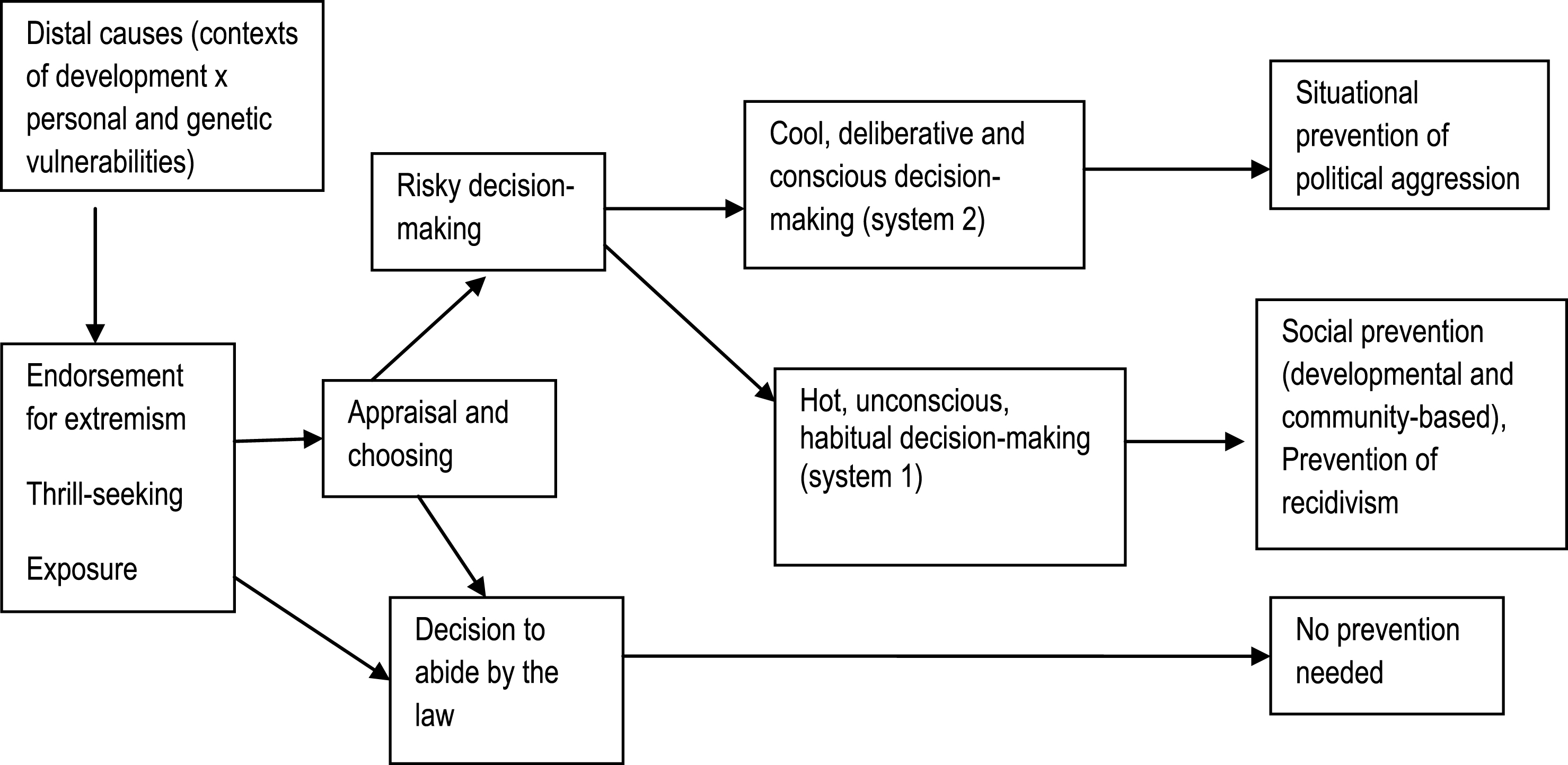
Criminal policy implications of the General Aggression Model (GAM).

Political aggression, endorsement for nationalist-separatist extremism and exposure in low thrill-seeking respondents.
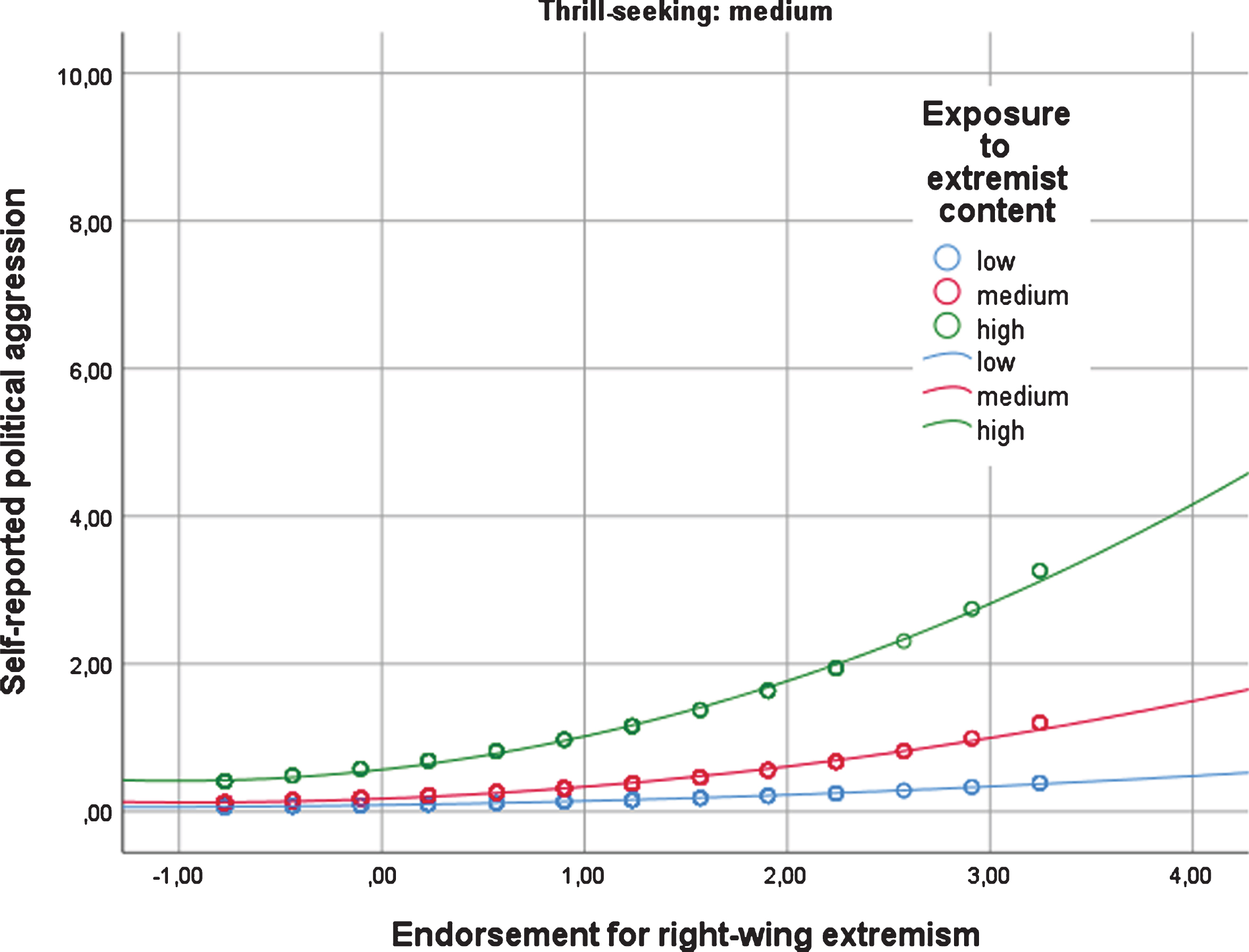
Political aggression, endorsement for nationalist-separatist extremism and exposure in medium thrill-seeking respondents.

Political aggression, endorsement for nationalist-separatist extremism and exposure in high thrill-seeking respondents.

Political aggression, endorsement for religious extremism and exposure in low thrill-seeking respondents.
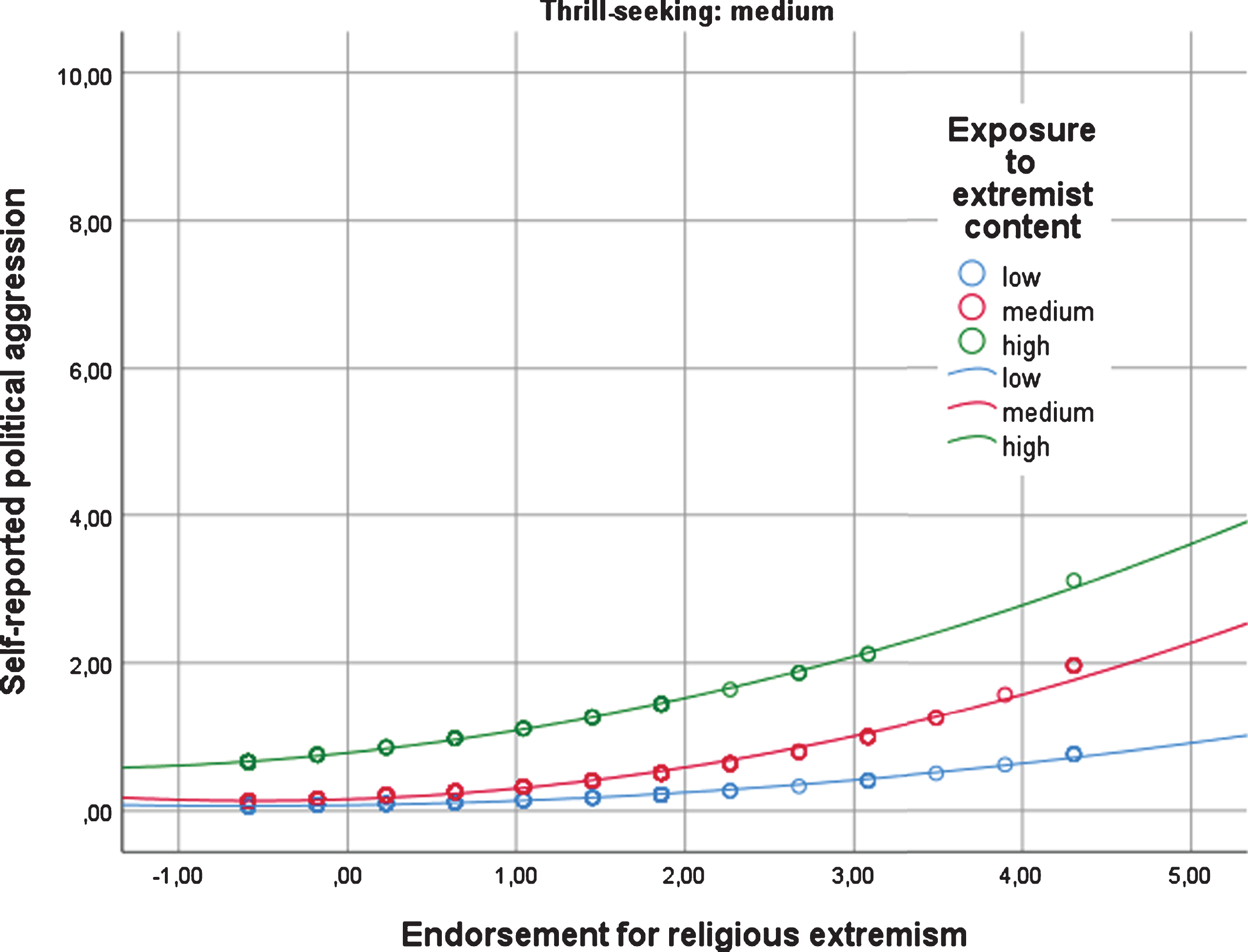
Political aggression, endorsement for religious extremism and exposure in low thrill-seeking respondents.

Political aggression, endorsement for religious extremism and exposure in high thrill-seeking respondents.
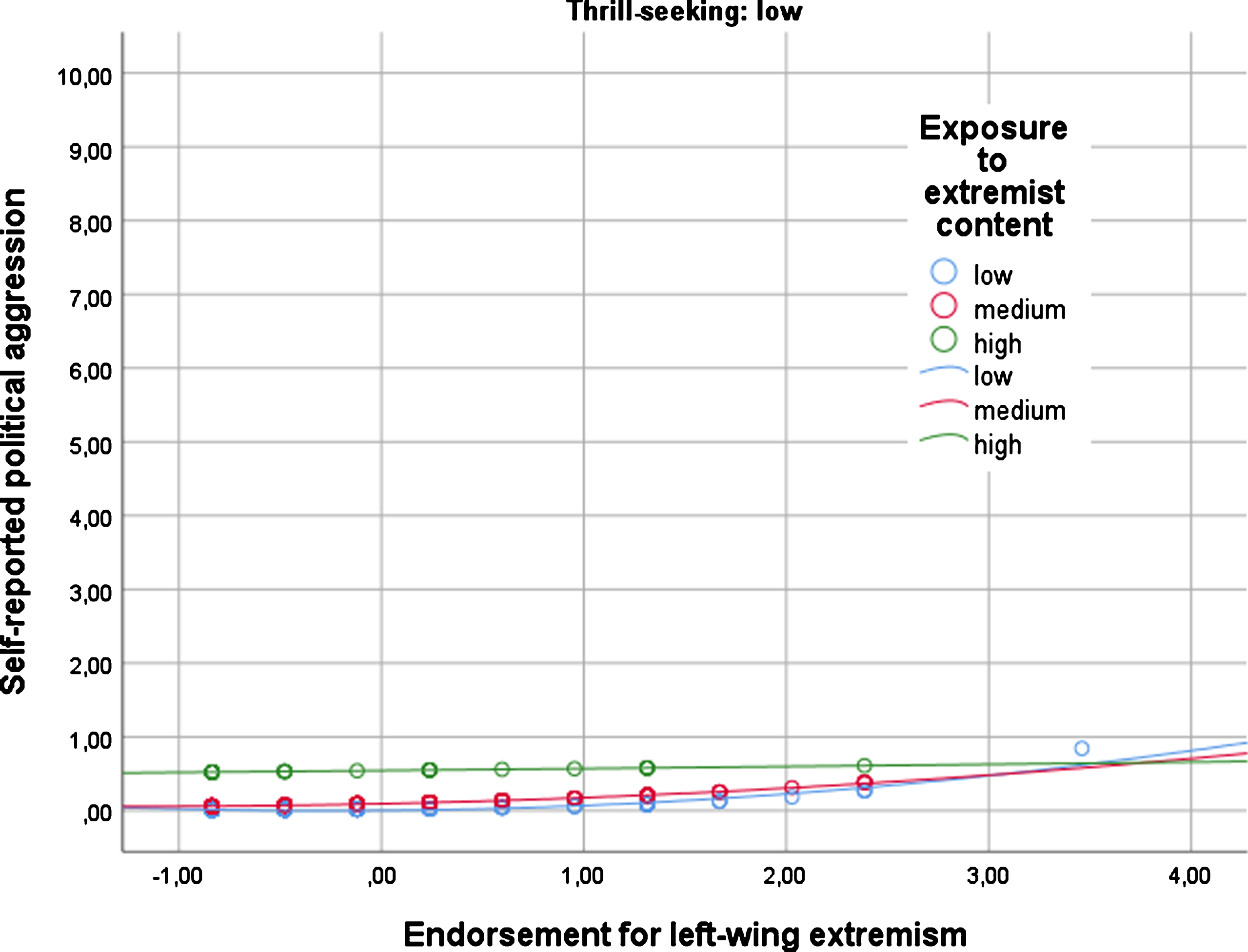
Political aggression, endorsement for left-wing extremism and exposure in low thrill-seeking respondents.
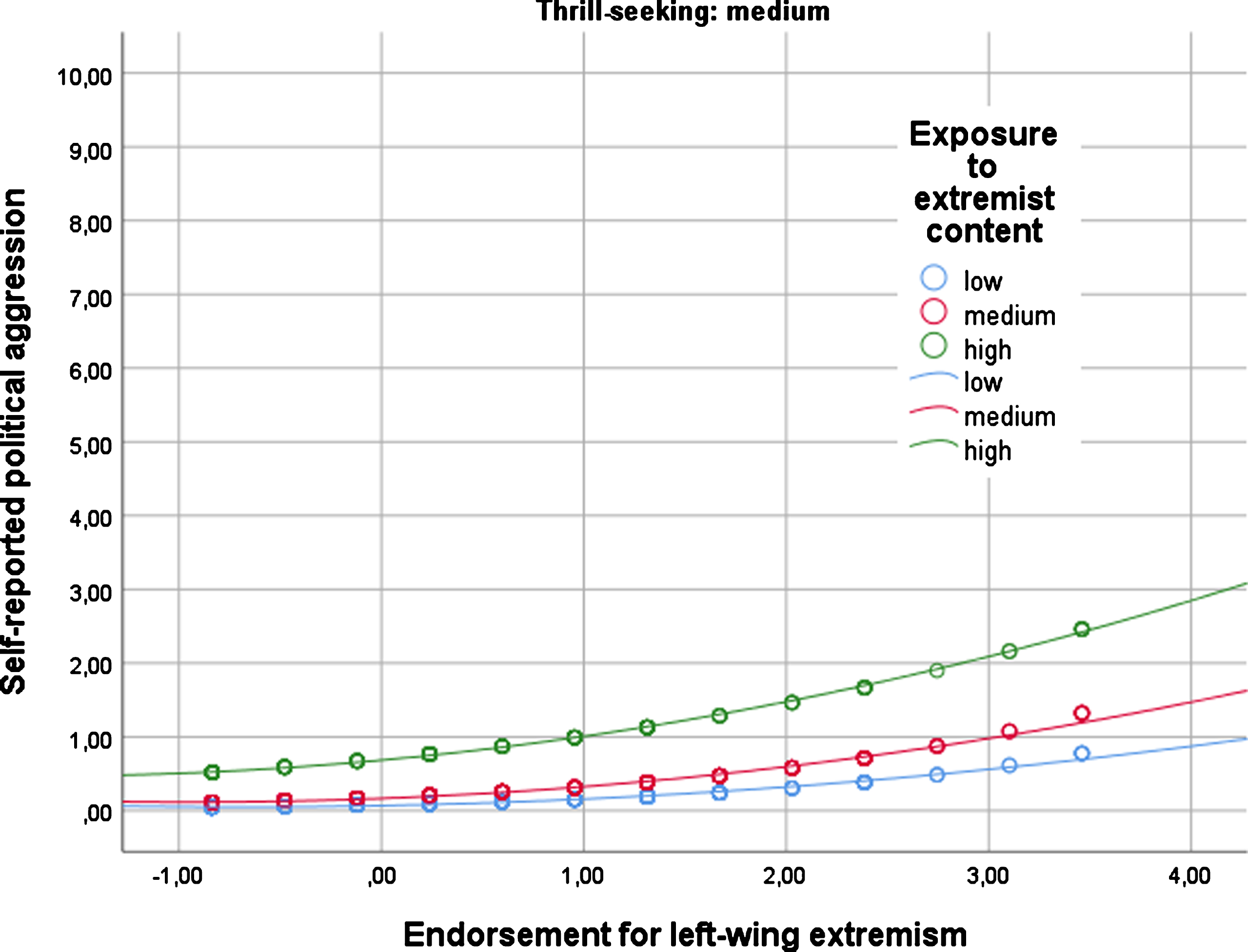
Political aggression, endorsement for left-wing extremism and exposure in medium thrill-seeking respondents.

Political aggression, endorsement for left-wing extremism and exposure in high thrill-seeking respondents.
Discussion
The major object of this study was to apply the General Aggression Model (GAM), a contemporary well-integrated theory which is highly informative to guide empirical research onto political aggression. One of the reasons why the model is attractive for scholars conducting research into processes of radicalization and political aggression is that it focuses on the interaction between personal characteristics and states like endorsement for extremism, thrill-seeking and situational characteristics such as exposure to extremist content. Human behavior is always utterly complex and the outcome of complex interplays between individual and circumstantial (i.e. situational) factors, influencing the perception and appraisal of behavioral alternatives and subsequent choices in a thoughtful (deliberate) or impulsive (hot) state. We assessed the overall stability of the three-way interaction effect between endorsement for extremism and exposure to extremist content, by creating extremism-specific measures of endorsement for extremism. We addressed to what extent exposure to extremist content amplified the relationship between endorsement and political aggression and to what extent one’s level of thrill-seeking further moderated this interplay. This study adds up to the growing body of literature demonstrating a statistical interaction between endorsement for extremism and online exposure to extremism. The relation between exposure to extremist content and self-reported aggression remains however controversial, not only from theoretical and empirical perspectives but also from a policy perspective. We are limited to repeat this discussion here but we can refer the interested reader to the lively debates regarding the effect(s) of exposure to violent video games. In short, such studies have shown mixed results, and those studies that do show significant effects of exposure reveal small but nevertheless significant effects. This study shares a similarity with the more conventional studies of exposure to criminogenic “violent” contexts. We studied the effect of exposure to extremism, albeit from a completely different angle: exposure to extremist content (online). Our results contribute to the literature because it is one of the first to demonstrate the statistical relationships between measures of exposure to extremism and self-reported political aggression, while utilizing specific measures of endorsement for extremism.
Limitations
While these results are interesting and stable across measures of endorsement for extremism, we should interpret the results of these findings with care. There are sufficient limitations to our analyses that warrant a careful interpretation. First of all, these data are cross-sectional in nature, which means that a causal interpretation is not warranted. Relationships between attitudes and behavior are not necessarily unidirectional and although we have shown some rather stable interactions, we have to take into account that the cross-sectional nature of the data is a weak design, especially from a developmental perspective. Besides, R-square is moderate. This is due to the fact that a limited number of variables are taken into account, but of course the impact of measurement error cannot be excluded.
Outlook: A Developmental Perspective
Key questions from a developmental perspective that remain under-researched and deserve further inquiry are 1) how do individuals acquire their endorsement for extremism? How stable are these attitudes through the life course? How stable are these interactive patterns across different phases of development? We have studied a large sample of young adults, but the life-course does not stop at early adulthood. Sometimes, individuals radicalize much later in life, sometimes with a history of deviance, but sometimes without any developmental history of externalizing behavior. If we really want to take developmental tests of processes of radicalization (and disengagement) seriously, panel data can be of high value. Young adolescents and even children have been drawn to travel to conflict areas because of a sudden and fast process of radicalization, thus, we need to increase our understanding of the differential susceptibility of several age groups to different kinds of exposure. The power of radical messages online and offline and the powerful discourses brought about by recruiters should neither be overestimated or underestimated. Small effect sizes in studies often lead to underestimating, but we argue that overall small effect sizes are related to differential susceptibility. Different age groups represent different phases in the life-course and thrill-seeking is especially higher in adolescents than in older populations, suggesting one plausible explanation for the vulnerability of adolescents. In fact, Moffitt (1993) was one of the first to introduce this idea in the field of criminology. What makes adults suddenly develop attitudes favorable to extremism? And how is the process of disengagement, i.e. the process of desistance brought about? Developmental psychology is an interdisciplinary field that shares some characteristics with life-course developmental criminology, which has a long tradition of studying the processes of entry and exit in troublesome youth groups (“gangs”) (e.g. Thornberry et al., 2003). In the field of criminology, we are only aware of one longitudinal study, assessing the conditional effects of strains (Nivette, Eisner, & Ribeaud, 2017).
Future studies should try to improve sound integrative theories that study all mechanisms that are involved in the explanation of political aggression, but also the processes that lead to the development of endorsement for extremism, and exposure to extremist content, which is probably caused by a combination of social influence (peer influence of members of extremist groups), social selection (i.e. urban segregation, which causes recruiters to target some areas more than others), and self-selection (i.e. processes of perception and choice, caused by a sense of belonging or similar human motives). In other words, it is of major importance for both theory and policy to disentangle the so-called “causes of the causes” of political aggression to further increase our understanding of how grievances and weak social integration gives rise to political powerlessness, alienation from wider society and the development of endorsements for nationalist-separatist, religious or left-wing extremism. While these attitudes and beliefs are different, the interactive processes that produce political aggression as an outcome seem to be highly similar. There is an urgent need to develop critical test of propositions derived from truly interdisciplinary integrative theories that incorporate elements of cognitive neurosciences, cognitive psychology (beliefs), sociology and geography (exposure to settings). Some disciplines will be more useful to explain some of the causes of the causes of violent extremism, while other will be more useful in explaining direct and situational causes of violent extremism. Our personal experience is that such theoretical integration will require scholars to learn each other’s language, but once this barrier has been overcome, challenging new research strategies can be adopted.
Policy Implications for the Prevention of Political Aggression
What do these results suggest with regard to the prevention of online radicalization into extremism? This study suggests that exposure to extremist content strongly triggers the effect of endorsement for extremism for individuals, while the magnitude of the effect of exposure to extremist content on self-reported political violence is further amplified by levels of thrill-seeking. This means that it’s all about complex interactions between individual and circumstantial characteristics. Websites and social media visited by adolescents, differ in nature and persuasiveness of extremist content, their content is sometimes very provocative, tempting at the same time, triggering human emotions, attitudes and norms (Ramsay, 2013; Roversi, 2008). Some virtual settings give very easily access to extremist content and pose a real danger for further recruitment into extremist groups or for preparing attacks in the form of “home-grown violent radicalization”. Although extremists might be present on mainstream virtual settings (such as chat rooms and web fora for a general audience), trying to spread hate and polarization, such mainstream settings are not extremist in nature. Closing down these general fora has no meaning at all, but polarizing extremist content should be removed to avoid further escalation. Governments should support the removal of extremist content on regular social media and regular fora.
Adolescents in an early stage of radicalization might also visit websites or YouTube channels with explicitly extreme content or join extremist groups on social media in search for black and white answers to complex problems related to social identity, (perceived) injustice, and so on. Closing down hard-core extremist websites is necessary as governments need to give a clear signal that it is intolerant towards the intolerant. However, such measures will never be effective when they stand alone. Situational prevention of political aggression, violence or “violent extremism”, today’s buzz-word in policy circles, should always be considered in close relation to social prevention. The main question remains why individuals become who they are, i.e. why they develop a justification for the use of violence to obtain political goals, why they become alienated from society and become increasingly susceptible to extremist content, provided online and offline by clever recruiters, who target the most vulnerable individuals.
Second, there has been a lot of talk about the use of counter narratives for the prevention of online radicalization (see also Leuprecht, Hataley, Moskalenko, & McCauley, 2010a, 2010b). We submit that the role of counter narratives should not be overestimated. Some scholars have argued that the use of the concept counter-narratives is not useful and that alternative narratives are a better way of dealing with the problem offer: The focus should move from counter-narratives to alternative narratives which provide strong and positive arguments (Weilnböck, 2013). The effect of such measures depends on a number of individual characteristics. From the point of view of GAM, a theoretical framework that explicitly takes person-environment interactions into account, it can be explained why. Individuals with low levels of thrill-seeking may dispose of a defence mechanism against the effect of endorsement for extremist ideologies, exposure to extremist content and their interaction on political aggression. Individuals who have very low scores on thrill-seeking may be easier convinced by providing information on unintended consequences of making wrong choices, i.e. through pointing at the perceived and possible costs and benefits of political aggression. Individuals who score high on thrill-seeking experience and amplification effect: In this group, the effect of endorsement of extremism is triggered by levels of exposure. Thrill-seeking pulls some individuals towards extremist groups.
Thus, especially these highly susceptible individuals may be more difficult to convince to abide by the law by such (online or offline) rational narratives alone. Online narratives will have few impact if the real life circumstantial characteristics are not addressed simultaneously. The prevention of the endorsement of extremism, be it on the left-wing, right-wing or religious wing, should be additionally achieved by developing interventions that reorient moral endorsement (e.g. through education and cognitive behavioral therapy) and cognitive nurturing (e.g. learning to overcome proneness to thrill-seeking), just like in developmental crimeprevention. In this study we have not addressed the problem of the causes of the causes, i.e. why and how (events and processes) some individuals develop their grievances, but several empirical studies have pointed to the role of grievances, group processes and alienation (e.g. Doosje et al., 2013).
To demonstrate the power of integrative or holistic prevention (e.g. see Bjørgo, 2013, 2016), we draw upon the Fig. 2, which merges GAM with ideas developed by Wikström and Treiber (2016), and argues that the prevention of radicalization may benefit taking dual processes of decision-making into account (e.g. Tversky & Kahneman, 1992; Loewenstein, 1996), which are influenced by individual-environment interactions and require a different approach. Individuals who have developed a certain level of endorsement for some kind of extremism, may decide to engage in political aggression either in a rather “deliberative” way (i.e. using system 2) or habitually, using system 1, when they are strongly oriented towards thrill-seeking. Situational prevention is best suited for individuals who would choose to engage in political aggression and consists of target hardening, removing excuses, etc., all kinds of interventions in all kinds of interventions in online and offline circumstances that may “deter” potential actors.
Some individuals may engage in aggression habitually, because it has provided previous rewards as a solution to solve problems encountered in life, or because they have been raised in ecological contexts of disadvantage. Here, social prevention is important and this may be done by removing at risk individuals from certain ecological contexts, in which they are repeatedly provoked or tempted. It is important that the prevention of political aggression has a profound knowledge-base and takes an analytical approach to avoid that problems of the day are solved with “measures of the day” (Wikström & Treiber, 2016). We hope that this study, which clearly demonstrates the complexity of political aggression, may guide interventions by analytically looking at the problem of political aggression.
Footnotes
Bio Sketches
Lieven J.R. Pauwels is professor of criminology at the Department of Criminology, Criminal Law and Social Law at Ghent University, Belgium. He is Director of the Institute of International Research on Criminal Policy (IRCP) since 2015. He is interested in a developmental ecological approach to juvenile delinquency, violent extremism and knowledge-based (crime) prevention.
Wim Hardyns is professor of criminology at the Department of Criminology, Criminal Law and Social Law at Ghent University, Belgium. He is member of the Institute of International Research on Criminal Policy (IRCP) since 2015. His current interests are crime mapping and statistics, environmental criminology, crime prevention, new security technologies, big data, radicalization andterrorism.
Acknowledgments
We would like to thank Belgian Science Policy (BSP) and the Belgian Ministry of the Interior (IBZ), who co-financed this research project to get insight in the relationship between exposure to extremist content and politically/religiously motivated aggression. We have complied with Helsinki Ethical Declaration in the treatment of our data.
Appendix
Correlation Matrix Between Theoretical Constructs
| (1) | (2) | (3) | (4) | (5) | (6) | (7) | |
|---|---|---|---|---|---|---|---|
| Total frequency political aggression towards persons (1) | 1 | 0.196** | 0.222** | 0.205** | 0.245** | 0.174** | 0.166** |
| Endorsement nationalist extremism (2) | 0.196** | 1 | 0.673** | 0.628** | 0.152** | 0.126** | 0.242** |
| Endorsement religious extremism (3) | 0.222** | 0.673** | 1 | 0.675** | 0.132** | 0.101** | 0.247** |
| Endorsement left-wing extremism (4) | 0.205** | 0.628** | 0.675** | 1 | 0.156** | 0.132** | 0.238** |
| Active exposure to extremist content (5) | 0.245** | 0.152** | 0.132** | 0.156** | 1 | 0.533** | 0.125** |
| overall exposure extremist content (6) | 0.174** | 0.126** | 0.101** | 0.132** | 0.533** | 1 | 0.163** |
| Thrill-seeking (7) | 0.166** | 0.242** | 0.247** | 0.238** | 0.125** | 0.163** | 1 |
Notes.*** = p < 0.001 ** = p < 0.01 * = p < 0.05 (*) = p < 0.10. Listwise N = 4,284.
Leading contemporary criminologists argue that the study of causes of crime is hampered by the heterogeneity of definitions, and suggest as a solution to this problem that it is more worthwhile to try to explain why people break rules, stated in law, knowing the sanction is possible. The rule-breaking element is what all crimes have in common, according to some criminological research traditions (Wikström & Bouhana, 2017). Definitional problems have challenged criminology for a long time (Agnew, 2011).
In this contribution we do not pay attention in separate paragraphs to the problems of defining violent extremism and terrorism, as a myriad of definitions exist. Radicalization is a complex process of incrementally experienced commitment to extremist political or religious ideology. For an overview of definitions of radicalization processes we refer to Horgan (2005) and Koehler (2017). For an overview of the relationships between extremism and terrorism we refer to Schmid (2011).
The Belgian Ministry of the Interior gave us the assignment us to conduct the survey in Wallonia and Flanders. This study is therefore the first large-scale study of political aggression in Belgium. One of the methodological consequences is that multi-level modelling, which is common when studying nested samples, simply was not allowed. We did ask for the postal code area but there were too few respondents to seriously consider multi-level modelling. This is an important take-home message. When doing research on such sensitive topics, anonymity is of major concern. While the topic already was highly politically loaded in 2012, we wonder if we would still be able to obtain similar large sample sizes. The reader may wonder how it can be explained that we still found an Alpha value of 0.69, while the items refer to different political fora. Results from qualitative studies suggest that extremists actively discuss their strong political beliefs and hate-speech on fora that not necessarily reflect their own political beliefs. From that point of view it is not surprising that we found an alpha value of 0.69.