



Abstract
It is a human fundamental to desire to be valued, loved and respected – to be significant. Social exclusion induce significance loss which elicits a ‘quest for significance’ – the search for opportunities to re-gain significance. The present article establishes this relation in a laboratory experiment (N = 71, mean age = 28, SD = 10.42, 65% women, 35% men), showing that socially excluded individuals who are subsequently included by a radical group, adapt their attitudes in line with this group. We use a modified version of the well-known paradigm ‘Cyberball’ to elicit the quest for significance. The results show that when experiencing social exclusion, highly rejection sensitive individuals tend to adapt to the radical group’s opinions. The results are important, highlighting a mechanism in the radicalization process and the importance of taking social factors into account in this process.
Public and scholarly debates about radicalization and violent extremism are centred on two standard explanations: (1) ideological explanations, such as the pull of militant Jihadism, and (2) social explanations, such as the push of socio-economic deprivation. Although most scholars of radicalization would agree that both factors play important parts, these are rarely investigated as simultaneous processes. The primary contribution of the present research is to fill this gap by using an experimental design that allows for studying the impact of both social and ideological factors simultaneously.
In addition, we propose that the socio-economic explanation needs to be re-defined. Previous research has shown that many extremists come from stable middle-class backgrounds (Krueger & Malečková, 2003), which suggests that the explanatory value of social and economic exclusion or societal marginalization is limited. Rather, grounded in the insight that social belongingness is a central psychological motivator, we argue that experiences of rejection can help us understand radicalization processes. Importantly, we also add that if rejection is to explain radicalization, needs for belongingness should also be taken into account. This implies that following rejection, an individual may perceive joining a radical group as a way to re-establish belongingness and hence adapt to that group. Essentially, this means that inclusion by a radical group following the exclusion experience is a necessary condition for adaption to the radical group to occur.
Because radicalization partly is explained by social motives, such as belongingness needs, individual differences will also matter for who is likely to become radicalized. For instance, adolescents are more sensitive to peer pressure and are also more likely to experiment with their worldview as compared to adults (Arnett, 2000; Baumeister & Muraven, 1996; Brown, 1990; Kroger, 2004). Further, research has shown that age has important consequences for emotional regulation of social stimuli in that younger individuals show less success in emotional regulation to negative social stimuli, and that this effect was magnified by individual differences in rejection sensitivity (Silvers, McRae, Gabrieli, Gross, Remy & Ochsner, 2012). Hence, young people should be a particularly vulnerable group that is more strongly influenced by rejection.
Radicalization is commonly thought of as a process of gradual attitude shifts, where shifts in attitudes results in an increased inclination to engage in violent political action. It is important to note that radicalization may or may not result in extreme behaviour, and thus the presence of violent action is not a fundament of radicalization (McCauley & Moskalenko, 2008). In line with this, Kruglanski and colleagues (2014) argue that radicalization is a matter of degrees, where a low degree of radicalization may entail support for radical groups and violence, and a high degree is the actual act of committing violence. This also mirrors what McCauley and Moskalenko (2008) call the pyramid model, where the large bottom part of the pyramid consist of supporters of a radical cause and where increased engagement is found among fewer numbers higher up in the pyramid.
The Quest for Significance
Our theoretical point of departure lies within the works of Kruglanki and colleagues (Kruglanski & Webber, 2014; Kruglanski et al., 2014), where one central underlying motivational force within the individual is what they call the ‘quest for significance’. This is the fundamental human need to be someone – to be important, to matter, to earn other’s admiration and respect. Kruglanski and colleagues argue that this major, universal human motivation is variously labeled need for esteem, achievement, meaning, competence, control and so on (Kruglanski et al., 2014; cf. Deci & Ryan, 2000; Fiske, 2010; Frankl, 2000; Higgins, 2012; Maslow, 1943; White, 1959).
Such needs are particularly important to adolescents who are in the process of shaping their identity (Brown, 1990). Even though identity development is a lifelong process, it tends to peak between adolescence and adulthood. This is the time when the individual’s social role is at its most malleable state (Arnett, 2000; Baumeister & Muraven, 1996; Kroger, 2004). This indicates that adolescents should be particularly likely to seek ‘significance’. The quest for significance may be activated through significance loss, which could be different forms of individual-based or group-based humiliation, shame or dishonour (Kruglanski & Webber, 2014; Kruglanski et al., 2014). In line with this, it has been argued that social exclusion can induce significance loss and hence awakens the quest for significance (Kruglanski, Chen, Dechesne, Fishman, & Orehek, 2009; Kruglanski & Orehek, 2011; Williams, 2012).
Rejection threatens the individual’s self-view and damages fundamental human needs such as feeling in power, belongingness, self-esteem, and feelings of a meaningful existence (Williams, 2007; Williams & Zadro, 2005). For instance, after a manipulation of ostracism, participants report strong feelings of anger, frustration, sadness, lowered self-esteem and feelings of control, and a meaningful existence (Williams & Zadro, 2005). Such needs fall within the concept of significance as presented by Kruglanski and colleagues (Kruglanski et al., 2009). In order to re-gain feelings of control, belongingness, and self-esteem, rejected individuals may become increasingly attentive to opportunities for social inclusion, and as indicated by previous studies, show increased conformity and even obedience to a new and including group. It has been argued that the motivation is to either gain a sense of self-control which has been damaged by the experience of exclusion, or to gain social approval (Bäck, Bäck, & Garcia-Albacete, 2013; Bäck, Bäck, & Knapton, 2015; Carter-Sowell, Chen, & Williams, 2008; Knapton, Bäck, & Bäck, 2015; Riva, Williams, Torstrick, & Montali, 2014; Williams, Cheung, & Choi, 2000). In terms of the theoretical framework of significance loss, this is what happens, when an individual searches for opportunities for significance gain. Sympathizing, or even engaging with extremist groups and goals present an extraordinary opportunity for significance gain and admiration from the own group (Kruglanski et al., 2014). Hence, from a social psychological perspective, entering an extremist group may in certain respects be a very rewarding choice.
Upon experiencing significance loss, the focal goal of the individual is to re-gain a sense of control and self-value. However, the ideological context, in which an individual is situated, defines the means to achieve this by determining the acceptable and appropriate means. (Kruglanski & Webber, 2014). Social ties, such as those constituted by the surrounding context, are more important to adolescents’ mobilisation than adults (Dostie-Goulet, 2009; Loader, Vromen, & Xenos, 2014). Peers become increasingly important to the adolescent trying to distance themselves from the family. Peers become important as reference groups or identity prototypes (Baumeister & Muraven, 1996; Brown, 1990). During adolescence, people are more sensitive to normative influence and tend to conform to groups they are motivated to be a part of, and adopt those values as their own (Brown, 1990).
Furthermore, previous research indicates that extremist ideology presents radical political action as a way to achieve significance independently of what the content of the ideology is, whether left, right, or religious (Kruglanski et al., 2014). Adaption to a radical ideology may therefore alleviate the pain of significance loss as induced by rejection.
A key boundary condition in this argument is that individuals have the possibility to be included in a radical group and to adapt to that group. For instance, Maner, DeWall, Baumeister, and Schaller (2007) argue that individuals will only conform to a new group, if it represents a possibility for inclusion after having experienced exclusion. We here take this one step further and argue that, when being excluded by some and included by another, the effects of inclusion may be particularly strong for individuals who are highly sensitive to rejection, as this offers an easy way out of the exclusion experience.
The Role of Rejection Sensitivity
Even though there is a vast literature establishing the reflexive effects of rejection as painful (Williams, 2007), there are individual differences in responses to social exclusion (Downey & Feldman, 1996; Williams, 2007).
Rejection sensitivity is a personality feature that explains why some people are more prone than others to conform to a new group following rejection. Rejection sensitivity has been defined as a disposition to anxiously expect, readily perceive, and intensely react to rejection (Berenson et al., 2009; Downey, Khouri, & Feldman, 1997). This explains why some individuals are more vulnerable to rejection than others (Downey & Feldman, 1996). Individuals, who are sensitive to rejection, have usually experienced rejection or other forms of exclusion from closeothers previously, and have learnt to expect rejection in different situations, motivating them to protect themselves against future rejection (Downey, Freitas, Michaelis, & Khouri, 1998). Moreover, previous victimization has been shown to strengthen the impact of a rejection experience (Ruggieri, Bendixen, Gabriel, & Alsaker, 2013). Given that one way to avoid rejection is by conforming to others, it is plausible that individuals who are highly rejection sensitive also will be more likely to conform (Romero-Canyas et al., 2010).
The Present Study
Against the backdrop that individuals conform to a new group that represents a realistic source of inclusion following rejection (Maner et al., 2007), the pre-existing match between the individual’s ideological position and that of the radical group constitutes an important link. For instance, we would not expect a left-leaning individual to become a neo-Nazi, simply because they experience rejection and are approached by a neo-Nazi group. It is considerably more plausible that an individual leaning to the political left may become part of the far-left movement, should the contextual and individual factors support this. For instance, an individual that is leaning to the left and that experiences rejection from other people in society, but who is subsequently approached by the radical left, should be quite open to the idea of aligning themselves with this group.
This essentially means that there is an interplay between individual, ideological, and social factors, which rarely has been tested in previous experimental research. Hence, we hypothesize that individuals, who are excluded and subsequently included by a radical group matching their pre-existing ideological stance, will increasingly adapt to this group as their level of rejection sensitivity increases.
In an experimental study we manipulate rejection using the well-established Cyberball paradigm (Williams, 2007). This paradigm has also been proposed as promising when studying ostracism in developmental science more generally (Scheithauer, Alsaker, Wölfer, & Ruggieri, 2013). Participants are either included, or excluded and subsequently included by a radical group member. They are then invited to participate in a survey on behalf of this radical group, where they are introduced to the goal of the group. Subsequently we can assess attitudinal adaption to the radical group.
Methods
The Cyberball Paradigm
To evaluate the effect of rejection and subsequent inclusion, we used an adapted version of the Cyberball paradigm (Williams et al., 2000), version 4.0. In its original form, a participant is asked to play a ball-tossing game supposedly over the internet with other participants. The game is presented as a visualization task and participants are asked to imagine that they are playing the game in real life. This manipulation has been extensively used and validated to induce feelings of being socially excluded and shown to elicit related emotions and cognitions (Hartgerink, van Beest, Wicherts, & Williams, 2015; Williams, 2007). Once connected, the participant can see avatars representing the other players and the players throw a ball to each other for a few minutes. The throwing sequence of the other players is pre-programmed. The basic set-up consists of two conditions: exclusion and inclusion. In the inclusion condition, all players throw the ball to each other in equal amounts. In the exclusion condition, after a few rounds, the participant does not receive the ball anymore.
Because conformity following exclusion is limited to when an inclusion opportunity presents itself (Maner et al., 2007), we manipulated the programming in the exclusion condition, such that after having been completely ignored by the other players for a few rounds the radical player starts to include the participant. The participant is still ignored by the other players throughout the game. In the inclusion condition participants received the ball equally from all players. This adapted Cyberball paradigm was pilot tested indicating that participants experienced similar feelings of rejection as in previous Cyberball studies (Hartgerink et al., 2015).
Design and Participants
Design
The design consisted of two conditions; inclusion (n = 36) or exclusion with following inclusion by a radical group (n = 35). The including player was a representative for a radical left-wing oriented action group. Participants were randomly assigned a condition. Prior to playing the Cyberball game, rejection sensitivity was measured.
Participants
71 students at Gothenburg University in Sweden participated in exchange for a lottery ticket. Mean age was 28 (SD = 10.42, range 17– 62), and there were 65% women and 35% men.
The study employed a left-leaning student sample. This was due to two reasons. First, as we expected that younger people should be more influenced by social factors such as rejection, and more malleable in their world-views, we wanted a younger sample. Second, we expected that this sample would be fairly left-leaning allowing us to hold ideological position fairly constant. The ideological baseline of the student sample was assessed in a pilot study where participants were presented with the (fictive) description of a left-radical group (the same used in the main experiment) and a right radical group. Overall, the results of the pilot study indicated that the students were more in favour of the left-wing group and its representative as compared to the right-wing group 1 . Importantly, this pilot study consisted of students drawn from the same population as the participants in the main study. Hence, we are fairly certain that the pilot sample is representative of the main study sample.
Procedure
Participants were recruited in groups and told that they were to play a game online with other participants in the study. They were told that it was a large-scale study conducted at several universities across the country and that players were randomly selected. They were each asked to provide their name (or a nickname) and a group affiliation that the experimenter supposedly entered into a main computer. They were told that they would not see their own name, but would see what the others had entered. They were then allocated a computer.The lab consisted of eight computers all divided by high screens on each side. First, a pre-measure was introduced, using a questionnaire on paper that gauged participants’ level of rejection sensitivity and various demographic features. The experimenter went around to set up the Cyberball game and when the participants had finished the paper questionnaire they pressed a start-button to start the game.
All of the players presented to the participant had names typical of the Swedish context and were presented with a group that the player had supposedly chosen. The players in all conditions were: Kim Backlund, [Student GU] (abbreviation for Gothenburg University), Niklas Liljeqvist, [Economy program], and Jonas Carlsson, [Network Direct Action]. Hence, the participant was playing with three other players. The set-up was completely pre-programmed and all participants were exposed to the same set of other players.
To increase credibility, participants had been informed prior to the study that there was one participant who wanted to send out a questionnaire after the game. According to the experiment leader the researchers did not know what it was about and this was not part of the study in any way. This functioned to prepare the participants that a questionnaire from one of the players was coming and to reassure them it was not part of the study. Hence, in the beginning of the Cyberball game a chat box appeared in which a message from the activist player was presented: “Jonas Carlsson [Network Direct Action]: Hello! Please answer my questionnaire after the game, thanks!” At this, the participant could reply with a message, but if they did, they did not get any replies.
In the inclusion condition, all players threw the ball in equal amounts to the participant and amongst each other. The exclusion condition was programmed as follows: In the first round the player was included, and then followed six rounds of exclusion from all players. This was to ensure that the participant experienced feelings of exclusion. After this, the radical player (Jonas Carlsson, Network Direct Action) started throwing the ball only to the participant and every time he received the ball. The other two players were programmed to throw the ball only to each other for four rounds. After this, they were programmed to randomly throw the ball to the radical player or the other student player, but not the participant. This set-up was to make sure the participant felt excluded and subsequently included by the radical player. Hence, the participant was excluded from their ingroup of other students and included by the activist player. This set-up was created to induce feelings of rejection and following inclusion. The number of throws and tossing-scheme was completely pre-programmed. Importantly, it was programmed such that after the period of exclusion, the radical player always threw the ball to the participant. Depending, on who the participant then chose to throw the ball to, they either received the ball immediately again (if they threw to the radical player), or after one or two throws (if they threw to another player).
This adapted Cyberball paradigm was pilot tested indicating that participants experienced similar feelings of exclusion as in previous Cyberball studies (Hartgerink et al., 2015) 2 .
After the game, a link from the radical player appeared. Upon clicking on the link, the participant was provided with a description of the group, their cause and their ideological stance, followed by a questionnaire supposedly from the group. The description of the group heavily emphasized a radical left-wing oriented ideology focusing on issues of immigration and racism. The material was created to mimic how Swedish autonomous left organizations present themselves. This includes stressing direct action as a political method, to view violent method as a sometimes justified instrument, and to highlight the fight against sexism, racism, and capitalism as interrelated (see Katsiaficas, 2006). As has been stressed by previous research (see Fominaya, 2009), furthermore, these features are in the information material combined with scepticism against the institutions of parliamentary democracy. Hence, the material was created to present a highly ideological group that fight for their cause using both traditional and non-traditional methods when needed. The group name was fictive but real left-wing groups found online inspired the text. Specifically, the text focused on structurally disadvantaged groups and emphasized immigrants and the problem with increased racism, which has been a prominent aspect of autonomous left-wing groups during the last few years.
After the information about the fictive group, a number of questions measuring attitudes towards immigration were asked the participant. The description ended with the group stating that they were looking for new members and that they needed to know what people thought of the group, and explained that his is why they asked the participant to answer some questions about their immigration attitudes. After this, the participants were debriefed, thanked and reimbursed.
Measures
In the pre-questionnaire, which was distributed prior to the Cyberball game, we assessed age, gender (free response), political self-placement, and rejection sensitivity.
Rejection sensitivity was measured using the short version of the Rejection Sensitivity Scale (Downey & Feldman, 1996). Participants are asked to imagine themselves in different situations describing things that people sometimes ask of others, for example “You ask your parents or another family member for a loan to help you through a difficult financial time”. For each situation, participants rate a) how concerned or anxious they would be over the others’ reactions, for example “How concerned or anxious would you be over whether or not your family would want to help you” (1 = very unconcerned to 6 = very concerned), and b) to what extent they expect the others to help them in this situation, for example “I would expect that they would agree to help as much as they can” (1 = very unlikely to 6 = very likely). Eight similar scenarios were presented. To calculate a score of rejection sensitivity for each situation, the level of rejection concern (response to question a) is multiplied by the reverse of the level of expectancy (response to question b). An index of overall rejection sensitivity is then calculated by taking the mean of all scores for each situation. Cronbach’s alpha was 0.66.
Political self-placement was assessed by asking participants to rate on a 10-point scale anchored at 1 = Clearly to the left to 10 = Clearly to the right.
Following the Cyberball game, a web questionnaire, ostensibly from the radical player, was distributed. This questionnaire assessed attitudes that were also supported in the presentation by the Network Direct Action. Specifically, this questionnaire assessed our main dependent variable, that is: attitudes to immigration/immigrants. To measure such attitudes, we used an adapted version of the Modern Racism Scale (Akrami, Ekehammar & Araya, 2000). Items were re-phrased so that they indicated more positive attitudes towards immigrants/immigration. This was because the questionnaire ostensibly came from the left-wing radical group, which heavily emphasized a positive view of immigration in a humanitarian perspective. Example items are “Discrimination against immigrants is a big problem in Sweden”, and “There have not been enough efforts done for unemployed immigrants” 3 . Answers ranged on a 5 point scale from 1 = Do not agree at all to 5 = Completely agree. The scale consisted of 10 items. The answers were averaged to form an index of positive attitudes to immigration/immigrants, Cronbach’s alpha = 0.83, indicating good internal consistency.
Results
The study was designed to measure conformity to the radical group when the ideological distance is relatively close to the participant. The mean for political self-placement was 4.20 (SD = 2.32), which is significantly different from 5 (mid-scale), t(70) = – 2.86, p = 0.006.
To investigate our hypothesis that individuals who are excluded but then subsequently included by a radical left-wing group will adapt their attitudes to those of the group as their level of rejection sensitivity increase, we performed a hierarchical regression analysis. In this analysis, we gauge the effect of the manipulation of rejection followed by inclusion in participants’ attitudes towards the views held by the fictive group Network Direct Action, and we gauge the conditional effect of rejection and rejection sensitivity to test our hypothesis.
In Table 1 the results of the regression are presented. The first model is without controlling for age and gender. In this model we first entered experimental condition and rejection sensitivity in Step 1, and their interaction in Step 2. The second model shows the regression controlling for age and gender. We entered age and gender in step 1 (control variables). In step 2 we entered rejection sensitivity and experimental condition, and in step 3 their interaction.
Hierarchical Regression Analyses Predicting Attitudes to Immigration. First Model Without Controlling for Age and Gender
Exclusion condition is coded as 0 = inclusion, and 1 = exclusion.
The interaction in Step 3, shown in Table 1, was significant, in both models. The interaction is plotted in Fig. 1. For individuals excluded by the other students, but included by the left-wing radical player there was a positive relation between rejection sensitivity and positive attitudes to the views held by the Network Direct Action, such that the more rejection sensitive an individual is, the more their attitudes will conform to Network Direct Action 4 . A simple slope analysis revealed that the slope was significant, B = 0.07, SE = 0.03, t = 2.09, p = 0.04. The slope for the included participants was not significant, B = – 0.05, SE = 0.05, t = – 1.10, p = 0.28. Hence, the results are in line with the hypothesis that rejected individuals who are later included by a radical group that is not too ideologically far away, will adapt their attitudes to the group’s attitudes as their level of rejection sensitivity increase. In Fig. 2, we show a 90% confidence interval for different levels of rejection sensitivity, plotting the marginal effect of the condition. As can be seen in Fig. 2, for highly rejection sensitive individuals (values of 11 and above on the RS scale), there is a positive and significant effect of condition.
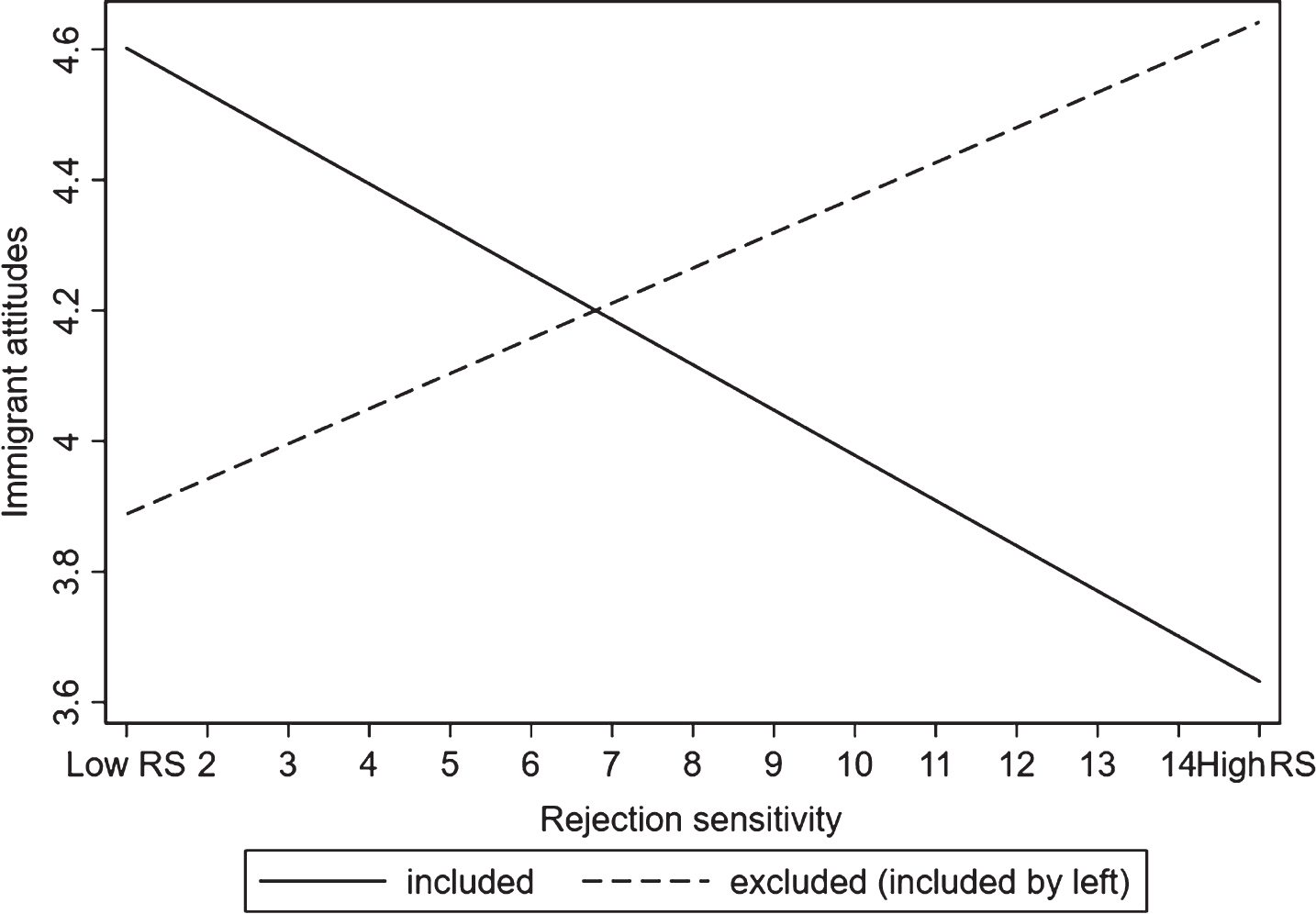
Interaction between rejection sensitivity and exclusion on immigrant attitudes. Note: Higher values on the Y-axis indicate more positive attitudes towards immigration.
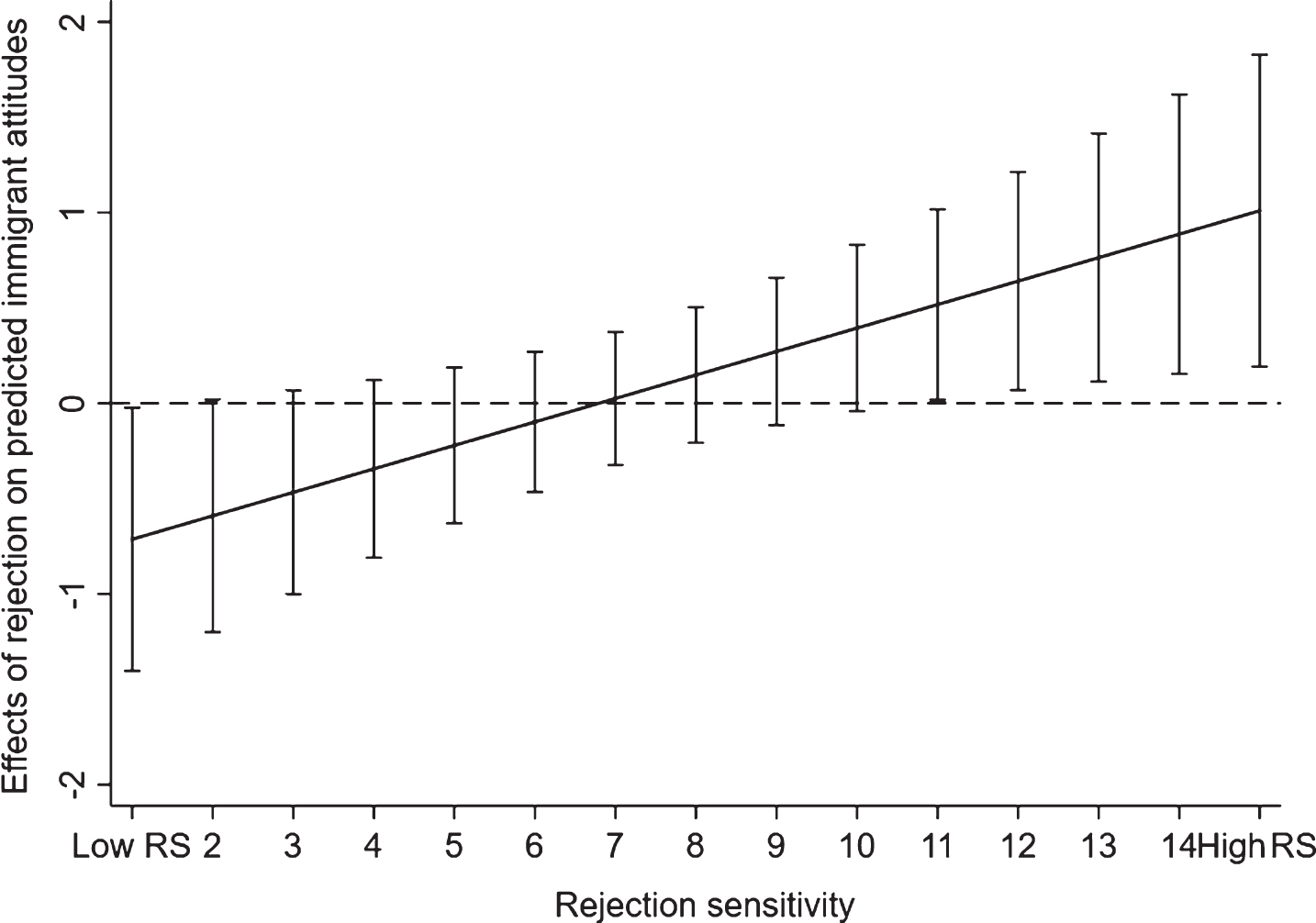
Marginal effects plot of the effect of rejection on immigrant attitudes for different levels of rejection sensitivity, 90% confidence intervals.
Discussion
The present study showed that when individuals are rejected and subsequently included by a radical group, they tend to adapt their attitudes to the new group as their level of sensitivity to rejection increases. This experimental situation mimics the processes involved in the ‘quest for significance’ (Kruglanski & Webber, 2014; Kruglanski et al., 2009; Kruglanski & Orehek, 2009), where an individual’s sense of worth or meaningfulness is threatened leading to a quest to restore worth or meaning. We propose that experiences of exclusion and subsequent inclusion matter and should be taken into account when seeking to explain attitudinal adaption to a radical group’s ideology. However, we also suggest that individual and other contextual factors matter. This paper has focused specifically on attitudinal shifts in line with a radical group. Since social exclusion has been shown to increase affiliation seeking due to belongingness needs (Knapton, Bäck, & Bäck, 2015), radical groups could benefit from this and recruit marginalized individuals. This is corroborated by interviews and accounts of how a sense of belonging and an identity, lead individuals to join both Islamic extremist and neo-Nazi groups as well as Al Qaida (Williams, 2007). Identifying and categorizing with highly cohesive and radical groups that provide clear directions for action and thought may also function to reduce feelings of uncertainty that may arise due to social exclusion (Hales, 2014; Hogg, Kruglanski, & van den Bos, 2013; Hogg, Sherman, Dierselhuis, Maitner, & Moffitt, 2007). This should be particularly prevalent among adolescents due to the increased uncertainty in this age that makes many people explore and ‘try on’ different identities and worldviews (Arnett, 2000; Baumeister & Muraven, 1996).
We here argue that rejection should be conceived of as significance loss as defined by Kruglanski and colleagues (Kruglanski & Webber, 2014; Kruglanski et al., 2014; Kruglanski et al., 2009; Kruglanski & Orehek, 2011; Williams, 2012). Rejection should awaken the ‘quest for significance’ and aligning with radical ideas and groups may provide one way to achieve significance. We suggest that this process is contingent upon three factors; the experience of rejection (significance loss), the possibility for inclusion (possibility for significance gain), and the individual’s own level of rejection sensitivity.
We have shown that rejected individuals react differently to invitations from a radical group, depending on their own level of rejection sensitivity. Highly rejection sensitive individuals conform to the attitudes of the radical group to a larger extent than less rejection sensitive individuals. This is in line with previous research on rejection and conformity in relation to rejection sensitivity (Bäck et al., 2015).
Attitude Shifts and Radicalization
In the present paper we focused on the adoption of beliefs and attitudes with regards to a radical group. Attitude shifts are not radicalization per se, but could be perceived of as igniting a radicalization process (although it does not have to lead any further). Nonetheless, viewing radicalization as a process facilitates the study of the mechanisms involved when an individual moves in a “non-normative” direction.
Radicalization is commonly thought of as a process of gradual attitude shifts resulting in an increased inclination to engage in violent political action. It is important to note that radicalization may or may not result in extreme behaviour, and thus the presence of violent action is not a fundament of radicalization (McCauley & Moskalenko, 2008). That being said, the presence of violent action being a key distinguishing factor of radicalization is still debated. Regardless of whether one sees actual violence as a definitional feature of ‘radicalization’ or not, there is no question that attitudinal shifts are part of this process.
Rejection as Related to Radicalization
The idea that individual radicalization is related to experiences of exclusion has been put forth before, in research as well as in public debates about violent extremism. However, our claim is that individuals are radicalized, not due to socio-economic factors per se, but by the individual experience of seeing one’s group belongingness being threatened and thus seeking new group affiliations. This could also be connected to the uncertainty-identity model (Hogg, 2000;2007; 2012), since such threats to the self or the groups to which you belong should lead to uncertainty about the self. By identifying and categorizing with a group that provides clear standards for how to think and act, such uncertainty may be reduced (Hogg & Adelman, 2013). Thus, the fact that many radicalized jihadists of the west have a middle-class background is not as surprising, since it is the sense of being rejected (which can occur in any social class), of having one’s social identity challenged, that can initiate a radicalization process. Or in Kruglanski’s terms, this is the loss of significance, awakening the quest for significance (Kruglanski & Webber, 2014; Kruglanski et al., 2009; Kruglanski & Orehek, 2009).
Currently, academic and policy discussions about radicalization centre on the influence of exclusion, often understood in socio-economic terms, and ideological convictions. Our research approach and results can serve as a ground for moving this discussion further. First, focusing on individual experiences of social exclusion rather than socio-economic definitions of societal exclusion or marginalization, means that we move away from a narrow focus on strictly societal factors. Although experiences of exclusion often is a result of unfavourable socio-economic factors, they are not synonymous; rejection from a social psychological perspective can be grounded in experiences in the family, in one’s upbringing, of experiences in one’s school, and so on. Thus, rather than a sociological conception of exclusion, our design starts from the psychology of the individual, which means that being excluded is as likely to lead to radicalization as living inpoverty.
This might for example explain the oft-advanced critique of a narrow focus on social exclusion, namely that many jihadists seems to be second-generation immigrants of middle-class background. From our perspective, it is not only income or employment status that matters, but whether people are having a sense of rejection stemming from any source. For example, research has proposed that second-generation immigrants are alienated as they do not feel part of their country or of the place that their parents left, leaving them in an identity-limbo and loss of sense of belonging. Thus, the experience of exclusion could be an interpersonal one, but social exclusion could also be experienced on a societal level, where some groups are more socially marginalized than others (Bäck et al., 2015; Knapton, 2014; Williams, 2007), and long-term discrimination is perceived of as rejection (Branscombe Schmitt, & Harvey,1999).
Limitations and Future Research
Some limitations with the experimental design are worth highlighting. First, we assumed that our student sample was left-leaning, and even though this was confirmed by investigating the mean of political self-placement as well as assessed in a pilot study, we believe that a more creative design could help pinpoint the mechanism more strongly. This could, for instance, be done by re-directing participants to different radical groups based on their political affiliation. Another limitation of the design is that we cannot be completely certain what the underlying cause of the attitudinal adaption is. Our design manipulates exclusion and following inclusion, which we argue is the necessary causal sequence if we are to be able to observe attitudinal adaption. However, we cannot rule out that only exclusion (without inclusion) would lead to the same outcome. Even though we believe that an including group is decisive for participants to adapt to the norms of that group, we do not know if they would adapt without explicitly being included. Nonetheless, we have tested this in an unpublished study, which showed that when participants were exposed to the standard inclusion/exclusion set-up as provided in the Cyberball paradigm, we did not see any adaption to a group following rejection. That is, when participants are not explicitly included, but simply offered the opportunity to engage with a group, they seem to refrain from this.
Another limitation of this study is the sample’s non-representativeness. In this study we employed a student sample, where its suitability can be discussed. The main contribution of this research was to provide some initial evidence for the proposed mechanism, and for that purpose we believe that this sample works. However, we also believe that future research should recruit a more representative sample.
Finally, it is important to note that we manipulate social exclusion, which we assume will lead to significance loss. This notion is supported by both Kruglanski and Williams (Kruglanski et al., 2009; Kruglanski & Orehek, 2011; Williams, 2012). However, it is important to note that there is no established measure for the concept of significance to date. Hence, we can only speculate, if our results in fact are a consequence of an awakened quest for significance or not.
Even though the results found here support our hypothesis, it is also worth noting that the sample is relatively small, and the results are relatively weak. It is our hope that this research will spur more research using experiments to disentangle a causal mechanism in the radicalization research, and that our results are taken as indicators of such a mechanism. However, to make definite claims, more research is needed, using stronger manipulations, larger, and more representative samples.
Authors’ note
The authors declare no conflict of interest. The present research has been ethically approved by the Regional Ethics Board, Dnr: 2012/278. This research was supported by a grant funded by Forte, Dnr: 2015-01017, a grant funded by the Marianne and Markus Wallenberg foundation, Dnr: MMW-2014-0160, and a grant funded by The Swedish Research Council, Dnr: 421-2011-1333.
Footnotes
Bio Sketches
Emma A. Bäck, Ph.D. Associate Professor of Psychology at the Department of Psychology, Gothenburg University, Sweden. Emma Bäck’s research focuses on social factors of radicalization and her main methodological approach is experimental.
Hanna Bäck, Ph.D. Professor in Political Science at Lund University, Sweden. Her research focuses on political behaviour and political parties. She is currently leading a project focusing on the psychological processes behind radicalization.
Niklas Altermark, Ph.D and researcher at the Department of Political Science, Lund University. Research about the intersection of social policy and prevention of violent extremism, disability politics and political theory.
Holly M. Knapton, Ph.D. candidate in Psychology at Lund University. Her research concerns what social factors drive people to engage in political activities, with a strong focus on the role of exclusion and belongingness for willingness to join and participate in extremist groups.
Appendix: Description of the radical group
We are the Network for Direct Action!
We look at today’s society and see women’s subordination, in men’s violence against women and in robustly solidified pay gaps. We look at our society and see homophobia and racism that threatens, harasses and kills. We see an increase in mental illness and child poverty but less of solidarity and care. We mean that there is a clear reason for all of this, that there is a power structure responsible for making our society look like this. We see how today’s society is rooted in the subordination of women, workers, the racialized and people of norm-breaking sexuality. We exist because something has to be done. We exist for change.
The Network for Direct Action (NDA) is a nationwide organization that views its main task to be fighting the prevailing and unequal power structure in society. Since sexism, homophobia, racism and the global capitalism are also found in buildings of parliament, we do not restrict our methods to the traditional: we work with opinion forming and demonstrations, but also using direct actions. We are an extraparliamentary network that view the choice of} method to simply be a matter of creating a more fair and equal society as effectively as possible. This also applies to whether we restrict ourselves to operate within the limits of the law. In our local branches, we apply direct democracy, and always aim to combat internal sexist, racist and homophobic structures. Everyone is welcome in our action groups, as long as they are willing to join in the fight for a society free from oppression.∥We believe that our struggle is about to enter a crucial stage. Once again, the fascists are taking their seats in both Sweden’s parliament and those of many European countries. Sexism surrounds us with an increasingly blatant sexualization of the female body. The conditions of Swedish wage-earners are rapidly worsening, resulting in increased social illness, poverty and increased absence due to illness. This means that we now more than ever need to fight together, in all arenas where we witness oppression from fascism, sexism or capitalism. We have to take up the fight in our everyday lives and bring it outside of the arena of established politics. Our strength is our solidarity, our collective voices and bodies, and the conviction that we will never succumb. Together we are stronger. Together we can stop the oppression.
Participants were 42 students (mean age = 26, SD = 6.26, 31% males [n = 13] and 69% females [n = 29]). We used adapted versions of Greenaway et al.’s (2015a, b) scales for desired inclusion. A sample item is “I would like to talk to members of the Network Direct Action and learn more about them”. Responses were anchored at 1 = Do not agree at all to 7 = Completely agree. The results from our student sample indicated higher desire to be included in the radical left-wing group compared to the radical right-wing group. Paired samples t-test showed that the participants more strongly desired to be included in the left group (M = 4.43, SD = 1.06) compared to the right group (M = 2.71, SD = 1.30), t (40) = – 6.20, p < 0.001. The participants liked the left-wing representative (M = 4.19, SD = 1.21) more than the right-wing representative (M = 2.38, SD = 1.01), t (41) = 6.60, p < 0.001.
In this pilot we measured need threats as described by Williams and Zadro (2005). Participants were 40 students, 20 in each condition. First we assessed the subscales belongingness, meaningful existence, control and self-esteem. There were significant differences on all measures between the included and excluded participants such that the excluded experienced these needs as more threatened, t’s(38) < – 4.53, p’s<0.001. Means and SD’s were as follows for the included participants; belongingness (M = 3.39, SD = 1.46), meaningful existence (M = 2.93, SD = 1.10), control (M = 3.30, SD = 1.17), and self-esteem (M = 3.23, SD = 1.28), and for the excluded participants; belongingness (M = 5.84, SD = 0.96), meaningful existence (M = 4.82, SD = 1.50), control (M = 5.33, SD = 1.31), and self-esteem (M = 5.56, SD = 1.10). Finally, we created an index of all threatened needs and tested this. This was also significantly different between the included and excluded participants, t(38) = – 6.34, p < 0.001. Again excluded participants (M = 5.58, SD = 1.00) felt that their needs were more threatened than the included participants (M = 3.35, SD = 1.21). This indicates that our modified version of Cyberball was successful in inducing feelings of being excluded.
Original items from the Modern Racism Scale are “Discrimination against immigrants is not a big problem in Sweden”, and “There has been enough efforts done for unemployed immigrants”.
Even though descriptive analyses showed that the sample was on average left-leaning, we performed a regression analysis controlling for ideological self-placement, including two-way interactions between ideology and rejection condition, and ideology and rejection sensitivity, as well as the three-way interaction between ideology, rejection condition and rejection sensitivity. The results showed that ideology did not have predictive power on its own, neither were any of the interactions including this variable significant. The interaction between rejection condition and rejection sensitivity became slightly stronger, B = 0.14, p = 0.024.