




Abstract
Radicalising individuals gradually accept violence as legitimate to instigate political and/or societal changes. In two studies, we investigate the beginning phase of the radicalisation process. We examine whether different trajectories into radicalism can be distinguished based on underlying needs, related to identity, injustice, sensation, or significance. Study 1 (N = 179, M age = 37.6, SD age = 12.1, Range age 19–75 years, 46.4% female) investigated the relation between these psychological needs and risk factors of radicalisation such as relative deprivation. Study 2 (N = 183, M age = 27.2, SD age = 12.0, Range age 18–81 years, 53.0% female) examined whether individuals are attracted to organisations that cater to their own psychological needs, and whether individuals who are thought to be more at risk indeed support violent organisations to a greater extent. Findings indicate that individuals with stronger desires for justice and status are attracted to organisations that can gratify such desires. In addition, at-risk individuals indeed support violent organisations to a greater extent. The implications of these findings for future research and government policy are discussed.
Terrorism is rapidly becoming a defining feature of modern times. In addition to direct human costs, exposure to terrorism has marked detrimental effects on mental well-being (Schlenger et al., 2002). Perpetrators of terror attacks have gone through a process of radicalisation to become prepared to display violence. A decisive moment in this process is recruitment into an extreme organisation, underlining the importance of understanding the psychological drivers behind this step.
In two empirical studies, we investigate psychological variables that may play a role in recruitment into extremist organisations, and the reasons why individuals may endorse violent organisations in particular. We do so by focusing on ‘psychological needs’. Specifically, Study 1 explores relations between such needs and other radicalisation ‘risk factors’ proposed throughout the literature. Subsequently, in an online social media context, Study 2 investigates whether individuals are attracted to organisations that purportedly cater for their needs, and whether ‘at-risk’ individuals indeed endorse violent action by these organisations to a greater extent than those less at risk.
By distinguishing the different types of psychological desires that potential radicals or future violent extremists may have, this research contributes to our knowledge about the various pathways into terrorism. This serves not only an academic interest, but is also expected to be of considerable use to practitioners and policy makers seeking to counter radicalisation and violent extremism.
Process of Radicalisation
Radicalisation is a process whereby individuals gradually accept violence as a legitimate form of behaviour to instigate political and/or societal changes (Doosje et al., 2016). This process is generally seen as comprising several stages, with each stage being characterised by a different set of psychological processes and pressures on the individual. Moghaddam’s (2005) ‘staircase to terrorism’ analogy illustrates how individuals might advance through such stages. Most people are situated on ‘the ground floor’, and only a select few ascend to higher floors; a move that represents an increase in radicalism.
Several authors suggest that individuals who advance from the ground floor tend to first experience some level of personal vulnerability (Horgan, 2008; Moghaddam, 2005), often triggered by a particular life event (e.g., death of a loved one; Feddes, Nickolson, & Doosje, 2016). In addition – or as a consequence – individuals can experience a ‘cognitive opening’, during which they are willing to explore new ideas and are particularly receptive to new worldviews (Wiktorowicz, 2004). The internet enables circulation of different ideologies around the globe, and social media provides a platform for extremist organisations to communicate their propaganda (Von Behr, Reding, Edwards, & Gribbon, 2013). Accordingly, the current research investigates how different psychological needs play a role in attracting individuals to various recruiting organisations online.
Seeker Types and Psychological Needs
Several researchers make use of typologies, distinguishing radicalising individuals based on a dominant underlying need (e.g., Buijs, Demant, & Hamdy, 2006; Feddes et al., 2016; Moghaddam, 2005). Broadly, four types of radicalising individual can be distinguished: identity seekers, justice seekers, sensation seekers, and significance seekers:
Identity seekers are individuals who above all desire positive identity and social bonding. Research on uncertainty-identity theory suggests that individuals may join or identify with a group to reduce their feelings of uncertainty in life (Hogg, 2014). In addition, research identifies the need for belonging and acceptance from others as a basic human need (Baumeister & Leary, 1995). Identity seekers may become attracted to an organisation because of their need to belong. Thus, identity seekers are individuals who may feel uncertain or have a particularly strong need to belong.
Justice seekers, however, primarily feel unjustly treated in life, and are especially motivated to rectify this. Research using economic games shows that people are generally sensitive to violations of fairness (e.g., Kagel, Kim, & Moser, 1996), however some individuals are more sensitive than others (Schmitt, Baumert, Gollwitzer, & Maes, 2010; Venhaus, 2010). Thus, we propose that justice seekers are particularly sensitive to violations of fairness.
Sensation seekers are those individuals that pursue excitement and adventure (e.g., Bjørgo & Carlsson, 2005). By definition, the activities of extremist groups are unconventional, and individuals could view them as an outlet to fulfil their desire for excitement and adventure. For example, there are several documented cases where so-called ‘jihadi brides’ have become attracted to organisations in a quest to find romance (Gellin, 2015). Thus, we propose that the need for sensation and the need for romance are characteristics of sensation seekers.
Finally, significance seekers wish to find purpose in life. Kruglanski et al. (2014) argue that a quest for significance in life is a key reason for involvement with radical organisations. Embracing the ideology of a group can fulfil the need for existential meaning, and can give individuals a clear purpose, such as achieving status in their group, or more broadly in a community as a martyr through suicide bombing (Horgan, 2008). We propose that the desire for existential meaning and for status and recognition characterise the significance seeker. Here, one might argue that there is overlap with identity seekers. However, where identity seekers desire group membership to reduce uncertainty, significance seekers seek a group to instil purpose in life.
Conceptualising the psychology of recruitment in this manner, we emphasise that radical groups may appear attractive to potential recruits largely due to a dominant, yet very normal, psychological need that potential recruits have, which has not been satisfied via other means. Thus, in part, initial involvement with a radical group may occur as a motivated response to address one’s own psychological needs. Extremist organisations may capitalise on one or several of these psychological needs when recruiting, in offline and online contexts.
Radicalisation Risk Factors
Psychological needs are insufficient for explaining why some individuals come to endorse violent extremism and others do not. In fact, everyone experiences these needs at some point throughout life, but a large majority does not radicalise. Other factors must then explain why some individuals are more at risk of radicalising than others. Several other contributing risk factors can be identified throughout the literature on radicalisation. First, non-radical individuals who perceive themselves or their group to be unjustly treated are said to experience individual or collective relative deprivation. These factors have been linked to more positive attitudes towards the use of violence (Doosje, Loseman, & Van den Bos, 2013; Moghaddam, 2005).
Furthermore, Doosje et al. (2013) report that low perceived procedural justice predicts favourable attitudes towards violence. In line with this, Moghaddam (2005) stresses that individuals must view society’s decision-making processes to be fair. Distrust in government procedures may lead to resentment towards authorities. Thus, perceived procedural justice is included as another risk factor. Relatedly, participation in decision making is included as an additional risk factor, assessing whether individuals perceive sufficient opportunities to influence decisions that are important to them.
Two final risk factors are symbolic threat and realistic threat. An individual experiences symbolic threat when they feel their values, norms, and culture are threatened by an outgroup. In addition, individuals experience realistic threat when they feel that concrete aspects of life are threatened, such as their economic status, job opportunities, or housing. Realistic and symbolic threat have been shown to indirectly predict a radical belief system, and intentions to use violence (Doosje et al., 2013).
Current Research
The central goal of this research is to investigate whether individuals are attracted to organisations that cater for their specific psychological needs, and whether other risk factors predispose individuals to liking and engaging with violent groups online. The goal of Study 1 is to assess relations between psychological needs and risk factors, and to construct scales to measure the four ‘seeker types’. The goal of Study 2 is to use these scales to test the hypothesis that participants who score high on a particular seeker type (e.g., identity seeking) will respond more favourably to organisations that cater to their specific needs (Hypothesis 1). In addition, participants who are more at risk of radicalising are expected to respond more favourably to violent organisations than individuals who are less at risk (Hypothesis 2).
Study 1
Method
Participants
Two-hundred and twenty-four participants from the United States filled out a survey online. Fifty-five participants were excluded because they answered a comprehension question incorrectly or completed the survey unreasonably quickly, leaving 179 participants (46.4% female, M age = 37.6, SD age = 12.1). Of these participants, 72.1% identified as Caucasian, 10.6% as Asian-Pacific Islanders, 7.8% as African-American, 5.0% as Latino or Hispanic, and 4.5% as “other”. In terms of highest level of education, 38.0% percent indicated a Bachelor degree, 27.4% some college but no degree, 12.3% a high school degree or equivalent, 11.7% an associate degree, 9.5% a graduate degree, and 1.1% less than a high school degree.
Materials
The survey featured seven psychological need scales and six risk factor scales. Participants indicated the extent to which they agreed with each item on a seven-point Likert scale (1 = strongly disagree, 7 = strongly agree). The number of items for each scale and reliabilities are reported in Table 1.
Means, Standard Deviations, Number of Items, Reliabilities, and Intercorrelations in Study 1 (USA Sample)
Note. n = number of items; ID = identity seeking; JU = justice seeking; SE = sensation seeking; SI = significance seeking; *is p < 0.05; **is p < 0.01; ***is p < 0.001.
Psychological needs
Identity seeking. Identity seeking was assessed with two constructs: need to belong and emotional uncertainty. The emotional uncertainty scale (Greco & Roger, 2001) measured the extent to which individuals experience the negative consequences of uncertainty (e.g., uncertainty frightens me). The need to belong scale (Leary, Kelly, Cottrell, & Schreindorfer, 2013) assessed the desire to be accepted by and belong to social groups (e.g., I have a strong need to belong).
Justice seeking. Justice seeking was measured with the ‘own disadvantage’ subscale of the justice sensitivity scale (Schmitt et al., 2010). This assesses the extent to which individuals care about unfair circumstances, such as unequal distributions or opportunities (e.g., It makes me angry when others receive a reward that I have earned).
Sensation seeking. Sensation seeking was assessed using two constructs: need for sensation and need for romance. The need for sensation was assessed using the brief sensation seeking scale (Hoyle, Stephenson, Palmgreen, Lorch, & Donohew, 2002) and two additional sensation-seeking items (Slater, Henry, Swaim, & Anderson, 2003). Need for romance was measured using the need for affiliation scale (Marelich & Lundquist, 2008), which assesses the desire for love and a partner (e.g., I need somebody to love).
Significance seeking. Significance seeking was measured using two constructs: need for existential meaning and need for status. The need for existential meaning was measured using the meaningful existence scale (Mann et al., 2015), which assesses the extent to which an individual desires meaning and purpose in life (e.g., I am not sure how to give meaning to my life). The need for status was measured using the affiliation motivation scale (Hill, 1987), which assesses the strength of an individual’s desire to gain status, recognition, and respect from others (e.g., I mainly like to be around others who think I am an important, exciting person).
Risk factors
Scales to measure individual collective deprivation (e.g., I feel that I am discriminated against), collective relative deprivation (e.g., I believe my group is discriminated against in the USA), perceived procedural justice (e.g., I think I am usually treated fairly), symbolic threat (e.g., In the USA, my group does not get the respect it deserves from other groups) and realistic threat (e.g., People in other groups hold too many positions of power and responsibility in the USA) were adapted from Doosje et al. (2013). In addition, a three-item scale was adapted from De Dreu and West (2001) to measure participation in decision making (e.g., In the USA, I have a real say in decisions that are important to me).
Means, Standard Deviations, Number of Items, Reliabilities, and Intercorrelations in Study 2 (Dutch Sample)
Note. n = number of items; ID = identity seeking; JU = justice seeking; SE = sensation seeking; SI = significance seeking; *is p < 0.05; **is p < 0.01; ***is p < 0.001.
Procedure
Participants were recruited from the United States on Amazon Mechanical Turk (MTurk) and paid for their participation. Participants were told that they would fill out an online Qualtrics survey about their perceptions of themselves and their society. They then answered items about psychological needs, risk factors, and demographics. The order in which scales were presented, and the order of items within each scale, was randomised. Ethical permission was obtained beforehand.
Results and Discussion
Table 1 indicates that all 13 scales have reliabilities ranging from good to excellent. Emotional uncertainty and need to belong were significantly correlated, indicating good convergent validity between these two identity seeking constructs. Sensation seeking (i.e., need for sensation and need for romance) and significance seeking (i.e., need for existential meaning and need for status) were not correlated, indicating poor convergent validity. In addition, each psychological need showed at least one significant correlation with a construct of another seeker type, suggesting inadequate divergent validity. As such, there are no grounds for combining the scales into overarching seeker type scales. Therefore, we proceeded using them as separate constructs inStudy 2.
We also inspected relations between risk factors. All intercorrelations were significant, suggesting that individuals who are more at risk on one particular risk factor are typically also more at risk on other risk factors. In other words, the overall picture implies that if an individual has one ‘risky’ social perception, they are also likely to have many others. Similar patterns have been found in previous studies (e.g., Doosje et al., 2013).
Finally, we examined relations between psychological needs and risk factors. Four of the seven psychological needs correlated significantly with at least one risk factor, namely emotional uncertainty, need to belong, justice seeking, and need for existential meaning. Emotional uncertainty and justice seeking were related to the greatest number of risk factor variables. However, the need for existential meaning had the three strongest relations with risk factors. For example, a strong negative correlation (r = –0.50) was found with perceived procedural justice, indicating that individuals who have stronger desires for existential meaning perceive decision-making processes in the USA to be more unfair on them. Moreover, individuals with strong desires for existential meaning also perceived themselves to be more deprived relative to other individuals in the USA (r = 0.43).
In summary, Study 1 reveals four key findings. First, the psychological need and risk factor scales are reliable. Second, combining psychological need scales into four overarching seeker type scales is statistically inappropriate, and thus, psychological needs should be treated separately in Study 2. Third, individuals who are more at risk on one particular risk factor are typically more at risk on another. Fourth, emotional uncertainty, need to belong, justice seeking, and need for existential meaning are psychological needs that are associated with risk factors.
We address two common concerns about MTurk; the first being whether MTurk samples are representative. In their widely cited articles, Buhrmeister, Kwang, and Gosling (2011) and Berinsky, Huber, and Lenz (2012) contend that the demographic characteristics of MTurk participants tend to be more representative and diverse than typical student and convenience samples. As such, this gives us reason to assume that our sample is at least as representative as the kind of sample routinely used elsewhere in the psychological sciences.
Second, of the original 234 participants, 55 were excluded because they answered a comprehension question incorrectly, or completed the survey unreasonably quickly. It is possible that the financial reward motivated participants to finish the survey as quickly as possible. Although 55 is a large number of exclusions, Thomas and Clifford (2017) argue that rigorous exclusion of careless or uncomprehending participants can help increase external validity, eliminating unreliable respondents and reducing statistical noise.
In addition, the main goal of Study 1 was to establish the reliability of the scales, and trim them to four items for use in Study 2. Given this and the arguments put forth above, we argue that the representativeness of the sample in Study 1 should not be of too much concern. Study 2 addresses this directly by recruiting a sample from public spaces in the Netherlands.
Study 2
Study 2 has two main objectives, namely: 1) to test whether individuals are attracted to organisations that cater to their specific psychological needs, and 2) to investigate whether those individuals who are more at risk of radicalising in terms of risk factors in fact support violent organisations to a greater extent.
Method
Participants
One-hundred and eighty-three participants (53.0% female, M age = 27.2, SD age = 12.0) were recruited in public spaces in the Netherlands, such as on trains and in parks. Of these participants, 75.4% felt most connected to their Dutch heritage, 3.8% to Turkish, 3.3% to Surinam, 2.2% to Moroccan, and 15.3% to another heritage. The majority of participants was born in the Netherlands (88.5%), and 2.2% in Surinam, 1.1% in Iran, and 8.2% in other countries. More than half of the participants had two parents who were born in the Netherlands (65.6%), whereas, of the remaining 34.4%, at least one parents was born abroad, mostly in Turkey, Surinam, and Morocco. Education level is not available for this study.
Materials
Psychological needs and risk factors
The same 13 scales used in Study 1 were used in Study 2. To keep the survey succinct, four-item scales were created by omitting items in a manner that maximised scale reliability. We randomised the order in which scales were presented, as well as the order of items within each scale.
Measuring support for organisations
Participants read four Facebook messages from a fictitious newspaper source called ‘Nederlands Nieuws’ (’Dutch News’; see Fig. 1). Each message described an organisation that caters for the needs of a particular seeker type. For example, the identity organisation ‘IDS’ are tight-knit, welcoming to newcomers, and offer many social opportunities to its members. Specifically, messages described the organisation’s objectives, life as a typical member of the organisation, and actions that the organisation had previously carried out.

English translation of sample Facebook message for the violent version of the identity organisation.
Two versions of each message were created: nonviolent and violent. In each case, the nonviolent message contained a paragraph describing nonviolent actions carried out by the organisation (e.g., The SEN hung a large banner from a skyscraper in Amsterdam. In order to get to the top of the building, its members snuck past security guards and up the stairs). Conversely, violent messages described violent action taken by the organisation (e.g., In order to get to the top of the building, its members set fire to a car in order to distract security guards and bashed in a number of locks). Other than this paragraph, each version of the message was identical.
Participants were shown six response items per organisation. Items assessed 1) how much participants liked the organisation, 2) whether they would engage with the organisation on Facebook, and 3) whether they could see themselves as a participating member (e.g., I think I would fit in the [organisation]). Participants responded to each item on a seven-point Likert scale (1 = strongly disagree, 7 = strongly agree).
Two new measures were created. Overall support for the organisation was calculated by taking the mean of the six response items per message (Cronbach’s α= 0.90). Preference for violent organisations was calculated by subtracting participants’ overall support for nonviolent organisations score from their overall support for violent organisations. Thus, the scale ranged from – 6 to 6. As such, positive scores indicated a preference for violent organisations, and negative scores indicated a preference for nonviolent organisations.
Procedure
Two researchers recruited participants in public spaces in the Netherlands. To ensure a representative sample, participants were recruited from different provinces and cities across weekdays and weekends and at various times. More specifically, potential participants were asked to participate in a study about how they perceived themselves and other groups. Both researcher and participant were blind to which Facebook message condition the participant was in.
Participants completed the study on a tablet device, which took on average around 12 minutes. During the survey, participants were shown four Facebook messages, one for each type of organisation. Of these, two messages were nonviolent and two were violent. To achieve this, participants were randomly presented two violent and two nonviolent messages. Thus, to clarify, participants read two violent and two nonviolent messages, which were assigned to them at random, and each message related to a different seeker type. Messages were designed to be easy to read and understood through the use of short sentences, short paragraphs and by avoiding difficult words. Data were anonymised with a code, and participants were told they could withdraw from the study at any time by quoting their personal code. Participation was rewarded financially. Ethical permission was obtained beforehand.
Results
Four multiple regressions were carried out to test Hypothesis 1. Predictor variables in each case were scores on psychological needs (e.g., need for sensation and need for romance) and the outcome variable was participants’ overall support for the organisation score (e.g., overall support for ‘SEN’). In line with Hypothesis 1, two psychological needs positively predicted support for their respective groups: need for justice (β= 0.25, p = 0.008) and need for status (β= 0.16, p = 0.039). In other words, individuals with stronger needs for justice gave more support to the organisation that fights for justice for its members. Moreover, individuals with stronger desires for status gave more support to the organisation whose members receive status and recognition. However, when applying a Bonferroni correction for multiple comparisons (α= 0.0125 for 4 tests; Armstrong, 2014), the latter finding becomes only marginally significant. Results from the five remaining psychological needs did not support Hypothesis 1: Emotional uncertainty (β= 0.10, p = 0.194), need to belong (β= –0.10, p = 0.277), need for sensation (β= 0.11, p = 0.118), need for romance (β= –0.06, p = 0.600), and need for existential meaning (β= 0.00, p = 0.964) failed to predict support for their respective organisations.
Seven linear regressions were carried out to test Hypothesis 2. In the first six, we regressed each risk factor separately on participants’ preference for violent organisations score. Separate linear regressions were used due to high correlation between risk factors, and to mitigate multicollinearity effects. The final regression used a combined risk factor score, calculated by taking the mean of all risk factor scores. This gave an indication of how participants’ overall ‘riskiness’ relates to support of violent organisations.
Results offer strong support to Hypothesis 2.Independently, individual relative deprivation (β= 0.28, p < 0.001), collective relative deprivation (β= 0.25, p < 0.001), perceived procedural justice (β= –0.23, p = 0.010), symbolic threat (β= 0.26, p < 0.001), and realistic threat (β= 0.25, p < 0.001) significantly predicted preference for violent organisations, and in the expected directions. Specifically, the more at risk an individual is on each of these risk factors, the stronger their preference for violent organisations. After applying a Bonferroni correction for multiple comparisons (α= 0.0083 at 6 regressions; Armstrong, 2014), perceived procedural justice only predicted preference for violent organisations with marginal significance. Only participation in decision making failed to predict preferences for violent organisations (β= –0.07, p = 0.316). In addition, in a separate regression analysis, the combined risk factor score predicted as expected (β= 0.61, p < 0.001), showing that the more at risk of radicalising individuals are in general, the more they prefer violent organisations.
It is worth noting that other variables not included in the regression analyses could have influenced the relation between predictor variables (i.e., psychological needs or risk factors) and outcome variables (i.e., support for the organisation or preference for violent organisations). Level of education is a plausible moderator. For instance, individuals who have had more opportunity to develop their critical analysis skills throughout their education might be more sceptical towards violent organisations and their actions. Similarly, individuals from less fortunate socio-economic backgrounds might be more attracted to radical groups. Gender may also play a moderating or mediating role: regardless of their psychological needs, men may have been socialised to prefer violent groups more than women. Finally, age could be important: perhaps younger people are more attracted to violent groups.
Whilst these four notions seem plausible, our own exploratory analyses of the current data and previous literature suggest otherwise. Previous research shows that level of education and degree of economichardship are unrelated to involvement in radical groups (Atran, 2003). We accept that supporting a violent organisation is not equivalent to deeper involvement in radical group life. However, this finding does give some indication that level of education and socio-economic status do not determine attitudes toward radical behaviour. Moreover, Moghaddam (2005) emphasises that objective indicators of material conditions, such as socio-economic status, are not what is important, but instead “perceptions of fairness are what matter most” (original emphasis; p. 163). In terms of age and gender, our own exploratory analysis revealed no significant differences between male and female participants, or between younger (≤25 years old) and older (>25) participants, in the level of support they gave to violent organisations, as measured by six items. In summary, although it is plausible that level of education, socio-economic status, age, and gender could have played amoderating role in the relation between psychological needs or risk factors and support or preferences for violent organisations, the literature on radicalisation and our own exploratory research suggest that they have not in the context of the current study.
Structural Equation Models
Two Structural Equation Models (SEMs) were tested on data from Study 2. In each SEM, support for violent organisations and support for nonviolent organisations were included as separate variables, and allowed to covary. We also constrained (to zero) all covariance pathways between psychological needs whose correlation was below 0.10. Model fit was assessed using a chi-square test and several other indices.
Model 1 (see Fig. 2) has direct paths from all seven psychological needs to support for violent and to support for nonviolent organisations. Results indicated that the model fitted the data well: Chi-Square (6) = 4.41, p = 0.621, CFI = 1.00, RMSEA <0.001, and SRMR = 0.029. Need to belong and need for status were the strongest predictors, predicting support for violent (but not nonviolent) organisations.
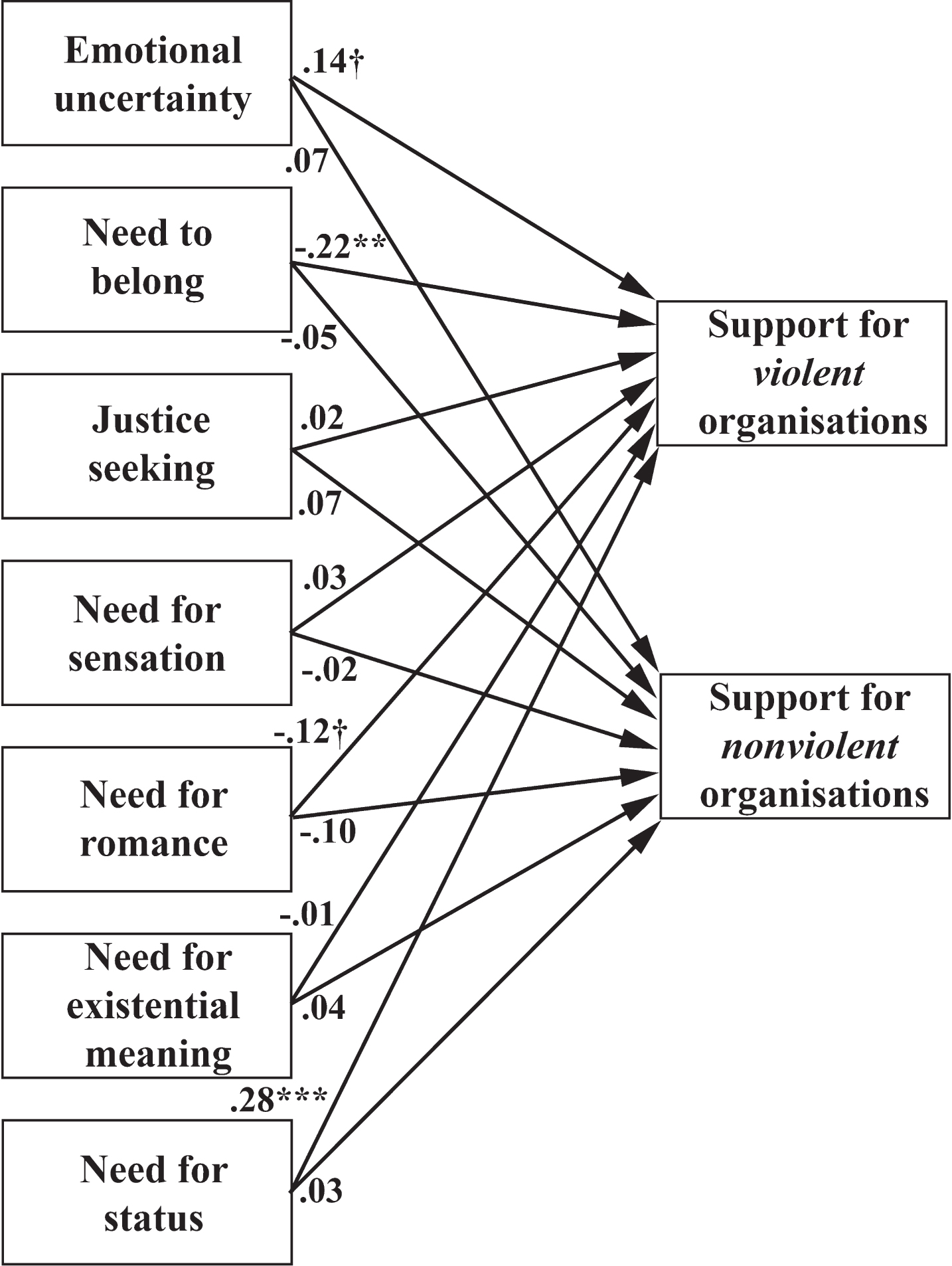
Diagram of model 1. Note. †is p < 0.10; **is p < 0.01; ***is p < 0.001.
Model 2 (see Fig. 3) is similar to Model 1, but includes the combined risk factor score as an intermediate variable between psychological needs and support for violent and nonviolent organisations. Again, model fit was good: Chi-Square (20) = 19.76, p = 0.473, CFI = 1.00, RMSEA<0.001, and SRMR = 0.043. In this model, need for status and justice seeking positively predict the extent of participants’ riskiness, which in turn positively predicts support for violent (but not nonviolent) organisations. In addition, the need to belong negatively predicts overall riskiness 1 .
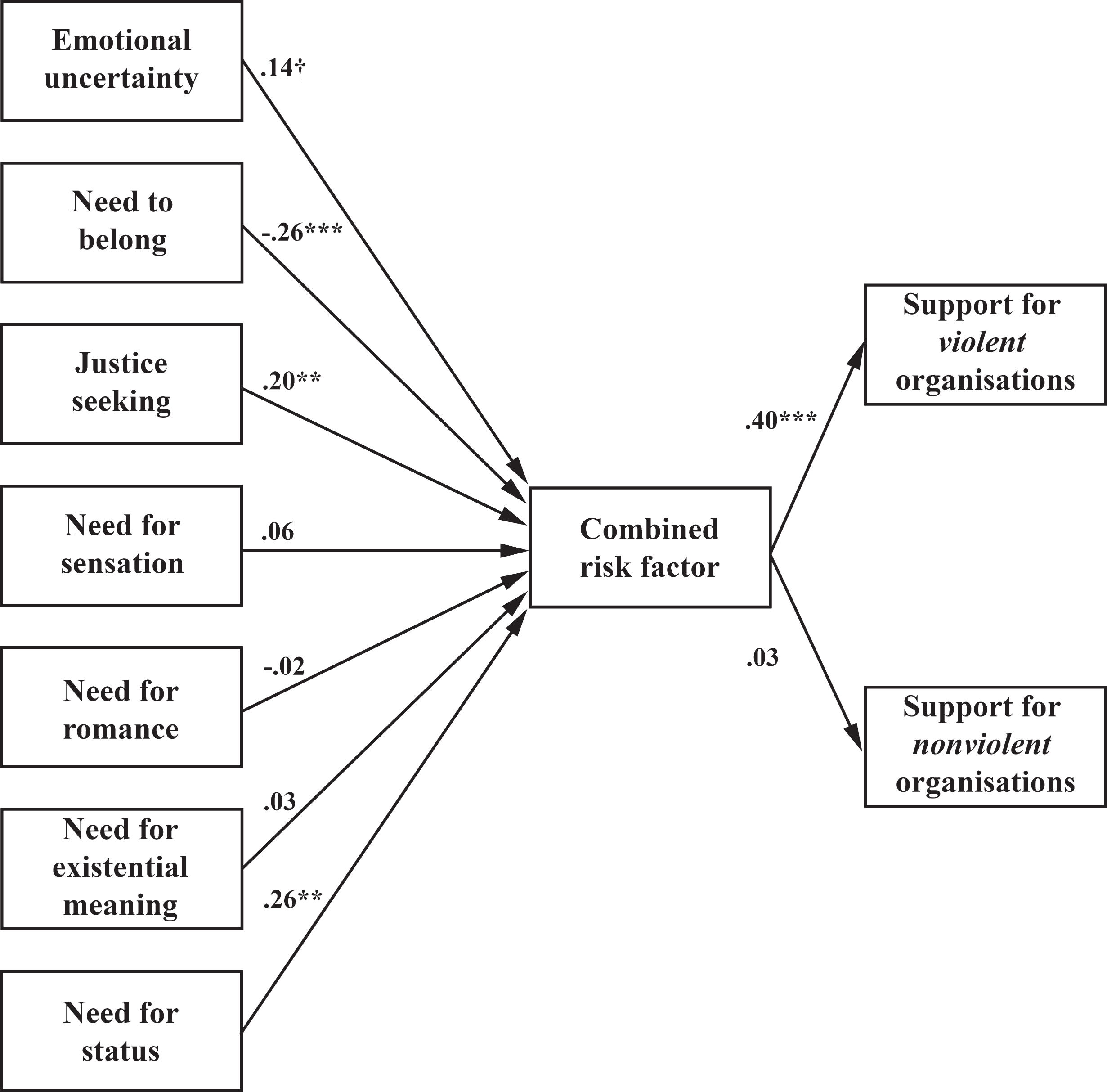
Diagram of Model 2. Note. †is p < 0.10; **is p < 0.01; ***is p < 0.001.
General Discussion
In this project, we tested two hypotheses: 1) individuals with particular psychological needs will be more attracted to organisations that cater for such needs, and 2) individuals who are believed to be more at risk of radicalising in terms of risk factors will support violent organisations to a greater extent than those less at risk. Results offer partial support for Hypothesis 1. As expected, individuals with stronger needs for justice expressed stronger support for an organisation that fights for justice for its members. Similarly, participants with stronger desires for status were more favourable towards an organisation that awards its members with status and recognition. The remaining five psychological needs did not predict support for their respective organisation. Furthermore, strong support was found for Hypothesis 2. Five of the six risk factors measured in Study 2, as well as a combined measure of overall ‘riskiness’, predicted stronger support shown by participants towards violent organisations, indicating that at-risk individuals indeed endorse violence to a greaterextent.
Our results show that individuals who desire justice are attracted to organisations that fight for justice. This proposition could imply that justice-seeking individuals view such organisations as an outlet for addressing their feelings of injustice, and as an opportunity to right any wrongs that they bore witness to. This finding also has implications for how radical organisations portray themselves online. Often, radical groups such as Islamic State (IS) portray their own actions as defensive, rather than offensive, highlighting the oppression and persecution of Muslims worldwide (Schmid, 2015). Based on our findings, such claims could capture the attention of, and entice, those seeking justice.
Our results provide evidence of a similar mechanism for individuals who seek significance in life via the objective of seeking status and recognition from others. This mechanism could work in at least two ways in context. First, the global recognition and infamy that radical groups such as IS receive could lure into involvement individuals who desire recognition. Second, on a more interpersonal level, extremist cells and organisations provide an environment to ‘prove one’s worth’ in front of others; where daring or violent behaviour is potentially rewarded with recognition, respect, or martyrdom (Bartlett & Miller, 2012). Based on our findings, information on social media and in the news portraying extremist groups in this manner may attract those who seek status.
Unexpectedly, the identity seeking (emotional uncertainty, need to belong) and sensation seeking constructs (combined sensation seeking scale, need for affiliation), and the construct ‘meaningful existence’, failed to predict support for their respective organisations. It is possible that these concepts are only at work in few individuals, and therefore the power of our research design may have been insufficient to pick up on an effect. To understand this, we carried out post-hoc power analysis for the regression of participants’ overall support for the organisation score on emotional uncertainty and need to belong, using G*Power (adj. R2 = 0.12, f2 = 0.14, α= 0.05, N = 183, number of predictors = 3; Faul, Erdfelder, Lang, & Buchner, 2007). The test indicated sufficient power (1-β= 0.99). Power analysis for the combined sensation seeking scale and need for affiliation, and the construct ‘meaningful existence’, showed similar results (1-β= 0.96 and 1-β= 0.97, respectively). Thus, our initial tests had sufficient power to find effects, but no such effects were found. Nevertheless, future studies could increase sample sizes to investigate rarer patterns of recruit-to-organisation attraction.
Another explanation could be that the identity and sensation seeking organisations appeared too artificial to participants. Alternatively, results could imply that, compared with those seeking justice and status, identity seekers are more hesitant and selective in which organisations they are drawn to. If true, this would add a further layer of complexity to understanding recruitment; namely, that the set of factors responsible for inhibiting or encouraging individuals to become members of a radical group could be different for each seeker type. Future work could investigate this by building on the current research design.
Changing the broad socio-political conditions in which individuals live can be extremely challenging (Horgan, 2008). A more practical approach might be to focus on the interaction between psychological needs and extreme organisations. By not taking into account individuals’ motivations, counter-radicalisation efforts may only temporarily prevent acts of terrorism (Kruglanski & Fishman, 2009).
In a developmental context, counter-radicalisation efforts could consist of two phases. First, the strongest psychological needs of individuals or groups could be identified. Second, these needs could be met via more socially acceptable activities (Venhaus, 2016). For instance, when individuals have a high need for justice, government and social organisation schemes could offer safe outlets to discharge and address injustice-related anger. These individuals could be encouraged to contribute to political discourse, join an activist group, or make a difference in the local community. Similarly, Individuals with strong desires for status could join a sports club, giving them opportunity to be a team player and gain respect from peers. Alternatively, challenging and changing negative media depictions of Muslims and other disparaged communities could go towards promoting feelings of higher status in such groups. In summary, our findings are only preliminary. However, they do indicate that alternative activities could be offered to help prevent susceptible individuals from radicalising. This would happen only through an understanding of an individual’s specific needs, and by tailoring appropriate alternative activities to them.
Results of Hypothesis 2 show that at-risk individuals responded more favourably to organisations that have a history of violence than individuals less at risk. Specifically, individuals more attracted toviolent organisations felt stronger feelings of relative deprivation, outgroup threat, and procedural unfairness. Moreover, the combined measure of overall ‘riskiness’ offered the best explanation of why some individuals were drawn towards violent organisations. These findings are consistent with Doosje et al. (2013). Perhaps most importantly, our finding regarding participants’ overall level of risk is in line with Horgan (2008), who states that factors such as these in combination “provide a powerful framework for what could be termed ‘openness to socialization’ into terrorism” (p. 85). Our second structural equation model provides evidence of this relation using empirical data: in combination, risky social perceptions predict support for violent, but not nonviolent, organisations.
Limitations and Future Directions
Our results are based only on participants’ reactions to information reported in a fictitious newspaper, rather than from an actual radical group. This format creates a distance between individuals and the organisation itself, and thus, in practice, responses may be different when individuals are confronted by a real organisation directly. Moreover, participants may give more conservative responses when faced with a message from an actual extremist group. To address these limitations, future research should consider ethical ways of presenting messages directly, and from real organisations.
Our results indicate that needs for justice and status may motivate individuals to seek out violent organisations. However, due to a correlational design, we cannot infer causality. Future research could investigate these variables in more depth by taking an experimental approach, exploring whether manipulating, for example, the need for status increases one’s attraction towards an organisation that caters for such a need. A similar approach could be taken using any of the risk factors used in this study. For instance, several studies have manipulated relative deprivation and observed the effects on attitudes towards outgroups such as immigrants (e.g., Jetten, Mols, & Postmes, 2015). Gathering data of this nature would increase our understanding of causation amongst psychological needs, risk factors, and attitudes towards violent action.
We acknowledge that our studies were conducted in a select few countries and cultures, and as such, the possibility of applying our findings to other places is limited. However, we believe our findings are to some extent generalizable for three reasons. First, Study 1 took place in the USA, whereas Study 2 was conducted in the Netherlands. As such, two samples with different nationalities have been used here, albeit in a Western (cultural) context in both cases. Second, demographic statistics indicate that participants in our samples were from a wide variety of backgrounds, cultures, levels of education, and so forth. Third, participants in Study 2 were recruited ‘in the field’, from public spaces, meaning that results are based on the general public, rather than a much more selective pool (e.g., university undergraduate students). All in all, we believe that our findings are sufficiently generalizable.
What implications can be drawn for government policy? Initiatives could be put in place that channel an individual’s needs towards safer alternatives. For example, individuals who have a strong desire for recognition could fulfil this need by becoming involved in competitive sports. Based on the current research, encouraging such inclusive, participatory initiatives would contribute to a long-term prevention strategy. Furthermore, our findings on socio-psychological risk factors imply that measures taken to reduce perceptions of deprivation, procedural injustice, and group threat would diminish at-risk individuals’ endorsement of violent action. Moreover, promoting fairness in democratic procedures would give marginalised individuals a say in important aspects of their lives.
Conclusion
This research offers insight into how individuals at the beginning of the radicalisation process interact with information about organisations online. We provide empirical evidence, which is to now a rarity in research on radicalisation, to suggest that people with a strong desire for justice and for status are more attracted to online organisations that can gratify such desires. This finding is particularly valuable for governments that wish to understand recruitment dynamics at the interface between the public and radical groups online, and for developing measures aimed at preventing initial involvement. The current research replicated previous empirical findings that risk factors related to deprivation, threat, and perceptions of fairness predict the extent to which people are willing to engage with violent groups. Finally, the present research used an experimental approach in a field where empirical data remains scarce.
Author’s Note
Alex I. Macdougall is currently affiliated with the University of Manchester.
Footnotes
Bio Sketches
Alex Macdougall, MSc., studied as an undergraduate at the University of Manchester (UoM), completing a dissertation on political ideology and other-regarding behaviour. He later graduated cum laude as a Master in Psychology (specialising in social psychology) at the University of Amsterdam, submitting a thesis on the key factors that influenced voting in the UK’s 2016 EU referendum. His current research interests are in understanding inequality and deprivation in the UK context.
Jaap van der Veen, MSc., graduated cum laude from the Research Master Psychology at the University of Amsterdam in 2017. Since 2014, he also holds Honours College Bachelor’s Degrees in Psychology and Philosophy from the University of Groningen. Research interests include extremism, radicalisation, social change, collective action, and sustainability. Please refer to www.jaapvanderveen.com for more information.
Allard R. Feddes, PhD, is an assistant professor at the Department of Psychology, University of Amsterdam, The Netherlands. He received his BA and MA from the University of Groningen, the Netherlands, in 2004 and his PhD from the University of Jena, Germany, in 2007. Currently his research focuses on radicalization, hate-crime, intergroup contact and attitudes towards refugees, and voting behaviour.
Lars Nickolson, MA, graduated cum laude as a Master in Philosophy in 2008. For over a decade, he has been involved with counter-radicalization policy as a researcher and advisor working within and outside of the Dutch government. He is currently also a PhD-candidate at the Department of Political Science of the University of Amsterdam.
Bertjan Doosje, PhD, is a Professor at the Department of Political Science and Department of Psychology, University of Amsterdam. He has received his BA and MA from the University of Groningen in 1990, and from 1991– 1995 worked on his PhD (UvA, cum laude). His research interest include intergroup relations in general, and radicalization, stereotyping, social trust, and intergroup emotions in particular.
In addition, a third model was tested, which placed psychological needs as intermediate variables between combined risk factor score and support for violent and nonviolent organisations. Model fit was poor, unless a direct path was added from combined risk factor score to support for violent organisations, bypassing psychological needs. However, adding this pathway undermined the strength of other pathways in the model. Thus, Model 2 was preferred.