



Abstract
The Situational Action Theory of crime submits that law-related morality, the ability to exercise self-control, and exposure to criminogenic settings are key predictors of both regular criminality and violent extremism. Indeed, morality and self-control were found to be significantly correlated with violent extremism, and especially right-wing inspired violence. However, while the effect of criminogenic exposure on crime has been established, its effect on violent extremism remains to be examined. Moreover, it is unclear whether morality, self-control and exposure can predict not only violent, but also non-violent extremism. The current study addresses the recent call to differentiate extremism from violent extremism, by examining how morality, self-control and criminogenic exposure affect both outcomes. To do so, we utilize a random sample of 684 young adults (age 19, 50.1% female) in Peterborough, UK. We find that exposure to criminogenic settings is a key factor in understanding the potential for violent extremism, and suggest pathways for further investigation.
The theoretical and practical quest to define, target, and mitigate political extremism is rapidly becoming a central objective for many Western democracies (Bleich, 2010; Schmid, 2014). Following the terrorist attack in London Bridge on June 2017, UK’s Prime-minister Theresa May declared that “There is, to be frank, far too much tolerance of extremism … We need to become far more robust in identifying it and stamping it out across the public sector and across society” (Stone, 2017). This political call for the elimination of extremism, alongside the increasing volume of terrorist attacks, supported a cross-disciplined body of literature focusing on the origins of extremism (Backes, 2010; Borum, 2011; Dean, 2014; Gill, 2015; Jasko, LaFree, & Kruglanski, 2017; Kebbell & Porter, 2012; Midlarsky, 2011; Nivette, Eisner, & Ribeaud, 2017; Simi, Sporer, & Bubolz, 2016).
In criminology, one of the central theoretical frameworks applied to the study of extremism is the Situational Action Theory of crime (SAT). As a general theory of moral action, SAT suggests a model relevant for many forms of deviant behaviour, from “traditional” crime to extremism (Wikström, Oberwittler, Treiber, & Hardie, 2012; Bouhana & Wikström, 2010). The main proposition of SAT is that human behaviour is the result of an interaction between individuals and their environment. To this interaction, the individual brings a cognitive predisposition, affected by three factors: his or her law-related moral perceptions, ability to exercise self-control, and past exposure to criminogenic settings (Wikström, 2009, 2014; Wikström & Svensson, 2010). Weak law-related morality and poor self-control encourage the perception of crime as an action alternative, increasing one’s vulnerability to criminogenic exposure. Put differently, morality, self-control and criminogenic exposure are the main predictors of deviant behaviour, be it robbery, murder, rape or extremism (Bouhana & Wikström, 2010; Wikström & Bouhana, 2016). The significance of morality, self-control and criminogenic exposure as predictors of delinquent trajectories has gained wide empirical support (Weerman, Bernasco, Bruinsma, & Pauwels, 2016; Wikström, 2009; Wikström & Butterworth, 2013; Wikström et al., 2012; Wikström, Mann, & Hardie, 2017; Wikström & Treiber, 2016, 2017).
As first suggested by Bouhana and Wikström (2010), the same principals of moral action apply for extremism and violent extremism. Indeed, weak law-related morality and poor self-control were found to be significantly correlated with the unlawful behaviour of violent extremism (De Waele & Pauwels, 2014, 2016; Pauwels & Schils, 2016; Schils & Pauwels, 2014). As for exposure, specific forms of extremism-related exposure - such as actively seeking extremist content on-line, or spending time with racist peers - have also been found to be positively related to self-declared involvement in violent extremism (Pauwels & De Waele, 2014; Pauwels & Ben Heylen, 2017; Pauwels & Schils, 2016; Schils & Pauwels, 2014). However, while the effect of criminogenic exposure on “traditional” crime has been tested and validated, the effect of this form of exposure on violent extremism remains to be examined. What is more, very little is known of the effect of morality, self-control and criminogenic exposure on non-violent extremism. Examining how these factors predict violent and non-violent extremism is important, as it supports a deeper understanding of the mechanisms translating extremist believes into violence. It will also contribute to a more general definition of extremism, one that does not revolve uniquely around the violent outcome (Schmid, 2014). And last, identifying the factors predicting the potential for transition from extremism to violent action may support mitigation strategies focusing on violence, rather than political and religious beliefs.
The current study examines the effect of morality, self-control and criminogenic exposure on both non-violent extremism and the potential for violent extremism. It does so by utilizing data collected as part of wave 6 of the Peterborough Adolescent and Young Adult Development Study (PADS+), examining attitudes, political perceptions, self-reported unlawful behaviour and its predictors among 684 young adults in Peterborough, UK (for more information on PADS+ see Wikström et al., 2012a). By analysing participants’ response to a survey as well as a space-time budget documenting their activities, we are able to test the separate effect of morality, self-control and exposure on non-violent extremism as a set of political beliefs, and on the combination of extremism with a violent tendency, representing the potential for violent extremism. The next sections review the predictors of violent extremism in the Situational Action Theory model, the existing empirical evidence and the differentiation of non-violent from violent extremism.
Predictors of Violent Extremism
In the aftermath of the terror attacks in Paris, London, and other European capitals in 2005–2017, recent years have witnessed a fast evolving interest in political extremism. It seems that everyone - researchers and policy makers alike - are motivated to pinpoint the causes of political extremism, often perceived as the starting point for terrorism (Baker-Beall, Heath-Kelly, & Jarvis, 2014; Gelfand, LaFree, Fahey, & Feinberg, 2013; Hogg, Kruglanski, & Bos, 2013; Khan & Azam, 2008; Stevens, 2011).
Similar to the study of the roots of crime, the literature on extremism has evolved from a risk-factor approach to the application of criminological theoretical frameworks, offering a comprehensive model through which the development of extremism can be analysed and explained (see Freilich & LaFree, 2015). One of the central frameworks applied to extremism is Situational Action Theory (SAT). Developed by P.-O. Wikström and colleagues, SAT holds that any deviant behaviour (including extremism and violent extremism) is a form of moral action, resulting from the interaction between the individual and their environment (Wikström 2009, 2014; Wikström & Svensson, 2010; Wikström et al., 2012a; Wikström & Treiber, 2016). As such, this interaction also applies to deviant moral behaviours, such as extremism (Bouhana & Wikström, 2011). The criminal or non-criminal outcomes of this interaction depend on one’s crime propensity – his or her perception of crime as an alternative form of action. In turn, crime propensity is the product of personal law-related moral perceptions, and the ability to exercise self-control. Law-related morality reflects one’s moral values and emotions in regards to criminal laws in their environment, while the ability to exerciseself-control is part of the individual process of choice at a given situation (Wikström, 2004; Wikström & Treiber, 2007.
Alongside the internal predispositions of morality and self-control, deviant behaviour is also affected by one’s accumulated exposure to criminogenic settings. By criminogenic exposure, SAT refers to the places in which individuals spend their time (“where”); to the people they spend their time with (“with whom”); and to the activities in which they engage during this time (“what”). Spending time unsupervised, with peers, in areas of poor collective efficacy reflects high criminogenic exposure; spending this unsupervised time with peers that are delinquent will also increase exposure. This form of exposure increases one’s probability to be involved not only in crime, but also in other forms of deviant (though not unlawful) moral behaviour, such as extremism (Bouhana & Wikström, 2011). Put differently, SAT’s model of behaviour holds that weak law-related morality, poor self-control, and exposure to criminogenic settings will encourage deviant behaviour, including extremism and violent extremism (Wikström & Bouhana, 2016).
Empirical Support for the Effect of Morality, Self-Control, and Criminogenic Exposure
Studies examining the effect of law-related moral perceptions and the ability to exercise self-control on self-reported violent extremism have largely supported SAT’s propositions (De Waele & Pauwels, 2014, 2016; Pauwels & De Waele, 2014; Pauwels & Schils, 2016; Pauwels & Svensson, 2017; Schils & Pauwels, 2014). Consistently, they find that weak law-related morality and poor self-control increase the likelihood of self-reported involvement in right-wing violent extremism. As for exposure, a few recent studies examined the effect of specific forms of exposure on self-reported violent extremism. Schils and Pauwels (2016) conducted a web survey examining predictors of violent extremism among 6,020 adolescents and young adults in Belgium. In this study, exposure was defined and measured as active exposure to online violent extremist content. They found that exposure to online violent extremist moral settings directly affected the likelihood of violent extremism. Using the same sample, Pauwels and Schils (2016) found that online exposure was related to self-reported violent extremism, and that exposure to peer delinquency was related to self-reportedviolent extremism towards property. Similar studies also found exposure to racist peers to be positively related to self-reported violent extremism (Pauwels & De Waele, 2014; Pauwels & Heylen, 2017; Pauwels & Schils, 2016).
The studies reviewed above support SAT’s proposition that morality and self-control are key predictors of violent extremism. They also suggest that some specific forms of exposure to extremist or delinquent settings promote violent extremism. However, to our knowledge, the effect of general criminogenic exposure, as defined by SAT, on the potential to be involved in violent extremism has not yet been examined. What is more, these studies did not differentiate the effect of morality, self-control and exposure on extremism (as a non-violent set of beliefs) and the potential for violent extremism. The present study examines the effect of law-related moral beliefs, the ability to exercise self-control, and criminogenic exposure on extremism as a set of beliefs, and on extremism with the potential for violence. It does so by deconstructing the potential for violent extremism to its basic components: extremism (as a set of political ideas or believes), and a violent tendency. It then tests the effect of law-related morality, self-control and criminogenic exposure on both extremism and violence, and on the combination of political extremism AND violence, representing a potential for violent extremism. The next section details the differences between extremism and violent extremism, leading to the working hypotheses.
Differentiating Extremism from Violent Extremism
Despite the volume of research on extremism, a theoretical and practical ambiguity of definitions remains (Gill, 2015; Neumann, 2003; Schmid, 2014). While there is a general agreement in the literature that extremism does not always (and maybe rarely) lead to violent action, non-violent extremism is still often defined only in regards to the potential for a final violent action (Borum, 2011; De Figueiredo & Weingast, 2001). Accordingly, extremism is frequently operationalized not as an out-of-norm set of political beliefs or ideas, but rather as the support for violent actions, or the involvement in such actions, on the basis of these ideas (Pauwels & Heylen, 2017).
For the purpose of the current study, we suggest that by defining non-violent extremism as the set of political beliefs supporting violent actions, the wide range of political extremism that is detached from a violent tendency is disregarded (see McCauley & Moskalenko, 2014). Instead, we examine how internal and external factors affect both non-violent extremism – defined as a set of political perceptions, and the potential for violent extremism. This potential is operationalized by the presence of both extremism and a violent tendency: When an individual holds a set of extremist perceptions on the one hand, and an existing violent tendency on the other, the potential for involvement in extremist violent actions becomes higher. The importance of considering violent tendency as an essential component of a potential for violent extremism derives from the difficulties and costs embedded in the transition into violence. As for many sorts of crime, supporting a cause – or even supporting the notion of using violence for a specific cause – is very different than the actual use of force (Weisburd & Lernau, 2006). For terrorist networks, this process of “getting used” to violent action is a vital part of the training (Borum, 2011). An existing tendency for violence facilitates this transition, allowing individuals to apply a familiar violent reaction to extremist causes (Simi et al., 2016). Considering both non-violent and violent extremism bears theoretical and practical importance: it supports deeper understanding of the developmental processes leading to extremism and to violence, allowing to point out the factors encouraging (or mitigating) a potential violent outcome. Additionally, a separate examination of the factors affecting non-violent extremism and the potential for violent extremism may support more focused prevent strategies, informing evidence-based decisions about the level of state intervention in non-violent political perceptions and actions.
Working Hypotheses
Following the literature on morality, self-control and criminogenic exposure reviewed above, we expect the predictors of deviant moral behaviour in the Situational Action theory to predict both non-violent extremism (as a set of political ideas and believes) and the potential for violent extremism, defined as a combination of extremist believes and a violent tendency (for a schematic representation of the main variables and estimated effects, see Fig. 1). Accordingly, we examine the following working hypotheses:
Weak law-related moral perceptions will increase the likelihood of both extremism and the potential for violent extremism. Poor ability to exercise self-control will increase the likelihood of both extremism and the potential for violent extremism. Exposure to criminogenic settings will increase the likelihood of both extremism and the potential for violent extremism.
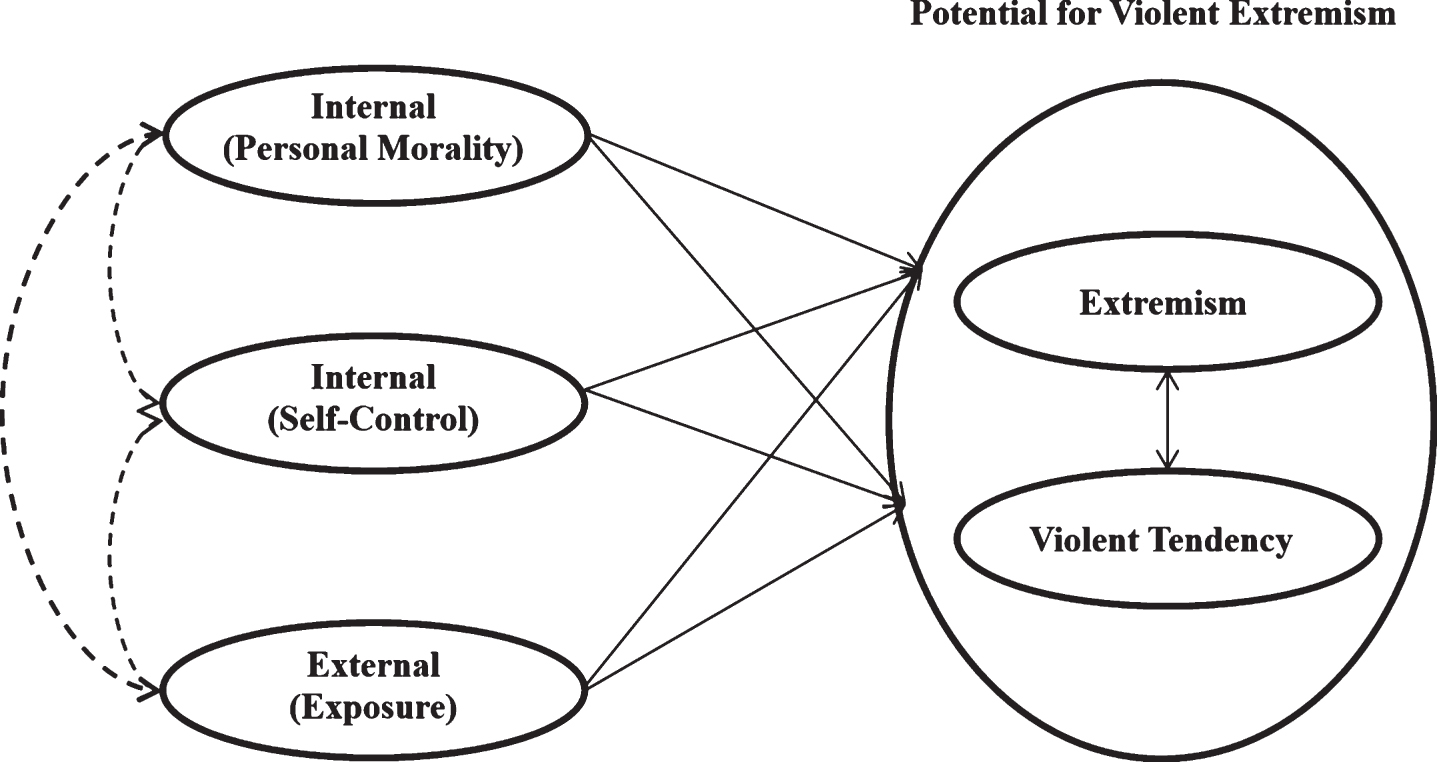
Main variables and estimated effects.
Methodology
To examine the effect of law-related morality, the ability to exercise self-control, and exposure to criminogenic settings on extremism and the potential for violent extremism, we utilize data collected from a sample of normative young adults (19 years old) in Peterborough, UK in 2010. The data is analysed using a multinomial logistic regression model as well as Structural Equation Modelling, as detailed below.
Data Collection and Sampling
Data for this study was collected as part of wave 6 of the Peterborough Adolescent and Young Adult Development Study (PADS+). PADS+ is an ongoing longitudinal study of a sample of young people residing in the city of Peterborough and nearby villages in the UK. Participants were randomly selected for the study at age 11, and constitute about one third of all members of the age cohort in the study area, representing a wide range of socioeconomic, religious and social background (for more information on the sample, see http://www.pads.ac.uk/). To date, PADS+ is considered one of the most comprehensive longitudinal databases in developmental criminology, combining diverse methods of data collection, including personal questionnaires, a space-time budget documenting participant’s day-to-day activities, and a community survey reflecting participant’s immediate environment.
The current study utilizes data collected as part of wave 6 of PADS+, when participants were 19 years old, as this is the first wave collecting information on participant’s political perceptions. As in each wave of PADS+, participants were asked to fill out an interviewer-led questionnaire, reflecting their political perceptions, law-related morality, ability to exercise self-control and violent tendency. To measure participant’s exposure to criminogenic settings, two additional data sets were collected: a space-time budget reflecting each participant’s day-to-day activities (when, where and with whom they spent their time), and a small-area community survey, reflecting the level of collective efficacy in the areas participants spend time in. The main purpose of the small area community survey was to collect data about collective efficacy, to be linked to the space-time budget measuring participant’s exposure to different social environments. The final sample included 684 participants; almost half of them (49.9%) were male, and 50.1% female. As for participant’s ethnic background, 79.6% of them were white British; 3.3% from other white origins; 4.1% black or mixed black; 12% Asian or mixed Asians; and 1% from another mixed origin (for a detailed review of data collection and sampling, see Wikström et al., 2012a).
Measurement and Main Variables
All measures for the current study were designed following previous studies on developmental pathways to crime (Wikström et al., 2012a). Independent variables included law-related personal moral rules, the ability to exercise self-control, and exposure to criminogenic settings. We also measured two dependent variables: political extremism and violent tendency, as detailed below.
Morality
The scale measuring law-related morality included 16 items, each describing a different unlawful act, ranging from “Ride a bike through red light” to “Use a weapon or force to get money or things from another young person”. For each item, participants were asked to report how wrong they think it was for a person their age to commit such an act, ranging from 0 (not wrong at all) to 3 (very wrong) (Cronbach’s α= 0.88; N = 684; M = 29.5)1.
For additional information on the construction and validation of the scales, see Wikström et al. (2012a)
Self-Control
The scale measuring participant’s ability to exercise self-control included 8 items, such as “I often act on the spur of the moment without stopping to think” and “I lose my temper pretty easily”. For each item, participants were asked to rank their level of agreement using a Likert scale, ranging from 0 (strongly disagree) to 3 (strongly agree) (Cronbach’s α= 0.78; N = 684; M = 10.3).
Criminogenic Exposure
Personal Criminogenic exposure was measured as the amount of time spent unsupervised with delinquent peers in areas with poor collective efficacy. It is important to note that in contrast to previous studies, exposure in the current study reflects only general criminogenic settings, and not extremism-related exposure. This measure was constructed using information from the space-time budget (amount of time spent in unsupervised activities, with peers), the questionnaire (peer delinquency) and the small area community survey (levels of collective efficacy). First, each output area of the city was dichotomized according to whether or not it had a low level of collective efficacy2
Collective efficacy was defined as “the effectiveness of informal mechanisms by which residents themselves achieve public order” (Sampson et al., 1997, p. 918).
Extremism and the Potential for Violent Extremism
To differentiate extremism from a potential for violent extremism, we measured participants’ political extremism (using declared voting patterns) and their violent tendency (personal involvement in violent incidents). First, participants’ political extremism was measured using their declared voting patterns, as reported in the questionnaire. Each of the participants was asked to report which political party they would vote for, choosing from a list of all political parties in the UK at the time of data collection. In line with previous literature on right-wing extremism, voting for the British National Party (BNP) was considered as indicating an extremist set of ideas or beliefs, while voting for other parties (Labour, Liberal democrats, the Green party, the Conservative party, or UK independent party [UKIP]) was not (Bowyer, 2008; Eatwell & Goodwin, 2010; Ford & Goodwin, 2010; Goodwin, 2011). Then, we used participants’ self-declared involvement in any sort of physical violent incidents in the 12 months preceding data collection to assess whether participants had a violent tendency. This involvement was measured by participants’ yes/no response to the question “Have you during the year (2010) beaten up or hit someone?”. Last, a combined measure of extremism and violence was created, to reflect a potential for violent extremism. Accordingly, participants were assigned to one of 4 groups: Not extremist or violent; extremist; violent; and potentially violent extremist (see Table 1 for groups’ characteristics).
Characteristics by Groups
Analysis
To test the effect of morality, self-control and criminogenic exposure on extremism and a potential for violent extremism, we followed a two-steps analysis. First, we used a multinomial logistic regression model to test whether crime propensity – weak moral rules and poor self-control – increased the likelihood of extremism, of a violent tendency, or of the potential for violent extremism. Then, we used structural equation modelling (Muthén & Muthén, 2012) to assess the odds ratio (OR) of the association between the predictors (morality, self-control, and criminogenic exposure) and the outcomes (extremism and the potential for violent extremism). The findings of this analysis are reported and discussed in the next sections.
Results
In-line with the working hypotheses mentioned above, we conducted the analysis in two stages. First, a multinomial logistic regression was used to examine the effect of weak moral rules and poor self-control on extremism, violent tendency, and the combination of extremism and violence, reflecting a potential for violent extremism.
Table 2 presents the results of a multinomial logistic regression examining the effect of weak moral rules and poor self-control on extremism, violence and the potential for violent extremism. As can be seen in Table 2, weak moral rules and poor self-control were significantly correlated with both extremism and a potential for violent extremism. Participants with weak moral rules and poor self-control were significantly more likely to have extremist political beliefs than other participants (OR = 1.06, 95% CI 1.01–1.10 for weak moral rules, and OR = 1.15, 95% CI 1.07–1.23 for poor self-control), more likely to have a violent tendency (OR = 1.13, 95% CI 1.08–1.18 for weak moral rules, and OR = 1.15, 95% CI 1.09–1.25 for poor self-control), and more likely to have the combination of extremism and a violent tendency, suggesting a potential for violent extremism (OR = 1.16, 95% CI 1.09–1.24 for weak moral rules, and OR = 1.23, 95% CI 1.10–1.38 for poor self-control). Hence, in line with our first and second hypotheses, we find that morality and self-control are positively related to both extremism and a potential for violent extremism.
Multinomial Logistic Regression Examining the Effect of Weak Moral Rules and Poor Self-Control on Extremism, Violence and a Potential for Violent Extremism
N = 684; R2 = 0.16 (Cox & Snell), 0.21 (Nagelkerke).
p < 0.001;
p < 0.01.
Next, path analyses were specified to investigate the role of weak moral rules, poor self-control and criminogenic exposure on young people’s endorsement of extremism and their potential for violent extremism, with a separate model for each type of outcome. In each model, the predictors were analysed in tandem to examine their relative strength, and correlations between them were specified to account for co-occurrences. Logistic regression paths were specified from each of the three predictors to extremism (non-violent or violent), using the software Mplus, the robust maximum likelihood estimator and a Montecarlo integration. Non-significant paths were removed from the final model.
As shown in Figs. 2 and 3, the three predictors were mildly positively correlated, such that those young people exhibiting weaker morality also had poorer self-control and higher criminogenic exposure than other young people. A higher likelihood of engagement in political extremism was exhibited by those young people who had weak morality (OR adj = 1.05, 95% CI 1.01–1.11), poor self-control (OR adj = 1.14, 95% CI 1.05–1.23), but not heightened criminogenic exposure. In contrast, a higher likelihood of a potential for violent extremism was exhibited not only by those young people who had weak morality (OR adj = 1.10, 95% CI 1.02–1.18) and poor self-control (OR adj = 1.20, 95% CI 1.07–1.35), but also by those who had a heightened criminogenic exposure (OR adj = 1.27, 95% CI 1.06–1.52).

Political extremism.
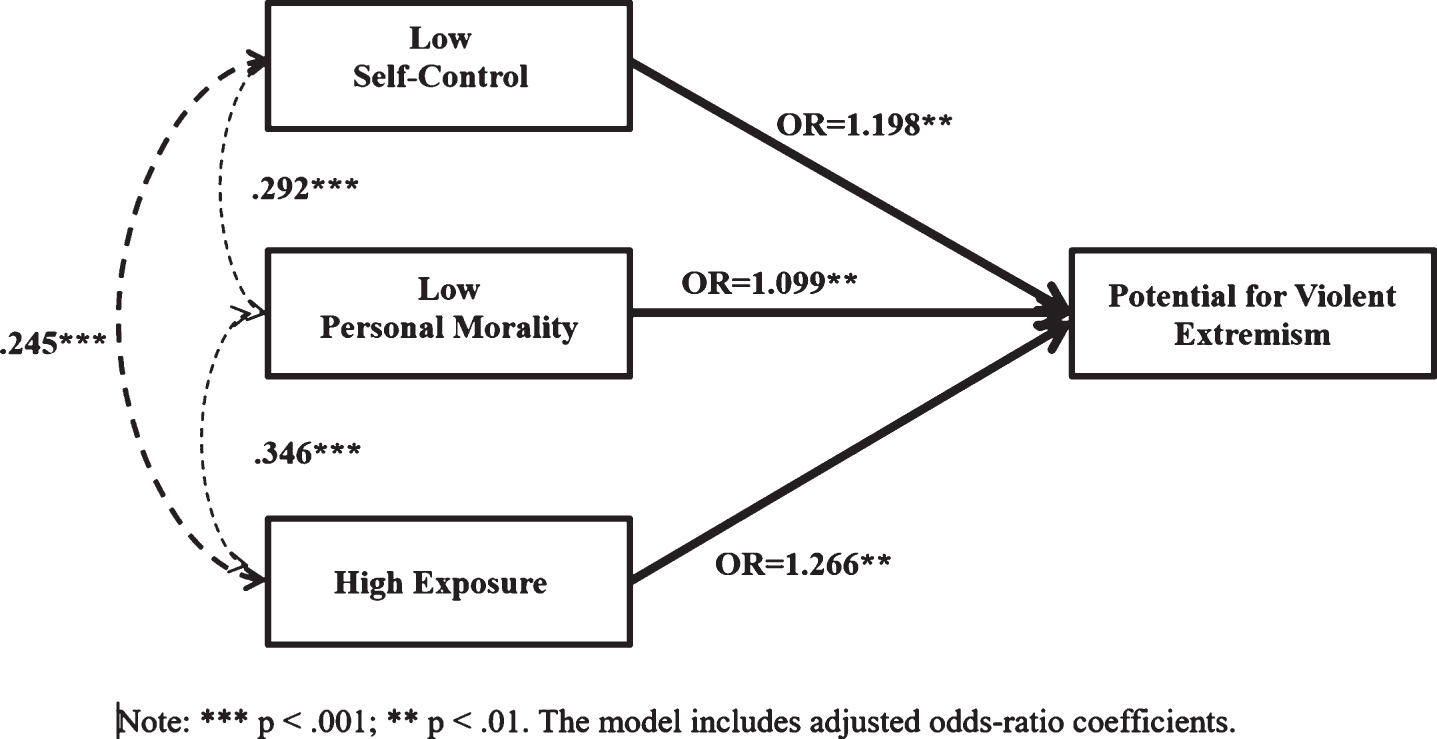
Potential for violent extremism.
Discussion
Despite the volume of literature and the wide public discussion on extremism, the ambiguity of definitions and the lack of an agreed theoretical framework still stand in the way of mitigation (Schmid, 2011). In this study we address these limitations by (1) applying the principals of a general theory of moral action to the study of extremism, and (2) breaking down the outcome to its basic components, testing the effects of SAT’s predictors on extremism, violent tendency, and the combination of beliefs and behaviour suggesting a potential for violent extremism.
In-line with previous applications of SAT to the study of violent extremism (Pauwels et al., 2014; Pauwels & Schils, 2016; Pauwels & Svensson, 2017; Schils & Pauwels, 2014, 2016; De Waele & Pauwels, 2016), our findings suggest that the basic propositions of the model hold for violent extremism as they do for other forms of crime. Weak law-related moral rules and poor ability to exercise self-control increased not only the likelihood of a potential for violent extremism, but also non-violent support for extremist right-wing ideology. As for exposure to criminogenic settings, this is the first study to examine the effect of general criminogenic exposure, as defined in SAT, on extremism. Indeed, we find criminogenic exposure to be significantly correlated with a potential for violent extremism, similar to its effect on other forms of unlawful behaviour (Wikström et al., 2012a). This finding stresses the role of violent extremism as a moral action, affected primarily by a combination of personal and environmental factors. The relevance of law-related morality, self-control and criminogenic exposure to the potential for violent extremism highlights the relevance of SAT as a theoretical framework for diverse forms of deviant behaviour.
However, the central finding in the current study is the role of criminogenic exposure in differentiating violent and non-violent extremism. While criminogenic exposure increased the likelihood of having a potential for violent extremism, it had no significant effect on non-violent extremism. In other words, while morality and self-control predicted both extremism as a set of beliefs and extremism with a violent tendency, criminogenic exposure increased the potential for violent extremism, but was not relevant for its non-violent form.
How can the different effect of criminogenic exposure on extremism and the potential for violent extremism be accounted for? As suggested by Weisburd and Lernau (2006), the transition from holding extremist beliefs, or even using these beliefs to justify violent actions carried by others, to the physical fulfilment of these beliefs in the form of a violent act, requires overcoming personal and social barriers associated with crime and violence. In the terms of behavioural psychology, this difference can be perceived as demonstrating the gap between attitudes and behaviour (Armitage & Christian, 2003). But beyond this general gap, physical violent action, even when justified by ideology, requires a form of “training”, lowering the embedded sensibility and fear often associated with it (Borum, 2007; 2010; Moghaddam, 2005). This is a well-known challenge for many terrorist networks, training their recruits to enable violence as part of the radicalization process (Borum, 2011). Following this line of reason, the findings suggest that the mechanism differentiating extremism from the potential for violent extremism will be the training for violence, via an exposure to criminogenic, unlawful and violent behaviour.
This differentiation between violent and non-violent extremism is important, as political extremism often remains within the realms of perceptions, not translating into violent action (Borum, 2011; Schmid, 2014). On the theoretical level, thisfinding suggest that the transition into violent extremism involves a passage into unlawful behaviour, therefore affected by the same form of exposure affecting “traditional” crime (Wikström et al., 2012a; Wikström & Bouhana, 2016). On the practical level, this finding suggests that early interventions for violent extremism should target the effect of criminogenic exposure on the violence component of violent extremism, rather than solely focusing on ideology. In other words, while non-violent extremism may be a concern and an “easy target” for Western democracies, dedicating more resources to reduce the criminogenic exposure supporting the translation of these perceptions into violence may account for more effective counter-terrorism.
Limitations
The current study is not without limitations. First, examining extremism within a normative sample of young adults in the UK raises questions about the generalisation of the findings. While voting patterns are often used as an indication of extremism, it is without doubt a limited measure (Kuhn, 2004; Melzer, 1995). Additional research, combining this measure for extremism with other self-reported attitudes, is required to support current results. However, findings from previous studies, examining the effect of SAT’s predictors of crime on different measures of extremism in Belgium, suggest that PADS+ sample is similar to other samples of normative youth (e.g., Schils & Pauwels, 2014; 2016). The quality of PADS+ as a unique dataset, and the generalisation of findings based on this dataset in regards to other forms of crime, have also been established (see Wikström et al., 2012a). Nevertheless, we encourage future studies to examine criminogenic exposure as a key motivation for violent extremism in other samples and contexts.
A second limitation of the current study is the gap between the potential for violent extremism, measured as the combination of extremist perceptions and a violent tendency, and actual involvement in violent extremism. Indeed, it is important to note that not every subject with extremist believes and a tendency for violence will necessarily commit an act of violent extremism. Accordingly, we encourage future research to further examine the effect of criminogenic exposure on young adults’ involvement in violent extremism. However, in-line with the literature emphasizing the “transition into violence” as the critical stepping-stone on the route to violent extremism, we suggest that this combination indicates the potential for a violent act committed on extremist grounds (Borum, 2011). Moreover, this operationalization allows a differentiation of extremism and violence, advancing the understanding of the mechanisms increasing the likelihood of one over the other.
The current findings suggest that for focused mitigation, it is essential to “take apart” the different components of violent extremism. Examining the violence component of the potential for violent extremism imposes the role of violent extremism as a form of crime and a moral action, laying the grounds for further exploring criminogenic exposure as a key motivation. While liberal democracies cannot avoid the social and legal discussion on the limits of political extremism, effective law enforcement should not neglect the role of criminogenic exposure and violence in the development of normative young adults into violent extremists.
Conclusions
We examine the role of Situational Action Theory’s predictors of crime – weak law-related morality, poor ability to exercise self-control, and exposure to criminogenic settings on non-violent extremism and on the potential for violent extremism. Using data on 684 normative young adults from the UK, we find that weak morality and poor self-control increased the likelihood of both non-violent extremism and the potential for violent extremism. Exposure to criminogenic settings increased the likelihood of a potential for violent extremism, but had no significant effect on non-violent extremism. We conclude that similar to other forms of crime, criminogenic exposure is a key factor, differentiating extremism as a set of political ideas or beliefs from a potential for violent extremism. Accordingly, we encourage further investigation of criminogenic exposure as a predictor of violent extremism, and suggest focusing early mitigation on the violent, rather than the ideological, component of violent extremism.
Author’s Note
Data collection for this study was supported by a grant from the UK Economic & Social Research Council (ESRC grant ES/K010646/1).
Footnotes
Bio Sketches
Gali Perry, PhD, Hebrew University of Jerusalem, is a lecturer at the Institute of Criminology, the Hebrew University of Jerusalem, Israel and a visiting scholar at the University of Cambridge Institute of Criminology, UK. Her research interests include political extremism, the policing of political violence and terrorism.
Per-Olof H. Wikström, PhD, Docent, Stockholm University, FBA, is Professor of Ecological and Developmental Criminology at the University of Cambridge Institute of Criminology. He is the director of the Peterborough Adolescent and Young Adult Development Study (PADS+) and his main research interests are developing unified theory of the causes of crime (Situational Action Theory), its empirical testing (PADS+) and its application to devising knowledge-based prevention policies.
Gabriela D. Roman, PhD, University of Cambridge is a researcher at the University of Cambridge Institute of Criminology. Her main research interest is the development of self-regulation in adolescence and early adulthood and the role it plays for young adults’ pathways of deviant and criminal behaviour.