



Abstract
How others behave (descriptive norm) and what they expect from us (injunctive norm) has a strong influence on how we behave. However, children and adolescents often overestimate the prevalence of negative behavior among their peers. The current study tested whether prompting peer norms for cyberbullying may foster anti-cyberbullying norms in an experimental design with N = 510 seventh, eighth and nine graders. In a pre-post control-group design, students completed an online survey during school lessons assessing the individual and classroom anti-cyberbullying norm before and after receiving simulated information about the classroom norm on cyberbullying. Results showed that individual anti-cyberbullying norms are negatively related to cyberbullying behavior. However, students did not change their individual norm differentially after reading the information about the classroom anti-cyberbullying norm. Possibly, the intervention was too minimal to change normative attitudes about cyberbullying or the school class is not a relevant reference group for online behavior of students.
Cyberbullying deploys digital forms of communication for aggressive behavior such as harassment, insults, threats and humiliation, and is intended to offend, hurt or discomfort others. It is usually associated with some degree of repetitiveness such as repeated threats or pictures being commented on or shared. Also, the target is assumed to be rather helpless, e.g. regarding removal of the offensive contents (cf. Tokunaga, 2010). A meta-analysis of 137 studies from around the world showed cyberbullying victimization to be significantly associated with depression, low self-esteem, anxiety, loneliness, low life satisfaction, drug and alcohol use, conduct problems, emotional problems, reduced prosocial behavior, increased somatic symptoms, stress and suicidal ideation. Cyberbullying perpetration was significantly related to depression, reduced self-esteem, anxiety, loneliness, drug and alcohol use, lower academic achievement, and reduced life satisfaction (Kowalski, Guimetti, Schroeder, & Lattanner, 2014). These are all serious adverse effects, which may have a lasting impact on the adolescents’ healthy and adaptive development. With prevalence rates of 15.5% for perpetration and 15.2% for victimization on average across countries (Modecki, Minchin, Harbaugh, Guerra, & Runions, 2014), cyberbullying affects a substantial number of adolescents. Thus, effective intervention and prevention measures are urgently needed and identification of determinants that could reduce cyberbullying and pro-cyberbullying attitudes is highly relevant. Communicating what peers normatively expect concerning cyberbullying (injunctive norm) could be such an influencing behavioral determinant and was investigated in the present study.
Social Norms and Peer Influence in Adolescence
Social norms are a set of rules and standards that are accepted and expected by the members of a group, which need not be stated explicitly and that guide and sanction behavior through the social network (Cialdini & Trost, 1998). Their influence on behavior can occur in two different ways: Through the perception of what most people in one’s social group do (descriptive norm) or through the perception of what most people in one’s social group approve or disapprove of (injunctive norm; Cialdini, Kallgren, & Reno, 1991). The descriptive norm people have for their environment such as the peer group has an informational function in the sense of “effective” behavior, whereas the injunctive norm is assumed to have a prescriptive function, i.e. it supposedly informs adolescents, for example, how they should behave if they want to be part of a certain peer group.
The social norms approach initially addressed health issues such as alcohol and tobacco use among college students or environmental topics like towel use in hotels or energy usage at home (Miller & Prentice, 2016), but it can also be drawn upon to understand mechanisms behind aggressive behavior. This approach refers to the misperception of the reference group’s social norms, e.g. classmates for adolescents. Students mistakenly perceive the attitudes and behaviors of their relevant peers to be different from their own when they are actually not (Berkowitz, 2005). They might then try to adapt to these perceived norms in order to belong to the group, gain popularity or even just to avoid becoming a victim of peer aggression or rejection. In this way, misperceptions predict behavior (Berkowitz, 2005), which is problematic if the target behavior is negative such as aggression. There is first evidence, for example, that adolescents rate their peers’ attitudes toward offline bullying less prosocial than their own (Sandstrom & Bartini, 2010) and this misperception of the group norms is related to less defending behavior toward the victim and more “joining in” (Sandstrom, Makover, & Bartini, 2013). Especially during adolescence, the peer group and the success within this group are highly salient (cf. Brechwald & Prinstein, 2011, p. 5). LaFontana and Cillessen (2010) showed that, as a function of developmental changes, peer status in class is increasingly prioritized during adolescence. Specifically, popularity among peers was more important for adolescents than friendships, empathy with others, socially acceptable behavior, personal achievement and romantic interest (which only becomes more important in later adolescence). This makes adolescents especially prone to peer influence. Accordingly, peer norms in the class play a crucial role in a multitude of adolescent behaviors such as alcohol and tobacco use (e.g., François, Lindstrom Johnson, Waasdorp, Parker, & Bradshaw, 2017; Pischke et al., 2015), sexual activity and sexual risk taking (Bongardt, Reitz, Sandfort, & Deković, 2015), bullying (e.g., Salmivalli & Voeten, 2004), and risky online behavior (e.g., Sasson & Mesch, 2017).
Cyberbullying and Social Norms
Cyberbullying has been linked to social norms in the very few studies that have been conducted on this topic so far. For example, Pyżalski (2012) found that cyberbullying perpetration was significantly correlated with perceiving less positive peer norms for positive behavior like engagement in after-school activities. At the same time, cyberbullying perpetrators perceived higher levels of negative peer norms such as approval of cigarette use. Gámez-Guadix and Gini (2016) found that cyberbullying perpetration was more likely in classes where students excused cyberbullying for various reasons like revenge or fun. Heirman and Walrave (2012) tested the Theory of Planned Behavior for cyberbullying and found that the perception of negative social pressure and disapproval from significant others was a significant predictor of a lower intention to perform cyberbullying. Other researchers assessing the influence of the descriptive norm, found that students reporting many of their friends to be involved in cyberbullying were also perpetrators more often (Hinduja & Patchin, 2013) and that the number of bullies within a class was a strong predictor of individual cyberbullying perpetration (Festl, Scharkow, & Quandt, 2013). Bastiaensens et al. (2016) examined the influence of social pressure on bystanders of cyberbullying and found that the perception of friends’ approval, mediated by social pressure, increased the likelihood to join in. In sum, these results point at the link between the prevalence of cyberbullying and negative social norms in the classroom.
Social Norms Interventions
The manipulation of social norms has shown to be quite successful and has been implemented for a number of health-related behaviors through social norms marketing (information campaigns with posters, publicity events, or emails), personalized normative feedback (providing information about own and peers’ behavior), or group discussions about causes and consequences of norm misperceptions (Miller & Prentice, 2016). In the age group of adolescents and college students, it has mostly been used to reduce or prevent alcohol consumption (e.g., Haines & Spear, 1996; Stock, Vallentin-Holbech, & Rasmussen, 2016), cigarette smoking (e.g., Pischke et al., 2012), and other drug use (e.g., Stock et al., 2016). For example, in the context of alcohol consumption, communicating the peer norm through a major information and media campaign including advertisements and pamphlets reduced both approval (injunctive norm) and prevalence of alcohol use (Haines & Spear, 1996).
In a first attempt to influence misperceived peer norms and students’ individual attitudes on bullying, Perkins, Craig, and Perkins (2011) presented students with posters containing messages based on the respective schools’ individual results in the bullying survey. They found that students considerably overestimated the descriptive norm, i.e. the prevalence of bullying, as well as the pro-bullying attitudes of their peers. They also replicated the association between perceived peer norms and own behavior and attitudes and achieved a reduction in the misperceptions and in individual bullying twelve to 18 months after the start of the intervention. Although this study had some methodological limitations such as not including a non-intervention control group or not linking pre- and post-intervention data to each other on a case-by-case basis, the results are promising as they suggest that already low-level interventions may be effective in reducing bullying behavior in school by confronting students with actual social norms. It is important to note, though, that there are some functional and conceptual differences between offline bullying (repeated intentional aggressive acts to harm less powerful individuals) and cyberbullying: Repetition is immanent in many modes of cyberbullying due to the public nature of social media, a greater audience, long persistence, a changed role of bystanders due to easier and faster ways of distribution and features for commenting, more reciprocity between perpetrators and targets, which weakens the criterion of power differential (Law, Shapka, Hymel, Olson, & Waterhouse, 2012), anonymity, no limits in space and time, which makes it more difficult for victims to disconnect themselves (Juvonen & Gross, 2008), and less direct feedback for perpetrators of their actions.
The Present Study
The present study tested the effect of increasing anti-cyberbullying norms by confronting students with actual social norms for cyberbullying in an experimental design. To the best of our knowledge, no experimental study tested this approach in offline bullying or in cyberbullying.
The school class is a very salient context for adolescents and perceived peer social norms can significantly influence students’ behavior, also regarding antisocial online behavior. Even if adolescents do not approve of cyberbullying, they might not live up to their own norms, because they think that they belong to a minority and so might not want to behave non-conform, when in fact they are part of the majority. Thus, they are more likely to behave conforming to the misperceived norm and stay silent about their own actual norms. This in turn could reinforce those with pro-cyberbullying norms and lead to further misperceptions in those with anti-cyberbullying norms (Berkowitz, 2005). Hence, it seems a good approach to communicate a realistic peer norm and correct misperceptions in order to target cyberbullying perpetration. Therefore, the present study wanted to replicate the association between norms and individual behavior for cyberbullying as found by Festl and colleagues (2013), Gámez-Guadix and Gini (2016), and Hinduja and Patchin (2013): The individual injunctive anti-cyberbullying norm is linked ⋯ negatively to self-reported cyberbullying behavior, ⋯ positively to the injunctive classroom anti-cyberbullying norm.
Further, based on results that perceived pro-cyberbullying norms of peers were associated with higher levels of cyberbullying in the individual (Festl et al., 2013; Gámez-Guadix & Gini, 2016; Hinduja & Patchin, 2013) we aimed to test whether the information that only a small proportion of peers actually endorses cyberbullying would be able to change individual norms in a more favorable direction with a minimal intervention using the social norms approach: Information about a (fictitious, but realistic) injunctive classroom anti-cyberbullying norm leads to ⋯ higher classroom injunctive anti-cyberbullying norm, ⋯ higher individual injunctive anti-cyberbullying norm.
Method
Participants
The study was conducted in four schools in different neighborhoods of a large German city. The schools and classes were randomly selected to participate. Selection criteria were 1.) a mixture of districts with different socio-economic background, 2.) a mixture of school tracks (two general high schools [Integrierte Sekundarschule] and two college-preparatory high schools [Gymnasium], and 3.) availability of internet access for each student in a school computer pool. From each school two classes from seventh, eighth, and ninth grade participated with a participation rate of 87%. Of N = 510 students in 24 classes, 52.0% were female and 48.0% were male adolescents, aged 12 to 16 (M = 13.5, SD = 1.1) years.
The number of participants was distributed about evenly between the two school tracks, general high school (n = 247, 48%) and college-preparatory high school (n = 263, 52%) and between experimental group (n = 256, 50%) and control group (n = 254, 50%, see below), respectively. In total, 41% of participants had a migration background, i.e. they and/or their parents were born in another country than Germany.
Procedure
The survey consisted of an anonymous online-questionnaire in an experimental design. Therefore, a sufficient number of computers in each school’s computer pools were necessary to guarantee one available computer for each student of the class, the exact same starting time, and the cover story about the (simulated) classroom norm. A trained test instructor supervised the completion of the questionnaire, thus protecting the privacy towards classmates or teachers, and answered any question. Ethical and data protection approval was granted by the federal state’s school administration. The school principal, school conference, participants and their parents (if students were under the age of 14) received detailed information and agreed to the voluntary participation before the study began.
Experimental Procedure
The survey consisted of three parts, which followed directly one after the other in one single data collection. Participants were welcomed, seated in front of a computer, informed about the topic of the study, gave their informed consent and had the opportunity to ask questions about the procedure. Then the participants received all further instructions from the screen and started the online questionnaire simultaneously. First, they were presented the pre-intervention questionnaire, including individual and classroom anti-cyberbullying norm T1, and experiences as a victim or perpetrator of cyberbullying. Subsequently, participants were randomly assigned to either the experimental or the control group. Accordingly, the students were presented a text including the definition of either cyberbullying (experimental condition) or the color brown-grey (Pantone 448C 1 , control condition). They were then asked about their attitude towards cyberbullying/brown-grey (good – indifferent – bad). Subsequently, the students saw a waiting screen with a text box “Please wait” and then were presented a graph showing the classmates’ simulated attitudes towards cyberbullying/brown-grey (2% good – 7% indifferent – 91% bad; see Fig. 1) 2 .
Participants’ understanding was assured using an open question about the impact of cyberbullying/colors in their own words (no participant had to be excluded due to irrelevant answers). In the third and last part, the post-intervention measures (individual and classroom anti-cyberbullying norm T2) were administered before the survey closed with a debriefing that the shown numbers were not the class’ actual numbers. Students were also provided information about where they could get help in case of cyberbullying. The whole procedure took approximately 20 minutes in total.
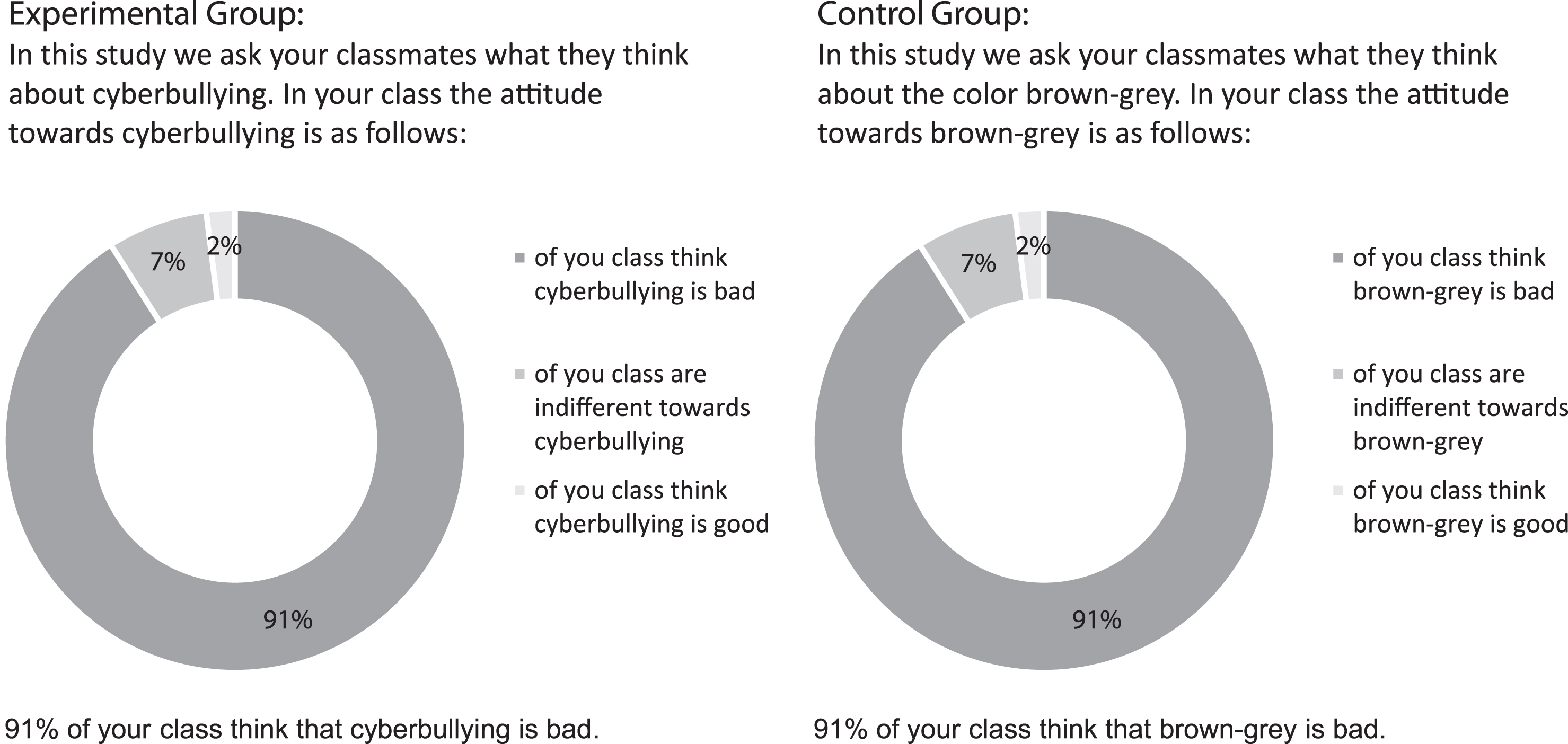
Visualization of the experimental manipulation.
Instruments
Involvement in cyberbullying was measured with the scale “Direct and Indirect Cyberbullying and Cybervictimization” (DICC; Pfetsch, 2013) using a 5-point Likert scale (1 “not at all”, 5 “several times a week”) and referring to the previous six months. The cyberbullying scale contained eight items (M = 1.12, SD = 0.27, α= 0.74), e.g., “I wrote mean messages to another person in order to offend him/her.” Students were classified as cyberbullies if they reported at least one of the eight behaviors at least “2 or 3 times a month”.
The Cyberbullying Class Mean was computed by averaging the continuous scores of cyberbullying across all students in each class (M = 1.12, SD = 0.07, Range 1.01 – 1.30, Median = 1.13).
Individual Anti-Cyberbullying Norm was measured with four items adapted from Perkins et al. (2011) on a 4-point Likert scale (1 = “does not apply at all”, 4 = “applies completely”; MT1 = 3.31, SDT1 = 0.84, αT1 = 0.82, MT2 = 3.42, SDT2 = 0.87, αT2 = 0.88), e.g.: “I think it is wrong to ridicule someone in front of others via internet or mobile phone.”.
Classroom Anti-Cyberbullying Norm was assessed with four items adapted and extended from Bastiaensens et al. (2015) on a 4-point Likert scale (1 = “does not apply at all”, 4 = applies completely; MT1 = 3.06, SDT1 = 0.64, αT1 = 0.70, MT2 = 3.14, SDT2 = 0.66, αT2 = 0.76), e.g., “My classmates think it is bad if I would insult someone severely via internet or mobile phone.”.
Data analysis
To test for the effect of receiving information about the injunctive classroom norm on cyberbullying (experimental group) vs. non-relevant information (control group) on the individual anti-cyberbullying norm and the classroom anti-cyberbullying norm, we used IBM SPSS 25 (IBM, 2017) to calculate two-way mixed ANOVAs with a between-subject factor (group: experimental vs. control), and a repeated within-subject dependent measure, one for each outcome (individual and classroom anti-cyberbullying norm, respectively). Additionally, we included age, gender and cyberbullying as covariates in subsequent ANCOVAs. Including the status as a cyberbully as a factor in the ANOVA was not possible due to sample sizes lower than 30 in experimental vs. control group (see prevalence below).
The assumptions for the repeated ANOVA were tested according to standard procedures (Field, 2013), which did not yield substantial violations, taking the big sample size and the equal group sizes into account (Glass, Peckham, & Sanders, 1972; Wilcox, 2012).
The data structure is clustered (students nested in school classes, students independently from classes were randomly assigned to experimental vs. control group) and we therefore calculated intra-class correlations (ICC) and design effects (DE) for the outcomes with Mplus 8 (Muthén & Muthén, 2017). Given low ICCs (0.031 to 0.071) and low design effects (1.299 to 1.686) and the clearer interpretation of results with ANOVA, we decided to report single-level analyses. However, a structural equation model that took the nested structure into account by adjusting the standard errors and that used a robust maximum likelihood estimator led to the same results.
Results
Descriptive Results
The prevalence of self-reported cyberbullying (cut-off-criterium: 2 or 3 times a month or more often during the last six months) was 9.8% of the sample, the continuous mean score for cyberbullying was rather low, M = 1.12, SD = 0.27 (on a 5-point Likert scale from 1 “not at all”, to 5 “several times a week”).
As can be seen in Table 1, which shows the bivariate Kendall’s Tau-b correlations for norms and cyberbullying variables, individual anti-cyberbullying norm at T1 and T2 correlated positively as did classroom anti-cyberbullying norm at T1 and T2. Although there is a positive relationship, it is of medium to large size, indicating that variation between the measurement points was present. Further, individual anti-cyberbullying norm correlated negatively with classroom cyberbullying, i.e. class mean of self-reported cyberbullying perpetration.
Correlations of Norms and Cyberbullying
Note: CB: Cyberbullying, Kendall’s Tau-b correlation, **p < 0.01, ***p < 0.001, 509 < N < 510.
Testing the Hypotheses
Significant negative correlations were found between individual anti-cyberbullying norms (both, T1 and T2) and individual cyberbullying behavior and class mean cyberbullying behavior (see Table 1). Also, individual anti-cyberbullying norms and classroom anti-cyberbullying norms were positively correlated both before and after the intervention. Thus, hypotheses 1a and 1b were confirmed.
The ANOVA for the effect of receiving information about the descriptive class norm of cyberbullying on individual anti-cyberbullying norm showed a significant main effect of time (F(1, 507) = 6.641, p = 0.010, η2p = 0.013), i.e., the individual anti-cyberbullying norm increased significantly from T1 to T2. However, the time×group effect was not significant (F(1, 507) = 0.011, p = 0.918, η2p = 0.000). The individual anti-cyberbullying norm did not change differently in experimental group or control group (see Table 2). In a subsequent ANCOVA that included the covariates age, gender and self-reported cyberbullying, the main effect of time was no longer significant, (F(1, 478) = 1.117, p = 0.219, η2p = 0.002), but the interaction of time×cyberbullying was (F(1, 478) = 5.560, p = 0.019, η2p = 0.011). Higher levels of cyberbullying before the intervention were associated with an increase of the individual anti-cyberbullying norm after the intervention.
Descriptives of Anti-Cyberbullying Norms at Two Measurement Points in Both Experimental Groups
Note: T1 before, T2 after presentation of classmates’ simulated attitudes towards cyberbullying/color brown-grey.
Regarding the classroom anti-cyberbullying norm, a significant main effect of time was found (F(1, 507) = 13.332, p < 0.001, η2p = 0.026). Again, the time×group effect was not significant (F(1, 507) = 0.181, p = 0.671, η2p = 0.000). Therefore, the classroom anti-cyberbullying norm did not change differently in experimental group or control group (see Table 2). In a subsequent ANCOVA including the covariates age, gender and cyberbullying, the main effect of time was no longer significant (F(1, 478) = 0.020, p = 0.889, η2p = 0.000). Also, neither the time×group effect (F(1, 478) = 0.163, p = 0.687, η2p = 0.000) nor the interaction of time×cyberbullying was significant (F(1, 478) = 0.855, p = 0.355, η2p = 0.002). Hypotheses 2a and 2b could not be confirmed.
Discussion
The present study aimed to test the relationship of anti-cyberbullying norms with cyberbullying behavior and whether information about the injunctive peer norm in the classroom influences anti-cyberbullying norms. As expected, individual anti-cyberbullying norms and classroom anti-cyberbullying norms were positively related to each other and both were negatively related to self-reported cyberbullying perpetration, thus replicating previous findings of social influence on cyberbullying behavior (Festl et al., 2013; Gámez-Guadix & Gini, 2016; Heirman & Walrave, 2012). While this speaks for the validity of the measures, the experimental manipulation did not show expected changes in individual and classroom anti-cyberbullying norms. Surprisingly, information about the anti-cyberbullying attitude of classmates was not generally effective in the present study.
The analyses initially showed a significant increase in individual anti-cyberbullying after the intervention. Including cyberbullying perpetration as a control variable revealed that this effect was due to changes in cyberbullies, i.e. the higher the score in cyberbullying before the intervention the larger the increase in individual anti-cyberbullying norms after the intervention. This is a positive result, although we cannot be sure that cyberbullies sustainably changed their attitudes. Possibly, the answers at T2 were influenced by perceived social desirability. However, since social desirability is also an expression of perceived norms, the intervention might at least have initiated some reflection in cyberbullies. Regarding non-cyberbullies the lack of change might be explained by a very low prevalence of approval of cyberbullying in the first place (floor effect).
Both, individual and classroom anti-cyberbullying norm increased from first to second time of measurement. However, the change did not differ between experimental and control group. What are possible reasons for this result? The change in both groups might possibly be attributed to methodological issues. Within each class, students were randomly assigned to one of the groups, i.e. control group participants were in the same class as experimental group participants and they worked on the material at the same time. Control group participants might have noticed from their peers that the study was really about cyberbullying. Or this might have happened simply through the constructs presented in the questionnaire, meaning the questionnaire was too easy to see through and the cover story was not convincing enough. Further, an attitude polarization could have taken place, although it is argued that mainly persons with neutral attitudes show a tendency to more extreme answers in repeated measurements and this may be due to response scale effects (Fabrigar, MacDonald, & Wegener, 2018). Another possible explanation is that by asking about cyberbullying, attention was drawn to this construct and initiated reflection about this topic (cf. Feldman & Lynch, 1988) thus causing also control group members to answer with increased anti-cyberbullying norms.
Moreover, the timeframe for the intervention and the subsequent post-intervention assessment might have been too short, posing the question regarding the potential for change in this minimal intervention. A number of studies have tested the effect of web-based personalized normative feedback (i.e. how the person behaves in comparison to a certain reference group, for college students usually a typical student) for intervention against alcohol use. A meta-analysis found brief, stand-alone personalized normative feedbacks to be effective in reducing college students’ alcohol consumption (Dotson, Dunn, & Bowers, 2015). The design of the intervention of the present study should be reconsidered and revised to be tested in a future study as this line of research seems promising despite the lack of significant changes in the present study. Using social norms marketing with a longer timeframe, personalized normative feedback, and/or group discussions about the causes and consequences of misperceptions (Miller & Prentice, 2016) seem promising steps for future research. Moreover, only a larger number of similar studies will allow a conclusion as to whether this sort of intervention is applicable to cyberbullying.
The study of Perkins et al. (2011) has some methodological limitations which makes it difficult to compare the results of this study to our results. However, they showed that exposure to social norm messages is highly correlated to change in bullying behavior and bullying norm perception. Thus, a strength of our study was that all students of the experimental condition were by design exposed to the social norm messages. However, the duration of exposure might be more important for achieving change since participants in our study were only exposed to the message for a few minutes as compared to the study by Perkins and colleagues where exposure lasted twelve to 18 months. Another reason why we did not find the same effects as Perkins and colleagues might lie in the differences between bullying and cyberbullying although we replicated the links between anti-cyberbullying norms and cyberbullying behavior. Possibly, different functional characteristics might underlie the mechanisms of norm and attitude changes such as the lack of direct feedback of a victim’s reaction, which lead cyberbullying to be perceived as less severe and requiring less action. Also, since cyberbullying seems to be more reciprocal between perpetrators and targets (Law et al., 2012) the power imbalance and helplessness of the victim might be perceived as less relevant and the situation itself as less unfair thus also requiring less action and higher anti-cyberbullying attitudes. The question of different mechanisms for bullying and cyberbullying should be addressed in future research.
Limitations
A limitation of the present study and a general problem of cyberbullying research is the reliance on self-report measures. Since perpetrators are asked to incriminate themselves to assess the extent of cyberbullying, levels of perpetration might actually be higher and thus closer to the reported descriptive norm. As suggested by Perkins et al. (2011), the gap therefore might be smaller than assumed. No good and reliable alternative has been found so far to more objectively assess a covert behavior like cyberbullying beyond self-reports.
The current study may have had difficulties in convincing participants that the displayed results about cyberbullying attitudes really reflect their classmates’ data. Debriefing conversations did not point to low credibility of the experimental manipulation, but as no manipulation check was included, this cannot be assured. Further, the presented data did not show the actual descriptive norm of the class. This raises ethical concerns about misleading information, but in order to reduce deception of participants, we displayed results from a previous study by the first author. Using this realistic and identical information for all students heightened the internal validity, statistical power and comparability of experimental conditions and reduced ethical concerns about a possible negative influence of displaying a norm of a high approval of cyberbullying. Further, as it was more complicated to show the actual norm of the class because of the varying internet speed in school computer pools, a standard procedure of debriefing was included and approved by the federal state’s school administration.
Additionally, the compared experimental conditions differ in terms of the thematic content (cyberbullying vs. brown-grey) and while the first condition refers to a negative social behavior, the latter refers to the perception of colors. Because an individual aesthetic preference is far less social than the attitude towards online aggression, one might think about comparing cyberbullying to another negative social behavior (e.g., teasing others, cheating in tests) and test the effect of these conditions. In the current study, however, we decided explicitly not to use a social behavior as control condition in order to diminish the overlap of the contents, spill-over effects and possible influences of the control condition on the dependent variable.
A further limitation of the current study is the short timeframe between measuring attitudes before and after the experimental manipulation. Participants could have remembered their answers at T1 and tried to answer consistent at T2, although the questionnaire instruction emphasized that “human attitudes can change in a short time” and participants should answer the questions as it applied at that specific moment. The short timeframe between T1 and T2 further implies a complication for changing attitudes, because the change of attitudes through descriptive norms of a relevant reference group as the school class could need more time. Obviously, changing attitudes in a minimal intervention is not as easy as assumed and different interventions with more elaboration on the discrepancy between own and classroom norms through group discussions or personalized normative feedback could be fruitful to study attitude changes. Further studies could also examine the salience of the reference group that was presented here. Bastiaensens et al. (2016) showed in their study, that only the norms and social pressure of friends were of relevance. Those of classmates in general did not turn out to have a significant influence in their study.
Also, a mere communication of anti-cyberbullying norms among peers may not be sufficient. Possibly, fostering empathy with the victims of cyberbullying is a more promising approach, because according to Berkowitz (2005), underestimation of peer discomfort with problem behavior may lead students to refrain from intervening. However, if the actual discomfort of the target became clearer to adolescents, they might be more willing to support the target(s) of cyberbullying. Therefore, testing the additive or exclusive effect of empathy induction and norm communication seems especially interesting.
Implications
In terms of practical implications for cyberbullying prevention and intervention the results show, that changing individual norms of cyberbullying could need more than the mere communication of the peer norm. A longer duration of the intervention, deeper elaboration on the causes and consequences of misperceptions between own and classroom norms, and a combination with cyberbullying prevention programs like Media Heroes (cf. Schultze-Krumbholz, Zagorscak, & Scheithauer, 2017), or Surf-Fair (Pieschl & Urbasik, 2013) seem promising. Further applied research for evidence-based practice is necessary to provide practitioners with effective and parsimonious interventions to change cyberbullying related norms and behavior.
Footnotes
This color was selected because we searched for an attitude reference object that would be as negative as cyberbullying behavior. Pantone 448C (opaque couché), which is also called the “ugliest color”, is mandatory for plain packaging of cigarettes in Australia in order to “reduce the appeal of tobacco products to consumers” (Office of Parliament Counsel, 2013, p. 11), and introducing this regulation was followed by a significant reduction of smoking prevalence (Diethelm & Farley, 2015).
All participants in each group received the identical graph (which only differed concerning the content, cyberbullying or grey-brown, respectively) and in both groups the proportion of the classmates’ attitudes were exactly identical. Students received a simulated information instead of the real proportion of attitudes in their class in order to assure comparable conditions in experimental and control group and to facilitate data collection in computer rooms with possible low internet access. Additionally, a simulated class norm prevented us from ethical problems that may arise if a high proportion of students approves of cyberbullying in any classroom. Instead, the simulated class norm displayed results from a previous study by the first author and showed a high rejection rate of cyberbullying that was expected to influence normative beliefs.