



Abstract
This study examined coping strategies as mediators of the relationship between parental emotion socialization and internalizing problems in late adolescence and emerging adulthood, and whether these relationships varied by gender or ethnicity. Participants were 1,087 individuals (Mage = 19.35 years; 50% male; 61% African American, 36% European American). Results from structural equation modeling indicated that parental supportive responses to sadness and fear were associated with less emotional distress, and this relationship was partly mediated by greater use of task-oriented coping and lower use of emotion-oriented coping. Parental unsupportive responses were related to greater emotional distress, and this relationship was fully mediated by greater use of emotion-oriented coping. Gender and ethnic differences emerged in the links between parental responses and several coping strategies. The findings suggest that parental emotion socialization may contribute to emotional functioning by fostering specific coping strategies, with some differences across gender and ethnicity.
Parental responses to emotional expressions, particularly to negative emotions such as sadness and fear, represent a direct form of emotion socialization that has a profound influence on children’s emotional functioning (Rodas, Chavira, & Baker, 2017; Schwartz et al., 2018). Existing evidence shows that unsupportive parental responses contribute to poor socioemotional outcomes, whereas supportive parental reactions are associated with adaptive emotional functioning (Dunsmore, Booker, & Ollendick, 2013). The present study focuses on individuals age 16–23 (adolescents and emerging adults). Most of research on emotion socialization has focused on young children, with fewer studies addressing this topic in older youth. However, findings from those studies concur that unsupportive parental emotion socialization of fear and sadness are linked to internalizing problems, including anxiety and depressive symptoms (Dunsmore, Booker, Ollendick, & Greene, 2016). Additionally, parents of depressed adolescents provided fewer supportive and more unsupportive responses to sadness than parents of non-depressed adolescents (Shortt et al., 2016). Finally, parents of youth with anxiety disorders were more likely to neglect their children’s emotions and engaged in less emotion coaching than parents of youth without anxiety disorders (Hurrell, Houwing, & Hudson, 2017). However, less is known about the mediating mechanisms that would explain the links between emotion socialization and internalizing problems (Shortt et al., 2016). One likely but understudied mediator is coping, which has been linked with both emotion socialization and internalizing problems in previous research (Edwards & Holden, 2001). Additionally, mixed results have been produced about gender and cultural differences in parental emotion socialization effects (Brown, Craig, & Halberstadt, 2015; Leerkes, Supple, & Gudmunson, 2014). Thus, the main goal of this study was to examine coping as a mediator of the relationship between recollections of parental emotion socialization in childhood and internalizing problems in late adolescence and emerging adulthood, and evaluate whether these relationships varied by gender and ethnicity.
Coping as a Mediator Between Emotion Socialization and Internalizing Problems
Coping encompasses both cognitive and behavioral strategies used by individuals to regulate emotion, cognition, behavior, physiology, and the environment in response to negative events (Tamres, Janicki, & Helgeson, 2002). Four dimensions of coping responses include task-oriented, emotion-oriented, social diversion coping and distraction coping (Endler & Parker, 1990). Task-oriented coping refers to active behaviors and thoughts that deal directly with the stressor, such as scheduling time better. Emotion-oriented coping involves self-preoccupation, fantasizing, and indulging in emotional responses to stress, such as blaming oneself. Social diversion coping and distraction coping (known as avoidant coping in general) refer to behaviors designed to escape the stressful situation, through social diversion or distraction, respectively. For instance, visiting a friend represents social diversion coping, whereas non-social activities, such as window shopping, would qualify as distraction coping (Endler & Parker, 1994).
Emotion Socialization and Coping
Limited research exists on the relationship between emotion socialization and coping among adolescents and emerging adults. However, multiple studies in younger children support the link between emotion socialization strategies and children’s coping styles. For example, parents’ beliefs that children’s emotions are valuable were associated with children’s task-oriented and social diversion coping, whereas parents’ beliefs that children’s emotions are dangerous were associated with distraction coping (Halberstadt et al., 2008). It is possible that supportive parental responses are related to better emotion regulation capacities (Katz, Maliken, & Stettler, 2012), that may promote more effective coping (Compas, Connor-Smith, Saltzman, Thomsen, & Wadsworth, 2001). On the contrary, children who repeatedly receive negative parental responses are more likely to experience heightened physical and emotional arousal in stressful contexts (Buck, 1984), which may interfere with their efforts to cope with stress (Eisenberg, Fabes, & Murphy, 1996).
Coping and Internalizing Problems
Coping plays a key role in health and adjustment (Lazarus, 1993). Based on the cognitive appraisal theory (Lazarus & Folkman, 1991), the type of coping chosen is largely dependent on individuals’ appraisal of the situation’s changeability. When the situation is viewed as remediable, task-oriented coping is more likely to be utilized. Otherwise, emotion-oriented and avoidant coping may be preferred (Zeidner & Saklofske, 1996). The chosen coping strategy then mediates the effects of the stressor on psychological outcomes (Lazarus & Folkman, 1984). Evidence shows that task-oriented coping and social diversion coping contribute to psychological adjustment in adolescence, whereas emotion-oriented coping and distraction coping are associated with more adjustment problems (Francisco, Loios, & Pedro, 2016; Frydenberg & Lewis, 2009).
The Moderating Role of Gender and Ethnicity
The links among emotion socialization, coping, and internalizing problems may vary with children’s gender. Parents usually use different emotion socialization strategies with boys and girls. Generally, boys report more parental tolerance of expressions of anger, whereas girls are more likely to report support for their expressions of sadness and fear (Klimes-Dougan & Zeman, 2007), which might lead to different perceptions and consequences of parental responses to emotions (Garside & Klimes-Dougan, 2002). Females are more likely than males to use the full range of coping strategies, especially emotion-oriented coping (Wilson, Pritchard, & Revalee, 2005), which may not be as harmful for females as for males. For instance, one study showed that the use of emotion-oriented strategies reduced depressive symptoms for females, but not for males (Howerton & Van Gundy, 2009). However, little is known about whether gender moderates the links between emotion socialization, coping, and internalizing problems.
Furthermore, few studies of emotion socialization used ethnically diverse samples, with the majority of research being conducted in the U.S. using primarily European American families (Cole & Tan, 2007). Studies indicate that European American parents typically endorse supportive emotion socialization strategies over non-supportive strategies (Wong, McElwain, & Halberstadt, 2009). The emotion socialization processes of African American families are less well-known (Cole & Tan, 2007), but recent studies indicate that African American families value and talk about both positive and negative emotions with their children (Dunbar, Leerkes, Coard, Supple, & Calkins, 2017; Parker et al., 2012). With regard to coping, African American children and adolescents face different stressors and utilize different coping strategies compared to European American youth (Chapman & Mullis, 2000), which may partly explain ethnic disparities in socioemotional adjustment (Friedlmeier, Corapci, & Cole, 2011). However, little is known about ethnic differences in the links between emotion socialization, coping, and adjustment.
Goals and Hypotheses
In summary, previous research suggests that emotion socialization is related to emotional functioning and coping, and maladaptive coping contributes to internalizing problems. Thus, it is possible that coping mediates the effect of emotion socialization on emotional functioning. This study aimed to examine if coping mediate the relationship between recollections of parental emotion socialization of sadness and fear in childhood and internalizing problems in late adolescence and emerging adulthood. These questions are highly relevant to this developmental period when parent-child relationships improve to become more intimate and less conflictual (Whiteman, McHale, & Crouter, 2011), coping skills are still developing (Zimmer-Gembeck & Skinner, 2011), and the prevalence of depression and anxiety disorders peaks compared to younger ages (Baxter et al., 2014). Moreover, anxiety and major depression are highly comorbid (Costello, Egger, & Angold, 2005), with both disorders conceptualized as overlapping manifestations of a higher-order internalizing factor (Krueger & Eaton, 2015). We hypothesized that supportive parental responses to child emotions would predict fewer internalizing problems, and this effect would be mediated by task-oriented and social diversion coping strategies. Additionally, unsupportive parental responses to child emotions would predict more internalizing problems, and this effect would be mediated by emotion-oriented and distraction coping. Moderating effects of gender and ethnicity on the links between emotion socialization, coping, and internalizing problems were also explored, but due to limited research on this topic no directional hypotheses were formulated.
Method
Participants
Participants were 1,087 (M age = 19.35 years, SD = 1.19; range = 16–23) individuals from a larger community-based study of adolescent health. This study focused on adolescence and emerging adulthood because this is a generally stressful transition period (Arnett, 2000), with limited research focused on this population. Youth were recruited from fifth grade classrooms in public schools in a large city in the Southeast U.S. and followed throughout adolescence. Four waves of data were collected at 5th grade, 7th grade, 10th grade and emerging adulthood. Because emotion socialization and coping were assessed only at the last wave, data from previous assessments were not included. Thus, data on all variables in this report came from the last wave only. There were 49.8% (n = 541) males and 50.2% (n = 546) females in the sample, with 61.4% (n = 667) identifying as African American, 35.7% (n = 388) as European American, and 2.9% (n = 32) as other ethnicities. Six percent of the sample dropped out of high school, 8.3% were still in high school, 29.9% completed high school but were not in college, and 55.8% were in college. Among the youth parents, 7.4% did not complete high school, 20.7% completed high school but did not attend college, 31.3% had some college education or a 2 year degree, and 40.6% graduated from a 4-year college or had a graduate degree.
Procedures
All study procedures were approved by the university Institutional Review Board. After providing informed consent (as well as parental consent for those under 18), each participant was interviewed individually by a trained interviewer using computer-assisted technology. Most participants were interviewed in person at a research lab, but individuals who have moved away from the local area (8.6%) were interviewed over the phone.
Measures
Emotion Socialization
An abbreviated version of the Emotions as a Child Scale (EAC; Magai & O’Neal, 1997) measured emotion socialization (see more details on the structure of the abbreviated version of EAC in Guo, Mrug, & Knight, 2017). The scale is composed of two subscales: supportive and unsupportive parental responses for anger, fear, and sadness. Supportive parental responses include reward (e.g., “comforted me”), neglect (e.g., “focused on me”; reverse-coded), and override (e.g., “told me to cheer up”) dimensions (7 items). Unsupportive parental responses include punish (e.g., “let me know s/he did not approve”) and magnify (e.g., “got very sad”) dimensions (5 items). Participants rate how often their parent responded to each emotion in the given way when they were children on a scale ranging from 1 (Never) to 5 (Very often). Since the focus of our study is on internalizing problems, we used the fear and sadness subscales of EAC. Psychometric properties indicated by Cronbach’s alpha for fear and sadness were.92 and.90 for the supportive subscales, respectively, and.77 and.65 for the unsupportive subscales, respectively. Items were averaged to form subscales. The 2-factor model had better fit and psychometric properties compared to the original 5-factor model, and the scales demonstrated sufficient gender- and ethnicity-invariance (Guo et al., 2017).
Coping
Coping strategies were measured using the Coping Inventory of Stressful Situations (CISS; Endler & Parker, 1994). The CISS has 16-item scales for Task-oriented coping (α= .88), Emotion-oriented coping (α= .86), and Avoidance coping, which can be divided into Social Diversion (α= .72) and Distraction (α= .78). Sample items include: “Focus on the problem and see how I can solve it” (Task-oriented coping); “Feel anxious about not being able to cope” (Emotion-oriented coping); “Visit a friend” (Social Diversion); “See a movie” (Distraction). Participants rated how much they engage in each activity when they encounter a stressful situation from 1 (Not at all) to 5 (Very much); items were averaged to form subscales.
Anxiety Symptoms
The 10-item physiological anxiety scale of the Revised Children’s Manifest Anxiety Scale (Reynolds & Richmond, 1978) was used (e.g., “Do you often feel sick in your stomach?”). Items were rated No (0) or Yes (1) and summed (α= .65).
Depressive Symptoms
The depression scale of the DISC Predictive Scales (Lucas et al., 2001) was used to assess depressive symptoms experienced in the last year (e.g., “During the past 12 months, has there been a time when you had less energy than you usually do?”). The 6 symptoms were rated on a dichotomous scale (No = 0, Yes = 1) and summed (α= .71).
Covariates
Participants’ age, gender (0 = male, 1 = female), ethnicity (0 = European Americans, 1 = African Americans), academic status, and parental education served as demographic covariates. Academic status included dropped out of high school, still in high school, completed high school but not in college; and in college (reference group). Parental education ranged from ‘did not complete high school’ (1) to ‘graduated from a 4-year college or had a graduate degree’ (4).
Data Analyses
Missing data (0.3% of all data points) were handled using Full Information Maximum Likelihood in all analyses. Associations among variables were examined with correlations and t-tests. Mediation models were tested using Structural Equation Modeling in Mplus 7.11 using maximum likelihood estimation with robust standard errors due to non-normal distributions of some variables. Since we were interested in the effects of overall emotion socialization rather than emotion socialization of specific emotions, we modeled two latent construct variables of emotion socialization from the fear and sadness subscales of EAC: supportive parental responses derived from supportive parental responses to fear and sadness; and unsupportive parental responses derived from unsupportive parental responses to fear and sadness. Similarly, since the goal of this study was to predict a general construct of internalizing problems rather than specific type of internalizing symptoms, we modeled emotional distress as a latent construct using the anxiety and depressive symptoms scales. First, the direct effect of parental responses on emotional distress was tested. Next, the four coping styles were added as mediators, with the indirect effects tested with bias-corrected bootstrapping using 10,000 bootstrap samples. Finally, multi-group modeling examined gender and ethnic differences in the relationship between emotion socialization, coping, and emotional distress. To test ethnic differences, African American youth were compared to European American youth, and other ethnic groups were excluded due to their small numbers. If a model showed overall group differences, follow-up analyses were conducted by freeing each path and comparing it to the model with all paths constrained to be equal by group.
Results
Preliminary Analyses
Descriptives and correlations are presented in Table 1. Although cutoff scores are not available for the depression and anxiety scales to determine the level of clinically significant symptoms in the sample, 24% of participants endorsed 5 or more of the 10 anxiety symptoms, and 39% endorsed 3 or more of the 6 depressive symptoms. Supportive parental responses to fear and sadness were associated with lower levels of anxiety and depressive symptoms, respectively. Similarly, unsupportive parental responses to fear and sadness were associated with more anxiety and depressive symptoms, respectively. Additionally, task-oriented coping was associated with fewer anxiety symptoms. Emotion-oriented coping was linked with more anxiety and depressive symptoms, and distraction coping was related to more anxiety symptoms.
Descriptive Statistics and Correlations among Main Variables
Note: *p < 0.05, **p < 0.01.
Independent-samples t-tests (Table 2) indicated that compared to males, females reported more supportive parental responses and fewer unsupportive parental responses to both sadness and fear, used more emotion-oriented, social diversion and distraction coping strategies, and reported more anxiety and depressive symptoms. In terms of ethnic differences, compared to European Americans, African Americans reported more unsupportive parental responses to fear and sadness and fewer supportive parental responses to fear, and used less social diversion coping and more distraction coping. However, these differences had a small effect size.
Gender and Ethnic Differences in Main Variables
Note: *p < 0.05, **p < 0.01, *** p < 0.001.
Main Analyses
As shown in Fig. 1, the fear and sadness subscales of EAC had high and significant loadings on the latent constructs of supportive parental responses (β= 0.91 and 0.83, p < 0.001) and unsupportive parental responses (β= 0.78 and 0.80, p < 0.001). Similarly, the anxiety and depressive symptoms scales loaded highly on the latent construct of emotional distress (β= 0.75 and 0.71, p < 0.001).
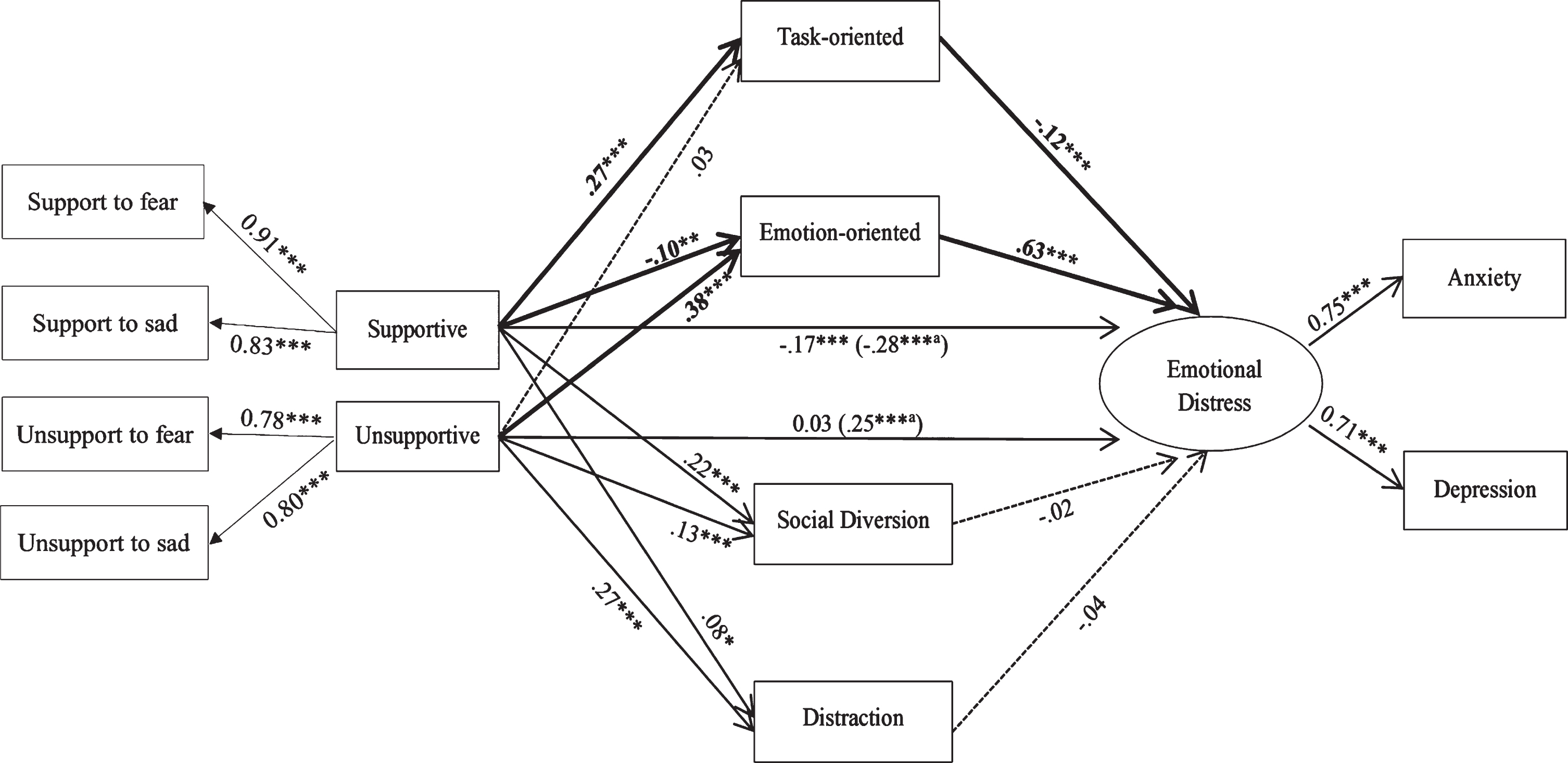
Coping styles as mediators between parental emotion socialization and emotion distress. Note: Bolded paths and coefficients indicate significant mediating paths. Dashed lines indicate nonsignificant paths. a When mediators are not in the model. *p < 0.05, **p < 0.01, ***p < 0.001.
Direct Effect Model
In the direct effect model, supportive parental responses predicted less emotional distress (β= –0.28, p = 0.000), whereas unsupportive parental responses predicted more emotional distress (β= 0.25, p = 0.000).
Indirect Effect Model
In the mediation model (Fig. 1), supportive parental responses predicted greater use of task-oriented, social diversion, and distraction coping, and lower use of emotion-oriented coping. In addition, unsupportive parental responses predicted more emotion-oriented, social diversion, and distraction coping. In turn, lower use of task-oriented coping and greater use of emotion-oriented coping predicted more emotional distress, but the use of social diversion and distraction coping did not. Analyses of indirect effects revealed that greater use of task-oriented coping and lower use of emotion-oriented coping mediated the effect of supportive parental responses on lower emotional distress (task-oriented: B = –0.010, 95% CI = [–0.017, –0.004]; emotion-oriented: B = –0.019, 95% CI = [–0.033, –0.006]). The direct effect of supportive parenting was reduced in magnitude but remained significant (β= –0.17, p = 0.000), suggesting partial mediation. Additionally, greater emotion-oriented coping mediated the effect of unsupportive parental responses on greater emotional distress (B = 0.128, 95% CI = [0.097, 0.162]). The direct effect became non-significant (β= 0.03, p = 0.55), suggesting full mediation.
Multigroup Models
Gender Differences
Multigroup modeling did not show significant gender differences in the direct effect model (χ2 (8) = 2.647, p = 0.95). For the mediation model, multigroup modeling showed significant gender differences (χ2 (50) = 91.48, p < 0.001). Follow up tests (Table 3) indicated that unsupportive parental responses predicted more task-oriented coping in females (B = 0.41, p = 0.02), but not males (B = –0.13, p = 0.42). As a result, the indirect effect of unsupportive parental responses through task-oriented coping was only significant in females (Female: B = –0.008, 95% CI = [–0.020, –0.001]; Male: B = 0.002, 95% CI = [–0.003, 0.010]). The links between parental responses and the other coping strategies, or the links between coping and emotional distress, did not differ across gender.
Gender and Ethnic Differences in the Mediation Model
Note: Supportive - supportive parental responses to child emotions; Unsupportive - unsupportive parental responses to child. emotions; Task - task-oriented coping; Emotion - emotion-oriented coping; Social – social diversion coping; Distraction – distraction coping; Bolded items indicate stronger path coefficients. *p < 0.05, **p < 0.01, ***p < 0.001.
Ethnic Differences
Multigroup modeling did not show significant ethnic differences in the direct effect model (χ2 (8) = 5.18, p = 0.74). For the mediation model, multigroup modeling showed significant ethnic differences (χ2 (50) = 205.94, p < 0.001). Follow up tests (Table 3) indicated that supportive parental responses predicted less emotion-oriented coping in African Americans (B = –0.30, p = 0.001), but not in European Americans (B = 0.05, p = 0.59). As a result, the indirect effect of supportive parental responses through emotion-oriented coping was only significant in African Americans (African Americans: B = –0.028, 95% CI = [–0.045, –0.011]; European Americans: B = 0.005, 95% CI = [–0.014, 0.023]). Additionally, supportive parental responses predicted higher distraction coping in African Americans (B = 0.15, p = 0.01), but not in European Americans (B = –0.07, p = 0.32). However, the indirect effect of supportive parental responses through distraction coping was not significant in African Americans (B = –0.002, 95% CI = [–0.006, 0.001]). The links between parental responses and the other coping strategies, or the links between coping and emotional distress, did not differ across ethnicity.
Discussion
This study examined four types of coping as mediators of the relationship between parental responses to emotions and internalizing problems in late adolescence and emerging adulthood. Emotion-oriented coping and task-oriented coping emerged as mediators between parental responses and emotional distress. The links between parental responses and coping strategies, as well as the mediating effects of coping, were further moderated by gender and ethnicity.
The Mediating Role of Coping
Emotion-Oriented Coping
Emotion-oriented coping demonstrated the strongest mediating effect between parental responses to emotions and adjustment in the overall model, although in the follow up multigroup analyses this indirect effect was only significant in African American but not European American individuals. The results are consistent with the literature showing close relationships between emotion-oriented coping and both parental responses and emotional functioning (Compas et al., 2001). Unsupportive parental responses to negative emotions may signal to children that negative emotions are unwelcome or unacceptable, leading to self-blame and repression of emotions. Unsupportive parental responses to negative emotions may hinder the development of adaptive emotional regulation capacities (Katz et al., 2012), and, in turn, contribute to negative emotions and maladjustment. On the other hand, supportive parental responses may convey to children that negative emotions are acceptable, and can be appropriately expressed and regulated (Buckholdt et al., 2014). Therefore, children may develop better emotion regulation skills and rely less on emotion-oriented coping. As suggested by the current results, it is also possible that emotion-oriented coping is a general mechanism that may explain the effects of parental unsupportive responses to a variety of negative emotions on both externalizing and internalizing problems, which warrants further research.
Distraction Coping and Social Diversion Coping
Contrary to expectations, distraction coping and social diversion coping did not yield significant mediating effects in the overall model. Nevertheless, both supportive and unsupportive parental responses contributed to greater use of both distraction coping and social diversion coping. However, the nature of the two coping strategies may differ across the two types of parental responses. For instance, distraction coping corresponding to supportive parental responses may be accompanied by acceptance of the situation, which may result in task-oriented coping. On the other hand, distraction coping following unsupportive parental responses may involve denial or avoidance, which may result in more emotion-oriented coping. To the extent that distraction coping may encompass both adaptive and maladaptive aspects, it is not surprising that it was unrelated to emotional functioning in the present study. Additionally, prior research linking social diversion coping with better adjustment typically examined the effect of social diversion coping separately, without considering the effects of other coping strategies (Lipińska-Grobelny, 2011). By contrast, our results indicate that other coping strategies (e.g., emotion-oriented and task-oriented coping) may play a more important role in emotional outcomes.
The Moderating Role of Gender and Ethnicity
Gender Differences
Contrary to expectations, unsupportive parental responses to fear and sadness predicted more task-oriented coping in females. As a result, task-oriented coping served as a mediator between unsupportive parental responses and adjustment for females only. Although this finding is quite surprising, it suggests that the effect of unsupportive parental responses may not always be harmful for girls. In support of this line of reasoning, a recent study (Mirabile et al., 2016) found that supportive emotion socialization behaviors failed to predict better socioemotional competence among 5- to 6-year-old children, indirectly suggesting that the role of unsupportive parental responses may vary throughout the development for girls in a potentially dynamic way that needs to be further explored in future research. This interesting finding can also be interpreted in terms of gender differences in general resilience, with the literature suggesting that contrary to social expectations, females are generally more resilient in adversity environments (e.g., unsupportive parenting) than males (Kraemer, 2000).
Ethnic Differences
In terms of ethnic differences, emotion-oriented coping served as a mediator between supportive parental responses and adjustment for African Americans only. This finding may reflect differences in social norms, where African American youth may be socialized to be less emotional, perhaps because they encounter more uncontrollable stress (Goldmann et al., 2011). For example, one such uncontrollable stressful situation might be potential racial biases preexisting in the larger cultural environment during adolescents’ development. Indeed, research has found that African American parents socialize their children’s emotions to prepare them for racial bias regarding how others perceive their emotions (Dunbar et al., 2017). Further, supportive parental responses were associated with more distraction coping in African Americans only. This finding may also be related to socialization in the context of more chronically stressful and unpredictable environments, where African Americans may be socialized not to deal directly with stressors. Finally, few ethnic differences emerged in the associations between parental response to internalizing emotions and adjustment, suggesting similar processes in African American and European American families.
Implications
The present study contributes to the understanding of theoretical mechanisms and the development of effective interventions. The findings suggest that parental responses to internalizing emotions may help foster specific coping strategies, which may in turn promote or hinder emotional adjustment. Thus, existing intervention programs for emotion socialization practices may be further improved by including components focusing on coping skills. Furthermore, the present study highlights the need to examine emotion socialization from a gender- and culture-specific perspective. The stronger role of specific parental emotion socialization in coping and emotional functioning of girls vs. boys and European American vs. African American youth suggests that some parental strategies may be more effective in specific subgroups of youth. Additionally, better understanding of gender role socialization and the cultural and socioeconomic contexts of parenting may help shed light on gender and ethnic differences in coping strategies acquired by youth through emotion socialization practices.
Limitations and Future Directions
Findings of this study should be considered in light of its limitations. First, due to the cross-sectional nature of the study, no causal inferences about the relationships studied could be made. Although the evidence supported hypothesized effects from emotion socialization to coping to emotional functioning, it is also possible that emotional functioning influences coping and parental responses to emotions. Second, all variables were reported by the youth, which may have inflated the studied relationships. Third, our measure of parental responses did not distinguish between caregivers (e.g., mothers versus fathers), who might play different roles in the emotion socialization processes (Miller-Slough, Dunsmore, Zeman, Sanders, & Poon, 2017). Fourth, alternative emotion socialization strategies may exist. For example, some cross-cultural studies found reflection-enhancing parental responses that encourage children to self-reflect on the causes and consequences of one’s behaviors (Chan, Bowes, & Wyver, 2009; Wang, 2006). Finally, we focused on the ethnic differences between European American and African Americans; other ethnic groups should be examined in future research.
Conclusion
This study provided a comprehensive examination of coping styles as mediators of the effects of parental emotion socialization on internalizing problems in late adolescence and emerging adulthood. The results showed that emotion-oriented and task-oriented coping mediated the effects of parental responses to emotions on internalizing problems. Some of the paths from parental responses to coping varied across gender and ethnicity, suggesting an important role of gender and culture in parental emotion socialization effects.
Footnotes
Acknowledgments
This work was supported by the National Institute of Mental Health of the National Institutes of Health [grant number R01MH098348; S.M. & D.C.K.].