



Abstract
Self-regulation and social cognition flourish as children begin school and engage with a new social environment. At the same time, this novel setting provides more complex social situations that children must navigate, including understanding when others may be lying to them. Social cognition and self regulatory abilities, such as Theory of Mind (ToM) and executive function (EF) respectively, may aid children in understanding such advanced social situations by helping children consider others’ viewpoints and focus on problem solving (Garte, 2016; Kultti & Pramling, 2015; Winsler, Fernyhough, & Montero, 2009). In order to investigate these possible relations, children between the ages of 3 and 5 (N = 92, M = 51.42 months, SD = 8.86, range = 37 to 69 months; 49 males; 38 3-year-olds, 31 4-year-olds, 23 5-year-olds) completed a battery of EF skills, ToM, and implausible lie detection measures. Results indicated that EF skills significantly predicted implausible lie detection, over and above both age and ToM. Findings are discussed in terms of the unique contribution that self-regulation skills, such as EF, make to young children’s blossoming implausible lie detection ability.
Keywords
The ability to appropriately and effectively interact with others hinges on early social cognition skill development (Garte, 2016; Kultti & Pramling, 2015; Winsler, Fernyhough, & Montero, 2009). When children enter preschool, their social world expands with the addition of social interactions with peers and teachers. Sometimes these interactions are more complex and ambiguous than children have previously experienced at home with their caregiver, requiring more sophisticated knowledge. Hence, preschooler’s social interactions may rely on their newly developing self-regulation and social cognition because of the increased opportunity to engage with others and find solutions to these social situations (Garte, 2016; Kultti & Pramling, 2015; Winsler, Diaz, Atencio, McCarthy, & Adams Chabay, 2000; Winsler et al., 2009).
Self-regulation and social cognition are broad terms used in a variety of ways in the literature. In his foundational work, Vygtosky examined self-regulation skills, defining them as cognitive processes that have origins based in social interaction. One example of self-regulation skills is executive functions (Fernyhough, 2010; Vygotsky, 1930-1935/1978). Likewise, social cognition is a broad term that encompasses a child’s ability to understand social cues and react appropriately, including abilities like Theory of Mind, as well as more advanced skills like deception detection (Lee & Cameron, 2000; Wellman, 1990). Contemporary researchers have expanded our understanding of these concepts by showing that children enhance their mental functions through increasingly complex interactions with others. One example of a more complex interaction that is less commonly addressed in the extant literature would be a situation that involves deception (Gopnik & Wellman, 2012; Wellman, 1990).
Overall, the number of studies in the literature concerning a child’s deception detection ability are sparse in comparison to those that examine related constructs, such as lie-telling or more general metacognitive abilities (e.g., false belief). Furthermore, the studies that have examined this detection skill report mixed results (Eskritt & Lee, 2017; for reviews see Mills 2013; Talwar & Crossman, 2012). For example, there are discrepancies in the type of lie used in the deceptive situation: Some have participants judge a video of a child saying whether or not they illicitly peeked in a game (e.g. plausible lies; Talwar et al., 2009), whereas others use fantastical creatures as the scapegoat for a deceptive task (e.g. implausible lies; Lee, Cameron, Doucette, & Talwar, 2002).
Previous studies exploring deception detection in preschool age children consistently use implausible lie tasks, wherein children must understand the distinction between fantasy and reality in order to successfully detect a lie (Lee et al., 2002; Talwar et al., 2009). Thus, the implausible lie task is an ideal choice for preschoolers because their understanding of the fantasy/reality distinction is intact (for reviews, see Harris, 2000; Woolley, 1995, Woolley & Ghossainy, 2013). As one would expect, research shows a developmental progression in children’s ability to detect implausible lies between the ages of 3 and 5 (Lee et al., 2002; Nancarrow, Gilpin, Thibodeau, & Farrell, 2018). In contrast, research with young children using plausible lies has shown that their detection of lies does not improve significantly over chance in this preschool age range (Feldman & White, 1980; Morency & Krauss; 1982; Talwar et al., 2009), as detecting plausible lies goes beyond just being able to distinguish between fantasy and reality and requires a considerable amount of sophisticated facial emotion knowledge (i.e., facial expressions that signal lying). Thus, to examine developmental progressions of implausible lie detection ability and related skills, the current study used an implausible lie task rather than a plausible lie task.
Of the few studies that have examined implausible lie detection, even fewer have looked at cognitive skills that might be related to this ability and its development (Nancarrow et al., 2018). We speculate that preschoolers acquire a fragile understanding of implausible lie detection as a result of their existing social cognition. Research has also shown that social cognition aids children in cultivating their self-regulation (Garte, 2016; Kultti & Pramling, 2015; Winsler et al., 2000; Winsler et al., 2009), which are necessary for more advanced social interactions. Thus, a good way to explore possible foundations of the development of implausible lie detection is to examine self-regulation and social cognition together as predictors of development for implausible lie detection.
The social cognition literature shows that young children rely on their verbal communication skills to determine how to evaluate a statement for its veracity (Lee & Cameron, 2000). The ability to gauge the veracity of a statement reflects a child’s understanding of another person’s mental state or knowledge, i.e., Theory of Mind (ToM), an ability that has consistently been shown in the literature to be established by the age of 4 (for a review see Wellman, 1990). ToM is an umbrella term that encompasses a child’s ability to understand his/her own mental states and appreciate that others have their own, possibly differing, mental states (Wellman, 1990, 2014). Young children with older siblings oftentimes have a head start on developing these abilities as they are interacting with peers consistently from a younger age (Cassidy, Fineburg, Brown, & Perkins, 2005). However, once in school, all children are required to work with other people and experience situations where people have different opinions, which requires them to use their ToM to navigate these increasingly complex social interactions (Wellman, 1990; Wellman, Fang, & Peterson, 2011; Wellman & Liu, 2004). As expected, previous research has shown that ToM abilities (e.g. having the understanding that others’ beliefs can be false) and implausible lie detection are related (Nancarrow et al., 2018; Young, Bernstein, & Iarocci, 2010).
An additional cognitive skill that develops concurrently (from ages 3–5) that encompasses self-regulation and may be implicated in implausible lie detection is executive function (EF) skills (Evans & Lee, 2011; Mills, 2013). EF skills facilitate a person’s cognitive control and allow for the cessation and replacement of automatic responses with ones that are more adaptive or goal oriented (Carlson, 2005). Some examples of EF skills are working memory, inhibitory control, and cognitive flexibility (Miyake et al., 2000; St Clair-Thompson & Gathercole, 2006). Early in development these fragile skills are interdependent, which makes it difficult to distinguish a 3-year-old’s individual skill at one type of EF from another (e.g., distinguishing inhibition from working memory; Baptista et al., 2017; Hughes et al., 2000; Hughes & Ensor, 2008; Lee, Bull, & Ho, 2013; Miyake et al., 2000; Prager, Sera, & Carlson, 2016; Wiebe, Espy, & Charak, 2008). EF skills are building blocks that enable higher order thinking, both cognitively and socially (e.g., math ability, social competence; Cassidy, 2016; Eisenberg, Hofer, & Vaughan, 2007; Prager, Sera, & Carlson, 2016).
These self-regulatory mechanisms combine with other skill sets to advance social behavior and understanding. For example, having the ability to inhibit one response and say another enables a child to take another’s perspective and understand that beliefs may be false (Carlson, Claxton, & Moses, 2015; Carlson & Moses, 2001; Gombos, 2006). In this vein, EF skills may help with understanding more sophisticated social situations, including when someone else tells a lie. This is achieved by inhibiting a more automatic response of simply accepting what is being said, and instead: (1) pausing and (2) refocusing attention on what was said and then (3) evaluating its consistency with your own knowledge (Evans & Lee, 2011, 2013; Lee et al., 2002; Talwar & Lee, 2002b). In support of the idea that EF skills may aid in social situations, previous research on EF skills and deception show that the sophistication of lie-telling is related to EF skills in older children (e.g. telling a direct lie versus feigning ignorance; Alloway et al., 2015; Evans & Lee, 2011). Thus, being able to detect deception, and thus understand a sophisticated social situation, may also benefit from stronger EF skills. The present study aimed to examine the relationship between EF skills and implausible lie detection in preschool aged children when these abilities are beginning to emerge. Gaining knowledge about this relationship will provide important information about the foundation of this social cognition task, which could lead to helping children who struggle with complex social situations.
Specifically, the primary aim of the present study was to examine how abilities, namely ToM and EF skills, relate to success in detecting implausible lies. By exploring EF skills and ToM as possible correlates of this detection deception, this study aims to lay the foundation for future longitudinal work to explore implausible lie detection’s development. Specifically, we hypothesized that ToM and EF skills will additively predict a child’s ability to detect implausible lies, such that both ToM and EF skills are positively related to implausible lie detection.
Materials and Methods
Participants
One hundred children ages 3–5 and their teachers were recruited from seven preschools and 25 classrooms in the Southeastern United States. The large number of classrooms prevented the nesting of data provided by teachers. An a priori decision was made to exclude any participants whose vocabulary scores were lower than the 20th percentile to ensure that participants had sufficient language skills to understand task directions (n = 3). Additionally, any participants who scored greater than three standard deviations outside the mean on any measure or were missing at least one complete measure were excluded from the analyses (n = 5). Thus, data from 92 typically developing children (M = 51.42 months, SD = 8.86, range = 37 to 69 months; 49 males; 38 3-year-olds, 31 4-year-olds, 23 5-year-olds) were included in analyses. Ninety-four percent of the children were Caucasian.
Measures
Implausible Lie Detection Measure
The implausible lie detection task was adapted from the implausible lie task by Lee and colleagues (2002). For this task, an adult confederate sat reading a book with a monster on the cover, while the experimenter read another book aloud with the participant, with no other people in the room. After reading, the experimenter placed a pencil on the table and asked the participant if they want to take a walk in the hallway before playing the next game. While the participant was gone, the confederate switched the regular pencil with an identical but broken pencil. The experimenter then returned with the participant and said, “Oh no! What happened to the pencil?” The confederate claimed that the monster on the cover of the book jumped out of the book, picked up the pencil and dropped it, thus breaking it. The experimenter did not respond to the confederate, and the confederate then said, “Okay well I have to go now. See you later!” and left the room. Following that, the experimenter asked the child, “Who do you think broke the pencil?” If the participant said that the confederate broke the pencil, they were given a score of 1. If the participant said anyone other than the confederate broke the pencil, including that they did not know who broke the pencil, they were unable to successfully detect the implausible lie and thus given a score of 0. Inter-relater reliability was not considered in this context, as it was clear that the participant either said the confederate broke the pencil, or something else. Anything said other than the confederate was counted as incorrect, which was an explicitly clear guideline for the research assistants.
EF Measures
Inhibitory control and short-term memory were measured in an EF battery. In order to assess inhibitory control, the Grass/Snow task (Gerstadt, Hong, & Diamond, 1994) was used. This Stroop-like task assesses how well children can inhibit an automatic response in order to say something else. They were presented with a picture of grass and a picture of snow. The experimenter said either “grass” or “snow” and the child was supposed to then point to the picture that is the opposite of whatever the experimenter says, thus inhibiting the more automatic response of pointing to the picture that is the same as what is said. For every correct answer, the child got one point, and no points were given for incorrect answers. If a child self-corrected, meaning they initially pointed to one but then corrected themselves before the next question is read, they got a half a point. Higher scores indicated better inhibitory control performance on this task.
Forward Digit Span (Davis & Pratt, 1996) was used to assess short-term memory. At this young age, this task has been used in previous literature as a precursor measure of working memory, which is another EF skill (Best & Miller, 2010; Gathercole, Pickering, Ambridge, & Wearing, 2004; Slot & von Suchodoletz, 2018; Thibodeau, Gilpin, Brown, & Meyer, 2016). For this task, the experimenter spoke a certain number of digits (0–9), beginning with 2 digits, and the child was asked to repeat them back to the experimenter. If the child was correct, the next string of digits would be one digit longer than the last. This process continued until the child incorrectly repeated the numbers back two times in a row. The longer the string of numbers remembered, the better the short term memory performance on this task.
Theory of Mind Questionnaire
The Children’s Social Understanding Scale - Short Version (CSUS; Tahiroglu et al., 2014) contained 18 questions on a 4-point Likert scale, with 1 indicating “definitely untrue” and 4 indicating “definitely true.” Teachers were asked to assess a child’s ToM ability and social understanding. Higher scores indicate stronger ToM. This scale was originally designed for parent report but can be used for teacher report with minor wording changes (e.g., “this child” in lieu of “your child”; D. Tahiroglu, personal communication, July 6, 2018). Internal consistency (Cronbach’s alpha) for parent report is a = .89 (Tahiroglu et al., 2014) with data from the current study’s teacher reports having an internal consistency of a = .91.
Vocabulary measure
The NIH Toolbox Picture Vocabulary Test (NIH Toolbox Cognition Assessment; Weintraub et al., 2013) was used to measure children’s receptive vocabulary. This measure has good psychometric properties with a reliability rate of 90% (NIH Toolbox Cognition Assessment; Weintraub et al., 2013). Participants played a game on an iPad where they were shown four pictures on a screen. The program said a word and instructed children to select the picture on the screen that represented that word. The task used computer adaptive testing to quickly identify the participant’s skill level (Weintraub et al., 2013). Higher scores indicate better receptive vocabulary performance. The sole purpose of this measure was to ensure that participants understood task instructions; thus, those with scores lower than the twentieth percentile were excluded from all analyses.
Procedure
Participants for this study were individually interviewed in a private testing room at the school for one 30-minute period. The Institutional Review Board of the university gave this study approval prior to the data being collected, showing ethical approval, and all research assistants were blind to the purpose of the study. Five trained research assistants conducted the direct assessments with the children –all were trained on administering the measures and had to pass a fidelity check with a 90% accuracy score or higher before going out to the preschools to test participants. Before testing began, each participant gave verbal assent with parents providing written consent. The measures were administered in a fixed order, based on past research that shows that research involving individual differences should avoid counterbalanced designs (Carlson & Moses, 2001). For this study’s battery, children were assessed first on a polite lie task (Williams, Moore, Crossman, & Talwar, 2016), then inhibitory control, followed by short-term memory, next the implausible lie detection task, then NIH picture vocabulary task and ending with a basic lie task (Talwar & Lee, 2002a). Note that the polite lie and basic lie tasks did not produce viable results because over half of the children did not lie. Thus, these measures are not considered in future analyses. Participants received a small prize or sticker for their participation in the study. Teachers also completed the Children’s Social Understanding Scale (CSUS; Tahiroglu et al., 2014) once the child direct assessment had been completed. Data collection took place at the end of the school year, so all teachers knew the children for at least nine months.
Results
Preliminary Analyses
All analyses were conducted in the Statistical Package for Social Sciences (SPSS; Version 25). Descriptive statistics for the variables used in analyses are provided in Table 1.
Descriptive Statistics
A composite variable was created for the EF scores, as is typical in the preschool EF literature. Composites of EF batteries typically show more reliable estimates of performance in the preschool years because at this early age there is less distinction between specific types of EF as much as a general measure of EF (e.g. Baptista et al., 2017; see introduction for full references). Additionally, previous research supports the idea that EFs in the preschool years are best represented by response inhibition and memory skills combined (Lerner & Lonigan, 2014; Lonigan, Lerner, Goodrich, Farrington, & Allan, 2016; Montoya et al., 2018). In order to calculate the EF composite, the scores for inhibitory control and short-term memory were converted into z scores. From there, each participant’s z-score for the two measures was added together to create a composite score.
Table 2 provides correlations between the variables of interest, including: age, EF composite, ToM, and implausible lie detection. Prior to the main analyses, all assumptions for hierarchical logistic regression were checked and met. Additionally, an Intra-Class Correlation value was performed to ensure nesting was not an issue for the ToM measure. This measure met the guideline in the extant literature by having a value below.10 (Robson & Pevalin, 2015).
Correlations Between Variables of Interest
**p < .001; *p < .01. Note: STM = short term memory, IC = inhibitory control.
Predictors of Implausible Lie Detection
Hierarchical logistic regression using Akaike’s Information Criterion (AIC) to select the best-fit model to predict implausible lie detection showed that EF skills were the strongest predictor of implausible lie detection success while controlling for age. ToM was a non-significant predictor but still explained enough variance to be included in the best-fit model with an AIC value of 104.17, compared to the age-only AIC value of 107.33. In a statistical comparison, the difference of 3.16 suggests strong support that the full model is a better fit than the age-only model (Burnham & Anderson, 2004). Additionally, this full model had a Bayes factor of.20, which indicates positive or substantial support for this model selection (Jarosz & Wiley, 2014). No significant interactions were found. Thus, age and EF, and to a lesser extent, ToM, were additive, positive predictors of implausible lie detection in the final model. Details of the model are included below in Table 3. The overall model was significant, X2 (3) = 27.63, p < .001. The results are shown graphically in Fig. 1’s sigmoidal curves. For the purpose of the figure only, we split the participants into thirds, using the lowest, middle, and highest third as groups in order to better visualize the difference in implausible lie detection.
Hierarchical Logistic Regression Analysis Details
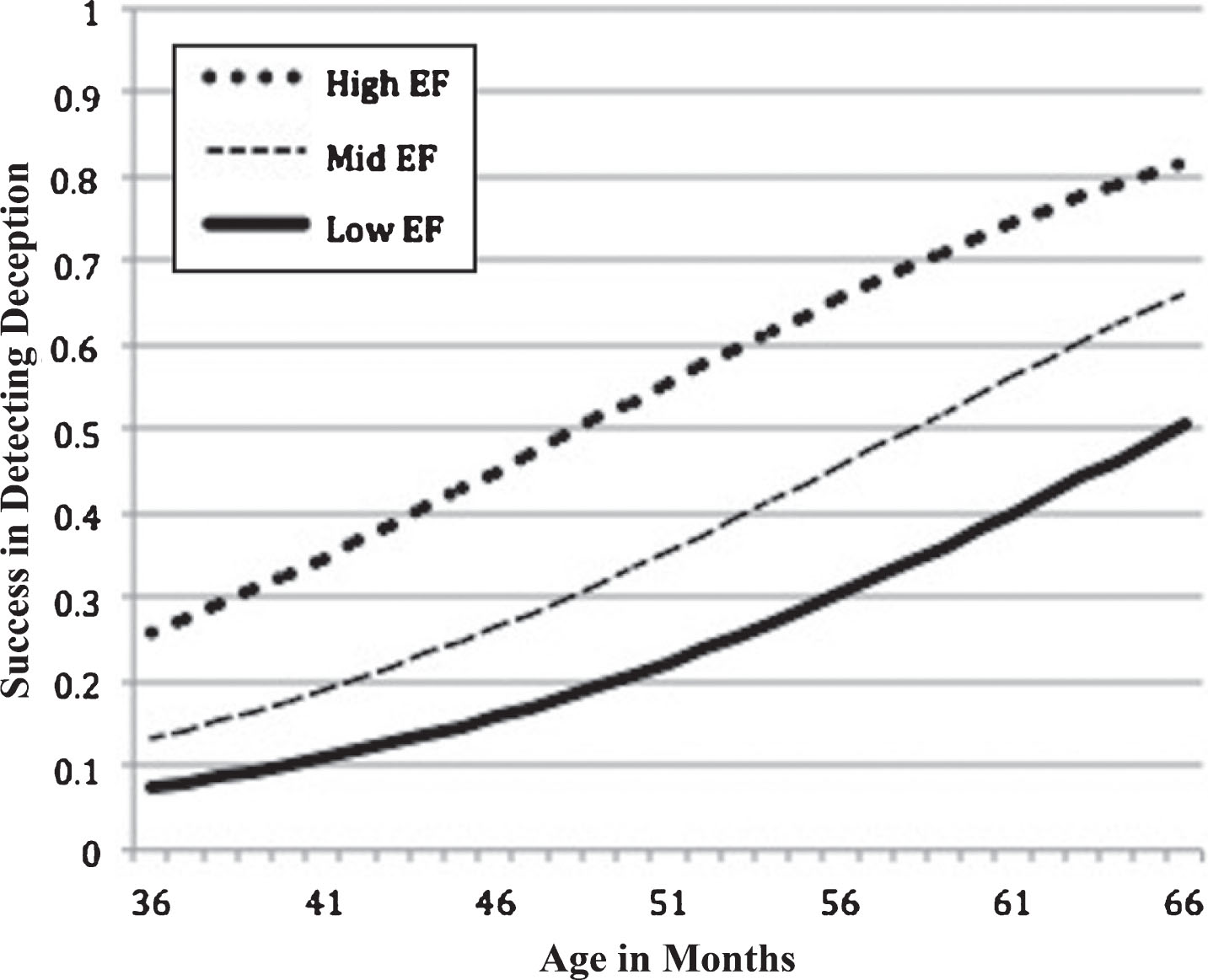
Hierarchical logistic regression results: Sigmoidal curves.
Discussion
Upon entering preschool, young children encounter more complex social situations that they must navigate. At the same time, children are developing social cognition and self-regulation abilities, such as ToM and EF. The present study aimed to examine if these abilities may help children navigate ambiguous social situations, such as deception. Specifically, we hypothesized that EF skills and ToM, would additively, positively predict implausible lie detection over and above age. The results confirmed that EF skills were a significant, positive predictor of implausible lie detection success. This finding suggests that a component of self-regulation is related to a child’s developing ability to process an ambiguous social situation. These EF skills may help a child detect implausible lies by inhibiting their initial reaction to the statement and then remembering it while comparing it to their existing knowledge to determine if the statement is veridical.
This study adds to the growing literature on the development of social cognition by addressing a common yet complex social situation, deception. Nonetheless, there were limitations to this research. It is important to note that the measure of implausible lie detection used in the present study, and throughout the literature, is a binary measure. A binary measure can capture less variance in how the child detected the lie. Additionally, this measure only uses one item to capture whether or not the child successfully detected the implausible lie. Other measures of lie detection (e.g. those used with adults) often have multiple questions to clarify the participant’s detection of a lie (Gray, 2011; Lui & Rosenfield, 2008). This gives us an inability to know whether or not the child was unsuccessful due to the specific question asked, or due to a genuine inability to detect an implausible lie. However, Lee and colleagues’ (2002) implausible lie task is the only one we are aware of that exists in the extant literature for children between the ages of 3 and 5. Thus, researchers should work to create a more thorough and encompassing measure of implausible lie detection for young children in future studies, including aspects such as how sure the child is in the lie detection.
In addition to creating new lie detection measures, future studies should also examine other advanced abilities that also may be related to the development of EF. For example, self-regulation may predict a child’s developing understanding of intentionality. Related to deception, when someone’s intention is not aligned with his/her action, discovering the true intention becomes complex. EF skills may be related to understanding intentionality by allowing the child to inhibit their immediate interpretation of intention that aligns with the action, and compare it to their existing knowledge about the person’s goals. Similarly, researchers are currently investigating the interactive development of EF and social problem solving skills, such as negotiating a solution when there is a conflict between peers (Bierman & Torres, 2016; Carlson, Claxton, & Moses, 2015; Greenberg, 2006). This growing area of research fits nicely with the current finding that EF skills significantly contributed to implausible lie detection success.
In contrast, ToM was not as strong of a predictor of implausible lie detection, yet still explained enough variance to be included in the best fit model according to AIC. Yet, previous research indicated that false belief understanding, which is a fundamental aspect of ToM, is related to implausible lie detection success (Nancarrow et al., 2018; Young, Bernstein, & Iarocci, 2010). Nonetheless, it was not a significant predictor in the current study. This could be due to the fact that basic ToM understanding usually does not solidify in children until around the age of 4 (Wellman, 1990, 2014), and about a third of the participants in the present study were younger than that. Additionally, the usage of a teacher report rather than a direct child assessment may explain this unexpected finding. Teachers are effective adult informants because they have a great deal of experience with children, spend a lot of time with them, and have many children to compare each child to when reporting (Kunter & Baumert, 2006; Pua, Lee, & Rickard Liow, 2017). However, teacher report has the potential to be biased based on children’s behavior in the classroom (Berg-Nielsen, Solheim, Belsky, & Wichstrom, 2012; Botting, Conti-Ramsden, & Crutchley, 1997; Clarizio, 1992). In this study, teacher report of ToM was specifically selected because it provided a more detailed, six-faceted application-based definition of ToM (i.e., belief, knowledge, perception, desire, intention, and emotion; Tahiroglu et al., 2014) rather than most ToM child direct assessments that are single task, and often dichotomously scored (i.e., false belief), or a more lengthy and taxing ToM scale, such as Wellman & Liu (2004). Given the unexpected findings, future research might use both a child direct assessment as well as parent/teacher report to evaluate a broader scope of ToM performance and application.
Conclusions
This study is the first step in examining relations between regulatory abilities and the development of implausible lie detection. Given the correlational nature of these findings, future research should employ a longitudinal and/or intervention design to further elucidate the directionality and causality of these potential mechanisms on developing social cognition. Future longitudinal data could inform both our general social cognition knowledge, as well as specific knowledge about how to improve treatments for people who are less socially adept and who struggle with advanced social situations like those involving deception.
Indeed, there are many intervention programs that already incorporate abilities such as EF or ToM in their curriculum (Fuchs et al., 2005; Passolunghi, Vercelloni, & Schadee, 2007; Welsh, Nix, Blair, Bierman, & Nelson, 2010). For example, Tools of the Mind incorporates activities that activate children’s EF skills by encouraging attention, problem solving, planning and remembering (Bodrova & Leong, 1996). Additionally, there are also numerous clinical programs that focus on ToM training in children, such as programs for children with autism (Beaumont, Rotolone, & Sofronoff, 2015). Now researchers are beginning to design similar training programs for typically developing children in order to advance ToM in middle childhood (Bianco & Lecce, 2016; Lecce, Bianco, Devine, Hughes, & Banerjee, 2014).
Based on the results of this study, future interventions might explore incorporating socially complex or ambiguous situations, such as implausible lie detection, to their programs to help young children navigate more intricate social interactions. Future research should also examine these relationships in a more diverse population, including those who are at risk for delays in social cognition development. By exploring complex social scenarios and expanding children’s awareness of people’s behaviors and intentions, children’s social cognition may improve. Additionally, children’s ability to pay attention to a problem and find solutions helps them work through more complex social situations. Together, self-regulation and social cognition enable a child to more successfully interact with others, and may help even when they encounter new and more ambiguous social situations.