




Abstract

Sexting is recognized as a common public issue as well as a prominent issue among researchers. Authors usually define sexting as sending, receiving, or forwarding sexually explicit messages or nude, partially nude, or sexually suggestive digital images of one’s self or others via a cell phone, e-mail, Internet, or Social Networking Service (Brown, Keller, & Stern, 2009; Calvert, 2009; Corbett, 2009; Dilberto & Mattey, 2009; Halder & Jaishankar, 2014; Jaishankar, 2009; Walker & Moak, 2010).
The prevalence of sexting behaviors increases with the spread of new technologies (Bianchi, Morelli, Nappa, Baiocco, & Chirumbolo, 2018). A recent systematic review and meta-analysis of 39 studies (Madigan, Ly, Rash, van Ouytsel, & Temple, 2018), conducted between 2008 and 2016, examining the prevalence of sexting among adolescents, reported that prevalence of sending and receiving sexual explicit content ranged from 14.8% to 27.4%, and forwarding content without authorization to about 12%. The prevalence of sending nude photos decreases significantly, and in linear manner, across increasingly older age groups from 19 to 24 years to 50+ years of age (Wysocki & Childers, 2011).
A review of the literature clearly shows that there are two different ways of “understanding” sexting. One group of authors describes sexting as a contemporary form of intimate communication between young people (Döring, 2014; Hudson & Marshall, 2018). Accordingly, their view seems to be supported by the fact that other authors state that sexting is “normal” in adolescents’ relationships (Mitchell, Finkelhor, Jones, & Wolak, 2012), or represents consensual behavior in which both sides participate without coercion (Hasinoff, 2013; Levine, 2013). According to other researchers, sexting is related to certain risk factors, but also negative outcomes. Sexting is sometimes used as a tool for blackmailing young people (Kopecký, 2014) or even as a tool for revenge on ex-partners (Walker, Sanci, & Temple-Smith, 2013).
Young people who engage in sexting have a higher risk of engaging in risky sexual behaviors (Gordon-Messer, Bauermeister, Grodzinski, & Zimmerman, 2013). Further, sexting is more common among young people from dysfunctional families (Gordon-Messer et al., 2013) and in young people with certain character traits, such as extroversion and neuroticism (Delevi & Weisskrich, 2013). More recently some authors have mentioned that dysfunctional styles of emotion regulation may be an important predictor for risky behavior, including sexting (Cooper, Quayle, Jonsson, & Svedin, 2016).
Emotion regulation is most widely defined as the process by which individuals influence emotions, and how they will experience and express emotions (Gross, 1998). However, recently other authors (e.g. Gratz, Weiss, & Tull, 2015) argued that defining emotion regulation as a strategy of modulation emotions is too simplistic. Therefore, it was proposed a conceptualization of emotion regulation as ability to monitor, accept, and understand emotions (Gratz & Roemer, 2004). Cooper, Wood, Orcutt, and Albino (2003) have suggested that dysfunctional styles of regulating emotions and emotionally driven behaviors may be an important predictor of risky behaviors in adolescence. Adolescents who lack skills for dealing with their emotional experiences may be more likely to engage in risky behaviors in an effort to deal with their negative affect or block out their feelings.
The aim of this viewpoint is to examine the existing literature on sexting and emotion regulation. To our knowledge, there are no recent reviews specifically analysing evidence on emotion strategies or abilities among sexters. Looking at the studies that examine association between sexting and emotion regulation across all age categories provided basis for more definitive conclusions that cannot be drawn from the data based on a single study. Moreover, conclusion drawn from synthesis of data could be informative for future researchers and practitioners.
Relation between Sexting and Emotion Regulation Difficulties: A Review of the Literature
This systematic review was conducted following the principles set by the Preferred Reporting Items for Systematic Reviews and Meta-Analyses (PRISMA; Liberati, Altman, Tetzlaff, Mulrow, & Gøtzsche, 2009). The electronic literature search was carried out using the following databases: EbscoHOST (PsycINFO, PsycARTICLES), ERIC, ResearchGate, SCOPUS, and Web of Science database. The search included any combination of the following terms in the title, abstract, and keywords: sext*, sexting*, sex*, nude*, explicit*, image*, photo*, picture*, message*, video*, control*, rumination*, acceptance*, suppression*, problem solving*, avoidance*, reappraisal*, self-compassion*, emotion*, affect*, mood*, feeling*, regulation*; competence*, awareness*, and tolerance*. The search was performed in April 2019.
The inclusion criterion was that sexting and aspect of emotion regulation have been the main focus of the article. Editorials, commentaries, or letters to the editor were excluded from the search results, but we went through their references to check if we missed some published studies. No exclusion criteria were given for location, year of publication, and study design. For language, we restrained the search to English and language mastered by the authors (Croatian, German, and Italian). Overall, our electronic search yielded 56 records, and 29 duplicate results have been excluded (Fig. 1). After additionally excluding articles as summarized in Figure 1, four articles remained that have been included and reviewed. After a thorough and systematic search has been conducted, the classification framework was designed. Five major themes were identified and coded. Themes related to sex were coded from A (women) to B (male); those linked to age were coded with schemes as adolescents (A), adult (B), and both (C); methods themes were coded as computer-based (A) and (paper-and-pencil-questionnaire) survey, while themes related to measurement (sexting and emotion regulation) were coded as standardized instrument (A) or self-developed items (B). Two researchers analysed separately the content and after that checked for consistency. The classification framework is presented in Table 1.
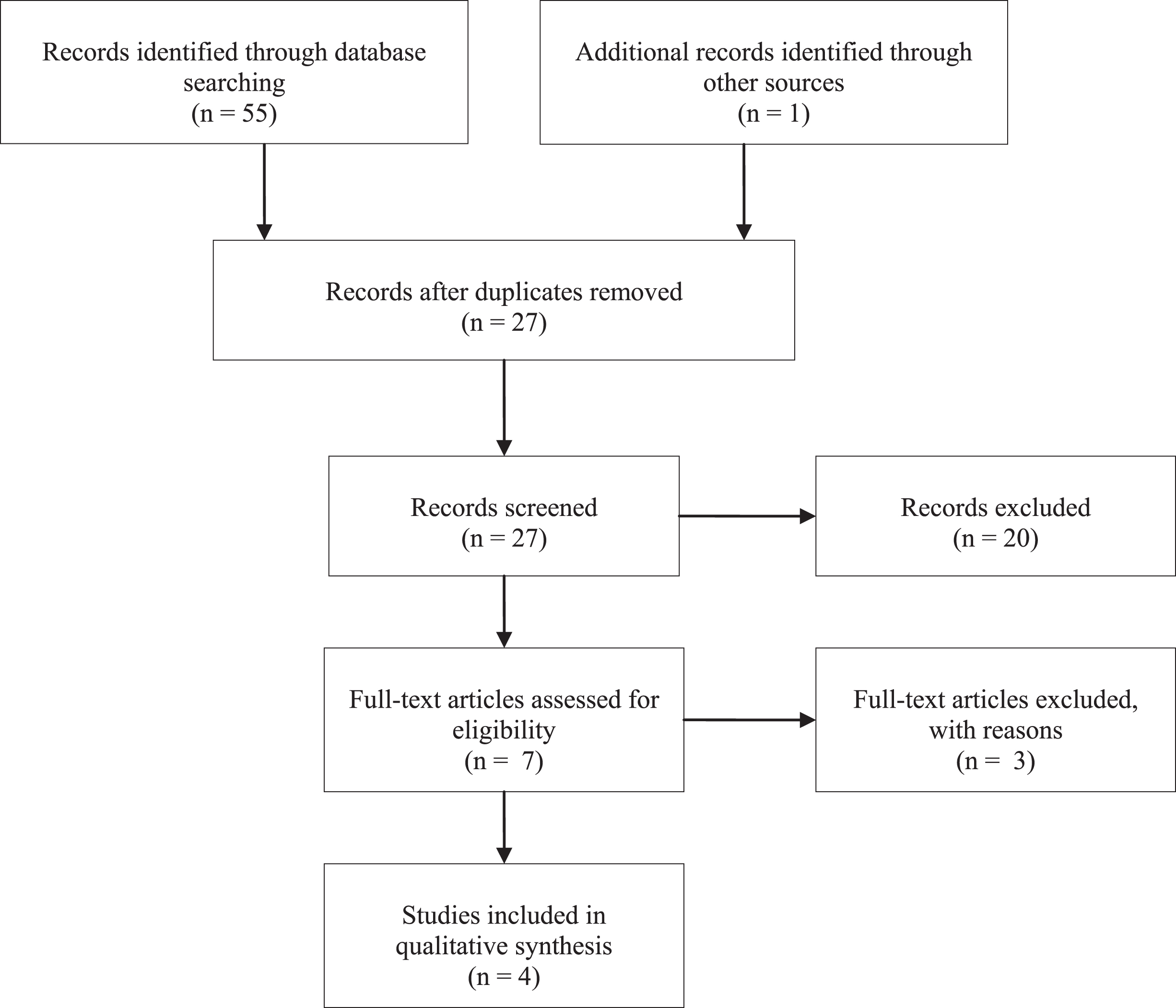
Flow of the studies selected through the review process.
Characteristics of Included Studies in the Systematic Review of Sexting and Emotion Regulation Difficulties
Four studies (Curro, 2017; Houck et al., 2014; Sesar & Dodaj, 2019; Trub & Starks, 2017) have examined the relation between sexting and emotion regulation. In sum, three of the studies, have indicated sexting to be related with difficulties in emotion regulation.
Of the four selected studies, two (Sesar & Dodaj, 2019; Trub & Starks, 2017) included a sample of young adults (18–29 years), one (Houck et al., 2014) a sample of early adolescents (12–14 years), and one (Curro, 2017) a variable sample including adolescents and adults (18–39). In one study (Trub & Starks, 2017) respondents were only women in intimate relationship, other included sex mixed samples, and there were no studies conducted on males only. All conducted studies were cross-sectional, whereas two (Houck et al., 2014; Trub & Starks, 2017) were computer-based studies while other studies followed a paper-and-pencil-approach. The majority of the studies measured sexting as sending, receiving, or publishing sexually explicit content (messages, images, and/or videos). In two studies authors used the Sexting Behavior Questionnaire (Curro, 2017; Sesar & Dodaj, 2019), in two others sexting was measured with four (Houck et al., 2014), or three self-developed items (Trub & Starks, 2017). Emotion regulation difficulties were mainly measured using Gratz and Roemer’s (2004) Emotional Regulation Scale (Curro, 2017; Houck et al., 2014; Trub & Starks, 2017). A subscale of the Emotional Regulation Scale (Gratz & Roemer, 2004) and the Self-Efficacy Questionnaire for Children (Muris, 2002) were used in Houck et al. (2014). The Emotional Regulation Questionnaire (Gross & John, 2003) was used by Sesar and Dodaj (2019) and the modified version of the Difficulties in Emotion Regulation Scale (Giromini, Velotti, de Campora, Bonalume, & Cesare Zavattini, 2012) by Curro (2017).
Relation between Sexting and Emotion Regulation Difficulties: Research Limitations
Our review identified a number of limitations in the research of sexting and related emotion regulation difficulties. Several methodological issues must be interpreted as serious limitations: a) differences across studies in sampling which represent difficulty in comparing data; b) cross-sectional studies cannot clarify questions regarding causality; c) studies used different methods to gather information about the relation between sexting and emotion regulation difficulties: some of the studies collected data through computer-based questionnaires, others used paper-and-pencil-questionnaires. While some studies examined sexting using only few items, others used multi-item-questionnaires. Regarding emotion regulation difficulties, various components of emotional regulation difficulties were examined – this limits the opportunity to compare different studies.
On the basis of these limitations, we identified five key issues in the process of conducting research with regard to sexting and emotion regulation difficulties. Sexting was measured very differently in the reviewed studies: Whereas some researchers used standardized self-assessment instruments (Curro, 2017; Sesar & Dodaj, 2019), others used direct items about participation in sexting (Houck et al., 2014; Trub & Starks, 2017). One of the main issues in research on sexting is related to the heterogeneity of defining and measuring sexting.
Additionally, age relevant issues have to be considered. The prevalence of sexting decreases significantly and linearly across increasingly older age groups from 19 to 24 years to 50+ years of age (Wysocki & Childers, 2011). Studies suggest that older adults are more motivated to regulate their emotions and are more effective at doing so than young adults (Birditt & Fingerman, 2005; Blanchard-Fields, Mienaltowski, & Seay, 2007; Carstensen, Pasupathi, Mayr, & Nesselroade, 2000). According to the socio-emotional selectivity theory (Carstensen, Isaacowitz, & Charles, 1999), older adults’ awareness that lifetime is shrinking motivates them to focus on the present, emphasizing goals related to emotional satisfaction and meaning. There is also evidence that older adults are more effective at regulating emotions. Their self-reported emotional control is higher than that of young adults (e.g., Gross et al., 1997; Lawton, Kleban, Rajagopal, & Dean, 1992), they report fewer interpersonal tensions (Birditt, Fingerman, & Almeida, 2005), and they use more effective emotion regulation strategies to deal with interpersonal tensions (Blanchard-Fields et al., 2007; Blanchard-Fields, Stein, & Watson, 2004). Thus issues related to age differences among sexting and emotion regulations skills should be taken into account in future studies.
For a more complete understanding of sexting and emotion regulation difficulties it is certainly necessary to consider gender issues. In a review of previous studies focused on individual determinants of sexting Sesar, Dodaj, and Šimić (2019) state that men engage in sexting more often than women. Shaming, social isolation, and other forms of punishment are frequent reactions on expressions of girls’ sexuality through the sexting. Women have a more developed ability to establish emotional communication with their environment, they are more successful in understanding their own emotions and the emotions of other people, and they act to a greater degree in accordance with their emotions (Van Deursen, Bolle, Hegner, & Kommers, 2015). Thus, it seems important to take gender differences into account when examining the relation between sexting and emotion regulations difficulties.
There are notable differences among the reviewed studies in the measurement of emotion regulation skills. Various aspects of emotion regulation were investigated which could have an effect on the comparison of studies. For example, two studies (Curro, 2017; Trub & Starks, 2017) reported that difficulties in controlling impulses is the underlying mechanism in sexting. A study conducted among early adolescents from a high-risk sample (Houck et al., 2014) reported that those who sexts showed less awareness of emotional states and less perceived self-efficacy in emotion regulation compared to those who do not sexts. In the study by Sesar and Dodaj (2019), examining the relation between sexting and two emotion regulation strategies (cognitive appraisal and expressive suppression), it was found that there is only difference in cognitive reappraisal between participant who post and who do not post sexually suggestive content. Thus, future studies should also come to a consensus regarding the measurement of components of emotion regulation. Gross and John (2003) distinguish two types of emotion regulation strategies: “antecedent-focused” and “response-focused“ strategies (Gross & John, 2003). Antecedent-focused strategies are regulatory processes occurring before the onset of an emotional reaction, while response-focused strategies occur after the emotional reaction is generated. Some of the frequently examined antecedent-focused emotion regulation strategies are: avoidance (situation selection), problem solving (direct situation modification), rumination (deployment of attention toward negative emotions), and reappraisal (changing the way of thinking about potentially emotion-eliciting situation). In the category of response-focused strategies we can distinguish the following: acceptance (active and conscious decision to accept situation), self-compassions (being caring and kind toward oneself in difficult situation), and suppression (inhibition of ongoing emotion behavior). With regard to effectiveness we can categorize the strategies as maladaptive (i.e., avoidance, rumination, suppression) or adaptive (i.e., acceptance, reappraisal, problem solving, and self-compassion) (Visted, Vøllestad, Birkeland Nielsen, & Schanche, 2018).
Conclusion
Although research activities on sexting are increasing, studies mainly focus on determining the prevalence of sexting or the relation between sexting and the consequences or motivation for sexting. Very few studies so far have addressed the relation between sexting and emotion regulation.
Our review of the literature and our own experience with conducting research in the field of sexting and emotion regulation have led us to identify several key considerations for researchers interested in conducting studies in the future. Most of the analysed studies suggested sexting might be viewed as a deviant behavior with negative consequences on development. However, as there are findings which do not assert emotion regulation difficulties among sexters we might believe that it could be a part of normal development. We might integrate the two views by defining sexting as deviant and normal behavior with regard to context and outcomes.