



Abstract
Due to a decline in diet quality during adolescence, youth are less likely to consume adequate nutrient dense foods to meet recommended requirements. Iron intake in particular is crucial for healthy physical and brain development in adolescence, but few studies have examined the role of iron intake in adolescents’ behavior problems. The current study examined the associations between iron intake and two types of behavior problems in early adolescents – aggression and rule breaking. The sample included 272 middle school students (Mage =12.08; 53% female; 47% Black, 37% White, 9% Hispanic, 6% other racial/ethnic group). Multivariate regression analyses adjusting for sociodemographic covariates revealed that higher iron intake was linked to lower aggressive behaviors (β = - .16, p < .05), but was not associated with rule breaking. These findings support the role of iron intake in healthy behavioral development in adolescence.
Introduction
Adolescence is a dynamic period of rapid change, which increases vitamin and mineral requirements to promote optimal growth and development. Iron needs increase during adolescence due to growth in muscle mass and blood volume, with iron also playing a critical role in brain development and neurochemistry (Donker et al., 2021). However, adolescents’ eating habits change in adolescence, with youth more commonly skipping breakfast and attending fewer family dinners, and thus missing opportunities to consume more nutritious foods than they have alone or with peers (Larson et al., 2013). As a result, diet quality typically declines during adolescence, with reduced consumption of nutritious foods that ultimately results in lower intake of essential nutrients, including iron (Cohen & Powers, 2024). In turn, lower iron intake puts individuals at risk for poor psychosocial functioning even without reaching anemia (Kim et al., 2015). Given the importance of iron intake in cognitive and behavioral functioning and the risk of low iron intake in adolescence, the current study examines the relationship of iron intake with behavior problems in early adolescence.
Compared to the well-established importance of iron for cognitive functioning (Jáuregui-Lobera, 2014), less is known about iron intake in relation to behavior problems, including different types of antisocial behavior. Nevertheless, the importance of iron for behavior functioning is suggested by longitudinal studies in infants and young children showing that 5 year old boys with iron deficiency had greater externalizing problems (aggression, rule breaking) at age 12 (Robinson et al., 2018). Further, infants with iron deficiency were at greater risk for general behavior problems in childhood and adolescence, whereas infants who received iron supplementation had fewer parent-reported conduct problems in adolescence (Doom et al., 2018). However, few studies have examined how iron intake during adolescence relates to distinctive types of antisocial behaviors, including overt antisocial behaviors such as aggression, and covert antisocial behaviors, such as rule breaking (e.g., theft, vandalism). Because diet is a modifiable behavior, understanding the role of iron intake in different types of antisocial behaviors would help identify intervention strategies to reduce behavior problems in adolescence.
Although prior studies support the causal role of iron in behavioral functioning of young people at risk for iron deficiency or behavior problems, the relevance of iron intake for behavior in a general population of adolescents has not been well studied. Yet such relationships can have long-term consequences, as both eating and behavior patterns that are established in adolescence likely persist into adulthood (Copeland et al., 2015; Movassagh et al., 2017). Thus, adolescents who consume a diet low in iron are at increased risk for continued iron deficiency into adulthood and thus may also be at risk for persistent behavior problems linked with low iron intake.
In summary, research demonstrates that iron intake during adolescence is critical for physical development (Mesías et al., 2013) and may have an impact on behavior (Kim & Wessling-Resnick, 2014). Specifically, low iron intake may contribute to externalizing behaviors, which often persist into adulthood (Fosco et al., 2019). However, few studies have examined the role of iron in behavior problems among adolescence, when diet quality begins to deteriorate (Lytle et al., 2000). Additionally, the role of iron in specific types of behavior problems, such as overt aggression vs. covert rule breaking, has not been addressed. Finally, many studies examining the role of nutrition in behavior only assess general diet quality rather than actual intake of iron or other nutrients (Kim et al., 2015), leading to limited precision. To address these gaps, the current study tested relationships between iron intake and both overt and covert behavior problems in early adolescence, adjusting for total caloric intake, BMI, and sociodemographic characteristics. It was hypothesized that youth that consume less dietary iron will engage in more aggressive behaviors and rule breaking.
Methods
Sample
The sample included 272 early adolescents (Mage = 12.08 years, SD = 0.44; 53% female; 47% Black, 37% White, 9% Hispanic, 6% Other, 1% unreported) and their primary caregiver participating in Wave 1 of the Adolescent Diet Study, a longitudinal study of adolescent health from 2019–2022. Students were recruited from 6th or 7th grade classrooms in 15 schools in the greater Birmingham, Alabama area of the United States. The sample was socioeconomically heterogeneous, with a median family income of $40,001-50,000 and median parent education being ‘some college’. The sample closely mirrored the demographic composition of the Birmingham metropolitan area.
Procedures
Trained project staff presented information about the study to students and distributed packets containing information about the study and consent forms. Signed parent consent and student assent forms were collected at school approximately one week later (45% participation rate). All data collection activities occurred at school during a regular school week, with trained research staff collecting 24-hour diet recalls each day. Parents completed confidential questionnaires online; paper copies were also available. Children and parents were compensated with gift cards for their time. University Institutional Review Board approved all study procedures.
Measures
Iron Intake
Dietary intake was assessed using assisted 24-hour dietary recalls covering seven consecutive days. On Friday, children were given a food diary to take home over the weekend to record all food and drinks consumed from Friday to Sunday. On Monday through Friday the following week, trained staff conducted individual daily interviews with each child to assess dietary intake during the previous weekend or day. These interviews utilized a standard protocol to estimate portion sizes. All foods and beverages collected from the dietary intake recalls were entered into Nutritionist Pro v 7.6. Average daily kilocalories and iron intake was calculated for each child across the week.
Behavior Problems
Youth self-reported on their behavior problems using the 16-item aggressive behavior subscale (e.g., I get into many fights; α = .84) and the 8-item rule breaking subscale (e.g., I steal at home; α = .60) of the Youth Self Report (Achenbach & Rescorla, 2014). For each item, youth indicated how true each statement was for them in the last six months (0 = Not true, 1 = Somewhat/Sometimes true, 2 = Very true/Often true). Items in each subscale were averaged with higher scores indicating more behavior problems. Cronbach’s alpha = .84 for the aggressive behavior subscale and.59 for the rule breakingsubscale.
Body Mass Index
Anthropometric measures were collected including height and weight of each child using standardized procedures. BMI was calculated using World Health Organization References 2007 SPSS macro package to calculate age and sex adjusted BMI z-scores (zBMI) (de Onis et al., 2007).
Demographic Characteristics
Parents reported their child’s sex (0 = male; 1 = female) and race/ethnicity, which was dichotomized (0 = Non-Hispanic white; 1 = Racial-ethnic minority). Parents also reported annual household income (13-point scale from 1=< $5,000 to 13> $90,000) and highest education completed (1=< 12 th grade/no diploma to 7 = Graduate or professional degree). Parent education and household income were standardized and averaged (r = .50, p < .001) to create a composite measure of family socioeconomic status (SES) that was used in the analyses.
Data Analysis
Descriptive statistics and distributions of all variables were examined using SPSS v.25. Pearson’s correlations were conducted to examine bivariate associations among key variables. Main analysis included a single multivariate regression model conducted in Mplus v.8.1. The model predicted aggressive behaviors and rule breaking behaviors from iron intake, adjusting for demographic characteristics, total daily kilocalorie intake, and BMI. Multiple students attended the same school, therefore (ICC = .67) the model accounted for clustering within schools.
Results
Descriptives and bivariate correlations for all variables are presented in Table 1. Scatter plots describing iron and behavior problems are also presented in Figs. 1 and 2. On average, youth consumed 10.38 mg (SD = 4.40) of iron per day which is slightly above the U.S. Recommended Daily Allowance (USDA & USHHS, 2020). Greater iron intake was associated with greater kilocalorie intake, lower zBMI, and non-Hispanic white race. Aggressive and rule breaking behaviors were moderately positively correlated with each other. Racial-ethnic minority youth reported more rule breaking behaviors and lower kilocalorie consumption compared to non-Hispanic white youth. Higher parent education was related to fewer rule breaking behaviors, lower zBMI and greater kilocalorie consumption. Family income was related to lower rule breaking and higher parentaleducation.
Descriptive Statistics and Correlations for Iron Intake, Behavior Problems, and Demographic Characteristics in Young Adolescents
Note. Milligrams (mg), z-score body mass index (zBMI); ∧ Spearman correlation. *p < .05, **p < .01.
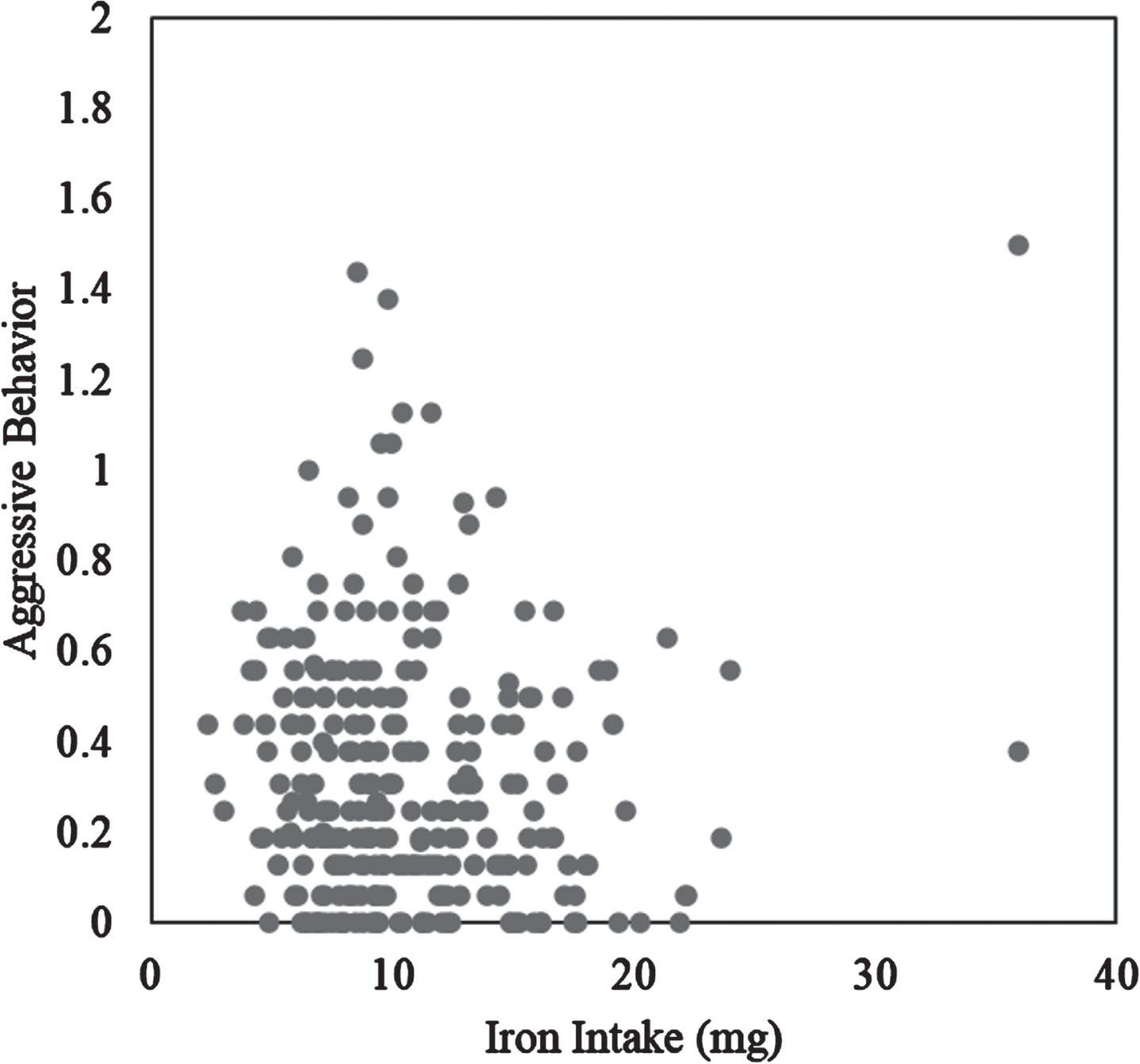
Scatter Plot of Iron Intake and Aggressive Behavior in Young Adolescents
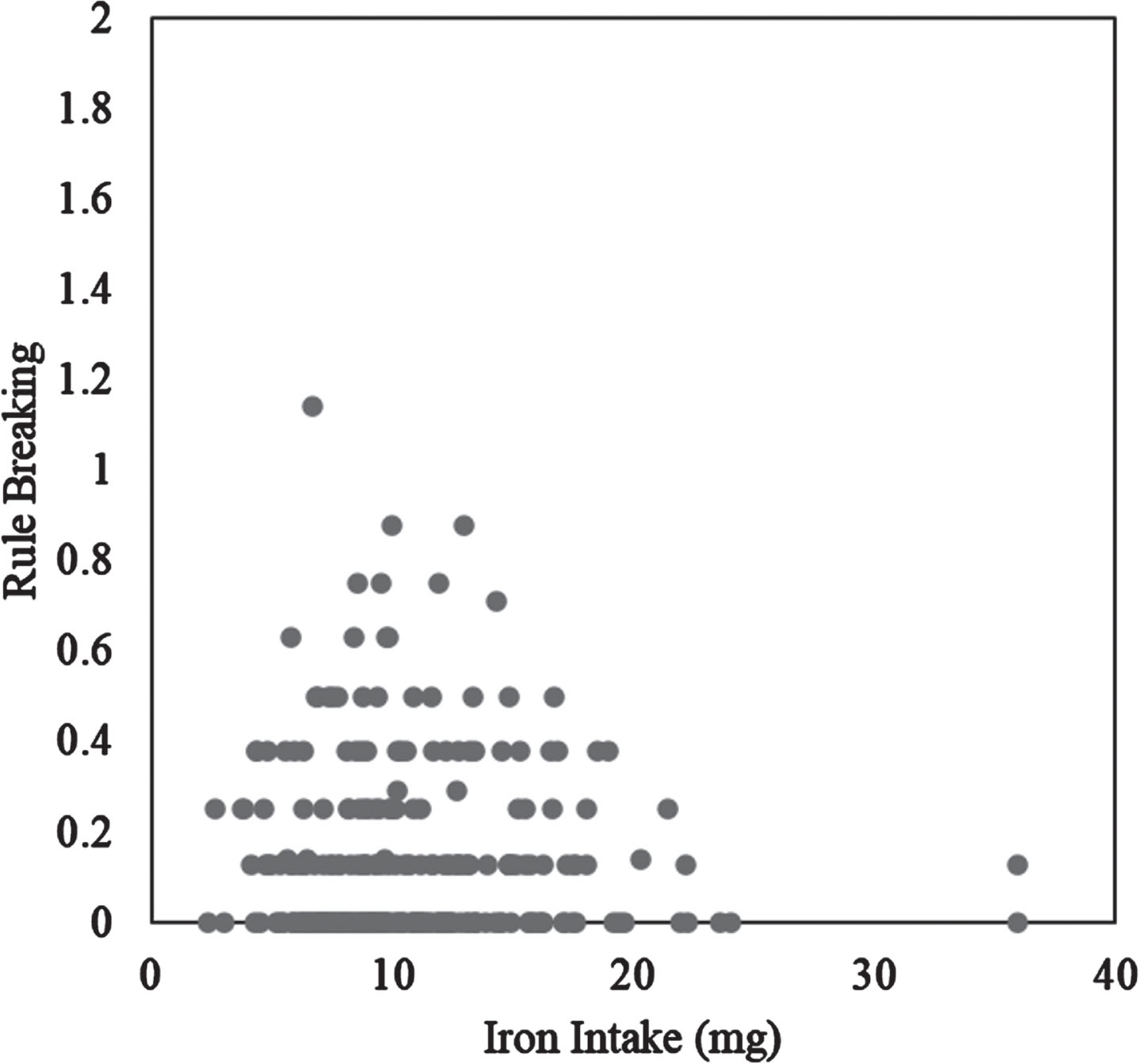
Scatter Plot of Iron Intake and Rule Breaking in Young Adolescents
Results from the multivariate regression model indicated that after adjusting for covariates, higher iron intake was uniquely associated with lower aggressive behaviors (Table 2). Iron intake was not uniquely related to rule breaking behaviors. Finally, lower family SES was related to more rule breaking.
Standardized Beta Coefficients from a Multivariate Regression Predicting Behavior Problems from Iron Intake and Covariates in Young Adolescents
Note: Socioeconomic status (SES), z-score body mass index (zBMI); Significant relationships are bolded. *p < .05.
Discussion
The current study used multi-source measurements to examine the role of iron intake in overt and covert behavior problems in an ethnically and socioeconomically diverse sample of early adolescents. Iron intake was related to higher total caloric intake and lower zBMI; it was also lower among racial/ethnic minorities. After adjusting for total caloric intake, zBMI, and sociodemographic characteristics, lower iron intake was uniquely associated with higher aggressive behaviors but not with rule breaking, suggesting that iron intake is more relevant for overt than covert behavior problems.
The association between lower iron intake and higher rates of aggression among early adolescents is consistent with prior studies linking iron intake with behavioral and emotional outcomes. For example, one study in young women found that low iron intake was linked to greater feelings of anger on the anger subscale of the Cornell Medical Index Health Questionnaire (CMI-J) (Sawada et al., 2014). Although anger is not itself an aggressive behavior, feelings of anger are closely linked to adolescents’ behavior problems through anger dysregulation (Hitti et al., 2019). Future studies should identify mechanisms explaining the associations between iron intake and these negative emotions and behaviors, such as characteristics of neural networks underlying behavioral and emotion regulation (e.g., structure, function, and functional connectivity). Indeed, iron deficiency has been linked with lower brain myelination and alterations in energy metabolism and neurotransmitter homeostasis, which have implications for emotional regulation (Kim & Wessling-Resnick, 2014).
Contrary to expectations, iron intake was not related to rule breaking. Although aggression and rule breaking often overlap in individuals, they have distinct behavioral and biological characteristics which may extend to differential relationships related to iron intake. For example, aggressive behaviors are more heritable and stable within individuals, whereas rule breaking fluctuates in relationship to social and contextual factors (Burt, 2012; Simcha-Fagan & Schwartz, 2017). Additionally, parent-reported aggressive behaviors, but not rule breaking, was associated with smaller right hippocampal volume in adolescence (Bos et al., 2018). This stronger biological and neural component of aggression may explain why it is related to iron intake, which plays an important role in cognitive and behavioral development and functioning (Larson et al., 2013). More research is needed to better understand the neurobiological mechanisms linking iron intake with aggressive behavior and to determine whether iron supplementation reduces aggressive behavior inadolescents.
Limitations
Results of this study need to be interpreted in the context of several limitations. First, the cross-sectional design limits inferences about the directionality of the obtained effects. Second, the participants were from mostly public schools in a large metropolitan area in the Southeast US, so the results may not generalize to other geographic regions, racial/ethnic groups, or cultures. Third, the current study was very specific to externalizing problems, however, it is plausible that internalizing behaviors (e.g. depression) may also be relevant to iron intake. As mentioned earlier, iron intake is important to cognitive functioning, however, the current study did not account for cognitive processes (e.g. attention) that are involved in lower psychosocial functioning that occurs due to decreased iron intake. Although the current study focused on behaviors that can be disruptive to a home and school environment, future studies should expand the examination of iron to gain a more comprehensive understanding of the role of iron on multiple facets of psychosocial functioning. Finally, the study included multiple informants and sources of data, but reports from youth and parents may still be subject to recall bias.
Conclusion and Implications
In conclusion, the findings demonstrate links between low iron intake and aggressive behavior in early adolescence. These findings highlight the importance of improving adolescents’ nutrition intake, an effort in which school nutrition programs and other federal and state nutrition programs play key roles. For example, the Healthy, Hunger-Free Kids Act of 2010 (HHFKA, 2010) led to updated nutrition standards for school meals, which increased portions of whole grains, fruits, vegetables, and legumes, while restricting fat, sodium and calories. As a result of these policies, students are now eating more iron rich foods such as lean meats, seafoods, legumes and dark green leafy vegetables (Mozer et al., 2019). Similarly, recent updates to the Dietary Guidelines for Americans included a reduction of added sugars (6% vs. 10% of daily calories) and a stronger emphasis on adapting diets to consider personal preferences, culture, and budget (Snetselaar et al., 2021). More research is needed to examine whether these initiatives facilitate the consumption of an iron rich diet by adolescents. Schools and federal programs must continue to work with families and communities to help provide nutrient dense, iron rich foods to youth, and especially those from low-income and underserved families.
Footnotes
Bio Sketches
Catheryn A. Orihuela, PhD, is a Scientist in the Department of Psychology at the University of Alabama at Birmingham. Her research centers on the impact of poverty on mental and physical health in adolescence and adulthood, with a focus on the impact of food insecurity on adults with chronic disease.
Retta R. Evans, PhD, MCHES, is a Professor in the Department of Human Studies at the University of Alabama at Birmingham. She also serves as the graduate program director for the PhD program in community health education. Dr. Evans has published widely on topics related to adolescent health behaviors focused on wellness, nutrition, and physical activity outcomes.
Sylvie Mrug, PhD, is a University Professor in the Department of Psychology at the University of Alabama at Birmingham. She studies risk and protective factors for emotional and behavioral problems in adolescence, as well as the long-term impact of adolescent experiences on mental and physical health in adulthood.
Destiny Kelly, BA is a Lifespan Developmental Psychology graduate study at the University of Alabama at Birmingham. Her research interests include the roles of racial identity and discrimination on risk and resilience in African American youth.