



Abstract
In this paper, I describe an interactive thought experiment and workshop that I conducted at a recent European LAM conference. In this experiment, I asked participants to imagine that we are at the very cusp of creating the next-generation curriculum for a libraries, archives, museum (LAM) program, and that we have a blank slate. I offered a way to think about determining this curriculum, a way to think about it at the level of designing, by starting fresh, erasing, as best we could, the idiosyncratic aspects of each field in order to determine the shared foundational core. Central to this process were systems thinking, complexity thinking, and the notion of the integrated curriculum. This paper outlines the reasoning behind this process and provides a glimpse at the actual steps. I position current LAM curriculum in the context of convergence trends, or more accurately, re-convergence trends, and ask what exactly is converging. Next I outline a framework derived from a systems-thinking-oriented approach to creating curriculum, suggesting that this approach is helpful in describing and defining the state of LAM in Library and Information Science (LIS) from the perspective of each department creating an integrated curriculum. Finally, I provide a brief overview of the process I used to conduct a workshop around the notion of starting over, or from a blank slate.
Introduction
Imagine that it is possible to erase the historical trajectories, bureaucratic structures, technological shifts, and budgetary constraints that have led us to current professional education silos between libraries, archives, and museums. If we erase the board, what do we have? What are the fundamental threads that connect these areas? Where are the distinctive differences? Is there a more efficient, logical, and meaningful approach to a curriculum that sees all three areas of study together?
These are the questions I asked in a recent conference around LAM (library/archive/museum) education. It has been about two decades now that we have been talking about the “convergence of the LAMs”. What is the status of this movement? Has there been a convergence? Is convergence the same as what we first though it was? Have curricula also converged? How can we train future generations of information professionals that are diverse, yet share so many goals?
In this paper, I describe an interactive thought experiment and workshop that I conducted at a recent European conference, a conference that for over 20 years has focused on the intersections between the three (library/archive/museum). In this experiment, I asked participants to imagine that we are at the very cusp of creating the next-generation curriculum for a LAM program, and that we have a blank slate. I offered a way to think about determining this curriculum, a way to think about it at the level of designing, by starting fresh, erasing, as best we could, the idiosyncratic aspects of each field in order to get at the foundational shared knowledge. In my experience, LAM curriculum designers are quick to point out what is different about these three fields but do not often linger on their similarities or foundations. Likewise, I asked participants that we not worry about regions or traditions in various parts of the world for this process, but to try to clear the slate of those as well. Central to this process were systems thinking, complexity thinking, and the notion of the integrated curriculum.
This paper outlines the reasoning behind this process and provides a glimpse at the actual steps. First, I position current LAM curriculum in the context of convergence trends, or more accurately, re-convergence trends, and ask what exactly is converging if anything. I follow this by outlining a framework derived from a systems-thinking-oriented approach to creating curriculum. I suggest that this approach is helpful in describing and defining the state of LAM in Library and Information Science (LIS) from the perspective of each department interested in creating an integrated curriculum. Last, I provide a brief overview of the process and documents I used to conduct a workshop around the notion of starting over, or from a blank slate.
Are we in a convergence or a re-convergence?
Often cited as the trigger of the current convergence movement are shifts resulting from emerging digital technologies. But as Given and McTavish point out, we are actually in a re-convergence. In this article, the authors ask:
Is the focus on a user-oriented definition of these institutions based on traditional understandings of knowledge acquisition, or is it exclusively fueled by new technologies and budget cuts? (Given & McTavish, 2010)
They say that the lines have become blurred across these organizations and that, particularly in the eyes of the user, divisions in approaches to gathering and providing access to cultural materials are present. In reality then, we are in a re-convergence (Given & McTavish, 2010) and while the recent phenomenon may indeed be triggered by technology (and probably budgetary constraints as well), it has not necessarily changed the essential elements across them. At the core, all three institutions are positioned at the intersection of users (people) and use (of documents), in particular environments (contexts), no matter the type of technology used (see review by Gorichanaz, 2016). In other words, all three institutions are mediators of “relations between persons and external memory” (White, 1992). I argue that the current convergence is not only a digital convergence but is, in fact, much more profound than that, stemming from the more fundamental nature of interactions between individuals in society and documents in the world. All three fields of study are part of a larger meta-discipline (Bates, 2015) or trans-discipline (Lee, 2017), in other words, a field that cuts across the entire spectrum of traditional disciplines such as the arts, humanities, social and behavioral sciences, natural sciences and math. All are concerned with information as it is used, created, and managed in particular contexts.
In 2010, Given and McTavish felt that the iSchools movement had great potential to bridge these fields. The claim of the iSchools movement, at the time of this publication, was:
reminiscent of the Baconian approach to learning…where “all knowledge” can be subsumed, to some degree, within an expansive view of individual engagement with learning and sources of information (Given & McTavish, 2010).
Given and McTavish point out that indeed, the contemporary iSchool members in 2010 consisted mostly of those focused on computing and information science realms of the field; they felt that the “full spectrum of information-focused professions and programs” (Given & McTavish, 2010) could and should be represented here and this includes library, archives, museum, and other related social science and humanities disciplines. Eight years later, my unsystematic review of this group shows that it still consists of only one end of this spectrum. In fact, the iSchools appear to have narrowed their focus rather than expanding it. My hope is still with them as the site for LAM education to merge, but as of now, there does not appear to be a lot of movement in this direction.
Coming back to Given and McTavish’s question about the re-convergence, it is worth asking – is it really about new technology or is it perhaps a re-uniting based on more foundational concepts? Perhaps we need to “zoom out” a bit more to see the bigger picture. We need to, at the very least, revisit this notion of re-convergence and what it means in educating future information professionals.
This leads me to the current exercise, and the topic of this article. What I propose might be considered a dream more than reality, but dreaming is where things often start. Here I will suggest one way to start clean, start over, using a blank slate. We can acknowledge that there are traditions, histories, structures in place, but possibly these are getting in the way of moving towards a converged curriculum. What would happen if we start over? Wipe it all clean? Using Systems Thinking, Complexity Theory, and neo-document/ation theory, I will suggest one way to “zoom out” and “start over.”
The past, or the filled-up slate
The reality is that, while we might see the obvious convergences, professionals continue to be trained in separate silos, and standards or principles are still not crossing disciplinary boundaries in terms of organization, preservation, and user access. We are stuck in our own history, structures, and practices. This is, of course, is the nature of knowledge production. It is difficult to undo what has been shaped by history whether it meets current needs or not. And most of the time, we value consideration of this past. But this past might be paralyzing us, making it difficult to see the bigger picture. After a long history that involved dissection and compartmentalization (in all fields), new technology (and its effects) were the catalyst in helping us understand (and perhaps remember) the similarities between the fields. Technology is not the only thing that connects us, however.
I argue that it is our historical past (and the thought systems this trajectory went through) that separated us, not the reality of what we do. How can anyone deny that libraries, archives, museums and possibly other information professions are not connected by the very fact that they are all have an imperative to collect, manage, and provide access to various forms of cultural and knowledge production? How can we deny that what all three institutions deal with is documents (however you may define that)? How can we deny that, at our base, we are all interested in the relationship between humans and documents in today’s world (if you choose, you may say information here, and we can agree to disagree on that point)?
In LIS, there are hints that a different approach is needed. A recent article by Yukawa, 2015 , for instance, asks how we can help our students prepare for the future in a complex, rapidly changing environment. Behind this question is a belief that new forms will emerge that are unimaginable now. How can we prepare our students for the unknown future in our field? Yukawa says that it starts with arming students to deal with complex situations and “wicked problems” (Yukawa, 2015) rather than to focus so specifically (or solely) on skills. Adaptive leaders are needed. How do we create programs that train “adaptive leaders”?
I have been exploring this notion of starting over, of “clearing the slate” for some time now. I helped build a program in museum studies within an MLIS program at Kent State University (Ohio, USA) that was intended to be integrated into the whole (of LIS). It has been successful but after more than eight years in process, it is clear that it too is succumbing to the silo-ing effects we so often find in this field. Because of this, I continue to explore and ponder how to truly bring together the training of future professionals of cultural heritage institutions, such as libraries, archives, and museums. I continue the process of exploring this potentiality and do not yet have any big, final answers. However, I have identified a way to start to think about it and how we might approach building new curriculum. It is this approach that I want to offer in this commentary.
A framework to guide us
The two most helpful bodies of literature that I have found useful in thinking about this situation are:
Systems Thinking, and Neo-document/ation theory
Most of this paper focuses on the Systems Thinking aspect; for practical reasons, there is not enough room to integrate the neo-document/ation theory, but I will use it in my examples.
Systems Thinking (ST) is a now a vast area of study and its applications are diverse. Others in LIS education have suggested it as well (e.g. Lee, 2017; Latham & Simmons, 2017). However, I am going to focus on a few authors from the world of curriculum theory who strive for a more integrated curriculum for all students and do this using principles of systems thinking and complexity theory (CT). In particular, the work of Edward Clark and William Doll will be highlighted. These two (among others) have used ST and CT to rethink today’s educational environment. Their foci are mostly on primary school but their research and tools can be applied just as well to higher education.
Clark’s integrated curriculum
In his book, Designing and Implementing an Integrated Curriculum: A Student-Centered Approach (Clark, 1997) positions the core of Systems Thinking (ST) as the central organizing thought system. For the recent past, he says, we have been operating on an “assumption of separateness,” derived from Newtonian/Cartesian science and this has given shape to a worldview made up of finite compartments that can be measured and sorted. Analytical Thinking (AT) and the scientific method are cornerstones of this understanding of the world. As a result, many of our Western institutions, including education (and some of the traditional disciplines) have been shaped by this analytical thinking. Newtonian/Cartesian science is a “science of the parts” and for the physical sciences, this makes fine sense. But applied to social sciences, this perspective is fragmented, impersonal, random, and mechanistic. Knowledge is reduced to the accumulation of facts; intelligence is defined as a fixed, mathematically measurable capacity for linear, sequential verbal, and mathematical abilities. Thinking is considered the function of an identifiable set of discrete cognitive tools (for example, Bloom’s Taxonomy). Learning is universally thought of in terms of memory and recall. In the analytical process, the big picture of the whole gets lost. This methodology encourages an inflexible literalistic interpretation of the universe. It uses concrete terms that carry the aura of absolute certainty and has led to the conclusion that “the map is the territory.” In this “assumption of separateness,” the Machine is the guiding metaphor.
Clark proposes that instead, we should work with a framework that involves the “assumption of wholeness”, which holds that at some fundamental level of reality, everything is connected to everything else (this is supported by theory of relativity, quantum physics, ecology, etc.). He calls this an “ecological worldview”, a science of whole systems, a science that is complementary to, rather than competitive with a science of the parts. With its focus on the big picture, systems science provides an important and necessary context for understanding traditional science’s analytical expertise. In this way of thinking, no single, discrete entity can be fully understood apart from the complex whole of which it is an integral part. It is contextual thinking because it recognizes that without a context, meaning is truncated and incomplete. Systems Thinking is a natural way of thinking that is integrative. In the “assumption of wholeness”, the Organism is the guiding metaphor.
According to Clark, there are several characteristics of systems thinking that help distinguish it from analytical thinking:
it incorporates a both/and logic (rather than either/or) it assumes a living universe it values ecological thinking it recognizes that we live in a participatory universe it is at the same time both local and global; and it honors the long-range view
It is important to note that the Systems Thinking view incorporates rather than replaces the analytical mode – it is additive, not a replacement. Each view provides important and necessary information about the nature of reality without which any insight, understanding, or knowledge is incomplete, biased, and fundamentally inaccurate, so a combination of AT and ST is needed in the teaching of a subject matter.
Our students’ learning AND the field itself are dynamic and ever-changing. Because of this, we need to structure programs that allow for this growth, change, and movement. The current re-convergence has emerged because the silo-ed structures were not fully pliable and adaptable, readying them for changes in the world that could not have been predicted.
In addition to the Systems Thinking view, we can learn a lot from Chaos and Complexity Theory. Clark’s ideas are supported by the work of others such as William Doll in the education field. Doll, 2010 has similar sentiments about the history of curriculum development. He places the current structure (i.e. the overall view of western education) in the hands of the Protestants’ ordered and routine method – connected with Cartesian ways – with its greatest contribution, linearity. Doll cites Peirce and Bateson, well known philosophers, who assert that human thinking moves abductively – that is across, sideways, diagonally, skipping node to node – not linearly. Linear thinking constricts natural human thinking. Doll uses chaos theory to make the point that the world is dynamic; it consists of nonlinearity, fractalness, self-organization, and an intertwining nature of order/disorder. According to Doll, the sphere of educating people, no matter what level, falls under the notion of complex adaptive systems. Our curricula, logically, should be built to deal with the dynamic changing nature of the human world.
Systems theory is about the dynamic relationship between parts and wholes. After all, the father of General System Theory, Bertalanffy, Bates, 1999, defined a system as ‘a set of elements standing in inter relations’ and goes on to define open systems which function just to keep the right amount of imbalance so that the systems might maintain a creative dynamism (and exchange of matter and energy rather than just energy). According to Doll, education is – or should be – an open systems frame.
This is the state we should be in with curriculum for LAM. Instead we find ourselves positioned as a closed system that functions toward a particular goal – one which can transfer and transmit, but not transform. What we have now is subsumed in the historical background of a framework that is linear, quantifiable, fact-oriented. This is what created the silos. However, Lee points out that LIS should not be treated as a closed system:
LIS in particular is a field that does not live in a silo; in fact, it must exist outside of closed system silos and into the open precisely because of its very transdisciplinary nature. There is nothing that does not fall under the influence of or is influenced by an LIS system in some manner. A trip to any library, archive, or museum (physical or online) demonstrates the influence of LIS and LIS systems in even the most remote topics (Lee, 2017).
How to use ST to build an integrated curriculum
It has become increasingly impractical in an age in which growth of information is exponential to “know it all”. Systems Thinking makes it possible to know more with less. The systems perspective provides a gestalt that enables one to be selective in determining what detailed information is required. We no longer have to “know it all” in order to understand an issue, a problem, or field of study. We can literally know more with less information.
Clark provides an analogy comparing structure of knowledge with structure of a house:
Thought systems
When establishing curricula using ST, we begin with thought systems – the “big picture” – as a context from which concepts, basic ideas, and facts can be deduced and understood. Students experience both deductive and inductive thinking/learning processes in an integrated, systemic manner. When we teach the concepts first, we leave open the human potential for creativity and generativity. Thought systems show how the various concepts, ideas, and facts fit together. Concepts are the framing, providing the conceptual framework, i.e. the mental model that give shape and meaning to the thought system. Clark says, for example, one knows more about a building a house by understanding its structure than from a pile of lumber, and likewise one can know more about a subject by understanding its conceptual structure, or the way it is organized. Ideas come from imagination and experience; master ideas such as “all men are created equal” can become the organizing principles that shape a culture. Ideas come before facts; facts are not the building blocks of knowledge but they do provide the detail and specificity, color and texture, that enhance meaning and makes each thought system unique. In creating LAM curriculum, perhaps we have been focusing too long on the furniture, forgetting about the blueprints and a bit of the framing. Perhaps we’ve been approaching curriculum development backwards?
The “big picture” (i.e. thought system) for us is LAM (or something like it), a meta-field that cuts across multiple parallel fields (Bates, 1999). Clark says:
Every academic discipline is, in essence, a thought system with its own internal structure or conceptual framework. This structure consists of the concepts and principles that are essential to the discipline and the way it is organized. Once you have grasped this structure (the big picture), it is relatively simple to identify the specific relationships and detailed information that you wish to investigate or is relevant to your need. In short, with this systems perspective, you know how to learn what you need to learn, when you need to learn it (Clark, 1997).
It is this big picture that we are now trying to understand, in the context of a world now embedded in context-altering technologies, a world that brought it back together after many years apart. It is the first step in creating a curriculum: what does our big picture look like?
What Does An Integrated Curriculum look like?
For Clark, 1997, an integrated curriculum (IC):
Begins with an assumption of “the connectedness of things” is learner-centered is mission-driven is contextual focuses on relevant questions is framed by a set of universal principles and concepts is shared by a “community of learners”
The creation of an IC begins with a Focus Question that captures the essence of the study; is necessarily broad in scope, and provides the directions that will be pursued. In our pre-established theme of LAM education, for example, we might ask: How do documents fit into today’s world? (see Fig. 1).
Using an example Focus Question (How do documents fit into today’s world), questions for each of the four contexts are suggested. Inspired by Clark (1997).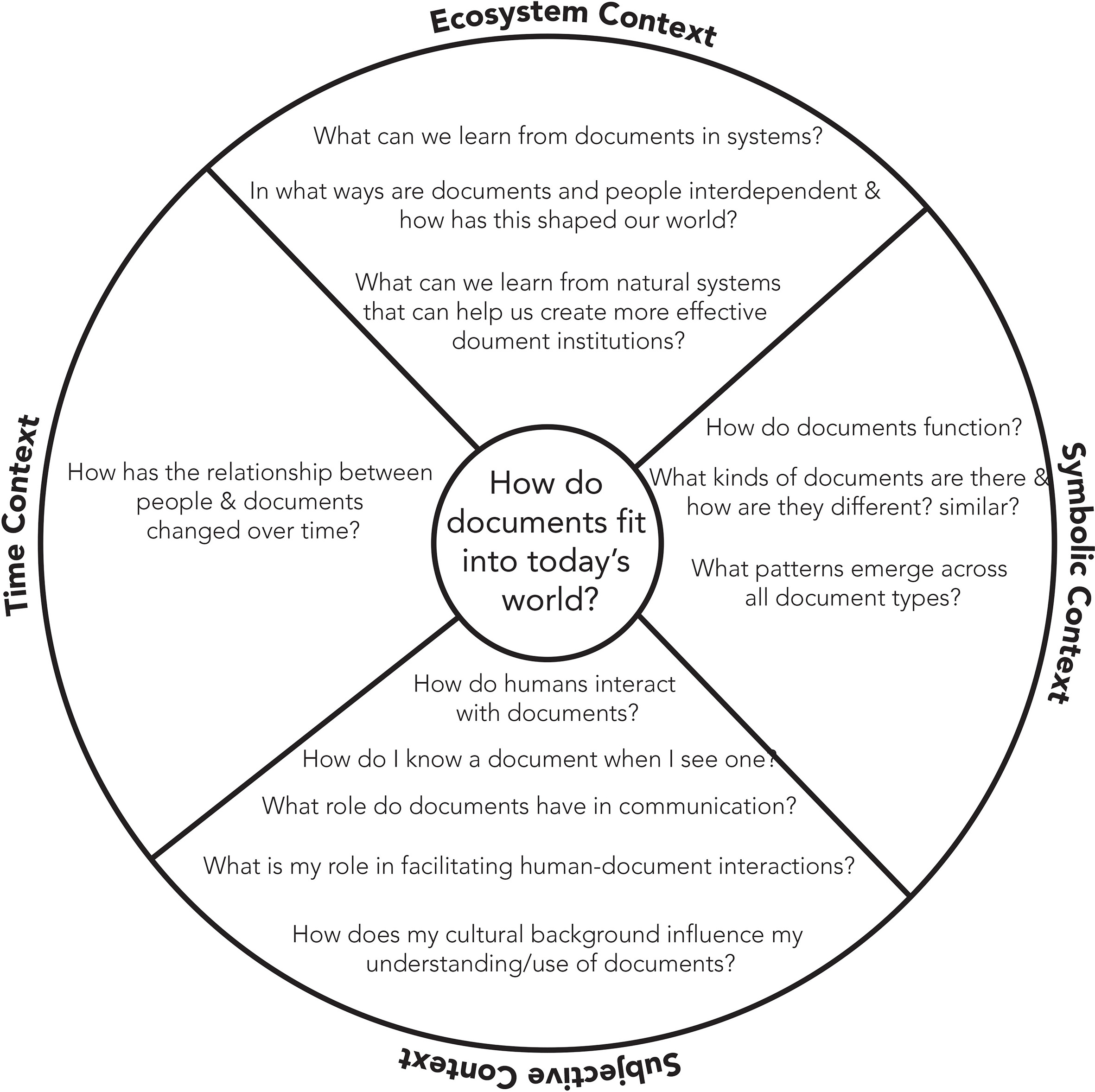
Once you have a focus question, you can then ask questions radiating out from it, in four different contexts: symbolic, time, subjective, and ecological.
In Fig. 1 I have suggested a few questions in each context that revolve around the example Focus Question: How do documents fit into today’s world?
Clark’s process takes this even further, eventually asking questions that are contextualized around the physical, biological, psychological, and social (Fig. 2). The last frame of reference to embed these questions (and thereby, concepts, ideas, and skills) is by systems, diversity, change, patterns, structure/function and values.
Further layers of Clark’s questioning sequence, in grey. These steps go beyond the process provided in this paper but take developers even farther along in the integration approach. Adapted from Clark (1997).
Once we work through these matrices, we can round back to the house and begin to determine the furniture. It will likely be that at this stage, specific skill sets are then offered that become more granular and specific to institutions and type of work.
In order to take us through this seemingly complex process (yes, it is complex), I developed a set of worksheets for a team to use at each “step” of the approach. These worksheets can be found in the appendix. Steps 1 and 2 are creating the Foundational Questions. It is good to have more than one question to work with, but it requires a time commitment to go through each one to the end of the process. The next four worksheets (Steps 3–6) should be done for each of the foundational questions. Step 3 asks team members to take one foundational question, then ask one question in each of the four contexts: symbolic, time, subjective, ecological. Step 4 then asks the team to think of concepts that are needed to understand each of those four contextual questions. Step 5 asks for the skills and knowledge related to each of those concepts and to draw out the relationships between them. Finally, Step 6 brings it all together in a single sheet to help team members share their results with others. Although this can be done in multiple ways, it might be useful to divide out into groups that are responsible for each foundational question, then come back together to work out and negotiate the details.
In the workshop, we went through all six steps in an afternoon but it clearly is designed for longer-term use, perhaps over a full semester. Much of the work requires external research and reflective thinking on the part of curriculum team members and therefore giving time for such reflection would be more effective. A lesson learned from the workshop was that at least three kinds of stakeholders need to be involved – practicing professionals, faculty, and students. We did not have any student representation and it was clear that the student voice was needed. It is also important to include students, faculty and professionals from each of the three areas of study – library, archives, museums.
Conclusion
In her chapter proposing systems theory as a central organizing theory for LIS, Lee noted:
…what can be hypothesized is to understand LIS as a system in system theory is to adapt to or change due to the environment. The environment, whatever may constitute as the environment, is not a static condition upon which systems simple exist within [sic]; a closed system. Instead, systems can and do change. LIS as it exists now is very different from LIS a hundred years ago and will be different a hundred years from now (Lee, 2017).
Using Systems Thinking to guide us through curriculum development can help us to step out of our concretized silos and begin to understand the foundational principles and concepts we share across LAMs. In doing so, we provide a more adaptable professional, a worker who is ready for the dynamism we find in all fields of LIS. Once we see these commonalities, we can begin to sort out the specific differences and enhance the attention on those areas in a more efficient and targeted way.
I end this exploration with an aspirational quote from Lee, who guides us to think bigger, think broader, and realize that LIS and LAMs are a part of a larger, more cohesive system than perhaps we realize:
No longer are those in the library and information sciences limited to thinking about themselves within the narrow confines of academic and professional silos. Instead, thinking beyond libraries or other traditional manifestations of LIS becomes a matter of understanding that we are all part of an information system in a changing information environment (Lee, 2017).
Footnotes
Appendix A