



Abstract
Literature review reveals that in sub-Saharan Africa, archives and records management (ARM) education is not yet grounded in institutions for higher learning. In eSwatini (previously Swaziland) the situation is even worse as only one institution of higher learning, the Institute of Development Management (IDM) offers ARM programmes at undergraduate diploma level. This is compounded by a lamentation by the beneficiary of the programme, the eSwatini National Archives (ENA), and the education regulator, the eSwatini Higher Education Council (EHEC), that the programme does not address the public sector’s needs in the country and is below the expected standards. Furthermore, the University of eSwatini, which is the biggest institution of higher learning in the country with economies of scale, does not offer any programme in ARM. As a result, organizations in eSwatini either send their records management staff to neighbouring countries such as South Africa, Botswana and Namibia for training, or engage external consultants to conduct in-house training. Sending employees out of the country for training is expensive for organizations and it also paralyses operations during the absence of these staff members. Furthermore, in-house training does not address the in-depth needs and requirements of ARM due to time limitations. In light of this situation in eSwatini, this study proposes a framework for the design and implementation of an open distance e-learning programme on ARM programme. Such a programme can be offered through the University of eSwatini to accommodate students within and outside the country and thus ensuring the eSwatini becomes a player in ARM space within the African continent.
Introduction and background to the problem
The management of archives and records in the African continent has faced numerous challenges over the years, resulting in poor governance (Nengomasha, 2013; Ngoepe & Van der Walt, 2009; Wamukoya & Mutula, 2005). This challenge, especially in Africa, is compounded by the lack of infrastructure, outdated pieces of legislation on managing digital records and very few universities offering archives and records management (ARM) programmes (Ngoepe & Keakopa, 2011; Ngoepe & Saurombe, 2016; Onyancha et al., 2015). Indeed, several factors are working against a thriving ARM field in Africa. For example, graduate-level education – which many experts argue is the preferred form of ARM education – is difficult to execute in Africa given the “low numbers of qualified staff, virtually non-existent research, poor quality of educational materials and outdated programmes, educational methodologies based on the model of rote memorization that does not encourage critical thinking, problem solving and creativity” (Katuu, 2015:107). Furthermore, according to the international research on permanent authentic records in electronic systems (InterPARES)1
The InterPARES Project is a major international research initiative in which archival scholars, computer engineering scholars, national archival institutions and private industry representatives are collaborating to develop the theoretical and methodological knowledge required for the permanent preservation of authentic records created in electronic systems. It was coordinated by the University of British Columbia in Vancouver, Canada from 1998–2018.
absence of organizational plans for managing e-records; low awareness of the role of records management in support of organizational efficiency and accountability; lack of stewardship and coordination in handling paper as well as electronic records; absence of legislation, policies and procedures to guide the management of both paper and electronic records; absence of core competencies in records and archives management; absence of budgets dedicated to records management; poor security and confidentiality controls; lack of records retention and disposal policies; and absence of migration strategies for e-records.
The challenges are still relevant as Ngoepe (2017; 2018) states that one of the root causes of problems in the African continent is the lack of ARM training programmes at most institutions of higher learning in Africa, including eSwatini (previously Swaziland until 2018). For example, an InterPARES study (2018) reports that out of 26 South African universities, only three offer fully-fledged ARM training, namely, the University of South Africa, University of KwaZulu-Natal and University of Fort Hare. The report further states that, in Botswana, the programme is only offered by the Institute of Development Management (IDM) and the University of Botswana. The situation is the same in eSwatini as there is only one college offering ARM training at undergraduate certificate and diploma level, that is, the Institute of Development Management.
According to Ngoepe (2017), the number of students who join these programmes is very small and in the long run, it may be very difficult for the HEI to sustain these programmes. For example, in the year 2015, only 10 students registered for ARM at IDM eSwatini campus on a full-time basis. These challenges and others resulted in the International Council on Archives (ICA) designing a strategy for Africa (2015–2020). One of the key elements of the strategy is training and education in ARM at the institution of higher learning in Africa (Lowry, 2017). African educators and archivists have repeatedly raised the need for support in redeveloping university curricula so that they reflect international good practice and recent development in the field.
There have been efforts to address the challenges of lack of education in the field of ARM in the continent in the past. Katuu (2015) reports that in the mid-1960s, the ICA, with support from the Society of American Archivists and UNESCO, conceptualised regional centres that would be attached to universities and offer archival training. Two such centres were created, one for Anglophone countries and the other for Francophone countries (Evans, 1988; Smith, 1976). However, due to various financial and logistical challenges, these efforts did not last longer than a decade, and since their demise, national education and training programmes emerged. It is worth noting that the Director of the National Archives of eSwatini (2003–2019) was one of the beneficiaries of the programme in the early 1980s. Despite intervention by several organizations, including UNESCO and ICA, the provision of ARM education is still an Achilles heel in many African countries, including eSwatini (Katuu & Ngoepe, 2015; Ngoepe & Katuu, 2017). As mentioned, eSwatini has only one diploma and certificate programme offered by the Institute of Development Management (InterPARES, 2018). This programme is not without problems, as the main beneficiary, the eSwatini National Archives (ENA), and the regulator, the eSwatini Higher Education Council (EHEC), lamented that the programme does not address the public sector needs in the country and is below the expected standards. In June 2019 EHEC implored institutions of higher learning to accredit their programmes with the Council (eSwatini Ministry of Education and Training, 2019). No institution in the country met the ARM accreditation standard. This study proposes a framework for archives and records management education to be offered in an open distance e-learning (ODeL) environment in eSwatini. The study suggests that such a programme can be offered through the University of eSwatini to accommodate students within and outside the country; thus ensuring that eSwatini becomes a player in the ARM space within the African continent. First, a contextual setting of eSwatini and ARM education is provided, followed by a justification for the need to develop an ARM programme through ODeL environment. The study then presents a framework to offer ARM education through ODeL environment.
As the context of the study is eSwatini, it is necessary to provide a brief background of the country, as well as the ARM offerings. On 19 April 2018, King Mswati III announced that Swaziland would in future be known as eSwatini. The name change was driven by a desire to fully break free from the country’s colonial past while ending international confusion between Swaziland and Switzerland. The change was part of the country’s celebrations of 50 years of independence. eSwatini is a landlocked country in the eastern flank of South Africa, where it adjoins Mozambique. It stretches about 110 miles (175 km) from north to south and about 80 miles (130 km) from west to east. At its largest dimensions, the country has close trade and financial ties with South Africa, which absorbs about 60 percent of Swazi exports and provides 80 percent of imports, including most of the electricity. Around 70 percent of eSwatini’s 1.1 million people are based in rural areas, with livelihoods predominantly dependent on subsistence agriculture. The Swazi economy is mainly driven by its membership of the South African Customs Union (SACU) and the Common Monetary Area (CMA) (UNICEF, 2018).
Education is regarded as the cornerstone of economic and social development in eSwatini; and the objective of the government is to provide education that is affordable, accessible and relevant. The main levels of education are primary, secondary and tertiary (higher education). eSwatini’ s higher education sector consists of seven institutions of higher learning, including a publicly funded university, publicly funded polytechnics and specialized colleges, and privately funded accredited universities and colleges. eSwatini universities aim to teach research skills and inculcate a culture of research for personal, professional and social development. According to the 2019/20 budget speech, education continues to be allocated a significant proportion of government expenditure (E3,543 billion) (Rijkenberg, 2019). Literacy (through basic reading and writing) in eSwatini stands at about 87.5 percent. Higher education in eSwatini is provided through the University of eSwatini (public university), private universities, colleges and training institutions.
Archives and records management education in eSwatini
There is scant literature on ARM education in eSwatini. Most of the literature about ARM in eSwatini tackles issues relating to e-government records preservation and audio-visuals (Tsabedze & Kalusopa, 2018; Msibi, 2015; Tsabedze et al., 2012; Maseko, 2010; Ginindza, 2008). However, such studies do point to lack of education as the cause of many ARM problems in eSwatini. For example, Tsabedze and Kalusopa (2018) indicate that the majority of records officers in government ministries in eSwatini have not been trained in ARM due to non-availability of institutions of higher learning in the country that offer the programme whose delivery mode caters for their needs as full-time employees. As emphasized by Onyancha, Ngoepe and Maluleka (2015) the challenge of lack of education and training in ARM is compounded by the fact that among library science schools (LIS) the in sub-Saharan African region, few have focused on ARM and more particularly at the undergraduate level. It is essential to point out that apart from accessibility to training in ARM, the content of the programme is equally important (Maluleka et al., 2018). Nengomasha (2006) argues that training institutions should make sure that their ARM curricula meet the needs of the industry.
It is noted that eSwatini has a notable number of ARM professionals trained and educated at various levels (certificates, diplomas, degrees – masters and doctorate) in archives and records management. Most are employed within the country by the government and private sectors. Ever since ARM became a recognized and required profession in eSwatini, both the government and private sectors have been sending prospective professionals for ARM higher education in other countries because of lack of education in ARM in the country. Scholarships for prospective students have been made available for ARM institutions in neighbouring countries, such as the University of Botswana, University of Namibia, University South Africa and the University of KwaZulu-Natal. The government, through the Ministry of Education and Training (MOET) and the Ministry of Public Service (MOPS), has been the main sponsor behind incumbent professionals who have been trained at postgraduate degree level.
The general norm in eSwatini for pre-service training in ARM and LIS has been service or attachment with functioning and recognized registry or library in order to gain hands-on experience and improve the candidate’s appreciation for the profession before formal tertiary education. This is largely still the case, with most training professionals having previously served in registries and libraries first. The pre-training practice has ensured that many professionals who complete their formal higher education in other countries have a secure job with their employer when they return to the country. However, some professionals search for better opportunities with other employers after formal higher education because of lower remuneration being paid by the government.
The education and training of ARM professionals outside eSwatini have several benefits. The country’s populace has, for example, the opportunity to educate in well-established and reputable ARM institutions while experiencing different social and cultural environments, which also contribute towards their personal development and growth (Ndlangamandla, 2012). They may also establish out-of-the-country contacts and networks that are necessary for their sustainable professional development. However, there are also some challenges. One challenge, as observed by Johnson (2007), is the relevance of the education and training received, which is often based on Western programmes and modelled on developed countries. Education and training outside the country may also increase dependence on the external environment and promote the notion that valuable training can only be obtained outside the country. Another challenge is that of cost, as education and training outside the country require a considerable amount of money, therefore limiting the number of ARM applicants that may access the training at a given time.
As mentioned earlier, eSwatini has only one institution, the IDM, which provides professional training to public and private sector staff. The IDM’s diploma and certificate programmes have been criticized by the MOPS and eSwatini National Archives (ENA) for failure to address problems experienced by the ministries and departments in the country. The eSwatini National Archives lamented that the ARM programme is dominated by many modules from other disciplines such as human resources, as well as occupational health and safety, which has nothing to do with ARM. The graduates lacked diversity, tended to specialize in narrow areas and lacked variety in their skills. The critique stated that in the present era of information and communication technology (ICT) and the implementation of e-government, higher education in ARM needs a stronger e-records management education component (Tsabedze, 2018). Furthermore, a call was made by the eSwatini National Archives that IDM must strike a balance between theory and practice while maintaining contact with the market in order to be relevant.
This has created a challenge for students that completed the programme to apply themselves in the ministries and department. The certificate programme at IDM caters for students who do not meet the diploma entry requirements. Upon successful completion of the certificate, they can qualify to enrol for a diploma programme or seek full-time employment. In 2019, the eSwatini Higher Education Council (EHEC), the standard regulator of education programmes in eSwatini, also complained that IDM offers a substandard ARM programme. The regulator complained that this programme is not informed by inputs from relevant stakeholders in eSwatini and does not address the needs of both the public and private sectors, as well as the needs of other stakeholders such as parastatals and NGOs.
The University of eSwatini, which is perceived as the biggest institution of higher learning in the country with economies of scale, does not offer the ARM programme. There is still much dependence on ARM education outside the country. As a result of this, archivist and registry staff are sent to neighbouring countries such as South Africa, Botswana and Namibia to acquire knowledge and competency in ARM, or foreign experts are brought in to conduct in-service training for government registry staff. Sending staff for training outside the country creates some operational challenges and disruption of work schedules during the absence of these staff members. A lot of money has been spent on higher education and training of ARM personnel outside the country over the years and the government has been the main sponsor. However, in 2017, the government of eSwatini announced a decrease in its scholarship funding and introduced a new criterion of awarding the scholarship based on certain priority areas, acceptable institutions and exceptional academic performance (Ministry of Education and Training Press statement, 2016; 2017). This, according to Tsabedze (2018), affected ARM professionals in the following ways: ARM and its related disciplines are not included in the priority areas, some ARM institutions are not included as approved and acceptable institutions to which the government would provide funding, and exceptional academic performance has not been a requirement to enter this profession.
Records surveys conducted in eSwatini government ministries and departments by Msibi (2015), Tsabedze, Mutula and Jacobs (2012) as well as by Maseko (2011) established that a number of registry staff members did not have competencies and skills required in ARM, although they were tasked with managing records in their ministries. The surveys observed a lack of records management systems in place. There is a glaring absence of the use of functional classification schemes, retention schedules and the systematic disposal of records, resulting in heavy congestion of offices and poor retrieval of information. Registries exist in these ministries and departments, but some of the officers do not know about their existence, they prefer to keep their records in their office cabinets. Perhaps this is because they found it much easier and faster to access them in their offices. They frequently transferred records to the registries when they no longer used them, effectively using the registry as a storeroom when in fact a registry is “the place where files and other records are processed, kept and retrieved”. It is the control centre of all information coming into and leaving the organization. The surveys also revealed that, at some stage, there were some systems in place which collapsed, probably due to the departure of experienced professional staff that left for greener pastures in the private sector. Some of the registry staff have applied for a transfer to other professions such as human resources, since the remuneration is better than that of ARM, leaving behind inexperienced graduates. Discussions with some senior government officials showed that there were once systems in these ministries and departments where all records were kept in well-referenced files in the central registry, and efficient messenger services ensured that officers would receive the files whenever they requested them. This point is emphasized by Ngoepe (2008) when arguing that in many government departments in South Africa, structured records management systems were common before 1994, operating as part centralised registry, often with a well-trained and experienced registry staff component. In this regard, senior public servants had an understanding of the importance of records management because the majority of them started their careers in the registry. With regard to surveys by Msibi (2015), one of the recommendations made is the need for proper training of records management personnel so that officers have enough confidence in them to manage their records.
However, training institutions cannot achieve this in isolation of government policies. The major challenge is to cultivate the commitment and support of senior government officials as this would drive the implementation of records management-related initiatives in the ministries and departments. This challenge concerns obtaining and sustaining commitment and support for records management initiatives among the senior government officials. However, commitment has remained lacking for unknown reasons. A conversation with the Director of ENA reveals prioritisation as another problem, as archives are not considered important. This problem faced by the ministries requires support from senior government officials, commitment and understanding to develop a national vision. There is a need to bring senior government officials on board to support ARM projects and oversee their implementation within the ministries. Ngoepe and Van der Walt (2010) reported similar challenges in South Africa.
As the eSwatini public sector grapples with the problems of managing its paper records, the problem has been compounded by the introduction of e-records. The records surveys by Msibi (2015), Maseko (2011), Tsabedze, Mutula and Jacobs (2012) as well as Tsabedze and Kalusopa (2018) showed that the government ministries and departments are adopting the use of digital technologies. Each office that creates e-records had its own way of maintaining, retrieving and storing e-records. There is no documentation of records in electronic form, which made them inaccessible to other officers. Similarly, Msibi (2015) argues that eSwatini government reforms require registry staff and archivists to have a firm grasp of records keeping so that they can carry out their responsibilities effectively and in accordance with ENA standard practices. The need for archivists as keepers of evidence to have in-depth knowledge of e-records is evident in the statement made by the Director of ENA in 2016. It reveals a strong pressure in support of multidisciplinary approaches and possibilities for cooperation between administrators, registry staff, archivists and IT officers, who should work together to implement electronic document records management system (EDRMS) that support e-government (Tsabedze & Kalusopa, 2018).
The introduction of e-government in the public service sector particularly requires professionals who are able to “understand trends and developments in technology, keep up with changes in the field, and need enough expertise to communicate with technology experts” (Dearstyne & Barlow, 1999: 138). The literature supports the view that common understanding among those involved in ARM-based on education and training is crucial to developing a credible ARM programme across organizations. This means that education and training should provide the platform for partnership building between various key players under a common education and training programme. If this is the case, for many registry staff, these needs entail a significant amount of relearning, and this cannot be achieved through the kinds of in-service training methods now used, most often in eSwatini, as the changes in work practices demand a deeper understanding of records keeping as suggested in the literature review. There is an urgent need to develop education and training tailored to the needs of the archivists and registry staff. Most scholars still believe that lack of relevant training is a contributing factor for poor records management. ARM education needs should be analyzed and evaluated in order to come up with a practical curriculum that addresses the problem of poor records keeping. Given the challenges alluded to above, this study proposes a framework for ARM education in an ODeL environment in eSwatini. The study further recommends that the University of eSwatini’s Institute of Distance Education Departments adapts, adopts, implements, monitors and evaluates this framework.
A proposed framework for ARM education in an open distance e-learning environment
The study established that the management of archives and records in eSwatini has faced numerous challenges over the years. These challenges have resulted in the poor governance and accountability structures within the government ministries in eSwatini (Tsabedze, 2018). The developments in ARM training at IDM has not done much to improve records keeping practices in organizations. The study revealed that one of the root causes of the problem in the ARM is the lack of training programmes in this niche area in almost all institutions of higher learning in eSwatini. The IDM is the only institution offering ARM training at undergraduate diploma level. This shows that although there is a need for trained ARM officers in the industry, there is limited access for the training of such officers. Tsabedze (2018) reveals that the majority of records officers in government ministries in eSwatini have not been trained in ARM due to non-availability of institutions of higher learning in the country that offer the programme whose delivery mode caters for their needs as full-time employees. In the light of all, this the study designed a framework for ARM education in an ODeL environment in eSwatini as reflected in Fig. 1. This framework attempts to address both the programme content and the delivery mode, which will address the needs of both the industry and trainees in ARM.
Proposed framework for ARM education in an ODeL.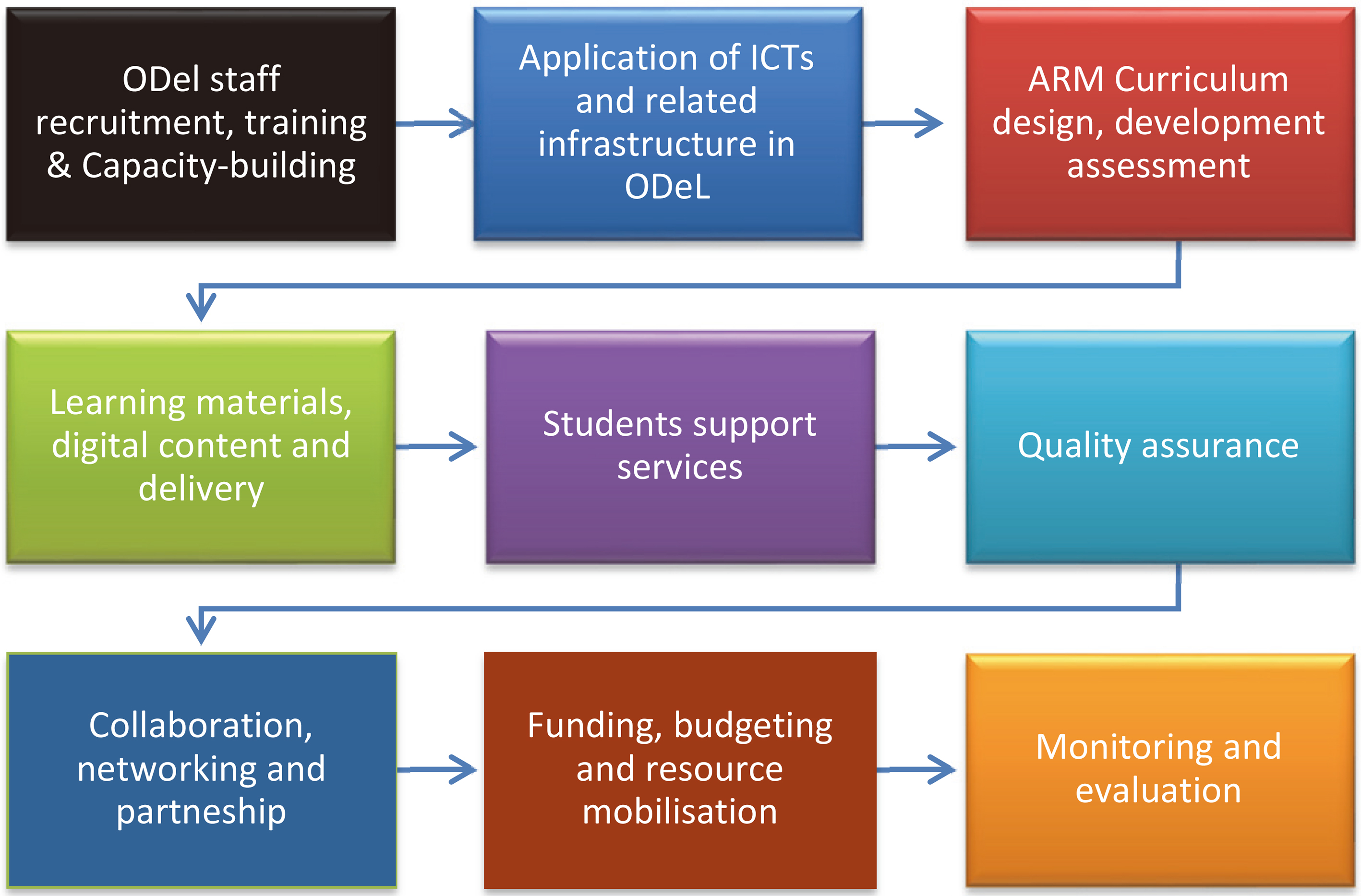
With regard to the implementation of ODeL in eSwatini, the University of eSwatini established the Institute of Distance Education (IDE), where some programmes have been offered through distance education. The experience of the IDE is that ODeL programmes are managed by staff who are also involved in conventional programmes. This creates a clash of priorities in favour of conventional programmes. However, the delivery mode of ODeL versus conventional programmes requires a different regulatory framework for management and administrative processes. This proposed framework is designed to guide the implementation, harmonisation and standardisation of the ARM programme. This framework is based on the following principles as identified by Moore and Kearsley (2012):
Openness and flexibility: Reducing constraints to access to education, including geographical, temporal, academic, socio-economic and cultural barriers. Learner-centeredness: Ensuring that the learner is at the centre of all learning in terms of resource requirements and the learning environment. Quality assurance and relevance: Ensuring the quality and relevance of ODeL programmes and learner support services. Collaboration and partnership: Promoting partnership in the development of learning materials, learner support systems and credit transfers. Efficiency: Ensuring optimum use of resources to increase access and improve the quality of education through ODeL. Equity and equality: Ensuring inclusiveness in terms of gender, rural, urban and special needs education. Training: Providing professional training and reskilling of staff. Upgrading: Ensuring the upgrading of academic qualifications.
The framework is premised on the assumption that every student learning can be optimally supported by modern electronic technologies and other digital facilities. The ARM students are assumed to have access to and be able to make optimal use of modern electronic technologies to access their study materials and to interact with their lecturers without necessarily being required to make physical contact. The increased interaction in this framework will lead to a reduction in the transactional distance between lecturers and the ARM students. Thus, modern electronic technologies result in e-learning, online learning or digital learning through the use of remote electronic communication. A further assumption of the framework is that it shall be guided by learner-centred educational theories. The elements of the framework include:
ODeL staff recruitment, training and capacity-building application of ICTs and related infrastructure in ODeL ARM curriculum design, development and assessment learning materials, digital content and delivery student support services quality assurance collaboration, networking and partnership funding, budgeting and resource mobilization monitoring and evaluation
The framework suggests that staff members with qualifications should be recruited. Focus can first be on eSwatini nationals with postgraduate qualifications in ARM. Thereafter, staff training and development in capacity building in ODeL skills and should follow. To keep up with the pace of technological and pedagogical developments in ODeL, training should focus on digital platforms. Therefore, since there are no ARM lecturers, administrators, key stakeholders and tutors in ODEL, the need to train and develop staff in ARM becomes essential such that the training and acquisition of skills required would transform or enhance the development and production of ARM materials. The selection and use of media, and tutoring and assessment of ARM students would be based on the expertise of ARM lecturers. The focus ensures that ODeL practitioners can:
design, develop, deliver, assess and provide access to high-quality teaching, ARM learning materials within the available resources analyze ARM students’ progress and take appropriate responsive actions as needed provide effective ODeL training to promote change and ensure quality train ARM curricula developers in creating and developing digital learning materials (Republic of Rwanda, 2016).
To strengthen the programme, additional staff members can be recruited from outside the country. The external staff members should be able to access all the content remotely, including assessments. This then calls for the application of ICT and infrastructure for ODeL.
Technology and infrastructure should be designed in such a way that it will sufficiently communicate ODeL content. Selection of technologies or the review of an existing technology must be guided by cost-effectiveness, reliability, security, robustness and, to a great degree, the applicability of the technology that satisfied the learning requirements. In addition, technology is required to operate efficiently where the disruption to learning and teaching is minimal. The output of this phase is storyboards that will present both technical and development-related issues in terms of the user interfaces and the system’s architecture. The instructional designers will utilize strategies and techniques most suited to the learning requirements and develop and present the course content (Wang et al., 2013).
The user interface storyboard includes: visual, text and audio elements, interactions detailing user interfaces and workflow for each screen, including learning objectives. The system architecture storyboard includes detail on the system, functionality, controls and business functionality. Role players have to maintain consistency throughout the design, so the learner could become familiar with user interfaces in the learning environment. The designer caters for sufficient contact time in which the learner interacts and engages with the system. The achievement of learning goals for an ODeL needs to be enhanced through practice and repetitive actions which are planned against set objectives. The designer needs to acknowledge the type and levels of learning that facilitates the relevant content to be learnt. The interface designers are required to design the presentation of learning content that promotes user-friendly ODeL interfaces. Learning content is also designed with activities that enable learners to perform assessments and determine their levels of performance that guide future learning requirements. The learner’s positive response to a system enhances learner motivation to use the system and results in user satisfaction. Alternatively, negative learning experiences result in poor performance and poor assessments and are detrimental to learner satisfaction. Therefore, the designer must consider the pedagogical effects as crucial during design to encourage positive, active learning interventions.
ARM curriculum design, development and assessment
To implement an ARM programme successfully, a curriculum must be developed and input obtained from the stakeholders, such as eSwatini National Archives and subject experts for ARM from other universities in the ESARBICA region which offer similar programmes. This also includes benchmarking with international universities, as well as involvement in research and community engagement projects. This will ensure that the programme addresses problems in local settings as the curriculum will be informed by research and community engagements, resulting in products that are relevant. The focus will be on:
analyzing the characteristics and needs of ODeL learners to inform the ARM curriculum development and delivery designing and developing ARM curricula with relevant stakeholders (eSwatini National Archives and subject experts from other universities outside eSwatini) registering and accrediting the ARM programme with eSwatini Higher Educational Council (EHEC) adopting and adapting the ARM curriculum into ODeL delivery mode exploring options for obtaining copyrights for developed ARM learning materials and digital content developing appropriate assessment strategies for the ARM programme and learning achievements adapting general academic regulations to suit the special circumstances of distance learners.
3.2.3.1. Development
The output from the design stage will be in the form of the storyboard (Section 3.2.2) which provides the input for the development phase. In this phase, the ODeL platform will be created. The development phase, therefore, will benefit from the application of the phases of instruction for effective transfer of knowledge, skill and recognition of prior knowledge. The timelines will play an important role in ensuring that the design of the learning system is conducted according to an agreed duration. The schedules are required for adherence to the project plan. This paper identified that the review and improvement stage is important throughout the cycle of ODeL where the development of processes required prompt additional changes in the development stage.
3.2.3.2. Assessment
The assessment and feedback phase identified and monitored the areas in the ODeL platform that worked well and the problematic areas that the stakeholders experienced. Through the feedback process, the information will be received and addressed through a support role that provides assistance and guidance on problems experienced on the ODeL. Depending on the level of impact on and enhancement required to the ODeL platform from the feedback received, the assessment of the feedback necessitates further planning. The system requires that records of the feedback received are maintained for identification of trends and commonalities among problems that were recorded. The feedback received will encourage stakeholder interaction and enable reflection on enhancing and updating the system maintaining the relevance of functionality and updated content. Identified as a pedagogical element is the assessment of and feedback on the proposed ODeL platform for learners and instructors to detail their experiences and assess the levels of user satisfaction (Vincent-Lancrin & Pfotenhauer, 2012).
The University of eSwatini as the biggest higher learning institution in the country with infrastructure can be the host of the ARM programme and ensure the development of quality teaching and learning materials that are accessible to ARM students through appropriate media. The focus will be on:
creating and developing electronic content in required ARM modules enabling ARM students and lecturers to use Open Educational Resources (OERs) and Massive Open Online Courses (MOOCs) sharing ODeL experiences and practices among practitioners promoting the use of a digital library or repository for access to digital learning materials to the students and lecturers promoting the inter-library loan of electronic resources creating a national repository for electronic resources developing ARM content and training manuals for ARM students and practitioners ensuring that ARM students and lecturers are empowered to address Internet-related risks on privacy and quality of content drawing up course development and delivery guidelines to reduce the risk of plagiarism and other liabilities
To enhance quality and success in ODeL delivery, the eSwatini Higher Education Council and the University of eSwatini will have to ensure that ARM students have efficient and effective learner support services. The focus will be on:
establishing appropriate structures for providing ARM students support services. adopting innovative approaches to learner support provision. ensuring that study centres are equipped with adequate and accessible learner support services. ensuring that ARM students have access to mentors (the university here can use expatriates since there are inadequate skills local). providing ARM students with orientation, guidance and other services in ODeL.
The framework offers significant and realistic direction in the design of quality ODeL to meet stakeholder requirements and objectives. Thus, quality assurance ensured that stakeholder satisfaction standards will be maintained according to policy, ARM curriculum requirements and strategic objectives of the institution. Establishing a structured and standardized approach in line with recognized qualification frameworks will be considered and highlighted in the planning phase. Benchmarking, quality metrics and ODeL quality frameworks will be proposed methods of monitoring and maintaining quality assurance according to stakeholders’ satisfaction (Chua & Lam, 2007).
Quality assurance standards must be in place to promote the delivery of a quality ARM programme and related student support services. The focus must be on:
ensuring that ODeL policies, rules and procedures are aligned with the eSwatini Ministry of Educational and Training (MOET) policies and strategies ensuring that guidelines to facilitate harmonisation, development, validation and delivery of the ARM programme are available and in use ensuring that the ARM programme is of appropriate quality and consistent with national and international standards ensuring that standards and guidelines for ODeL quality control are developed and in use ensuring that standards for governing the establishment of the ODeL institution and ARM programme are adhered to establishing appropriate mechanisms and guidelines for regulating the development and use of electronic content validating the ARM programme ensuring that the ARM programme is developed and delivered in accordance with the relevant eSwatini education laws.
Collaboration is important in offering ODeL education. The University of eSwatini can set up mechanisms to promote and support collaboration, networking and partnerships with other universities which offer the ARM programme in an ODeL platform such as the University of South Africa. The focus can be on:
sharing best practices and expertise in ODeL development, delivery and related research findings tencouraging Public Private Partnership in ODeL promoting the ARM students and staff exchange programmes with other universities with a similar programme
The University of eSwatini must set aside funding, budget and resources to facilitate the implementation of the ARM programme. The focus can be on:
allocating budget for the capital and operational ODeL costs in line with national targets developing a resource mobilisation strategy to support the implementation of the ARM ODeL programme promoting public-private partnerships to fund ARM initiatives developing innovative mechanisms to make ARM programme financially self-sustaining
Monitoring and evaluation of the framework must be guided by evaluation plans and evaluation forms that analyze the effectiveness of the learning design process and the ODeL system that support pedagogy requirements. A further assessment of the learner has to be carried out to ascertain the relevance of design and development techniques, the quality of the learning provided, method of instruction, layout, design and relevance of content. According to the development process, the learner’s feedback must be analyzed, and subsequent changes referred to the development stage. The review and improve stage proved functionally important at every step in the proposed pedagogical framework where systems were to be kept updated with:
learning trends, technology updates and research increased e-learning awareness to learners changes and developments in policy and curriculums technology and infrastructure changes suggested improvements or enhancements based on objectives or stakeholder requirements (African Virtual University, 2014).
Reviews of the system and subsequent improvements took place from the foundation dimension through the curriculum stage in the proposed framework. The aim was to manage enhancements through the cyclic dimension in maintaining a structured approach. The role of the cyclic dimension was imperative and considered changes in stakeholder requirements, objectives and included comments and outcomes received through the assessment and feedback. The proposed framework through the review and improve stage recommended that based on the complexity of the change, the request be addressed through the curriculum stage, maintaining structure in requested changes to the system.
The study analysed the implementation of the ARM programme in African higher education institutions (HEIs) in general, and in eSwatini specifically. Literature review was conducted to demonstrate the need for a framework to implement ARM programme through ODeL environment in eSwatini. It emerged from the analysis in the study that few HEIs in Africa offer ARM programme in the ODeL platform to cater to students who are already engaged in full-time employment in the corporate world. In eSwatini, in particular, one institution IDM offered the ARM programme in full time at the undergraduate level. Since this programme was offered fulltime it was not convenient for prospective students undertaking full-time employment as lessons clashed with their work schedules. Furthermore, the offering of the ARM programme through the contact sessions limits the involvement of foreign expertise from neigbouring countries and abroad.
It was established that in June 2019, EHEC implored institutions to offers programmes that it has accredited. No higher education institution in eSwatini met the standards for the accreditation of the ARM programme. Such a situation further aggravated the challenge of shortage of qualified ARM practitioners in both the private and public sectors, especially government ministries and departments whose service delivery relies mostly on the availability of accurate records. Based on the analysis and the status of the ARM programme in eSwatini the study developed a framework for implementation of the ARM programme in eSwatini through an ODeL platform. The study proposed that this framework should be implemented by the UNESWA through engagement with the stakeholders. UNESWA has adequate resources necessary for the implementation of the proposed framework. Offering ARM programme through ODeL environment at UNESWA will go a long way in ensuring that upcoming local eSwatini academics in this field are mentored virtually and be able to sustain the programmes. Apart from being adopted by UNESWA, the developed framework is also suitable for adoption by other HEI that share the same context in eSwatini such as Lesotho and others abroad. The numbers of eSwatini students who received formal qualifications in ARM are very small and in the long run, it may be very difficult for the only institution that is offering undergraduate ARM to sustain these programmes. It is hoped that these graduates will contribute to the academic staff of the increasing number of proposed programme, as well as actively participate in global research. The limitation of this study is that it used only literature review to justify the need for development of a framework for offering of ARM programme through ODeL in eSwatini. A further empirical study on the analysis of ARM education needs in eSwatini is recommended. Such a study can further look at how other institutions around the globe such as the University of Dundee and University of Bologna are offering online ARM education to mention just the two. Furthermore, the study can look at the possibility of developing massive open online courses in ARM in eSwatini.