



Abstract
This paper describes the 20-year evolution of an information studies program from one primarily focused on librarianship, to one that now encompasses a range of interdisciplinary topics including knowledge management, user-experience design, data science, and bioinformatics, among others. The program revisions, course development, and faculty renewal were guided by the School’s strategic plan to centre its teaching and research on the focus of the interaction between people and information, supported by technology. Over twenty years, the proportion of interdisciplinary courses increased from less than 10% to almost half. There were a number of challenges throughout the process, including finding the right balance within the program, maintaining accreditation, and working with limited resources. Yet, the outcomes have been well worth the effort, and we suggest best practices based on our lessons learned.
Introduction
The School of Information Studies at McGill University was founded in 1897 when an apprenticeship training program was offered through the university library. The formal library education program, the first in Canada, began in 1904. Our masters degree has been continuously accredited by the American Library Association (ALA) since 1927. In this time, the School has had 16 Directors (five as Acting Directors) and has occupied five different locations on campus. The names of both the school, and the accredited masters degree have also changed over time. These key milestones are illustrated in Fig. 1.
The first accredited program was a summer course in library science in 1927, followed by a diploma in 1930. The graduate Bachelor of Library science (BLS) program began in 1931; it was accredited by the ALA, and the first such degree program in Canada. In 1956, a Master of Library Science (MLS) degree with thesis was offered, with the BLS as a prerequisite. In 1965, a 2-year Master of Library Science program, without a thesis, replaced the one-year BLS and the thesis MLS. The two-year masters degree became the Canadian norm, and was adopted by most library schools to prepare professional librarians.
In 1986, the name of the MLS degree was changed to Master of Library and Information Science (MLIS) and changed again in 2015 to Master of Information Studies (MISt). The name changes served to better reflect the changing and increasing interdisciplinarity of both the academic discipline and the professional field of practice of Information Studies. Similarly, the name of the School changed from the McGill Summer Library School (1904) to the Graduate School of Library Science (GSLS, 1965) to the Graduate School of Library and Information Studies (GSLIS, 1985) to its current name the School of Information Studies (SIS, 2007). The name of the School and the degree had to be renewed several times in order to keep pace with changes in the types of students we were attracting and the types of careers they wanted to be prepared for.
SIS Timeline with Milestones (McNally, 1993; 2004).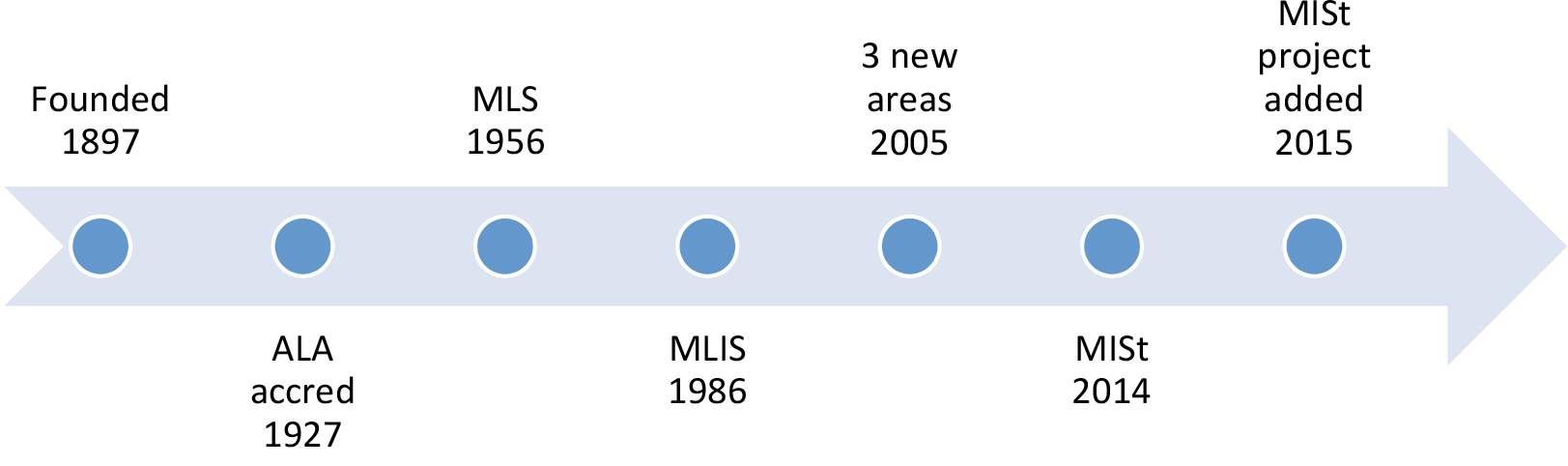
In parallel with these changes, the School also changed its affiliation beginning with its initial home within the library administration (1897), moving to the Faculty of Arts and Sciences (1940), to the Faculty of Graduate Studies and Research (1965), the Faculty of Education (1996) and finally to its current home within the Faculty of Arts (2014).
In addition to our accredited masters degree, the School introduced the post-master Graduate Diploma in Library and Information Studies in 1996 and the Graduate Certificate in Library and Information Studies in 2001 to offer refresher training for our graduates. In 2014, we introduced a research project option within the Master program, to allow students interested in research to complete an 18-credit research project in lieu of additional elective courses. This allowed us to attract students interested in a career that includes more research, potential doctoral students, and at the same time enabled these students to be eligible to apply for research grants.
The first step towards interdisciplinarity occurred with the introduction of two new areas of specialization within our masters program, Archival Studies, and Knowledge Management, and offering the existing curriculum as a specialization in Librarianship. However, a core of four required courses were mandatory for all three specializations in order to ensure the key learning outcomes were met by all our graduates. In parallel, three new graduate certificates were introduced: Graduate Certificate in Digital Archives Management, Information Architecture, and Information and Knowledge Management, reflecting the three new specialization areas.
There are many definitions of interdisciplinarity and the term multidisciplinarity is often (erroneously) used as a synonym. Newell et al. (2001) note that “interdisciplinarity is necessitated by complexity, specifically by the structure and behaviour of complex systems…Complex systems also unify the apparently divergent approaches to the interdisciplinary study of the humanities and sciences” (p. 1). They note that in order to justify the interdisciplinary approach, its object of study must be multifaceted, yet its facets must cohere. This is in contrast to a multidisciplinary approach where disparate disciplines can be brought under the same program without the need for coherence – the different disciplines remain divergent. Interdisciplinary programs, such as our Information Studies program, require integration of the different disciplinary areas, in order to best prepare information professionals for their careers.
Interdisciplinary studies can therefore be defined as “a process of answering a question, solving a problem or addressing a topic that is too broad or complex to be dealt with adequately by a single discipline or profession” (Klein & Newell, 1998, p. 393). This is the foundation of our curriculum; it is not a matter of simply adding on more disciplines or courses, as we did not want to lose our focus, our identity of Human Information Interaction. The evolution of interdisciplinarity in our School involved the addition of complementary content while maintaining a common core curriculum. One critical point to consider was whether library science and information science are separate disciplines? Rubin (2017) notes the complementary nature of these disciplines and focuses on their convergence. Raywards (1983) describes the relationship between library science and information science as a “disciplinary continuum …with no easily identifiable boundary separating them though the difference between the extreme ends of the continuum are clear and even dramatic” (p. 344).
The evolution of interdisciplinarity in our School mirrored the evolution of LIS education as well as that of the professional field of practice. A good example of this evolution is the iSchool movement that grew out of a need to increase the scope of LIS education (Chu, 2012; Dillon, 2012; Lyon & Brenner 2015; Seadle & Greifeneder, 2007); SIS became a member of the iSchool Consortium in 2014.
Our move towards a more interdisciplinary program paralleled the development of many other information related programs and disciplines of study. These disciplines bear names such as “informatics” (e.g., health informatics), “omics” (e.g., proteomics), “digital” (e.g., digital humanities), and “data” (e.g., data science, big data). Yet within this increasingly diverse landscape, information studies remains the only discipline which is centred on humans and their interaction with data, information, and knowledge, regardless of the source, format or the technology used to support and facilitate the interaction. Information studies offers a distinct and unique perspective to the information domain, one that is complementary to other disciplines such as computer science, informatics, or data science. Our goal in expanding the interdisciplinary aspects of our program was not to duplicate other fields, but to complement them, both by bringing new content into our program, and reaching out to other programs in which information studies principles and practices were relevant. At the same time, it was also important to not lose our distinct identity, and to maintain our focus on the concept of human-information interaction.
The move to an interdisciplinary curriculum was also in response to local consultations. The introduction of Archival Studies and Knowledge Management were recommended based on benchmarking done by a consultant to identify trends in the professional field and education. Curriculum workshops and forums with employers and graduates have continued to reinforce the need for management and technology skills among our graduates. And, all our faculty have recognized the evolution of the field, and have increased our interdisciplinary research and collaboration.
The evolution of our interdisciplinarity is further described below.
Over the past 20 years, our program has evolved to encompass a range of interdisciplinary courses and program options, while still retaining the identity of a School of Information Studies. The common thread to the program is the interaction between people and information, Human-Information Interaction, supported and facilitated by technology. All of the strategic planning, faculty selection, course and program development adhered to this vision. Thus, interdisciplinary content within the program required an explicit connection to information studies. The intent was not to branch out in different directions or into different domains of study, but to make connections among them. In some cases, this involved incorporating perspectives and fields of study from outside information studies into the program in a complementary approach. In others, it involved taking an information studies perspective to other disciplines.
The discussion of the program evolution draws on a variety of internal data sources, including course descriptions, annual course schedules, meeting minutes (curriculum committee, departmental committee, strategic planning committee, and advisory committee), notes from curriculum forums, and program plans from the ALA accreditation process. The results are summarized in narrative format.
The timeline for the program evolution is shown in Table 1.
Evolution of interdisciplinarity
Evolution of interdisciplinarity
Twenty years ago, the program remained primarily focused on librarianship, with a few courses relating to archival studies. The first significant move towards a more interdisciplinary program was the introduction of streams into the program in 2005. The three streams were: Archival Studies, Knowledge Management, and Librar-ianship. The program design recognized that all three areas fit under the broader umbrella of information studies, with core elements in common, but that they also each had their own areas of expertise. Rather than requiring all students to take a librarianship-centred program and then add courses in archival studies or knowledge management, the streams allowed students to focus on their area of interest. Archival Studies focused on the management of records in paper and electronic formats through the use of recordkeeping systems for facilitating organization memory, legal compliance, and decision-making; it included both the management of historical records in archives in a traditional sense, and of active records through records management. Knowledge Management concentrated on an organization’s knowledge resources, as formed primarily through experience. Librarianship emphasized mediating access to (usually) published information, in a wide range of formats, while responding to users’ information needs. Graduates were prepared for careers in a wide range of milieus from traditional libraries to the information industry.
Within the 48-credit (16 courses) program, there were four core courses required for all students (Information and Society, Research Principles and Analysis, Information System Design, and Information Agency Management). These four courses were foundational to the streams and are similar to the core courses offered in other MLIS programs (Dillon & Norris, 2005). Students also took four required complementary courses specific to their stream. These additional foundational courses were oriented toward the skills, knowledge and competencies relating to each stream. As an example, in the pre-stream program, all students took the required organization of information course, which had a strong library orientation (e.g., AACR (Anglo-American Cataloguing Rules), DDC (Dewey Decimal Classification), LCSH (Library of Congress Subject Headings), etc.). With the introduction of streams, each stream included a required organization of information course, but one that was specific to the stream. Archival studies students focused on archival organization including RAD (Rules for Archival Description), while knowledge management focused on how to build consensus for organizational knowledge taxonomies in the absence of any authoritative reference.
The remaining 8 courses (24 credits) were electives. Four courses were selected from a list of complementary electives specific to each stream. Courses were included in each list because they related directly to one of the three streams, and they complemented the students’ education in their chosen stream. The final four courses were free electives.
The introduction of streams was an early step in recognizing the interdisciplinarity within information science, specifically that librarianship and archival studies, while they are related, are not the same, and have their own disciplinary focus. Knowledge management, on the other hand, does not have a defined academic (nor organizational) home. Knowledge management is found in a wide variety of faculties such as Law, Management, Education and Computer Science. Knowledge management as an academic discipline and as a field of professional practice is very interdisciplinary, and crosses such silos as human resources management, information technology, cognitive science, organizational design and knowledge representation.
Over time, as part of ongoing program evaluation, it became apparent that the academic and professional distinctions among the three stream areas were becoming increasingly fuzzy, and that students were interested in taking courses from more than one stream. At the same time, one of the key findings of a 2011 curriculum forum was that the masters program should provide students with additional course choice flexibility in order to tailor their program of study to meet the requirements of a broader set of information professional positions in both the public and private sectors. This prompted a curriculum revision. Plans for adding new courses and for modifying existing courses were discussed and approved in line with the review of the program goals, objectives and learning outcomes. At the same time, a strategic hiring plan was developed to ensure alignment between potential new hires and potential new course offerings.
The revised MISt program, introduced in 2014, has five required courses, which are foundational to all areas of information studies research and practice. The first four (Foundations of Information Studies, Organization of Information, Information System Design, and Information Behaviour and Resources), are usually taken during the first term, and are similar to the core courses offered in other MLIS programs. The final required course, Integrating Research and Practice, is a capstone course, taken in the final term of the program.
The remaining courses are electives. It is through the choice of these courses that students are able to craft a personalized program of study that matches their individual career aspirations and learning objectives. Rather than prescribing required courses for different career paths or interests, the electives are grouped into suggested clusters supporting various areas of interest. The areas of interest represent both traditional and interdisciplinary perspectives to information studies, but allow for interdisciplinary content within traditional areas. Since the clusters are an advising tool, rather than a program requirement, they are very flexible and dynamic, and can be quickly updated as needed. The current areas of interest are archival studies, knowledge management, librarianship, user-centred design/user experience design/HCI, and data science/data mining/AI. The next area will be cybersecurity and two of the five courses for this area have been developed.
Interdisciplinary courses
Even two decades ago, when the program had a sole focus on librarianship, it included courses which were interdisciplinary in scope, reflecting the fact that librarianship has always referred to disciplines outside its own. However, as shown in Table 2, the number of interdisciplinary courses has steadily increased, from a low of two (6.9% of courses offered) in 2001/02, to a high of 14 (40% of courses offered) in 2018/19. The 2002/03 academic year marked the first significant increase in interdisciplinary content, with the introduction of knowledge management courses to the program (Fig. 2). That year also marked the beginning of a series of new faculty hires. The second significant increase started in the 2012/13 academic year. This also corresponded to a round of faculty hiring, which was strategically targeted towards more interdisciplinary areas of research, which in turn resulted in the development of new interdisciplinary courses.
Number of courses by year
Number of courses by year
Percentage of interdisciplinary courses by year.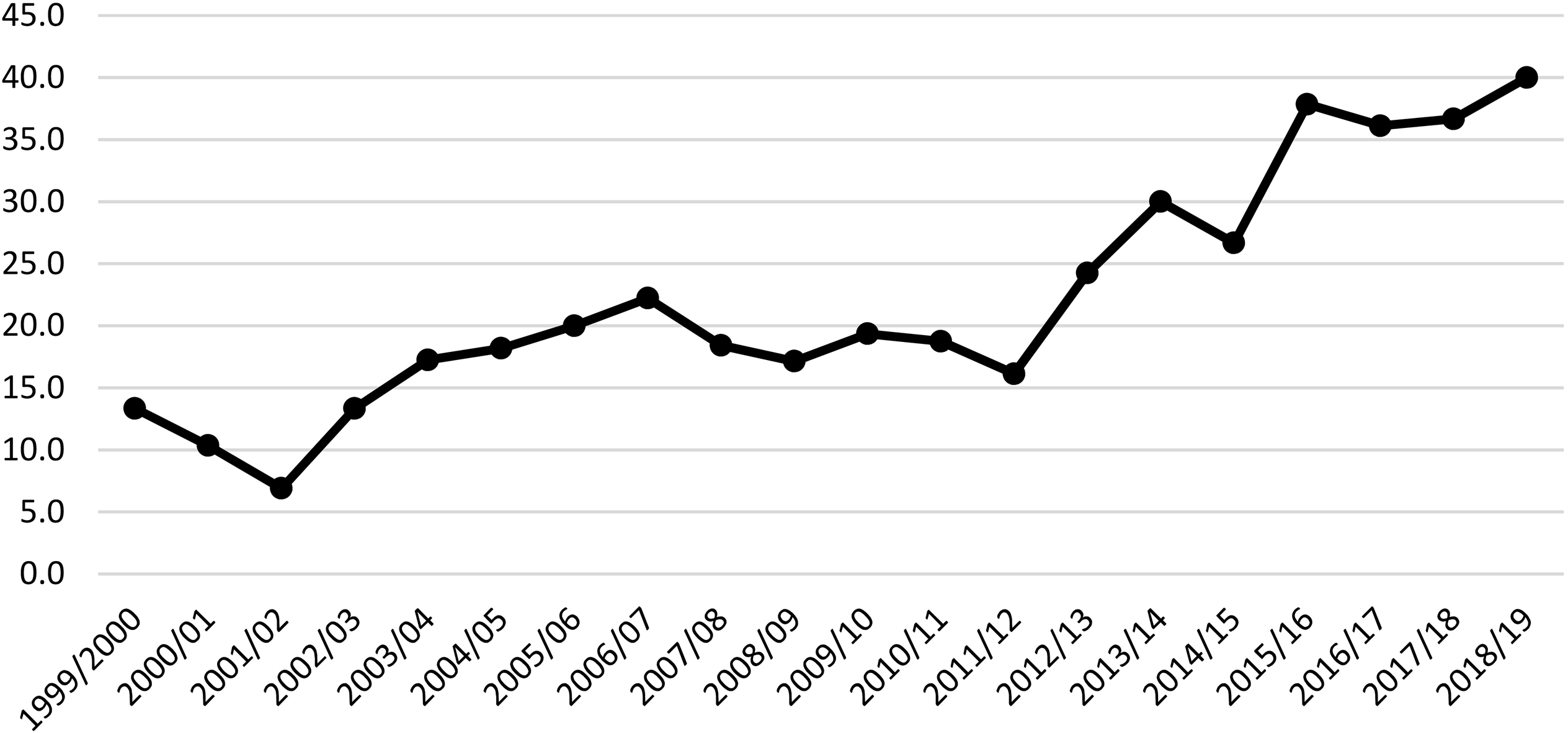
The school currently offers 18 interdisciplinary courses in the program; all interdisciplinary courses offered since 1999 (including one no longer offered) are listed in Table 3, along with the academic year in which each was introduced, and the current calendar course description. The introduction of these courses reflects a strategic and deliberate plan to strengthen the areas of management, research, and technology knowledge and skills. These areas were specifically noted by alumni and employers during our curriculum forums as critical skills for new graduates. We also decided very deliberately not to stay in our silos, both within and beyond our program. The removal of formal streams broke down the silos within the school, not limiting students to only one aspect of information studies. At the same time, we also sought new faculty members, new research collaborations, and new opportunities for teaching.
Course descriptions of interdisciplinary courses
Four courses pre-dated the introduction of streams into the program, and were part of the program when it had a sole focus on librarianship. However, they still drew upon interdisciplinary content and perspectives in support of librarianship. Systems Thinking discussed the traditions of systems analysis, and applied them to information science contexts. Multimedia Systems incorporates elements of computer and software engineering, as well as sound, image and video processing. Language and Information draws upon linguistics and language processing to explore the impact of language (bilingual, multilingual) on information system design. Information Policy is now linked to the university’s new School of Public Policy; the School of Information Studies is one of many units supporting this new, interdisciplinary program.
The majority of the interdisciplinary courses have been developed since 2002, in parallel with the strategic program revisions and hiring initiatives. The first group of new courses added knowledge management to the program, and corresponded to the introduction of the Knowledge Management stream. Knowledge management emerged as an academic discipline after initially being introduced as a professional practice. The early adopters were the major consulting companies and while there was an early period of skepticism, the practitioners publicly called for academia to take over the lead and to inject more evidence-based approaches in the late 1990’s. In the past two decades, knowledge management has been integrated into universities around the world, in such units as Education, Information Science, Management and Computer Science (e.g. Roknuzzaman & Umemoto, 2009; Maceviciute, 2002). The major focus of knowledge management is to identify valuable knowledge (both documented explicit knowledge and intangible tacit knowledge) in order to ensure that it can be shared and used throughout an organization as well as preserved for future reuse by often unknown users. Knowledge management “sits on top of” information, document, data and record management and makes use of much the same processes: create, store, share, disseminate, preserve and reuse (Dalkir, 2017). There is a natural fit with information studies and McGill introduced this complementary stream in 2002 with the development of four new courses: Knowledge Management Foundations, Knowledge Taxonomies, Intellectual Capital Management and Knowledge Networks (originally Communities of Practice). The Foundations course is a survey course that serves as an introduction to knowledge management. Knowledge Taxonomies focuses on the building of consensus to arrive at an organizational taxonomy that is often unique or customized. Intellectual Capital Management outlines how to identify and assess the value of intangible assets such as experience and expertise. Knowledge Networks describes social capital and how to use techniques such as Social Network Analysis to identify knowledge sharing flows. Existing courses on Competitive Intelligence, Database Design and Management of Information Organizations formed part of this new stream and a new faculty member was recruited with knowledge management expertise.
Three new archival courses were then introduced: Archival Description and Access, Preservation Management, and Electronic Records Systems. Along with existing courses in Archival Principles and Practice, and Records Management (now Enterprise Content Management), these formed the core of the new stream in Archival Studies, and added an interdisciplinary focus within information studies. A new faculty member with professional archival experience and expertise was recruited in 2003. Both the introduction of the Archival Studies stream, and its continuation as an area of interest in the increasingly interdisciplinary curriculum are consistent with calls to maintain a strong and contemporary archival studies presence in information studies and iSchool programs (Cox & Larsen, 2008).
The next two courses, Bioinformatics Resources and Introduction to Museology have similarities in that both take an information studies perspective to areas which are, by definition, multi-disciplinary. Bioinformatics is typically dominated by biology and computer science. Our course took an information service perspective, focusing on the use of bioinformatics resources as a source of information, and considering aspects such as information search and retrieval, organization and curation of information, and usability of resources, as well as on the contributions information professionals can make in this field (Bartlett, 2005). The course was designed to be complementary to other information service courses such as Health Sciences Information. It is also included as an elective course in the Bioinformatics Certificate program. Likewise, Introduction to Museology takes an information studies perspective to a field that also has strong ties to areas such as history, archeology, and anthropology, but that also has the potential of closer collaboration with information studies (Kim, 2012). The course includes topics such as organization of material, digitization, preservation, and the design of web-based and other virtual exhibits. It also addresses the current environment in which libraries and archives often present museum-style exhibits, and helps future librarians and archivists develop skills and knowledge in museology.
Three courses, Usability Analysis and Assessment, User-Centered Design, and Information Architecture, form the core of the user-centred design/user-experience design area of interest. The content in these courses overlaps with that taught in computer science, computer engineering and information systems programs. In keeping with the school’s focus on users and services, these three courses take a user-oriented focus.
Another three courses, Data Science, Data Mining, and Information Security, form the core of the data science area of interest. These courses do not duplicate those offered in computer science or information systems. Instead, they introduce information studies students to the foundational principles of data science, data mining, and data and information security practice, while also retaining a focus on the human interaction with or use of the data and information system. The inclusion of these courses and area of interest is a response to the importance of data science within information studies programs (Lyon & Brenner, 2015).
The final two courses added to our program link information studies with other disciplines. Music Information Retrieval addresses the challenges inherent in applying information retrieval in the context of music, such as non-textual representations (e.g., audio) of music, feature extraction (e.g., tempo, key, timbre), and assessment of relevance. Information and Cognition applies cognitive psychology to information behaviour, focusing on the cognitive processes that underpin information behaviour. It discusses issues such as information overload, problem solving, decision making, and the connection between cognitive style and personality and differences in information behaviour.
Moving towards a more interdisciplinary program has had many benefits for the school and our students, but it was not without challenges.
Maintaining a good balance within the program is challenging, and must account for a number of factors. When students were required to choose a stream, their path through the program was fairly predictable, and thus courses could be scheduled accordingly. With students now having the flexibility to select their own path, it is more challenging to ensure that all students can take the courses relevant to their interests. The make-up of each cohort varies from year to year; one year, there can be a strong interest in librarianship, the next, an interest in UX design. Our program includes a practicum course as an elective, which offers students an opportunity to do a field placement within an information organization. Again, the fluidity of our student cohorts from year-to-year makes it challenging to maintain a stable set of practicum host sites.
As a professional program, there is always a need to balance theory vs. practice, knowledge vs. skills, and academic vs. professional aspects of the field. Traditionally, LIS faculty would have included professional training as part of their education, possibly with a background including professional practice. They would be familiar with a professional masters program. As faculty hiring has become more interdisciplinary, information studies professors now come from a variety of disciplinary backgrounds. Those from outside of LIS have most likely followed a more traditional, research-oriented masters and doctoral degree path. For them, a terminal masters program intended to educate students for careers as information professionals may not be familiar. It may take a bit of orientation for new faculty to adjust to the fact that the masters program is not necessarily a research degree, nor a stepping stone to doctoral studies.
Similarly, there needs to be the right balance between theory and practice, and knowledge and skills. Students must graduate with enough knowledge and theory to allow them to respond to the ever changing information environment, and continue lifelong learning throughout their careers. At the same time, they need sufficient practical skills to be able to start working as information professionals. For those faculty coming from a research-oriented background, there is a need to consider how to apply research in practice. One solution to balancing research and practice is to have both faculty members (professors with a research-focus) and sessional lecturers (practicing information professionals) teaching in the program. This allows students to benefit from both the depth of research knowledge of faculty, while also learning cutting edge practical skills from current professionals.
As a small school, our faculty have numbered a maximum of twelve tenured or tenure-track professors. This has meant that often coverage of a particular course, or even area of expertise, falls to a single faculty member. Faculty are supplemented by sessional lectures on a term-by-term basis; albeit with a fairly limited budget. As a consequence, we are not necessarily able to schedule a course if that professor is unavailable, for example on sabbatical leave. Likewise when a faculty member leaves the school, there may not be continued coverage for courses they had taught. It is an ongoing challenge to cover the broad spectrum of an interdisciplinary curriculum. However, the options it provides to our students make the effort worthwhile.
Our graduates pursue a variety of career paths; since librarianship is among them, our ALA accreditation status is important. Evaluating an interdisciplinary program against standards focused on librarianship is challenging. Our approach has been to clearly articulate how the various interdisciplinary elements of our program are complementary to librarianship, while also maintaining a strong set of required courses focusing on the core of LIS.
One unexpected challenge were the responses from other departments in the university. Adding interdisciplinary courses, by definition, entails some overlap with other departments. The course and program approval procedures require us to identify these actual or potential overlaps, and to clearly articulate how our courses and programs are distinct from those offered elsewhere, and how and why they fit within an information studies program. We are also required to conduct a formal consultation with departments if there is potential overlap. In some cases, the process went very smoothly, with the other departments recognizing the information studies perspective of our courses, and the fact that they offered a complementary perspective, not a duplication, of their courses. In some cases, this process even led other departments to include our courses within their own programs. In other cases, however, the process was less smooth, and prompted territorial wars as to who could claim the “info” space and name. In the end, we have not been prevented from offering the courses we have wanted to, but, the process has required patience, tact, diplomacy, and perseverance.
Best practices
As our program has evolved over the past two decades, we have learned a number of lessons, and thus identified a number of important best practices. Ongoing assessment of the courses and program has been core to our planning process. We have continuously solicited feedback from students, alumni and employers.
Students provide feedback on courses through end-of-term course evaluations, which are reviewed by the professor and the school’s director. Annually, graduating students complete a placement survey, which asks them how long it took to find a job, whether they found a job in the area they wanted, what element of their degree they found helped them out the most and so on. Town Hall meetings are held at least once a semester in order to provide an informal forum for discussion of issues relating to the school and program. There is a separate town hall for MISt students and PhD students. The goal is for the Director (often accompanied by the Graduate Program Director and the Curriculum Committee Chair) to share news about key changes in the School and the context in which they are taking place. The bulk of the forum is left open for students to raise any questions or issues they may have. Students are active participants in the school’s governance, with voting positions on the departmental and curriculum committees. Their active participation on these committees provide an opportunity for student input and feedback at all stages of program and course planning.
Alumni and employers serve on the school’s advisory board and accreditation committee. They provide insights into current and anticipated needs of employers, and guidance on the skills and knowledge valued in new graduates and potential hires. More significantly for our program planning, they also participate in periodic curriculum forums. These day-long meetings provide a format for current students, recent graduates and employers to discuss the curriculum, how well it fits graduates for the current job market, and what skills they anticipate graduates requiring in the future. The curriculum forums have been key in informing the evolution of our program.
Strategic planning is critical to supporting program and course planning; curriculum revision should not happen in a void, but should be part of a larger strategic plan which also encompasses hiring, research trajectories, and collaborations, among others. In our case, the decision to expand the scope of our program to include more interdisciplinary elements was part of an overall strategic plan that also included expanding the research scope of our school. A strategic plan should also be consistent with the vision, goals and objectives of the school. In our case, we determined that the unifying feature of our teaching and research was human-information interaction, and the curriculum was further guided by the principles of a service orientation, and a human/user-centred emphasis. Identifying and maintaining this unifying vision is crucial, otherwise there is the risk that the addition of interdisciplinary courses and programs can lead to a loss of focus.
The strategic planning sessions are also used to guide our faculty recruitment goals. The first steps towards interdisciplinarity involved hiring three new assistant professors in the new streams (Archives, Knowledge Management and Librarianship (bioinformatics)). The second wave led to the hiring of five new faculty: one in the area of digital archives and social media and the remaining four in the ICT area. Our faculty continues to represent a wide range of disciplines including doctoral and master degrees in library and information studies, professors also have degrees in biology, business administration, computer science, education, educational technology, English studies and literature, history, psychology, and psychoacoustics. Such diversity of background provides a solid foundation for interdisciplinary teaching (Luo, 2013; Wiggins, 2009).
Another best practice at our School involves maintaining continuity in the face of such continuous change. Continuity not only ensures there is no break in the various activities of the School but also that the School’s culture is preserved (Sporn, 1996). One way of achieving this continuity has been to have significant overlap in the School’s leadership. This means that the incoming chair of an important committee or an incoming Graduate Program Director (GPD) has the opportunity to sit in on meetings and receive mentoring from the outgoing chair or GPD. We have been fortunate that to date, all outgoing leaders have remained at the School and thus were able to serve as valuable sources of knowledge and know-how. This overlap extends to the Directorship of the School in much the same manner; there is overlap between new and previous Directors. There is deliberate succession planning in that future potential directors are approached and engaged in active conversations concerning both the timing of the change as well as how to work together during the transition phase (Rothwell, 2010). Future leaders are either directly involved in or briefed on current activities and decision making in order to better prepare them for the tasks and challenges ahead.
Finally, communication and co-ordination is critical to the success of an interdisciplinary program. This takes many forms. Each year, the instructors of the four required first-term core courses co-ordinate their syllabi. This ensures that content is co-ordinated. Examples include appropriate sequencing of complementary material from different courses (e.g., subject indexing and searching using controlled vocabulary), ensuring that topics occurring in more than one course complement, not duplicate, one another, and also staggering the timing of the final exams. This communication also ensures that all instructors are aware of the content of all the courses, and that collectively, the courses support the program learning outcomes. Similar co-ordination has taken place within course clusters (e.g., knowledge management, user-experience design).
Within a program with interdisciplinary content, faculty members will likely not be proficient or knowledgeable in all aspects of the program. Yet, they do need to be aware of the full breadth of the program, and be able to advise students. When our program was organized by stream, it was relatively straight-forward to match students and faculty advisors based on similar interests. Since students are no longer required to formally declare their area(s) of interest, and have flexibility in how they plan their program, they will not necessarily be assigned a faculty advisor who shares their interests. It was therefore important that the structure of the program, the clustering of courses around areas of interest, the basic content of each course, the possible paths through the program, and the expertise of each faculty member be clearly communicated within among faculty.
It is also critical that communication with students is effective. This must be bi-directional – information from the school being communicated to the students, but also ensure that there are channels for students to communicate back to the school.
Conclusion
Our curriculum has evolved over the past twenty years from a librarianship focused program with only a few courses with interdisciplinary content to a diverse, dynamic and flexible program with almost half of its courses being interdisciplinary. Even though the concept of interdisciplinary content is not new to information studies, it is much more prevalent and important today. Information studies education cannot remain in historical silos, but must include knowledge and skills from other disciplines. At the same time, information studies has a lot to offer to other disciplines, so schools should also look for opportunities for collaboration and outreach.
Our experience shows that implementing an interdisciplinary curriculum is resource intensive, and logistically challenging. But the outcomes are well worth the effort. The interdisciplinary aspects of our program prepares our students for a variety of current and future career options, and provides a foundation for lifelong learning.
It is important to note that as the program has evolved in response to the changing information landscape, and the corresponding educational needs of our students, it has remained true to its roots, without rejecting or discarding the long history and foundations from which the field was built. The interdisciplinary changes do not preclude also introducing new courses with core information studies areas (e.g., Information Literacy, Archival Literacy and Outreach), revising existing ones to reflect current needs, and maintaining the areas of interest related to more traditional aspects of information studies. The unifying focus at the heart of our program remains connecting people with information.