



Abstract
This study aims to determine the predictors of cyberloafing behaviors of university students. In this context, we examined the effects of smartphone and internet addiction variables on cyberloafing levels. Besides, the mediator effect of internet addiction was determined in the impact of smartphone addiction on cyberloafing. We conducted the questionnaire-based study with 341 students studying at different departments of a state university (faculty of education, faculty of engineering, and vocational school) in Turkey. Participants consisted of 182 male and 159 female. Students filled out the smartphone addiction scale, the internet addiction scale, and the cyberloafing activities scale. The data obtained from the 5-point Likert type scales were evaluated with correlation and regression analyses. The results showed that there is a significant positive relationship between smartphone addiction, internet addiction, and cyberloafing. While internet addiction was a predictor of cyberloafing, it mediated the effect of smartphone addiction on cyberloafing. We discussed the results of this study and offered suggestions for future research.
Introduction
Today, technologies such as smartphones and the internet have become an important part of education, business and social life. Smartphones attract attention as a device that is getting more widespread due to its advanced features and easy portability. Students are using smartphones for different purposes such as entertainment, playing games, education and online shopping as well as communication (Chou & Lee, 2017). While smartphones have become a technology that students spend a lot of time with many features that make daily life easier, they constantly want to use their smartphones at home, in school or in their social lives. This situation puts students at risk of smartphone addiction (Rudkovska et al., 2020).
The fact that smartphones contain many features that are easy to use, and facilitate access to the internet can cause individuals to spend more time with mobile devices and cause problematic use of these devices. Smartphone addiction is the emergence of problems in education, social and business life as a result of excessive use of smartphones and the feeling of deprivation and pressure when the smartphone is not with them (Mok et al., 2014). The effects of the internet on students such as avoiding pressure and stress, gaining autonomy and self-confidence lead them to be interested in the virtual environment rather than the real life environment (Masaeli & Farhadi, 2021). Students mostly use smartphones together with the internet. In this context, smartphone addiction is evaluated in relation to internet addiction. Internet addiction is a person’s excessive and uncontrolled use of the Internet (Young, 1998). People may spend more time online than necessary, and their other activities in life may be negatively affected. Studies that found the relationship between internet addiction and smartphone addiction emphasized examining how these two variables affect each other and their relationship with different variables (Jeong et al., 2020).
According to the We are social (2022) digital report, while people spend 6.58 hours a day on the Internet, the rate of accessing the Internet with smartphones has reached 92.5%. In addition, the use of mobile internet and social media has shown a continuous increase in the last ten years. While this situation distracts the students’ attention during the learning process, they may cause them to engage in cyberloafing by doing extracurricular activities (Villena Martínez et al., 2020). Cyberloafing draws attention as an increasing problem in learning environments, and it can be said that determining the factors affecting cyberloafing is important in terms of reducing students’ extracurricular activities. In addition, while cyberloafing is a subject that is mostly studied for the business environment, it has become an important issue in educational research with the active use of mobile internet technologies in educational environments (Gülnar & Ünsal, 2020; Metin-Orta & Demirutku, 2020).
Although information and communication technologies have many features that make students’ lives easier, it has also brought problems such as smartphone addiction, internet addiction and cyberloafing (Sarıtepeci, 2020). Researchers stated that identifying the predictors of students’ cyberloafing behaviors can contribute to reducing the factors that may distract students in the teaching process (Askew et al., 2014; Coskun & Gokcearslan, 2019; Karabıık et al., 2021). This study examined students’ smartphone and internet addictions and the predictive effects of these addictions on cyberloafing behaviors. In this respect, based on the findings in the literature, it was thought that internet addiction could have a mediating role on the way smartphone addiction to cyberloafing. Therefore, both direct and indirect effects of smartphone addiction on cyberloafing were studied. It was observed that there was no previous study in the literature addressing the relationship between smartphone addiction, internet addiction, and cyberloafing in terms of a mediating model, therefore, this study aimed to fill this gap in the literature.
In the following sections, studies emphasizing the relationship between smartphone addiction, internet addiction, and cyberloafing and their results were summarized. We also discussed the findings and conclusions of the research and expressed recommendations for future research.
Literature review
Smartphone addiction
Being used extensively and worldwide with their advanced features, smartphones (Liu et al., 2017) are utilized for many purposes such as socializing, entertainment, and shopping owing to their opportunity to access the internet without any time and space limit. In recent years, new designs of these devices as large-screen, fast and capable of performing some computer functions have encouraged not only adults but also students to use smartphones. Students can connect to the internet via smartphones end e-mails, shop online, watch and share videos, conduct banking transactions, play games, make voice calls and video calls, and use social networks. These functions can make smartphones an integral part of life, leading to their inappropriate use (Samaha & Havi, 2016). Although they offer great convenience, smartphones can cause emotional changes and even problematic physiological reactions and smartphone addiction (Han et al., 2017).
Due to its rapid growth rate and serious consequences, smartphone addiction has become a problem in the world (Liu et al., 2017). Smartphone addiction, as a type of behavior disorder, is the excessive and compulsive use of smartphones. A kind of technological addiction, smartphone addiction is defined as the loss of control, increasing time spent with smartphones (tolerance), and a state of psychological unrest that emerges when smartphones cannot be used (withdrawal). Students develop social relationships with smartphones and make new friends. The fact that smartphones perform many different functions, provide the opportunity for portability and access to the internet from anywhere reinforces smartphone addiction. Even though smartphones facilitate the lives of students, they can negatively affect their learning processes. Inappropriate use of these devices can lower the motivation levels of students in the classroom environment and prevent face-to-face communication. This increases the importance of studies examining smartphone addiction levels of students. When the literature is examined, it is seen that there is a greater need for studies examining smartphone addiction of students (Chen et al., 2016). In addition, internet addiction is seen as an increasing risk with the addition of advanced features to smartphones and the ability to access the internet from anywhere.
Internet addiction
Today, the internet is widely used since it provides rapid access to information, communication, e-commerce, and various entertainment opportunities (Kant, 2018). The internet has become the platform where users spend a lot of time with the advent of social networks, blogs and online games. In this context, previous studies have revealed that the duration of internet use among individuals is gradually increasing. According to the We are social (2022) digital report, the daily internet usage time in the world is on an increasing trend and is approximately seven hours, while social media usage is approximately 2.5 hours. The effective use of the internet in the educational and social fields has made students an important risk group in terms of internet addiction (Zochil, 2015). Studies also revealed that internet addiction is widespread among university students (Lei et al., 2018).
Internet addiction is defined as the impulse control disorder without intoxicating substance use (Young, 1998). Internet addiction is expressed in different ways such as excessive internet use, pathological internet use, problematic internet use (Iskrenovıc-Momcıloıc, 2017). This addiction can lead to negative situations such as depression, loneliness, social isolation, intention to suicide and aggression (Chou & Lee, 2017). Although the internet is a medium where students make use of their spare time, discover knowledge, develop their interpersonal relationships, and take the opportunity to learn everywhere, excessive and uncontrolled use of the internet causes internet addiction. This addiction negatively affects the educational and social life and mental health of students (Fayazi & Hasani, 2017).
As an indicator of internet addiction, students are unable to control their time while playing online games, using social networks, shopping online, or working on apps (Zochil, 2015). They tend to delay their educational responsibilities while spending time on the internet, abstaining from doing research (Beavers et al., 2015). Hence, as the level of internet addiction increases, the cyberloafing tendencies of students also increase (Hadlington & Pearsons, 2017).
Cyberloafing
Cyberloafing is the use of the internet by employees for personal purposes during the working hours, acting in a manner that neglects responsibilities (Askew et al., 2014). These acts include certain behaviors such as checking emails, using social networks, banking transactions and playing online games (Varol & Yıldırım, 2018). Cyberloafing, nitially the subject of the business field, has attracted the interest of educational research studies with the introduction of information and communication technologies in schools (Dursun et al., 2018), therefore, it has also been treated as a behavior displayed by students.
Cyberloafing for students is the behavior of using the internet for irrelevant activities during course (Kalayci, 2010). Students can use social networks in class, play online games, watch videos and surf through the websites. Facilitating access to the internet through computer and mobile technologies in schools makes it easier for students to engage in such irrelevant activities and causes them to be distracted. Therefore, these cyberloafing behaviors can negatively affect the student performance. In this regard, cyberloafing is seen as a problem in the learning environment. On the other hand, even students, who see cyberloafing as a negative behavior, can tend to display cyberloafing behavior (Arabacı, 2017). Thus, cyberloafing in the education field poses an important problem when it is not controlled, and additionally, there is an increasing need for research studies on this subject (Varol & Yıldırım, 2018).
Research hypotheses
The relationship between smartphone addiction and internet addiction
The features of today’s smartphones are more advanced compared to their counterparts in the past. However, these advanced smartphones constantly encourage students to go online. Although this brings some benefits at the point of access to information, it can increase internet addiction levels of students. Therefore, students, who are addicted to advanced smartphones, may also be addicted to the internet. As a matter of fact, in previous studies it was observed that there are positive relationships between smartphone addiction and internet addiction. Hadlington (2015), for example, examined the relationship between problematic smartphone use and internet addiction with 210 participants from different age groups in the United Kingdom. The results of the study demonstrated that there was a positive relationship between problematic smartphone use and internet addiction. In a study on 448 college students in Taiwan conducted by Chiu, Hong and Chiu (2013), revealed that smartphone and internet addiction levels of students were not at the clinical level. On the other hand, it was found that there was a significant relationship between the smartphone addiction and internet addiction of students. Ezoe and Toda (2013) determined the relationship between smartphone addiction and internet addiction in 105 medical students in Japan. The findings suggest that students with high smartphone addiction levels also have high internet addiction levels. Carbonell et al., (2018) conducted a study on 792 students attending the departments of psychology in Spain between 2006 and 2017, and examined the development of smartphone and internet addiction. The results of the study revealed that the smartphone addiction and internet addiction levels of students increased similarly over the years.
Previous studies found that smartphone addiction has a relationship with internet addiction and that smartphone addiction affects internet addiction. On the other hand, related studies also suggested that there should be a focus on the causes of smartphone and internet addiction. In this context, it was thought that smartphone addiction could affect internet addiction and the following hypothesis was developed:
H1: Smartphone addiction positively affects internet addiction.
The relationship between smartphone addiction and cyberloafing
Although smartphones facilitate the daily lives of students, the fact that they also cause students to spend inefficient time negatively affects their active participation in learning activities in schools. This causes students to display cyberloafing behaviors (Varol & Yıldırım, 2018). Dursun, önmez and Akbulut (2018) investigated the factors that predict the cyberloafing levels of 1856 preservice information technology teachers. It was determined that having access to mobile devices predicted the cyberloafing levels of students. Saritepeci (2020) conducted a study to identify the factors that predicted the cyberloafing levels of 269 high school students. The findings demonstrated that there was a positive relationship between smartphone addiction and cyberloafing behavior. Varol and Yıldırım (2018) examined mobile technology using levels and cyberloafing levels of 228 prospective teachers (students). The findings demonstrated that, with the widepread use of mobile technologies in the learning environment, the cyberloafing levels of students also increased.
Based on the findings of the abovementioned studies on smartphone addiction and cyberloafing, it was thought that smartphone addiction may affect cyberloafing levels of students. In this context, the second hypothesis of the study was developed as follows:
H2: Smartphone addiction positively affects cyberloafing.
The relationship between internet addiction and cyberloafing
The increasing need for the internet also increases the risk of students becoming addicted to the internet, while also causing them to engage in irrelevant activities in the educational environment. Previous studies revealed that internet addiction increases the potential for cyberloafing (Hadlington & Pearsons, 2017). Keser, Kavuk, and Numanğlu (2016) examined the relationship between the levels of internet addiction and cyberloafing among 139 undergraduate students. The findings demonstrated that cyberloafing levels of studets were positively correlated with internet addiction. Baturay and Toker (2015) investigated the effect of demographics of 282 high school students on their cyberloafing levels. The findings of the analysis demonstrated that students with higher internet experience had higher levels of cyberloafing.
Studies in the literature presented above demonstrated that internet addiction levels of students and their cyberloafing behaviors are correlated. In this context, the third hypothesis of this study was developed as follows:
H3: Internet addiction positively affects cyberloafing.
The mediating role of internet addiction
As smartphones rapidly become widespread and provide the opportunity to access the internet from any location (Samaha & Hawi, 2016) these devices and the internet have become an important part of everyday life. This has not only affected private life but also caused students in the education field to become addicted to smartphones. This led to students spending too much time on the internet and facing the risk of becoming addicted, therefore, the emergence of smartphone addiction also triggered internet addiction (Hadlington, 2015). On the other hand, the intensive use of smartphones and the internet has made it common for students to engage in social networking and play online games during the courses (Carbonell et al., 2018), in other words, smartphone addiction and internet addiction resulted in cyberloafing behaviors of students (Sarıtepeci, 2020). Therefore, based on the findings of the researh studies suggesting that smartphone addiction increases the level of internet addiction and the level of internet addiction increases the behavior of cyberloafing, the following research hypothesis was developed:
H4: Internet addiction plays a mediating role in the effect of smartphone addiction on cyberloafing.
Purpose of the study
Although smartphones and the internet have many beneficial features for students, it has been revealed in different studies that they have risks, such as negatively affecting the learning process, addiction and cyberloafing (Fayazi & Hasani, 2017; Han et al., 2017; Seçkin & Kerse, 2017; Varol & Yıldırım, 2018). The fact that smartphones are portable and facilitate access to the Internet can cause students to engage in extracurricular activities and cyberloafing. Cyberloafing can negatively affect the execution and efficiency of learning activities (Saritepeci, 2020). This situation encouraged researchers to examine students’ cyberloafing behaviors, and it has been suggested that research should be conducted to examine the predictors and consequences of cyberloafing (Karabıyık et al., 2021; Özdemir et al., 2021). In previous studies, students’ cyberloafing levels were evaluated in relation to variables such as academic erformance, attitude, and various addiction types. It can be said that it is important to determine the predictors of cyberloafing in order to reduce students’ cyberloafing behaviors today, where online and mobile technologies are actively used in the teaching process (Metin-Orta & Demirutku, 2020). In this context, unlike previous studies, we examined smartphone and internet addictions as predictors of cyberloafing and aimed to contribute to the literature by evaluating the mediator role of internet addiction. Additionally, in this study, the effect of smartphone addiction on cyberloafing was determined both directly and indirectly (through internet addiction).
Method
This research was a quantitative study conducted with a survey method. The research data were obtained from undergraduate students through the convenience sampling method.
Participants
This research was conducted with students studying at the different departments of a state university in Turkey. According to the We Are Social (2022) digital report, Turkey, as a developing country, ranks 14th in the world in terms of daily time spent on the Internet, and 9th in social media usage. The scales were prepared using paper. The researchers distributed the scales to the students studying at the faculty of engineering, faculty of education and vocational school with the help of advisors. At this stage, we gave the scales only to students who wanted to participate in the research. The students were told that the surveys would be answered on a voluntary basis, and subsequently, 380 surveys were distributed to the students. 360 of these surveys were returned, but 19 surveys with data losses were excluded from evaluation. Therefore, analyses were carried out with the data obtained from 341 participants. When the demographic characteristics of the participants were examined, it was determined that 182 of them were male and 159 of them were female students, and the highest number of the students were the 1st graders (227), while the least number of students were the 4th graders (22). The age of the students participating in the study varied between 18 and 23. When the departments of students were examined, it was determined that students were attending difference departments (computer technologies (62), management and organization (34) business (20), mechanical engineering (30), social security (36), accounting (15), mechatronic engineering (16), banking (22), finance (14), electronic engineering (18), social studies education (32), computer and instructional technologies education (21), and Turkish education (21)).
Data collection tools
Smartphone addiction: In this study, a 28-item scale developed by Fidan (2016) was used in determining the smartphone addiction levels of students. The 5-point Likert-type scale includes seven factors: salience, tolerance, withdrawal, emotional change, conflict, relapse, and mobile internet tendency. The salience is that the use of smartphones has become the most important activity for students and suppresses their emotions and thoughts. Tolerance is the growing use of smartphones. Withdrawal is when physical or emotional problems arise when students stay away from the smartphone. Emotional change is the emergence of different emotional states in students while using smartphones. Conflict is that smartphones cause conflict in students’ social life. Relapse is the repetition of addictive behaviors even if the student takes a long break from using the smartphone. The mobile internet tendency is the level at which students use smartphones to connect to the internet. Among the items of the scale are “When using a smartphone, I forget my planned tasks” and “Without my smartphone, life is useless”.
Internet addiction: A 19-item scale developed by Şahin and Korkmaz (2011) was used in ordr to determine the internet addiction levels of students. The 5-point Likert scale has three factors. Loss of control is the inability of students to control their behavior while using the Internet. The desire to stay online more is the increasing amount of time students spend online. Negativity in social relations is that the internet negatively affects students’ social relations. Some examples of items in the scale include “I spend more time on the internet than I planned” and “I often delay my responsibilities in order to spend more time on the net”.
Cyberloafing: A 23-item scale developed by Yaşar (2013) was preferred to determine the cyberloafing behavior levels of the university students. The scale has four factors: individual, search, social and news. The individual factor includes students’ personal activities online. The search factor is the behavior of students to search for extracurricular information online. The social factor is the activities that students do in relation to their online social communication. The news factor is that students follow developments in daily life. Among the items in the scale are “I search in the search engines for interesting websites that have nothing to do with the course (pictures, videos, wise sayings, etc.)” and “I check my emails”. The scales used in the study were presented to the participants in Turkish language and each one was prepared as a 5-point Likert scale (1
Statistical analysis
The construct validity of the scales used in this study was tested by confirmatory factor analysis through the Amos package program. The SPSS 20.0 package program was used to determine the relationship between variables. In addition, the PROCESS Macro program with SPSS extension was preferred for the hypothesis acceptance/rejection decision.
Findings
Testing of the normality
Before the basic analyses were conducted in the research, it was determined whether the data provided met the assumption of normality. Although the assumption of normality can be checked through different methods, it was preferred to examine the skewness and kurtosis coefficients of the scales in this research. Skewness indicates the level of deviation of the value of a variable from the mean, that is, whether it is skewed to the right or to the left. Kurtosis, on the other hand, is a graphic representation of the distribution of values of a variable (pointed or flattened) (Gürbüz & Şahin, 2018). The fact that the skewness and kurtosis coefficients are between
Testing of the validity and reliability
In the study, by taking into account the sample size in the confirmatory factor analysis, the items with factor loads below 0.40 were excluded from the analysis. In addition, the model fit index values of each scale were examined and modifications were made on the items in order to meet the reference criteria.
As the conclusion of the confirmatory factor analysis administered to the 28-item mobile addiction scale, some scale items violating the 0.40 reference value (6 items) were excluded from the analysis. On the other hand, modifications were made on the substances to improve the model fit index values and the criteria for the referenced fit index were satisfied (Table 1).
As the conclusion of the confirmatory factor analysis applied to the 19-item internet addiction scale, it was observed that item factor loads were higher than 0.40. Certain modifications were made on the items in order to improve the goodness of fit values of the scale, and each reference value was satisfied (Table 1).
Finally, a confirmatory factor analysis was conducted on the 23-item cyberloafing scale. In the analysis, item factor loads satisfied the reference value. Modifications were made on the substances to improve the model fit index values, and thus, the reference criteria were met (Table 1). Therefore, the findings of the analysis for the scales revealed that the scales used provided construct validity.
Scale model fit indices
Scale model fit indices
Once the construct validity of the scale was determined, scale reliability analyses were made. Cronbach alpha coefficients were examined concerning the reliability analyses. In the findings of the analysis, it was determined that the Cronbach alpha value of each scale (smartphone addiction
Before testing the hypotheses, it was determined whether there was a common method bias in the research. In order to determine the common method bias, Harman’s single factor test was preferred (Podsakoff et al., 2003). Accordingly, all items in the smartphone addiction, internet addiction, and cyberloafing scales were subjected to the exploratory factor analysis. The results revealed that a multifactorial structure with an eigenvalue greater than 1 was obtained, and that the first factor did not explain the majority of the variance. Therefore, it was concluded that there is no common method bias problem.
Descriptive statistics and correlation analysis
Before testing the hypotheses in the research, the relationships between smartphone addiction, internet addiction and cyberloafing variables were examined. In order to determine these relationships, considering that the data demonstrated a normal distribution, Pearson correlation analysis was preferred. The Pearson correlation analysis findings are presented in Table 2 below.
Findings concerning the normality and correlation
Findings concerning the normality and correlation
According to the findings in Table 2, there is a positive significant relationship between smartphone addiction and internet addiction (
After determining the relationships between the variables in the research, appropriate analyses were conducted to test the research hypotheses. For the hypothesis acceptance/rejection decision, the regression analysis based on Bootstrap technique was performed through the Process Macro program with SPSS extension. Biases are corrected in the Bootstrap technique (Gürbüz, 2019), which enables to obtain more reliable findings than the mediating criteria of Baron and Kenny (1986) and the Sobel test (Hayes, 2018). In this technique, hypothesis acceptance and mediating effects must be significant for the value of p or the values in the 95% confidence interval (CI) should not have the value of 0 (Gürbüz, 2019). The findings of the regression analysis conducted by taking into account these stated criteria are presented in Fig. 1.
Regression findings.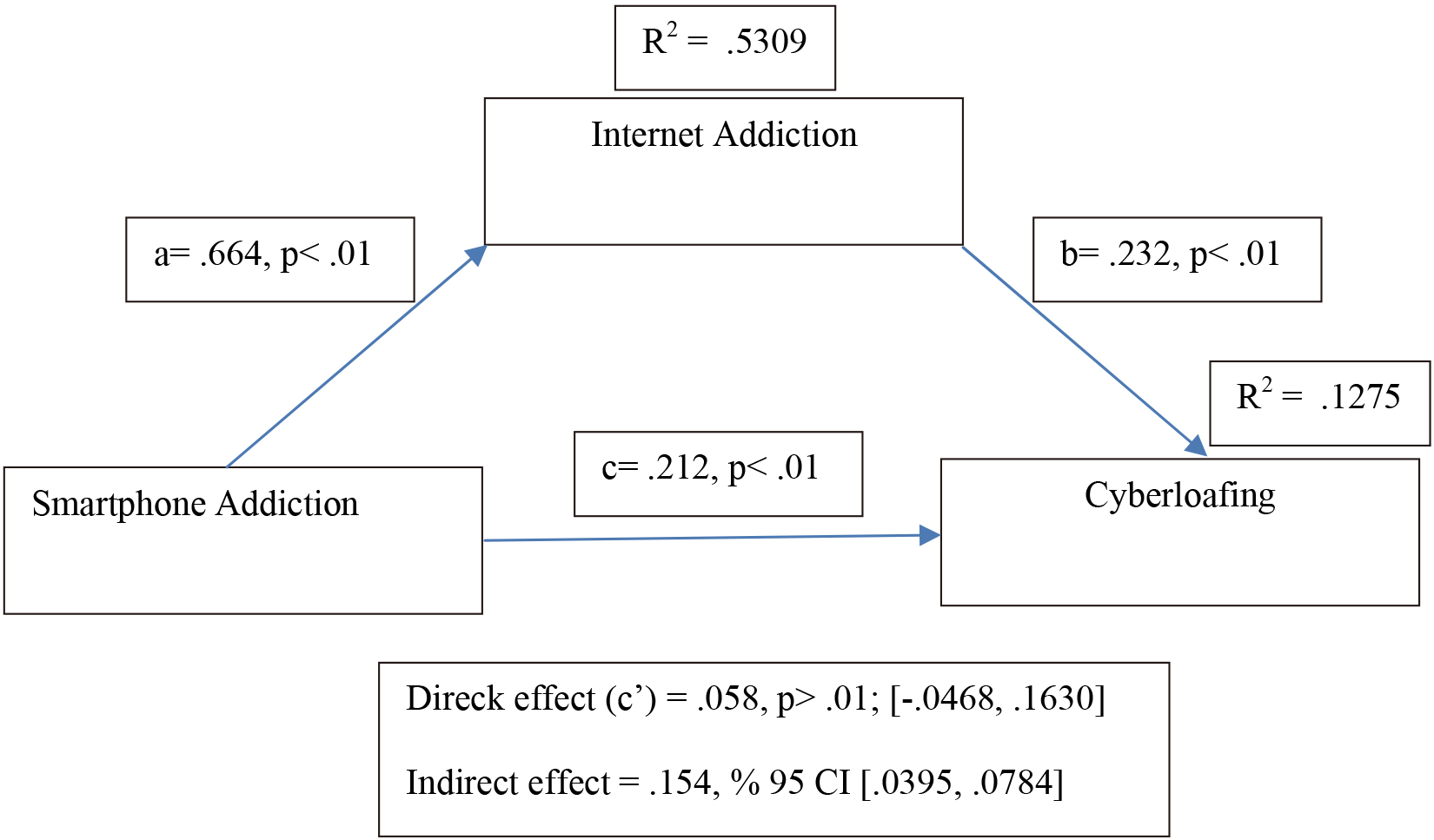
According to the findings in Fig. 1, smartphone addiction positively affects internet addiction at a significant level (a
When the findings concerning the test of the mediating hypothesis of the study are examined, it is observed that smartphone addiction indirectly affects cyberloafing (indirect effect
When the results of the study were examined, it was observed that smartphone addiction and internet addiction had a positive relationship with each other. The results of the study are similar to the results of previous research (Chiu et al., 2013; Hadlington, 2015). In addition, it was determined in the research that smartphone addiction significantly affects internet addiction. Carbonell et al., (2018) revealed that the development of smartphone addiction and internet addiction are similar and affect each other. Students spend a lot of time with smartphones as smartphones offer communication, entertainment and learning opportunities. In addition, the opportunity to access the internet without any limit of time and space results in the intensive use of the internet. Indeed, the results of the current study also demonstrated that internet addiction increases as the level of smartphone addiction increases.
It was determined in the study that there was a positive and significant relationship between the smartphone addictions of the students and their cyberloafing behavior. The results of the study are in parallel with the results of previous studies in the literature (Saritepeci, 2020). On the other hand, it was determined that smartphone addiction did not affect cyberloafing directly at a significant level. Studies demonstrated that students, who use smartphones, social media and a large number of applications, tend to display cyberloafing behaviors (Dursun et al., 2018). This suggests that smartphones can affect cyberloafing with the addition of new features that can be used with the internet besides talking and messaging. Although there was a positive relationship between smartphone addiction and cyberloafing in this study, it was observed that the effect of smartphone addiction on cyberloafing was not direct, but it was actually taking place indirectly.
Another finding in the study was that there was a positive significant relationship between internet addiction and cyberloafing. It can be mentioned that similar results were obtained in the previous studies of the literature (Keser et al., 2016). In addition, internet addiction significantly affected cyberloafing. Students spend more time on the internet encourages them to exhibit cyberloafing behavior. Becoming widespread and easier in schools, the internet access not only makes positive contributions, but also raises the risk for students to engage in irrelevant activities.
The study found that smartphone addiction, internet addiction, and cyberloafing behaviors are related, affecting each other. However, it was also determined that smartphone addiction did not directly affect cyberloafing. Studies demonstrated that the addition of internet and online applications to smartphones increases students’ tendency to display cyberloafing behaviors in schools (Baturay & Toker, 2015; Chen, 2016; Hadlington & Pearsons, 2017). In this study, it was determined that internet addiction is the exact mediator in the effect of smartphone addiction on cyberloafing.
Implications
In this study, it was attempted to determine the variables that predict the cyberloafing levels of university students. In this respect, the effect of smartphone addiction and internet addiction on cyberloafing was studied. As a conclusion, we found that internet addiction is a predictor of cyberloafing. While it was revealed that smartphone addiction affected internet addiction, it was also determined that it did not directly affect cyberloafing. However, internet addiction had a full mediating role in the effect of smartphone addiction on cyberloafing. In other words, contrary to what is known, it was determined that the effect of smartphone addiction on cyberloafing was not direct, but it was an effect taking place through the internet addiction. In this context, students’ increasing interest in smartphones causes internet addiction, while this addiction increases the tendency to cyberloafing. Therefore, cyberloafing behavior is actually caused by internet addiction, and internet addiction is caused by smartphone addiction.
It has been seen that smartphones and the internet are important factors in students’ cyberloafing behaviors. Smartphones can cause cyberloafing with their features that facilitate access to the internet. Considering the increasing use of smartphones and the internet, precautions can be taken to restrict students’ use of smartphones during lessons. The instructor should plan activities to increase class participation in order to prevent students from doing extracurricular activities in internet-based activities. In this study, the smartphone and internet addictions and cyberloafing levels of university students were examined by a quantitative research method. In future research, more detailed data can be collected by conducting qualitative studies on the effects of smartphones and the internet on cyberloafing levels.
Cyberloafing behavior was explained only by considering addiction variables ignoring other variables such as the personality of the student, classroom environment and the nature of the course. In this context, it may be suggested for further studies to take into account these and other similar variables and try to determine the causes of cyberloafing with moderated mediation models by adding variables such as personality to the model. Since this research was conducted with students in a developing country, the results of the study can be compared with the addiction status of university students living in a developed country and different culture, and the factors that predict smartphone and internet addiction can be evaluated.