



Abstract
Innovation capability (IC) research by university libraries is lacking but provides a clear view of the current body of knowledge. The themes underpinning innovation capability were explored while a novel framework was developed. The IC could be established when libraries reflect organisational relevancy (OR) and librarians’ confidence (LC) moderated by relationship-based leadership (RL). The IC potentially facilitates innovation performance (IP). The RL is a unique variable that must be examined in the wider context.
Given the current dynamism of university libraries as knowledge hubs through innovations and adaptations, this qualitative study incorporated the practices of developing innovation capabilities (IC) in libraries, particularly for Indonesian state-owned higher education institutions using grounded theory. In expanding the current body of literature on IC, this research highlighted non-profit stances and proposed a framework for the present context. As the first empirical work to map IC processes from university libraries, this study presented an in-depth view of their progress and a novel variable, relationship-based leadership (RL), for further examination. Notably, potential research topics were formulated for future works.
Introduction
The conventional role of university libraries as an important source of academic books has undergone significant shifts following the advent of rapid, reliable, and affordable internet and academics’ digital information-seeking behaviour (Chen et al., 2018). In Soroya and Ameen (2018), library users’ current behaviours, which diverge from the notion of a library as a physical facility, are challenging. Kohl (2006) implied that university libraries should be perceived as a source of content available beyond time and space rather than a physical facility on campus premises. Generally, libraries evolve through digital information distribution that facilitates virtual reference management systems, loan renewals, and user training (Ramos, 2016). Libraries also emphasise knowledge discovery programmes, community learning, and knowledge management implementation to complement such digitalisation (Shen, 2019). Meanwhile, Jantz’s (2012) study outlines multiple library innovations focused on products, technical processes, and leasing services. Extensive research on the university library innovation framework would offer useful insights that ensure a higher probability of innovation success. Despite much research on IC, none of the works examined this element from a library-related viewpoint.
The aforementioned conclusion was drawn through in-depth reviews of published articles in Scopus-indexed journals.1 Research on IC based on (i) the most highly-cited publications and (ii) recent research denotes two data types. A total of 50 studies, with the latest publication in June 2021, were examined for each dataset. Three conclusions were drawn from the studies. First, most IC-related studies emphasise the determining variables and outcomes and their interconnections. Second, the largely quantitative studies limited the presence of qualitative viewpoints. Lastly, all the empirical works revealed the market and profit-based organisational innovation abilities. Despite the presence of one study involving higher education, the work was associated with commercialisation and profit-making opportunities, which could result from developing ICs. No IC from university libraries has been presented to date.
The researchers, who also performed context-based studies for ICs in libraries, investigated Scopus-indexed journals from 2000 to 2022 using the term ‘library innovation’.2 This keyword is referenced in 35 English-language publications. Resultantly, innovation-oriented studies in the context of libraries fall under antecedents, processes, and tools to complement innovation. This research revealed various processes that libraries must employ for innovative outputs following the second conclusion which is the most common finding. Although several empirical works emphasised the necessary tools to foster innovation in libraries, only one counterpart involved users’ responses to innovation rather than IC in the Indonesian context.
In line with the study outcomes, academic community members’ IC-related endeavours in university library settings are non-existent. The ICs were examined from a profit rather than a university library perspective. Contextually, only two local (non-IC) studies were performed. None of the works characterised the framework of thinking in IC development. An inadequate understanding of ICs from this perspective implies a wide gap between innovation success and failure. Such paucity necessitates further IC-based research as librarians have begun engaging in innovation generation and management.
Theoretical background
Scholars performed in-depth literature reviews by integrating both library and non-library settings as a theoretical foundation to generate the study hypotheses. Given the failure of library-based works in outlining how innovation is developed from input-process-output perspectives, researchers integrated the multiple viewpoints to formulate research questions for informants. Innovation is not a novel phenomenon for organisations seeking to gain a competitive edge (Mendoza-Silva, 2021). Innovation has led to optimal economic growth and organisational success since Schumpeter’s study in 1934. The IC concept was derived from the resource-based view (RBV) of a company. Amit and Schoemaker (1993), who strived to understand what and how company resources and capabilities should be managed, subsequently extended Schumpeter’s work.
Resources in university libraries are both tangible and intangible (Kostagiolas, 2012). Tangible library resources, which involve managing printed books and computers, could be broadly perceived as a way for stakeholders to access their intangible counterparts. For example, computers are utilised to explore intangible library resources in the form of digitalised information. Intangible resources may only prove valuable when accompanied by their tangible counterparts. Summarily, both resource types are crucial for optimal outcomes. The technologically-advanced libraries investing in intangible asset development should not disregard the development of their tangible counterparts. Following Roos et al. (2005), libraries constitute both financial or traditional and intellectual capital resources. The first resource group entails monetary and physical resources, such as land and buildings, whereas the second group encompasses human, organisational, and relational resources. Human resources manage competence, attitude, and intellectual agility. Company resources could be externally (access to digital collections, library subscriptions, and network of distributors) and internally oriented (library culture, company philosophy, computer software, automation systems, and manuals). Meanwhile, relational capital entails how libraries manage their relationships with external stakeholders: providers, users, potential users, other libraries and companies, and even investors. The development of digital libraries, which allow users to access library collections beyond time and space, clearly exemplifies library resource utilisation (Sheikhshoaei, 2021). Although the RBV concept of resource management was primarily used in organisations, including libraries, the validity of this notion is highly debatable. The acknowledgement of IC implies another vital component that facilitates competitive advantage.
Gruber and Niles’s (1972) early work on IC emphasised the need for organisations to simultaneously manage both their products and innovations. Perceivably, research results in new discoveries and technologies. Kanchanabha and Badir (2002) denoted IC as the organisational ability to generate novel ideas and processes, products, or services for a competitive edge in the marketplace and high performance and sustainability (Kanchanabha & Badir, 2021). Organisational (library) resources, such as access to digital collections, networks of distributors, and financing prove necessary for innovation. Parallel to Saunila (2020), leadership, company culture, knowledge exploitation from external parties, managerial competence, and human resource creativity are the organisational IC dimensions. The IC determinants consist of input and output following Park, Anderson and Seo (2021). Input implies the organisational readiness to create output, whereas output could imply intangible assets, such as the patents and licenses resulting from innovation. Likewise, Noordin and Mohtar (2013) highlighted that the ability to practically manifest organisational ideas significantly influence successful innovation. Guo et al.’s (2022) recent study contended that firms could be innovative with a generative innovation capability involving knowledge acquisition, inheritance, and upgrading.
Companies should also acknowledge the essentiality of accommodating dynamic environments, which is also known as dynamic capabilities, to develop innovation capabilities. Following Teece (2007), dynamic capabilities lay the foundations for companies to excel in terms of innovation, invention, and manufacturing abilities. Individuals and firms potentially gain a competitive edge and adapt through dynamic capabilities. Interestingly, dynamic capability practices are contextually diverse despite specific similarities in alignment with past studies. This concept applies to both individuals and companies. Theoretically, dynamic capability is a critical viewpoint in strategic management to boost organisational competitive advantages (Zooto et al., 2021) and distinctive innovativeness. Dynamic capabilities in the context of university libraries could be applied to increase organisational reputability (Jadhav & Shenoy, 2022) and the possibility of attracting and retaining more faculty members, scholars, and students. In this vein, university libraries could proactively seek opportunities through open innovation (Gupta & Rubalcaba, 2022), where libraries collaborate with private institutions for innovation projects, and librarians’ expertise to generate knowledge-based dynamic capabilities and manage large-scale university data (Zooto et al., 2021) to manage the current dynamics.
Vital leadership behaviours, such as appropriate group norms, strategic team design, interaction with non-core team members, support as a leader, company support, and effective organisational performance management prove necessary to internalise and accommodate IC in a dynamic setting(Kremer et al., 2019). In Deschamps (2003), leadership for innovation emphasises consumer insights, technical competence, encouraging talents, reward management, and knowledge-sharing. The outcomes elicited from these behaviours were outlined by Carmeli et al. (2010). Innovation leadership promotes a strategic fit, which complements company performance and stakeholder needs while still considering internal capabilities. From library-oriented perceptions, successful leadership implies a smooth transition from a conventional library to a more agile, innovative, and digital counterpart (Ashiq et al., 2021) in boosting creativity and innovation and encouraging librarians’ active engagement with users. In line with Wong (2021), work experiences and social relations essentially develop librarians’ quality leadership. Arguably, librarians’ leadership abilities include personal competence, attributes, and actions in daily work routines.
Methodology
This study employed Charmaz’s (2006) qualitative grounded theory following its ability to generate a proposition or theory based on the information derived from a sparsely-researched context. As previously mentioned, IC is a novel phenomenon from the State-Owned Higher Education Institution (SOHEI) library perspective. In-depth semi-structured interviews were conducted in six Indonesian SOHEI libraries for data collection purposes: Universitas Indonesia, Gadjah Mada University, Airlangga University, Diponegoro University, Universitas Sumatera Utara, and Udayana University. The management of these university libraries is presumably top-notch following their reputability in terms of research, teaching, and community development. A total of 29 informants involving high-ranking librarians and users (lecturers and students) were interviewed between November and March 2021. Librarians were selected in this study to represent the internal perspectives of IC development. Meanwhile, users could provide feedback on librarian-managed innovations. All the study informants were interviewed online following the movement control order imposed during the research period. Essentially, the interview questions were structured following the RBV theory, dynamic capabilities, and innovation leadership in the library context.
Charmaz’s (2006) evaluation method was employed to analyse the collected study data based on the study questions and perform preliminary coding and categorisation. Atlas.ti concept diagrams were utilised to refine codes and categories in line with data derivation. Furthermore, additional rounds of interviews, which began with researchers presenting (i) the diagram, findings, and what each variable signifies and (ii) anonymous quotes from informants, were also performed for outcome validation post-framework completion. The researchers elicited general comments and input post-presentation. Based on these successive rounds, the themes and sub-themes that were subsequently developed proved more comprehensive for analysis purposes. The researchers fulfilled the source triangulation validity check through this process and interviewed a library management expert, the Head of the National Library Association of Indonesia, for external validity.
Questions to informants
Questions to informants
Innovation-related cases that emerged from the interviews were first identified for a clear depiction of the study findings. These cases were based on informants’ responses when researchers posed RBV-related questions. No attempts were made to dispute informants’ perception of which items constituted innovation following their responses as the individuals, who regularly manage their library, are considered library management experts.
Cases of innovation projects
Several past and ongoing library innovation projects, which were implemented in this study, were categorised into four main groups:
Digital Library System Libraries primarily serve to optimise digital library systems, particularly for online access. Librarians are highly aware of the transition in user learning and research from physical libraries to remote contexts. These systems could range from a simple generation of users’ institutional emails to complex online collection lending and a single sign-on system. Digital Collection and Repository Digital collections and repositories are inextricably linked to the digital library system. In this case, efforts were made to elevate the number and relevance of subscription content (journals and eBooks) and offer a better repository for student theses. Information and Communication Literacy Information literacy and librarian-to-user communication are equally essential to the first two innovations. Libraries are aware of their multi-generational users and the subsequent need to enhance their information and communication skills. On-site Library Facilities Libraries are currently striving to preserve collection, increase budgets, and even collaborate with state-owned and private organisations for high-quality digital facilities, which are more significant and essential than their on-site counterparts.
Emergent themes and sub-themes
Emerging themes and sub-themes, which were derived from extensive coding and categorisations following each informants’ interview transcript, were developed through librarians’ and users’ perspectives using extensive data. The initial coding and categorisations were evaluated and reworked before developing holistic themes and sub-themes.
The first theme, determinants of innovation capability, emerged when informants highlighted support from higher management, digital collection availability, skills of librarians, and willingness to innovate as the key factors affecting innovation. Several informants stated as follows:
“In the past, we did not have online database procurement, only physical books. Yet users are demanding faster access for their research. They also need online journal articles, which can provide them with new and relevant information. Therefore, the library needs to follow the trend and development, both from within and outside the institution. If not, we will be left behind.” (A2)
“What we are lacking is the ability to communicate policies using language that is understandable for users. In the library, I am asking my colleagues to not just be smart in cataloguing, social media content, flyers, and many others but cannot socialise it properly … for me, that is the main competency. Our jobs in creating a catalogue, creating UIYANA, and online journals are for whom? I believe for users, right? So how can we not have proactive and proper communication skills? I hope this is taken seriously.” (A1)
“I feel that the motivation for every librarian to innovate is not at the same level. This condition creates its own challenge. There are those that can easily be motivated. However, some librarians need to be motivated at all stages during an innovation project. This is something that requires more effort by management.” (A3)
Regarding the second theme, critical understanding of the innovation process, librarians demonstrated clarity in terms of their prioritisation and understanding of initiating innovation projects, collaboration management strategies, and the team required for innovation.
“The process starts with an internal discussion. Afterwards, I will discuss this with my supervisor under Vice Rector 1. If a budget is required, then I will discuss it with Vice Rector 2 before I submit the proposal to the rector. We might have a coordination meeting with all vice-rectors and the rector. We discuss, explore solutions and decide on whether we will implement the innovation project.” (A11)
“We design our team by combining librarians and non-librarians. We design it based on the capabilities they have. For instance, we have our creative team. They are working to support our PR department in the branding effort for the library. They also work to create creative programmes for librarians and our users.” (A5)
“In the past, there was an online submission project for students’ theses. We need to coordinate with other departments, including the leadership. The librarians were involved particularly to identify needs and create flow charts and the process itself. The whole team then decides on the policies as an example of how to make all faculties agree and use the system.” (A2)
The third theme involves how librarians evaluate innovation where librarians mentioned having indicators to evaluate their innovation performance. Both the library and university management also awarded librarians who generated innovative outputs as anticipated but emphasised the need for an improved system. As non-routine tasks, innovation projects require more effort in terms of management.
“This is what we are still working on (ed: rewards). We do have our main roles and functions with clear indicators. The system is already in place. If I have time, I will work to ensure that we have better indicators which will let us know, ok I do this, I get this.” (A1)
“As librarians, we have to design our yearly target which will be a document on how we will be evaluated. The target should be based on our main roles, including innovation projects.” (A8)
Lastly, librarians mentioned the efforts (training to improve innovation and building relationships with librarians) exerted to enhance innovation capabilities from their side. The first approach implies skills enhancement in managing innovations while the second counterpart denotes the establishment of an emotional connection to encourage librarians to innovate.
“We are developing our human resources. We believe that the skills and knowledge of librarians need to be improved. For instance, technology and information literacy must always be upgraded. Even though these librarians are developing both competencies informally, we as the management have a responsibility to improve these competencies too.” (A6)
“I am telling them in our group that my door is always open for anyone. Let’s not discuss everything in a group because it can lead to anger and negative emotions. We can discuss it in my office. I want everyone to work as a family.” (A9)
Findings from the in-depth interviews with library service users (lecturers and students) also produced intriguing themes and sub-themes to be explored. For example, users expressed their anxiety about communicating with librarians and accessing resources for research and facilities in the first theme.
“For the digital collection, the library can subscribe to more journals. It will be very helpful for our access. It will be perfect since buying journals on our own will be very expensive, especially since we need lots of references.” (C7)
In the ‘determining online resources and the library’s activities’ sub-theme, users stated their passive involvement in using library services. Users who acknowledged that libraries occasionally requested them to provide input for new collections rarely knew the follow-up to their feedback. Users mostly participated in various library programs, including webinars and internships.
“As far as I can remember, back then we had the privilege to decide which books will be part of the library’s collection. Our feedback was gathered by faculty and given to the library for selection. What I forget is whether this program is now a yearly event or not.” (B5)
“Students and lecturers have been given chances to participate more. As a sample by providing internship opportunities.” (C2)
Concerning the final theme, users understood how libraries innovate to provide user services. For example, users acknowledged their librarians’ innovations of facility services in the first sub-theme and hard work to provide relevant services even when working from home. Students particularly highlighted librarians’ need to be empathetic when engaging with new students. Users (lecturers) from universities outside of Java recognised the budget constraints encountered by libraries in fulfilling all their demands as opposed to the students.
“However, when communicating on how to use OPAC, how to provide the best service based on users’ needs, I will say they are still insensible.” (C5)
“Compared to other universities, especially in Java Island, my library is still a level below. I see that based on our database subscription; others are more prominent in investing budgets. Thus, students and lecturers will not have a difficult time in utilising the resources.” (B5)
Discussion
A framework of IC was structured by integrating all the study concepts. The procedure commenced with researchers considering all the informants’ comments and determining their interrelations. Multiple inputs to build IC were examined from organisational and individual viewpoints. For example, an organisational viewpoint potentially reflected how informants perceive resource availability as a prerequisite to innovation. The primary catalysts of internal library management were also examined to catalyse innovation capabilities. For example, informants expressed their innovation strategy development concept with a system to manage it. Lastly, informants provided information on their IC assessment strategy. Remarks on rewards and an accountability mechanism were duly highlighted to ensure success.
This framework functioned as a research proposition with interconnected variables validated by informants. Regarding the validation process with informants, all the individuals concurred that the framework clearly, comprehensively, and pertinently mapped out the innovation process from input to output. No librarian perceived this framework as contradictory or diverged from their current roles and functions. Essentially, no past IC framework was utilised as a benchmark in the current model development. All the variables and links were developed from the ground up based on the grounded theory research. The understanding derived from this qualitative study served as a framework for hypothesis development in future works.
The abbreviation for each theme is tabulated as follows for the reader’s convenience.
Theme abbreviation
Theme abbreviation
The IC framework in library.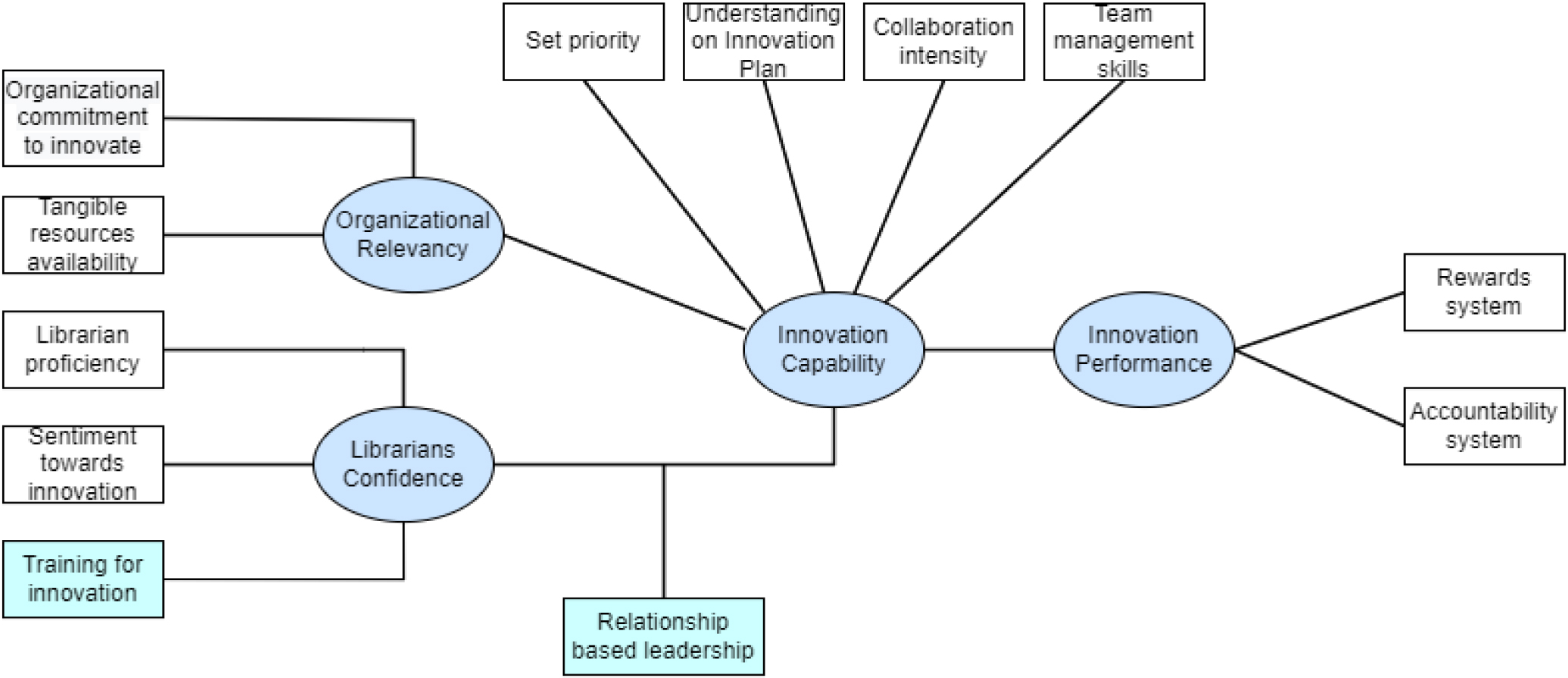
The first variable, OR, influenced IC in the study setting. University commitment to the library and the availability of digital resources were characterised as facilitators in this variable. Meanwhile, LC following their proficiency from formal learning, sentiments toward innovation, and training for innovation (TI) facilitated their IC. Furthermore, RL functioned as a mediating variable. The library leaders in this study focused on personal encouragement and motivational factors. By increasing the intensity of these actions, changes in librarians’ motivation could facilitate the development of an improved innovation-oriented perspective.
Four indicators (set priority, understanding of innovation strategy, collaboration intensity, and team management skills) complemented the library of IC. The set priority makes judgments on the type of innovation projects pursued by libraries, whereas understanding the innovation strategy entails managing internal university procedures before innovation project initiation and management. The degree of collaboration implies how libraries cooperate with one another and external parties to resolve their shortcomings. Team management skills denote how libraries could improvise their rigid structure while concurrently developing optimal innovation projects entailing associated parties. Finally, innovation performance indicates how librarians’ accountability and reward systems function. As better systems support innovation, both indicators potentially facilitate optimal performance. This framework, which functioned as the study proposition with interrelated variables and paralleled IC-oriented studies from a library-oriented viewpoint, was duly validated by informants. Notably, the framework novelty lies in its contextual build-up.
The OR might influence innovation capability following the study framework. Based on profit organisation-related research, companies should emphasise innovation production from current business models. Such commitment would allow firms to enhance their IC (Latifi et al., 2021). Empirically, library leaders must be dedicated to innovation in routine organisational operations to empower other librarians to innovate. This finding paralleled Huang et al. (2022), where ineffective regulations and low support structures for librarians in Chinese libraries lowered IC. In terms of innovation management resources, innovation could occur in the library through investments in collection management, such as heritage collections (Borowiecki & Navarret, 2017). Libraries must invest in knowledge management innovation, a critical resource for meeting users’ requirements and creating a conducive environment in modern library contexts (Xiao, 2020). From an innovation viewpoint, libraries must constantly engage in service modification through self-analysis and the assessment of user needs. Owing to the competitive landscape involving the Internet and computers, libraries must strengthen their physical libraries and resources through strategies and relevant investments (Otike, 2022). Summarily, ample evidence does not necessarily imply an influence of organizational relevancy on IC.
From a scholarly perspective, LC might influence IC through RL. Close rapport with librarians could induce good organisational practices, promote change, and develop leaders but not IC (Martin, 2017). Specifically, IC could be deterred in the presence of conservative library management approaches involving instruction and withholding information. Regardless, this research did not address leaders’ actions that could boost IC (Chuang et al., 2018). Kakhki’s (2020) study demonstrated that empowering librarians could induce knowledge-sharing behaviours rather than IC. Following Huang et al. (2022), a supportive company climate could elevate librarians’ job satisfaction but not IC. Evidently, RL is yet to influence librarians’ IC. Additionally, none of the studies rejected this proposition. Despite remaining inconclusive, the research propositions have introduced new variables that require further examination.
Lastly, IC might influence innovation performance. Gupta (2021) stated that innovative companies influenced financial performance, customer happiness, internal business processes, and organisational capability but not specifically on innovation performance. Parallel to Orozco et al. (2022), IT investment, skilled personnel, research and development, and organisational members’ engagement in networks could directly and gradually impact company performance. Notwithstanding, these attributes were not regarded as IC. Similarly, library management strategies encourage the creation of innovative output while sustaining current practices albeit with no emphasise on IC (Jantz, 2012). Although Cruz et al. (2020) suggested that capabilities facilitated users’ and librarians’ involvement in innovation creation, IC would not directly affect innovation performance. Overall, future works could depict various answers based on the current research proposition.
Identification of current innovation capability state in university libraries
Each informant’s comments were thoroughly examined and cross-checked before drawing a conclusion. For example, an informant who comments on the increase of rewards offered by the university management motivated the researchers to determine whether such a case occurred in other institutions. This comment would then be grouped under the ‘improving positively’ category following the accumulation of relevant information. In this vein, the current states were classified as follows: improving positively, needing more attention, and requiring critical improvement. The first state depicts an overall feeling of positivity towards innovation capability progress for libraries, whereas the second and third counterparts imply the conditions in which libraries require more support from the university management.
First state: Improving positively
The three indicators of IC (RL, set priority, understanding of innovation plan, and team management skills) developed positively under the first category. Meanwhile, the accountability system that was established without major concern from librarians strengthened the innovation performance variable. As previously explained, RL is a novel idea conceived by library leadership for IC development. Despite the absence of standpoints in library management literature, RL is a prominent phenomenon that necessitates further examination. The set priority is evident as library leaders already possess a framework of thinking that attempts to find a balance between necessary innovation projects and internal resources. Librarians recognised and developed internal processes while striving to establish innovation projects. In alignment with Noordin and Mohtar (2013), an organisation requires the ability to transform ideas into new and valuable outputs in order to innovate. Kanchanabha and Badir (2021) agreed that the organisational capability to innovate implies how it could produce new processes. Team management proved concrete as librarians understood how to use the hierarchical structure and form new teams as needed for specific innovation projects. The KPIs from the library and university also aimed to accommodate librarians for recognition. Following Kremer et al. (2019), having a formal structure and system in place while allowing rotation is one of the key determinants of successful innovation. Additionally, IC is associated with how companies could alter their organisational structure and processes for cost-effectiveness (Silva, 2020).
Second state: Required attention
The second category holds some positive points and room for improvement with five indicators spanning all variables. Both the OR indicators fell under this category. Regarding organisational commitment to innovate, budget availability is manageable by librarians although some concerns were raised. Budget reallocation would be necessary if only limited support is provided as innovation projects potentially generate new output or function as a non-routine investment. Budget availability is one of the tangible financial resources sought by libraries to initiate and manage their innovation programmes (Roos et al., 2005). With regards to tangible resource availability, both libraries and users concurred that a digital collection is the most essential resource. As digital collections are the primary reason underpinning the usage of library services. libraries aim to expand their current collection of journals and books. Customers who positively acknowledge the efforts exerted by libraries demonstrate the fact that libraries recognise and comprehend their users’ most pressing needs. Nevertheless, users also admitted to their rare involvement in the selection of library collections. Despite the presence of a procedure for title requests, the protocol is seldom used or disregarded. This situation was exacerbated by a limited or non-existent follow-up mechanism, which could lead to a gap in establishing library collections based on user needs. Based on Roos et al. (2005), the digitalisation and accessibility of library collections are resources that users could benefit from.
Sentiments towards innovation require improved strategies. Although some librarians’ innovation ambitions and motivations are strong, others require further encouragement. This statement holds true from the perspective of users, who stated that librarians may either be responsive to their needs or demonstrate less empathy in managing their requests. Such a challenge may lead to inconsistencies in how librarians deliver services to users. In Deschamps (2003), innovation requires leaders who can encourage innovation-related involvement. Such individuals should be prepared to openly challenge the status quo and implement better processes. Regarding RL, libraries generally understand the value of having great relationships to convince reluctant parties to innovate. Leaders must first inspire their followers and establish the right group norms to catalyse innovations in line with past research (Deschamps, 2003; Carmeli et al., 2010; Kremer et al., 2019).
Ashiq et al. (2021) highlighted the significance of encouraging librarians in an academic setting to continuously engage in self-improvement and fulfil user needs. Leaders should also demonstrate ethical practices to inspire others to do the same. The challenge now lies in developing a more structural approach to relationship-building practices. Library leaders primarily employ this practice on a needs basis rather than in a strategic manner. Libraries frequently cooperate with external parties on a national level or librarians. Such cooperation ideally increases further innovation. Companies operate optimally through norms, such as information exchange and collaborative efforts (Carmeli et al., 2010). Nevertheless, this practice reflects several limitations. Indonesian libraries, which minimally collaborate with other libraries and organisations outside Indonesia, restrict knowledge-sharing opportunities and globally-impacting innovation projects. Concerning rewards, most incentives are offered periodically to each librarian rather than as part of a mandatory task.
Third state: Critical improvement
The third category of critical improvement involves librarians’ proficiency and TI. With regards to librarians’ competencies, communication is the most critical skill to be developed. Although both libraries and users agree on this point, attempts to hone this skill remain poor. It is deemed crucial to invest in communication enhancement, which should be perpetually encouraged (Kremer et al., 2019). Overall, companies should focus on new service testing, production, and delivery processes (Saunila, 2020).
In terms of TI, training is frequently established with limited decision-making and understanding of goals and strategies. Training was generally conducted to address rising opportunities with limited consideration of learning and growth strategies. This seemingly aimless operation method may hamper the development of successful innovation capabilities. Despite much emphasis on information literacy and technology, training does not address communication skills. Unsurprisingly, users asserted librarians’ lack of proactive communication and scepticism about library strategies and abilities to communicate innovative output. Almost all the users stated that they would be unaware of any library updates without active information-seeking. Although social media content communication could resolve this intricacy, identifying sound reasons and appealing content in attracting people to follow the library’s social media accounts proves challenging. Consequently, the practice of building and documenting expertise must be seriously regarded for innovation to occur (Kremer et al., 2019).
Based on the aforementioned justifications, the researchers’ interview with an expert informant demonstrated affirmative comments with additional insights. As the current Head of the National Library Association of Indonesia/Forum Perpustakaan Perguruan Tinggi Indonesia, this informant highlighted the need for librarians to demonstrate their efforts for improved library performance. Indonesian librarians generated various innovative products as they are now more capable of performing their job and going beyond routine work due to strategic and continuous support from multiple parties. First, universities and library management allow librarians to work from home and support them with relevant instruments and facilities for a conducive work environment. Second, periodical training and workshops could be organised by the institution or association of librarians to increase competence. Although adequate training elevates LC, the informant agreed that confidence alone proved insufficient as librarians would require more support and motivation from their leaders. As such, building relationships between library leaders and librarians is equally crucial. Library leaders should provide opportunities for librarians to assert their ideas. Additionally, innovation-oriented approaches need to be bottom-up rather than top-down: “Ideally, leaders need to build relations with their librarians to develop their innovation capability. A good relationship means that library leaders provide opportunities for librarians to give their ideas. So, it is a bottom-up approach.”
The informant also opined that librarians need to demonstrate their IC and generate more innovative outputs to attract the attention of both library and university leaders, who are likely to appreciate their effort through monetary or non-monetary (recognition) rewards. Librarians could also engage in numerous innovation-oriented competitions at local, national, or even international levels with organisational support. Furthermore, an innovation-related indicator must characterise librarians’ performance evaluation for a consistent and established IC. The local government and institutions have incorporated innovation into their evaluation system: “In our evaluation system, innovation is part of an additional obligation. So, librarians that are able to create innovation will be given extra points.”
The new IC framework proposed in this work, which highlights specific inputs, processes, and outputs in the context of SOHEI libraries, underpins the study novelty. Following Park et al. (2021), every IC necessitates the documentation of the overall process. This framework contained six interlinked variables, namely OR, LC, TI, RL, IC, and IP and was also validated by the research interviewees. Notably, the current framework is the first to map out the end-to-end process for this context. In the study setting, RL implies a novel variable that could impact IC development. For example, the current work could provide the current IC development of Indonesian SOHEI libraries. Specific improvements with notable points for further research were also considered as users’ viewpoints.
Limitations
This study summarised the SOHEI library perspectives from six of the most reputable Indonesian universities. Resultantly, additional factors may be present when applied to other SOHEI or private university libraries. No attempt has yet been made to apply this study to a larger population as the current study aimed to construct a framework and explain its development rather than prove the hypotheses.
The practice of developing IC, primarily in SOHEI libraries, was outlined through a systematic framework and the current state of IC. Notably, SOHEI libraries in Indonesia struggled to increase their OR to users. This IC framework offered recommendations for the SOHEI library to be incorporated into strategic plans and practices. Library leaders and researchers should pay more attention to this part with much emphasis on RL. This investigation, which drew a unique conclusion from non-profit perspectives, expanded the current body of knowledge on IC. The IC focused more on developing optimal organisational practices with financial support and non-monetary goals following the nature of SOHEI libraries. Potential IC scholars could (i) extend the current view across multiple contexts within the non-profit sector and (ii) test and develop the proposed hypotheses with the current framework and larger samples.
Footnotes
TITLE-ABS-KEY (innovation AND capability).
TITLE-ABS-KEY (“library innovation”) AND PUBYEAR