



Abstract
Library and information science (LIS) as a discipline is constantly changing in line with the trends of the profession, so in order to ensure that LIS curriculum in higher education addresses the needs of contemporary stakeholders, evidence-based evaluation is needed. Student satisfaction has become an important factor in considering the success of the institution of higher education. The studies on student motivation for enrolling in LIS programs are many, but papers on student perception of satisfaction with their LIS study programs are rarer. This paper focuses on the efforts of ensuring curriculum quality of the LIS program at the graduate level of study at the Department of Information Sciences of the Faculty of Humanities and Social Sciences at the University of Osijek, Croatia. The main aim of the study was to determine how satisfied the students are with the quality of their study program and to identify its strengths and weaknesses. The study was carried out by anonymous online survey in which the students were asked to rate their satisfaction with the study program and the obtained professional and lifelong learning competences. While findings of the study are relevant for the revision of the LIS study program at the Osijek Department, this study can also have larger implications for LIS education trends globally, for it has confirmed some of the results from international studies.
Introduction
Quality assurance of higher education (HE) in general has been a topic of many scientific discussions and for that purpose various international and national bodies were charged with the task of ensuring quality in the area of higher education (e.g. the European Association for Quality Assurance in Higher Education [ENQA], 2021). In Croatia the Agency for Science and Higher Education [ASHE], (2022), a public and independent agency, is taking care of quality assurance of higher education and science at the national level. Next to those international and national institutions, there are also subject-specific organizations or associations that are interested in ensuring and enhancing the quality of education in their specific discipline. For the field of library and information science of particular importance are IFLA Guidelines for Professional Library and Information Science (LIS) Education Programmes (2022) and ALA’s Core Competences of Librarianship (2021). The most recent document prepared by the International Federation of Library Associations and Institutions (IFLA) is intended to serve as a framework for developing LIS education programs whereas the document prepared by American Library Association (ALA) defines the basic knowledge to be possessed by all persons graduating from an ALA-accredited master’s program in library and information studies. Although Croatian LIS programs are not accredited by ALA, those competences proved to be universal to all library schools at a global level.
This paper focuses on the efforts of ensuring curriculum quality of the Library and information science (LIS) program at the graduate level of study at the Department of Information Sciences of the Faculty of Humanities and Social Sciences at the University of Osijek, Croatia.
Library and information science (LIS) is a discipline that has been undergoing a significant transformation for some time. At the global level, policy makers and other stakeholders agreed that the process of curriculum design and development needs to be more evidence-based and systematic. Organisation for Economic Co-operation and Development (OECD, 2019) launched the Future of Education and Skills 2030 project with the goal to address the issue of competences (knowledge, skills, attitudes and values) students need in today’s society as well the issue of designing learning environments that can nurture such competences (OECD, 2019). In the area of European higher education, the European Commission has issued a number of policy documents relevant for all those creating and planning educational programs and competences for the modern society (European Commission, 2019; European Commission, 2020). At the professional level, a number of professional associations and bodies such as IFLA (2022) and American Library Association (ALA, 2021) have been defining (and constantly revisiting) the lists of core knowledge, skills and competences for library and information professionals working in the modern society.
Theoretical framework
Student satisfaction in higher education
In the area of higher education, student satisfaction has become an important element in considering the success and image of the institution of higher education. It is also often used as a measure of HE’s performance (Jereb et al., 2018), or one of the means by which resources are being distributed across HE institutions (Australian Department of Education, Skills and Employment, 2020). In addition, student satisfaction with their chosen program has been linked to academic achievement, retention and student motivation (Duque, 2014; Mihanović et al., 2016; Nastasić et al., 2019).
Student satisfaction, however, is a multifaceted concept. Studies show that students’ perceptions of the program quality (quality of teaching, feedback provided by instructors, teaching styles of instructors, quality of learning experiences and class sizes) are the most important factors that influence satisfaction (Gruber et al., 2010; Jereb et al., 2018; Nastasić et al., 2019; Paul & Pradhan, 2019; Thomas & Galambos, 2004; Weerasinghe et al., 2017), but there are also other, institution-related factors, such as ease of access to student services as well as the facilities it offers (e.g. e.g. teaching facilities, IT facilities, study areas, etc.) (Hanssen & Solvoll, 2015; Jereb et al., 2018; Weerasinghe et al., 2017). Other, less prominent factors, may include, among others, institution’s reputation (Hanssen & Solvoll, 2015; Jereb et al., 2018) and students’ own life experiences while at college (Mihanović et al., 2016; Nastasić et al., 2019; Weerasinghe et al., 2017). Beyond the aforementioned factors, the recent studies have brought to limelight students’ interpersonal interactions in HE as important predictors of student satisfaction. HE students recognize the importance of interactions with their colleagues and the faculty on academic-related matters (Burgess et al., 2018; Hurst et al., 2013). Recent lockdown measures and suspension of in-class education due to the COVID-19 outbreak had a negative impact on student social interaction aspect of HE (UNESCO International Institute for Higher Education in Latin America and the Caribbean, 2020) and emphasized further the importance of this factor for the overall student satisfaction levels.
In addition, several studies found that general satisfaction tends to decline as students move through their programs (Cherry et al., 2011; Gruber et al., 2010). Finally, a strong correlation was found between satisfaction with employment opportunities and program satisfaction more generally (Krehbiel & McClure, 1998).
However, the HE institutions must be very careful when considering the student satisfaction as an only, or at least, a dominant measure because students’ motivation may not be to pursue the service excellence and sometimes, giving students’ what they want may result in negative effects on students as well as on institutions (Wong & Chapman, 2022).
Student motivation, satisfaction and perception of LIS programs
Interest, educational talent and scientific ability are among the most important factors that influence the choice of the field of study – these factors also help prevent later problems such as drop-outs or student dissatisfaction (Enayati Novinfar et al., 2013). A meta-analysis of 45 papers on reasons for enrolling the LIS programs (Moniarou-Papaconstantinou et al., 2015) revealed that intrinsic reasons (love of books and reading, nature of library work, desire to help people) dominate. Extrinsic reasons such as employment opportunities or career prospects, although mentioned in some studies (Hallam & Partridge, 2005; Moniarou-Papaconstantinou et al., 2010), are not that frequently named. However, students that choose to study LIS (even though motivated by the love of books and reading) find out that the study encompasses much more than just books and reading. A good LIS curriculum should provide students with required knowledge, skills and competences, guide students as they move through the program, interest them further for the profession and be strongly connected with the work environment and future employers so that the learning outcomes can be constantly reevaluated and modified.
Therefore, as LIS educational institutions plan and design new educational programs and curricula it is necessary to bear in mind that those programs constantly need to be evaluated, and consequently changed and modified to address the needs of contemporary stakeholders (policy makers, professional bodies, but most important ones among them being students and employers). A number of studies were conducted on the required competences and skills for the new graduates. A wide range of technical and soft skills seem to be among the most highlighted skills (Chaka, 2020; Saunders, 2015; Saunders, 2019). Fraser-Arnott (2017) grouped the competences into the following five categories: (1) collaboration, client service and communication; (2) organizational understanding and strategic alignment; (3) program and service delivery and management; (4) records, information and knowledge management technical competencies; and (5) personal qualities. ALA (2021) grouped competences that should be possessed by library professionals around nine areas: gateway knowledge, information resources, lifelong learning and continuing education, management and administration, organization of recorded knowledge and information, reference and user services, research and evidence-based practice, social justice, and technological knowledge and skills. Those competences might be roughly categorized into professional competences (that include all aspects of professional expertise, including technical and soft skills) on one hand, and lifelong learning and civic competences (such as social justice and technological skills) on the other. IFLA Guidelines for Professional Library and Information Science (LIS) Education Programmes (2022) lists various LIS areas that need to be included in the curricula, but includes also ICT knowledge, multiliteracies and life-long learning. These non-professional knowledge and skills align with the key competences for life-long learning: literacy competence; multilingual competence; mathematical competence and competence in science, technology and engineering; digital competence; personal, social and learning to learn competence; citizenship competence; entrepreneurship competence; and cultural awareness and expression competence (The Council of the European Union, 2018).
Although there are quite a number of papers on student motivation for enrolling LIS programs of study (Ard et al., 2006; Dukić, 2019; Hands, 2018; Lo et al., 2016; Oguz et al., 2015; Sibiya & Shongwe, 2021), the papers on student perception of and satisfaction with their LIS study programs are not that common. Canadian authors, however, found this to be an important topic and produced a number of papers that contain data on students’ perceptions of LIS program quality. One of the major criticisms to LIS programs is that they do not prepare students for the subsequent employment. A 2006 Canadian study found that only 37% of students believed that their graduate LIS program provided them with an understanding of a career as a librarian or in a related profession. Although the areas such as evaluation of management, leadership, and business skills taught in MLIS programs were considered to have slightly improved in comparison to earlier studies, a good share of both recent graduates (22%) and institutional representatives (35%) believed that these areas still needed improvement. (Canadian Association of Research Libraries, 2015). Cherry et al. (2011) conducted a four-year study of master’s students enrolled in the Master of Information program at the University of Toronto and found out that only 34.1% rated the overall quality of the academic program as excellent or very good whereas 55.6% agreed or strongly agreed that the program was preparing them for a professional career. Students in this study wanted a practically and professionally oriented program that would prepare them for subsequent employment in the field. This was visible through their strong desire (90% respondents) that in future a stronger emphasis be placed on professional work (e.g. internships). Besides a stronger emphasis on practical skills, the students in this study believed that, in future, the graduate LIS program should be modified to accommodate more joint and collaborative programs with other departments (78%), and to put greater emphasis on technology and computing (70%). Putting a stronger emphasis on theory was the least desired direction of development (41%). In the follow-up research conducted at six Canadian universities (Cherry et al., 2013), the authors found that 90% of respondents believed that the program they attended provided them with education that facilitated growth and development and the mean satisfaction rating for the education received in the program was 6.6 (on a 10-point scale). The quality of faculty members received the highest percentage of positive ratings (86.6%), followed by the satisfaction with their fellow students (77.5%), academic standards (77.2%) and relationship between faculty and students (71.8%). While researching LIS experience of students enrolled in the School of Library and Information Science at Louisiana State University Dow (2011) found that students with different educational backgrounds had different views of their LIS programs. In the study conducted among first and final year LIS students at three LIS undergraduate schools in South African Republic it was found that 73% of first year and 82% of final year students were satisfied with the scholarly content of LIS programs. The reasons for satisfaction were: the availability of job opportunities in LIS field in their country, perception changes about LIS (by the program), students’ love of books and reading, the ease of the subject and a love for helping others find required information. Students’ satisfaction with their program was strengthened by the fact that 70% of first year and 82% of final year students would recommend LIS program to other, potential, students (Sibiya & Shongwe, 2021). The students in Thailand think that LIS curriculum should put more emphasis on digital technology (83%), followed by professional and practical experience (78%) (Ammarukleart et al., 2021). A Latvian research on student perceptions of program quality at the Department of Information and Library Studies of the University of Latvia (Holma & Pakalna, 2007) found that the mean course quality rating was 8 (on a 10-point scale) and that 78% of respondents would recommend others to enroll into the program. In their research of undergraduate student perceptions of LIS programs in Croatia and Turkey Faletar Tanacković et al. (2018) discovered that the highest level of satisfaction both for Croatian and Turkish students was with the student-faculty relationship (Croatian students – mean 4.09; Turkish students – 3.87). The lowest level of satisfaction for Croatian students was measured for the range and number of elective subjects (mean 2.96), but almost equally dissatisfied were they with the amount of practical training included in the program. This dissatisfaction was also shared by Turkish students – majority of respondents (65% for Croatian and 57% for Turkish students) thought that the LIS training should include more practical training than the classroom instruction. A request for more practice-oriented LIS curriculum and development of practical skills seems to be universal to LIS students across the world – this desire was also expressed by Canadian (Cherry et al., 2011; Canadian Association of Research Libraries, 2015), Thai (Ammarukleart et al., 2021) and Israeli students (Aharony & Raban, 2008). The tension between theory and practice is present everywhere and it is quite worrying that LIS students, in general, fail to see the value of theoretical components of their academic LIS program (Cherry et al., 2011).
Regardless of possible misgivings about the LIS programs, students still seem pretty satisfied with their choice of study and majority plans to seek employment in the LIS field upon graduation. In Canadian study 73.5% of LIS students wanted to find employment in the field of study (Cherry et al., 2011), in Croatia it was 71.4% (Faletar Tanacković et al., 2018), in Latvia 65% (Holma & Pakalna, 2007). The lowest scores were measured for Turkish students (56.8%) (Faletar Tanacković et al., 2018).
A number of studies bring results of alumni perspectives of their LIS program. In India 50.9% were moderately satisfied and 32.1% very satisfied with their LIS curriculum (Yadav, 2022). The study found that the alumni believed that computing skills, library automation and library digitization were absolutely essential for the library profession. ‘Soft skills’ (combination of personal, communication, social and behavioral skills) were also found to be quite important. This study found that the alumni were satisfied with the practicum module (mean 4), whereas their levels of satisfaction with LIS curriculum and how it prepares students for work environment was lower (mean 3). LIS alumni students from Zimbabwe were relatively satisfied with the program but they recommended improvements to the information and communication technology (ICT) and knowledge management courses (Mugwisi & Hikwa, 2015). Alumni from Punjab in Pakistan thought the LIS curriculum needed improvements in the area of teaching methods and recommended recruitment of trained teachers who were up to speed with the changing trends (Mahmood & Shafique, 2012)
This paper presents a portion of findings obtained in the study that focused on LIS graduate students’ satisfaction with and perceptions of their graduate program at the Department of Information Sciences of the Faculty of Humanities and Social Sciences at the University of Osijek, Croatia.
Context of the study
The Department of Information Sciences in Osijek was founded in 1998, originally under the name Department of Librarianship. The introduction of the Bologna process (in the academic year 2005/2006) resulted in the name change of the Department, which reflected the changes in the curriculum.
In the academic year 2021/2022 the Department employed 23 faculty members and catered for the needs of 134 undergraduate and 55 graduate students. It offers accredited undergraduate (3 years) and graduate study (2 years) programs in Information Sciences. From the academic year 2015/2016 students that enroll into the graduate program can choose between the following majors: Information Technology and Publishing, Publishing and Library and Information Science and Information Technology and Library and Information Science (Faletar Tanacković & Petr Balog, 2020). In the period between the academic years 2005/2006 and 2015/2016 students could only study Library and Information Science as one-major program that incorporated courses on publishing and IT but did not offer the specialization in any field, as it does now. The Department has been aware that the program in general needs to be updated and significantly changed to meet the needs of contemporary employers and it started working on the program modification. First, the undergraduate three-year program underwent a major revision and from the academic year 2020/2021 it has been possible to study Library and Information Science as both single major and two-major programs. As a double major program at the undergraduate level the Library and Information Science is combined with various other study-programs that can be studied at the Faculty of Humanities and Social Sciences (e.g. English language and literature, German language and literature, Croatian language and literature, Philosophy, Art History). The Department is expected to start the revision of the graduate program in academic year 2023/2024.
The majority of practical work is allocated mostly to undergraduate program. For single-major students it means that they need to spend 330 hours doing practical work and thus earn 11 ECTS credits (out of 180) which amounts to 6% of all ECTS that they can earn during the undergraduate study. Double-major undergraduate students have a slightly less practical work in number of hours (270 hours which translate into 9 out of 90 ECTS) but in percentage their practical work amounts to 10% of all ECTS that they can earn (9 ECTS out of 90). Present graduate study program slightly neglects students’ practical work (which is one of the reasons it needs to be changed). It is a double-major program (with both majors rooted in library and information science) and students have only one major practical work assignment (called Practical project) at their final study year. The idea behind this project is for students to create a major, community-based project where they will utilize all their knowledge and competences acquired during their studies and create something practical and useful for the local community. Double-major graduate program of Library and information science requires that students spend 60 hours on the practical project, for which they get 4 ECTS (out of 60 ECTS), which is 7% of all the credits they can earn within the program.
Both undergraduate and graduate programs can be studied only fulltime. In order to enter the undergraduate program a sufficient score must be obtained from Undergraduate Placement Examination and a solid GPA from secondary school is required (Faletar Tanacković et al., 2018). Even though the prospects of finding a job in the field with only a Bachelor degree are not good, the Department has experienced a decline in the number of students who want to pursue the graduate study. This might be a result of the European market which is constantly in need of labor force, even though this means that students are pursuing career outside the LIS field. Applicants for the graduate programs are ranked according to their GPA at the undergraduate level. In the past, they needed to have a GPA of 3.5 or higher, but this restriction was lifted because the number of applicants for the graduate program declined. Majority of graduates enroll into the program immediately after finishing the undergraduate level, without any substantial work experience in LIS or a related field. In the past, graduates from the Department used to find placements in traditional environments such as different types of libraries but recently that changed and they are increasingly finding job in the growing IT sector that is extremely aggressive in recruitment and offers financial and other benefits other fields cannot compete with. Currently, only a smaller degree of graduates find employment in libraries or in publishing industry.
Research questions and methodology
The main aim of the study was to identify strengths and weaknesses of the LIS study program at the Department of Information Sciences of the Faculty of Humanities and Social Sciences at the University of Osijek, Croatia, and to understand how satisfied LIS students are with their study program and the obtained competences (both professional and lifelong learning).
The study tried to answer the following research questions:
How satisfied are students with their study program? 1.a. Are there any differences in satisfaction between graduated students and currently enrolled students? 1.b. Are there any differences in satisfaction between single major students (those studying only LIS) and double major students (those studying LIS and IT or Publishing)? How satisfied are students with the competences they received? 2.a. Are there any differences in satisfaction between graduated students and currently enrolled students? 2.b. Are there any differences in satisfaction between single major students (those studying only LIS) and double major students (those studying LIS and IT or Publishing)? What are the strengths and weaknesses of the studied study program?
The study was carried out by anonymous online survey (Appendix 1) in the period between November and December 2021. In the survey, students were asked to rate their satisfaction with the study program according to its various attributes (learning outcomes, competences, practical work, internship abroad, elective courses, quality of library collection, quality of teaching, teacher expertise, etc.) as well as their satisfaction with the acquired professional (core LIS competences) and lifelong learning competences (communication skills, learning skills, digital competences, social and civic competences). They were asked to describe how well the program prepared them for the job-market and if they would choose the same program again. Finally, in order to learn about possible ways of improving the existing study program, students were asked to describe the strengths and weaknesses of their study program, as they perceive them. Survey included multiple choice, open-ended and Likert-type questions. The quantitative results were analyzed with the help the software package SPSS (T-test was used to measure statistically significant differences between the groups of respondents). The qualitative results from open ended questions were analyzed with the help of content analysis. Findings have been presented according to the research questions.
Limitations of the study
Due to COVID-19 restrictions the lectures at the University J. J. Strossmayer in Osijek (and consequently, at the Faculty of Humanities and Social Sciences) were organized as online classes in the summer semester of the academic year 2019/2020 (during lockdown) and continued throughout the academic year 2020/2021. The only difference between these two academic years is that in the academic year 2020/2021 online exams were prohibited. One part of our sample, the currently enrolled graduate students, were having distance education at the time of our survey and it is considered that this might have influenced their opinions expressed in the survey. Taking into consideration that graduate program lasts only two years, majority of currently enrolled respondents based their experience with graduate study program primarily on the distance education. Which, in turn, might have affected their views and satisfaction with the program and the experience of studying on the whole.
Another limitation of the study is the time effect on the answers received by graduated students in our sample (alumni). It is not uncommon that one tends to remember more favorably one’s past and this might have happened in our study. Since some students graduated even 10 years ago, it is fair to conclude that they do not remember all the details and the competences they gained during their study. Their perceptions and judgements could also be limited with the requirements of their work place. And finally, statistically representative power of the graduate students’ sample is another limitation.
Research results and discussion
Table 1 presents the demographic data about the sample. The survey was filled out by a total of 63 respondents: 27 out of 55 students currently enrolled in the LIS graduate program at the Department of Information Sciences in Osijek (recall 49.1%), and 36 out of 219 LIS students who graduated from the Department in the period from 2010 through 2021 (recall 16.4%). In the sample dominated female respondents, and those that specialized in both LIS and IT. The demographic characteristics reflect the characteristics of student population at the Department in general: majority of graduate students are female and study a combination of LIS and IT.
Sample demographic data
Sample demographic data
Table 2 illustrates Mean values for respondents’ satisfaction with the following attributes of LIS study program: alignment of learning outcomes with job market demands, provision of core LIS content and competences, provision of generic competences (communication, presentation skills, problem solving, teamwork, leadership), amount of practical work, organization of practical work, international internship or study abroad opportunities, number and choice of elective courses, availability of exam literature, teachers’ expertise, relationship with teachers (availability, support etc.), and opportunities for participation in extracurricular activities (research and community based projects, conferences etc.). Students were asked to indicate their satisfaction with listed attributes on a Likert-type scale (1 – Not satisfied at all, 5 – Very satisfied).
Satisfaction with the study program
Satisfaction with the study program
Text marked with * represents statistically significant differences in the sample.
Findings show that respondents are moderately satisfied with all studied attributes and aspects of the study program except for the amount of practical work (Mean 3.17) and its organization (Mean 3.38), and the number and quality of elective courses (Mean 2.30). As far as the practical work is concerned, it is offered only at the second year of the graduate study (a total of 45 hours, or six working days, carrying 4 ECTS) and is organized as a project-based work in a library or any other information-related institution, with supervisors from both academic and host institution. Although the study program aims to offer a fair number of elective courses, the offering of elective courses has always been a weak point at the Department caused by insufficient number of teachers and/or formal restrictions. In practice this usually means that there is not a list of available elective courses from which students can choose those they prefer but that they have to take those that are offered from year to year. In addition, even when the Department was in position to offer more electives, the Faculty administration banned courses that enrolled less than 10 students. Findings also show that respondents are satisfied to the largest degree with the teachers’ expertise (Mean 4.24), their relationship with the teachers (Mean 4. 64) and opportunities for extracurricular activities (Mean 4.21). This is not surprising because the study groups usually do not exceed 25 students and there is in general a very good student teacher ratio at the Department (8 : 1). Also, teachers work hard to promote extracurricular activities among students and include them in as many activities as possible (summer schools, participation in research projects, volunteering and community work, conferences, publishing etc.).
Comparison of LIS study program attributes – currently enrolled vs. graduated students.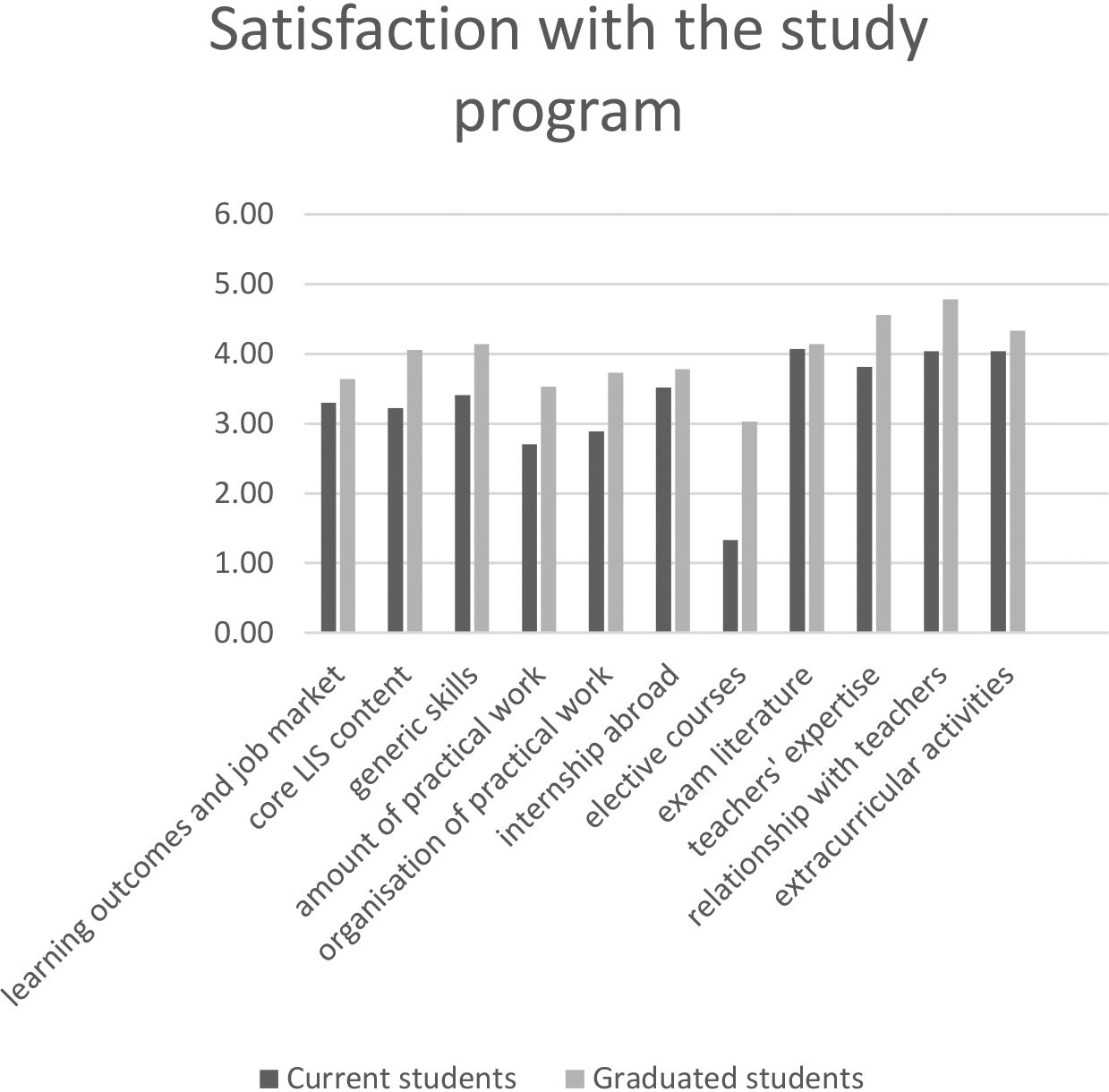
While findings show that currently enrolled students are more critical on all accounts toward the study program than the respondents who have already graduated (Fig. 1), statistically significant differences have been identified only in relation to some of the variables (marked with * in the table). Current students are less satisfied with the share and quality of core LIS content (
Comparison of LIS study program attributes – single major vs. double major students.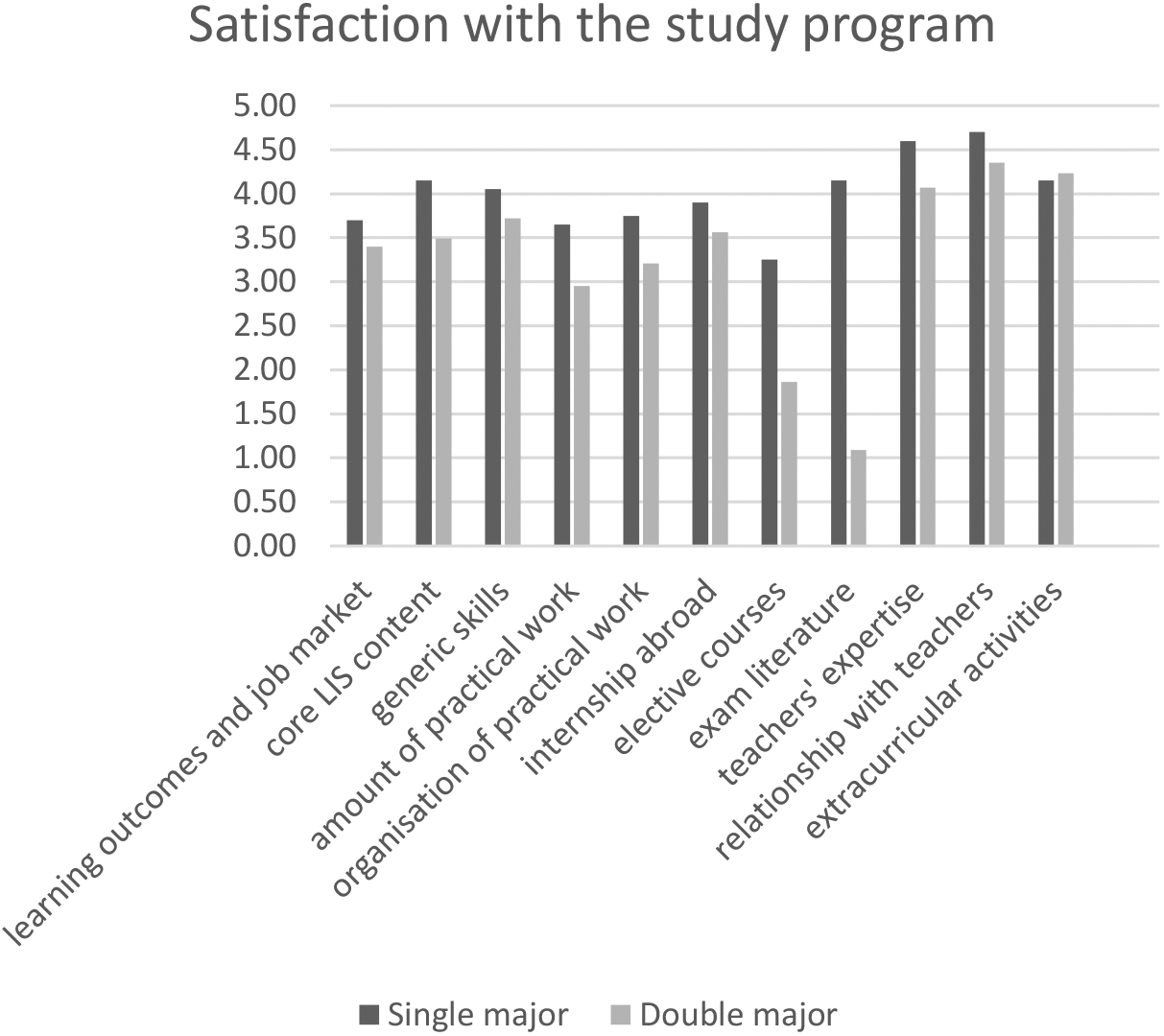
Findings also show that single major students (those studying only LIS) are in general more satisfied with all characteristics of the study program than the double major students (those studying LIS and IT or Publishing) (Fig. 2). However, statistically significant differences have been identified only in relation to the following variables (marked with * in Table 3): the share and quality of core LIS competences (
Perception of the study program
Text marked with * represents statistically significant differences in the sample.
Table 4 illustrates Mean values for respondents’ satisfaction with the LIS-related professional competences and the following generic or lifelong learning competences they acquired during their studies: communication, digital competence, learning to learn, and civic competence. Communication competence was defined as successful communication (written or oral) in mother tongue and foreign languages. Digital competence referred to a high level of ICT application and its responsible use. Learning to learn competence was described as skills for independent, team and lifelong learning, time and task management. Civic competence was identified as a recognition of professional social responsibility and importance of free access to knowledge and information literacy as a precondition for democracy, plurality of thought and active citizenship. Students were asked to indicate their satisfaction with listed variables on a Likert-type scale (1 – Not satisfied at all, 5 – Very satisfied).
Satisfaction with LIS-related and generic competences
Satisfaction with LIS-related and generic competences
Text marked with * represents statistically significant differences in the sample.
The largest level of satisfaction was reported for communication (Mean 4.44) and learning competences (Mean 4.17) and respondents are least satisfied with the professional competences (Mean 3.71). While findings show that currently enrolled students are again less satisfied with all acquired competences than respondents who have already graduated (Fig. 3), statistically significant differences have been identified only in relation to professional (
Comparison of competence satisfaction – currently enrolled vs graduated students.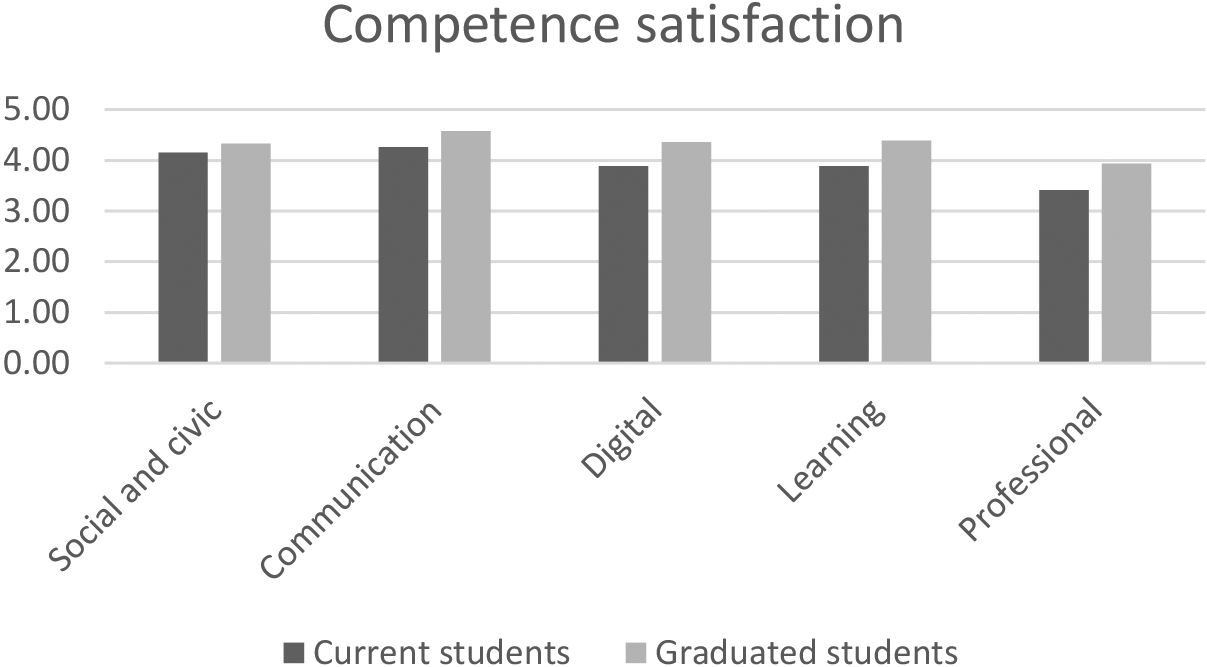
When asked in an open-ended question to list three competences, either generic or professional, that they found in particular useful at their workplace, respondents as a rule indicated generic competences such as information literacy, digital and communication competences, collaboration and team work, problem-solving, creative thinking, social competences, leadership and organizational skills. Although quantitative findings show that respondents were in general least satisfied with professional competences, when asked in an open-ended question to list competences and skills, either professional or generic, which they lacked most at their workplace, respondents reported most frequently that they lacked communication skills (and in particular written communication in foreign language), social competences, organizational and pedagogical skills. When referring to the lack of professional skills, respondents listed cataloguing, bibliometrics and coding. One respondent (R676) noted: “I do not think that I lacked any generic skills. We received a good knowledge base at university and we can easily make up for competences which we did not acquire during studies. I think that we have been very well prepared for lifelong learning.” Another respondent (R697) reported: “Generic skills are very important because one can use them at any workplace.”
While only 5.4% of graduated students are not satisfied how the study program prepared them for the job market, 75% would enroll in the same program if they had to do it again. A total of 84.7% of all respondents (both current and graduated students) would like to work in LIS-related field, whereas only 8.5% would like to earn their living by working in the field unrelated to LIS. It is interesting to note that 30.5% would like to start their own business. It would be very interesting to look into this issue in some future study and learn what kind of work, unrelated to libraries, would students like to pursue, and what ideas they have for their own businesses.
In the open-ended questions in the final section of the questionnaire, respondents were asked to comment on the strengths and weaknesses of their study program. On one hand, respondents listed the following strengths: good communication with teachers, extracurricular activities (conferences, projects, mobility), small groups, project and team work, independent work, good atmosphere, wide employment possibilities, interdisciplinarity and development of critical thinking through practical project work.
“I find that this interdisciplinary study program, with different courses aimed at developing professional and generic competences, perfectly meets the needs of a current job market and offers us wide opportunities for employment.” (R1058) We have a lot of opportunities to work in teams but also to build our skills for independent work. Also, teachers are very professional and always available for questions regarding university or other matters.” (R1017) “Some of the teachers really go out of their way to motivate us to participate in different projects, conferences. Sometimes this can help a lot in finding a job.” (R1005) “It was good to learn how to adapt to different situations and obtain organizational and communication skills. Today, one cannot do without them.” (R1031)
On the other hand, respondents indicated the following weaknesses: not enough practical work, project-based practical work, too many theoretical courses, too many assignments/quizzes/essays, lack of elective courses, lack of pedagogical courses which would equip students to work in educational institutions, and repetition of content from undergraduate study.
“We have too much to learn by heart. There are too many assignments and tasks to hand in.” (R1070) “There are too many courses. We are exhausted from running from one course to another. I am really good in time management but there are just too many things to do.” (R1071) “I think that we a losing our precious time on learning theoretical things. I do not see the point of it. I think that some of these things are made up just for the sake of teaching. I have never encountered these things in real life … The emphasis should be on preparing a student for practical work in particular institution or business.” (R1080) “In my opinion, courses should be updated more often. Sometimes we learn about things that are outdated … Everything in our field changes so quickly.” (R1089) “We have too many small-size courses which fragment the topic. And this is why we often have the feeling that there is a lot of repetition.” (R111)
Concluding discussion
The main aim of the study presented in this paper was to identify the strengths and weaknesses of the LIS graduate study program at the Department of Information Sciences of the Faculty of Humanities and Social Sciences at the University of Osijek, Croatia, as perceived by the students, and to understand how satisfied LIS students are with their study program and the obtained professional and lifelong learning competences. The study was envisioned as a starting point in a revision of graduate program that the Department is planning to carry out in the academic year 2023/2024. The online survey was filled out by 49.1% students currently enrolled in the LIS graduate program at Osijek Department and 16.4% students who graduated from the Department. Although number of graduated students is not a statistically representative, the response rate is deemed relatively satisfactory because it is very difficult to reach students once they graduate and move away (in the country or abroad).
Findings show that respondents are moderately satisfied with all studied aspects of the study program (alignment of learning outcomes with job market demands, provision of core LIS content and competences, provision of generic competences, international internship or study abroad opportunities, availability of exam literature, teachers’ expertise, relationship with teachers, and opportunities for participation in extracurricular activities) except for the amount of practical work and its organization, and the number and quality of elective courses. Findings also show that currently enrolled students (double major students) are less satisfied with all attributes of the study program than the respondents who have already graduated (RQ1).
These findings are similar to those from a Canadian study at University of Toronto where the mean satisfaction rating for the education received from the program was 6.6 (on a 10-point scale) and the quality of faculty members and relationship between faculty and students received very high percentage of positive ratings: 86.6% and 71.85 respectively (Cherry et al., 2013). Interestingly, the student-faculty relationship at the Osijek Department received the highest satisfaction rating in the earlier study as well (4.09 on a 5-point scale).
Respondents are also relatively satisfied with the acquired professional and lifelong learning competences (communication, learning competences, digital competences, civic competences). Again, currently enrolled students were less satisfied with all acquired competences than respondents who have already graduated. Surprisingly, no such distinctive differences were identified between single and double major students (RQ2). While only 5.4% graduated students are not satisfied how the study program prepared them for the job market, 75.0% would enroll in the same program if they had to do it again. Furthermore, a total of 84.7% of all respondents would like to work in LIS-related field.
These findings support earlier studies in Canada, Croatia and Latvia, where large majority of LIS students wanted to find employment in the field of study: 73.5% in Canada, 71.4% in Croatia and 65% in Latvia (Cherry et al., 2011; Faletar Tanacković et al., 2018; Holma & Pakalna, 2007). General satisfaction with the study program is confirmed also by 82% of final year undergraduate students in South African Republic who would recommend LIS program to other students (Sibiya & Shongwe, 2021).
The respondents recognized the following strengths of the LIS study program: good communication with teachers, extracurricular activities (conferences, projects, mobility), working in small groups, project and team work, independent work, good atmosphere, wide employment possibilities, interdisciplinarity and development of critical thinking through practical project work. Interestingly, most of these refer to lifelong learning competences, and not professional knowledge and skills. On the other hand, they also pointed out to the following weaknesses of the program: not enough practical work, project-based practical work, too much theoretical courses, too much assignments/quizzes/essays, lack of elective courses, lack of pedagogical courses which would equip students to work in educational institutions, and repetition of content from undergraduate study (RQ3). It should be noted that most of these issues also do not refer to any particular area of professional knowledge but mostly to the ways teaching and learning is organized and assessed.
Some of these findings are in line with earlier study conducted in Croatia and international studies conducted in Canada, Thailand and Israel where students required that LIS training should include less theoretical knowledge and more practical training, and at the same time include more ICT skills (Cherry et al., 2011; Canadian Association of Research Libraries, 2015; Ammarukleart et al., 2021; Aharony & Raban, 2008; Faletar Tanacković et al., 2018). Although practical skills and training are important and should be represented in a sufficient degree in a LIS curriculum, there should be ways to make students see that practice is not meaningful and purposeful without a solid theoretical framework.
The study revealed also that the alumni, i.e. graduated students, who were mostly employed in the LIS field, were much more positive in their rating of satisfaction with the various aspects of LIS curriculum. It may be that they are less critical because they tested their competences and skills obtained at the university in a real-life work environment and they passed the test. In addition, it was noted that the most positive attitudes were expressed by single-major LIS alumni, and this might lead to the speculation that they were more pleased with their competences and skills because they were able to study in depth various topics during their studies. And finally, currently enrolled graduated students studied during the COVID-19 lockdown measures in 2020 and online classes, which resulted in a negative student experience as found by other studies (Mihanović et al., 2016; Nastasić et al., 2019; Weerasinghe et al., 2017) and reflected negatively on their levels of satisfaction with the LIS program. Whatever the possible explanation for this discrepancy in satisfaction between the currently enrolled and graduated students might be, it requires further investigation.
Findings of the study presented in this paper are very relevant for the upcoming revision of the LIS study program at the Osijek Department because they provide a good insight into the students’ perception and experiences. When combined with the follow-up qualitative study among students and perceptions of other stakeholders (mainly employers) it will be a solid base for making evidence-based decisions in the curriculum revision process. However, it is believed that this study can have larger implications for LIS education in general because it has confirmed some of the results from international studies on this topic and thus indicated possible trends in LIS education worldwide. Without doubt, development of future LIS study programs, which will be conducted offline or online, will have to pay more attention to the balance between theoretical and practical knowledge and skills, professional and lifelong learning competences, and adequate teaching methodologies.
Footnotes
Appendix 1: Survey questionnaire
Satisfaction with the study program
Dear participants,
The Department of Information Sciences of the Faculty of Social Sciences and Humanities in Osijek is conducting research among its current and former students (CS and FS respectively) in order to examine their satisfaction with the study program and gained competences. The questionnaire is anonymous, and it will take you about 10 minutes to fill it out. Please be honest, because there are no wrong answers, and each of your experiences and opinions is important to us. The data obtained from the research will serve to improve existing study programs.
Choose one of the offered answers. Please choose only one of the offered answers.
Female Male Other
Currently enrolled student Graduated student
Choose one of the offered answers. Please choose only one of the offered answers.
Information sciences Information sciences and Information Technology Information sciences and Publishing
Alignment of learning outcomes with job market 1 2 3 4 5
Quality of core LIS competences 1 2 3 4 5
Share and quality of generic/transferable knowledge and skills (e.g. communication, presentation skills and public speaking, problem solving, teamwork and project management, entrepreneurial skills and leadership, etc.) 1 2 3 4 5
Hours of practical work 1 2 3 4 5
Organisation of practical work (project work) 1 2 3 4 5
International internship or study abroad opportunities 1 2 3 4 5
Number and choice of elective courses 1 2 3 4 5
Availability of exam literature (exam literature, sources for seminar work) 1 2 3 4 5
Quality and expertise of teachers 1 2 3 4 5
Relationship with teachers (availability, support etc.) 1 2 3 4 5
Extracurricular activities 1 2 3 4 5
Professional competences – competences from different LIS-related fields 1 2 3 4 5
Communication skills and literacy – successful communication (oral and written) in native and foreign languages 1 2 3 4 5
Learning competences – independent, team and lifelong learning skills, time and task management skills 1 2 3 4 5
Digital competences – a high level of application of information and communication technology and its responsible use 1 2 3 4 5
Social and civic competences – awareness of responsibility towards society, the importance of dissemination and promotion of cultural and scientific achievements, the importance of the right to free access to knowledge and information, awareness of information wealth as a prerequisite for progress, and the importance of a plurality of opinions and ideas for the development of democratic societies, and actively and democratic participation in the community 1 2 3 4 5
__________________________________________________
__________________________________________________
The same (LIS) Something else
I would like to work in a LIS profession or a profession closely related to LIS I would like to work in a completely different field I would like to start my own business
__________________________________________________
__________________________________________________