



Abstract
Intellectual property includes not only copyright but also industrial property (IP), which consists of inventions (patents), trademarks, industrial designs and models, and designations of origin. In order to identify the importance of these competencies of non-lawyers, e.g. engineers, managers, in companies, an online survey was conducted in some European countries as part of the Erasmus
Introduction
Intellectual property refers to various creations of the mind, such as literary and artistic works, inventions, designs, symbols, and names (World Intellectual Property Organization, 2016) and is protected by law, which has a positive effect on creativity, innovation, competitiveness, development, research, and investment (Slovenian Intellectual Property Office, 2022; World Intellectual Property Organization, 2016). While copyright is one of the most recognizable type of intellectual property, industrial property (IP)1
The acronym “IP” is most often used for Intellectual Property. However, as this paper focuses on Industrial Property, which is its sub-area but consists of words with the same starting letters, we use IP to denote the latter.
Although IP competencies are most often expected from lawyers, they are also very beneficial for non-law experts, such as engineers, researchers, business managers, and entrepreneurs (Dukhan & Rayes, 2014; Philbin, 2021; Vairis & Petousis, 2014), because workers with awareness and competencies in IP are amongst fundamental prerequisites for creating innovative and legally safe work environments. For example, knowledge of intellectual property, particularly IP, is very important for engineers because a lot of technical innovations occur in engineering institutes and to protect them knowledge of IP is necessary. Knowledge of IP helps an engineer to not only protect his valuable ideas and thus create ‘intellectual property’ but also to promote its licensing and development in the larger interests of society (Lane, 2014; Sarda et al., 2018).
This study was done as part of the Erasmus
Depending on the country, IP is governed by different international and national laws. Each country has the Industrial Property Code and other legislation which are based on European regulations (e.g. Council Regulation, Regulation EU), other international sources (e.g. Agreement on Trade-Related Aspects of Intellectual Property Rights) and national resources. In all of the four countries, IP rights are subject to the European Union legislation (Bux & Maciejewski, 2022) and additionally regulated by various national acts, meaning that the situation differs to a certain extent. In Slovenia these are the Industrial Property Act (Zakon o industrijski lastnini, 2001), Act Amending the Industrial Property Act (Zakon o spremembah in dopolnitvah Zakona o industrijski lastnini, 2020), and Employment Related Industrial Property Rights Act (Zakon o pravicah industrijske lastnine iz delovnega razmerja, 2003) that determine the types of IP, procedures regarding their registration and protection, and defines rights and obligations of stakeholders – detailed list of all relevant legislation available in IO3 – descriptions and links about IP – Slovenia (2022). In Portugal, copyrighting and industrial property are regulated autonomously. Copywriting is subject to the norms provided by the Portuguese Copywriting Code (Código do Direito de Autor e Direito Conexos) and industrial property is governed by the Industrial Property Code (Código da Propriedade Industrial). They have two important institutions: Portuguese Institute of Industrial Property and Arbitration Centre specialised in Industrial Property – detailed list of all relevant legislation available in IO3 – descriptions and links about IP from Portugal (2022). In Romania they follow national laws and other multilateral agreements and treaties, as well as government ordinances, orders, and instructions – detailed list of all relevant legislation available in IO3 – descriptions and links about IP from Romania (2022). Croatian national legislation covers laws and rulebooks on patents, trademarks, designs, geographical indications, topographies or semiconductor circuits, and intellectual property in business relations. They have a National IP office and collective rights management offices – detailed list of all relevant legislation available in IO3 – descriptions and links about IP from Croatia (2022).
Awareness of intellectual property issues and challenges has become even more important with digitisation, global access to digital works and the dissemination of information about products, as this increases the likelihood of unauthorized access, distribution, or other types of misuse. As argued by Hanel (2006), the management of knowledge assets in general and intellectual property rights in particular is gaining importance. Intellectual property is used as a financial asset because the value of firms in knowledge intensive activities is determined by the value of their intellectual property. Along with other factors (such as legal and fiscal frameworks, the state of science and technology, etc.), intellectual property is a fundamental prerequisite for creating an encouraging, supportive, innovative, and legally safe environments. As the result companies are allocating more human resources to management of intellectual property rights and to their training (Hanel, 2006). There is a demand in the labour market for workers who have a high level of awareness and competencies in intellectual property field (Soetendorp, 2008). In regard to the technical field, this implies the need for IP competencies as a subfield of intellectual property. These competencies play an important role in various disciplines, from mechanical engineering, biotechnology to fashion.
Competencies are often defined as a dynamic set of knowledge, understanding, skills, abilities, and attitudes or behaviors, that enable an individual to effectively perform specific tasks in a particular context (Abotalebi & Biglu, 2017; Chan, 2013; Peyvand Robati & Singh, 2013, Zabukovec, 2014), some authors (e.g. Chan, 2013) adding other aspects, such as beliefs, motivations, values, and interests. Chan (2013) also notes that the concept of competencies can be defined differently depending on the area or context of research. For the purpose of this research, we used the model by Marrelli (2001) and Marrelli et al. (2005) where competencies are defined broadly, as a combination or set of knowledge, skills, abilities and individual characteristics. This is to say that competencies are thus viewed as a broader term, encompassing knowledge, skills, abilities, and individual characteristics. Marrelli (2001) defines knowledge as what an individual understands (consisting of facts, principles, concepts, theories, and guidelines), and can be divided into concrete/abstract, general/specific, simple/complex, and is acquired through a combination of experience and memorization. Skills are individual’s capabilities that enable the execution of a task at a concrete or abstract level, which can be most effectively developed and improved through repetition and correction in different situations. Abilities, as cognitive and physical potentials needed to perform a task, can thus be (or tend to be) complex and can be developed through more demanding and long-term types of learning. Individual characteristics (often named personal dispositions) are beliefs, values, and personality traits, which influence the so-called enabling behaviour. This behaviour includes characteristics such as work habits, communication, self-direction, and self-management, and can only be developed in social situations. Competencies can therefore not be viewed as a static, unchangeable set – on the contrary, they are dynamic, evolving and development-oriented human characteristics that also need constant monitoring and assessment.
Literature shows that, in general, the employers value IP skills in engineers, although not always with the highest importance (Pattanapairoj et al., 2021), while some studies found that some industry sectors (IT, Engineering Services, Manufacturing) value these skills as more important than pure technical skills (Kulkarni & Chachadi, 2014; Nilsson, 2010). While IP knowledge can be (and often is) self-taught, it is more effective when provided by competent professionals as part of their systematic training and formal educational processes (Vairis & Petousis, 2014). However, some analyses (Jug et al., 2022; Vilar et al., 2022) show that it is questionable whether IP training is included in the curricula of faculties other than law schools. In some countries there are so-called Knowledge Transfer Centres/Offices located at public universities, whose task is finding links between HE and industry sectors (Jug et al., 2022). Introduction of knowledge transfer intermediary organizations between science and business sector has been proven as a positive approach (Szulczewska-Remi & Nowak-Mizgalska, 2023).
Higher education (HE) institutions are positioned at the crossroads of research, education, and innovation, with a goal to act as sources of competent workforce. Meanwhile, academic libraries are an integral part of HE teaching and learning, with two complementary purposes: they support the curriculum, and research of faculty and students. Not only teachers, but also academic libraries, which are usually part of HE institutions, should play an important role in these processes by providing relevant sources, consulting, and participating in teaching. Through their innovative approaches, librarians are slowly transforming from mere instructors to active collaborators in the educational process (Corrall & Jolly, 2019), in accordance with Nilsson’s (2016) argument, that libraries and library organizations have a responsibility to increase copyright knowledge by supporting copyright training and to push for a balanced approach to copyright. In some countries, intellectual property and IP centres are located in public, university, state, or special libraries (Allinson et al. 2019; Todorova et al., 2017; Wallace & Reinman, 2018; Yang & Liu, 2021).
In terms of relevant competencies specifically for IP, a good example is given by World Intellectual Property Organization (WIPO) (2013), which states that “IP education may be as important to business managers, engineers and scientists, as it is to jurists” (p. 12), as it enables them to better protect their creations, and to not act in violation of the existing legislation and rules in the industry. The idea of IP education for non-jurists is therefore twofold: it should enable them to know when to apply for IP protection and how to manage the industrial creative processes without excluding such protection, and it should equip them with knowledge when they may use others’ materials and when they may not. As stated by Kaplan and Kaplan (2003), engineering, among all academic disciplines, may be the one to encompass most of the patentable technological breakthroughs, but some engineering students are never exposed to IP education, while such education should in fact be regularly included in all study projects and start early in the studies, because, “if taught early, starting in the freshman year, and often, throughout their undergraduate education, IP awareness will be ingrained into the students’ creative thought process” (p. 9). They also argue that “the more an engineering student is exposed to IP, the better prepared the graduating engineer will be to utilize this information and understand IP options to protect his or her creations” (p. 10). According to WIPO (2013), at least basic knowledge of IP is not only important to creative individuals in the companies, it is often the most important asset of a company, carrying economic and competitive values, and as such it should be also known to managers, because it represents a core issue in the management of businesses and entrepreneurships. As noted by the European Commission (2003), the protection and management of IP assets is important to the competitiveness of organizations and to their attractiveness in the eyes of investors, and for this reason it is advocated that “every student in science, engineering and business should receive at least a basic training on intellectual property” (p. 5). WIPO (2013) thus gives the objectives of IP education of non-jurists as:
Engineers and scientists should primarily have fundamental knowledge of IP and be familiar with basic concepts of IP: General awareness of what IP is; How to utilize IP beneficially; Hazards of infringing other people’s IP assets; Importance of seeking timely professional legal counsel. Business managers and entrepreneurs should primarily possess basic knowledge on the different types of IP (the different rubrics in IP, the sort of assets that are best protected by each rubric, their relative advantages and disadvantages etc.), general knowledge regarding the process of obtaining each type of protection (required time, associated costs and obtaining timely legal counsel), knowledge on risk management (identifying where the risk of infringement of other people’s IP assets lies, what must be done to minimize such risks) and the role IP assets play in strategic business planning.
Since many engineers could at some point become managers or run their own businesses, both groups of competencies are in fact relevant for them.
Therefore, in the context of IP, a central focus of HE teaching in the technical fields should be on developing such competencies, although an ongoing discussion is who should be teaching the IP content and how it should be addressed for successful preparation of graduates to assist people in the process of translating copyright literacy to a life skill (Todorova et al., 2017). These competencies should be acquired besides soft skills like project management, teamwork, communication ability and life-long learning (Silva et al., 2009; Soares et al., 2013; Araujo et al., 2020). On the other hand, Safari and Samiazadeh (2012), as well as Magdoiu and Rada (2013) conclude that students need to acquire such skills as the principle of business, business design, communication, management and organization, legal and commercial regulations, accounting, business establishment, marketing, strategic management, and international business. Bonnaud and Hoffmann (2010) also argue that it is important for engineering students to also acquire complementary competencies to prepare them for their professional life. But, it is also important that the educational focus and efforts are aligned with the actual needs and expectations of the labour market and industry (Jug et al., 2022; Magdoiu & Rada, 2013), which must be carefully investigated, and sometimes even influenced to raise the employers’ awareness, and developed through including the employers in the design of the education and training (Kolga & Onisiforova, 2021).
Employers’ expectations are one part of cooperative, inclusive, transparent, and centrally coordinated approaches to skills assessment, monitoring and development (Markes, 2006). Stemming from this, we investigated awareness and attention to IP competencies of non-lawyers (engineers, scientists, business managers, entrepreneurs) in the labour market of partners’ countries. The goal was to ascertain how important IP competencies employers in the industry, as well as to analyse which IP competencies are needed in the labour market, and to see whether there are differences among the countries and/or industry sectors. Since no previous studies with this goal have been done, we composed a content framework based on a) the Marrelli (2001) broad model of competencies, focusing only on knowledge and skills (and maintaining this terminology in the survey), and b) the WIPO (2013) recommendations on relevant IP competencies for non-jurists. Our research questions were:
RQ1: How important are IP competencies of non-lawyers to the employers in general? Are these perceptions different in different countries and/or industry sectors? RQ2: Which IP competencies of non-lawyers are needed in the labour market? Are various IP competencies of non-lawyers perceived differently in terms of importance? Which differences in the perception of IP competencies of non-lawyers can be observed in different countries and/or industry sectors? RQ3: What is the attitude of the employers towards training in IP? Which differences regarding employers’ attitudes, if any, can be observed in different countries and/or industry sectors?
We used an online survey with 11 questions (menu-based, Likert-scale, alternative), which were based on previously described content framework and were shaped through several rounds of debates among project partners. Sampling was convenient, target population being companies and offices in the partner countries, that handle industrial property (often as outsourcing agents), work with graduates seeking employment, work with patents, trademarks, models, etc., or have an intellectual property department or function. We tried to reach our potential participants with personal invitations by personal phone calls and e-mails, and through social media, intellectual property offices, chambers, and technical libraries. Also, a snowball sampling technique was used, as the message/email about the study was spread though social networks and email addresses. Each partner executed the survey locally in February 2021, and (since the project was paused due to the Covid-19 pandemic) in September and October 2021. In Croatia the first step concerned the selection of a valid and reliable sample group relevant to this study. The sampling frame for this study was an openly available platform created by the Croatian Chamber of Economy. The platform, Digital Chamber, provides insight into the operations of all business entities on the territory of the Republic of Croatia, and provides access to a search engine indexed by industry branches, based on a national classification of activities (NKD – National Classification of Activities). For each of the 52 groups of industry branches, the search was limited to 5 large companies and 5 medium-sized companies, which were ranked by profit. Not all 52 sub-categories of business branches have listed up to 5 large- or medium-sized companies. Finally, the described procedure generated a list of 307 companies. After two weeks data collection, the response rate was rather low; only 18 filled out questionnaires were received, yielding a 6 percent response rate. In Portugal a snowball sampling technique was used as a message/email was spread though social networks and email addresses. A total of 194 individuals start the survey, and 68 complete and valid questionnaires were obtained. A completion rate of 35% was achieved. In Romania invitation to the survey was distributed using Survey Monkey tool by email and resulted in 38 adequately filled-in surveys. In Slovenia invitation to the survey was distributed in various ways to try for maximum attention from potential respondents thus generating maximum response: through the national Office for Intellectual Property, national Chamber of Commerce and Industry, Intellectual Property Office of the University of Ljubljana, Central Technical Library and various individual channels. The survey was clicked on by 215 respondents (of which 94 only clicked on the first page) and resulted in 62 adequately filled-in surveys. Overall, the response rate was in all countries very low.
Research results
We present comparative analyses of 177 respondents from four partner countries: Slovenia, Croatia, Portugal, and Romania. Smallest sample are responses from Croatia, where response rate was very low (
IP competencies are either relevant or somewhat relevant to employers in all countries. Also, noteworthy, though not prevalent, is the relatively high percentage (average of all four countries 16%) of opinions ranking these competencies as not relevant at all. The highest percentage is in Slovenia, where 34% of respondents rate this knowledge as not relevant at all.
The industry in those countries is not so unified regarding the circumstances, as the frequencies of dealing with IP issues varied. In some countries, the overwhelming proportion responded that they very rarely deal with it (57% of respondents in Slovenia and Portugal), while in others IP issues are dealt with moderately frequently (30%) and in some places very frequently (21%). This is also related to the industries in which respondents deal with IP issues, e.g., engineering and technical consultancy, construction, automotive.
The results clearly show that IP competencies are considered beneficial for most companies. They also generally believe that more employees with IP competencies would represent an advantage for them in the market and that they would be a benefit for the company (60%) (although here a relatively large share (20%) were not sure). Here the biggest differences between partner countries were identified (Fig. 1): Slovenian companies seem least convinced that employees with IP competencies would be an advantage for them, while in all other countries this belief among employers seems stronger.
Opinion whether employees with IP competencies would be beneficial for the activities of the company/organization.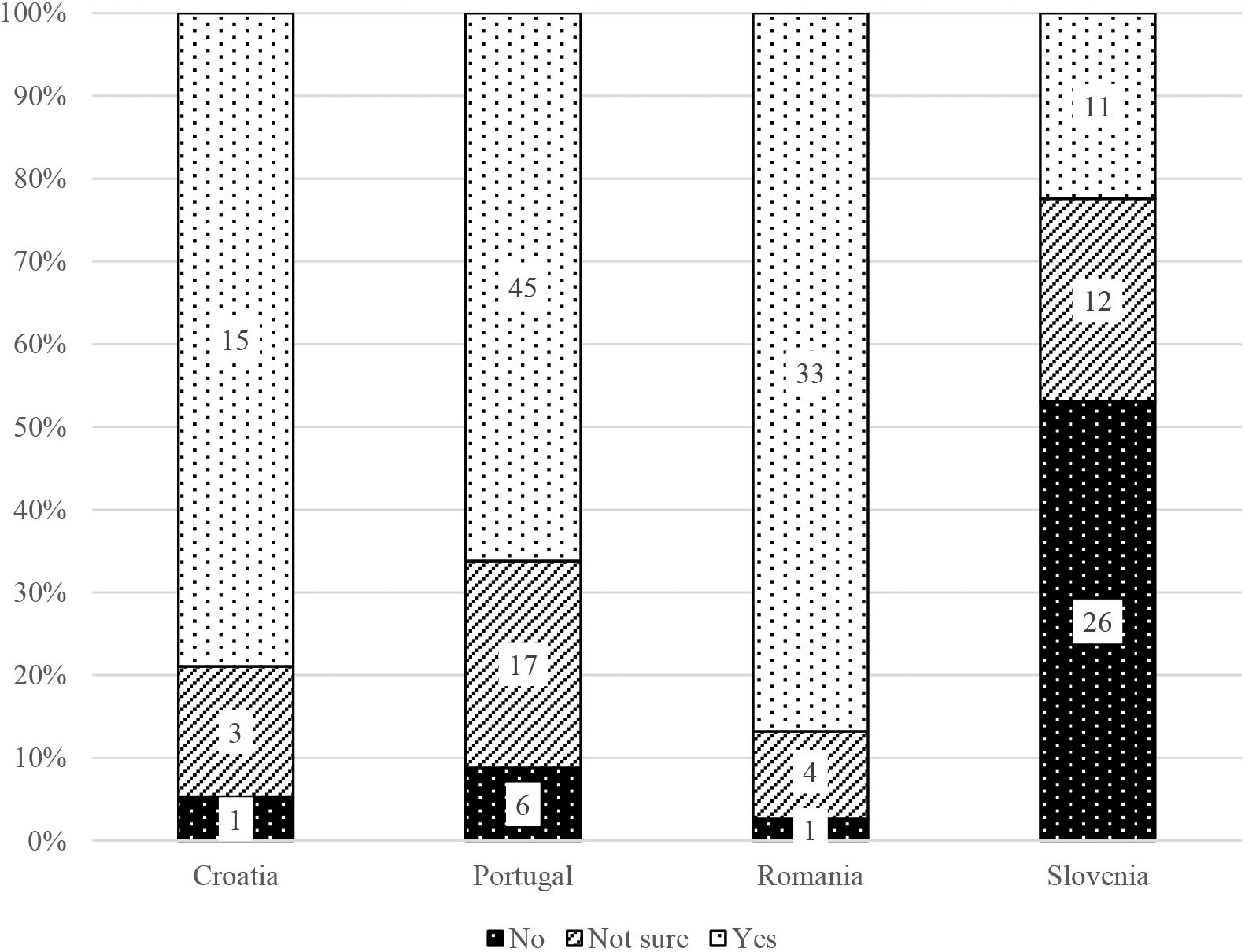
When dealing with IP issues, does the organization/company prefer to consult an outside specialist in the field or your employees with these competencies.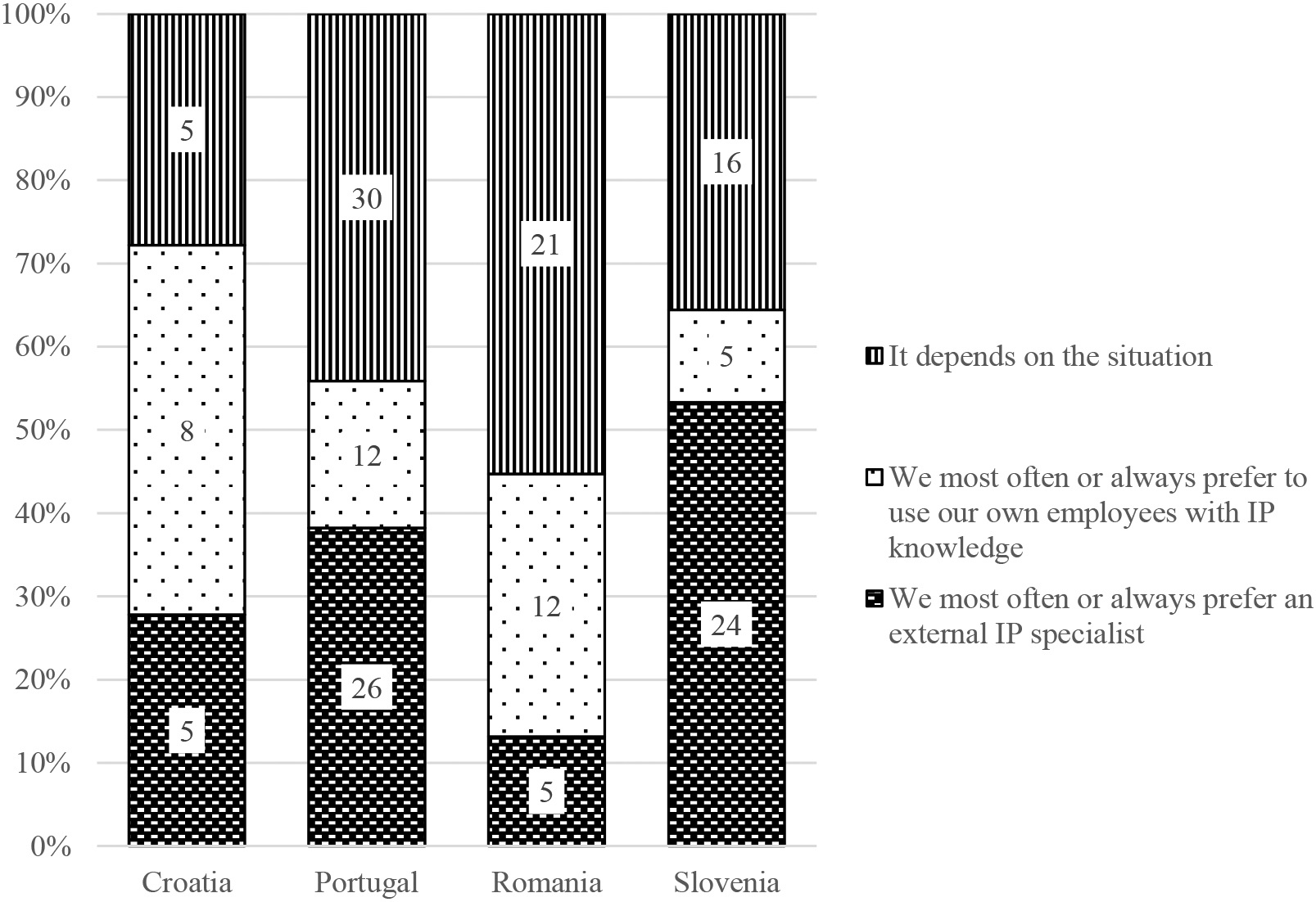
We also found out that in all countries the companies most often consult outside IP specialists (35%) or decide upon situation (43%) as it shown at Fig. 2. In-house IP knowledge is therefore not consulted that often (22%). The exception is Croatia where the largest share of employers (44%) and Romania (32%) do use their own employees when dealing with IP issues.
Importance, given by the employers, to various areas of IP competencies with job candidates
Importance, given by the employers, to various areas of IP competencies with current employees
In both Likert-scale-type questions, where we asked about the importance that is given by the employers to various areas of IP competencies when recruiting, i.e. with job candidates, and with their current employees, interesting differences between countries were revealed, as shown in Tables 1 and 2. No competencies received only extreme perceptions (positive/negative), also no competencies were perceived as only indecisive. In general, data shows that most valued are Knowledge of hazards of infringing or misappropriating other people’s IP assets and Knowledge what IP is, while least valued are Basic knowledge on the process of obtaining protection of IP, Skills for financial assessment of IP assets, and Knowledge of the basics of IP law.
While some competencies, such as Knowledge, what IP is, Knowledge of hazards of infringing or misappropriating other people’s IP assets, have shown as important in all partner countries and in both groups (job candidates (Table 1) and current employees (Table 2)), with most other competencies there was less consensus, sometimes little or none. For example:
Knowledge of the basics of IP law is was considered much more important in Portugal and Romania than in Slovenia and Croatia; Skills for financial assessment of IP assets had the least consensus, as they were considered important in Romania, not so important in Portugal and Croatia, and noticeably least important in Slovenia; Basic knowledge on the process of obtaining protection of IP, Knowledge where to find information on existing patents, trademarks, models, and Knowledge when and how to consult with an IP expert or adviser were considered more important in Portugal and Romania than in Croatia and Slovenia; Knowledge of the role IP assets play in strategic business planning, Skills for IP-related risk management turned out most important in Romania, and least important in Slovenia. With job candidates, least valued are Basic knowledge on the process of obtaining protection of IP and Skills for financial assessment of IP assets. In general, these competencies are most valued in job candidates in Romania, and least in Croatia and Slovenia. The least valued among job candidates were Basic knowledge on the process of obtaining protection of IP, Skills for financial assessment of IP assets, and Knowledge of the basics of IP law. The largest difference among countries is that Romanian employers value with job candidates Skills for IP-related risk management, while Slovenian employers do not. With current employees, most valued are Knowledge of hazards of infringing or misappropriating other people’s IP asset, Knowledge when and how to consult with an IP expert or adviser and Skills for IP-related risk management. These are most valued by Romanian respondents, while Slovenian show least appreciation. Least valued with current employees were again Basic knowledge on the process of obtaining protection of IP, Skills for financial assessment of IP assets, and Knowledge of the basics of IP law.
How often does the company/organization have to deal with IP issues in their work.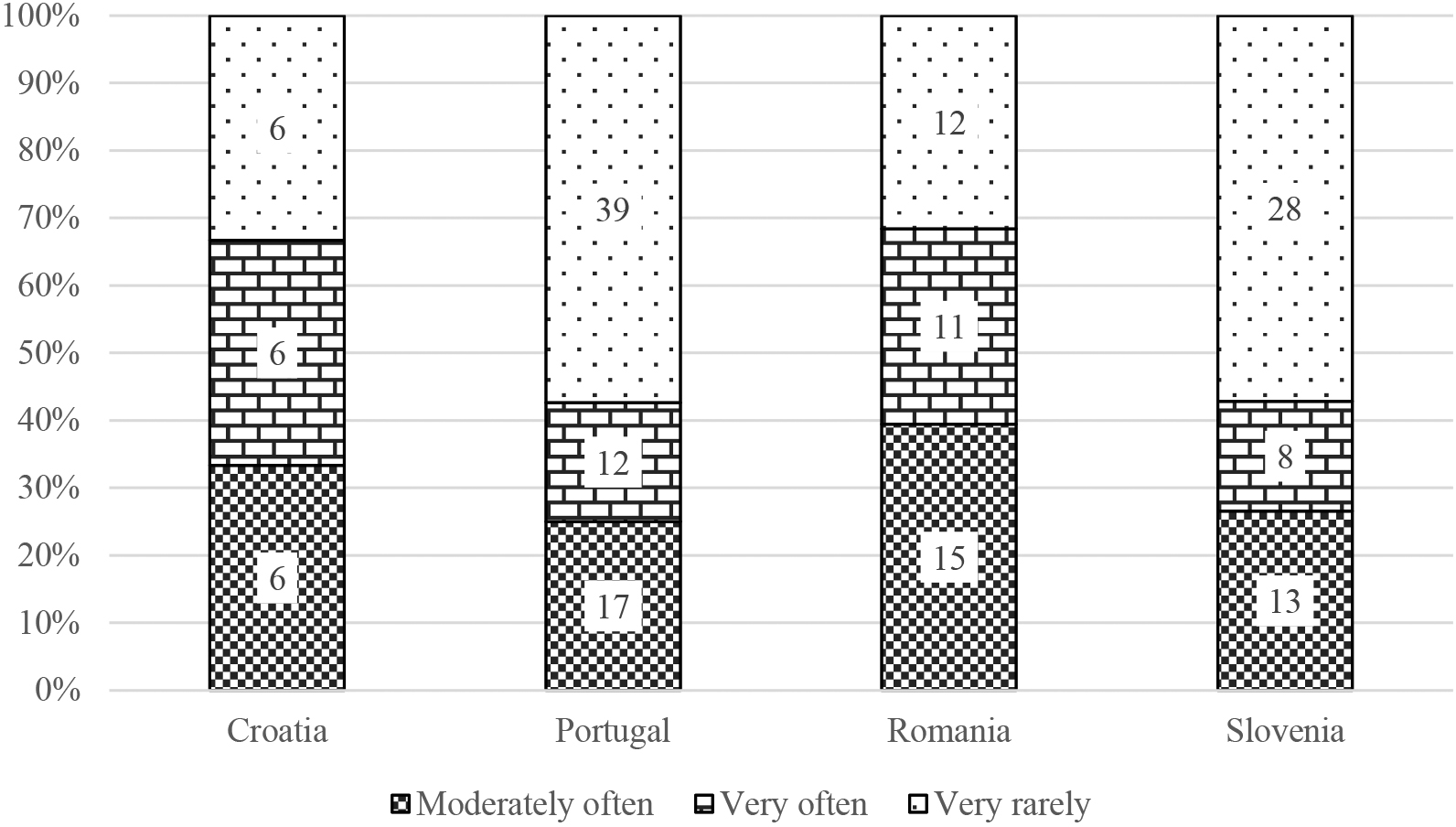
Does the company/organization think that IP competencies of their employees/colleagues would be beneficial for their activities.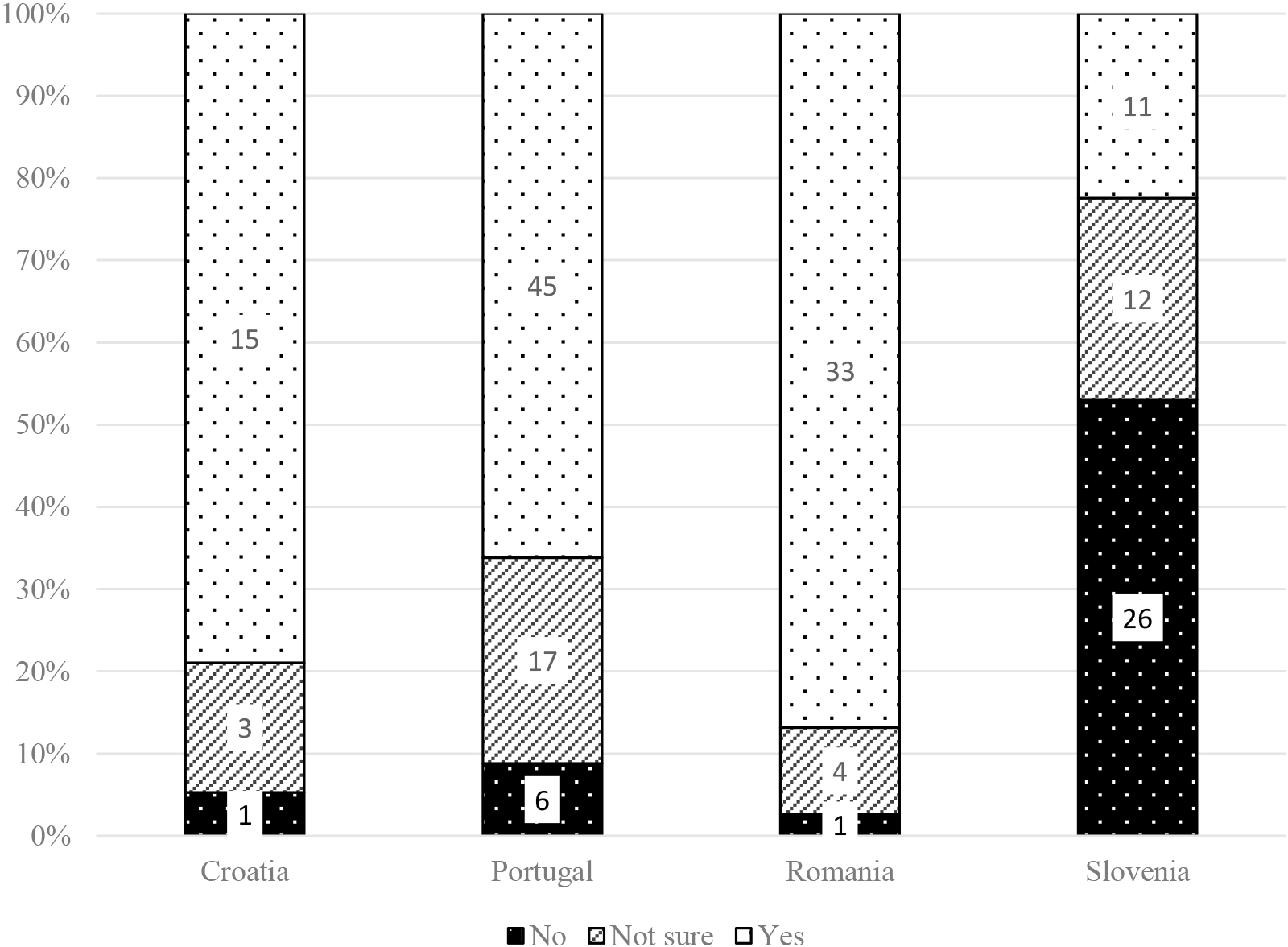
If the company/organization had more employees with IP competencies, would this be an advantage in terms of saving cost/time etc.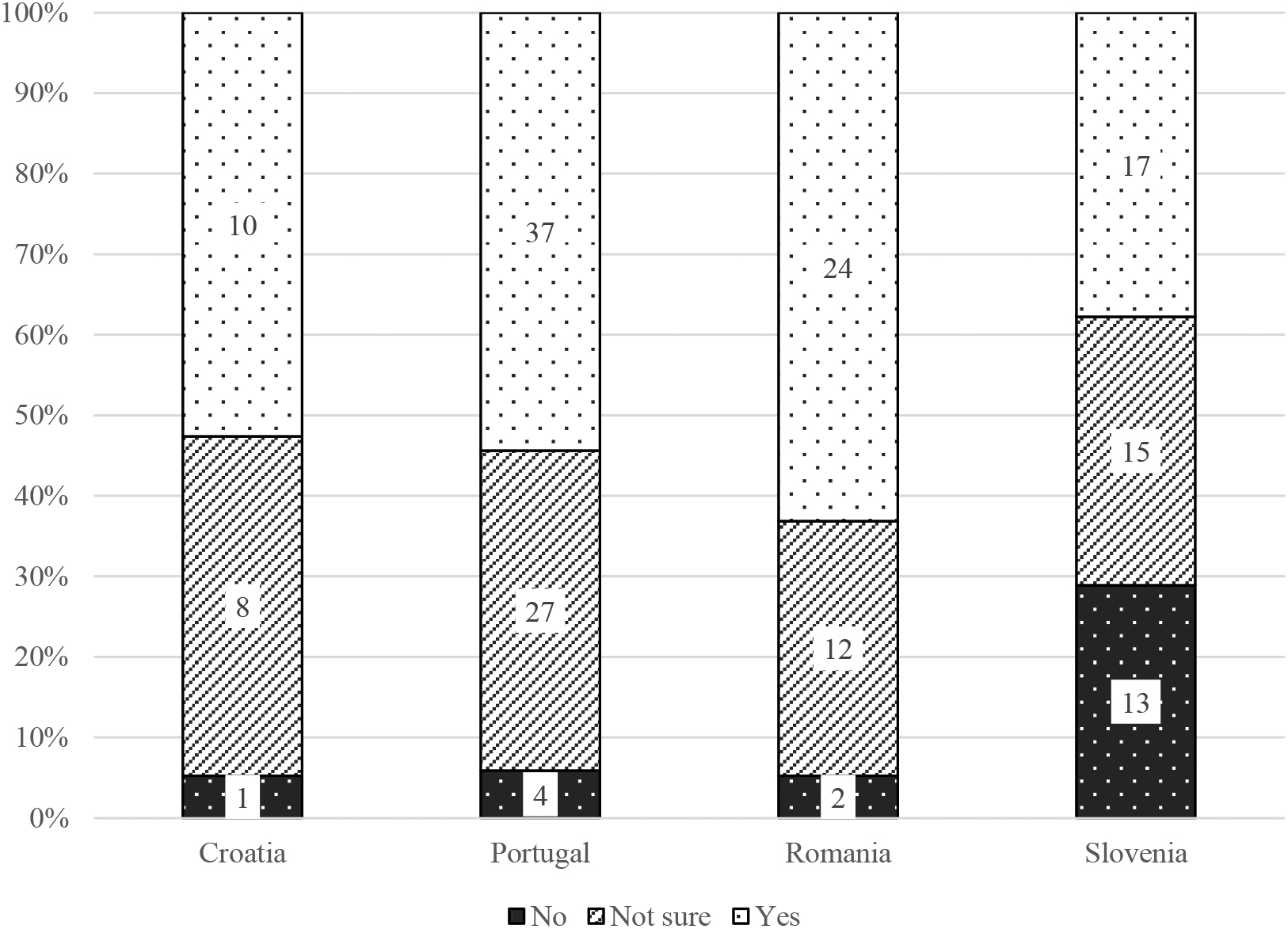
When asked about training on IP that should be offered in the workplace, we found that it is never (34%) or almost never (29%) offered, which makes for more than 60%. The Portuguese and Romanian companies stand out here, offering much more of these. Such a high percentage (63%) confirms that companies do not put these skills on their priority list. However, it is interesting to see that employers still largely believe (56%) that this knowledge would be beneficial to their employees and the company, although also a relatively high percentage (29%) are not sure.
Answers to the question about the frequency of this training, i.e., how often it should be offered, show that the predominant response (45%) across all countries was that training should be provided regularly, but no more than once or twice a year. On the other hand, 31% thought that they should be organized when training is needed, i.e., whenever an IP issue arises.
Respondents gave the answers about how often they have to deal with industrial property issues in their work (Fig. 3). Companies, regardless their sector, do not deal with IP issues very often (49%). The rarest occurrences are in Slovenia and Portugal (57%). Regarding industry sectors, in Slovenian sector of vehicle industry, they rarely deal with IP issues, while, on the other hand in Romanian vehicle sector, they very often deal with the IP issues. Conjectures about why such differences occur could be wrong or misleading. Taking this sector as an example, we can only comment that there is a difference in responsibility, as they have a full-scale factory in Romania, while in Slovenia there is only a branch of car company.
Nevertheless, companies seem to be convinced that IP knowledge of their employees would be beneficial for their activities, as it is shown Fig. 4.
This is further confirmed with answers to question “If you had more employees with industrial property knowledge, would this be of an advantage to your company/organization in terms of saving cost/time etc.?”, where the positive answer strongly prevails in joint answers (Fig. 5), although there is a noticeable share of those who are not sure.
As previously argued by Hanel (2006) the survey results confirm that IP competencies are very relevant to the company and organization’s work. The frequency of dealing with IP differs from country to country and IP competencies are in some areas more valued than in others. Similar to the findings of Kulkarni and Chachadi (2014), Nilsson (2010), and Pattanapairoj et al. (2021), in most countries (Croatia, Portugal, and Romania), IP competencies of the employees are perceived as beneficial for the activity of the company. On the other hand, the results show that Slovenian employers think that workers do not need this knowledge to the same extent as elsewhere. Further, when dealing with IP issues, most respondents prefer to consult an external specialist, but many of them also rely on their internal or in-house knowledge.
It seems that we can infer a few general conclusions that have not been found in any previous research, as Dukhan and Reyes (2014), Vairis and Petousis (2014) and Philbin (2021) only confirmed that IP competencies are expected also from non-law staff. Our findings reveal the following: The employers seem to relate relatively more basic IP competencies with their non-law personnel, especially with job candidates – this is seen from the lower values given to the more in-depth knowledge of IP law, as well as to connections of IP knowledge to financial, strategic, decision-making areas. They also seem more benevolent, regarding IP issues, towards job candidates, which could imply that they consider that there is still room for the development of new staff through training and experience.
Two competencies are important for both, job candidates and current employees: Knowledge, what IP is, and Knowledge of the dangers of infringing or misappropriating other people’s IP assets. Both would definitely require to be included in the education and training everywhere, while other competencies would probably be best included on more local levels. Also, industry sectors have proven to be very diverse in their perceptions of IP competencies. The first observation is that employers apparently have higher appreciation of IP skills for their current employees than for job candidates. While the same two competencies emerged as most important, as they did in the country analysis, the least valued for job candidates seem to be the ones most frequently acquired “on-the-job”: Skills for financial assessment of IP assets, Basic knowledge regarding the process of obtaining protection of IP, Skills for IP-related risk management, Knowledge of the role IP assets play in strategic business planning, and Knowledge how to utilize the IP domain in order to acquire information on competitors.
As discussed in the introduction, the aim of the study reported here was to investigate awareness and attention to IP competencies of non-lawyers in the labour market of four IPEDU partners’ countries through ascertaining of the importance these competencies to the employers.
In regard to the three research questions, we found that analyses according to industry sector were not possible due to inadequate data, and therefore, these parts of the research questions remain unanswered. We focused on the differences among countries, in regard to general views, and in regard to individual IP competencies.
The general view of importance of IP competencies by non-lawyers, covered by the first research question, has shown interesting and to some extend even contradicting results in partner countries. While in general IP competencies are considered relevant or somewhat relevant, which confirms earlier findings of Hanel (2006), Nilsson (2010), Kulkarni and Chachadi (2014), Dukhan and Reyes (2014), Vairis and Petousis (2014), Philbin (2021) and Pattanapairoj et al. (2021), there are rather large shares of the employers who do not value them at all, but would on the other hand consider it beneficial for their company and would like to have more employees with IP competencies. We conclude that employers in all countries would be interested in a relatively easily available training and education opportunities, such as distance learning and e-learning. Here we see a good opportunity also for the libraries and their educational services. This can be further supported with the fact that we found instances where employers prefer to use in-house IP competencies, meaning that these competencies have weight for them. At the same time, it might imply that more IP competent workers, due to having better education and training opportunities, would raise the share of use of in-house knowledge. IP competencies are more appreciated in some countries than in others, which implies that this could even be a matter of promotion and advocacy, followed by a targeted offer of education and training – again areas where libraries could jump in. Especially since most employers show positive attitude toward the influence of IP competencies of their employees on their business and see these competencies as an advantage (with some again showing more scepticism, thus opening new windows for promotion and advocacy).
The second research question covered perceptions of various IP competencies, which has not yet been done in previous research. There is no doubt that employers have different opinions on different competencies: some hold more merit than others. While Knowledge on hazards of infringing or misappropriating other people IP assets was evaluated in all countries as the most important IP competency of job candidates and current employees (except in Slovenia), the lowest rated competency for job candidates was linked to skills of financial assessment, while for current employees it was the Knowledge of strategic business planning and Knowledge how to obtain IP protection. The identified differences in perceptions would also require further investigation. It could be that some IP competencies are in the view of the respondents more related to other profiles than engineers and researchers, who are also non-lawyers, but were not included in this survey.
Training needs and possibilities were covered in the third research question. Undoubtedly, IP training is never or almost never offered in all countries, although the employers mostly believe that it would be of benefit to their employees and to the company – this, again, confirms earlier findings (Dukhan & Reyes, 2014; Hanel, 2006; Kulkarni & Chachadi, 2014; Nilsson, 2010; Pattanapairoj et al., 2021; Philbin, 2021; Vairis & Petousis, 2014). But employers everywhere have relatively firm opinions that such training should not be offered too often, and best at the moment when the knowledge is needed in the work process. All of this provides a good basis for training planning, in this case especially for current employees, and may even open up opportunities for awareness, promotion and advocacy. These findings are also useful when estimating the labour market needs for training, which, as shown earlier, needs to be done in contact with the employers (Jug et al., 2022; Kolga & Onisiforova, 2021; Magdoiu & Rada, 2013; Markes, 2006).
It needs to be noted that the results imply that situations in these countries, even though they are all EU member states, are influenced by large cultural, economic, business-related, and legal-framework-related differences.
Conclusion
Our study shows that IP knowledge and skills are an important area in the industry and that these competencies are in fact expected also from job candidates, in spite that these are probably not their most important competencies. This is also shown because training opportunities in IP are offered rarely or not at all. It does seem that at least some knowledge of IP is linked to greater business success of the companies, with increased financial profits. On the other hand, poorer knowledge of IP could lead to business loses (financial, image-related etc.), especially under stricter legislative frameworks, which, in turn, could increase the employers’ appreciation of and need for training and education. This means that companies would be interested in securing these assets through competencies of their current and new employees.
Despite the differences between sectors and countries, and despite the fact that the data allowed for limited possibility of analysis, we found that IP is an asset that is appreciated by the employers and needs constant development and progress. While the expectations of job candidates are mostly a question of formal education, and as such should be addressed to the HE (and within this also academic libraries), expectations of current employees are an issue of training opportunities that should be available when needed.
Not all IP competencies are considered equally necessary for non-law personnel by employers. Some seem to be more perceived to pertain to the managing profiles but should nonetheless be addressed in the training, since also engineers can find themselves in manager positions. The question arises as to whether employers themselves need some kind of awareness raising regarding competency in IP of their non-law experts.
Our study showed some methodological inadequacies that should be better addressed in future investigations of this area. Especially in regard to data gathering, more attention should be given to the design of the survey, possibly adapting it to take into account cultural, legislative, social and other differences, thus assuring better response rates and comparability of data.
We believe that in the future the importance of IP area will greatly increase. In this respect we might estimate the topic of our study to be an early bird, especially linked to education and training and to libraries. Taking as an example the area of copyright, which was much less important a decade or so ago, this is likely to be also the question of raised social awareness, followed by legislative and other solutions. From this aspect, HE programmes, including academic libraries, and possibly also special libraries in the industry, should not leave these topics unaddressed and left to chance, but strategically include them in their educational programmes. These issues should also be addressed in future research.
Footnotes
Acknowledgments
This research was done within the project IPEDU (Intellectual Property Education for Lifelong Learning and the Knowledge Economy Strategic Partnerships for Higher Education – Agreement no. 2020-1-IE02-KA203-000758)),
Available at: