




Abstract
University students as members of Generation Z (late 1990s and early 2000s) have rich experience in living the digital life. Previous studies show that Generation Z cares about their privacy and is more apt than older generations to implement complex privacy and security measures, but they are also more willing to compromise their privacy if they see any benefit. The aim of this research was to examine digital privacy protection attitudes, knowledge and skills of university students in Croatia. Obtained results suggest that respondents appreciate their digital privacy, have a cautious attitude toward protecting their data and are self-initiative regarding learning about digital privacy. However, their knowledge about digital privacy is not comprehensive and uniform, nor are their strategies of digital privacy protection. Privacy protection on social networks gives a better impression, which can be connected with the practice of frequent use of social networks and the need to maintain a certain image online. The above is also supported by data that the majority of respondents consider the publication of content in which they appear without their consent to be a very serious violation of their privacy. Furthermore, 65% of respondents would like to receive additional education on digital privacy.
Introduction
In a world where billions of people worldwide use Internet and social media, many aspects of our lives take place online. By using various applications and online tools on a daily basis, users leave data about their interests, behaviors and habits. Capturing, storing and analyzing data on their consumers allows companies to understand users’ habits and preferences and personalize user experience online. Therefore, personal data has grown to have a significant value (van Lieshout, 2014). Companies are able to monetize user data by creating microtargeted ads to promote their products and services, or by selling data to a third party (Freedman, 2023).
The issue of digital privacy has been discussed more intensively since 2016, when, due to several major scandals related to the illegitimate use of user data, the EU General Data Protection Regulation (GDPR) was passed (GDPR Archives – GDPR.Eu, n.d.). According to GDPR, an individual has the right to know for what purposes his/her data is used, who protects it and until when, who can access it, and has the right to request that this data be deleted or changed.
Although the user’s privacy is legally protected, in practice there are various challenges. Sometimes users are forced to share data in order to access certain content (Syme, 2022). Other times, users ignore privacy settings, or agree to provide data in order to receive various benefits in return in terms of obtaining information, personalized content, access to additional content etc. (Bergström, 2015). Although users appreciate the benefits of personalization, the idea of collecting their data for commercial purposes creates a sense of concern. According to a recent survey among a nationally representative audience of U.S. adults, 86% of consumers feel a growing concern about their data privacy (Lucas et al., 2021).
With the first generation of digital natives coming of age, the growing number of young people are becoming a part of the consumer population. Generation Z (Gen Z, zoomers, iGeneration, post-millennials etc.) is a generation born during the late 1990s and early 2000s (Eldridge, 2022). The use of the Internet and mobile devices is a central part of their everyday life and most of them do not remember life before internet, Google and smartphones. Since Generation Z spends so much time online and share so much information, it is important to address the privacy issues that inevitably arise (Park & Vance, 2021). Research on the digital privacy of young people in Croatia has not been conducted so far, therefore with this study we wanted to get preliminary insights into this topic in the Croatian context on a sample of university students.
The media habits of Generation Z
Generation Z has been living with technology from an early age. For members of Generation Z, smartphones are the main source of entertainment, information and connection with others (Ahmed, 2019). Members of Generation Z spend a large amount of time on the Internet and they are the most active social media users (Briggs, 2022). Studies across the globe indicate that they use several social networks to access various content for entertainment, information and education (Bhatnagar & Pry, 2020; Engels, 2019; Trninic & Kupresanin, 2021; Viţelar, 2019). Members of Generation Z also actively create and share digital content and maintain communication online (UGC White Paper, 2020). Besides using digital platforms in their free time for communication and leisure, they are increasingly adopting online learning tools as higher education shifts into the cloud (Park & Vance, 2021). For them, social networks are also the main source of shopping (Kambuno et al., 2022). Members of Generation Z often do their online shopping based on ads that are offered to them (Smith, 2017). With the rise of consumer privacy activism, technologies are being developed to pinpoint specific customers using location, facial recognition and biometric measures. Most consumers are still hesitant to incorporate new technologies to protect their privacy, however Generation Z and Millennials (Generation Y born between 1977 and 1995, roughly) are more willing to share their personal data for an enhanced shopping experience (Holmes, 2022). Since the share of Generation Z in the consumer population is rising, there is a growing interest in their attitudes and behavior in the context of privacy in order for the companies to adapt their privacy policies to this group of users (Analyzing Gen Z Spending Habits Before and During COVID-19, 2020).
There are not many studies of Generation Z in Croatia in general. From the few conducted studies and official statistics, we know that for the most part they share the similar media usage characteristics with their peers from the Western countries (Daljevec, 2020; Primjena Informacijskih i Komunikacijskih Tehnologija (IKT) u Kućanstvima i Kod Pojedinaca u 2021., 2021). According to a recent study done in 2022, when it comes to social networks usage among Generation Z in Croatia, the most popular is Instagram, where 51 percent of those surveyed spend the most time. Facebook is used by another fifth of members of the Generation, while Tik Tok is not yet as popular as in Western countries and is used by 14 percent of respondents (L.Š-/Hina, 2022). Since there was no formal education on digital privacy until school year 2019/2020 when the Ministry of Science and Education in Croatia issued a Decision on adopting a curriculum for the interdisciplinary topic Use of Information and Communication Technology for primary and secondary schools in the Republic of Croatia (Odluka o Donšenju Kurikuluma Za Medupredmetnu Temu Uporaba Informacijske i Komunikacijske Tehnologije Za Osnovne i SrednjeŠkole u Republici Hrvatskoj, 2019), the question arises to what extent young people in Croatia who belong to Generation Z are familiar with the topic of digital privacy and how they protect it.
Generation Z data privacy preferences, attitudes and behaviors
Studies regarding digital privacy of Generation Z point out that members of this Generation care about their privacy online (Engels, 2019; Holmes, 2022; Leiponen et al., 2022; Park & Vance, 2021), however, as mentioned before, they are open to compromise it if they will get certain benefits (Bhatnagar & Pry, 2020; Holmes, 2022). In a study of German Generation Z in 2017, more than half of the respondents would not decide to pay for the protection of their data despite the expressed critical position on the issue of online privacy. However, generalization of these results is not possible as most respondents were 17 years old (Engels, 2019). In a study of attitudes, awareness, and perceptions of personal privacy on social media of university students in USA conducted in 2020, half of the respondents were willing to give up their privacy in return for free applications or services. Another half perceived being monitored as an advantage because of targeted advertising, whereas a quarter merely regarded it as an accepted standard while engaging in online activities (Bhatnagar & Pry, 2020).
Especially informative studies are those that compare the attitudes and behavior of different generations in order to observe the particularities of each. A recent study comparing Generation Z to non-Generation Z shows that members of Generation
However, research findings are not consistent. For example, a survey comparing Generation Z and Millennial cybersecurity habits from 2020 on a sample of 520 respondents indicated that Millennials employ higher privacy settings on all of their accounts compared to Generation Z. Furthermore, while the majority of respondents across all age groups indicated they desired more privacy online, over 20% of Generation Z respondents stated they did not. Although the majority of poll participants claimed that they understood many security principles (for example, what constitutes a strong password), the majority of participants did not want to go out of their way to improve their online security (Cohen, 2020). A study by Debb. et al. (2020) came to similar conclusions. 593 respondents participated in a study comparing the attitudes and behavior regarding online security of Millennials and Generation Z. When asked about regularly reviewing privacy policies, updating antivirus software and acting on malware warnings, the results showed that Millennials use security measures to protect their privacy more often than Generation Z (Debb et al., 2020).
The described research points to the conclusion that younger generations are more apt than older ones to apply more complex privacy and security measures, however they are also more willing to compromise their privacy if they see any benefit from it. They don’t mind sharing their personal information with third parties, and they value targeted advertising. Generation Z and Millennials share similar digital habits in the context of protecting their digital privacy and security. When answering the question of which generation protects its digital privacy to a greater extent, the research results are not consistent. However, if we take into account the recency of the conducted studies and the fact that more recent studies include more older members of Generation Z simply because this generation is getting older, it can be assumed that Generation Z is becoming more aware of possible risks and beginning to appreciate its digital privacy more.
As mentioned before, in 2019 the Ministry of Science and Education in Croatia issued a Decision on adopting a curriculum for the interdisciplinary topic Use of Information and Communication Technology for primary and secondary schools in the Republic of Croatia. The purpose of the mentioned cross-curricular topic refers to effective, appropriate, timely, responsible and creative use of information and communication technologies in all subjects and levels of education. Topics on the protection of digital privacy, personal data and responsible behavior in the digital environment are implemented already from the 1st and 2nd grade of primary school, with an emphasis on the application of simple strategies for protection of personal data, familiarization with the concepts of protection (viruses, malicious programs and anti-virus programs), familiarization with the basic rules of appropriate behavior on the Internet and respect for other people’s privacy. Since digital privacy entered the formal education during the school year 2019/2020, only a segment of Generation Z received a formal education about it and we expect that this will be reflected in the results of the research (Odluka o Donošenju Kurikuluma Za Medupredmetnu Temu Uporaba Informacijske i Komunikacijske Tehnologije Za Osnovne i SrednjeŠkole u Republici Hrvatskoj, 2019).
Generation Z across the globe is entering the world of adults with all the advantages and responsibilities. They have rich experience in living the digital life, but many are without formal education on how to deal with the challenges and responsibilities in that world. Therefore, the question arises to what extent members of Generation Z are equipped with the necessary knowledge and skills, and what are their views on the protection of digital privacy.
Research on the digital privacy of university students
Research objective and research questions
The goal of this research was to examine digital privacy protection attitudes, knowledge and skills of university students in Croatia and gain preliminary insights into this topic in the Croatian context. University students were selected as adult members of Generation Z.
The study was guided by the following research questions:
To what extent and in what ways are respondents informed about digital privacy protection? What are their habits and practices related to protection of digital privacy? How do respondents protect their privacy on social networks? What are their experiences and attitudes with regard to digital privacy violations?
A survey method using an online questionnaire was used. The survey was conducted at the Faculty of Humanities and Social Sciences at the University in Osijek, Croatia. This university was chosen for convenience as the authors are employed there and this allowed us to conduct the survey in person. The Faculty of Humanities and Social Sciences was chosen because it is one of the largest faculties of the aforementioned University and enrolls the largest number of different study programs in the field of social sciences and humanities, which are the most popular fields of study in the Republic of Croatia. Student population in Croatia last year consisted of 154 894 students, of which 49.4% were students of humanities and social sciences (76 517) (Studenti Upisani Na Stručni i Sveučilišni Studij u Zimskom Semestru Ak. g. 2021./2022, 2022).
The survey started on 1 June and ended on 25 July 2022. Students completed the questionnaire via smartphones at the Faculty or online via the link on the profile of the Faculty of Humanities and Social Sciences in Osijek on the social network Instagram. Due to the preliminary nature of the study, the convenience sampling method was used. The respondents were students of humanities and social sciences in several degree programs (Croatian language, Information science, History, Psychology, Sociology, Philosophy) and in all years of study. 149 respondents took part in the study which is 1% of the total student population of the University in Osijek and 11.5% of the student population of the chosen Faculty (Agencija za znanost i visoko obrazovanje, 2022). Due to a limited number of respondents and the fact that all respondents belong to the same scientific fields, we did not aim to determine the differences between different study groups or years of study.
A total of 149 respondents took part in the research, of which 112 were female (75.2%) and 37 (24.8%) were male (see Fig. 1).
Gender of respondents (%).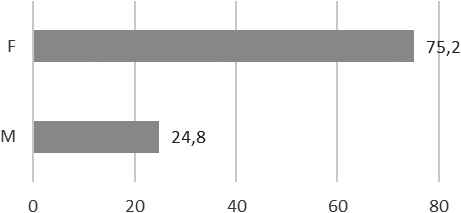
Age of respondents (%).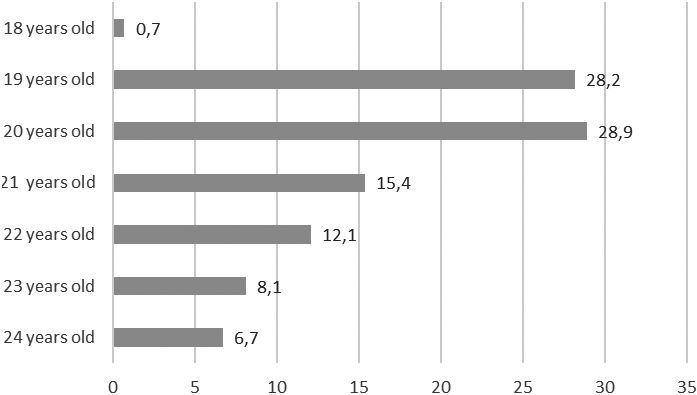
10 (6.7%) respondents are 24 years old; 12 (8.1%) are 23 years old; 18 (12.1%) are 22 years old; 23 (15.4%) are 21 years old; most respondents are 20 years old, namely 43 (28.9%) of them; 42 (28.2%) respondents are 19 years old; and one (0.7%) respondent is 18 years old (see Fig. 2).
An online questionnaire was used for the study. The questionnaire contained 21 closed questions, some of which required only one answer to be marked, and some of which allowed for multiple answers. Each question had to be answered. The survey questionnaire was anonymous and it was conducted in Croatian language. The questions were divided into six groups:
demographic questions regarding the gender and age of the respondents questions about the ways in which respondents gained knowledge about digital privacy protection, and statements about different aspects of privacy protection where respondents were asked to mark statements that they considered factually correct questions about the perception of the sensitivity of personal data the respondents provide online, the extent to which respondents think about the risks and consequences of sharing data and the methods they use to protect their privacy online questions about the number of social networks used by the respondents, the frequency of their use and the ways in which they protect their privacy on social networks questions about experiences with digital privacy violations questions about attitudes towards digital privacy violation asking respondents to characterise the severity of specific privacy violation situations on a scale of 1 (“insignificantly severe”) to 5 (“very severe”), and questions about additional education on privacy protection on the Internet.
A survey questionnaire was translated to English and is included in the section “Appendix”.
The results will be presented and discussed in relation to the four topics covered by research questions that guided the study. The four topics were 1. acquisition of knowledge and the level of knowledge about digital privacy; 2. digital privacy protection habits and practices; 3. privacy protection on social networks and 4. experiences and attitudes toward the violation of digital privacy. Essential findings are shown in the Fig. 3.
Essential findings.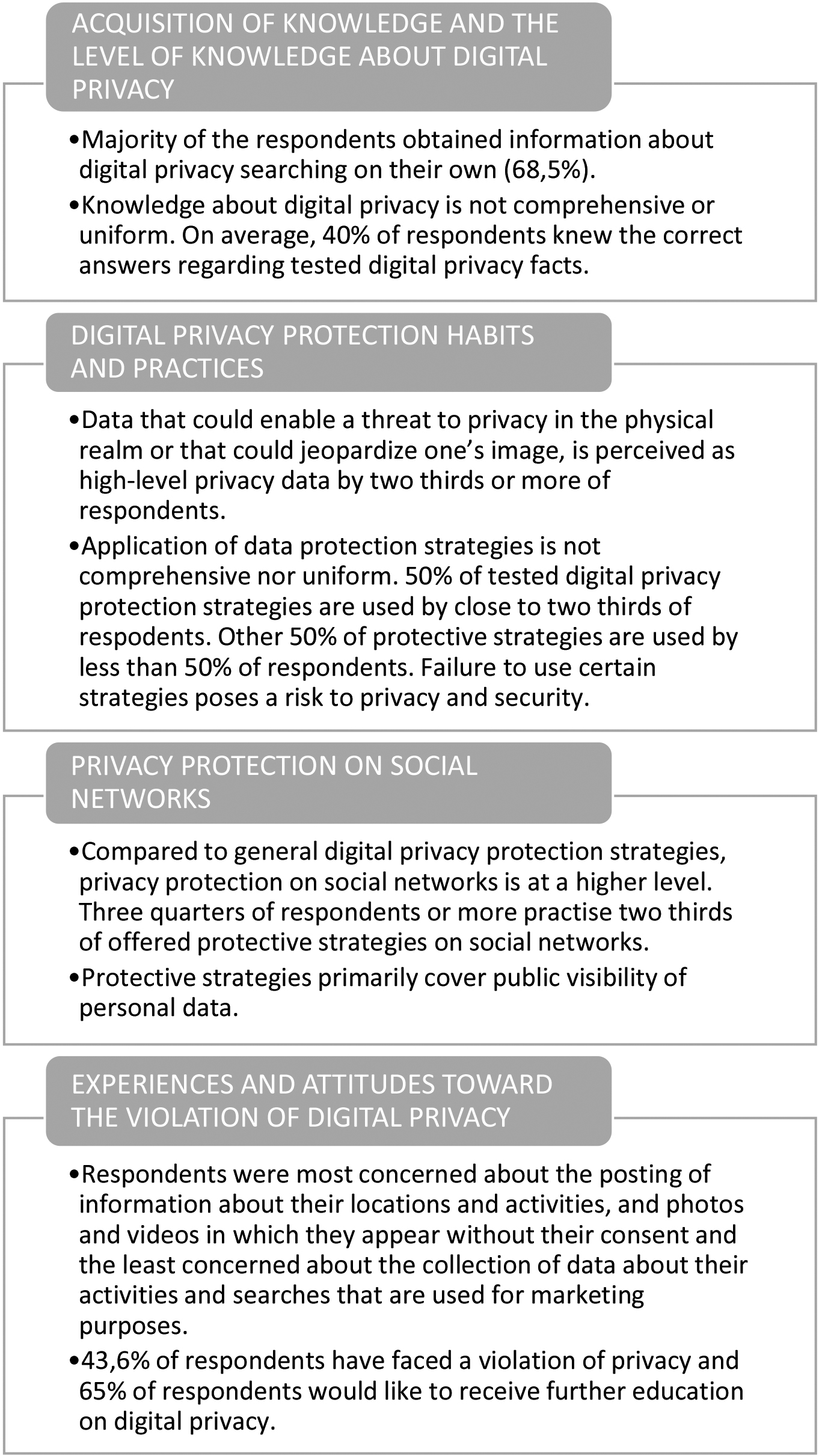
Each of the four topics will be discussed in more detail in the following subsections.
The first research question asked “To what extent and in what ways are respondents informed about digital privacy protection?” To answer this question, we asked in the survey questionnaire a multiple response question in what ways the respondents were informed about online privacy. Results are presented in Table 1.
Source of information about privacy protection
Source of information about privacy protection
Although almost two thirds of respondents (63.8%) received information about digital privacy at school, they still researched the topic on their own as well. In fact, the largest share of respondents indicated that they had researched the topic on the Internet (68.5%). This result suggests a considerable level of self-initiative regarding familiarization with digital privacy among our sample and can be related to findings from other studies that claim Generation Z members care about their digital privacy (Engels, 2019; Holmes, 2022; Leiponen et al., 2022; Park & Vance, 2021). However, this finding also raises the question what prompted more than two-thirds of respondents to research digital privacy on their own. Findings also show that digital privacy is not significantly represented in the study programs (30.9%) included in the sample, nor discussed in the family (28.9%).
We also attempted to answer the first research question by examining users’ level of knowledge about various aspects of digital privacy. Seven statements regarding digital privacy were included in the questionnaire and respondents were asked to mark True, False, or I don’t know. Results are shown in Table 2. Correct answers are in bold.
Users’ level of knowledge about various aspects of digital privacy
On average the majority of respondents (49.2%) answered that they did not know if the statements were true or not. An average of 40% of respondents knew the correct answers, and the range of correct answers to each statement was from 3.4% to 77.9%. Only two statements were correctly marked by more than a 50% of respondents (Other websites can track activity on the visited website for marketing purposes – true, and Incognito mode allows complete anonymity while browsing – false). Although the sample of a few statements does not allow for generalization of the results, it suggests that knowledge in the field of digital privacy among our sample is not comprehensive nor uniform.
Second research question aimed to gain insight into habits and practices related to protection of digital privacy.
A multiple-choice question asked what data respondents provide on online servers without hesitation. Results are presented in Table 3.
Data users leave on online servers without hesitation
Data users leave on online servers without hesitation
The great majority of respondents provide information about their first and last names (86.6%), date of birth (77.9%) and their e-mail address (72.5%) without hesitation. These data can be characterized as low-level privacy data because it is easily given away. On the other hand, respondents are mostly reluctant to provide data such as personal identification number (4%), location data (10.7%), home address (13.4%) and video recordings (12.8%). Previous studies came to very similar conclusions (Leiponen et al., 2022; Trninic & Kupresanin, 2021). Data that respondents perceive as high-level privacy is either the data that could enable an unwanted threat to privacy in the physical realm (home address, phone number, location) or it is data that reveals details about personality, habits and experiences that could jeopardize one’s image.
Respondents were also asked how often they think about the potential risks and consequences of providing personal data on the Internet. Figure 4 shows that distribution of answers is approximately normally distributed.
Considering potential risks and consequences of providing personal data on the Internet (%).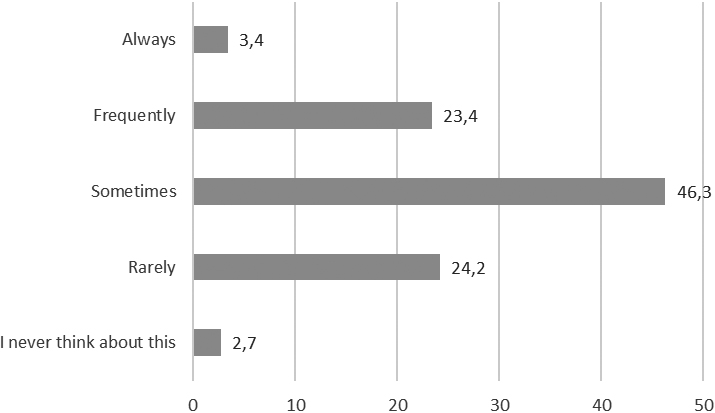
An almost identical share of respondents said that they often (23.5%) and rarely (24.2%) think about the possible risks and consequences of providing personal data online. These results are similar to previous research (Trninic & Kupresanin, 2021) and point to additional questions about the differences among respondents who report high-level worry, on the one hand, and low-level worry about digital privacy, on the other hand, especially if worry is related to digital privacy protection practices.
Following question which allowed multiple answers to be selected, asked how users protect their data and privacy on the Internet. An analysis of the strategies that respondents use to protect their privacy on the Internet is presented in Table 4.
Privacy protection strategies on the internet
Out of fourteen protective strategies that were offered, only one is used by the great majority of respondents, and it is logging out of user accounts on public computers (87.2%).
Six protective strategies are used by close to two thirds of respondents (not using public computers for shopping (71.1%), deleting applications that are not used regularly (71.1%), not leaving any personal data if possible (70.5%), not turning on location tracking on mobile device (63.8%), accepting only necessary cookies when accessing online sites (61.1%) and not using cloud to store sensitive information 57.7%)).
All other protective strategies, i.e. seven of them which make up 50% of all offered strategies, are used by less than 50% of respondents (using incognito mode for viewing sensitive content (47%), not sending and receiving sensitive data when using a public network (44.3%), deleting user accounts that are no longer used (43.6%), having a separate e-mail in addition to a private one (39.6%), checking and adjusting privacy settings when downloading software applications (22.8%) and enabling the secret conversation option in messaging applications (20.1%)). The least frequently chosen option was encrypting sensitive data in the cloud (16.1%). The list of privacy protection strategies used by a smaller portion of respondents includes certain measures, the non-compliance of which can endanger not only privacy but security as well.
The recent study by Holmes (2022) also found that although Generation Z is most likely to use secure VPNs, privacy-focused browsers and two-factor authentication compared to other generations, less than 40% of respondents do so. If we keep in mind that Generation Z spends most of their typical day in the digital space, that they use digital tools for almost all domains of life, from entertainment and personal communication, through education to shopping, these data point to the need for more extensive research into digital privacy protection of Generation Z.
Third research question aimed to gain insight into the use of social networks and the protection of privacy on them.
Respondents were asked how many social networks they use and how often they use them. Results are presented in Figs 5 and 6.
Number of social networks used (%).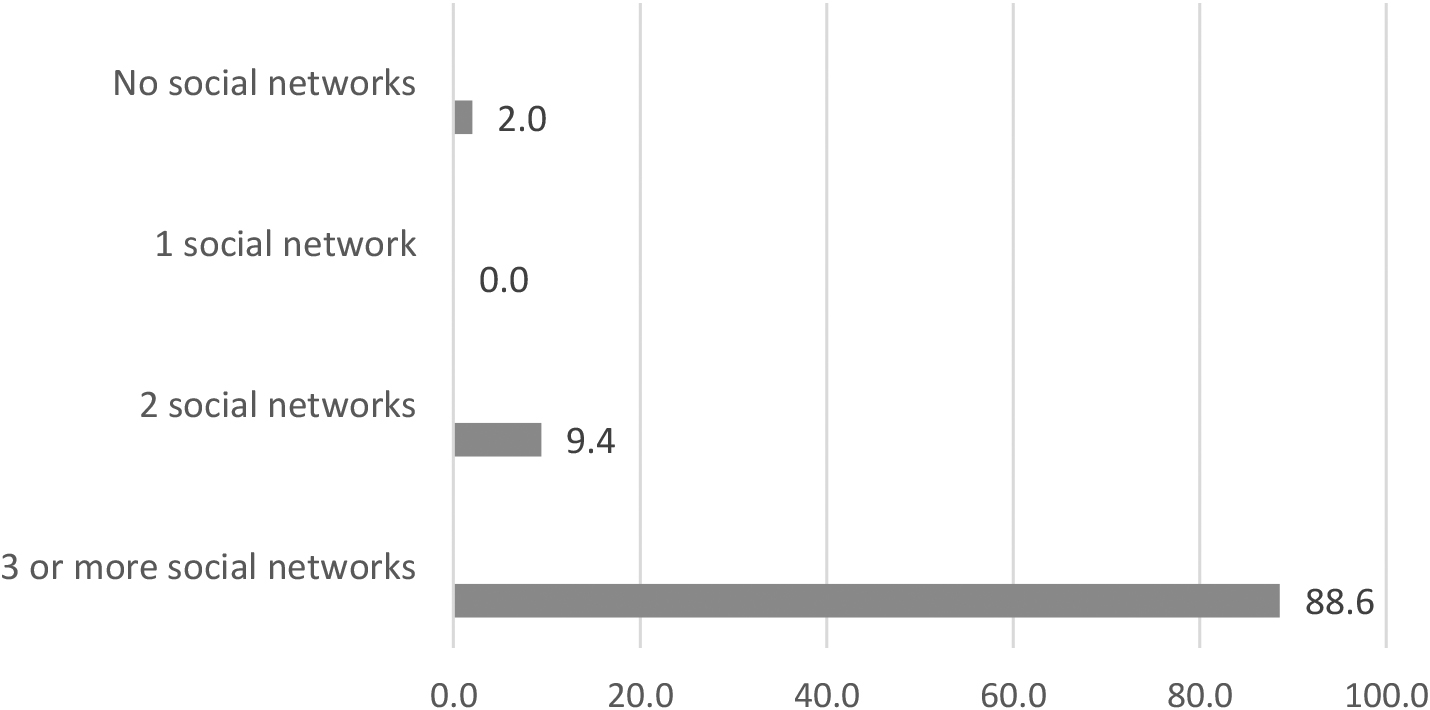
Frequency of using social networks (%).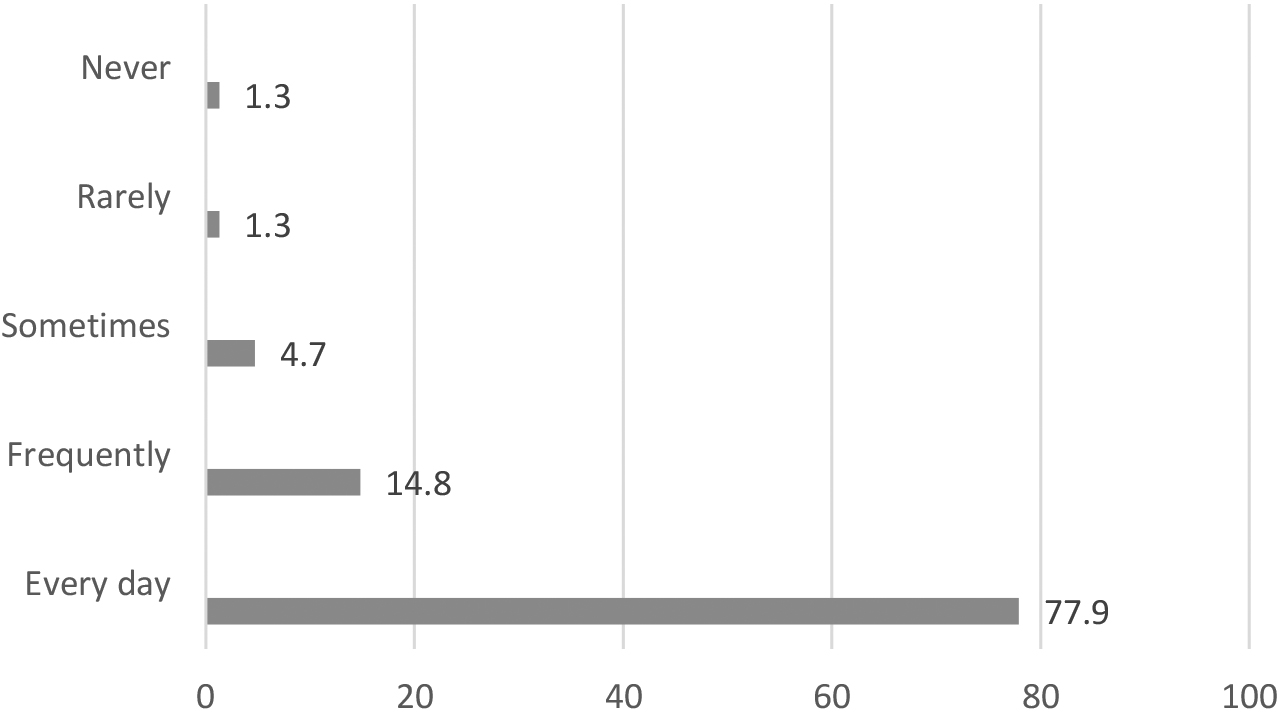
Key findings which show that the majority of respondents use 3 or more social networks (
The following question which asked how respondents protect their privacy on social networks allowed the selection of multiple answers. Results are presented in Table 5.
Privacy protection on social networks
Compared to general protective strategies on the Internet (Table 4), privacy protection on social networks is at a higher level. The majority of respondents (three quarters or more) practise two thirds of offered protective strategies on social networks. However, only 15.4% of the respondents regularly monitor and update changes to privacy settings on the social networks they use and close to 50% of respondents did not familiarize themselves with the privacy settings on all the social networks they use. This finding can be related to a recent study by YouGov UK which showed that 86% of Gen Z do not read The General Terms and Conditions which cover the rights for the transfer and use of personal data in social networks (IONOS, 2023). This points to the fact that Generation Z primarily cares about the public visibility of their data, and to a lesser extent about what happens with their data in the “background” that is not visible.
Fourth research question aimed to gain insight into experiences and attitudes toward the violation of digital privacy.
The question about whether the respondents’ privacy had ever been violated was a multiple-choice question. Answers are presented in Table 6.
Violation of privacy on the internet
Violation of privacy on the internet
A relatively large share of the respondents (43.6%) have faced a violation of privacy. Compared to other similar studies across the globe, reported incidents were higher in the Croatian sample. However, these differences may also be attributed to different methodologies used in these studies (29% (Bhatnagar & Pry, 2020) and 27.2% (Trninic & Kupresanin, 2021)). The most frequently reported incident by 36 (24.4%) respondents was having photos of them posted without their consent. A recent report on perceptions from Generation Z and parents regarding privacy and security found that 73% of Generation Z wish their parents would ask permission before posting photos of them online (Forever Connected: The Realities of Parenting and Growing up Online, 2022). This data shows that Generation Z cares about maintaining a certain image online and that they consider the publication of content in which they appear without their consent to be a serious violation of their privacy. The next question from the questionnaire dealt with the aforementioned problem.
Attitudes toward the violation of digital privacy were investigated by statements describing situations that respondents were asked to assign a severity level to, according to their opinion. It was possible to select options on a scale from 1 “insignificantly severe” to 5 “very severe”. Results are presented in Table 7.
Perception of the seriousness of online privacy violations
The obtained data are consistent with the previous statement that Generation Z tends to preserve a certain image online. While close to 40% of respondents consider customising the ads (38.9%) and the news (37.6%) based on data on their Internet activity very severe or mostly severe violation of digital privacy, twice as many respondents consider publishing photos (82.5%) and videos (84%) in which they appear without their prior consent as very severe or mostly severe violation of digital privacy. Publishing data on activities, places visited, etc. without their consent was also considered as very severe or mostly severe violation of privacy by twice as many respondents (83.2%).
This finding is in line with previous studies that show that members of Generation Z do not mind collection of data for various marketing purposes, and that in fact they find personalised ads helpful (Bhatnagar & Pry, 2020). However, although a clear gradation can be observed in the perception of the seriousness of the violation of privacy between different types of personal data and the purpose of their use, there is still a significantly high proportion of respondents who perceive even the least serious situation of violation of privacy as a serious violation of privacy, and compared to international studies, Croatian students express a more cautious attitude.
The final question of the questionnaire aimed to examine whether the respondents would like to be further educated about the protection of privacy and their data on the Internet. The answers were Yes (
Being born and growing up in a highly technological environment significantly shaped the lives of Generation Z and is reflected in the way they spend their time and fulfil the whole range of their personal and professional needs. Although research results are conflicting, if we look at the results of the studies with regard to the date of their conduct, new research shows the growing interest of Generation Z in digital privacy issues. It is probably due to the fact that the Generation is maturing, entering the world of adults, becoming a part of the consumer population with its own resources and becoming more exposed to possible risks in the context of digital privacy.
The purpose of this study was to gain preliminary insights into the attitudes and behaviors of university students in Croatia related to digital privacy protection. We have investigated four topics: 1. acquisition of knowledge and the level of knowledge about digital privacy; 2. digital privacy protection habits and practices; 3. privacy protection on social networks and 4. experiences and attitudes toward the violation of digital privacy.
The results convincingly point to a conclusion that there is interest in the mentioned issue among the researched population. Moreover, based on the data on how many respondents independently researched the topic and how many of them would like additional education on the topic, we could say that the interest is extraordinary, and this opens up additional questions about the reasons why this is so.
Knowledge about digital privacy and the application of protection strategies is not comprehensive nor uniform. This is to be expected considering that digital privacy was only included in the curriculum of primary and secondary schools in 2019/2020, and not all respondents were informed about digital privacy at school, and even fewer were informed at university. On the other hand, privacy protection measures on social networks give a better impression, at least in terms of protecting the public visibility of data. We can speculate about the reasons, but the assumption is that Generation Z’s need to preserve their image affects the practice of protecting the visibility of data that could affect their image. The aforementioned conclusion is also indicated by the data that respondents were most concerned about the posting of information about their locations and activities, and photos and videos in which they appear without their consent and the least concerned about collection of data about their activities and searches that are used for marketing purposes. However, there is still a significantly high proportion of respondents who perceive even the least serious situation of violation of privacy as a serious violation of privacy, and compared to international studies, Croatian students express a more cautious attitude.
Having in mind that this study was conducted on a convenience sample of students of social sciences and humanities in Croatia, the results cannot be generalized. However, the results provide an argument that the digital privacy of university students in Croatia is a topic that needs further consideration and more extensive study of research problems included in this paper.
Footnotes
Appendix
Dear students,
we invite you to participate in the Digital Privacy of Generation Z survey. Through the survey, we want to find out what your experiences, behaviors and attitudes are regarding the protection of your digital privacy. The survey is anonymous and takes no more than 10 minutes to complete. Thank you in advance!
Please indicate your gender.
F M Please indicate your age.
18 19 20 21 22 23 24 On average, how much time do you spend per day using the Internet?
0–1 1–3 3–6 More than 6 hours Have you been informed about the protection of digital privacy in any of the above ways? Mark all the answers that apply to you.
Yes, I was informed about it by my family members. Yes, I was informed about it at school. Yes, I was informed about this at the university. Yes, my friends informed me about it. Yes, I was informed about it through the media. Yes, I found out about it on the Internet.
Below are seven statements on different aspects of privacy protection. If you do not know whether a particular statement is correct, please do not guess the answer, but mark the answer – I don’t know.
The optimal recommendation is to block all cookies on websites.
Correct Incorrect I do not know While you are on a website, other websites may track your activities on the website you are viewing for marketing purposes.
Correct Incorrect I do not know Incognito mode enables complete anonymity when surfing (e.g. hiding IP address and network activities).
Correct Incorrect I do not know You can request that links to websites containing your name be removed from Google search results if the information is inaccurate, inappropriate, irrelevant or excessive.
Correct Incorrect I do not know User data collected by social networks (e.g. Facebook) is deleted after five years.
Correct Incorrect I do not know The General Data Protection Regulation has been passed in the USA.
Correct Incorrect I do not know If you no longer want to have a profile on the social network and have deactivated it, you have the right to ask the social network to delete the personal data it has about you.
Correct Incorrect I do not know What data do you leave on the network servers without hesitation (you have no problem leaving data if requested)? Mark all the answers that apply to you.
Name and surname Date of birth Personal identification number Home address Email address Telephone number Photos Videos Locations Personal interests Work experience Sexual orientation Religious denomination Views on various issues Examples of personal experiences How often do you think about the possible risks and consequences of leaving personal data online? Choose one answer.
Constantly Often Sometimes Rarely I never think about it How do you protect your data and privacy online? Mark all the answers that apply to you.
I use the cloud (eg Google Drive or Dropbox) to store important and sensitive data. I protected sensitive data in the cloud with encryption. I use incognito mode to browse sensitive content on the Internet. I do not turn on the location tracking function on my mobile device. I refrain from leaving any personal information whenever possible. In addition to my private e-mail address, I also have a special e-mail address for subscribing to various newsletters, registering on websites or shopping on the Internet. If necessary, I protect my messages in applications such as Viber, WhatsApp, etc. by turning on the secret chat option. I check and adjust privacy settings when downloading software applications. I delete applications that I do not use regularly. I delete user accounts on services that I no longer plan to use. I generally only accept necessary cookies when accessing online sites. I do not use public computers (e.g. at the Faculty) for shopping. I always log out of my user profiles (e.g. from email) on public computers (e.g. at the Faculty, in the library, etc.). When using public wireless networks (e.g. in a coffee shop), I do not send or receive sensitive data, but use my data traffic for that. How many social networks do you use (e.g. Facebook, Twitter, Instagram, YouTube, Snapchat, Pinterest, TikTok, etc.)
0 1 2 3 or more To what extent do you use social networks?
Never Rarely Sometimes Often On a daily basis How do you protect your privacy on social networks? Mark all the answers that apply to you.
I don’t use social networks. I have familiarized myself with the privacy settings on all the social networks I use. I have limited the visibility of information about myself according to my wishes on all the social networks I use. I set the visibility of data about my activity on all the social networks I use. The content of my profile is visible only to my friends, not to all users of the social network I use. I have limited who can see my posts on the social networks I use. I monitor changes in the privacy settings of the social networks I use and update them regularly. I responsibly choose the content that I will publish on my profile on social networks. I choose who to accept as a friend on social networks. I don’t accept friend requests from people I don’t know. Has your privacy ever been violated online? Mark all the answers that apply to you.
Yes, my profile has been hacked. Yes, my personal information has been misused. Yes, some of my photos/some photos of me have been published without my consent. Yes, the video of me appearing was published without my consent. Yes, someone made a fake profile of me on some social networks. I have never experienced a violation of privacy on the Internet. Has the privacy of someone you know or someone close to you ever been violated on the Internet?
Yes No I do not know How serious do you consider the following situations to be a violation of your privacy? (1 “negligibly serious” to 5 “very serious”.)
Would you like to be further educated about the protection of privacy and your data online?
Yes No I do not know
A. Collection of data about your activities on the Internet (search) for the purpose of adjusting the ads and commercials that will be shown to you.
1 2 3 4 5
B. Collection of data about your activities on the Internet for the purpose of adjusting the news that will be shown to you.
1 2 3 4 5
C. Collecting data about your locations for the purpose of customizing the service ads that will be shown to you.
1 2 3 4 5
D. Posting photos of you without your consent.
1 2 3 4 5
E. Posting videos featuring you without your consent.
1 2 3 4 5
F. Publishing information about your activities, places visited, etc. without your consent.
1 2 3 4 5