




Abstract
This study explored university students’ information-seeking behaviours related to nutrition. The focus was on cognitive authority, specifically, the trust given to information sources. Research questions encompassed identifying university students’ nutrition needs, information sources usage, and the levels of trust in those sources. A questionnaire was completed by 138 students, and six students were interviewed. Overall, the Internet is the most used information source on nutrition, followed by family and friends. Trust in the information from the Internet in general and social media is relatively low. However, specific authors on social media are perceived as trustworthy. Interviews revealed that students evaluate specific online sources based on author expertise, systematically organised information, and other cues. Expert sources of information are highly trusted but, on average, not often used. Only students with health problems mostly rely on experts and professional literature. Students engaged in training and weight maintenance primarily follow social media, notably specific authors on YouTube and Instagram. Trust in information sources is correlated to their usage, especially for Instagram and other social media. These insights into university students’ information-seeking behaviours can inform experts involved in educating students on making informed choices based on information gained from trustworthy sources.
Introduction
Background and rationale for the study
University students usually leave home and assume greater responsibility for their life, including health and well-being. Having accurate and appropriate information can improve youth’s abilities to manage their health matters successfully. Healthy eating habits are essential to maintaining one’s health, and accurate and appropriate information is among the core elements in ensuring that youth develop such habits. Some youth use online health information to help them in healthy eating habits and can be particularly interested in diet and fitness (Wartella et al., 2016). University students often have poor eating habits (Cousineau et al., 2004). A study conducted in Croatia showed that leaving the family to study and live independently generally reduces the quality of university students’ diets (Lončarić et al., 2017). As for the general health information needs of young people, according to research by Martinović et al. (2021), the most popular topic (36%) among young people when searching for health-related topics is nutrition.
Innovative approaches to nutritional education are needed to inform university students about health, nutrition, and eating habits (Cousineau et al., 2004; Lončarić et al., 2017; Pavičić Žeželj et al., 2019; Šmuljić et al., 2019). In this context, it is essential to understand which information sources university students use and trust. Trustworthiness is a primary facet of cognitive authority, especially when searching for medical information, although further research is needed to explore it in detail (Rieh, 2002). Many studies focus on information needs and trust in different sources; however, not many studies have been done on youth’s nutrition needs and their trust in credible information sources.
This paper presents part of the results from a larger study. Some results, which focus on one subtopic, have already been published in a journal article (Kolarić et al., 2022).
Aim and research questions
This research aims to establish if university students have specific nutrition needs and what nutrition information sources they use and trust.
The research questions proposed in this paper are:
Research question 1: Do students have specific nutrition needs, and what are they? Research question 2: Which information sources do students use for nutrition information? Research question 3: How much do students trust in the accuracy of information from each source? Research question 4: Does the use and trust in information sources depend on specific nutrition needs?
Theoretical framework
This study uses a theoretical framework based on Wilson’s conceptualisation of cognitive authority. Wilson describes people constructing knowledge based on first-hand experience, that is, their own experiences and second-hand information from others. Second-hand learning depends on people’s trust in information sources (Wilson, 1983). Cognitive authority influences the way of thinking and is also related to an individual’s needs and context. Cognitive authority is a source of information that a person accepts as trustworthy and allows this source to influence one’s thinking. The source is accepted as an authority because it is considered credible or worthy of belief. According to Wilson (1983), there are two primary components of credibility: competence and trustworthiness. Although these components are closely related, competence is closer to the concept of expertise, while trustworthiness is closer to the concept of impartiality. This theoretical framework can be applied to investigating trust in information sources, relying specifically upon Rieh’s operationalisation of Wilson’s definition of cognitive authority, defined as “the extent to which users think that they can trust the information” (Rieh, 2002). Rieh’s Model of Judgment of Information Quality and Cognitive Authority has six facets: trustworthiness, reliability, scholarliness, credibility, officialness, and authoritativeness (Rieh, 2002). People judge information sources based on different cues and concerning their different needs. Savolainen argues that information sources are often selected and used by perceived reliability and trustworthiness, which are more important in the modern information environment where conflicting information is often available (Savolainen, 2008).
According to Wilson (1983), credible sources might become cognitive authorities. Savolainen (2007) explains that the questions of cognitive authority concentrate on how individuals recognise sources as competent and trustworthy enough to be taken seriously and capable of influencing the individual’s thinking and decision-making. It has to be noted that cognitive authority refers to the believability of individual sources in specific situations (Savolainen, 2008) and within a specific sphere of interest (Wilson, 1983; Rieh, 2010). Rieh explains that “a person can speak with authority within one sphere, but with no authority on questions outside that sphere” (Rieh, 2010). Authority is limited to competence and should be trusted to provide information within those limits.
Literature review
Youth information needs in health context
Information needs generally signify a knowledge gap which may lead to information seeking and formulation of requests for information (Ingwersen & Järvelin, 2006). In recent decades, considerable attention has been devoted to various health information needs across disciplines. Health-related needs are considered the primary needs of individuals and different user groups in different environments and contexts.
Two decades ago, Skinner et al. (2003) investigated how Canadian adolescents used technology for health information, with participants aged 10–28 years. The health-related information needs identified in the study included the need for information about specific medical conditions and diseases, body image and nutrition. Askola et al. (2010) focused on university students’ practices of seeking weight management and nutrition information. The results showed that Japanese students encountered more nutrition information, and Finnish students actively sought more information on exercise. Wartella et al. (2016) argue that the Internet has become an essential resource for youth who use online health information to help them eat healthier and can be particularly interested in diet and fitness. The results show that 42% of respondents had searched for information on fitness and exercise and 36% on diet and nutrition.
A study with Finnish adolescents found that personal health information needs are lifestyle-related and focused mainly on nutrition and exercise (Känsäkoski et al., 2021). Nutrition proved crucial for young people in several other research studies. Martinović et al. (2021) explored health information needs among adolescents in Croatia and learned that nutrition was the most popular health-related topic, with 36% of students interested in it.
Young people are in the stage of life when they are increasingly forming their eating habits (Huang et al., 2003). Previous research showed that students experiment with greater freedom of choice in their food choices during their academic studies (Pop et el., 2021). The fact that they are moving away from the family home assumes greater responsibility for food preparation and purchasing for the first time, which affects dietary habits (Papadaki et al., 2007).
Meeting nutritional needs is related to health status and quality of life. Colić Barić et al. (2003) evaluated daily menus at Croatian students’ restaurants and the dietary habits of Croatian university students and found that the restaurants offer meals of adequate nutritional value. However, Lončarić Jelić and Tolušić (2017) found that leaving the family to attend university and live independently generally reduced the quality of students’ diets. Most students who lived in a dormitory reported believing they ate healthier while living in the family home and consuming less unhealthy food.
Adequate nutrition knowledge and information are essential for choosing a diet that provides essential nutrients for a healthy life. Accordingly, the voices of researchers unanimously call for nutrition education campaigns and programs that would be incorporated into university educational programs (Colić Barić et al., 2003; Krešić et al., 2009; Šmuljić et al., 2019). Such programs should be tailored to meet students’ specific nutrition information needs, aiming to improve students’ dietary habits.
Use of nutrition information sources
Factors critical to health decision-making are: seeking, understanding, and using health information (Chen et al., 2018). The Internet is an essential source of information in different contexts, including health-related ones (Jia et al., 2021), especially because of the rise of social media and smartphone use. Online health information seeking is growing among youth in colleges and other higher institutions of learning (Obasola & Agunbiade, 2016). Gazibara et al. (2022) analysed the influences of online health information on adolescent health-related decisions. In an online survey (
Information sources can be categorised based on different perspectives, for example, interpersonal sources, such as parents, doctors and friends, and a wide variety of sources available on the Internet. Lately, social networking sites are the sources that young people like to choose when searching for relevant information, depending on their different information needs. For example, Instagram posts and lifestyle blogs related to nutrition and exercise are information sources that Finnish adolescents use (Känsäkoski et al., 2021).
Trust in nutrition information sources
Not all of the sources often used are trusted as credible. However, trust in information sources is crucial because even when the source is used, the information will not be internalised into one’s knowledge and attitudes if it is not trusted (Joshi et al., 2007; Kapitan & Silvera, 2016). As stated in the theoretical framework (Wilson, 1983), the source that has this kind of influence on one’s cognition is called cognitive authority.
Corritore et al. (2007) developed and tested a model of online trust of health care websites among undergraduate and graduate students and showed that the given trust could be explained by the perceptions of credibility, ease of use, and risk. Credibility was viewed as a concept with four components: honesty, expertise, reputation, and predictability. Rowley et al. (2015) found that various factors influence trust judgments among undergraduate students aged 18–21. Perceived credibility was the most important of the factors influencing trust formation. These factors include the dimensions of believability, objectivity, impartiality, quality of information and the extent to which the source contains facts (versus opinions). The content was the second most important factor, including the components of currency, comprehensiveness, reliability, and accuracy. The style also proved to be important, referring to the understandability, information structure and presentation of information. Usefulness and brand were also recognized as the factors that influence trust judgments. Interestingly, Rowley et al. (2015) found that recommendations from members of the social media community and online recommendations from other users of the website were of low importance in trust judgments.
According to previous research on adolescents, they trust different sources, such as nutritionists, dietitians, doctors, nurses, parents and friends (Šmuljić et al., 2019; Askola et al., 2010; Worsley, 2003; Kim, 2016; Känsäkoski et al., 2021; Martinović et al., 2021).
Trust in nutrition information sources has proved essential as it is a significant public health issue and beneficial for users (Worsley, 2003). The main goals of this research are to examine the use and trust of the primary sources of nutrition information used by young adults.
Research
Research objectives and questions
This research aims to establish if university students have specific nutrition needs and what information sources on nutrition they use and trust.
In this respect, four research questions were formulated in this study:
Research question 1: Do students have specific nutrition needs, and what are they? Research question 2: Which information sources do students use for nutrition information? Research question 3: How much do students trust in the accuracy of information from each source? Research question 4: Does the use and trust in information sources depend on specific nutrition needs?
Methodology
This study used a mixed-method exploratory sequential research design. A mixed-method approach applied in this study included two main research phases (interviews and a survey), which was preceded by a short pre-survey with the main goal of reaching potential respondents for the first research phase. The qualitative exploration of the topic via interviews was done first since this topic is under-researched in Croatia. Therefore, a special type of connecting qualitative and quantitative research phase was applied (Pluye et al., 2018). The qualitative results, with the addition of the literature review, were used for identifying themes that require further study. Based on this, variables for the quantitative phase were developed.
Research phase 1: Interviews
In the first research phase, the data were collected through semi-structured individual interviews via Skype and combined with a think-aloud technique. Participants were encouraged to say out loud any thoughts that came to mind during the interview and while browsing online sources of information. The interview instrument included four open-ended questions related to the respondents’ diet-related behaviour. The questions were:
What is your main reason for taking care of your nutrition? Where or from whom do you seek ideas, advice, and information? Do you trust that the ideas, advice, and information you are getting from the source is accurate? What makes you think so?
Interview data were collected in December 2020. The interviews were recorded and transcribed. Qualitative data analysis was conducted with the MAXXQDA software package. Coding resulted in 34 categories that were interpreted and rearranged into four themes. As the research design was exploratory sequential, the results from the first research phase, with the addition of the literature review, were used for developing variables for the second research phase.
A survey instrument was developed and used for data collection in the second research phase. In total, the questionnaire had 81 questions organised in six major groups of questions, out of which three groups are analyzed in this paper. The three groups of questions include nutrition needs, use of information sources, and trust in the accuracy of information from those sources (26 questions in total). The item about specific nutrition needs included the following responses: none, special diet related to training, diet to maintain weight, and other specific dietary needs (e.g., health conditions). The last response option included an open-ended question to specify other needs. Items concerning the frequency of using specific information sources about healthy nutrition included responses on a scale with the following options: 1 – never, 2 – rarely, 3 – sometimes, 4 – often, and 5 – always. Trust in the accuracy of the information on healthy nutrition from specific sources was assessed with items including response options ranging from 1 – I have no trust in the accuracy of information to 5 – I completely trust the accuracy of information. In order to keep the respondents’ attention during the survey, an effort was made to reduce the number of questions. Therefore, six categories of information sources used in the survey were broadly defined.
Survey data were collected in April 2021. Quantitative data were analyzed with TIBCO Statistica, using descriptive statistics, correlation analysis, and ANOVA.
Research sample
The first research phase included interviews with six students (
Twenty-four students (
After six interviews were conducted, it was concluded that the saturation point was reached and that there was no need to seek additional participants. The saturation was determined in relation to earlier interviews and the reviewed earlier studies as the data were in line with these studies. Sampling for the interviews was convenient and purposive; all respondents were female.
The second research phase included a survey distributed to the students’ social media groups on Facebook and Instagram. The survey sample was also convenient and purposive (
Research results
Key findings are organised in consideration of the proposed research questions.
Research question 1: Do students have and what are their specific nutrition needs?
The results from the first research phase (interviews) show that the respondents listed the following reasons for managing their diet: health, physical appearance, feeling better and having more energy. Table 1 represents the respondents’ answers.
Reasons for managing diet
Reasons for managing diet
The results from the survey (second research phase) indicate that more than a half of the surveyed students do not have special nutrition needs (57%,
The sum of the above-stated percentages is over 100% because some students have various combinations of dietary needs and preferences. For further analysis, students with nutrition needs related to weight control and training were grouped together since they showed similar behaviours regarding the use of information. Finally, there were three groups differing in terms of their nutrition needs: a group with no specific nutrition needs (57%,
The interview results show that the respondents use a variety of information sources to obtain nutrition information. Table 2 presents the listed sources and the respondents who reported using them.
Sources of information the respondents use for obtaining nutrition information
Sources of information the respondents use for obtaining nutrition information
A respondent who reported looking for information on nutrition facts on food labels, sometimes using apps to verify the label’s accuracy said:
“For example, peanut butter is often presented as a healthy product, let’s say, while most of what is offered to us on the market is not actually how it is presented. That is why it’s important for me to see what is actually in it (…) I used to use applications (…) which, by scanning a bar code, for example, list the ingredients.”
The results from the survey show that students mainly use Internet portals, media, and search engines to access nutrition information (
The interviews showed that the respondents base their trust on various cues. For example, athletes are trusted because of their sports results:
“Well, because when it comes to a famous athlete, I assume that that person eats healthy. Otherwise, he would not have the results he has, of course, we can talk about steroids, but that is another matter. But yes, mostly in general because this person gives me the perception of someone who actually knows how to eat, how to eat better, and his body obviously gives better results.”
Table 3 presents the trusted sources and bases of the given trust, as explained in the respondents’ answers.
Trusted information sources and the bases of trust
Trusted information sources and the bases of trust
The results from the survey show that students have the greatest trust in information obtained from experts (
Use of information sources and trust in the accuracy of information from those sources.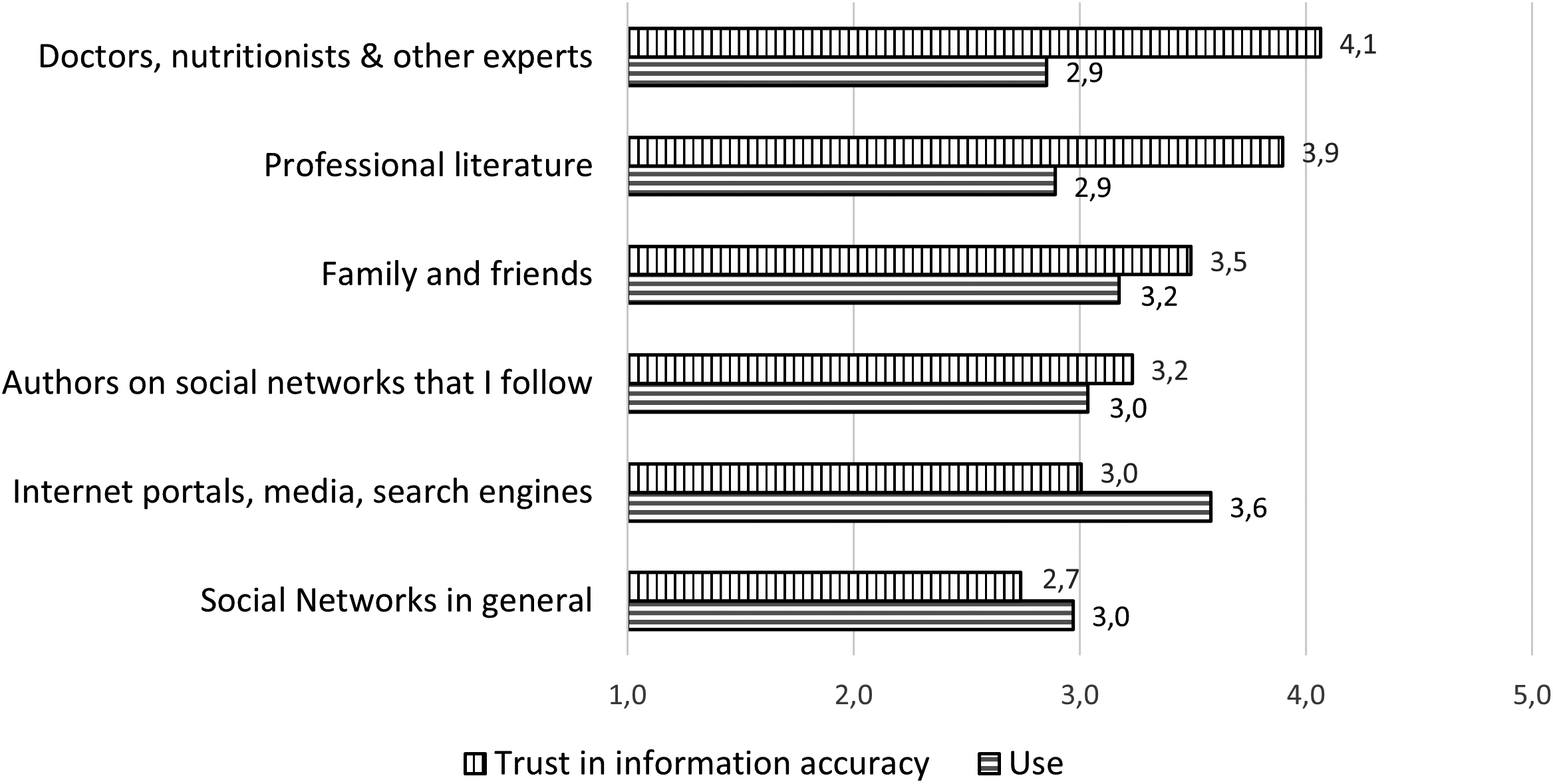
The lowest is the average trust in social media in general. Among students who use specific social networks at least occasionally, the levels of trust in these networks are moderately high. Users of social networks have a slightly higher level of trust in nutrition information from Instagram (
Correlations between the students’ use and trust in information sources
All correlations are significant (
Pearson’s correlation analysis was conducted to examine the relationship between the use and trust in information sources (Table 4). All of the correlations are found significant. The highest are the correlations between the use of social networks and the trust in the information gained from those sources. Students who do not use information from social networks have less trust in those sources, and vice versa. Experts and expert literature are trusted even by students who do not use those sources, which is reflected in lower correlation strength.
To explore possible differences in information sources use (ANOVA and post hoc HSD tests) depending on the specific nutrition needs, students were grouped into three nutrition needs groups: no specific needs (57%,
Differences in average information use between three nutrition needs groups of students
Differences in average information use between three nutrition needs groups of students
Students on a diet to maintain weight and/or practice sports use YouTube (
Differences in average trust in the accuracy of information from various sources between three nutrition needs groups of students
Scale 1–5; 1 – no trust, 5 completely trust.
All students have a similar level of trust in doctors and other experts (doctors, nutritionists and others), professional literature (books, journals), and various other sources. However, there are two exceptions. Among students on a diet to maintain weight and/or practice sports, the level of trust in specific authors on social networks (
The discussion section relates to the interpretation of our findings concerning previous literature, research gaps, and identifying topics for further research.
Research question 1: Do students have and what are their specific nutrition needs?
The first research question examined if students had specific nutrition needs and what their specific nutrition needs were.
The results of the interviews show that the participants take care of their nutrition to maintain their overall health, which includes a healthy lifestyle, body fitness, and physical appearance.
Based on this insight and the survey results, it can be concluded that nutrition needs are related to maintaining health or adapting the diet to specific diseases and health problems. The largest group of survey respondents consider that they have no specific nutritional needs; in the sample, they make up 57% of respondents. At the same time, it is assumed that this percentage is even higher in the student population because it is assumed that students who are not interested in the topic of healthy eating have not responded to the survey invitation to a greater extent. However, the fact that they do not have specific dietary needs does not mean they do not follow nutrition information sources. They use nutrition information from Internet portals, media, search engines, and family and friends as frequently as students with specific dietary needs. On average, they use those sources sometimes. Among students with specific dietary needs, there were two main groups: students with health problems and students with nutrition needs related to training and weight maintenance. Overall, 43% of the surveyed university students need specific nutrition information. This percentage is comparable to the results of other similar studies. Martinović et al. (2021) reported that the most popular health-related topic was nutrition, with 36% of students interested in the topic. Among the teenagers from the study by Wartella et al. (2016), 36% looked for information on diet and nutrition.
The respondents’ health problems and endeavours related to training and weight maintenance which give rise to specific nutrition needs can be interpreted as specific life situations which give rise to information needs. According to Shenton and Dixon’s (2004), this is a life-centred approach to information needs research. Also, the respondent’s engagement in seeking nutrition information from diverse information sources implies that their information-seeking activity has been motivated by their nutrition information needs (Case, 2016). Therefore, the study results can be considered in light of the results of existing research on the information behavior of young people. University students are young people whose nutrition knowledge can be limited (Belogianni et al., 2022). Therefore, it can be assumed that their health problems and nutrition needs related to training and weight maintenance give rise to the need for appropriate nutrition information. This conclusion is in line with our study, that has shown that students with specific nutritional needs more often use certain information sources, as explained in more detail in the discussion related to research question 4. Such an assumption is in line with the results of earlier research on youth information needs that showed that youth need information on diet and nutrition (Skinner et al., 2003; Askola et al., 2010; Wartella et al., 2016; Martinović et al., 2021; Maceinaitć et al., 2021; Känsäkoski et al., 2021), body image (Skinner et al., 2003), fitness and exercise (Askola et al., 2010, Wartella et al., 2016; Känsäkoski et al., 2021), weight management (Askola et al., 2010) and diseases and allergies (Martinović et al., 2021).
Research question 2: Which information sources do students use for nutrition information?
In the interviews, the respondents reported using a variety of nutrition information sources, starting from internet-based sources such as social media, the Internet (in general), Google search and websites, interpersonal information sources, such as a mother and friends, and traditional information sources, such as a magazine and books. Nutrition fact labels and apps used for label checking and calorie intake tracking were also among the used sources. information.
The survey results have found that students mainly use internet portals, media, and search engines to access nutrition information (
Research question 3: How much do students trust in the accuracy of information from each source?
Rowley et al. (2015) argue that qualitative research could contribute to an understanding of trust formation in the use of multiple sources and whether approaches used in trust judgments of digital health information differ from those used in judging information from other sources such as friends and family. The interview results revealed the bases of authority (Wilson, 1983) or reasons the respondents think the sources used are worthy of trust. Trust given to the information sources is based on various cues (Table 3). Specific influencers who share nutrition information via Instagram are trusted for being perceived as experts, for motivational interaction with users and for their popularity (Kolarić et al., 2022). Moreover, the participants believe that their body shape is evidence of the quality of their diet. Similarly, athletes who share information via websites and YouTube are trusted because of their sports results. Nutritionists who share information on websites are trusted for their expertise. Expertise as a reason for trusting information sources was identified in previous work by Corritore et al. (2007), as being a component of credibility.
In the presented study, well-organized website information is reported as important for trust formation, which is in line with the finding by Rowley et al. (2015) who found that style (including the understandability, information structure and presentation of information) was an important factor in trust judgments on online information. Furthermore, this study shows that the websites of organisations and institutions are trusted for being perceived as professional and impartial. Impartiality is also a reason for trusting other people, who are also trusted for their experience. Rowley et al. (2015) have noted that impartiality as a dimension of credibility is an important factor in trust formation. Experience and reliability are reasons for trusting a mother for the provision of nutrition information, as reported by one participant.
The study showed that a close relationship with an interpersonal source of information is a reason for trusting a mother and a friend. Finally, books are trusted because of authors who are experts and for general trust in a professional publishing process. Trust in a library as an institution was also mentioned in one answer. Overall, the respondents base their trust in information sources on various cues that were, in some cases, related only to specific sources. For example, such is the case with popularity which is socially generated and used to evaluate information on social media, and with the quality of the relationship in the cases of a mother and a friend.
The students trust the used nutrition information sources that are perceived as experts, who are perceived as experienced and impartial, which is in line with results from previous studies which show that young people trust experts (Šmuljić et al., 2019; Känsäkoski, 2021). For some students, the quality of the relationship is a reason for trusting sources such as a mother and friends. When it comes to authors who publish nutrition information on Instagram, motivating interaction and popularity are among the reasons for trusting. For some respondents, Influencers and athletes are trusted for the visible results of their diet. Other bases of trust include well-organized and professional content for websites and general trust in the traditional publishing process.
In the second phase of the research, the survey investigated in depth the extent to which respondents trust certain sources of information.
Regarding the question of trust in the accuracy of information from each source, respondents from the present study are aware of the untrustworthiness of the many online information they use. Results indicate that the most trusted information is from experts (doctors, nutritionists, and other experts) (
According to Case (2016), people who are seeking health-related information turn to family and friends first. Case concludes that access is more important for most individuals than issues of quality and credibility of sources. The results of the present study show medium levels of average trust in authors on social networks, internet portals, media, and search engines. Among those, the results reveal that the lowest was the average trust in social media in general.
However, results indicate that the levels of trust in social networks are higher among those students who use specific social networks at least occasionally. Regarding the types of social networking sources, users of social networks have a slightly higher level of trust in nutrition information from Instagram (
Research question 4: Do the use and trust in information sources depend on specific nutrition needs?
The present study has found that students use various information sources dependent on their specific nutrition needs. Respondents who follow a diet to maintain healthy weight and/or practice sports use YouTube more often and follow specific authors on social networks for nutrition advice. Gazibara (2022) also found that YouTube was used for health-related topics, and among those topics, the surveyed high school students were mostly interested in fitness (52%) and diet/nutrition (35%). However, the differences in the use of information sources with regard to the type of students’ interests were not explored in the study by Gazibara et al. (2022).
Students with health problems are more likely to follow the advice of doctors and other professionals. Both groups of students with specific nutrition needs recognise the importance of reading professional literature, while the respondents who do not have specific nutrition needs use professional literature less. Regarding the use of other information sources, such as family, friends, the Internet in general (portals, media, search engines), and other social networks, besides YouTube, they are used approximately equally often by all students, regardless of whether they have special nutrition needs. Therefore, even students who do not have specific dietary needs use those sources to inform themselves about healthy nutrition as often as students who have specific needs. The results of the present study indicate that the three nutrition needs groups from the research sample (no specific needs, weight control and training, and health problems) have not differed significantly in terms of trusting the accuracy of information from various sources, with only two exceptions. Students on a diet to maintain weight and/or practice sports give more trust to information from Youtube and to specific authors on social networks. The results show that all students have a similar level of trust in doctors and other professionals, professional literature, and various other sources, regardless of their nutrition needs. These results confirm some previous research (Kim, 2016), whose results show that university students tend to consider medical and health organisations (
Gazibara et al. (2022) established that students who were interested in the topic of diet/nutrition topics had a stronger perception that online health information influenced their health-related decisions. There is an implicit assumption that usage of information sources and trust in them are positively related; that is, the more people trust a source, the more they will use it and vice versa. Yang et al. (2016) found correlations between the use and trust in information sources,
Moderate correlations between use and trust in information gained from the internet in general (portals, media, search engines) and from family and friends indicate that those are not simple, straightforward relationships. This could be explained by the insights from the interviews with think-aloud protocols used while browsing online sources. The participants approach each source with the awareness that not all of them are credible. They evaluate websites based on their authorship expertise, systematic organisation of content and other credibility cues.
Study limitations
All participants in the first phase of the study were women, and 82% of the respondents in the second phase were also women. Only 24 male students were surveyed, so gender comparisons are not reliable. There are indications that men less often use professional literature and social networks. However, various aspects of their information behaviour when searching for nutrition information need to be examined on a larger sample of students. Also, a larger sample of participants is needed in order to examine possible differences between students who are engaged in training without the need to maintain weight and those who are only on a weight control diet without training. In this research, they were analysed as one group due to the limited sample size and negligible differences in information sources selection. However, the sample was large enough to explore the differences between three major student groups regarding nutrition needs.
The age span of the surveyed university students was wide, although the majority of them were between 18 and 25 years old. In previous studies, the category of youth and adolescents sometimes included high school students, sometimes university students or wider age groups. In future studies, more possible relevant variables should be taken into account, such as the question of whether the participants live with their parents and their employment status.
Conclusion
It is known that leaving the family home can negatively affect the quality of university students’ diets. This study sought to explore university students’ information-seeking behaviours, focusing on the trust they give to various information sources on nutrition. The aim was to reveal the specific nutritional needs of students, the specific sources of information they use and how much they trust them. Wilson’s conceptualisation of cognitive authority was used to frame the issues of students’ trust in different information sources for the provision of nutrition-related information. The source that is one’s cognitive authority is considered worthy of belief and influences one’s thinking.
The study among university students at the University of Zadar revealed that the majority of students do not have specific dietary nutrition needs. However, almost all of them are at least sometimes informed about nutrition. In this research, students with specific nutrition needs were divided into two groups: students with needs related to health problems and students with needs related to training and weight maintenance.
Overall, the Internet in general (portals, media, search engines) is the most frequently used information source on nutrition, followed by family and friends. Even though it is easy to access information via the Internet, this kind of information has low cognitive authority. Trust in the Internet and social media, in general, is relatively low. However, specific authors on social media are perceived as trustworthy. Students highly trust expert sources of information regarding the accuracy of nutrition information. Even so, they are not used as sources of information often. The exceptions are students with health problems since they mostly rely on professional sources of nutrition information, including both the experts and the professional literature. Students engaged in sports and weight maintenance also increase the use of professional literature, but they primarily follow social media, especially specific authors on YouTube and Instagram. Moreover, students on a diet to maintain weight and practice sports put a higher level of trust in YouTube as a source of information. Those who use various social media more often also put more trust in the information gained from those sources. This is reflected in the high correlations between usage and trust in social media. However, the correlations for the expert sources are low. This is because the majority of students trust professional sources of information, regardless of how often they use them. Moderate correlations of use and trust for family and friends and the Internet in general as information sources indicate a more complex relationship between the use and trust. Generally, trust in family and friends is moderate because students know the people close to them are well-intentioned and worthy of trust. However, they might not be experts when it comes to nutrition information.
Based on the insights from the interviews, the students’ cognitive authority of each information source is established based on various indicators of trustworthiness. Some of the participants expressed basing trust in different information sources on perceived expertise, experience and impartiality. However, the participants also constructed cognitive authority on some features that can be attributed only to specific information sources. These are the popularity and motivating approach on social media, visible evidence of a good diet, the quality of a relationship with interpersonal information sources, and the traditional publishing process. It can be concluded that trust judgments are source-specific and sensitive to special attributes of different information sources.
This study provides a better understanding of university students’ use and trust of online health information, specifically nutrition. It contributes to the existing knowledge about students’ use of nutrition information sources, revealing the complexity of the relationship between the use and trust. It shows that information sources can be trusted but not used, and vice versa. It also shows that despite general scepticism toward online nutrition information, the students can identify some cues used to evaluate internet-based information sources that provide trustworthy information.