



Abstract
The floriculture sector is booming in Ethiopia, making the country the second largest flower exporter in Africa and one of the largest suppliers of flowers globally. Despite the enormous advantages of the Ethiopian floriculture industry to the country’s economy, the industry’s unsustainability related to environmental and human rights is growing. Failure to protect the environment can have profound negative impacts on long-term economic development and human rights, including the right to life, adequate food, water and housing. The floriculture industry has been identified as having the potential to grow and contribute positively to the agricultural transformation and economy of Ethiopia.
Policy, laws and regulations play a vital role in the implementation of any regulatory objective. During the last decade, Ethiopia has developed many policies and laws that link to improving the environment, and the flower farm industry itself has adopted self-regulation and standards, enhancing the protection of workers and the environment. But there is increasing evidence that the economic benefits of the flower industry come at the expense of the environment. So, what is the impact of these State and non-State regulations on a safe and clean environment?
This paper aims to analyse how, why and under what circumstances environmental policy implementation might work or fail, by investigating the challenges for the floriculture industry relating to the intensive use of pesticides and water, and inappropriate waste disposal in the policy implementation process. It is safe to say that Ethiopia has developed a lot of legislation on the environment but the challenge of effective monitoring and enforcement remains. This paper concludes with recommendations, based on the fact that the principles of environmental rights, the right to life and the right to development cannot be realised in the absence of the right to a healthy environment.
The globalisation of production and a decline in government regulatory capacity in developing countries have fuelled the rise of environmental hazards (e.g., pollution, environmental damage and climate change) that threaten both livelihoods and development. Poor people are especially dependent on environmental assets and, as such, are vulnerable to hazards.
“Sustainable agriculture” describes an agricultural system that, over the long term, enhances environmental quality and the resource base on which agriculture depends, provides for basic human food needs, is economically viable and enhances the quality of life for society as a whole (UN DESA, 2013). “Sustainability”, in this context, is demonstrated by operating within the “limits to growth”. In working towards sustainable development, the importance of human rights has increasingly been recognised. This should not be surprising: the protection of human life in relation to health, culture and living standards is central to any social, environmental or economic programme. The right to life cannot be realised without the basic right to clean water, air and land (Shelton, 2002). A human rights approach allows the quality of life of people, in particular the most vulnerable, to be integrated into environmental decision-making.
There are two main approaches to the intersection of human rights and the environment: (i) the use of existing human rights, and (ii) the need for a new human right to a safe and clean environment. The UN General Assembly’s 2015 adoption of 17 Sustainable Development Goals represents an unprecedented moment in human history for global governance, for the protection of human rights and for the environment. They position both human wellbeing and the environment at the centre of the UN’s post-2015 development agenda. They recognise environmental degradation and unsustainable agricultural practices among the greatest challenges of our time.
The concern underlying the call for a human right to a clean and healthy environment is not new (see, e.g., IHRC website). Its development and the growth of concern for the environment have characterised much of the 20th century.
There is yet much to be done before the rights set out in the UN Universal Declaration of Human Rights can be fully realised for all people, yet the principle that “human rights should be protected by the rule of law” is still universally recognised. The protection of human rights by the rule of law remains one of the keystones for democratic expression, within a framework that guarantees legal action while fostering dialogue.
This paper argues that the principles of human rights, the right to life and the right to development cannot be realised in the absence of the right to a healthy environment. Many international agreements since the 1972 Stockholm Conference have talked about such a right. Some 60 nations have constitutions or pieces of legislation intended to ensure this right, although there is little evidence of work to make it a reality.
Significant implications face the State regarding environmental policy, including questions about the appropriate scope and role for government in protecting the environment. The 1995 Constitution of the Federal Democratic Republic of Ethiopia defines “environment” as follows:
“Environment” means the totality of all materials whether in their natural state or modified or changed by humans, their external spaces and the interactions which affect their quality or quantity and the welfare of human or other living beings, including but not restricted to, land, atmosphere, weather and climate, water, living things, sound, odour, taste, social factors, and aesthetics.
In recent years, the floriculture industry has been identified as one of the industries with an opportunity to grow and contribute positively to the economy of Ethiopia. The sector is booming and making the country the second largest exporter in Africa and either the fourth or fifth largest supplier of flowers to the global market, depending on the source consulted. It is now among the country’s five top foreign-exchange earning commodities and also provides employment opportunities for hundreds of thousands of individuals. In addition to the enormous economic advantages of the industry, however, concerns are increasing about environmental impacts and unsustainability associated with intensive use of unregistered pesticides and water, and improper waste disposal.
The aim of this paper is to investigate the State’s failure to protect the environment in the floriculture industry, where enforcement is crucial and contested. Methodologically, the study combined primary data (collected by the author) and secondary data (collected by other researchers who likely had different research objectives).
At present, there are more than 84 companies in Ethiopia that grow cut flowers. Out of these, 52 are foreign while 26 are local companies and six are joint ventures. Primary data were collected using structured and semi-structured questionnaires, as well as interviews with key informants and personal observations from 15 farms.
International Instruments for Environmental Protection and Sustainable Development
Several environmental instruments have included provisions regarding a human right to a safe and healthy environment, including the Declaration of the United Nations Conference on the Human Environment (1972), followed by the UN Declaration on the Right to Development (1986), the Rio Declaration on Environment and Development (1992), the Millennium Development Goals (2000) and the Johannesburg Declaration on Sustainable Development (2002). Since the United Nations Conference on the Human Environment held in Stockholm, the relationship between human rights and the environment has received increased attention from States, international institutions and civil society. Large-scale agricultural law strives to promote investment in the sector while environmental law aims at protecting the environment. The relationship between large-scale agricultural investment law and environmental law has long been the subject of debate (Dias, 2000).
In 2012, the UN Conference on Sustainable Development, known as “Rio + 20”, emphasised that every State has the responsibility “to respect, protect and promote human rights”, and that “democracy, good governance and the rule of law are essential for sustainable development” in each of its three dimensions: economic growth, social development and environmental protection (Knox, 2015). States are called on to promote the protection, preservation and improvement of the environment and to adopt the necessary measures to the extent allowed by their available resources and their degree of development to implement these objectives. If necessary, legislation may be required to realise these objectives. However, a State can only promote a healthy environment according to its resources.
Similarly, the right to a decent working environment imposes obligations on States to give effect to the various rights contained in the 1966 International Covenant on Economic, Social and Cultural Rights, including reporting mechanisms to secure a State’s compliance with these obligations.
The Human Rights Council has observed that sustainable development and the protection of the environment can contribute to human wellbeing and the enjoyment of human rights. The principle of sustainability is clearly one of the cardinal principles that will shape the future development of international law. Sustainable human development places people at the centre of all development activities, promotes human dignity and the realisation of all human rights (economic, social, cultural, civil and political). Sustainable development can be considered as integrating all three of the “pillars”: international environmental law, international human rights law and international economic law (Dias).
National and Regional Instruments/Frameworks for Environmental Protection
2.1 National Perspective
2.1.1 Pillars of ‘Sustainable Development’ Under the Ethiopian Constitution
Article 43(1) of the Constitution of the Federal Democratic Republic of Ethiopia specifies that “The People of Ethiopia as a whole, and each Nation, Nationality and People in Ethiopia in particular have the right to improved living standards and to sustainable development”. With Article 92, this embodies the issue of environmental rights and environmental objectives in Ethiopia. The right to development and Ethiopia’s economic objectives are respectively embodied in Articles 43 and 89 of the Constitution. The Constitution does not merely envisage economic growth, but sets targets of “sustainable development”, and in effect envisages development and social wellbeing in the context of environmental sustainability.
At Articles 88 to 91, the Constitution goes on to require the State to promote the political, economic, social and cultural development of its peoples. Meanwhile, Article 92 provides that “The design and implementation of programmes and projects of development shall not damage or destroy the environment”. The right to a clean and healthy environment and the duty of the Government to ensure this right are respectively enshrined in Articles 44 and 92(1) of the Constitution. These provisions call for a balance which addresses the duality of the constitutional objectives of development without damaging the environment or infringing the constitutional right to a clean and healthy environment. The right to development, enshrined in the Ethiopian Constitution, thus envisages not only the rights, but also the responsibilities of individuals, investment projects, neighbourhoods, communities and the State.
2.1.2 Environmental Policy of Ethiopia
According to Getu (2009), the 1997 Environmental Policy of Ethiopia (EPE) (FDRE, 1997) includes various policy directions which address the need to protect and develop the environment and conserve national resources for sustainable use. As a key guideline principle, the policy takes the position that when a compromise between short-term economic growth and long-term environmental protection is necessary, it is better to err on the side of caution as far as possible because rehabilitating a degraded environment is very expensive. This policy underlines the necessity of undertaking full environmental, social and economic impact assessments of all development programmes. In addition to the EPE, the Ethiopian Water Sector Policy (FDRE, 2004) and the 2001 Ethiopian Water Sector Strategy make it very clear that environmental conservation will be an integral part of all water-related projects. To this end, environmental impact assessment (EIA) is mandatory in all water resource projects.
Under these policies and strategies, standards and classification systems will be established in relation to the various water uses by laying down quality and quantity standards, including setting limits or ranges of desirable and permissible levels, applicable to waste discharges, source development, catchments, management, etc. For example, they will regulate waste management by stipulating that waste disposal guidelines and strategies, and regulations to enforce them, will be formulated, and an effective monitoring system will be established (Kassa, 2017). There seems to be a gap in these documents, however, regarding when and by whom these standards are to be formulated.
The EPE stresses the importance of recycling waste water when it is found to be safe for health and the environment, and the recycling cost is not high. It also promotes the use of organic matter for fertiliser. The preamble of the Environmental Pollution Control Proclamation (No. 300/2002) (EPCP) notes that “some social and economic development endeavours may cause environmental harm that could make those endeavours counter-productive”. It underlines the duty and responsibility to protect the environment and in particular to safeguard “human health and wellbeing” and also maintain “the biota and the aesthetic value of nature”. To this end, the preamble notes the need “to eliminate or, when not possible, to mitigate pollution as an undesirable consequence of social and economic development activities”.
2.2 The Right to Development Under the Ethiopian Constitution
Article 43 (“The Right to Development”) of the Ethiopian Constitution consists of four clauses. Clause 1 states that “The peoples of Ethiopia as a whole, and each Nation, Nationality and People in Ethiopia in particular, have the right to improved living standards and sustainable development”. Clause 2 deals with the rights of citizens to participate in development and be “consulted with respect to policies and projects affecting their community”. Clause 3 requires that “All international agreements and relations concluded by the State shall protect and ensure Ethiopia’s right to sustainable development”. And finally, Clause 4 emphasises that the “basic aim of development activities shall be to enhance the capacity of citizens for development and to meet their basic needs”.
2.2.1 The Right to Improved Living Standards
Article 43(1) of Ethiopia expressly states the target beneficiaries of this right to be “Peoples of Ethiopia as a whole, and each Nation, Nationality and People in Ethiopia in particular”. On the other hand, Article 89(8) makes reference to the promotion of “health, welfare and living standards of the working population of the country”. The words “working population” evoke some query regarding the scope of the provision’s coverage. Work seems to be the basis of improved standards of living promised under Article 89(8) of the Constitution. For example, Article 90 of the Constitution does not promise “improved living standards”, but instead, the formulation of policies that “provide all Ethiopians access to public health and education, clean water, housing, food and social security” to the extent that resources permit.
One may argue that the right envisaged under Article 90 is narrower than the right accorded to the “working population” under Article 89(8). This line of interpretation is supported by other provisions such as Article 89(2) which requires the government “to ensure that all Ethiopians get equal opportunity to improve their economic conditions and to promote equitable distribution of wealth among them”. In other words, the government is expected to formulate policies that create equal opportunities and conditions conducive to development and equitable distribution of wealth. This envisages job opportunities for the unemployed and the poor (Article 41(6)), the right of citizens to be engaged in an economic activity of choice in any part of Ethiopia (Article 41(1)), and the duty of the State “to increase opportunities for citizens to find gainful employment” (Article 41(7)).
2.2.2 Environmental Rights and Sustainable Development
As envisaged under Article 43(1), “sustainable development” could potentially be subject to either a weaker or a stronger interpretation. The weaker version regards economic growth and the enhancement of investment as preconditions for environmental protection, while the stronger version holds that environmental protection is a precondition to ensure that development can meet the needs of present generations without adversely compromising the needs of posterity. It thus becomes necessary to determine whether the stronger, the weaker or a “hybrid” model of sustainability is intended under the Constitution and other Ethiopian laws. This determination may vary according to the general content and objective of each particular legislative instrument.
2.2.3 The Right to Participate in and be Consulted About National Development Programmes
According to Sen and Wolfensohn (1999), any development programme presupposes active involvement of people at all levels; and they should be given the opportunity to shape their own destiny, rather than being considered “as passive recipients of the fruits” of development programmes. Article 43(2) of the Constitution duly recognises the right of nationals to “participate in national development and, in particular, to be consulted with respect to policies and projects affecting their community”. This is a fundamental right which raises the question whether communities are being consulted when policies and projects that affect their livelihoods and communities are formulated and put into effect. With regard to floriculture, for example, this right envisages that communities be consulted about the projects and the effects thereof.
2.2.4 The Enhancement of Capabilities
Article 43(4) of the Constitution reads as follows: “The main objectives of development activities shall be the citizens development and the fulfillment of their basic needs”. As Sen and Wolfensohn note, “the State and the society have extensive roles in strengthening and safeguarding human capabilities”. This, according to Sen and Wolfensohn, “is a supporting role, rather than one of ready-made delivery”.
2.2.5 Conformity of International Agreements with Sustainable Development
Article 43(3) of the Constitution requires all international agreements and transnational relations to “protect and ensure Ethiopia’s right to sustainable development”. This provision enables scrutiny of various international commitments that impact sustainable development. For example, current concerns about the impact of passive liberalisation in the context of “globalization” evokes the query whether agreements which are concluded or other transnational relations of the State can be regarded as unconstitutional if they do not protect and ensure Ethiopia’s right to sustainable development.
Table 1 summarises the Ethiopian government’s support to horticulture for export:
Ethiopian government support to export horticulture
Ethiopian government support to export horticulture
Proclamation No. 280/2002 (as amended) deals with: (i) investment objectives, areas and incentives (Articles 4– 9); (ii) forms of investment capital and requirements for foreign investors (Articles 10 and 11); (iii) investment permits (Articles 12– 17); (iv) transfers of technology, loans, utilisation of foreign currency, and remittance of funds (Articles 18– 20); (v) investment guarantees and protection (Article 21); (vi) investment administration (Articles 22– 25); and (vii) the establishment and powers of the Investment Board, Investment Authority and other miscellaneous issues (Articles 26– 42).
2.4 Regulation of the Floriculture Industry
In the last few years, the Government of Ethiopia has made efforts to create favourable investment conditions that have enabled private-sector development of the floriculture sector to grow rapidly. The country’s first private floriculture producer started operations in 1997, a second in 1999. From 2001 onwards, other growers started coming in and according to the Ethiopian Horticulture Producer Exporter Association (EHPEA), Ethiopia now has 72 active flower farms, thanks to the government’s allocation of a substantial amount of finance for investors who would like to engage in the sector, and special loans are also provided through the Development Bank of Ethiopia.
In addition to the constitutional provisions on the right to a clean and healthy environment, as described above, there are other laws of particular relevance to environmental compliance standards in floriculture. They are the Environmental Impact Assessment Proclamation (No. 299/2002), the EPCP (No. 300/2002), and the Council of Ministers Regulation to provide the Code of Practice of the Floriculture Sector (FDRE, 2011).
2.4.1 Industry Self-Regulation
In addition to the above, industry self-regulation through producer associations in developing countries has also been quite active in introducing new standards and codes of practice to the floriculture industry (Joosten, 2007; Rikken, 2010; Sedex, 2018). In 2007, the EHPEA was created. It has adopted a code of environmental and social practices (CoESP) – a voluntary standard developed by the sector to guide, monitor and communicate the social and environmental performance of flower farms engaged in production for export. The CoESP serves as a type of guarantee for the buyer and/or final consumer regarding certain characteristics of the product and production process. It sets requirements for good agricultural practices, protection of the environment, worker welfare and employment practices at three levels: Bronze, Silver and Gold.
Bronze-level certification includes basic legal requirements and key issues for the market and local stakeholders while the Silver-level certification is broadly similar to the recognised market labels in use in the sector. The farms that qualify may say that the Silver-level of the Code is equivalent to Global GAP (a trademark and a set of standards for good agricultural practices (FAO-GAP, 2003)) for flowers and ornamentals, and that the code contains equivalent content to the ETI standard of Good Social Compliance (Sedex, 2018). The social components of the Silver-level of the Code are also similar to the level and content of Milieu Programma Sierteelt-Socially Qualified (MPS-SQ) (Riisgard, 2009). Gold-level certification requires a farm to be actively implementing corporate social responsibility, product quality management and capacity-building for the sector. Currently 90 percent of the farms are members of the EHPEA, and the association hopes that in the future the other 10 percent will become members. By December 2010, almost 80 percent of the 50 growers had already achieved compliance with the Bronze level. The benefits from doing so include ease in negotiation with the government, representation in the global market, and training and technical assistance.
2.4.2 International Regulation
Because the industry relies on the international market for investment and exports, there is an inherent need for collaboration between actors in the floriculture industry and actors abroad.
2.4.3 The Ethiopia-Netherlands Partnership
The Netherlands has a vested economic interest in Ethiopia and therefore is committed to preserving and promoting the sector. The partnership emphasises the importance of both environmentally and socially friendly production as well as positive economic development (Helder and de Jager, 2006). In order for the sector to grow economically, the Netherlands recognises that the sector must become more sustainable in its practices. The Netherlands has promoted environmental standards through the creation of certification programmes and market labels for the industry (Rikken).
2.5 A Southern Perspective
Agenda 21 rightly points out that unsustainable consumption and production patterns in richer nations are “the major cause of continued environmental degradation” (Agenda 21, 1992; Riisgard, 2009). While this is primarily a northern issue, it also raises concerns for poorer nations. There is a need for an acknowledgement by some Southern governments that they are also responsible for the continued loss and depletion of natural capital, mainly by failing to implement international obligations (Bigg, 2013).
In many of the developing States, seven factors are critical with regard to the prevailing situation: poor management of resources with inequality of access and ownership; weak environmental laws, which are subject to manipulation by the Executive, leading to a failure to implement those laws; inability to implement convention obligations and to integrate them into public policies and programmes; lack of State accountability in use of natural capital, enhanced by the use of political power to frustrate environmental policies and programmes; lack of local control over resources: specifically, the removal of decision-making authority or ownership at the local level; continued marginalisation of pastoral and rural communities as well as urban migrants; and a failure to acknowledge the role of women as environmental managers and a lack of involvement of women in the development and execution of programmes.
With regard to the latter, although major steps have been taken in some countries such as Uganda, domestic pressures of poverty and inequality still prevail.
Together, the above factors indicate a general failure to respond to the Rio Conventions, whose underlying goal is to improve conditions in particular at the community level. There is an urgent need for a new approach. If such an approach is based on a human right to a healthy environment, then it will link to and support initiatives that address other inequity issues (Bigg). In particular, it is useful to consider the outcomes of the 2002 World Summit on Sustainable Development (Johannesburg) which stressed “the recognition of three particular principles of international sustainable development law” (Fitzmaurice, 2009) i.e., common but differentiated responsibilities, precaution and public participation (Burns, 2016).
The experiences of South Africa, India and Nigeria demonstrate that the promise of environmental protection or environmental rights does not always translate into rights on the ground. What one finds instead is that although the way in which environmental protection is secured in national laws (i.e., in a constitution or in statutes) is not the critical factor; such provisions can provide effective and powerful means of securing environmental benefits. Instead, it is the availability and potency of enforcement that determines how effective an environmental protection regime will be. In the end, as often occurs, the power lies with the judiciary (Burns, 2017).
Sometimes, the enforcement problem is inherent in a constitutional provision itself. Rather than creating a justiciable right, the constitution instructs the legislature to take action, without prescribing a remedy in the event the legislature is inactive. The environmental provision in India’s Constitution was of this type, serving as an explicitly unenforceable policy directive, leaving Indian citizens without a constitutional environmental right until the Indian judiciary found it elsewhere in the Constitution. This is also the case in Nigeria, which remains without any enforceable environmental rights. Even when a constitution instructs that a legislature “shall” take action – rather than using the more permissive “may” – in an attempt to impose a duty on the legislature to act, courts may still be unwilling or unable to force action upon the legislature. In this way, statutes seem preferable to constitutions, as they do not suffer from the fault of unenforceability or non-justifiability (Burns, 2016).
Results and Discussion
To sum up, as presented in Fig. 1, this study has looked at the growth and investment laws and environmental regulations at three different levels – State-based environmental laws, international environmental standards, and industry self-regulation.
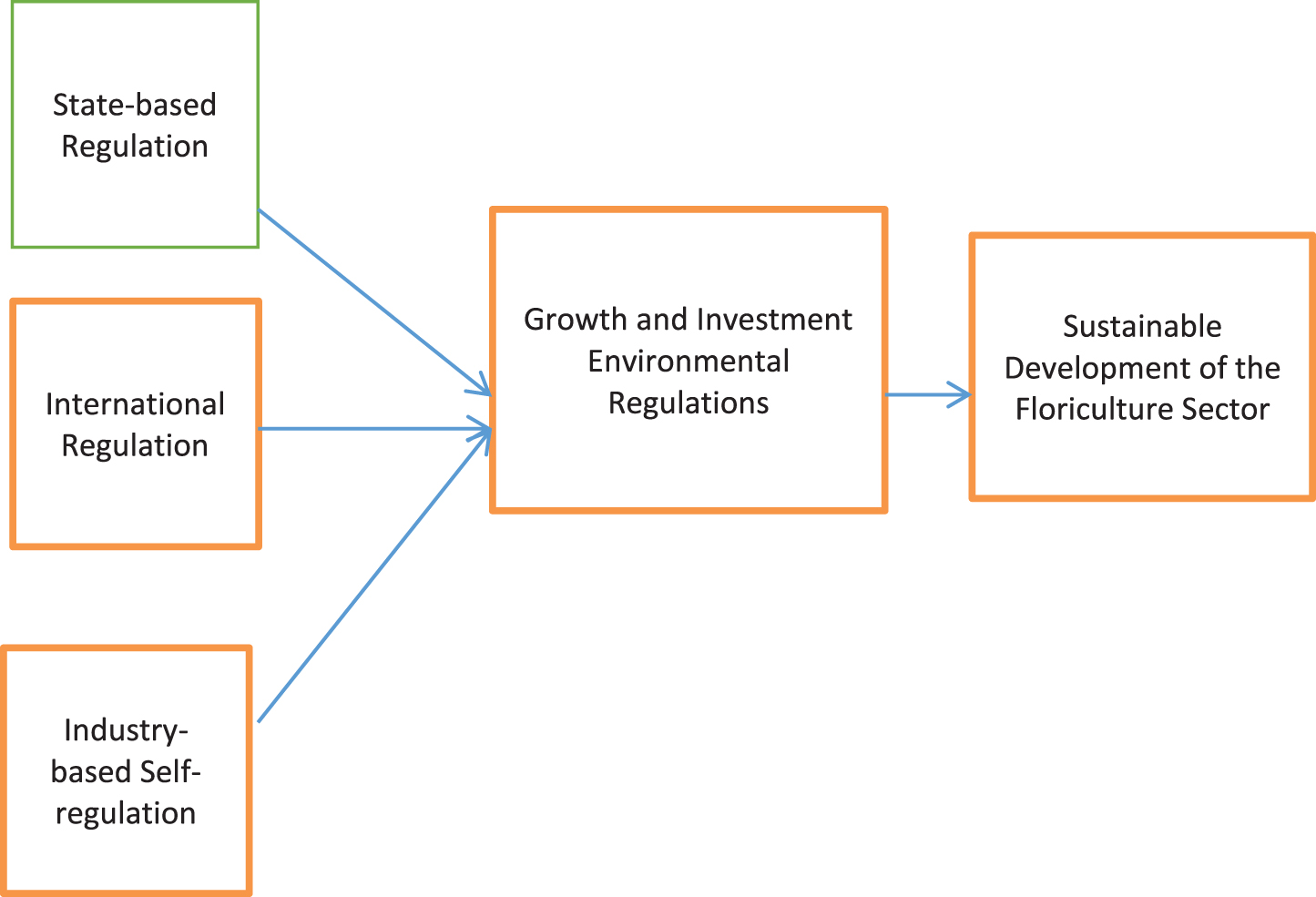
Regulation opportunities for environmentally sustainable floriculture (Sources: Riisgaard, 2009; Rikken, 2010).
It is now necessary to explore how each of these potential sources of environmental regulation could best promote sustainable development in the Ethiopian floriculture sector.
3.1.1 Legislative Interpretation of Key Concepts
In Ethiopian official instruments, many relevant terms are carefully defined, including “environment”, “chemical”, “effluent”, “hazardous material”, “hazardous waste”, “pollutant”, “release” and “pollution” as well as other terms defined in Article 2 of the Pesticide Registration and Control Proclamation (No. 674/2010).
In relation to floriculture, the release of liquid from the greenhouses into surface or ground freshwater systems or any release of gas while burning green waste or other waste or inappropriately disposing of any other harmful gas or liquid satisfies the Proclamation’s definition of “effluent”: “waste water, gas or other fluid, treated or untreated, discharged directly or indirectly into the environment”. The release of gas or liquid in a manner that harms unprotected (or inadequately protected) workers against chemicals and pesticides also falls under the term “effluent”. The categories of pesticides and chemicals that are classified as harmful fall under the following definitions of hazardous material and hazardous waste:
“Hazardous material” means any substance in solid, liquid or gaseous state, or any plant, animal or micro organism that is injurious to human health or the environment.
“Hazardous Waste” means any unwanted material that is believed to be deleterious to human safety or health or the environment.
The term “pollutant” is also relevant to the flower sector. It is defined in the Proclamation as:
any substance whether liquid, solid, or gas which directly or indirectly... alters the quality of any part of the receiving environment so as to effect its beneficial use adversely [or] produces toxic substances, diseases, heat, or any other phenomenon that is hazardous or potentially hazardous to human health or to other living things.
An act or omission that involves “placing any pollutant in the environment in any way, be it intentionally or otherwise” shall constitute the “release” of such a pollutant under Article 2(15) of the Proclamation. In this clause, the word “otherwise” means that the purview of this provision is wider than simply intentional or negligent behaviour.
Other critical requirements relevant to environmental compliance in the flower sector are found in the provisions of the Investment Proclamation and EHPEA Code. For example, in Article 2 of the Proclamation, “pollution” is defined as follows:
[A]ny condition which is hazardous or potentially hazardous to human health, safety, or welfare or to living things created by altering any physical, radioactive, thermal, chemical, biological or other property of any part of the environment [in violation of the law].
3.1.2 Other Provisions Relevant to the Floriculture Industry
Even where inadvertent negligence that falls under Article 59 of the Ethiopian Criminal Code is not proved, the word “otherwise” suggests that not only cases of negligence but also strict liability irrespective of moral guilt or responsibility will apply. However, the issue whether such strict liability should extend beyond civil liability to include criminal liability is debatable. According to Article 3(1) of the Proclamation, “No person shall pollute or cause any other person to pollute the environment by violating the relevant environmental standard”. It goes on to provide the following, in Article 3(3), (4) and (5):
Any person engaged in any field of activity which is likely to cause pollution or any other environmental hazard shall, when the Authority or the relevant regional environmental agency so decides, install a sound technology that avoids or reduces, to the required minimum, the generation of waste and, when feasible, apply methods for the recycling of waste.
Any person who causes any pollution shall be required to clean up or pay the cost of cleaning up the polluted environment in such a manner and within such a period as shall be determined by the Authority or by the relevant regional environmental agency.
When any activity poses a risk to human health or to the environment, the Authority or the relevant regional environmental agency shall take any necessary measure up to the closure or relocation of any enterprise in order to prevent harm.
The phrase “relevant environmental standard” that appears in Article 3(1) is crucial in the effective application of Article 3 and of the Proclamation in general. The issue of environmental standards is addressed in Article 6, which entrusts the Environmental Protection Authority with the responsibility for formulating “practicable environmental standards based on scientific and environmental principles”. Article 6 refers to standards for, inter alia, “the discharge of effluents into water bodies and sewage systems”, and “the types and amounts of substances that can be applied to the soil or be disposed of on or in it”. Article 6 also requires the Environmental Protection Authority to formulate standards in waste management by “specifying the levels allowed and the methods to be used in the generation, handling, storage, treatment, transport and disposal of the various types of waste”.
In the absence of such measurable standards, most of the stipulations in the various laws on environmental protection (including the EPCP) largely remain weak. Although the Proclamation includes provisions on inspectors (Articles 7– 9), offences and penalties (Articles 12– 17), and other provisions that deal with enforcement, they are likely to be largely ineffective if the formulation of valid and measurable standards and the institutional framework commensurate with the nature and scope of environmental degradation in Ethiopia are not put in place.
The purposes of the Environmental Impact Assessment Proclamation (Proclamation No.299/2002) include firstly, the prediction and management of the environmental effects of proposed development activities in the various phases of design-setting, construction, operation, or in relation to on-going activities, and secondly, “assessment of possible impacts on the environment prior to the approval of a public instrument” with a view to “harmonizing and integrating environmental, economic, cultural and social considerations into a decision making process in a manner that promotes sustainable development”. According to Article 2(10), “public instrument” refers to “a policy, a strategy, a programme, a law or an international agreement”. The third rationale of the Proclamation is to maximise socio-economic benefits and foster the “implementation of the environmental rights and objectives enshrined in the Constitution” by predicting and managing adverse environmental impacts. And finally, the preamble underlines the need for administrative transparency and accountability, and the significance of public and community participation “in the planning of and decision making on developments which may affect them and the environment”.
This proclamation defines “impact” as “any change to the environment or to its component that may affect human health or safety, flora, fauna, soil, air, water, climate, natural or cultural heritage”. It includes within this term any change in physical structure or subsequent alterations of “environmental, social, economic or cultural conditions”. While assessing the impact of a given project, the Environmental Protection Agency considers, inter alia, “the duration, reversibility, irreversibility or other related effects of the project” as well as the “cumulative effect with other concurrent impacts or phenomena”. The Proclamation clearly adopts the precautionary principle in the course of determining the negative impact of a project. A proponent of any project (private or public) which is required to submit an EIA is required to “identify the likely adverse impacts of [the] project” and incorporate “the means of their prevention or containment”. The EIA report (prepared by experts based on the requirements specified under the relevant directive), together with any other documents required, are to be submitted to the Environmental Protection Authority or the relevant regional environmental agency.
It further regulates the occurrence of new circumstances after the submission of an impact assessment study report which may lead to the revision of the EIA. Moreover, the compliance of the proponent of the project with all commitments and obligations are evaluated and monitored by the Environmental Protection Authority or regional environmental agency. Where necessary, rectification measures are ordered to be undertaken, or the approval for the implementation of the project may be suspended or cancelled. The measures stipulated in the Proclamation may also constitute an offence and involve penalties where, for example, a person “makes false presentations in an environmental impact assessment study report” or “fails to keep records or to fulfil conditions of authorization”. Where the offence is committed by a juridical person “the manager who failed to exercise all due diligence shall be liable to a fine”. Article 18(5) of the Proclamation further requires the restoration of the damage inflicted or compensation in addition to conviction and penalty for the offence.
3.2 Translating Rights into Practice in the Ethiopian Flower Industry
3.2.1 Pesticide Registration and Legal Status
Pesticide registration entails the evaluation of scientific data and assessment of risks and benefits associated with the use of a pesticide product and its potential effect on human health and the environment (WHO and FAO, 2019). Pesticide registration is an important step in the governance of pesticides as it allows authorities primarily to regulate pesticides according to their active ingredients and to formulate a product dossier index (of chemical and physical properties, toxicology, efficacy, residues and fate in the environment), determining which pesticide products are permitted to be used and for what purposes. It also enables governments to exercise control over quality, labelling, packaging and advertising of pesticides, thus ensuring that the best interests of end-users as well as the environment are well protected (Damalas and Eleftherohorinos, 2011). Before any pesticide can be commercially imported and/or used, several tests are conducted that determine whether a pesticide has any potential to cause adverse effects on the environment, humans and other non-target organisms.
The use of pesticides has proved to be very beneficial in agriculture since they lead to improved productivity due to protection of crops from pests and diseases. However, intensive use of pesticides can be an environmental challenge in agriculture including in the floriculture production. Pesticides can move from the site of application via drift, volatilisation, leakage and run-off. It is estimated that often less than 0.1 percent of an applied pesticide reaches the target pest, leaving up to 99.9 percent as an unintended pollutant in the environment, including in soil, air and water, or on nearby vegetation (Pimentel, 1995). Under the Pesticide Registration and Control Proclamation, all pesticides that are to be introduced for use in Ethiopia must undergo the necessary registration and procedures that are implemented under the Ministry of Agriculture (MoA).
However, the government made an interim arrangement allowing flower growers to import unregistered pesticides which they considered essential for their farms. As a result, flower growers have been regularly importing many different kinds of pesticides for routine use. Between 2007– 2014, according to Vieira (2009) and a report of the Plant Health Regulatory Directorate (PHRD) of the MoA (2014), flower farms in Ethiopia imported 96 types of insecticides and nematicides and 105 types of fungicides; of these, 37 were not officially registered in Ethiopia. For roses alone, more than 212 types of pesticides with different active ingredients were used (Joosten; Sahle and Potting, 2013).
Some products imported for flower farms in 2014 were either not mentioned or prohibited on the EU Pesticide property database and were on the World Health Organization (WHO) negative pesticide list. These included Spinosad 480 G/Lt, Organosilicone 100 percent, Beauveria Bassian Straingha 11.370, Hexythiozox 100 G/L, Milbemectin 10 G/L, Clofentezine 500 G/L, Emamecin Benzoate 19.2, Abamectin 18 G/L, Lefenuron 50 G/L and fungicides such as Fomoxodane, Bupinimate 250 G/L, Azixystrobin 250 G/L, Boscalid 200 G/L, Kresoxin-Methyl 100 G/L (PHRD of the MoA).
All growers interviewed for this article reported the use of pesticides that the WHO classifies as Class II (highly toxic) and III (moderately toxic). Although none of the growers reported the use of Class I pesticides (Class Ia “Extremely hazardous” or Class Ib “Highly hazardous”), some still use WHO Class I active ingredients such as Dichloruos 1000 G/L and Cadusafos 100 G/L.
Only three out of the 15 farms included in the study are applying “integrated pest management”, in accordance with good agricultural practices. The farmers revealed their experience that, although integrated pest management has a positive effect on controlling spider mites (Tetranychus urticae), other pests (especially thrips, aphids and mealybugs) present a bigger problem. Most of the interviewed growers had carried out on-farm trials to evaluate the efficacy of biological controls in their own localities.
3.2.2 Liquid and Solid Waste Management Practices
Another environmental concern in the flower industry is solid and liquid waste disposal. According to Hatch and Wells (2012) and Mengistie et al. (2017), wastes from floriculture activities cover a broad range – liquid to solid and hazardous to non-hazardous – and require differentiated types of safe waste disposal management and treatment. Empty fertiliser or pesticide containers and water used to wash their contents, as well as obsolete chemicals, are the major spheres of concern. Agricultural wastes such as cut-off crop parts, unused soil and waste water are another waste stream generated in the sector. Tamirat (2011) noted others, including chemical containers, diseased plants, residue of cut-flower stems and plastics. Liquid waste that cannot be reused or recycled should be collected and kept in impermeable containers or solar evaporation ponds. Flower farms in Ethiopia have been heavily criticised for not having adequate waste management systems.
Waste avoidance, waste reduction and waste recycling related to pesticides are all important points in the EHPEA Code of practice, and in the MPS, ABC and/or GAP certification systems. Currently the most common waste treatment practice for solid waste such as empty containers is rinsing the package material and puncturing it to prevent reuse. In some cases, empty pesticide containers are burnt in on-farm incinerator barrels. Suppliers and even State authorities and the EHPEA recommend these practices, which are, however, potentially hazardous to human health and the environment, and as such should instead be discouraged.
Safe burning techniques require a good understanding of pesticide chemistry, including controlling the temperature of the incinerator and understanding the environmental behaviour of pesticides. Most of the farmers in this study are still burning pesticide containers (together with damaged pesticide cloth, cartons, boxes, plastics) in old steel barrels (poorly designed containers and some have made incinerators from bricks. Generally, the survey indicated that there is only one difference between farms that comply with the EHPEA Code of Practice, have all three types of environmental certification (MPS, ABC and GAP) and adhere to one certification scheme regarding empty pesticide container management. That difference is whether the incinerator is a barrel or is made of bricks.
The bulk of liquid waste (effluent and waste water from flushing drip lines or cleaning spraying equipment) from flower farms was found to contain leftover pesticides, as does the waste water produced by rinsing pesticide containers at the place of use. On one farm, some guards are using empty pesticide containers as water storage containers. These liquids are diluted and disposed of in a sump, constructed from charcoal, sand, and gravel, as part of the cleaning of the tank. Such a sump has a life span of two years. It is believed to prevent the leftover pesticides from reaching the deeper soil by filtering out the active ingredients, but this is not correct. It does not prevent chemical residues entering the uncontrolled environment.
These certified operations differ substantially in terms of observable practices. Some of the farms in the Debrezeit cluster still directly discharge the effluent into the river and on to grazing land without any waste-water treatment. The survey also showed that, while all growers stored pesticides in a separate room, most lacked appropriate warning signs and arrangements based on their class of toxicity. A few farms in Ziway have put liquid waste-water management techniques into practice, to protect the area’s wetlands.
3.2.3 Obsolete Pesticides and Oversupply
Obsolete pesticides present another problem for flower growers. Such pesticides are stocked, but can no longer be used for their intended purpose or any other purpose and therefore require disposal. Obsolete pesticides are improperly stored in some farms and have the potential to leak into the environment. Twelve out of fifteen farms faced this problem. Study of the reasons that those stocks exist at all is needed in order to formulate preventive measures. Most farms reported that pesticide ineffectiveness, oversupply at the initial stage (resulting in excess leftovers) and lower pest incidence than expected may have been the causes that resulted in unused pesticide stocks.
3.2.4 Intensive Use of Water
Another key problem facing the environment today relates to the intensive use of water. Previous research on flower farms has shown that the proximity of farms and the lack of technology about how to treat agro-pesticides causes contamination of water and overuse of groundwater (Getu; Damtie and Bayou, 2008; Negatu et al., 2016). The cultivation of flowers requires a great deal of water, which in tropical countries like Ethiopia comes at the expense of smallholder farmers growing other crops. A study in 2011 disclosed that the consumption of water for the production of cut flowers had reached 60,000 litres/ha per day (Tamirat). Greenhouses need water for irrigation, pesticide application, cooling, root-zone land preparation, and clean-up (Sisay, 2007; Sahle and Potting; Teklu, 2016).
This is not unusual for the industry. In Colombia, for example, one hectare of flowers uses 150,000 litres of water per week. Unsustainable cultivation led to sinking groundwater levels and dry rivers so that the supply of drinking water is no longer guaranteed in some areas like Sabana de Bogotá. Similar water problems resulting from floriculture have been reported from Kenya. A case study of the Lake Naivasha region in Kenya identified the negative impacts from flower production due to worsening environmental conditions affecting fishing, local food security and community health from water pollution and over-abstraction (David, 2002; Bolo, 2008). A significant number of the foreign firms in Ethiopia (Linsen, Abyssinia, Maranque, Karuturi and Sher-Ethiopia) came from other African countries, including Kenya, and have brought their unsustainable practices with them.
Some of the farms studied (mainly those located in the Holleta area) revealed that the scarcity of groundwater during the dry season was caused by the over-concentration of commercial farms in that specific area. Those located in the highland areas rely mainly on groundwater. There are also farms that use river and pond water during submerged pump failure to pump water from underground but this consumption is very low. On the other hand, farms located in the lowland areas (specifically in the Ziway cluster) use nearby Lake Ziway as their only source of water.
In 2009– 2010, Alterra (the environmental research institute of the Wageningen University and Research Centre) conducted water quality research at three sampling sites near a floriculture complex built next to Lake Ziway. They tested for 200 pesticides and found 30 with concentrations of 0.1μg/l or higher, five of which were classified as high-risk pesticides (Jansen and Harmsen, 2011). Concentrations of some of the pesticides were occasionally above thresholds where negative impacts on water organisms could be detected. Some farms in the Sebeta cluster are surrounded by residential areas, bringing possible conflicts with existing agricultural land use as well as potential impacts on community health.
3.2.5 Environmental Impact Assessment
As noted above, EIA is an important tool in mitigating these impacts and achieving sectoral sustainability; however, none of the flower farms undertook EIAs before starting operation. Investment and other relevant laws do not clearly require the approval of an EIA report before a permit can be issued to a foreign investor (Altayesh, 2016). As a result, key social and environmental protective measures have not been applied: in particular, intensive and unsustainable water use continues to be an important problem around all farms. In Ziway, as noted above, the concentration of large flower farms and their exploitation of lake water has meant that the supply of drinking water is no longer guaranteed, due both to overuse and to the the levels of pesticide contamination noted in the 2009–2010 Alterra study cited above. Water-use efficiency in irrigation is generally very low and there are major concerns regarding resource depletion and persistent conflicts over water rights. Unsustainable exploitation of groundwater may lead to unforeseen problems such as arsenic contamination of drinking water in Ethiopia.
The EIA Proclamation does not yet specifically identify the sectors that are required to conduct EIAs.
3.3 Enforcement: Government Failure and Environmental Protection
3.3.1 Weak Law for Strong Industry
Gwartney and Lawson (2008) stated that weak governmental, legal and financial institutions would impede the successful pursuit (sustainability) of an active industrial policy such as floriculture. To the contrary, however, Wijnands et al. (2007) found that, although growth in per-capita GDP is strongly correlated with good institutions, the growth of exports in cut flowers had no correlation with the strength of institutions. A good environmental governance system is a function of policy and legal instruments which are prepared in a participatory manner and the effective application of these instruments by using strong and well-coordinated institutions.
During the last decade, Ethiopia has developed many policies and laws aimed at improving the environment. Environmental authorities are in place and many international environmental agreements have been signed. In addition, Ethiopia has developed pesticide registration and control procedures with the framework of FAO pesticide registration, distribution and use. Therefore, the overall policy with respect to pesticide plays a key role in improving the environment, the health of growers and the surrounding community, and stimulates the economic performance of the Ethiopian agricultural sector. It does not, however, provide a clear answer to the question whether the policy was effectively and sustainably implemented. There are gaps between the environmental commitments made and the actual implementation to improve environmental outcomes (Mengistie et al.). Cut flowers have loose regulatory status in the importing countries because they are not edible crops and are exempted from regulations on pesticide residues, hence they are not inspected for residues though they carry 50 times more pesticides than would be allowed on foods (Kargbo et al., 2010). Even at the international level, regulatory standards are generally weak. A recent study by Toumi et al. (2016) detected 107 active substances amongst the 90 samples it tested. Analysis of bouquets of cut flowers, including those imported from Ethiopia and sold in Belgium, found that they contained high levels of pesticide residue. This failure of public governance institutions to keep pace with economic development has created a “governance deficit”.
This study also revealed that the cut flower industry is not properly regulated by the Ethiopian government. Although the government provides long-term credit on very generous terms, there is a lack of sufficient specific laws to regulate the sector and a lack of commitment to enforce such relevant laws as do exist (Getu; Kassa). According to the Pesticide Registration and Control Proclamation, all pesticides that are to be introduced for use in Ethiopia must undergo the necessary registration procedures under the Plant Health Regulatory Directorate (PHRD) of the MoA; however, the government made an interim arrangement allowing flower growers to import unregistered pesticides which they considered essential for their farms.
Although the application of toxic pesticides is a very common practice, there is not sufficient legal regulation in Ethiopia for the provision of basic personal protection for the workforce in flower farms. Based on the investigations in this study, none of the relevant government actors have conducted periodic and random inspections of pesticide stores and working conditions in the floriculture industry to ensure compliance with statutory regulations. The government’s desire to attract foreign direct investment is manifested in the deregulation of the sector. There is, therefore, a need for change and focus in order to address the shortcomings of the current approach and to identify options or governance mechanisms for such change.
3.3.2 Failure to Apply Voluntary Standards
Key interviews also revealed that many growers within the industry are not implementing environmental and social policies, standards, and/or codes of practice in accordance with EHPEA standards. This needs to be considered by those who promote industry self-regulation – control of their collective action by the voluntary association of growers – as a complement to government regulation. King and Lenox (2000), for example, argue that the establishment of such structures may institutionalise environmental improvement; while critics suggest that without explicit sanctions, such structures will fall victim to opportunistic behaviour. The interaction between growers and the relevant State actors (e.g., the MoA, Ministry of Environment and Ministry of Labour and Social Affairs, as well as others at local and federal levels) is very weak within the sector. For instance, the Ethiopian federal system allows the regional governments to administer and control land and other natural resources, in accordance with federal laws. This functionality, however, is not working in the case of flower farms. In addition, regional governments have no autonomy to monitor the environmental and social performance of flower growers.
3.4 Is Environmental Certification a Viable Option?
Given the weak governmental capacity to enforce environmental and social regulation in many developing countries, ethical trade is an important alternative for remedying some of the negative impacts of global supply chains in the South. World-wide trade in cut flowers is addressed in at least 20 different certification and labelling schemes, including social and environmental standards (Riisgaard, 2011; Rikken). These include Fairtrade, Ethical Trade Initiative, MPS-ABC, MPS-SQ, FFFP and the EHPEA Code of Practice among others (see Table 2, above). At the moment, in Ethiopia, some farms have been certified by most of these and others by none. The majority have at least one certification.
Certification and labelling schemes for cut flowers
Certification and labelling schemes for cut flowers

Sources:Riisgaard, 2009; Rikken, 2010.
The question arises whether certification can improve the sustainability of the production of flowers, countered by the question to what extent it would become a barrier to trade. Studies by Humphrey (2008) on Kenyan horticulture and Mengistie et al. on the flower industry of Ethiopia support the notion that the adoption of emerging certification on standards can play a positive role by serving as a catalyst for promoting a positive image and act as reputation insurance against negative events. Certification of growers under social and environmental standards is often a requirement from buyers. Given that different buyers demand different standards, it is usual for growers to hold multiple certifications. Most farms that have achieved two or more certifications appear to the buyers to be better and more professional than those that have not; although it is hard to see on the ground whether certification makes a visible difference in terms of safety, the environment and workers’ health. Private certification on standards may not always deliver what they promise to consumers. According to Mengistie et al., interviewed Dutch wholesalers indicated that successful farms are those that have, inter alia, “good certifications for good marketing”. The wholesaler’s choice of certification depends on customer interest which is country-specific. For example, the majority of the interviewed Dutch consumers (48) had no idea what Fairtrade-certified flowers are, where they come from and how they are produced. Many responded that flowers are a luxury product and not edible so they did not worry about environmental and social issues.
Ethiopia’s environmental laws and regulations intended to address sustainable development, including in the floriculture industry, are relatively well-developed. The overall conclusion from the study, however, is that there are gaps between policy and practice. These gaps and the challenges they indicate constitute the main barrier to the realisation of sustainable flower production. These findings have a number of implications for environmental policy and agricultural sustainability in general, and the flower industry in particular. Environmental policy implementation processes are or should be interactive processes between actors along the global flower supply chain.
The failure of the environmental policy laws and regulations in Ethiopian floriculture is mainly due to factors pertaining to the level of commitment of governmental actors to proper monitoring of waste disposal, use of pesticides and water use. In Ethiopia, policy-makers in environmental governance must not only “talk the talk” in creating policy but also “walk the walk” by implementing their policies to achieve sustainable development. Weak policy implementation exposes communities and the environment to the side effects of pesticides and it is often the poorest people who, indirectly, are most negatively affected by weak institutions (Baba et al., 2012; Stadlinger et al., 2013).
Ethiopia’s various environmental policies and regulations address environmental management and social and economic development; however, their implementation is, for the most part, rather weak. There are still many gaps that require attention in order to prevent and reduce the undesirable impact of the flower industry in terms of improper application of toxic chemicals and extensive use of water. Implementing the existing laws and regulations will require heavy investment; however, the development of human capacity in environmental management is essential.
Owing to, inter alia, weak recognition of sustainability in most policies, the absence of a national programme for the promotion of sustainable consumption and production, lack of enforcement capacity, weak institutional capacity for monitoring and lack of decentralisation to local authorities, African countries have found that the promise of environmental protection or environmental rights does not always translate into rights on the ground (Pretty et al., 2011). One finds that the way in which environmental protection is secured in national laws is not the critical factor. Instead, it is the availability and potency of enforcement that determines how effective an environmental protection regime will be. The obligations of States to protect their people’s right to health include requirements for “the prevention and reduction of the population’s exposure to harmful substances such as harmful chemicals or other detrimental environmental conditions that directly or indirectly impact upon human health”. Violations of the obligation to protect the right to health follow from the failure of a State to take all necessary measures to safeguard its people from infringements of the right to health by third parties. “This category includes such omissions as the failure to regulate the activities of individuals, groups or corporations so as to prevent them from violating the right to health of others; ... and the failure to enact or enforce laws to prevent the pollution of water, air and soil by extractive and manufacturing industries”. In Article 24, the African Charter on Human and Peoples’ Rights also recognises the right of all peoples to a “general satisfactory environment favourable to their development”. This right is more widely known as the right to a healthy environment.
In the context of corporate activity, the duty to protect these rights requires States to have in place adequate and effective systems for regulating business activity. While action to prevent corporate operations from harming human rights should be the priority, a 2010 report from the Special Representative of the UN Secretary-General underlined that “State regulation proscribing certain corporate conduct will have little impact without accompanying mechanisms to investigate, punish, and redress abuses”. This means that regulation must be backed by enforcement mechanisms and appropriate penalties, which should be applicable to the corporation as a legal entity and to directors and officers of companies where this is appropriate. The scope of the State duty to protect human rights in the context of business activity must include an extraterritorial dimension. Corporate entities operate across State borders with ease; however, State borders often present institutional, political, practical and legal barriers to corporate accountability and redress for the victims of corporate human rights abuses. There are numerous ways in which multinational corporate groups can negatively affect human rights in different jurisdictions. For example, the decisions made by one branch of a multinational corporate group based in one country can lead directly to human rights abuses in another country; the actions of a subsidiary may be substantially influenced by its parent company, or the parent may derive financial benefit from a subsidiary whose operations are responsible for human rights abuses; a company in one country may contract with a company in another country whose operations on its behalf result in abuses.
An additional dimension of the problem is the fact that corporate groups headquartered in developed countries but operating (directly or through subsidiaries or partnership) in developing countries have been shown to operate to standards that would be unacceptable in their home State, due to various factors, including the weakness of developing country regulatory frameworks, as described above; the company’s status, as a relatively powerful economic actor, exerting undue influence in the country; and the susceptibility of some countries’ executive or legislative arms of government, or of the agencies and civil servants in charge of regulation. While developed countries are by no means immune from corporate bad practice, the challenges that some developing countries face in regulating companies has meant that people living in poverty are more likely to experience corporate human rights abuses and less able to access remedies.
Lastly, economic activities and development should be conducted with respect for human rights and based on integrating three “pillars”: international environmental law, international human rights law and international economic law. All stakeholders/actors along the flower supply chain (growers, investors, government, farm workers, consumers, NGOs, pesticide importers) should receive proper training and should be made more aware of the various laws, policies and regulations about environment and sustainable development.