



Abstract
The need for sustainable development underscores the role and importance of integrating environmental concerns in non-environmental policies because it is evident that environmental regulations only are insufficient to manage all environmental issues. Law enforcement on environmental protection in Vietnam clearly demonstrates this situation. Vietnam’s legal system of environmental protection is incompatible or overlapped with other sectoral laws and in fact many environmental matters have been implemented in accordance with sectoral laws while disregarding environmental considerations due to the lack of specific and explicit environmental provisions or requirements in sectoral laws and regulations. From that situation, the paper emphasizes the need to integrate environmental protection requirements into the sectoral laws of Vietnam and proposes some fundamental criteria and procedures to integrate environmental requirements into sectoral laws.
Keywords
Introduction
Both the awareness and behaviour of countries around the world on development have changed in the direction of increasing commitment on environmental protection, moving from focusing on economic development only while ignoring environmental protection, in the years before 1950, to development comes first, environmental protection later (period 1950–1990), to integrate environmental protection for sustainable development (from 1990–2010) and most recently, from 2012, to encourage investment in environmental protection for economic growth and green economy development. With these changes, research and implementation related to environmental integration/mainstreaming are becoming more and more popular. The issue of integrating environmental policies has also been on the agenda for decades and has become increasingly the focus of interest in international forums in recent years. In 1997 the Treaty of Amsterdam introduced the requirement of integrating environmental protection requirements into other European Union policies and activities; this was reaffirmed in the 7th Environment Action Programme to 2020. Interests in environmental policy integration (EPI) have diverged in both practice and research. At the international level, there has been a new interest, both before and after Rio+20 in 2012, in the broader and more common mandate for environmental, economic and social policy integration. At the national level, instead, countries have focused on more specific forms of integration. Here, not only climate policy integration (CPI) is concerned; other forms of EPI by sectors, such as biodiversity integration, 1 are also emerging. Finally, although national and local EPI efforts have been documented and assessed, more work is needed to develop a knowledge base on promoting environmental integration at an international level, and institutional challenges and barriers to EPI are highlighted.2,3,4, 2,3,4
Based on the pioneering researches by5,6,7, 5,6,7 on policy integration, EPI has been gradually developed. EPI principles and practices aim to help harmonize economic and environmental goals by proactively seeking early opportunities in the policy-making process of any industry while prioritizing environmental issues. EPI is driven by the recognition that each industry or sector will not be able to realize its own environmental goals in isolation. 8 Each sector must take into account how far environmental policy goals are achievable in order to reduce policy incoherence and to achieve synergies in order to more effectively address environmental problems. 9
In spite of its longtime emergence internationally, in Vietnam, research on integrating environment into sectoral legal system is still a relatively new matter, and the number of research papers related to this topic is still quite meagre. 10 This paper will outline the status quo of environmental legislation of Vietnam and clarify the need for, as well as identify some criteria for, the integration of environmental protection requirements into the sectoral legal system inVietnam.
Literature review
Underdal 5 in a frequently cited article on maritime policy integration first created the concept of policy integration. Although Underdal discussed policy integration in general, and did not specifically address environmental policy integration, his approach to the issues is essential when focusing on the way policy-making processes can bedescribed.
Collier’s study of the role of EPI sets out three goals of EPI. 6 Accordingly, EPI has a role in: achieving sustainable development and preventing environmental damage; eliminating conflicts between policies as well as the environment policy itself; realizing common interests and facilitate mutually supportive policies.
Lafferty and Hovden 8 argued that an important issue in EPI evaluation was the relative weighting of sectoral and environmental goals in policy-making. Lafferty clearly addressed what was proposed to be at the core of the EPI problem - the relative importance of sectoral and environmental goals in the integration process.
Persson 11 studied the overview of EPI from the formation process, related studies and specifically investigated EPI evaluation criteria. EPI refers to the integration of environmental aspects and policy goals of the sector, such as energy and agriculture, and is also considered to be sectoral integration. EPI is not only politically challenging, considering the trade-offs between the environment and other sectoral goals, but also embodies a highly elasticconcept.
Runhaar 12 summarized the tools for integrating environmental objectives into policy and implementation practices and assessed the effectiveness of these tools. Such tools include environmental indicators to facilitate policy monitoring and evaluation; Environmental Impact Assessment (EIA) and Strategic Environmental Assessment (SEA); poverty analysis; evaluation of ecosystem services; assessing sustainability;13,14,15, 13,14,15 institutional tools focus on reforming state agencies, by measures such as the establishment of environmental units within line ministries. 16 There are also ‘regulatory” economic tools: environmental taxes, permits, green budgets, payments for ecosystem services. 17
At national level, 18 analysed the problem of integrating environmental issues in the Portuguese planning system and identified existing problems as well as challenges. He realized that the then-current land use planning process in Portugal was not only unable to prevent environmental problems but also caused many other problems, including urban booming and devastation of natural areas. The author therefore called for changes in the planning process, with more clearly defined goals, simplified documents and added planning evaluation.
Bugge 19 investigated the fragmentation in environmental law and discretionary decision making through the case of Norway. Analyzing Norway’s environmental protection legislation system, the author pointed out that environmental protection laws were sector-based and highly fragmented. They were fragmented horizontally across sectors as well as vertically across governmental levels, and there was no effective mechanism for coordination. To overcome this problem, according to the author, there needed to be more efforts in balancing environmental concerns and sectoral objective, and in resolving inconsistencies among legislations.
Ahmed 20 investigated the Ethiopian sectoral laws with the aim of analyzing the nature, scope and extent to which environmental norms and principles are incorporated into these laws and noticed that “although they contain environmental protection provisions, the language, manner and extent of stipulation adopted differ”. While Mining Operation Proclamation No.678/2010, Energy Proclamation No.810/2013 and Petroleum and Petroleum Products Supply Operation Proclamation No.838/2014 unequivocally integrate environmental protection, Investment Proclamation No.769/2012 and Transaction of Precious Minerals Proclamation No.651/2009 do not use similar language with proclamations. In conclusion, he suggested that the problem of inadequate integration of environmental safeguards in Ethiopian investment laws can be addressed through a holistic law reform process, and with unequivocal language used inproclamations.
In Vietnam, research on integrating environment requirements into sectoral legal systems is still a relatively new matter, as the amount of research related to this topic is still quite meagre. So far there has been only one project, research funded by the Swedish Government in 2007 that mentioned integration of land and environment into land legislation. 21 This pilot project just sketched some requirements of environmental integration into land law and unfortunately was discontinued. Thus, it is necessary to have more specific and detailed integration of specialized environmental protection requirements into the land legal system. Across the nation, at present, there are many different definitions related to environmental protection integration or mainstreaming. The implications of these concepts are all directed towards the goal of considering the issues that need to be integrated into the implementation process to achieve the desired effect. However, the concept of integration and mainstreaming is often regarded as the same. 10 Whereas, according to, 22 mainstreaming is a comprehensive, macro-level concept, considering issues at the policy level to regulate the activities of all sectors of society through forecasting potential environmental impacts to formulate national, sectoral and local development strategies and policies, while integration is the process of specific mainstreaming, to ensure the implementation of mainstreaming goals at specific policy and solution level.
It is possible to understand the integration of the environment in development policy as being a variation of environmental mainstreaming in the sense of the process of incorporating environmental goals into all stages of the policy-making process of all sectors. As for integrating the environment requirements into a sectoral legal system, this is a more directly targeted activity or effort, in that it is the legalization of environmental protection regulations into laws and by-laws of relevant sectoral laws, such as laws on natural resources management, energy, construction, investment to improve the legal effectiveness on environmental protection in each of these sectors, thereby contributing to improving the effectiveness of environmental protection in general, whereas environmental law by itself isinadequate.
There is a close and mutual relationship between environmental mainstreaming in development policy and environmental integration in the sectoral legal system for the same goal of integrating the environment and sustainable development. 10 Integrating the environment in the sectoral legal system should follow the orientations of environmental mainstreaming in development policies and be concretized in relevant sectoral legal documents to overcome inconsistencies and conflicts, while promoting the overall validity of the legal system for environmental protection.
Vietnamese environmental law and sectoral laws
The system of environmental laws in the past has been developed and increasingly improved to meet the requirements and tasks set out for the state management of environmental protection. The enactment of the Environmental Protection Law 1993 (later replaced by the Environmental Protection Law 2005 and the Environmental Protection Law 2014), as a single environmental legislation, confirms the deep concern of the Vietnamese Government for environmental protection. 23 In addition to the environmental protection legislation, some environmental protection requirements are also specified in various sectoral laws (such as Law on Investment 2014, Law on Public Investment 2014, Law on Construction 2014, Law on Water Resources 2012, Law on Science and Technology 2013, Law on Land 2013, Law on Mining 2010, Law on Biodiversity 2008, and many others).
However, in reality the pollution and degradation of the environment in Vietnam is tending to increase, there are many places where the environment has been seriously polluted, the ecosystem is exhausted and destroyed to an alarming level. 24 Violations of the law on environmental protection in production, business and service sectors have been taking place quite commonly, and awareness of environmental protection in society is insufficient.
Preliminary review suggests that the requirements of environmental protection have not been seriously taken into consideration in the making of sectoral legal systems, and also that between sectoral laws and the Law on Environmental Protection there are inconsistencies and incompatibilities. For instance, the contents of Environmental Impact Assessment (EIA) are regulated in many different laws (such as Law on Investment, Law on Public Investment, Law on Construction, Law on Water Resources, Law on Mining, Law on Planning); however, among these laws, there are many incoherencies and gaps hampering the effectiveness of environmental protection management. The Law on Environmental Protection 2014 stipulates that “the decision to approve the EIA Report is a prerequisite for the competent authorities to decide on the investment policy of the project” (Article 18) while the Law on Investment 2014 and the Law on Public Investment 2014 do not require investors to acquire EIA Report prior to the decision on investment policy. This inconsistency causes many difficulties for investors, businesses and regulatory agencies in the application of the law, leading to many cases where competent authorities still approve for investment projects without EIA reports. Up to now, there is no specific regulation on the environmental protection of the project for all the stages of preparation, construction, trial operation, commercial operation and project closure. 25 In addition, some provisions in laws such as Law on Investment, Law on Construction, Law on Mining, and Law on Environmental Protection still lack uniformity regarding investment project approval. 26
Two fundamental principles in the application of the law as Lex specialis derogat legi generali (special law repeals general laws) and Lex posterior derogat legi priori (a later law repeals an earlier law - in the case of legal documents issued by the same subject) are tacitly accepted in Vietnam, but there are no constitutional mechanisms in place for resolving legal conflicts between laws or the role of courts in resolving this matter.27,28, 27,28 Only the Law on Promulgation of Legal Documents 2015 (Article 156) applies the principle of Lex posterior derogat legi priori. However, this is also a controversial issue and causes a lot of confusion in implementation, such as the difficulty of determining which is the general law and the special law in each case, or the matter of promulgated time if several laws are promulgated at the same time. 29 In addition, there is concern that the application of these principles can lead to environmentally negative impacts due to the lack of specific environmental regulations in the special legislation.
Therefore, for the objectives of environmental protection and sustainable development it is crucial to integrate environmental provisions into related laws in a proper manner to tackle existing incoherencies and to harmonise environmental requirements.
Roles of environmental integration into sectoral laws
An important goal is to establish the basic contents of environmental protection requirements prescribed in the environmental protection legislation that need to be included in the sectoral legal system. The integration of environmental protection requirements in the sectoral legal system should aim to overcome shortcomings and inadequacies in environmental protection requirements in the current legal system, ensuring uniformity and synchronization of environmental protection requirements in the Vietnamese legal system, improving the effectiveness and efficiency of environmental protection legislation, contributing to the implementation of the sustainable development goals.
The integration of environmental protection requirements into sectoral laws has the following essential roles: Raising awareness of all levels and sectors, especially at the policy-making level on the relationship between sectoral development and environmental protection. Environmental protection is one of the basic pillars of sustainable development and therefore needs to be considered and evaluated comprehensively in sectoral laws. Providing orientation in the process of developing sectoral laws, which requires analysis and forecasting of the environmental impacts of these laws, in order to offer solutions to minimize adverse impacts on the environment. Accordingly, environmental protection must be considered, investigated and discussed right from the moment of drafting, collecting opinions and votes at the legislature to ensure sustainable development of the country in terms of economic, social and environmental interests. It is not for the immediate benefits of the sector management but has serious long-term environmental consequences.
Criteria and procedure of environmental integration
Certain criteria are required to integrate environmental protection requirements into sectoral laws. As mentioned above, in Vietnam the construction of laws is conducted according to branches and fields. The current legal system has many sectoral laws, each of them has different subjects and scope of regulation. The integration of environmental protection requirements into a sectoral law is only possible when such sectoral law has contents/regulations within the scope of regulation which are suitable to contents/regulations as stipulated by the Law on Environmental Protection. Likewise, to integrate certain environmental protection requirements into a sectoral law, we must ensure similar criteria on the subject of fulfilling environmental protection requirements in environmental protection legislation and sectoral legislation.
On the other hand, the risks and impacts on the environment of industries and sectors are also different. Some sectors directly affect the environment (for example, investment, construction, minerals, and land), but there are also industries and sectors that indirectly affect the environment (such as finance, banking, justice). More specifically, the contents/regulations governed by sectoral laws have different environmental impacts. Therefore, in addition to assessing the level of environmental compliance in practice, the integration of environmental protection requirements into sectoral laws should also consider the criteria of environmental impacts of integration.
Additionally, each sectoral legal system is designed at various hierarchical levels (laws and sub-laws). Therefore, the content of environmental protection requirements to be integrated in a specific legal document should be designed with appropriate levels of detail.
In summary, to integrate certain environmental protection requirements into sectoral laws, it is necessary to base them on the criteria of scope of regulation, subject of application, level of environmental impact, and detailed contents of environmental requirements integration.
The set of criteria for integrating environmental protection requirements into the sectoral legal systems includes:

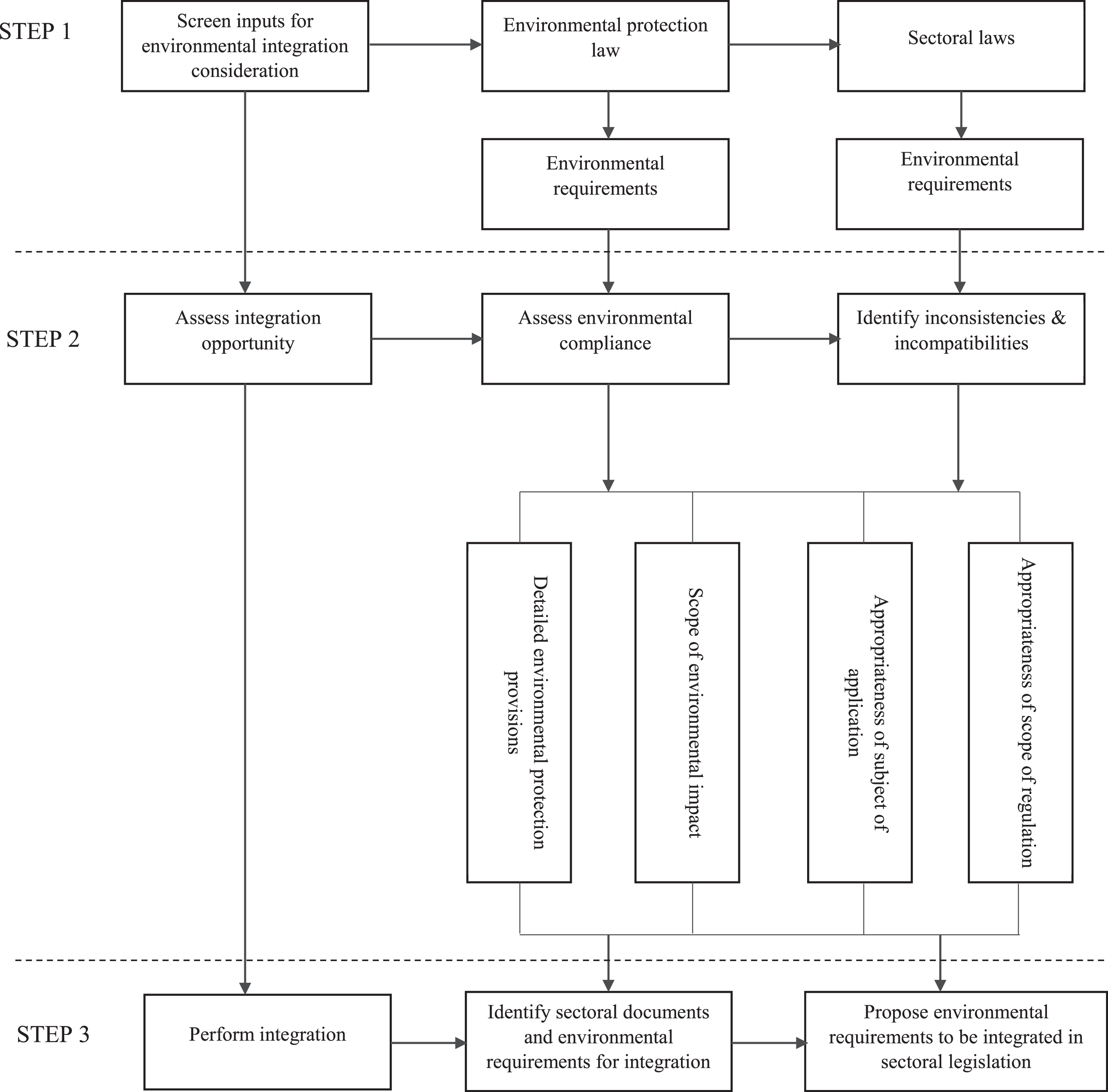
The procedures to be taken to integrate environmental protection requirements into sectoral laws are outlined in the diagram below.
Accordingly, the process of implementing the integration of environmental protection requirements into sectoral legal systems will commence from an initial step of reviewing the information for integration of environmental protection requirements, including the review of regulations and requirements on environmental protection of environmental law and sectoral laws. This initial review of information will help us to identify such regulations and requirements, thereby providing a basis for assessing the compliance with environmental protection requirements, identifying limitations, constraints and inadequacies in regulations related to environmental protection in sectoral laws to conductintegration.
After the initial review, the next step will be to conduct an assessment of the practicability of integrating environmental protection requirements into sectoral laws. Assessing the practicability of integrating environmental protection requirements into sectoral legal systems will help us identify and recognize necessary sectoral laws which are capable of integrating environmental protection requirements. In order to assess the possibility and necessity of integrating environmental protection requirements in sectoral legal systems, it is essential to determine the level of compliance with environmental protection requirements, identify contradictions and inadequacies in environmental protection requirements and the values and benefits if a sectoral law is integrated environmental provisions. Once the need is identified, an assessment of the feasibility of the integration should be undertaken. Factors that help in this assessment process include consideration of the suitability of the scope of regulation and subjects of application, the degree of environmental impacts as well as the level of detail on environmental protection requirements.
The final step is to integrate the environmental protection requirements into the targeted sectoral legal documents, including the identification of contents and integration of specific environmental protection regulations into the selected sectoral legal documents. Basically, determining the content of environmental protection requirements that need to be integrated in sectoral legislation, will be based on the requirements of environmental legislation and from practical requirements to environmental protection of sectoral laws. This process will help us identify and select appropriate environmental protection requirements for integration into sectoral legislation.
Conclusion
One of the key features of sustainable development is an emphasis on integrating environmental goals into non-environmental policy areas. This requires a fundamental recognition that the environment sector acting alone cannot guarantee its environmental objectives and therefore each sector must take environmental policy objectives into its own policy. This is perhaps the most important common environmental policy axiom of the 1980s and 1990s, and is a central element of the concept of sustainable development. The integration of environmental protection has been studied by many authors andapplied by some organizations, such as the EU, in policy-making.
It can be seen that, within the current context of Vietnam, integrating environmental protection requirements into the sectoral legal system has a very significant role and meaning.Environmental law is an important legal branch within the Vietnamese legal system. So far, the State has issued relatively many legal documents governing this issue. However, the current sectoral legal system is still heavily focused on sectoral development thinking aligned with sectoral interests, but has not adequately considered environmental protection requirements for the common development benefit. This leads to the situation where the legal systems of the various sectors ignore or care little about the environment protection content, even neglecting the environmental requirements of the sector.
In Vietnam, the policy of integrating environmental protection requirements into development policies and strategies has been set, but in reality, environmental protection requirements have often received little attention in terms of integration into the legal system, resulting in inconsistencies, and even conflicts with the law on environmental protection.
Certain criteria are required to integrate environmental protection requirements intosectoral laws. Based on the determinationof these integration criteria, a proposedintegration process taking into account thespecific conditions of the Vietnamese legal systemis developed to ensure integration effectiveness. This process will certainly take time butit needs to be seriously considered as soon as possible.
Footnotes
Acknowledgments
This paper builds on work of BÐJKH.37/16-20 “Nghiên cúu lồng ghép yêu cầu bảo vệ môi trường trong hệ thống pháp luầt chuyên ngành”, which received funding under the BÐJKH/16-20 National Programme for Science and Technology. We would like to thank the Program Office for their cooperation and support and reviewers for their comments and feedback.

Adelle, C. and Nilsson, M. (2015). Environmental Policy Integration. In: Encyclopedia of Global Environmental Politics and Governance. Philipp Pattberg and Fariborz Zelli (eds). Edward Elgar.
Alons, G. (2017). Environmental policy integration in the EU’s common agricultural policy: Greening or greenwashing? J Eur Public Policy 2017, 24, 1604–1622. DOI: 10.1080/13501763.2017.1334085
Venghaus, S., Märker, C., Dieken, S., Siekmann, F. (2019). Linking environmental policy integration and the Water-Energy-Land-(Food-)Nexus: A review of the European Union’s energy, water and agricultural policies. Energies 2019, 12, 4446; doi:10.3390/en12234446
Underdal, A. (1980). ‘Integrated marine policy: what? why? how?’, Marine Policy, 4(3), 159–169.
Collier, U. (1994). Energy and environment in the European Union. Aldershot: Avebury.
Peters, G. (1998). “Managing horizontal government: The politics of coordination”. Research Paper No. 21. Ottawa: Canadian Centre for Management Development.
Lafferty, W. M., & Hovden, E. (2003). Environmental Policy Integration: Towards an Analytical Framework. Environmental politics, 12(3), 1-22.
Van Oosten, C., Uzamukunda, A., Runhaar, H., (2018). Strategies for achieving environmental policy integration at the landscape level. A framework illustrated with an analysis of landscape governance in Rwanda. Environmental Science and Policy 83 (2018) 63–70. doi.org/10.1016/j.envsci.2018.02.002
Mai, T.D., Nguyễn, M.K., Phan, T.T.H., (2019). Lồng ghép yêu cầu bả o vệ môi trường trong hệ thống pháp luật chuyên ngành ở Việt Nam – Một số vấn đề lý luận. Tạp chí Khí tường thủy văn, 10/2019. DOI: 10.36335/VNJHM.2019(706).26-32
Persson, A. (2004). Environmental Policy Integration: An Introduction. Stockholm Environment Institute, June 2004.
Runhaar, H. (2016). Tools for integrating environmental objectives into policy and practice: What works where? Environmental Impact Assessment Review 59 (2016)1–9.
Gillingham, R. (2008). Poverty and Social Impact Analysis by the IMF: Review of Methodology and Selected Evidence. Washington, International Monetary Fund.
Obst, C., Hein, L., Edens, B., (2015). National accounting and the valuation of ecosystem assets and their services. Environ. Resour. Econ. (article in press).
Jordan, A.J., Lenschow, A. (2008). Integrating the environment for sustainable development: an introduction. In: Jordan, A.J., Lenschow, A. (Eds.), Innovation in Environmental Policy? Integrating the Environment for Sustainable Development. Edward Elgar, Cheltenham, pp. 3–23.
Runhaar, H., Driessen P. and Uittenbroek, C. (2014). ‘Towards a systematic framework for the analysis of environmental policy Integration’, Environmental Policy and Governance 24(4): 233–246.
Fidelis, T. (2005). Integrating environmental issues into the Portuguese planning system – 10 years of emerging challenges and persistent problems. Sustainable Development and Planning II, Vol. 1. DOI: 10.2495/SPD050331
Bugge, H.C., (2010). Environmental law’s fragmentation and discretionary decision-making. A critical reflection on the case of Norway. In: Røsæg, E., Schäfer, H.B., Stavang, E. (Eds.), Law and Economics: Essays in Honour of Erling Eide. Cappelen Damm Akademisk, Oslo, 55–75.
Chương trình hìp tác Việt Nam – Thuy -DJiển (SEMLA, 2007). Báo cáo tổng hìp các vấn đề lìng ghép đất đai và môi trường. Hà Nội – 2007.
Tô, T.N., (2015). Tích hợp nội dung bả o vệ môi trường và úng phó với biḗn đjổi khí hậu trong quy hoạch phát triển kinh tḗ - xã hội. Kỷ yḗ Hội thả o khoa học quốc gia lần thú III - Môi trường và phát triển bền vũng trong bối cả nh biḗn đjổi khí hậu, Nhà xuất bả n Khoa học tự nhiên và Công nghệ, tr. 335-347.
Võ Trung Tín (2019). Assessing Vietnam’s environmental laws and direction for improvement. Vietnamese Journal of Legal Sciences, Vol 01, No 01, 2019, pp. 64-76. DOI: 10.2478/vjls-2020-0004
Ministry of Natural Resources and Environment (MONRE, 2020). Five years Summary Report on enforcement of Law on Environment Protection 2014.
Tô, T.N., (2015). Tích hợp nội dung bả o vệ môi trường và úng phó với biḗn đjổi khí hậu trong quy hoạch phát triển kinh tḗ - xã hội. Kỷ yḗ Hội thả o khoa học quốc gia lần thú III - Môi trường và phát triển bền vũng trong bối cả nh biḗn đjổi khí hậu, Nhà xuất bả n Khoa học tự nhiên và Công nghệ, tr. 335-347.
Thái Thị Tuḗt Dung (2011). Các nguyên tắc giả i quyḗt xung đjột trong các văn bả n quy phạm pháp luật. Khoa học pháp lý, ÐJại học Luật TP. H`ồ Chí Minh, 2011, Số 05(66).
Lê Thị Thúy and Nguyễn Hoàng Việt (2020). Bất cập của các nguyên tắc áp dụ ng pháp luật trong Luật Ban hành VBQPPL nhìn từ thực tiễn xử lý VPHC. Bộ Tư pháp, 5-2020.