



Abstract
Sustainable development in Bahrain is considered one of the national core objectives in the Government Action Plan. Bahrain has enacted environmental legislation and adopted the National Environment Strategy. This study examines the appropriateness of the current environmental legislations in the context of SDGs. To achieve this goal; a scoping review was conducted to assess their compatibility. The study revealed that the successful integration of SDGs with the current environmental legislations can be carried out by recognising the challenges highlighted in the 2030 Agenda. This study suggests the quick-updating of the current environmental legislations in line with SDGs. There is still room for improvement, and more comprehensive and sustainable approaches need to be developed in the environment dimension to stay on track to reach the SDGs. The policies should factor in the possible linkage opportunities to develop a holistic management approach in the implementation, considering the international conventions’ obligations. The study can be deemed as the first attempt to examine the consistency of the SDGs with the national environmental legal framework, which can be employed to enhance the sustainable practices. Moreover, the study develops a simple framework that can assist in reviewing, keeping the legislations and strategy consistent with the SDGs.
Introduction
The outcome document –the Stockholm Declaration –of the first historical conference on environment, agreed on 26 principles, particularly principle 11 call the countries to enhance the environmental policies based on sustainable development concept. 1 This was followed by Agenda 21 (adopted in 1992), stating that laws and regulations of each country is the most important tools for transforming environmental and development policies into actions. 2 Further, the 2030 Agenda and its 17 sustainable development goals (SDGs) 3 , is guided by a number of international legal instruments, 4 & 5 specifically the UN Charter (signed in 1945), the Universal Declaration of Human Rights (accepted in 1948), and the Rio Declaration on Environment and Development (adopted in 1992). 6 In this regard, the SDGs provide guidelines for regulations to achieve a broad purpose, 7 and called all countries to carry on procedures to formulate policies aligning with national development planning to attain the SDGs. 8 According to Beier et al.; the outcomes of the green economy concept (GEC) that the SDGs affected the global sustainable development policies for the next decade 9 . Therefore, implementing the SDGs needs further policy coherence, and involvement of the private sector 10 , and strategies need to be supported by the national law. 11 Furthermore, the sixth UN Global Environment Outlook report 12 mentioned that extensive efforts were taken to advance methods for enhancing environmental governance by strengthening the regulations, and empowering the policies to promote voluntary actions. In this regard, both –the 2030 Agenda and Addis Ababa Action Agenda 13 (AAAA) assign significance to sustainable and resilient infrastructure as a precondition to accomplishing sustainable development, 14 but in the SDGs’ era, sustainability is the principal aim at regional and national levels. 15
Due to the vital role of the industrial sector, the consensus about the significance of industrial development in driving economic growth has increased globally 16 &17 because this sector is accountable for controlling environmental impacts through its compliance with the legislatives, 18 &19 and a good regulation is one of the most feasible solutions for some SDG issues, 20 thus, this sector need empowering regulatory frameworks to participate in sustainable development. 21 From an economic standpoint, companies are trying to make an impact on the regulations sustainability, 22 therefore, the SDGs’ contributors in the industrial sector are eager that governments must make regulations convenient to implement SDGs, 23 and formulate effective environmental policies. 24 In some cases, influential regulations encourage companies to implement more sustainable and efficient production processes, 25 such international standards (e.g., ISO 14001), which often fill the regulative gaps due to the dearth or absence of local regulations and international policies. 26 Rashed and Shah have suggested that updating and reformulating effective legislations based on SDGs’ requirements is one way to ensure effective implementation. 27 Moreover, the legislative requirements are one of the motivations to invest in sustainable projects; 28 and adequate regulations and incentives can be a driver for innovations that enable companies to increase their competitiveness indirectly. 29 Some studies indicate that the country’s legislative framework is the most significant factor that affects the environmental performance of the companies towards desirable behaviors. 30 &31 In this vein, Thabit et al. pointed out that the companies that integrate sustainable development into their policies will obtain long-term benefits such as improved performance and productivity. 32 Another study by Dahlmann and Bullockb found that the companies’ managerial devices have various responses towards supporting compliance with the sustainability legislations. 33
Other studies concluded that imposing sustainable development regulations still poses a key challenge 34 due to lack of global regulations correlated with sustainable industrial initiatives, 35 thus, governments should improve the environmental regulations, 36 for instance, improving environmental regulations to minimize carbon dioxide emission, especially in the transportation sector. 37 Furthermore, the United Nation Environment Programme (UNEP) highlights in its revised environmental impact assessment legislation the great significance of both strategic environmental assessment (SEA) and environmental impact assessment (EIA) in attaining the 2030 Agenda 38 &39 due to their effective role in enhancing sustainable development, 40 where EIA aims to minimise the negative impacts, and SEA ensure added environmental factors to policies and strategies. 41 Further, the EIA if fully implemented will provide a platform for the attainment of SDGs. 42 In this context, the EIA system affords an efficient framework for the integration of environmental policies and developmental strategies which drive to attain the sustainable development. 43
This study –to my knowledge –is the first that aims to assess the appropriateness of Bahrain’s environmental legal tools with regard to the SDGs. The research methodology employed is a scoping review that scrutinizes their compatibility and effectiveness within the SDGs’ context. The proposed framework consists of five actions to achieve SDGs from a coherent policy perspective at the national level.
Bahrain’s Environmental Legal Tools
The Supreme Council for Environment (SCE) is the government entity responsible for developing programmes, regulating policies, and formulating strategies to attain environmental sustainability. Since 1996, the environment law and its technical ministerial decrees (see Fig. 1) have aimed to address and control several environmental issues that cover air quality, chemicals, wastewater, hazardous waste, and environmental impact assessment. For example, to monitor and control air pollution from industrial sources, it is required follow the best available techniques to ensure no harmful impacts on public health or the environment directly or indirectly. 44
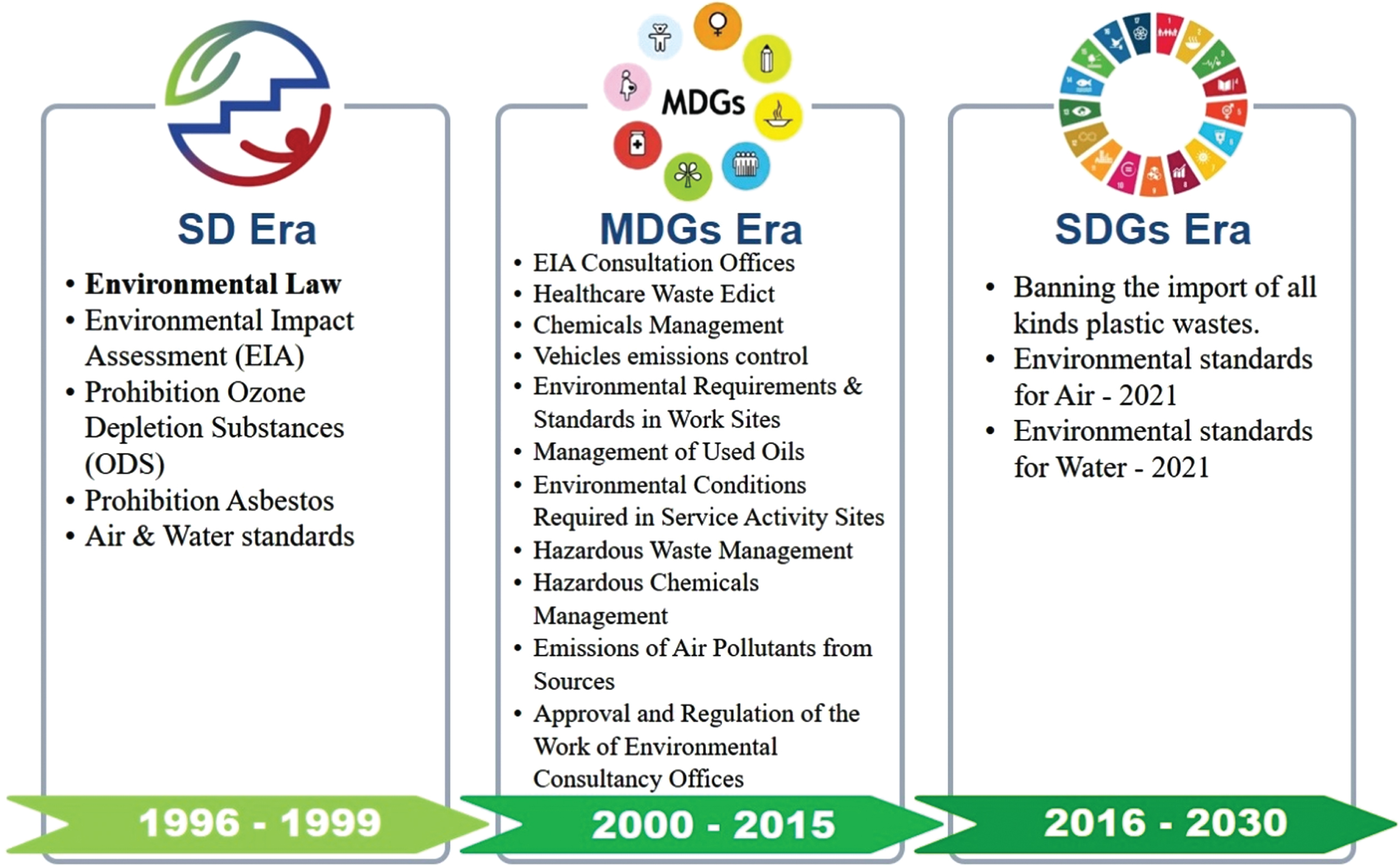
The evolution of environmental legal tools in Bahrain (Author’s own depiction; data sources 45 ).
Besides the environmental legal tools, the Charter of National Action (CNA), adopted in 2001, highlights the basis of the overall development of the national sustainable policy, 46 and the Constitution of 2002, as Article 9(h). 47 As a result, in 2006, the National Environment Strategy (NES) was approved by the Cabinet, and it is one of the priorities of the first MDGs report. Bahrain’s strategic goal for environmental policy is to integrate the environmental matters related to human health protection and natural resources management within the entire national policies. 48 According to Al-Khalifa, there is a low level of basic awareness in Bahrain’s private sector about the sustainable development and the national sustainable strategies, thus, it is essential to raise awareness. 49 Further, there is a dearth of economic initiatives and an absence of a cohesive policy to enhance and strengthen a green-technology industry in Bahrain. 50 A positive finding of Basarir and Arman showed that Bahrain’s environmental protection policies do not impact the economic development and the gross domestic product (GDP) growth leads to a decrease in environmental pollution. 51
Based on previous studies in the area of assessing legal tools and sustainable development, the next section investigates the research method employed in the study to examine the appropriateness of the current environmental legal tools with regard to the SDGs.
Studies on the integration of environmental policies principally examine the efficiency of different methods in implementing integrated approaches. 52 &53 The current study uses a scoping review by employing the key concepts in the UN’s formal documents on the SDGs, and it attempts to identify the synergies, gaps, the extent of appropriateness between environmental legal tools and the SDGs, and how environmental legal tools are utilised and addressed by the government to facilitate the possibility of attaining the SDGs. Scoping studies adopt a basic approach for conceptual mapping within a research field of practice-based studies and evidence. 54 Usually, the results of this approach are narrative, with little statistical data and more tables of information. This methodology is appropriate for research in practice, education, and policy, 55 and adequate when systematic reviews are unable to achieve the fundamental aims or knowledge requirements. 56 Furthermore, a scoping review analyses all existing literature reviews on a particular topic to provide recommendations for improving policy or practice and identify the aspects of that which have not been addressed. In addition, this methodology minimises author bias. 57 Therefore, this approach was employed to study the environmental legal tools in Bahrain.
Data on Bahrain’s environmental legal tools were collected primarily by searching the Legislation and Legal Opinion Commission 58 database, and the keywords were ‘environment’, ‘air’, ‘water’, ‘waste’, ‘chemicals’, and ‘work environment’. The search was repeated for all possible results to make sure that all the required environmental legal tools were obtained. The search results, as per the keywords, are as follows: environment –213, water –214, waste –11, chemicals –22, air –5, and work environment –10, which contain various subjects of legal tools in different fields.
The outcome of the screening process was a list of 19 environmental legal tools to be utilized in the assessment and analysis process in this study. The collected environmental legal tools were divided into five categories, except the general environmental law: environmental impact assessment, air and water, chemicals management, waste management, and work environment. A systematic qualitative analysis was conducted for assessing the interlinkage and alignment between the existing environmental legal tools and the SDGs by examining the content addressed by each legal tool and identifying its related goals and policy gaps.
Reviewing the Existing Environmental Regulations and Their Appropriateness Concerning the National and International Environmental Changes
The periodic reviewing of environmental regulations, whenever needed, is a fundamental approach to ensure their efficiency, robustness and verify that all environmental issues are under control. In this regard, Saner et al. proposed that international environmental conventions can be utilised to enhance the SDGs’ implementation and provide needful amendments to the national environmental laws. 59 In the same vein, one of the methods for revising environmental policymaking to resolve environmental matters and assure sustainability is to address where national laws intersect with international conventions, and take into account the global governance when designing environmental laws. 60 Furthermore, the policymakers can benefit from the multilateral environmental agreements to strengthen the implementation of existing legal tools; 61 and future regulations should be better, covering several actions and commitments to the SDGs; 62 in addition, governments and companies should shift essentially towards development via adjusting their actions concerning the SDGs. 63
The former Commission on Sustainable Development (1992–2003) and the United Nations Conference on Sustainable Development (Rio+20) have guided how to translate sustainable development into national contexts. 64 The national planning mission for the SDGs took several years, including unattained MDGs; 65 thus, an early quick-start to takes the SDGs’ actions is a significant step to ensure affirmative achievements by 2030. 66 For instance, in the Netherlands, the assessment results of existing regulations found that three out of forty-one environmental targets focused on the SDGs were not included in the current policy targets and not yet attained. 67 Besides the attention to the financial needs, the environmental policy should count in the SDGs’ costing process to avoid what happened in the MDGs’ era in this regard, because the great significance focused on environmental policy, and formulating the strategies is to attain the SDGs. 68 Consequently, the developing countries have to design national planning and reviewing mechanisms and draft legislation associated with the SDGs. 69 For instance, during the last 40 years in the Arabian Peninsula, the economic and social overconsumption of energy and rapid urbanisation has led to deteriorating air quality; without strict regulations. 70 Therefore, environmental governance should comprise efficient regulations within the context of the SDGs 9, 11, 12, 13, and 17, 71 and environmental assessment is highly pertinent to foster any improvement during the policymaking process. 72
The environmental policies in Bahrain rest on four principles, namely the precautionary principle, the polluter pays principle, the concept of sustainability, and the concept of shared responsibility. 73 The first Environmental Law (No. 21) was issued in 1996, which was amended in 1997. This law aimed to protecting the environment from polluting sources and factors, by implementing the necessary plans and policies; and includes a broad scope of environmental issues and is consistent with the famous Brundtland Commission definition of sustainable development. 74 It seemingly refers to the principles of the 1992 Rio Declaration on Environment and Development; for example, Article No. 3 of Law 21 is consistent with Principle 11 with regard to the enactment of effective environmental legislations; and Articles 11, 15, 16 and 21 are consistent with Principle 15 that calls for the necessity of employing precautionary approaches to protect the environment.
From 1998 till 2021, legislations on environmental protection to support the Environment Law have been issued. These legislations were intended to control, prevent, and correct the negative practices and impacts on the environment. In 1998, Edict No. 1 was issued based on the environmental assessment of the projects; it stated that all new projects, as well as the development of existing projects, are subject to the submission of a data forms for assessing the environmental impacts of the project or development (e.g., expansions) for their mitigation. The EIA system in Bahrain clearly specifies the duties and responsibilities of the concerned parties in the assessment process, representing the effectiveness of the Edict, 75 &76 and positively contributing to improving the environmental situation and sustainable development. 77
To facilitate the implementation of the EIA Edict, two Orders were issued: Order No. 3 of 2000 regarding the approval of consultation offices specialised in the environmental assessment of projects and environmental studies, and Order No. 4 of 2014 regarding the approval and regulation of the work of environmental consultancy offices. Both Orders organise the scope of work of private consultancy offices with regard to EIA studies. Figure 2 illustrates the number of projects that have undergone the environmental impact assessment process since the issuance of the EIA edict until 2019.

The number of projects that have undergone the EIA process for the period 1996–2019 (Author’s own depiction, data sources 78 ).
Although the degree of importance varies among several environmental legislations, they are all integrated towards achieving the core goal of the Environment Law. The aim of Orders Nos. 2 & 3 of 2021 concerning the environmental standards for air and water are to organise and assess the projects according to the environmental provisions and standards. In 2006, Order No. 10 regarding the emission of air pollutants from sources was issued, which supported the aforementioned Orders. It is worth mentioning that Bahrain’s first national report on climate change, mentioned that the main sources of emissions where the energy sector (70.7%), solid and liquid wastes (12.9%), industrial activities (9.6%), and the transportation sector (6.6%). 79
With regard to issues caused by waste and chemicals, a range of edicts covering chemicals management, industrial, healthcare, and used oil waste were issued; it covered inspections, identification, labeling, storage, transportation, treatment, and disposal procedures. Order No. 1 of 1999 pertained to the control on substances that deplete the stratospheric ozone layer, followed by Order No. 1 of 2001 concerning the management of hazardous healthcare waste and Order No. 7 of 2002 requiring the control on the import and use of banned and severely restricted chemicals. Three years later, Order No. 4 of 2005 concerning the management of used oils was issued, followed by Order No. 3 of 2006 pertaining to hazardous waste management, and Order No. 4 of 2006 related to hazardous chemicals’ management. In 2013, Orders No. 3 and 4 of 2006 that amended Orders No. 6 and 7 were issued. At this point, the merits of these legal tools are that they included all aspects of chemicals and waste management and that there is some integration among them.
Besides the previously discussed environmental legal tools, there are three other important Orders focused on work environment issues and safety. Order No. 2 of 2001 concerning the procedures of environmental inspection; as it aims to verify the extent of compliance with legislative requirements and their implementation in work environment. In 2005, Orders No. 3 and 5 were issued, one on the environmental requirements and standards in worksites and the other on environmental conditions required in service activity sites.
In sum, it is clear that the legal legislative system has covered the most important environmental issues, following the passage of 24 years since the issuance of the Environment Law before adopting the MDGs and SDGs; therefore, there is an urgent need to amend it to reflect the national and global changes in environmental governance. The 2018 Bahrain Human Development Report states that there is a need to review the environmental issues, consequently requiring the updating the legislations correlated to soil, air, and water pollution. 80 Although, the current legal tools are still operative and efficient, but they require updating to fill the gaps, resolve any lack, and close them with SDGs requirements to keep up with the rapid changes, as we are in the era of the fourth industrial revolution (Industry 4.0).
The 2030 Agenda for sustainable development calls all actors from all levels to show commitment to policy coherence, 81 and this concept is an outcome of the academics and practitioners discussions over the last three decades, 82 and was first used by OECD in 1991. 83 The lack of coherence within the SDGs’ framework poses a significant challenge in their implementation. 84 Therefore, there is a need to harmonise the nexus among the national environmental legal tools and the SDGs. The main task in assessing the environmental legal tools is to find the gaps and inadequacies and strengthen its implementation. In this context, the role of assessments is to identify the significant issues that policymakers should focus on to achieve the SDGs 85 because they still face the challenge of translating the 2030 agenda into workable development policies. 86
The following tables depict the existing set of environmental legal tools and a brief description of them, in addition to identifying the issues related to the SDGs sorting the SDGs associated with each legal tool.
Table 1 presents the legal tools pertaining to air and water; after more than 20 years, the legislation (No. 10 of 1999) on air and water, and its amendment (No. 2 of 2001), this Order was rescinded on 8 April 2021 and replaced with two separate Orders, which are Order No.2 of 2021 concerning the environmental standards for air, and Order No.3 of 2021 concerning the environmental standards for water. Article 7 of Order 2 allows the use of other measurements methods -not listed in legislative- approved by environmental international agencies and organizations. The environment authority has a favourable opportunity to amend this Article to align it with the SDG 13 requirement. Further, Article 15 of Order 2 and Article 9 of Order 3 stipulates that the projects are obligated to conduct quarterly analysis and measurements and whenever requested. The environment authority has a favourable opportunity to amend this article to fulfil the SDGs’ requirement. It is interesting to note from annexures that the Orders on air and water standards reflected in the SDGs 3, 6, 9, 11, 13, and 14. Besides the edicts, Bahrain employs the provisions of the International Convention for the Prevention of Pollution from Ships (MARPOL) as a basis for national legislation on marine oil spill, and the National Oil Spill Contingency Plan that intends to preserve the marine environment was adopted in 1993. 87 Further, approximately 90%of industrial wastewater is treated before being discharged into the marine environment, and it is mandatory to obtain disposal permit by law. These efforts meet the requirements of SDG 6 and 14. 88
Air and water Legislations and their relation to the SDGs
Air and water Legislations and their relation to the SDGs
Table 2 presents EIA’s legal tools; Article 8 of Edict 1 of 1998 specify the EIA report should contain elements that represent comprehensive requirements; specifically, this article offer’s a great opportunity to add sustainability dimension. In the same edict, Article 9 complements the requirements of Article 8 by identifying the project impacts, which must be considered to avoid any adverse impacts on the environment. The edict on EIA is reflected in SDGs 9, 11, 12, and 15, and the extent of the impact assessment system will increase the number of SDGs covered by the impact assessment process. Naser stated that the EIA process generally lacks environmental guidelines. 89 As a case in point, in the comparative study on EIA systems among the Gulf Cooperation Council states, the EIA system in the gulf states lack sectoral procedures, specific technical guidelines, and monitoring and implementation. 90 In this regard, the comparative analysis of countries’ regulations provides important support for policymakers to improve them. 91 Literature shows the EIA is an essential tool in the planning of sustainable development, while still there is a lack of studies into whether the EIA system leads to a reduction in environmental impacts and how to measure it. 92
Environmental impact assessment legislations and their relation to the SDGs
Table 3 illustrates the set of chemicals management legal tools. After examining them, it was observed that they were designed basis on the precaution and prevention principles to reduce their exposure risk and adverse health impacts. Additionally, it covered the management aspects including the licensing, uses, storage, handling, and transportation. The proposed addition is regulating chemical uses and prevent import in bulk quantities to avoid the expiration and generation of chemical waste.
Legislations on chemicals management and their relation to the SDGs
Table 4 mentions the set of waste management legal tools; it is found that the legislations on waste management are comprehensive and integrated, covering all aspects of the waste management issue.
Legislations on waste management and their relation to the SDGs
Concerning the legal tools pertaining to waste and chemicals, as mentioned in Tables 3 and 4, there needs more focus on the environmental impacts, and sustainable consumption policies must be adopted. Moreover, there is a need for extended producer and importer responsibilities towards controlling the quantity of chemicals imported to avoid expiration or the remaining of excessive quantities, consequently avoiding waste chemicals’ generation. Given the importance of the issue of waste and chemicals, the sound management of chemicals and waste is one of the significant drivers for attaining the SDGs. 93 In addition, the Inter-Organization Programme for the Sound Management of Chemicals (IOMC) 94 mentioned that the management of chemicals and waste are included clearly in several SDGs, such as 3, 6, 11 and 12.
Table 5 presents the set of work environment legislations. These regulations are aimed at ensuring a safe and healthy work environment for workers in workplaces. Besides this set of legislations, there are two Orders issued by the Ministry of Labour, which are directly related to the Orders issued by the SCE. From the viewpoint of policy, this is an advantageous opportunity as it opens a pathway for the legal coordination and integration among government parties.
Legislations on work environment and their relation to the SDGs
With regard to the SDGs’ era, Gore 95 identified some critical weaknesses that may limit the transformative possibility of the SDGs; there is a dearth of coherent fundamental policy frameworks, and attaining the novel global goals will require novel global rules in return. In line with this, Galli argued that including the SDGs within the national context entails a long-term evident vision propped by novel aims and the updated national policy. 96 Across 16 thematic goals, 42 targets concentrate on the ‘means of implementation’, and there is necessity to reform policies and institutions if a transformational development is to occur. 97
The review revealed that Bahrain’s environmental legislation is a combination of information request and management request, which is reflected almost in all resolutions. Further, the regulations are consistent in their overall strictness and the compliance requirements, in addition to being based on penalties and fines dictated by the environment Law. Although the necessary requirements to improving national laws should be realized to implement environmental policies, the cooperation among government institutions is also required to compile their efforts to enforce and strengthen environmental legislation. Given the complexity of the policy evaluation process, it should be accelerated by facilitating the consultations among the concerned stakeholders.
Furthermore, from the viewpoint of policy, Bahrain must foster additional effective policies and measures to improve the current environmental state and adapt to future challenges and emerging social and economic needs to achieve sustainable development. 98 The challenges faced by the environment and development can neither be resolved via laws nor overseas development assistance solely. There is a need to raise the extent of integration among the environmental and economic policies, which could assist in resolving those challenges. Further, an innovative combination of policies, economy tools, and market-based standards are needed, which leads to changes in the production and consumption patterns. 99 In this regard, there is a shared view among the majority of the companies in Bahrain that accounting regulations need enforcement to obligate companies’ reporting on environmental accounting; 100 for instance, the EIA system in Bahrain is still facing challenges, and to strengthen it, the improvements are critically needed for integrating all EIA system aspects, 101 &102 and oil and gas are two of the large industrial sectors and that their projects consumed high energy. 103 Order No. 1 of 1998 requires that the EIA report include a description of any potential increase in non-renewable resources’ demand; however, there is no legal condition that binds the project owner to submit an energy management plan. This gap could be narrowed by amending the legislation and placing guidelines to ensure the efficient consumption of non-renewable resources. Notably, in some developed projects, the impacts are low but cumulative, so one should consider that any development will generate environmental impacts, which need to be reflected in the EIA legislation’s provisions.
There is an opportunity to add sustainability as a requirement in the EIA report, especially the issue of resource efficiency aspect that is related to SDGs 8, 11, and 12. Recently, consulting companies around the world have started qualifying specialised expertise to study the challenges of sustainable development and provide solutions. 104 Another legal suggestion is that environmental auditing tool should have adopted in the compliance with the regulations, and added to the private consultation offices’ duties. Environmental audit is a significant factor for sustainable development, because it plays a crucial role in updating laws to create a legal frame for sustainable development. 105 In addition, it is an essential policy tool for the assessment and development of environmental policies and plans’ performance, 106 and some of its benefits lead to compliance with environmental regulations and sustainable development. 107
The SDGs did not directly refer to air, although it is indicated clearly in two targets: Target 3.9, which is related to air pollution as a single mechanism harming human health, and Target 11.6, pertaining to an element of the environmental impact of cities. Also, the issue of air is included indirectly in some goals such as SDG 13. In this context, Bahrain has taken earnest actions to commit to the global efforts to fight climate change by signing the United Nations Framework Convention on Climate Change (UNFCCC) in 1992, and the 2015 Paris Agreement. Adding to those efforts, the air quality standards were monitored since 1999, and plans have been developed to raise the number of air portable-monitoring stations. Moreover, the SCE mandated to formulate a National Air Quality Strategy to assess the current challenges. 108
The legislations on chemicals lack a mandatory annual inventory request. The UNITAR and SCE’s chemicals assessment report recommends that an effective chemicals management mechanism must be established between the key stakeholders to avoid any unlawful trade and breach of national legislations. 109 In addition, the management of chemicals and waste is one of the primary challenges that should be tackled by adopting and implementing legal tools that determine the liabilities of the public and private sectors for monitoring and improving legislation systems. With regard to the issue of waste, Bahrain employed the provisions of Basel Convention as a basis for national legislation pertaining to hazardous waste management until issuing the legislative on hazardous waste management.
The matter of human health, which most environmental legal tools referred to in their master aim, is considered an important indicator that reflects the extent of a sound environment. It is covered in Goal 3 that indirectly meets with the requirements of SDGs. The aspects of occupational health and safety cannot be separated from the environmental aspect as both complement each other. It is also committed to conducting inspections of workplaces, and providing information and guidance for employers. This intersects with the work environment decisions issued by the SCE, thereby confirming the necessity of integration from a legal standpoint.
With reference to the concerns and recommendations of Bahrain’s MDGs reports, the second MDGs report raised an important question on how Bahrain can achieve sustainable development, and how the economic growth can void the environmental considerations. 110 In this regard, the third MDGs report reveals that ‘the national strategies and government policies have not succeeded in controlling economic activities, particularly real estate activities, major construction projects and sea reclamation within a manageable and sustainable level consistent with Bahrain’s environmental capacity’. 111 On a positive note, the 2015 MDGs endpoint report notes that significant national actions have been taken since the previous MDGs reports by including the national environmental priorities in the State Strategic Plan 2014 –2016, namely health and the environment, energy and climate change, and urban growth and weak land-use planning. 112 As a reflection, the Government Action Plan (2015–2018) is a short-term national development programme with goals and priorities in line with the SDGs, for example, SDG 6 Targets 6.1, 6.4, and 6.5 are included in the infrastructure, urban development, and environment pillars. Continuous progress, one of the priorities of the Government Action Plan (2019–2022), is facilitating an enabling environment for sustainable development, and section 6 prescribes regulating environmental protection and sustainability. This priority is focused on keeping up with international legislations and agreements considering the best environmental practices, and developing national strategies to protect the environment as well as promote and activate environmental awareness. 113
Based on the assessment outcomes, study recommendations, and the literature review findings, the author’s proposed framework (see Fig. 3) consist of five actions for reviewing the environmental legal tools by cooperating with the government authorities and other stakeholders to fill the gaps, tackle deficiencies, and provide proposals. The first action is the preparation of a second state of environment (SOE) report to study the current environmental situation to get perspicacity into various issues of environmental priority, the pressures underlying the environmental changes and its impacts. Also, such a report is required to evaluate the current legal tools and proposed policy actions. The second action has to do with the updating of the National Environment Strategy based on the outcomes and recommendations of the second SOE report and including the SDGs. Environment strategy sets out the vision and goals, ranks the environmental priorities concerning the current state, and endeavours to recognise actions that enhance the efficiency of resources and attain various benefits in the context of the SDGs. Actions three and four entail updating and proposing amendments that should translate the outcomes of the strategy. The last action is to set up environment action plan, including indicators to monitor the progress in the first three actions.
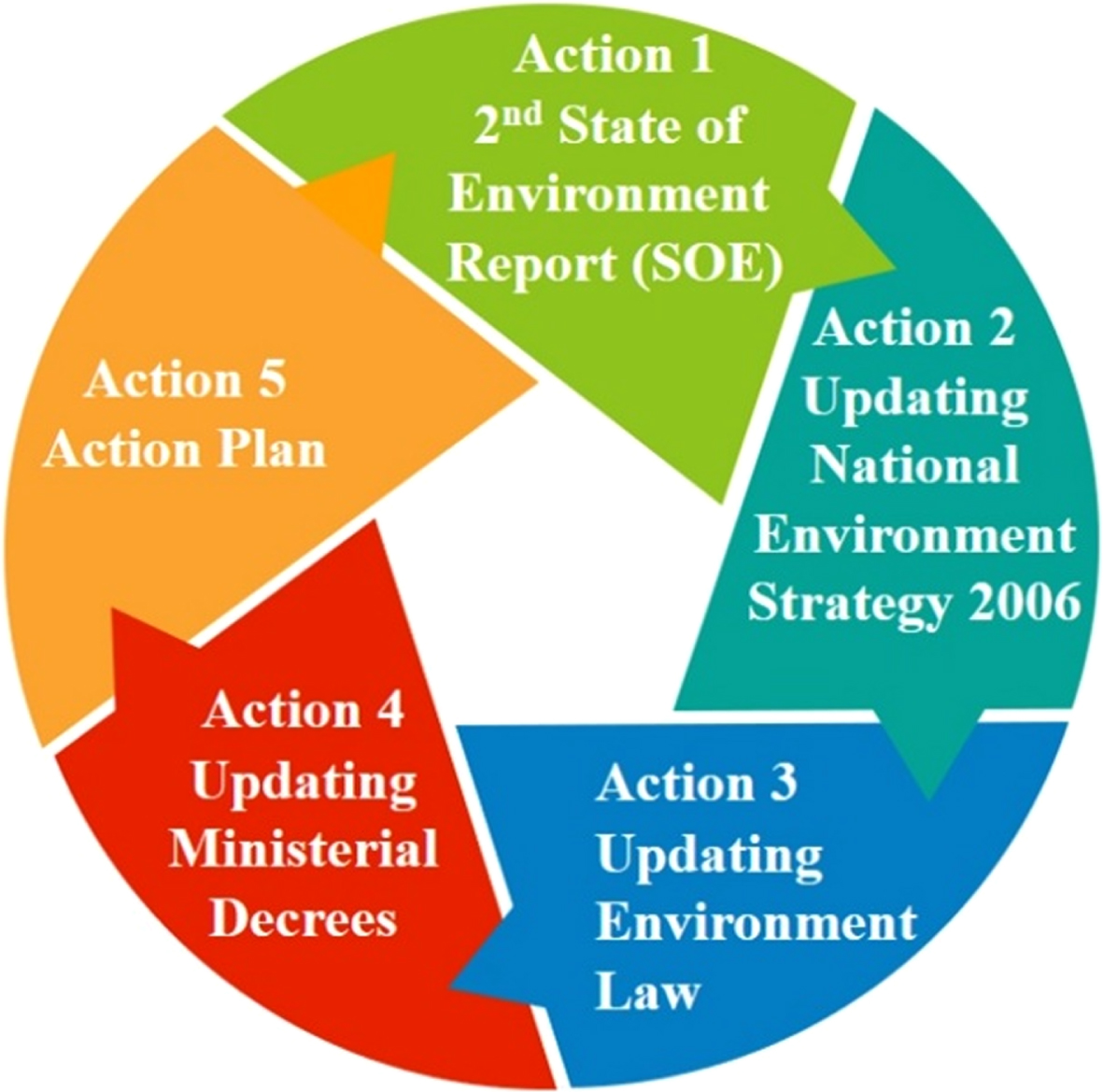
The author’s proposed framework of actions for reviewing the environmental legal tools.
The continuous impacts of human activities in various sectors warn the destruction of the developmental progress of decades. Therefore, more than ever, there is an urgent need for the activation of the 2030 Agenda’s vision and its SDGs via an earnest action to foster the policy coherence starting from the national level. Further, environmental policies should not be formulated in an isolated manner regarding the global environmental changes and challenges, and they must reflect the environmental obligations explicitly and systematically. Sustainability can be accomplished by amalgamating the legal policy aspects of the environmental, technical, economical, institutional, and socio-cultural dimensions. More specifically, the SDGs are a strong support point for the integration among the national legal tools, because it is not possible to deal with each goal individually and must be approached as a set.
To carry out the current legislations and make it more effective in Bahrain; there is a need to continuously enhance the legal and institutional capacity to cope with the emerging issues affecting the environment. The government should strategically recognize that the SDGs era will end-up in 2030 and the remaining period is 10 years. Therefore, there is a necessity to place long-term plans for the environmental legal tools and strategies beyond 2030, and it should be subjected to periodic reviewing and updating via creating a participatory mechanism among the key stakeholders. The extent of concern for the environment is clear from the government action plans, therefore, it should take a step forward to study, identify, and address the inadequacies of the existing environmental legal tools.
For the successful implementation of the SDGs, the national strategies and plans need to be strengthened by effective environmental legal tools, and this is a significant pillar in the field of sustainable development law and in the aim of Principle 10 of the Rio Declaration. Against this background, it is essential to highlight the significance of reviewing and scrutinising the current environment legal tools to eliminate the gaps, deficiencies, contradictions, and repetitions, which will strengthen the capabilities crucial for the successful implementation and enforcement of these legal tools.
Footnotes
Acknowledgments
Thanks are due to my PhD supervisors, Dr. Suad Ahmed Rashdan and Prof. Ahmed Y. Ali-Mohamed at the Department of Chemistry, College of Science, University of Bahrain for their guidance and constructive criticism.
United Nations (UN) (1973). Report of the United Nations Conference on the Human Environment: Stockholm, 5–16 June 1972. New Yurok.
United Nations Conference on Environment and Development (UNCED) (1992). Agenda 21, Rio Declaration. New York: United Nations.
(1) No Poverty, (2) Zero Hunger, (3) Good Health and Well-being, (4) Quality Education, (5) Gender Equality, (6) Clean Water and Sanitation, (7) Affordable and Clean Energy, (8) Decent Work and Economic Growth, (9) Industry, Innovation and Infrastructure, (10) Reducing Inequality, (11) Sustainable Cities and Communities, (12) Responsible Consumption and Production, (13) Climate Action, (14) Life Below Water, (15) Life On Land, (16) Peace, Justice, and Strong Institutions, (17) Partnerships for the Goals.
Kim, R. E. (2016). The nexus between international law and the sustainable development goals. Review of European, Comparative & International Environmental Law, 25(1), 15–26.
Ladan, M. T. (2018). Achieving Sustainable Development Goals through effective domestic laws and policies on environment and climate change. Environmental Policy and Law, 48(1), 42–63.
United Nations (UN) (2012), Future We Want. Outcome document no. A/RES/66/288.
Dong, Y., & Hauschild, M. Z. (2017). Indicators for environmental sustainability. Procedia CIRP, 61, 697–702.
Chapman, A., & Shigetomi, Y. (2018). Developing national frameworks for inclusive sustainable development incorporating lifestyle factor importance. Journal of Cleaner Production, 200, 39–47.
Beier, G., Niehoff, S., & Xue, B. (2018). More sustainability in industry through industrial internet of things?. Applied sciences, 8(2), 219.
Breuer, A., Janetschek, H., & Malerba, D. (2019). Translating sustainable development goal (SDG) interdependencies into policy advice. Sustainability, 11(7), 2092.
See, note 5.
UNEP (2019). Global environment outlook –GEO-6: Healthy planet, healthy people. Nairobi, Kenya. University Printing House, Cambridge, UK.
support the implementation of the 2030 Agenda and provides a new global framework for financing sustainable development by aligning all financing flows and policies with economic, social and environmental priorities.
Aizawa, M. (2018). A Scoping Study of PPP Guidelines. United Nations, Department of Economics and Social Affairs.
Stevens, C., & Kanie, N. (2016). The transformative potential of the Sustainable Development Goals (SDGs). International Environmental Agreements: Politics, Law and Economics, 16(3), 393–396.
UNIDO (2016). The Role of technology and innovation in inclusive and sustainable industrial development. Industrial Development Report 2016, Vienna, Austria.
UNIDO (2018). Demand for manufacturing: Driving inclusive and sustainable industrial development. Industrial Development Report 2018, Vienna, Austria.
Abtew, M. S. (2017). Sustainable development goals, governance, and the private sector. In Management Challenges in Different Types of African Firms (pp. 73–93), Singapore: Springer.
Roni, M., Jabar, J., Muhamad, M. R., & Murad, M. (2017). Sustainable manufacturing drivers and firm performance: Moderating effect of firm size. Int. J. Adv. Appl. Sci, 4, 243–249.
Agarwal, N., Gneiting, U., & Mhlanga, R. (2017). Raising the bar: Rethinking the role of business in the Sustainable Development Goals. Oxfam.
Ridho, T. K. (2018). The Role of private sector in Sustainable Development Goals (SDGs): The case of Indonesia.
Baumgartner, R. J., & Rauter, R. (2017). Strategic perspectives of corporate sustainability management to develop a sustainable organization. Journal of Cleaner Production, 140, 81–92.
Scheyvens, R., Banks, G., & Hughes, E. (2016). The private sector and the SDGs: The need to move beyond ‘business as usual’. Sustainable Development, 24(6), 371–382.
Asghar, N., Anwar, A., Rehman, H. U., & Javed, S. (2019). Industrial practices and quality of environment: Evidence for Asian economies. Environment, Development and Sustainability, 1–23.
Dhahri, S., & Omri, A. (2018). Entrepreneurship contribution to the three pillars of sustainable development: What does the evidence really say?. World Development, 106, 64–77.
Brandi, C. A. (2017). Sustainability standards and sustainable development –Synergies and trade-offs of transnational governance. Sustainable Development, 25(1), 25–34.
Rashed, A. H., & Shah, A. (2020). The role of private sector in the implementation of sustainable development goals. Environment, Development and Sustainability, 1–18.
Buganová, K., & Hudáková, M. (2015). Increase of the competitiveness of enterprises through the implementation of risk management projects in Slovakia. In 19th World Multi-Conference on Systemics, Cybernetics and Informatics, WMSCI 2015 (Vol. 2, pp. 394–398).
Abdul-Rashid, S. H., Sakundarini, N., Ariffin, R., & Ramayah, T. (2017). Drivers for the adoption of sustainable manufacturing practices: A Malaysia perspective. International Journal of Precision Engineering and Manufacturing, 18(11), 1619–1631.
Pechancová, V., Hrbáčková, L., Dvorský, J., Chromjaková, F., & Stojanović, A. (2019). Environmental management systems: An effective tool of corporate sustainability. Entrepreneurship and Sustainability Issues.
Morseletto, P. (2020). Targets for a circular economy. Resources, Conservation and Recycling, 153, 104553.
Thabit, T. H., Aldabbagh, L. M., & Ibrahim, L. K. (2019). The auditing of sustainable development practices in developing countries: Case of Iraq. Revista AUS, 26(3), 12–19.
Dahlmann, F., & Bullock, G. (2020). Nexus thinking in business: Analysing corporate responses to interconnected global sustainability challenges. Environmental Science & Policy, 107, 90–98.
Banik, D., & Lin, K. (2019). Business and morals: Corporate strategies for sustainable development in China. Business and Politics, 21(4), 514–539.
Poulsen, R.T., Ponte, S., Lister, J., 2016. Buyer-driven greening? Cargo-owners and environmental upgrading in maritime shipping. Geoforum 68, 57–68.
Ribeiro, F.M., & Kruglianskas, I., (2015). Principles of environmental regulatory quality: A synthesis from literature review. J. Clean. Prod. 96, 58–76.
de Oliveira Neto, G. C., Pinto, L. F. R., Amorim, M. P. C., Giannetti, B. F., & de Almeida, C. M. V. B. (2018). A framework of actions for strong sustainability. Journal of cleaner production, 196, 1629–1643.
United Nations (UN) (2015). Resolution 70/1 in 2015: Transforming our World: The 2030 Agenda for Sustainable Development. United Nations General Assembly.
UNEP (2018). Assessing environmental impacts –A global review of legislation. United Nations Environment Programme ISBN: 978-92-807-3679-3.
Del Campo, A. G., Gazzola, P., & Onyango, V. (2020). The mutualism of strategic environmental assessment and sustainable development goals. Environmental Impact Assessment Review, 82, 106383.
Jenkins, B. R. (2019). Comparison of Sustainable Development Goals and Environmental Impact Assessment. In International Association of Impact Assessment conference (IAIA) website. Brisbane.
Abija, F. A. (2018). Gap analysis and strategic implementation of environmental impact assessment a pathway to achieving the SDGs in Nigeria. International Journal of Environmental Monitoring and Protection, 5(4), 81–86.
Joseph, K., Eslamian, S., Ostad-Ali-Askari, K., Nekooei, M., Talebmorad, H., & Hasantabar-Amiri, A. (2019). Environmental Impact Assessment as a tool for sustainable development. Encyclopedia of Sustainability in Higher Education, 588-596.
eGovernment (2020). Environment protection in Bahrain. Kingdom of Bahrain. Access Date: 10/12/2020. The Supreme Council for Environment, Kingdom of Bahrain (sce.gov.bh)

See, note 44.
The State shall take the necessary measures for the protection of the environment and conservation of wildlife.
Derasat & UNDP (2018). Bahrain Human Development Report 2018: athways to sustainable economic growth in Bahrain.
Al-Khalifa, L. (2015). Advancing sustainable development in Bahrain through the triangulation approach. In Bryde David, Yusra Mouzughi and Turki Al Rasheed (Eds.), Sustainable Development Challenges in the Arab States of the Gulf. Berlin, Germany: Gerlach Press, pp. 113-138.
Dutta, A. (2015). Green Management and Sustainable Development: The Case of Kingdom of Bahrain. Journal of Empirical Research in Accounting & Auditing, 2(1).
Basarir, A., & Arman, H. (2014). Sustainable development and environmental Kuznets curve in GCC countries. In Proceedings of the 13th International Conference on Environmental Science and Technology.
Tosun, J., & Lang, A. (2017). Policy integration: Mapping the different concepts. Policy Studies, 38(6), 553–570.
Stevens, C. (2018). Scales of integration for sustainable development governance. International Journal of Sustainable Development & World Ecology, 25(1), 1–8.
ElAlfy, A., Palaschuk, N., El-Bassiouny, D., Wilson, J., & Weber, O. (2020). Scoping the evolution of corporate social responsibility (CSR) research in the sustainable development goals (SDGs) era. Sustainability, 12(14), 5544.
Peterson, J., Pearce, P. F., Ferguson, L. A., & Langford, C. A. (2017). Understanding scoping reviews: Definition, purpose, and process. Journal of the American Association of Nurse Practitioners, 29(1), 12–16.
Munn, Z., Peters, M. D., Stern, C., Tufanaru, C., McArthur, A., & Aromataris, E. (2018). Systematic review or scoping review? Guidance for authors when choosing between a systematic or scoping review approach. BMC medical research methodology, 18(1), 143.
Piñeiro, V., Arias, J., Dürr, J., Elverdin, P., Ibáñez, A. M., Kinengyere, A.,... & Torero, M. (2020). A scoping review on incentives for adoption of sustainable agricultural practices and their outcomes. Nature Sustainability, 3(10), 809–820.
An independent body of a judicial nature; it has three main competencies, which are: legal opinion, preparation and drafting of legislation, and review of contracts.
Saner, R., Yiu, L., & Kingombe, C. (2019). The 2030 Agenda compared with six related international agreements: Valuable resources for SDG implementation. Sustainability Science, 14(6), 1685–1716.
Almannaei, N. A., Akhter, M. S., & Shah, A. (2020). Improving environmental policy-making process to enable achievement of sustainable development goals. Environmental Policy and Law, (Preprint), 1–8.
Takeuchi, K., Osamu, S., Lahoti, S., & Gondor, D. (2017). Growing up: 10 years of publishing sustainability science research. Sustainability Science, 12(6), 849–854.
Renda, A. (2017). How can Sustainable Development Goals be ‘mainstreamed’ in the EU’s Better Regulation Agenda? CEPS Policy Insights, 12.
Georgeson, L., & Maslin, M. (2018). Putting the United Nations Sustainable Development Goals into practice: A review of implementation, monitoring, and finance. Geo: Geography and Environment, 5(1), e00049.
Risse, N. (2016). Implementing the 2030 Agenda and its SDGs Where to Start? International Institute for Sustainable Development (IISD).
Sarwar, M. B. (2015). National MDG implementation: Lessons for the SDG era. London, UK: Overseas Development Institute.
Lucci, P., & Lally, S. (2016). Starting strong: The first 1000 days of the SDGs. London, UK: Overseas Development Institute.
Lucas, P., Ludwig, K., Kok, M., & Kruitwagen, S. (2016). Sustainable Development Goals in the Netherlands. Building blocks for environmental policy for 2030. The Hague, Netherlands: PBL Netherlands Environmental Assessment Agency.
Vorisek, D. L. & Yu, S. (2020). Understanding the cost of achieving the Sustainable Development Goals. Policy research working paper no. WPS 9164. Washington, D.C.: World Bank Group.
Sarvajayakesavalu, S. (2015). Addressing challenges of developing countries in implementing five priorities for sustainable development goals. Ecosystem Health and Sustainability, 1(7), 1-4.
Farahat, A. (2016). Air pollution in the Arabian Peninsula (Saudi Arabia, the United Arab Emirates, Kuwait, Qatar, Bahrain, and Oman): Causes, effects, and aerosol categorization. Arabian Journal of Geosciences, 9(3), 196.
Scharlemann, J. P., Brock, R. C., Balfour, N., Brown, C., Burgess, N. D., Guth, M. K.,... & Kapos, V. (2020). Towards understanding interactions between Sustainable Development Goals: The role of environment–human linkages. Sustainability Science, 15, 1573–1584.
Kørnøv, L., Lyhne, I., & Davila, J. G. (2020). Linking the UN SDGs and environmental assessment: Towards a conceptual framework. Environmental Impact Assessment Review, 85, 106463.
see, note 44.
World Commission on Environment and Development (WCED) (1987). Our Common Future, Transmitted to the General Assembly as an Annex to document A/42/427 –Development and International Co-operation: Environment.
Naser, H. A. (2012). Evaluation of the environmental impact assessment system in Bahrain. Journal of Environmental Protection, 3(2), 233.
Naser, H. A. (2015). The role of environmental impact assessment in protecting coastal and marine environments in rapidly developing islands: The case of Bahrain, Arabian Gulf. Ocean & Coastal Management, 104, 159–169.
Yaqoob, M. E., Naser, H. A., Elkanzi, E. M., & Janahi, E. M. (2019). Towards an effective environmental impact assessment (EIA) in the industrial sector of Bahrain, Arabian Gulf. Arab Journal of Basic and Applied Sciences, 26(1), 113–124.
See, note 44
See, note 44
See, note 48
See, note 38.
Tosun, J., & Leininger, J. (2017). Governing the interlinkages between the sustainable development goals: Approaches to attain policy integration. Global Challenges, 1(9), 1700036.
See, note 52
See, note 4
Amin-Salem, H., El-Maghrabi, M. H., Rodarte, I. O., & Verbeek, J. (2018). Sustainable development goal diagnostics: the case of the Arab Republic of Egypt. Policy research working paper no. WPS 8463. Washington, D.C.: World Bank Group.
El-Maghrabi, M. H., Gable, S., Rodarte, I. O., & Verbeek, J. (2018). Sustainable development goals diagnostics: An application of network theory and complexity measures to set country priorities. Policy research working paper no. WPS 8481. Washington, D.C.: World Bank Group.
Marzooq, H., Naser, H. A., & Elkanzi, E. M. (2019). Quantifying exposure levels of coastal facilities to oil spills in Bahrain, Arabian Gulf. Environmental monitoring and assessment, 191(3), 1–16.
Al-Noaimi, M. A. (2020). SDG goal 6 monitoring in the Kingdom of Bahrain. Desalination and Water Treatment, 176, 406–427.
see, note 75
Al Azri, N., Al Busiadi, R., & Sulaiman, H. (2013). Evaluation of Environmental Impact Assessment (EIA) systems in GCC States through performance criteria. APCBEE Procedia, 5, 296–305.
Suwanteep, K., Murayama, T., & Nishikizawa, S. (2016). Environmental impact assessment system in Thailand and its comparison with those in China and Japan. Environmental impact assessment review, 58, 12–24.
Loomis, J. J., & Dziedzic, M. (2018). Evaluating EIA systems’ effectiveness: A state of the art. Environmental Impact Assessment Review, 68, 29–37.
Syeda, S. R. (2020). Framework for sound management of chemicals: Toward a sustainable chemicals industry in Bangladesh. ACS Chemical Health & Safety, 27(5), 288–298.
IOMC’s vision is to shapes a sustainable future through coordinated global act on to achieve the sound lifecycle management of chemicals and waste for healthy lives and the environment.
Gore, C. (2015). The post-2015 moment: Towards Sustainable Development Goals and a new global development paradigm. Journal of International Development, 27(6), 717–732.
Galli, A., D - urović, G., Hanscom, L., & Knežević, J. (2018). Think globally, act locally: Implementing the sustainable development goals in Montenegro. Environmental science & policy, 84, 159–169.
Stafford-Smith, M., Griggs, D., Gaffney, O., Ullah, F., Reyers, B., Kanie, N.,... & O’Connell, D. (2017). Integration: The key to implementing the Sustainable Development Goals. Sustainability Science, 12(6), 911–919.
See, note 44.
See, note 48.
Gibbon, J., & Joshi, P. L. (1999). A survey of environmental accounting and reporting in Bahrain. Journal of Applied Accounting Research, 5(1), 4.
See, note 75.
See, note 76.
See, note 77.
Hannemann, L. (2019). Sustainability consultancies and their contribution to sustainable development. In Advances in consulting research (pp. 229–249). Cham: Springer.
Hakim, W., & Yunus, A. (2017). Environmental audit as instrument for environmental protection and management. The Business & Management Review, 9(2), 228–232.
Cook, W., van Bommel, S., & Turnhout, E. (2016). Inside environmental auditing: Effectiveness, objectivity, and transparency. Current Opinion in Environmental Sustainability, 18, 33–39.
Asalos, N. (2019). Environmental auditing –An organization management tool. Ecoforum Journal, 8(1).
See, note 48.
See, note 44.
See, note 44.
See, note 44.
See, note 44.
See, note 44.