




Abstract
The menace caused by plastic waste is one of the biggest challenges the world is facing today. It is established that plastic pollution and its accumulation in the world ocean is one of the greatest threats exacerbating all three planetary existential threats identified by the UN. The presence of plastic pollutants in the marine environment is due to its transboundary and cross-continental movement. Therefore, after five decades of the Stockholm conference, it seems necessary to explore how far the principles and objectives of the Stockholm Declaration can be utilized to accommodate the rising concerns and to address the existing environmental crises, including the plastic pollution. There is a need to develop a cooperative scheme that enables the international community of States to come together and find a solution using the expertise of the Basel Convention. Such an initiative –a sort of alliance of states, both members and non-member States to the Convention - could also pave the way for similar collaboration among States to tackle the issues associated with plastic and other forms of pollution.
Keywords
Introduction
Plastic, a synthetic or semi-synthetic hydrocarbon polymer, has managed to ensure its ubiquitous presence in all the four spheres of the earth –geosphere, hydrosphere, biosphere and atmosphere due to its chemically stable and non-biodegradable nature. 1 Ever since 1907, 2 when plastic was discovered it has become indispensable for humans. However, due to its chemically stable and non-biodegradable nature, it has posed a serious threat to the functioning of the marine ecosystem. Its presence is documented from polar regions to equatorial regions, from the Arctic to the Pacific Ocean in the form of the great pacific garbage patch. 3 It is estimated that 1.1 to 1.8 million tonnes of plastic by weight enter the ocean annually from coastal communities. 4
The presence of plastic pollutants in the marine environment is due to its transboundary and cross-continental movement. The menace caused by plastic waste is one of the biggest challenges the world is facing today. Therefore, after five decades of the Stockholm conference, it seems necessary to explore how far the principles and objectives of the Stockholm Declaration can be utilized to accommodate the rising concerns and to address the existing environmental crises, including the plastic pollution. It is in this context that this paper aims to examine the legal measures taken to control the plastic pollution and the effectiveness of such measures. The focus of analysis is the new plastic waste amendment to the Basel Convention, which became operative since November 2021. It is an encouraging development towards resolving the plastic waste crisis.
However, the question remains as to whether this initiative is adequate in tackling plastic pollution. Accordingly, this study examines international cooperation for monitoring the movement of plastic waste from the freshwater stream to the marine environment, using the source to seas approach and the other means for enhancing transboundary cooperation among the states sharing the same drainage basin. For the sake of brevity, this article focuses on marine plastic pollution and the sources of plastic pollutants along with their transboundary movement that falls within the scope of the Basel Convention. 5
It examines the provisions and mandate of the Basel Convention and the new amendment of 2019 6 which enables the Convention to tackle plastic waste and its management across borders. In doing so, this article analyzes the attributes of the management of plastic waste as per the requirement of the Basel Convention at the source i.e., land-based plastic pollution and explore the issue of ill-managed disposal of plastic waste into the freshwater stream which eventually makes its journey to the world ocean resulting in marine plastic pollution. On the basis of the analysis of these issues some concluding observations presents towards the end of this article.
The Journey that began in Stockholm
In the year 1972, the first ever United Nations Conference on the Human Environment was convened in Stockholm. This landmark event had recognized for the first time the linkage between human activities and emerging pollution caused due to human-induced industrialization and economic activities of unsustainable nature. 7 Another key achievement was the initiation of a dialogue between the developed and developing world to tackle the issue of emerging water, air and ocean pollution and to consider how it adversely affects human wellbeing across the globe.
The initiation of the dialogue between the developed and developing world was rooted in the understanding of the fact that pollution to the environment is transboundary and would require collaborative action by all States to tackle the issue. 8 Half a century ago the action plan was drawn to watch, assess and make a plan to manage the activities at a national and international level. As a result, the United Nations Environment Programme was created and it was entrusted with the task, inter alia, to provide support to the States and international organizations working at a national and international level in the field of the environmental assessment and the management of environmentally harmful activities.
As the Stockholm Declaration is completing 50 years in 2022, the world finds itself wedged in the triple planetary crisis of –“climate crisis, the biodiversity and nature crisis, and the pollution and waste crisis", which is described as “our number one existential threat” that needs “an urgent, all-out effort to turn things around,” by UN Secretary-General António Guterres. 9 Our inability to deal with plastic pollution affects the global environment adversely. The impact of plastic pollutants is exacerbating the above-mentioned triple planetary crisis individually and jointly. Climate change is identified as the first planetary crisis. Extreme and unpredictable weather patterns are evident across the globe, the rising temperatures are forcing the sea levels to rise. 10 Greenhouse gas emissions continue to increase despite all the efforts and conclusive scientific information backing up the harmful impacts of a warmer climate for present and future generations. 11
In principle, governments have taken the initiative in terms of law, policy and political commitments at a local, international, regional and universal level to tackle the crises and the Paris Climate Change agreement is one of the latest major agreements in this direction, 12 which is backed by the scientific findings. 13 Scientific backing provided by the International Panel for Climate Change (IPCC) is emphasising the urgent need for the world to target and eliminate greenhouse emissions by 2050, and cut them to half by 2030. 14
In the last five decades, the development seen in environmental law-making has been phenomenal yet, it does not seem apt to deal with emerging crises given the change in climatic conditions. This is evident from the failure of the international community to maintain equilibrium between the earth’s natural environment and socio-economic development as mentioned in ‘UNEP’S report Making Peace with Nature (2021)’. 15 The shortcomings in the law-making and its implementation are evident and the business-as-usual practices of state and non-state actors have proven not so efficient to tackle the climate crisis and most of the practices have been identified as false solutions to the climate crisis. 16
Plastic Pollution
Plastic originates from fossil fuel and when it is exposed to solar radiation in water or air, it generates greenhouse emissions. 17 Whereas, the plastic that reaches the world ocean undergoes a process of weathering and leaching resulting in the creation of microplastic or nano plastics. 18 In this process of breaking down marine litter into smaller components such as microplastic or nano plastic, greenhouse gas emissions are emitted. It also negatively affects other living organisms such as planktons. Phyto-planktons are at the base of the marine food chain and play a crucial role in tackling climate change. They take CO2 from the atmosphere and sequester this carbon in deep ocean sink; parallelly, they contribute to the production of O2 which contributes to the balancing of the gaseous constitution of the atmosphere. 19
This ability of the ocean to sequester carbon is threatened by the presence of plastic in the marine ecosystem. When there are more micro-plastic components in the marine atmosphere, they will threaten the plankton population by interfering and altering their genome-wide transcriptional changes. 20 They result in the decline of the plankton population or lead to non-natural adaptations/modification in planktons which ultimately incapacitates them to sequester carbon that may lead to the increased concentration of greenhouse gases.
The second planetary crisis is the biodiversity and nature crisis. The ubiquitous presence of plastic in our water bodies such as lakes, rivers and oceans are threatening aquatic biological diversity by direct and indirect means. Birds, animals and other forms of creatures often mistake plastic for food or prey which causes toxicity and discomfort leading to the loss of life or, they get entangled in floating plastic and polythene waste ultimately dying of suffocation. 21 Consequently, they suffer from issues such as lacerations, infections, reduced ability to swim, and other internal injuries causing serious damage to their health and survival. 22 The indirect impact of the presence of plastic on biodiversity is due to the fact that plastic leachates affect the plankton population thereby impending the ability of phytoplankton and cyno-bacteria at the base of the marine food web to photosynthesis, which threatens the survival of marine biological diversity. 23 Additionally, plastic degrades and modifies the marine environment resulting in loss of ecosystem services and values which negatively impacts marine biodiversity and onsets nature crisis. 24
The pollution and waste crisis are the third and last of the identified planetary crises. Most of the plastic used is single-use (which is discarded after a single use). A large amount of plastic never reaches recycling plants and the one that reaches recycling plants is disposed of by dumping them in landfills or burning them in the incinerators. It is estimated that today human beings produce 300 million tonnes of plastic waste every year. Present research indicates that more than 8.3 billion tonnes of plastic had been produced since 1950 and only 40% of which had been recycled, leaving the remaining in the natural environment. The day-to-day single-use plastic contributes as one of the major plastic pollutants by quantity. As per UNEP estimates, only 7% of plastic is recycled and 12% of total plastic waste is incinerated. The rest 79% ends up in landfills, dumps or in the natural environment. 25 It should be noted that that the presence of plastic worsens all three identified planetary crises. Therefore, the need is to find a way to legally laminate the means to regulate or govern the generation, production and consumption of plastic waste and its impact on the natural world and the human environment.
Plastic litter reaches the marine environment through river streams making them one of the major contributors to marine plastic pollution. It has been estimated that ten transboundary rivers of the world carry more than 90% of plastic to the world ocean. 26 The marine environment around the globe is littered with floating plastic debris; almost 80% of all marine debris from surface waters to deep-sea sediments is made up of plastic waste. 27 28 Most of this mismanaged plastic waste is found in the developing or low-income world.
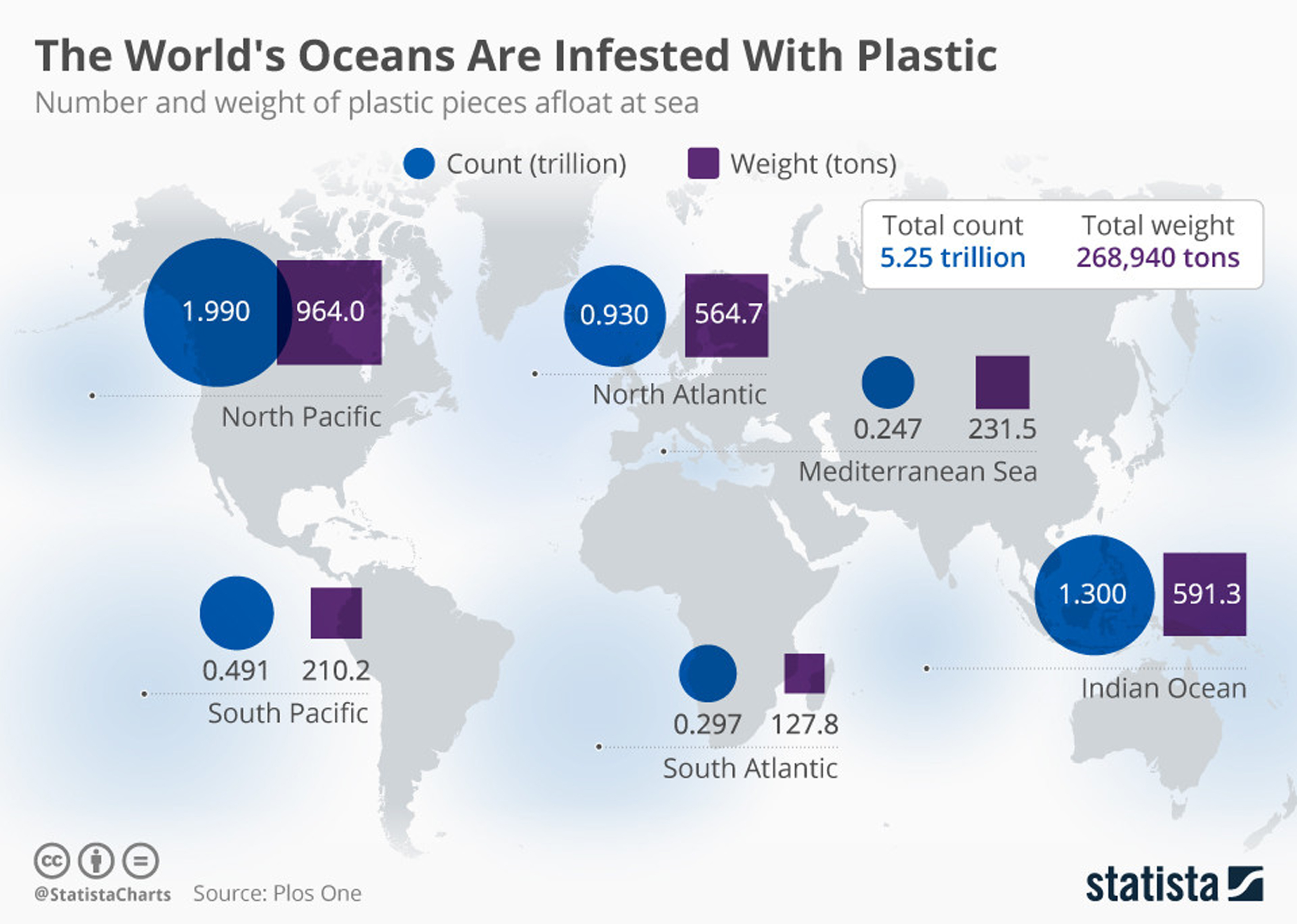
The World’s Oceans are Infested with Plastic.28
The Basel Convention on the Control of Transboundary Movements of Hazardous Wastes and their Disposal was signed in 1989, ever since many amendments and protocols followed the Convention. 29 Plastic and its products in their original form, in the form of micro-plastic after disintegration and plastic debris, have left governments with a dilemma as to how to manage plastic waste. This very question led the world leaders to come together to rectify one of the past mistakes of not classifying plastic within the original classification of hazardous substances covered by the Basel Convention. Consequently, the Conference of Parties/COP14 adopted the Basel Convention Plastic Waste Amendment, 2019.
The amendments refer to changes to the scope of the plastic wastes covered by the Basel Convention that will have a significant impact on the rules governing the movement of plastic waste across international boundaries. The changes to the Basel Convention were adopted through three amendments to the annexes to the Convention. Accordingly, the new categories of plastic waste that will be subject to the regulation under the Convention are: (i) control procedure for transboundary movements (Prior Informed Consent (PIC) procedure) and the conditions under which this procedure applies or not (ii) provisions pertaining to waste minimization and (iii) provisions pertaining to the environmentally sound management of wastes. The amendments as such do not impose a ban on the import, transit or export of plastic waste. They provide clarification as to when and how the Convention applies to plastic waste. 30
The first amendment deals with the PIC procedure under which obligations of member states to share information, seek permission and comply with other norms dictated by the Convention while dealing with transboundary movement of such waste are stipulated. 31 . Under the second amendment entry B3010 is substituted by entry B3011 in Annex IX, which clarifies that the plastic waste categorized under this head are non-hazardous thus not subjected to the PIC procedure. 32 . The third amendment has led to the insertion of entry Y48 in Annex II, which covers plastic waste and their mixtures other than the one categorized as hazardous and non-hazardous falling under entries A3210 and B3011. This amendment to Annex II requires special consideration. 33 .
The amendment causes significant changes in the manner member states of the Convention deal with non-party members of the Convention; it prohibits the trade in plastic waste and scraps with non-party member countries. However, a permissible exception is provided under Article XI of the Basel Convention 34 designed to encourage the bilateral, multilateral and regional agreements for transboundary movement of hazardous and non-hazardous waste among parties and non-parties to fulfil the objectives of the Convention, provided that the requirement that the provisions to such an alternative arrangement is not less environmentally sound than those provided by the Convention. This allows members to conclude an agreement with non-parties subject to conditions specified in the Convention.
The amount of residual waste in the form of plastic or plastic mixed variants of waste has increased manifold in the last few decades. Although the Basel Convention primarily establishes soft law procedures on the control of transboundary movements of hazardous waste, it directs and encourages the States to ensure strict enforcement of the provisions, protocols and amendments to the Convention. 35 To that effect, States are at liberty to determine measures of their own for ensuring compliance with the treaty provisions using the policy development and soft law-based guidance provided by the Convention.
However, after the plastic amendment of 2019 was adopted, new list of components has been added and to honour these additional responsibilities the member countries must take initiatives to develop circular economies for environmentally sound waste disposal of such plastic waste. 36 This requires new initiatives in policymaking and partnership among different stakeholders from national governments and multilateral institutions alike. Some of such initiatives have the potential to tackle the plastic waste crisis and be regarded as covered by the amendment to the Basel Convention.
An example of such an initiative is Ellen MacArthur Foundation’s Plastics Pact Network. It is a private initiative to manage plastic waste. It brings together multiple stakeholders to innovate and design the solutions tailored to the specific need of the geography it is to be implemented. This is an open platform bringing people with similar objectives together creating a database, best practices and creating awareness and exchange of information to cause the transition of the circular economy of plastics. 37 “The new plastic economy is a vision of a circular economy for plastic, where plastic never becomes waste. It offers a root cause solution to plastic pollution with profound economic, environmental, and social benefits”. 38 The foundation has built a plastic pact network comprising of state and non-state actors both and aims at connecting the regional and national initiatives to build a circular economy for plastic-based on six key elements. 39
With a similar view, a Plastic Waste Partnership (PWP) involving different stakeholders to improve environmentally sound management of plastic waste and to minimize its generation at every possible level - national, regional and global levels was established under the Basel Convention. 40 At its 14th meeting the mandate was set by the decision BC-14/13 for the establishment of PWP and its working group entrusted with the task of drawing and agreeing the terms of reference to such partnership. The meeting requested the working group to implement its plan for two years at a stretch. 41 . The immediate goal of this decision was to minimise waste generation and to ensure environmentally sound handling of the waste generated with a long-term goal of eliminating the discharge of plastic waste and microplastics from the environment with a specific emphasis on the marine environment.
Another key feature is that the membership of the partnership is regulated as per prescribed terms of reference for membership but it remains open to all the parties - public, private, coordinating centres and regional seas programme under the Basel Convention with expertise and experience to perform the task to be undertaken under the partnership. 42 Some of the best practices and workable mechanisms have been compiled and developed into guidelines over the years by the framework under the Basel Convention for addressing issues related to marine plastic litter and microplastics and such guidelines are expected to be shared and followed while dealing with the transboundary movement of plastic waste. 43
Cooperative Initiative to Tackle Plastic Pollution
General obligations enshrined in Article 4 of the Basel Convention by nature deal with transboundary import and export of hazardous and other waste among parties to the Convention. However, section 2 of Article 4 of the Convention emphasizes the obligations of the parties to the Convention concerning the generation and adequate disposal of such waste at the source itself. As far as plastic waste is concerned the State parties to the Convention are obligated to minimize generation of such waste as per the provision of Art 4(2)(a) 44 and are required to ensure adequate disposal facilities for the waste generated locally as far as possible in accordance with the provisions of Art 4(2)(b) of the Convention. 45 . As per Article 2(9) of the Convention, the scope of national jurisdiction of the State is defined to include any land, marine area or airspace over which the State can exercise its administrative and regulatory control. In other words, the jurisdictional scope of the Convention remains silent as far as the riverine ecosystems are concerned. However, it should be noted that the laws and the customary practices of States that regulate freshwater bodies whether it is a river, pond or lake apply to whole territory of the State concerned. 46 Likewise, the principle of sovereignty of states enables the States to exercise their rights over the natural resources available within its territory. 47 This is how the provisions of the Convention can be satisfied to include riverine ecosystem within its jurisdiction and extend the application of the obligations under the Basel Convention to the measures designed to ensure environmentally sound management of the plastic waste disposed on the riverine ecosystem.
Most of the waste accumulated as marine plastic pollution has reached through riverine channel. They do so through freshwater streams by the direct or indirect discharge of land-based pollutants and reach the marine ecosystem. However, it is important to note that this kind of transboundary movement of plastic waste is not what concerns Basel Convention. This transboundary movement of plastic waste is non-voluntary and originates from the inability of the State to minimize waste generation and its disposal in an environmentally sound manner at the site/source of waste generation, 48 violating directly or indirectly the obligation contained in Art 4 of the Convention. 49
Since it is through the riverine channel that the majority of plastic enters the ocean, it is imperative to address marine plastic pollution through strict implementation of plastic waste at the source itself (land-based pollutants) itself. The plastic waste that enters rivers from land-based pollution is easier to monitor, identify and track as the waste itself is in its original form and the process of weathering or its further disintegration into micro-plastic or nano-plastics has not yet started, making it easier, a cost-effective and environmentally sound option for waste treatment and recycling. 50 That can be achieved by municipal laws and strict domestic implementation of the Basel Convention by the member states. This can further be enhanced by combining the efforts required to fulfil the commitments for achieving Sustainable Development Goals. 51
Additionally, to minimize the amount of plastic waste generated and the quantity that reaches the riverine ecosystem, member countries must take initiatives to develop circular economies for environmentally sound disposal of plastic waste generated. Of course, not all the countries are at the same level of development as far as the economic prosperity, technological know-how and the ability to develop circular economies for the disposal of plastic waste is concerned. 52 Therefore, it is inevitable for some of the plastic waste to end up in the world ocean in one form or another coming through the land-based sources through the riverine channel. To address this issue of transboundary movement of plastic litter and marine plastic pollution a dedicated international cooperative solution is required. For such cooperation to function, it must accommodate all of the states (member and non-member states of Basel Convention) located in the drainage basin, whether a single or multiple river basin for this purpose.
Given the foregoing state of affairs, the Source-to-Sea (S2 S) approach seems appropriate to tackle the plastic pollution to limit the amount of plastic waste entering the marine environment. 53 The S2 S approach was coined on the realization of the interdependent and organic linkages between freshwater, land, coast and oceans. Under this approach the entire drainage area, which tends to include several river basins, of a sea would be identified to tackle the problem of marine plastic pollution. 54 This approach propounds a holistic approach and guides appropriate planning, management and governance. The success of the scheme would rest on intervention, engagement and a thorough understanding of governance, which is tailored to the need of a locality and flexibility to accommodate the dynamic changes. The S2 S management approach acknowledges the adverse impact of unsustainable human activities on land and its impact on the aquatic, riverine and marine ecosystems. 55
Moreover, this kind of plastic waste management scheme should be a conscious, deliberate and multi-level effort by the state and other stakeholders, which requires time, planning, infrastructure, investment 56 and appropriate means for implementation. 57 For this, it would be necessary to have provisions for environmental regulation and governance that is supported by international conventions, policies and others, at various levels. This is exactly why a secondary and parallel mechanism that concentrates on the water channel starting from freshwater stream to the ocean water must also be developed to tackle the plastic waste movement and its disposal in an environmentally sound manner. For this purpose, Article XI of the Basel Convention could be explored.
For such a scheme to succeed, the entire river basin and all the riparian states must commit to the cause otherwise the efforts of all the remaining riparian states will go in vain. In order to bring this transboundary movement of waste within the framework of accountability, the soft law provision mentioned in Article X and XI 58 of the Basel Convention could be useful. Such measures could be combined with the principles enshrined in the 1997 International Watercourses Convention 59 under which the international cooperation among the riparian states can be established by having the member and non-member states party to the Convention who belong to the same drainage area that consists of several river basins using the source-to-seas approach.
The international cooperation discussed above would not undermine the plastic waste amendment provisions of the Basel Convention. This is because, the proposed form of cooperation would not amount to an abrogation of any of the provisions in the Convention nor would it go against the general principles of environmental law. Since the proposed scheme of cooperation would not be geared to categorizing or regulating the transboundary movement of plastic waste, it would not affect the regime of cooperation and regulation envisaged under the 2019 plastic amendment and the Basel Convention. The proposed scheme is about dealing with the broader and overall objective of the member and non-member states of the Convention coming together for tackling the transboundary movement of plastic waste across a water channel thereby targeting the crisis of marine plastic pollution.
It is established that plastic pollution and its accumulation in the world ocean is one of the greatest threats exacerbating all three planetary existential threats identified by the UN. 60 Thus, the proposed cooperative scheme would enable the international community of States to come together and find a solution using the expertise of the Basel Convention. Such an initiative –a sort of alliance of states - could pave the way for similar collaboration among states to tackle the issues associated with plastic and other forms of pollution. Such a collaborative approach would enable States to come together for the fulfilment of the broader objectives of the Basel Convention and other initiatives such as Sustainable Development Goal 14 of 2030 61 and other local, 62 international, 63 regional and global commitments for a sustainable tomorrow.
Conclusion
Global environmental governance and regulation have come a long way since 1972 when the first-ever conference on the human environment was concluded in Stockholm. There world has witnessed the conclusion of an array of international conventions, development of customary and general principles of environmental law and the adoption of hard and soft law instruments, principles and mechanisms towards attaining the objectives of the Stockholm Declaration. However, while the number of states party to such conventions varies, these instruments do not go far enough in facilitating cooperative schemes between the member and non-member States of an international or regional or sub-regional instrument to achieve the overarching objectives of the international community. That is why this article has suggested the development of a cooperative scheme or cooperative alliance between member and non-member states to tackle plastic pollution of the marine environment.
Another approach to achieve the overarching objectives of the international community in the field of environmental protection is the rights-based approach. Recently in 2021 using the rights of nature approach, the 5th International Rights of Nature Tribunal took place on 3rd and 4th Nov in Glasgow, alongside the United Nations Conference on Climate Change (COP26). The Tribunal heard two fundamental ecological cases facing the world today: the false solutions to the Climate Change crisis and the Amazon - a threatened living entity. The Tribunal is founded upon existing normative frameworks of universal law, which are inviolable, non-negotiable and applicable to all living beings. 64 This kind of investigation is required to assess the impact and utility of the solutions proposed in real-time to ensure that the solutions proposed to tackle the plastic pollution are not false solutions but the real solutions to the crisis, thus, not letting the business-as-usual practices to continue.
Given the nature of the threat posed by plastic pollution, it is prudent to ensure that the solution we wish to apply for resolving plastic pollution is a real solution with the ability to create a positive difference for upcoming future. 65 The identified planetary existential threats are indicative of the fact that the business-as-usual practices to tackle climate change are not working and the present time demand for alternative robust mechanisms. To deal with the plastic pollution it is suggested for States to strictly follow the obligations enshrined in the Basel Convention and aim towards developing a circular economy for plastic at the local level. Additionally, there is a need to develop a transboundary collaborative joint mechanism amongst the States sharing drainage basins to monitor and regulate the flow of plastic waste from freshwater streams to the ocean resulting in accumulated marine plastic pollution.
The cooperation among member and non-member states party to the Basel Convention must be guided by the provisions of the Convention, 66 Plastic Waste Amendment to the Convention 67 and the 1997 International Watercourses Convention. 68 The solutions to deal with plastic waste at the source of its generation should be adopted and adapted domestically and fostered through a cooperative alliance of States. In doing so, it is imperative to ensure that they are not the false solutions to the crisis at hand. Therefore, the strength of the proposed solutions to the plastic waste crisis should be drawn from a number of new initiatives, ideas and principles, including the rights-based approach to environmental protection and climate change litigation.
Footnotes
American Chemistry of Life, ‘Leo Hendrick Baekeland and the Invention of Bakelite National Historic Chemical Landmark’, (Dedicated November 9, 1993, the National Museum of American History in Washington, D.C.).
Society, ‘Great Pacific Garbage Patch: The Great Pacific Garbage Patch is a Collection of Marine Debris in the North Pacific Ocean - Marine Debris is Litter that ends up in the Ocean, Seas, and Other Large Bodies of Water,’ Society Resource Library| Encyclopaedic Entry; available at:  (accessed on 9 February 2022); See also: L Lebreton, B Slat, F Ferrari and Others, ‘Evidence that the Great Pacific Garbage Patch is rapidly Accumulating Plastic’, (2018) 8 Sci Rep 4666.
United Nations (1992), Basel Convention on the Control of Transboundary Movements of Hazardous Wastes and their Disposal, Basel, 22 March 1989’ (Entry into force: 5 May 1992, in accordance with Article 25(1), U.N.T.S, Vol. 1673, Signatories: 53. Parties: 189).
United Nations, Basel Convention Plastic Waste Amendments, (2019) (The Fourteenth Meeting of the Conference of the Parties to the Basel Convention (COP-14, 29 April–10 May 2019) adopted amendments to Annexes II, VIII and IX to the Convention with the objectives of enhancing the control of the transboundary movements of plastic waste and clarifying the scope of the Convention as it applies to such waste).
United Nations, ‘Report of the United Nations Conference on the Human Environment’ Stockholm, 5-16 June 1972 (A/CONF 48/14/Rev.1).
JA Church, PU Clark, A Cazenave and Others, ‘Sea Level Change. In: Climate Change: The Physical Science Basis, 2013’, (Contribution of Working Group I to the Fifth Assessment Report of the Intergovernmental Panel on Climate Change [Stocker, T.F., D. Qin, G.-K. Plattner, M. Tignor, S.K. Allen, J. Boschung, A. Nauels, Y. Xia, V. Bex and P.M. Midgley (eds.)). Cambridge University Press, Cambridge, United Kingdom and New York, NY, USA.
EB Weiss, ‘Climate Change, Intergenerational Equity, and International Law’, 2008 (9) Vermont Journal of Environmental Law 615.
Paris Agreement to the United Nations Framework Convention on Climate Change, Dec. 12, 2015, T.I.A.S. No. 16-1104.
M Delmotte, P Zhai, A Pirani and Others (eds), ‘IPCC, 2021: Climate Change 2021: The Physical Science Basis. Contribution of Working Group I to the Sixth’, (Assessment Report of the Intergovernmental Panel on Climate Change, Cambridge University Press. In Press).
IPCC, ‘Summary for Policymakers (2021) - M Delmotte, P Zhai, A. Pirani, and Others (eds.), ‘In: Climate Change: The Physical Science Basis, Contribution of Working Group I to the Sixth Assessment Report of the Intergovernmental Panel on Climate Change V’, (Cambridge University Press, 2021. In Press).
S Fankhauser, SM Smith, M Allen and Others, ‘The Meaning of Net Zero and How to Get it Right, 12 (2022) Nat. Climate Change 15–21; See also: Anisa, ‘False Solutions Instead of Just Solutions: Testimony for the Peoples’ Tribunal’ (Post Types, Asia/World, Climate & Environment, Corporate Accountability Nov 7, 2021); available at: (accessed on 9 February 2022).
TD Nielsen, J Hasselbalch, K Holmberg and Others, ‘Politics and the Plastic Crisis: A Review Throughout the Plastic Life Cycle’, (2020) 9 (1) Wiley Interdisciplinary Reviews: Energy and Environment e360.
A Jahnke, HPH Escher, BI Gewert, and Others, ‘Reducing Uncertainty and Confronting Ignorance about the Possible impacts of Weathering Plastic in the Marine Environment’, (2017) 4 (3) Environmental Science & Technology Letters 85.
M Macleod, H Peter, Mine B Tekman and Others, ‘The Global Threat from Plastic Pollution’ (2021) 373 (6550) Science 61.
SG Tetu, I Sarker, V Schrameyer, and Others, ‘Plastic Leachates Impair Growth and Oxygen Production in Prochlorococcus, the Ocean’s Most Abundant Photosynthetic Bacteria’, (2019) 2 (1) Communications Biology 1.
CBD, ‘Impacts of Marine Debris on Biodiversity: Current Status and Potential Solutions, Montreal, Technical Series No. 67’, (Secretariat of the Convention on Biological Diversity and the Scientific and Technical Advisory Panel—GEF, 2012).
CBD, Technical Series No. 67: Impacts of Marine Debris on Biodiversity: Current Status and Potential Solutions, (Secretariat of the Convention on Biological Diversity and the Scientific and Technical Advisory Panel—GEF, (2012) Montreal) 1; See also: CBD, ‘Ocean Plastics Pollution: A Global Tragedy for Our Oceans and Sea Life’; available at: (accessed on 9 February 2022).
SG Tetu, I Sarker, V Schrameyer and Others, ‘Plastic Leachates Impair Growth and Oxygen Production in Prochlorococcus, the Ocean’s most Abundant Photosynthetic Bacteria’, (2019) 2 Communications Biology 184.
GGN Thushari and JDM Senevirathna, ‘Plastic Pollution in the Marine Environment, (2020) 6 (8) Heliyon 1.
C Schmidt, T Krauth, and S Wagner, ‘Export of Plastic Debris by Rivers into the Sea’ (2017) Environmental Science & Technology 51.
F Thevenon, C Carroll and J Sousa (eds), Plastic Debris in the Ocean: The Characterization of Marine Plastics and their Environmental Impacts: Situation Analysis Report, (Gland, Switzerland: IUCN, 2014).
United Nations (1992), n. 5.
Basel Convention Plastic Waste Amendments: The fourteenth meeting of the Conference of the Parties to the Basel Convention (COP-14, 29 April–10 May 2019) adopted amendments to Annexes II, VIII and IX to the Convention with the objectives of enhancing the control of the transboundary movements of plastic waste and clarifying the scope of the Convention as it applies to such waste; available at: (accessed on 9 February 2022).
Ibid.
Ibid.
Ibid.
United Nations (1992), n. 5.
KK Peiry, ‘Basel Convention on the Control of Transboundary Movements of Hazardous Wastes and their Disposal Basel, 22 March 1989’, Executive Secretary of the Basel Convention on the Control of Transboundary Movements of Hazardous Wastes and their Disposal United Nations Environment Programme, United Nations Audiovisual Library of International Law; available at: (accessed on 9 February 2022)
E Benson, The Basel Convention: From Hazardous Waste to Plastic Pollution, (Centre for Strategic and International Studies, Washington DC, USA, 7th Oct 2021).
The Ellen MacArthur Foundation, ‘Plastic Pact Network’, see n. 37.
UN, UNEP, ‘Terms of reference for the Basel Convention Partnership on Plastic Waste and Workplan for the Working Group of the Partnership on plastic Waste for the biennium 2020-21’ (UNEP/CHW.14/INF/16/Rev.1, 11 June 2019, Basel Convention).
Ibid.
UNEP, Technical Guidelines for the Identification and Environmentally Sound Management (ESM) of Plastic Wastes and for their Disposal (UNEP/CHW.6/21); Framework for the ESM of Hazardous Wastes and Other Wastes (decision BC-11/1); Guidance to assist Parties in Developing Efficient Strategies for achieving the Prevention and Minimization of the Generation of Hazardous and other Wastes and their Disposal (UNEP/CHW.13/INF/11); Practical Manuals for the Promotion of the ESM (UNEP/CHW.13/4/Add.1); Draft Practical Manuals on extended Producer Responsibility and Financing Systems for ESM (UNEP/CHW.13/INF/8); Guidance Manual on How to Improve the Sea-land Interface (UNEP/CHW.13/INF/37).
United Nations (1992), see n. 5, Article 4(2)(a).
Ibid.
MCS Lalika, P Meire, YM Ngaga, ‘Exploring Watershed Conservation and Water Governance along Pangani River Basin, Tanzania’, (2015) 48 Land Use Policy 351.
P Gumplova, ‘Sovereignty over Natural Resources –A Normative Reinterpretation’, (2020) 9 (1) Global Constitutionalism 7; See also: United Nations Human Rights Office of the High Commissioner, ‘General Assembly Resolution 1803 (XVII) of 14 December 1962, “Permanent Sovereignty Over Natural Resources".
JT Smith II, ‘The Challenges of Environmentally Sound and Efficient Regulation of Waste —The Need for Enhanced International Understanding’ (1993) 5 (1) Journal of Environmental Law (OUP) 91.
United Nations (1992), see n. 5, Article 4.
J Jambeck, BD Hardesty, AL Brooks and Others, ‘Challenges and emerging solutions to the land-based plastic waste issue in Africa’ (2018) 96 Marine Policy 256.
FD Bastos de Sousa, ‘The Role of Plastic Concerning the Sustainable Development Goals: The Literature Point of View’, (2021) 3 Cleaner and Responsible Consumption.
CD Stone, ‘Common but Differentiated Responsibilities in International Law’, (2004) The American Journal of International Law 98 (2) 276-301; See also: Lucy Baker, Benjamin K. Sovacoo, ‘The Political Economy of Technological Capabilities and Global Production Networks in South Africa’s Wind and Solar Photovoltaic (PV) Industries’, (2017) 60 Political Geography 1.
G Keane and K Thakar (eds), ‘Source-to-Sea Framework for Marine Litter Prevention: Preventing Plastic Leakage from River Basins,’ (Stockholm International Water Institute, SIWI 2019).
RE Mathews, A Tengberg, J Sjodin and B Liss-Lymer, ‘Implementing the source-to-sea approach: A Guide for Practitioners’, (S2S Platform, SIWI 2019)8.
Ibid, at 12.
E Watkins, JP Schweitzer, E Leinala and Others, ‘Policy Approaches to Incentivise Sustainable Plastic Design -Environment Working Papers, No. 149’, (OECD Publishing, Paris ENV/WKP (2019)8).
CI Idumah, and IC Nwuzor, ‘Novel Trends in Plastic Waste Management’, (2019) 1402 SN Applied Sciences.
United Nations (1992), n. 5, Art. 10.
United Nations, Convention on the Law of the Non-navigational Uses of International Watercourses, 1997, Adopted by the General Assembly of the United Nations on 21 May 1997. Entered into force on 17 August 2014. See General Assembly resolution 51/229, annex, Official Records of the General Assembly, Fifty-first Session, Supplement No. 49 (A/51/49).
Goal 14 Life Below Water: Conserve and Sustainably use the Oceans, Seas and Marine Resources for Sustainable Development, Target 14.1: Reduce Marine Pollution - By 2025, Prevent and Significantly Reduce Marine Pollution of all Kinds, in particular from Land-based Activities, including Marine Debris and Nutrient Pollution’ the Global goal for Sustainable Development; available online: (accessed on 9 February 2022).
The Ellen MacArthur Foundation, ‘Plastic Pact Network’, n. 37.
5th International Rights of Nature Tribunal, Nov 3rd and 4th 2021, COP 26, Glasgow, Scotland, U.K. Verdicts from the Fifth International Rights of Nature Tribunal Hearing held on 3rd November 2021 in Glasgow, Scotland, UK. Case 1: False Solutions to the Climate Change Crisis; Case 2: The Amazon as a threatened living entity; available at: (accessed on 9 February 2022).
GAIA, ‘False Solutions to the Plastic Pollution Crisis’, (Africa - False Solutions –2020) [As the global plastic pollution crisis continues to grow, so does industry hype around techno-fixes, including waste-to-energy incineration and chemical processing of plastic waste. Such downstream approaches create more problems and distract from the real imperatives, however, by emitting more pollutants and perpetuating overproduction of plastic]; available at: (accessed on 9 February 2022).
United Nations (1992), n. 5. Articles 10 and 11.
United Nations, Basel Convention Plastic Waste Amendments, the fourteenth meeting of the Conference of the Parties to the Basel Convention (COP-14, 29 April–10 May 2019) adopted amendments to Annexes II, VIII and IX to the Convention with the objectives of enhancing the control of the transboundary movements of plastic waste and clarifying the scope of the Convention as it applies to such waste.
United Nations, Convention on the Law of the Non-navigational Uses of International Watercourses, 1997, Adopted by the General Assembly of the United Nations on 21 May 1997. Entered into force on 17 August 2014. See General Assembly resolution 51/229, annex, Official Records of the General Assembly, Fifty-first Session, Supplement No. 49 (A/51/49).