



Abstract
This article envisions the future of the Third Pole Region (TPR) considering the principles and mechanisms for a regional alliance among the countries sharing the Third Pole environment. The TPR comprises the largest and the highest mountain ranges on earth connecting 12 countries. Often referred to as the “Water Tower of Asia” it is the headwater of 10 major Asian rivers that provides water to over 1.4 billion people downstream. The Third Pole environment is rapidly changing – changes driven by both climate and anthropogenic influence. Impact of the increased greenhouse gas emissions is considered to be more serious in the Third Pole than any other place in the world. The rapidly changing climate and its impacts on TPR environment means cascading changes in snow, water, air, land, biodiversity, and people not just in the TPR but also in the adjacent river basins and landscapes. Such transboundary implications demand attention going beyond country led climate action. It demands collaborative science interventions to develop a thorough understanding of climate trends and projections, drivers of changes, depth of consequences, but importantly harmonization of laws and policies to navigate the cost of impact and inactions for the entire region. The prospective “Third Pole Alliance” regional cooperation framework outlined here provides an institutional justification and governance set up to harmonize actions of 12 countries sharing the TPR. The alliance is going to be crucial if we are to regulate development oriented anthropogenic influences, streamline global, regional and local investments for collective climate action, and contribute to keeping the target of 1.5°C – the target which is already too high for the TPR.
Keywords
Introduction
The Third Pole Region (TPR hereafter) – with a 5 million km2 area stretches from the Pamir and Hindu Kush in the west to the Hengduan Mountains in the east, from the Kunlun and Qilian mountains in the north to the Himalayas in the south. 1 It represents the largest and the highest mountain ranges on earth and has the most snow outside the Arctic and Antarctic regions - hence the name the “Third Pole” (Fig. 1). Geopolitically, it connects 12 countries - Afghanistan, Bangladesh, Bhutan, China, India, Kazakhstan, Kyrgyzstan, Myanmar, Nepal, Pakistan, Tajikistan, and Uzbekistan, but socio-economically, touches lives of more than 1.5 billion people in and around the region. The strategic elevated topography of the Third Pole is said to influence the entire global atmospheric circulation 2 and the climate systems in the northern hemisphere. 3 The region, often referred to as the “Water Tower of Asia” has the headwater of 10 major Asian rivers providing fresh water to over 1.9 billion people who live within the watershed of these rivers. 4
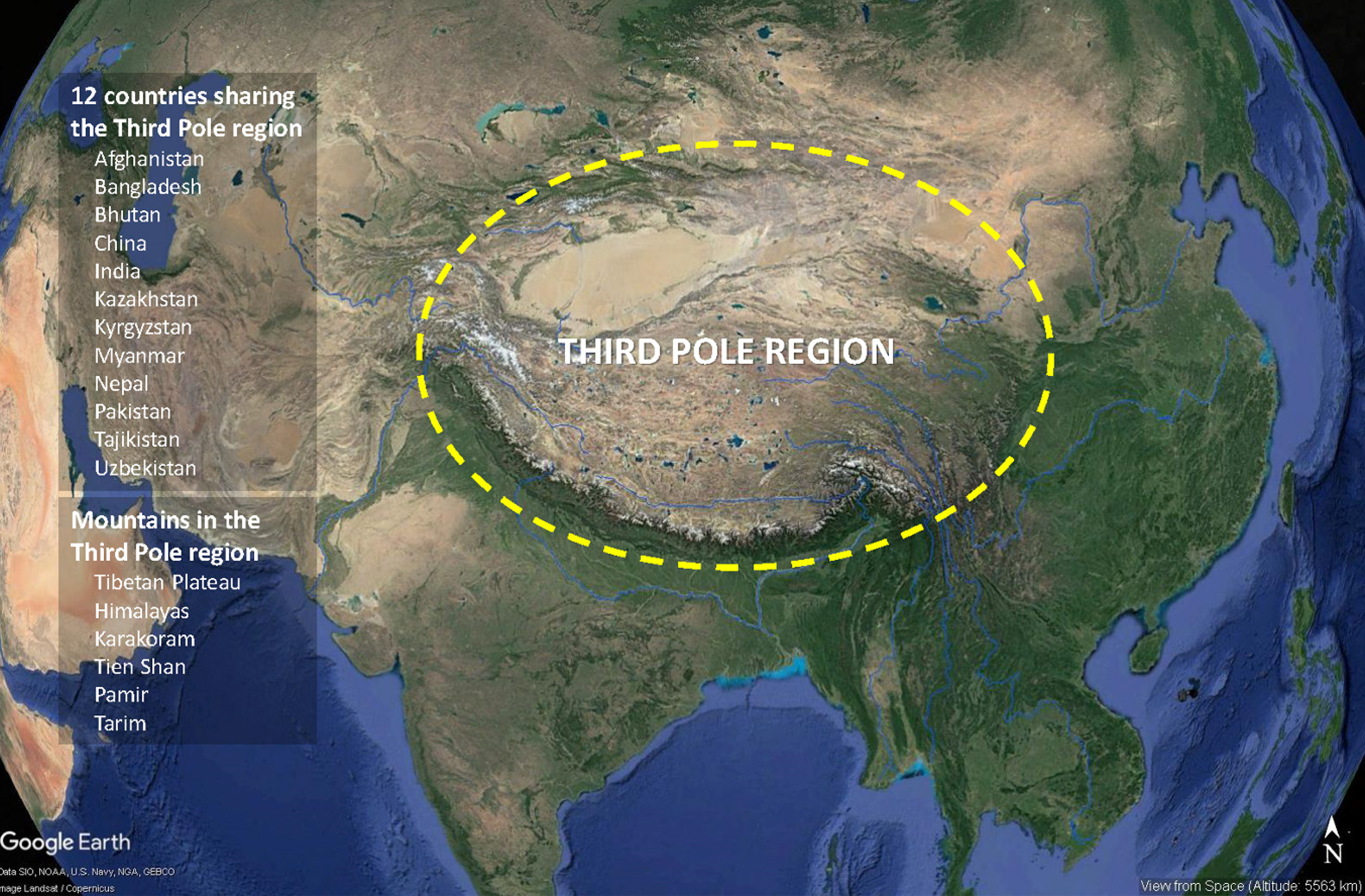
The Third Pole Region (TPR) at the heart of Asia.
The Third Pole environment is rapidly changing with changes driven by both climate and anthropogenic influence. 5 A rise in temperature of up to 0.3°C which is approximately three times the global warming rate has been reported. 6 Scientists report of warming also induced by black carbon and other Persistent Organic Pollutants. 7 8 The precipitation in most parts of the northwestern Third Pole is projected to increase in the 21st century. 9 Scientists warn about accelerated glacier retreat, permafrost degradation, variations in monsoon patterns, and rapid changes in snow duration, snow depth and ice cover. 10 11 12 13 In-situ monitoring of permafrost shows significant increase in active layer depth and ground temperature. 14 The degradation and thinning of permafrost, while a consequence of warming also has a carbon feedback loop where with warming a large pool of carbon sequestered in them gets released back into the atmosphere accelerating global warming. 15 Impact of the increased greenhouse gas emissions is considered to be more serious in the TPR than any other place in the world, 16 with severe consequences evident in the downstream communities. 17 Being one of the most sensitive areas to climate change, the TPR has been considered as the place where early warning signals of global warming can be easily observed. 18
Key concern is the transboundary and upstream-downstream consequences. The atmospheric pollutants generated far down in South Asia gets transported to the greater Himalayan Region via the Indian monsoon and westerlies, inducing greater warming of high-altitude areas. 19 The impact on the several of the larger glaciers in the Third Pole through glacier collapse, glacier surge, glacial debris flow, and glacial lake outburst flood have consequences on water resources management and socio-ecological systems on lower reaches. 1 Glacial lake outburst floods (GLOFs) are most apparent in the Third Pole 21 that devastate lives and livelihoods up to hundreds of kilometers downstream of their source. 22 23 The Hindu Kush Himalaya – an integral part of TPR – often referred to as “the pulse of the planet” and “a barometer for the planet’s health crises” aptly describes the scenario that i) the impacts of climate change and any other environmental changes are strongly evident here, and ii) changes that happens here have greater repercussions outside the region – probably across the entire planet. 24 The rapidly changing climate environment in the TPR means cascading changes in snow, water, air, land, biodiversity, and people not just in the Third Pole but adjacent river basins and landscapes as well as across continents. For example, degradation of permafrost will impact underground water and soil, altering water and nutrient regulation functions of alpine ecosystems such as lakes, marshes, bogs, and pastures, 25 and then affecting their biodiversity and ecosystem services. With ecosystem services affected, the well-being of mountain people and those dependent on natural resource-based livelihoods is compromised. 26
With scenarios as critical as this, climate action and sustainable development in the TPR requires dedicated attention by scientists and policy makers. While a thorough scientific understanding of climate trends and projections, drivers of changes, and depth of consequences are necessary, identifying the cost of impact and inactions is equally vital. This is a herculean task for the geographic areas as large as 5 million Km2 and for any one country and one institution to take the responsibility. Scientific collaboration among all 12 countries is going to be key, but science alone is not the solution. The scientific finding needs to be translated into sustainable actions, and actions needs to be reinforced by regulatory mechanisms- the laws, policies, and legal frameworks. Strong environmental policies and laws are going to be crucial in future if countries sharing the TPR are to regulate anthropogenic influences and streamline long term global investments for climate action for the region. The countries of the TPR have a proactive role to play and show stronger commitments beyond their respective national obligations. The time is running out as scientists from across the world make explicit the threshold of 1.5°C, and the ‘tipping points’ for social-ecological systems beyond that warming threshold. 27 For the TPR, and especially for the mountains in general, even 1.5°C is already too high and damaging. 28
The TPR countries require concerted actions to combat both causes and consequences of climate change. This calls for access to a long-term, affordable finance to implement wide scale climate-resilient recovery measures, and harmonized green development solutions across all Third pole countries. 29 While technological and financial solutions are indispensable, regional policy solutions are going to be crucial and urgent. 30 Such policies provide a normative foundation for governance and administration across different scales, sectors, and countries. The international framework already provided a good basis to scale up national climate agenda at the regional scale for the Third Pole. The Paris Agreement (Article 6) recognizes the possibility of voluntary cooperation among Parties for setting higher ambition and principles – including environmental integrity, transparency and robust accounting – for any cooperation on international transfer of mitigation outcomes. It also emphasizes on a cooperative and facilitative basis with respect to loss and damage associated with the adverse effects of climate change (Article 8). Further, it establishes binding commitments by all Parties to carve nationally determined contributions (NDCs) to pursue domestic measures for climate actions (Article 4).
The Individual Governments’ role in creating that enabling regional mechanisms and legal procedures to harmonize actions among countries is fundamental if “carbon neutral- carbon negative” scenario is to happen for the TPR over the next century. The 12 countries of the Third Pole have made the global commitments and have their domestic legal arrangements in place. The member countries now need to put their heads together and raise collective concern and keep a broader vision for the entire TPR. A framework similar to those for other mountain regions in the world such as Arctic and Alpine Conventions would probably set that stage for concerted actions.
In the light of the above, a regional cooperation framework for Third Pole region to address climate change impacts could be beneficial for all the countries in the region, and also for its indigenous people and local communities. This document offers a basic conceptual background to this and looks into that future possibility of stronger and formalized regional cooperation among the countries particularly for climate actions where scientific evidences are strong and now globally recognized. 31 We envision an improved future climate scenario building on statements by governments at the recent Glasgow CoP26 negotiation, and existing enablers, and conclude with prospective governance mechanism for regional cooperation especially touching upon the role and implications of future alliances across the Third Pole nations. We begin with building the rationale for TPR examining the international legal instruments for mountains, and how other mountain regions have capitalized on such mechanisms, and where the TPR stands.
Need for the Third Pole Lens
Mountains in the world cover 22% of the earth land surface, shelter 25% of terrestrial biodiversity, supply 60–80% of global freshwater, provide range of ecosystem goods and services, and cater to 13% of the world’s population. 32 In general, poverty is higher in mountains and people are more at risk than people elsewhere. Yet, they do not receive considerable attention in international debate and discourse. The Agenda 2030, one of the most recent and transformative multilateral agenda for sustainable development has 169 targets within its 17 goals, and there is only one dedicated target for ‘mountains’ - target 15.4 to “ensure the conservation of mountain ecosystems, including their biodiversity, in order to enhance their capacity to provide benefits that are essential for sustainable development”. There are two other targets where the word ‘mountains’ are featured – Target 6.6 to “Protect and restore water-related ecosystems, including mountains, forests, wetlands, rivers, aquifers and lakes” and Target 15.1 to “Ensure the conservation, restoration and sustainable use of terrestrial and inland freshwater ecosystems and their services, in particular forests, wetlands, mountains and drylands, in line with obligations under international agreements.”
These are assuring but not adequate. The regional assessment of the Hindu Kush Himalayan region 33 identifies situations in the mountains that concerns all SDGs. To name a few, ending poverty in all its form (SDG1) where proportion of population below the international poverty line and proportion of population not covered by social protection are high; food and nutrition security (SDG 2) where average income of small holders and food producers are low, and proportion of food insecure population are high; gender and social equity (SDG 5) where participation, access to resources, technologies and decision making is limiting for women and marginalized communities; water security (SDG 6) where water for productive purpose, drinking and sanitation are inadequate; access to energy (SDG 7) where paradox of clean energy potential and energy access clearly exists; economic opportunities and development infrastructure (SDG 8 and 9) where despite huge potential for tourism and small and medium scale enterprises, outmigration is rampant; and importantly climate and disaster (SDG 17) where actions to keep global level climate change threshold to 1.5°C is urgent and crucial. These contribute to wider scale vulnerability in the mountain region. The SDGs are meant to be universal and indivisible, but mountain regions have undoubtedly been left behind, so is the mainstreaming of wider SDGs into climate actions.
Globally for the mountains, some progresses have been made. The 6th Assessment Report of Intergovernmental Panel on Climate Change (IPCC) now for the first time, featured a chapter on the impact of climate change in mountains. This is the endorsement of the scientific evidence on elevation-dependent warming, shrinking glaciers, reduced snow cover and changing precipitation patterns and their impacts on downstream water supply, energy production, ecosystem integrity, agricultural and forestry production, and disaster preparedness. 34 Scientists have played their role. The networks and alliances are making their mark. The Mountain Partnerships – a voluntary alliance of more than 200 Governments and organizations have been advocating for “conservation, health, vitality and stewardship of mountain ecosystems”. At Glasgow, The International Network of Mountain Indigenous Peoples called upon United Nations Framework Convention on Climate Change (UNFCCC) to protect indigenous land and food systems as a key solution to the climate crisis and preparedness.
There are examples of regional alliances among countries. For example, the Carpathian Convention which is the multi-level governance mechanism signed by the seven countries committing for the cause of Carpathian Mountain. There is a broader Alpine convention which is a sub-regional treaty-based regime for the protection and sustainable development of a mountain region worldwide. It provides a framework for cooperation and multi-sectoral policy coordination, a platform for developing joint strategies, and a forum for multi-stakeholders’ dialogue – linking the local community, national and international organizations, regional and national Governments, and the United Nations.
Although, progressive awareness of climate change impacts on mountains, mountain ecosystems and mountain communities across the world are happening over several international debates such as the United Nations Conference on Environment and Development in Rio de Janeiro in 1992, the Sendai Framework for Disaster Risk Reduction 2015–2030, the Paris Agreement 2015 of the United Nations Framework Convention on Climate Change (UNFCCC), greater pursuits for newer mountain perspectives are required that not only talk of mountain vulnerabilities but also of the prospects and opportunities mountains provide to mitigate the global challenges. 35
At the TPR, efforts are ongoing but are fragmented and the pace to achieving the 1.5°C climate target by countries are all different. There are countries such as Bhutan that is already ahead with carbon negative development status, while many of the bigger nations such as China, India are still to decarbonize their economies. Nepal – another smaller mountainous country sharing the Third Pole environment – in 2009 hosted a cabinet meeting at the snowclad Everest region to draw the attention of global community on how global warming was threatening the Himalayan mountains. The Mountain Alliance Initiative was proposed to bring all mountainous countries together for global negotiation. In 2012, the government hosted an International Conference on Mountains and Climate Change releasing a 10-point Kathmandu Call for Action appealing United Nations for effective flow of financial resources to mountainous countries. However, the momentum for concerted climate action for the mountains did not pick up. It was a small nation making the appeal. The mountain and climate agenda need to become a collective political agenda with all the Third Pole countries coming together with one regional cooperation and action framework for the TPR.
The HKH call to action (HKHC2A) was a recent facilitation by the International Centre for Integrated Mountain Development (ICIMOD) to get the Government of eight countries- Afghanistan, Bangladesh, Bhutan, China, India, Myanmar, Nepal, and Pakistan at one platform to promote the mountain agenda for the Hindu Kush Himalaya 36 . The Governments validated HKHC2A signing a ministerial declaration for regional cooperation to collectively address the climate crisis. However, it was difficult for countries to justify one stance for the Third Pole, with varying national development context and climate scenarios. Bhutan is ahead with their already carbon negative stance backed up by a clear pro-environmental national policy to reinforce the target. Nepal is taking an assertive pathway with timely commitment to the net zero target through stronger policy interventions. China has questioned the net zero and 1.5°C target stating that there is already too much carbon in the atmosphere and emissions have to be immediately stopped - the scenario which is very unlikely in the development context.
Both, India and China have moved their national target for net zero much beyond 2050. Other developing nations including Bangladesh and Pakistan have questioned that “Copenhagen Pledge of 100 billion” in 2019 from rich nations for developing nations to adapt to climate change and mitigate further rises in temperature- were never met. The Organization for Economic Co-operation and Development (OECD), an intergovernmental body mostly comprising developed countries report of their $80 billion contribution in climate finance to developing countries in 2019. 37 The question is where and how countries sharing the Third Pole find convergence and have one voice for drawing available Other Development Assistance (ODA) related to climate actions.
Envisioning the Future
Our arguments for the future of the Third Pole are built from the current stance some of the Third Pole countries, and regional organizations have taken at Glasgow COP 26. These reflect upon the hope for positive national level scenario for being carbon neutral or carbon negative, importance of regional cooperation, international commitments. We then draw examples of other mountain conventions to shed light on the prospect of a wider “Third Pole Alliance” to intensify voice for urgent investments and actions.
(i) Hope for a Positive National Scenario
The Minister of Agriculture and Forests from Bhutan indicated that Bhutan is not only “carbon neutral”, but also “carbon negative”. It has already realized the goal of the Paris Agreement, which the rest of the world intends to achieve by 2050 or beyond. The first key point is that positive climate scenario for mountains is possible and countries at the Third Pole have potential to make that happen. The countries are committed and adopting greener solutions that are less environmentally invasive, and climate smart that is less carbon emitting and high carbon removing. It is to be noted that the carbon negative scenario of Bhutan is backed by strong pro-environmental Constitution of Bhutan and its Gross National Happiness (GNH) development strategy that creates enabling legal condition for achieving that ambitious climate innovation.
(ii) Need for Regional Efforts
The eight HKH countries made their statement clear that the causes and impacts of climate change are transboundary in nature, and addressing them requires a regional approach, while actions are being taken at local and national levels. The second point is that regional efforts are necessary and transboundary interventions are now being acknowledged by the both national and global institutions, for example transboundary landscapes management 38 and transboundary water governance. 39 The Ministerial Declaration in support of the HKHC2A is now there to support increased financial investments in climate action and to strengthen regional cooperation to deliver climate action at scale for the Hindu Kush Himalaya. Globally, the multilateral agreements such as the Agenda 2030 also acknowledges the importance of regional frameworks, regional economic integration and interconnectivity in sustainable development and the role of regional institutions to facilitate the effective translation of policies into concrete actions at national level. 40
(iii) Expression of Support at Glasgow COP26
The Climate Action for a Resilient Asia (CARA) program was announced during COP26 by the UK Government. The representative from the UK Government remarked that, “The Climate Action for Resilient Asia (CARA) program takes a regional approach to addressing shared environmental challenges”. The third point here is that Other Development Assistance are available for the regional scale efforts and it is essential that the countries develop a collective plan of action under the overarching Third Pole alliance- which we realize can be a powerful means for regional cooperation for climate action in the TPR.
(iv) The Idea for Regional Mechanism
Developing the alliances of the government however is not an overnight process. It took four decades of preparation for Alpine Convention to happen since its conception in 1952. 41 The Alpine Convention Framework needed to first recognize economic, recreational, cultural, and environmental elements of Alps, and their values beyond. It needed to factor in the significant differences that were there among the States ratifying the Convention. The research and monitoring, legal, scientific, economic and technical cooperation, the institutions mechanism for decisions and collective messages needed to be outlined. Despite all, the implementation took longer for countries to mainstream the Convention agenda into their national policy settings. Key drawbacks were the harmonization of thematic proposals and actions, and consensus on interventions sectors. Language was also the key barrier and official language had to be defined before signing. Ratification of convention was also a slow process of constant negotiations- often oscillating between different offices and levels. Such difficulties are prominent too for the TPR. Rather than a formal convention, a quick formulation of an alliance for the Third Pole may be more feasible- one that is bound by a regional cooperation framework. The collective purpose would be to raise global awareness about the Third Pole environment, how it is influenced by downstream development actions, and how its degradation affects the wider landscapes and livelihoods. The alliance may help identify transboundary issues that is beyond the national legislation, one that requires regional interventions such as air pollution, energy, water, and climate resilience.
The development of a Third Pole regional information system would be useful to monitor longer term trends both scientific and investments on both adaptation and mitigation actions. The vision would be about all 12 countries engaged in dialogue and collaborative scientific actions to begin with. However, the policy dialogues will have to begin gradually to garner political will and harmonize environmental and climate policies and laws across the nations reinforcing actions for common concern. One major role of the alliance would be to draw global investments and channelize for the sustenance of Third Pole - the key therefore, would be innovating a mechanism to mobilize the resource equitably.
Why A Regional Cooperation Framework?
Article 7 of the Paris Agreement recognizes adaptation as a global challenge faced by all the parties. To this end all parties in the TPR have their adaptation plans to be implemented in a way that it minimizes unsustainable resources harvesting and reduces GHG emission. This can be done in much more systematic and collaborative way if done under a common regional framework. A critical advantage of this would be increased bargaining power of each country with cumulative result performances, while countries get to fulfill their national obligations. In addition, technical cooperation among the member countries can be harmonized and better facilitated and realized for greater predictability, which helps to streamline the program implementation process. The framework provides that effective means to develop a shared understanding about larger ecosystems to which they are one component. It will help them realize collective opportunities and their own shared risks of overall impacts of climate change.
Another advantage of regional cooperation framework would be its capacity to safeguard the rights of indigenous people and local communities in the mountains. A regional cooperation framework would be an opportunity to promote wider societal learning and exchange, and knowledge generation. A wider range of actors and stakeholders could be engaged and made aware. The regional framework would offer an opportunity for regular government level dialogue and discussions to iteratively refine adaptation and mitigation actions, painting a much more convincing picture for TPR to the global negotiations.
One of the contentious issues in Paris Agreement was the loss and damage, and how the loss and damage could be compensated in particular to large scale climate induced disaster. Regional cooperation framework could be resourceful here with equitable compensatory mechanism agreed to mitigate impact of such transboundary disasters and damaging events. Sharing of information on different aspects of cryosphere, glaciology, hydrology, temperature rise and other aspects of climate change impacts is going to be vital for enhancing the technical and scientific collaboration. The role of robust clearing house mechanism has been widely acknowledged 42 basically to support dissemination of authentic and comparable scientific information.
The Third Pole Alliance: Proposed Regional Cooperation Mechanism
(i) Principles and Agenda for Engagement
First and foremost, the regional cooperation framework for the establishment, governance, and sustenance of the Third Pole Alliance will require a shift in paradigm thinking about the principles of engagement. Its basis has to be the principle of Do No Harm 43 rather the principle of Common but Differentiated Responsibilities by States. 44 Climate change is certainly the most important harm we have inflicted upon this earth, but rarely the no-harm principle is featured into the international climate regulations. This shift is necessary to ensure that actions falling within the national jurisdictions do not cause transboundary harm or cross-border damage. The principle of no-harm has been particularly difficult in terms of climate negotiations as many a times influential states have been accounted for inducing greater damage to climate and environment. However, with greater awareness of damaging consequences of climate change and devastations all over the world, the no-harm principle is becoming the cornerstone of international environmental law 45 and is being considered as a cross-cultural and cross-disciplinary climate ethics for betterment of humanity. 46 This implies that the Agenda for the Alliance will also have to look beyond a voluntary funding commitments and nationally determined contributions and endorse a regional regime of rights and obligations and collaborative responsibilities and restorative investments to mitigate damage beyond the border.
The possibility of TPR Alliance can further be strengthened through arguments around safeguarding TPR as a common biocultural heritage. The framework on biocultural heritage often provides a softer ground for knowledge co-production and integrated landscape analysis, and translation of knowledge to culturally sensitive policy and management. 47 The Alliance may therefore endorse the agenda of i) collective climate response measures that considers synergies and trade-offs and avoids deliberate damage; ii) shared understanding and awareness about the impact of climate response measures; and iii) long term investment mechanism to promote regular exchange of knowledge, information and innovative solutions around climate adaptation and mitigation.
(ii) Prospective Governance Mechanism
The Third Pole Alliance governance mechanism (Fig. 2) is intended to respond to the collective interest of countries and communities in the TPR by defining a transformative knowledge pathway to move from a current crisis scenario to a resilient and climate smart TPR. The target is to be achieved through an iterative processes of regional scale agenda setting, Third Pole Alliance secretariat establishment, and Third Pole collective fund establishment, implementation of actions, and monitoring and evaluation. Regional cooperation framework needs to set the stage for all Third Pole countries to collectively reflect how transboundary climate risk can be addressed, how joint research and data sharing can be facilitated, and ultimately how regional and international learning and technology transfer for innovation, capacity building, and green development can be pursued.
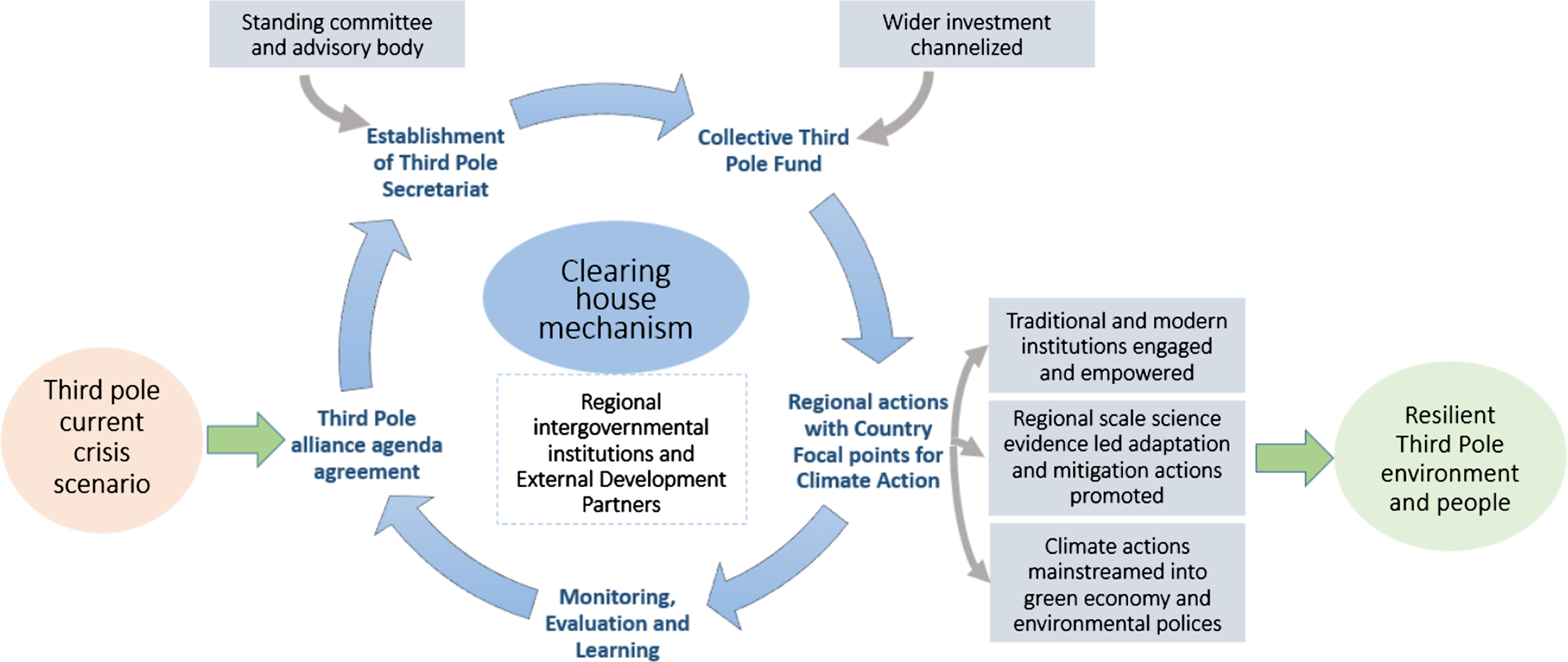
Prospective governance mechanism for regional cooperation in TPR.
We envision that the role of Clearing House Mechanism is going to be central for knowledge management, communication and outreach; and for long term monitoring and evaluation of results, progress, partnerships and investments. Equally crucial is the role of intergovernmental and regional institutions and external development partners to facilitate the process of regional dialogues and global negotiations, and support regional management and resource infrastructure, as well as substantiate technical backstopping for implementation of climate actions. Recent example of such support comes from the Hindu Kush Himalaya where the collective voice of eight countries for climate negotiation was made at Glasgow. 48
The first on the list of iterative process is getting the 12 countries to develop a common agenda for climate actions that is built from science evidence and comprises interdisciplinary topics. Thematically, NDCs-SDGs connect can be explored. The 2020 agenda places climate actions as one of the 17 goals - the Goal 13 which is dedicated to urgent action to combat climate change and its impact. The connection among different disciplines: cryosphere, glaciers, water, air, ecosystems, food, energy, livelihoods, and gender and social inclusion can be discussed before defining a common TPR action agenda. A variety of institutional issues would have to be discussed such as the country’s laws, regulations and policies, and the organizational set up to steers low carbon socio-economic activity. A harmonized regional legislative framework and policies will be necessary importantly to build strong political will for sustaining the Alliance.
The operationalization of the Alliance needs a strong institutional set up. We propose an establishment of a Third Pole Secretariat overseeing key administrative processes, probably hosted within regional institutions at the TPR. Formulation of a standing committee and advisory board can serve as a decision-making body. The committee may comprise key stakeholders and the right holders in the Third Pole region such as all 12 signatory countries, national and regional institutions with relevant mandate and capacity; and key investors. The standing committee may include climate change focal point from all signatory countries, assisted by a consultative body comprising private sector representative, civil society organization, research institutions and academia, and other relevant international institutions and donor agencies.
The importance of large-scale investment to facilitate a low carbon transition is well highlighted. 49 International development partners are coming forward, however substantial funds have to be generated from inside the region. National government have plenty of legal authorities to raise revenues to fund carbon neutral actions and likewise eliminate support for unsustainable and climate insensitive actions. Government need to use their power to raise fund and direct investment flow multiplying the efforts. Scaled-up investment is required to deliver ambitious climate action for the HKH and the Third Pole. This includes an increase in financial resources, enabling policy, technology, and capacity to transition to a green, resilient, and inclusive world by 2030. 50 Dedicated investment for research and development would be necessary to regularly monitor trends and results and innovate technological innovations that accelerates transition to a low carbon economy. Two of the big Third Pole countries- China and India are massively increasing their research and development investment. There is a need to develop and address the systemic challenges to enhance the climate capital. Some of the challenges are: organizational silos and competing mandates, limitations of available financial instruments and risk paradigms, and weak local disbursement capacity. For this, establishing a regional Third Pole investment fund would be desirable to effectively and equitably mobilize the resource. Funds can be sourced and assessed from international commitments. Multilateral Climate Funds play a critical role in stimulating climate action. It will help accelerate innovative and scaled-up finance unlocking economic resilience. 51 Some funds can be accessed through the multilateral climate finance architecture like Green Climate Fund (GCF) and Adaptation Fund which are operating entities of the financial mechanism of UNFCCC. Key would be widening the investment channels for the TPR.
Regional climate actions in the respective countries have to be streamlined in a way to engage and empower both traditional and modern institutions, to promote regional scale research and knowledge led mitigation and adaptation actions; and to mainstream climate into both economic and environmental policies and planning. Establishment of an effective monitoring, evaluation and learning (MEL) platform is going to be crucial to measure change and define results and responsiveness of regional mitigation and adaptation actions. The MEL framework is essential also to foster collaboration among climate information providers and users and investors supporting the process. Effective learning mechanism is essential for iterative improvement and design of the Third Pole Alliance and the progress it brings.
The Third Pole alliance of the 12 countries will be pivotal in achieving the global target of limiting climate warming to 1.5°C, as it would provide a common operating space for all Third Pole countries. The countries would have a collective understanding of changes happening in the Third Pole, of the legal measures different countries have put in place, and of the capacities and resources needed to make change happen. The regional alliance mechanism will help governments to monitor allocation of resources, reinforce regulatory mechanisms, and steer the pace of change towards net zero target. A comprehensive all-government approach is absolutely vital to coordinate actions in different countries, especially those that have transboundary consequences. There are already innovative existing legal measures and strategies available with different countries which need to be capitalized upon and scaled out. For example, there is “Gross National Happiness” for Bhutan looking at a happy, equitable, and resilient society; there is “ecological civilization” for China that is geared towards environmentally oriented development. Importantly, there are growing volume of scientific evidence guiding the understanding of long-term climate change risk and consequences.
In the future, the level of effort for the Third Pole has to be a legally cumulative one, with policy directions balancing both mitigation and adaptation measures. This implies that key means of implementation including finances, technologies, and businesses have to be bigger with regional scale orientation, ambitious enough to drive longer term mitigation strategies designed to regulate sources of greenhouse gas emissions; complemented by adaptation strategies designed to immediately respond to the impact of climate change on humans and the environment. Efforts need to be in place to support countries and national government to substantiate the regional effort through strong environmental policies and guidelines- mainstreaming them into other sectoral policies and programmes, including national budgets going to subnational and local scales. It is important for the national Governments to raise their level of ambitions to talk about the bigger picture – the Third Pole - the safeguarding of which is critical and which is possible only if 12 countries join hands as allies.
Footnotes
Qiu, J. (2008), “The third pole: climate change is coming fast and furious to the Tibetan plateau. Jane Qiu reports on the changes atop the roof of the world”, Nature, 454(7203), 393-397.
Bothe, O., Fraedrich, K., & Zhu, X. (2011), “Large-scale circulations and Tibetan Plateau summer drought and wetness in a high-resolution climate model”, International Journal of Climatology, 31(6), 832-846.
Liu, S., Wu, Q., Wang, L., Schroeder, S. R., Zhang, Y., Yao, Y., & Hu, H. (2020), “Modeled Climate Responses to Realistic Extremes of Northern Hemisphere Spring and Summer Snow Anomalies”, Journal of Climate, 33(22), 9905-9927.
Immerzeel, W. W., van Beek, L. P. H. & Bierkens, M. F. P. (2010), Climate Change Will Affect the Asian Water Towers. Science, 328, 1382-1385.
Moors, E. J., Groot, A., Biemans, H., van Scheltinga, C. T., Siderius, C., Stoffel, M.,... & Collins, D. N. (2011), “Adaptation to changing water resources in the Ganges basin, northern India”, Environmental Science & Policy, 14(7), 758-769.
Qiu, J. (2008), “The third pole: climate change is coming fast and furious to the Tibetan plateau. Jane Qiu reports on the changes atop the roof of the world”, Nature, 454(7203), 393-397.
Wang, X. P., Gong, P., Yao, T. D., & Jones, K. C. (2010), “Passive air sampling of organochlorine pesticides, polychlorinated biphenyls, and polybrominated diphenyl ethers across the Tibetan Plateau”, Environmental science & technology, 44(8), 2988-2993.
Xu, B., Cao, J., Hansen, J., Yao, T., Joswia, D. R., Wang, N.,... & He, J. (2009), “Black soot and the survival of Tibetan glaciers”, Proceedings of the National Academy of Sciences, 106(52), 22114-22118.
Yao, T., Thompson, L., Chen, D., Zhang, Y., Wang, N., Zhao, L.,... & Wang, W. (2020), “Third Pole climate warming and cryosphere system changes”, Bulletin n°, 69, 1.
Yao, T., Wang, Y., Liu, S., Pu, J., Shen, Y., & Lu, A. (2004), “Recent glacial retreat in High Asia in China and its impact on water resource in Northwest China”, Science in China Series D: Earth Sciences, 47(12), 1065-1075.
Che, T., Hao, X., Dai, L., Li, H., Huang, X., & Xiao, L. (2019), “Snow cover variation and its impacts over the Qinghai-Tibet Plateau”, Bull. Chin. Acad. Sci, 34, 1247-1253.
Bolch, T., Kulkarni, A., Kääb, A., Huggel, C., Paul, F., Cogley, J. G.,... & Stoffel, M. (2012), “The state and fate of Himalayan glaciers”, Science, 336(6079), 310-314.
Yao, T., Xue, Y., Chen, D., Chen, F., Thompson, L., Cui, P.,... & Li, Q. (2019), “Recent third pole’s rapid warming accompanies cryospheric melt and water cycle intensification and interactions between monsoon and environment: Multidisciplinary approach with observations, modeling, and analysis”, Bulletin of the American Meteorological Society, 100(3), 423-444.
Yang, M., Nelson, F. E., Shiklomanov, N. I., Guo, D., & Wan, G. (2010), “Permafrost degradation and its environmental effects on the Tibetan Plateau: A review of recent research”, Earth-Science Reviews, 103(1-2), 31-44.
Jin, H. J., Yu, Q. H., Wang, S. L., & Lü, L. Z. (2008), “Changes in permafrost environments along the Qinghai–Tibet engineering corridor induced by anthropogenic activities and climate warming”, Cold Regions Science and Technology, 53(3), 317-333.
Duan, A., Wu, G., Zhang, Q., & Liu, Y. (2006), “New proofs of the recent climate warming over the Tibetan Plateau as a result of the increasing greenhouse gases emissions”, Chinese Science Bulletin, 51(11), 1396-1400.
Zheng, G., Allen, S. K., Bao, A., Ballesteros-Cánovas, J. A., Huss, M., Zhang, G.,... & Stoffel, M. (2021), “Increasing risk of glacial lake outburst floods from future Third Pole deglaciation”, Nature Climate Change, 11(5), 411-417.
Yao, T., Xue, Y., Chen, D., Chen, F., Thompson, L., Cui, P.,... & Li, Q. (2019), see n.13.
Xia, X., Zong, X., Cong, Z., Chen, H., Kang, S., & Wang, P. (2011), “Baseline continental aerosol over the central Tibetan plateau and a case study of aerosol transport from South Asia”, Atmospheric environment, 45(39), 7370-7378.
Emmer, A. (2018), “GLOFs in the WOS: Bibliometrics, geographies and global trends of research on glacial lake outburst floods”, (Web of Science, 1979–2016). Natural Hazards and Earth System Sciences, 18(3), 813-827.
Carrivick, J. L., & Tweed, F. S. (2016), “A global assessment of the societal impacts of glacier outburst floods”, Global and Planetary Change, 144, 1-16.
Cook, K. L., Andermann, C., Gimbert, F., Adhikari, B. R., & Hovius, N. (2018), Glacial Lake outburst floods as drivers of fluvial erosion in the Himalaya. Science, 362(6410), 53-57.
Dubey, S., & Goyal, M. K. (2020), “Glacial lake outburst flood hazard, downstream impact, and risk over the Indian Himalayas”, Water Resources Research, 56(4), e2019WR026533.
Krishnan, R., Shrestha, A. B., Ren, G., Rajbhandari, R., Saeed, S., Sanjay, J.,... & Ren, Y. (2019), “Unravelling climate change in the Hindu Kush Himalaya: rapid warming in the mountains and increasing extremes”, In The Hindu Kush Himalaya Assessment (pp. 57-97). Springer, Cham.
Connon, R. F., Quinton, W. L., Craig, J. R., & Hayashi, M. (2014), “Changing hydrologic connectivity due to permafrost thaw in the lower Liard River valley, NWT, Canada”, Hydrological Processes, 28(14), 4163-4178.
Yang, M., Nelson, F. E., Shiklomanov, N. I., Guo, D., & Wan, G. (2010), “Permafrost degradation and its environmental effects on the Tibetan Plateau: A review of recent research”, Earth-Science Reviews, 103(1-2), 31-44.
IPCC, T. (2001), “Climate change 2001: synthesis report”, Intergovernmental Panel on Climate Change (IPCC), Geneva, Switzerland.
Krishnan, R., Shrestha, A. B., Ren, G., Rajbhandari, R., Saeed, S., Sanjay, J.,... & Ren, Y. (2019), see n.24.
Roy, J., Moors, E., Murthy, M. S. R., Prabhakar, S. V. R. K., Khattak, B. N., Shi, P.,... & Chitale, V. (2019). “Exploring futures of the Hindu Kush Himalaya: scenarios and pathways”, In The Hindu Kush Himalaya Assessment (pp. 99-125). Springer, Cham.
Corbera, E., Roth, D., & Work, C. (2019), “Climate change policies, natural resources and conflict: implications for development”, Climate Policy, 19(sup1), S1-S7.
IPCC (2021): Climate Change 2021: The Physical Science Basis. Contribution of Working Group I to the Sixth Assessment Report of the Intergovernmental Panel on Climate Change [Masson-Delmotte, V., P. Zhai, A. Pirani, S.L. Connors, C. Péan, S. Berger, N. Caud, Y. Chen, L. Goldfarb, M.I. Gomis, M. Huang, K. Leitzell, E. Lonnoy, J.B.R. Matthews, T.K. Maycock, T. Waterfield, O. Yelekçi, R. Yu, and B. Zhou (eds.)]. Cambridge University Press.
Veith, C., & Shaw, J. (2011). Why invest in sustainable mountain development?
Wester, P., Mishra, A., & Mukherji, A. S. A., The Hindu Kush Himalaya Assessment: Mountains, Climate Change, Sustainability and People. The Hindu Kush Himalaya Assessment (Springer International Publishing, 2019). doi:https://doi.org/10.1007/978-3-319-92288-1
IPCC (2021), see n.31.
Sharma, E., Molden, D., Rahman, A., Khatiwada, Y. R., Zhang, L., Singh, S. P.,... & Wester, P. (2019), “Introduction to the Hindu Kush Himalaya assessment”, In The Hindu Kush Himalaya Assessment (pp. 1-16). Springer, Cham.
Wester et al (2019) see n.33
Organisation for Economic Cooperation and Development [OECD] (2021), Climate Finance Provided and Mobilised by Developed Countries: Aggregate Trends Updated with 2019 Data.
Kotru, R. K., Shakya, B., Joshi, S., Gurung, J., Ali, G., Amatya, S., & Pant, B. (2020), “Biodiversity Conservation and Management in the Hindu Kush Himalayan Region: Are Transboundary Landscapes a Promising Solution?”Mountain Research and Development, 40(2), A15.
Timmerman, J., Matthews, J., Koeppel, S., Valensuela, D., & Vlaanderen, N. (2017), “Improving governance in transboundary cooperation in water and climate change adaptation”, Water policy, 19(6), 1014-1029.
UN (2015), “Transforming our world: the 2030 agenda for sustainable development,”New York: United Nations, Department of Economic and Social Affairs.
Price, M. F. (1999), “Towards co-operation across mountain frontiers: The Alpine Convention”, European Environment, 9(3), 83-89.
Lunde, L. (1992), “Towards Cost-Effective Climate Agreements: Is a Clearinghouse Mechanism the Logical First Step?” International Challenges, 12(2), 23.
Mayer, B. (2016), The relevance of the no-harm principle to climate change law and politics. Asia Pacific Journal of Environmental Law, 19(1), 79-104.
Honkonen, T. (2009), “The Principle of Common but Differentiated Responsibility in Post-2012 Climate Negotiations”, Review of European Community & International Environmental Law, 18(3), 257-267.
Sands, P. (2016), “Climate change and the rule of law: Adjudicating the future in international law”, Journal of Environmental Law, 28(1), 19-35.
Rentmeester, C. (2014), “Do no harm: a cross-disciplinary, cross-cultural climate ethics”, De Ethica, 1(2).
Lindholm, K. J., & Ekblom, A. (2019), “A framework for exploring and managing biocultural heritage”, Anthropocene, 25, 100195.
Kaur, N., Sharma, D., Rana, P. J., Mishra, U., Shrestha, A. B., Koziell, I., & Gyamtsho, P. (2021), “HKH2Glasgow: Promoting Ambitious Climate Action for the Hindu Kush Himalayas”, Mountain Research and Development, 41(4), P1-P3.
Bolton, R., Foxon, T. J., & Hall, S. (2016), “Energy transitions and uncertainty: Creating low carbon investment opportunities in the UK electricity sector”, Environment and Planning C: Government and Policy, 34(8), 1387-1403.

Zhongming, Z., Linong, L., Xiaona, Y., Wangqiang, Z., & Wei, L. (2021), Supporting developing countries on the road to a climate-resilient recovery from the COVID-19 pandemic.