



Abstract
Since the recognition by the UN General Assembly resolution 43/53 (6 December 1988) that “climate change is a common concern of mankind” as well as adoption of the UN Framework Convention on Climate Change (UNFCCC) at the 1992 Rio Earth Summit, climate change has emerged as one of the most pressing global environmental challenges. The IPCC AR6 (April 2022) curated scientific evidence has explicitly observed that “Net anthropogenic GHG emissions have increased since 2010 across all major sectors globally.” The cumulative effect of GHG emissions appears to exacerbate the abnormal weather events, melting the polar ice caps and cause other cataclysmic climatic changes. The effects of climate change transcend territorial boundaries and continents. It has provided a normative basis for the concerted international law-making process underneath the existing UNFCCC led global regulatory regime. It designated climate change as a common concern of humankind. The resultant soft normativity has been shaped into the hard law through the trajectory of three international legal instruments that took the forms such as common but differentiated responsibilities and respective capabilities (1992 UNFCCC) to international legal commitments only for Annex I countries (1997 Kyoto Protocol) and the nationally determined commitments by the parties (2015 Paris Agreement). This study has sought to place under scanner the graded evolution of the climate change regime through the in-built law-making process premised upon a common concern of humankind. In the aftermath of the UN Secretary-General’s warning about climate emergency as part of “triple planetary crisis”, it is high time the international law scholars, the UN General Assembly and the UNFCCC regulatory process shift into the higher trajectory of climate change as a planetary concern.
Keywords
Introduction
The inaugural remarks of the UN Secretary-General Antonio Guterres on 2 June 2022 at the historic Stockholm+50 Conference about “climate emergency” 1 as one of the “triple planetary crisis” has brought to the fore the spectre of existential planetary scale threat to the humankind. This author’s observations 30 years ago, exactly at the time when the 1992 Rio Earth Summit 2 set the stage for signature on the finally adopted text of the UN Framework Convention on Climate Change (UNFCCC), 3 hold relevance as it has vindicated that:
“much of the developmental process in the world today does not appear to be sustainable. Many of our economic, monetary and trade policies in sectors such as energy, agriculture, forestry and human settlements tend to induce and reinforce non-sustainable development patterns and practices. Apart from the irreversible squandering of our biological capital, we are confronting a growing problem of environmental refugees - people who are forced to abandon their traditional habitat because of adverse environmental conditions - which is also peculiar to our age. In fact, the human quest to conquer nature through science and technology has brought us on to the present brink. The threats to our eco-system essentially emanate from human activities in almost every sector.” 4
It has been feared for long that armed with the prowess of science and technology, the humankind has assumed considerable ability to transform the earth’s fragile essential ecological processes. There are strong indications of a simmering global environmental crisis at work. The root cause of many of the present-day ecological upheavals 5 lay in this environmental disequilibrium that prevails in the world.
Advent of Climate Change
Though it is difficult to define climate change, Article 1(2) of the UNFCCC states:
“Climate change” means a change of climate which is attributed directly or indirectly to human activity that alters the composition of the global atmosphere and which is in addition to natural climate variability observed over comparable time periods. 6
In April 2022, the curated sixth assessment report of the Intergovernmental Panel on Climate Change (IPCC) explicitly observed: “Net anthropogenic GHG emissions have increased since 2010 across all major sectors globally” and in fact pegged at “54% (21 GtCO2-eq) higher than in 1990.” 7 This increase in emissions has been attributed to urban areas and the rising global activity levels in areas such as industry, energy supply, transport, agriculture and buildings. The cumulative effect of anthropogenic GHG emission-driven gradual warming of the atmosphere seems to exacerbate the threat of melting the polar ice caps and trigger major climatic changes around the world. 8
Since the effects of climate change transcend across territorial boundaries and the “climate emergency” 9 is now felt on a planetary scale, it has been regarded as one of the ‘common concerns’ of the humankind. The issue of climate change is linked with development as well as ethics and equity. It has become part of the present and future predicament of the humankind. According to Article 1 (1) of the UNFCCC:
“Adverse effects of climate change” means changes in the physical environment or biota resulting from climate change which have significant deleterious effects on the composition, resilience or productivity of natural and managed ecosystems or on the operation of socio-economic systems or on human health and welfare. 10
The first opening line of preamble to the UNFCCC has placed climate change on a high pedestal by acknowledging that “change in the Earth’s climate and its adverse effects are a common concern of humankind”.
It is in this background that the study 11 seeks to present some reflections on international law-making process underneath the existing global regulatory regime on climate change. The scheme of discussion comprises the following: 1. Introduction; 2. Advent of climate change; 3. From common heritage to common concern; 4. Sui Generis Law-making Process; 5. ‘Differentiation’ for Common Concern; 6. Equity as a basis for Common Concern; 7. 2015 Paris Agreement: Dilution of ‘Differentiation’? 8. From Common Concern to Planetary Concern; 9. Conclusion.
From Common Heritage to Common Concern
The mosaic of international law has witnessed law-making process for the regulation of certain areas going through usage of loaded concepts such as common interest, common heritage and common concern. It underscores the working of pragmatism, convenience and co-operation amongst the states to address some special global problematique. It is the General Assembly (GA), as plenary organ of the 193-member United Nations (UN) that has played a crucial role in the evolution of normative engineering needs of the time, prevailing cooperative spirit among the sovereign states and invocation of the regulatory technique warranted by the issues at stake.
The UNGA’s potential to influence the international law-making processes remained largely unrealized and untapped for almost a decade since inception of the UN. It began to provide a forum for the international law-making process with emergence of the newly independent states. These former colonies used the plenary organ of the UN to rectify legacy of immanent inequalities in the spheres of economic and social development, gain collective legitimization of their common needs and aspirations, as well as sought to bring about changes in some of the rules of traditional international law. In fact, they were able to swiftly crystallise the principles such as permanent sovereignty over natural resources, non-intervention and self-determination, among others, as the fundamental norms of international law. 12
In the international law-making process, the UNGA has acted as ‘conductor of a grand orchestra’ that provides political guidance to the States, notwithstanding the inbuilt Charter limitation that it can only make ‘recommendations’ 13 through its resolutions. The UNGA has adopted a familiar modus operandi in this process. Through resolutions, it recognizes and takes cognizance of a given issue of global significance (such as environment, population, women, and social issues) and sets the stage for the convening of a global conference of the member states. The technique of ‘global conferencing’ does help in focusing attention and galvanizing international public opinion and, thereby, goading the states to cooperate to collectively take a specific course of action. In order to sustain this momentum, the UNGA has sought to put into place required institutional structures as a follow-up instrumentality. For example, in the area of environment, it has established United Nations Environment Programme (now called UN Environment) and Commission on Sustainable Development (now disbanded and replaced with the High-Level Political Forum on Sustainable Development). 14
In the specific case of the climate change issue, the UNGA has played a catalytic role to launch the global regulatory process and adopted a resolution 43/53 (1988): Protection of Global Climate for Present and Future Generations of Mankind. It declared that climate change is a common concern of mankind and that “necessary and timely action should be taken to deal with climate change within a global framework.” 15 It welcomed and appreciated the initiative of Malta to consider “conservation of climate as a ‘common heritage of mankind”. The UNGA was concerned that “certain human activities could change global climate patterns that are threat to present and future generations with potentially severe economic and social consequences.” However, unlike the 1982 UNCLOS, the efforts by Malta did not succeed to have the UNGA declare conservation of climate as a “common heritage of mankind”. 16 In fact, in the Explanatory Memorandum annexed with its request to the UNGA, Malta contended that climate was “a natural resource” and, therefore, there was need for “a global strategy to conserve climate in order to ensure that life on Earth can be sustained.” 17 Malta further reasoned that the problem of climate change was of such magnitude that there must be some means of ensuring that the available limited resources were effectively utilized in the interest of all mankind. 18 In the end, the General Assembly recognized the issue of climate change as a “common concern of mankind.” 19
The echo of this salutary declaratory statement came to be reflected in two global conventions on climate change (UNFCCC) 20 and biological diversity (CBD) 21 that opened for signature at Rio de Janeiro during the 1992 United Nations Conference on Environment and Development (UNCED). The notion of ‘common concern’ catered to the requirements of international community interest in a common resource. It laid down a prima facie basis for common action through an appropriate regulatory framework. Since such issues cannot be addressed, in a bilateral context or by a limited number of states, it was contended that:
In principle, the proclamation that safeguarding the global environment or one of its components is a matter of common concern for the whole of mankind would mean that it can no longer be considered as solely within the domestic jurisdiction of States, due to its global importance and consequences for all...the States, under the jurisdiction of which environmental components are to be found and the conservation of which constitutes a common concern of mankind, should be considered as trustees charged with their conservation. 22
Thus, the negotiations consciously avoided the use of the term common heritage that was applied earlier with reference to the exploitation of resources of the deep-sea bed. The idea of regarding a resource as a common heritage implies a duty of care to preserve it for future generations. In turn, ‘common concern’ can be regarded as forming part of ‘common heritage.’ An explicit reference to the term ‘common heritage’ appears to have been avoided as it ran into problems subsequently in the case of the 1982 UN Convention on the Law of the Sea Convention (UNCLOS). Moreover, after the 1994 Agreement Relating to Implementation of Part XI 23 of the UNCLOS (common heritage of mankind), it has been stonewalled.
Interestingly, the subtle change in emphasis from common ‘heritage’ to common ‘interest’ to common ‘concern’ at various stages appears to have been made to accommodate conflicting interests of the negotiating states. As such the draft resolution sponsored by Malta was titled as Conservation of climate as a part of the common heritage of mankind. However, after informal consultations, the title was finally revised as Protection of global climate for present and future generations of mankind. 24 It does underscore the nature of the issues sought to be dealt with, need for approaches beyond the confines of national or bilateral domains as well as the conflicting demands it places on various international actors. In the end, the common concern for climate change came to be addressed within a multilateral framework. In the 1992 UNFCCC, it took the form of common but differentiated responsibilities and respective capabilities. 25
The advent and usage of this new phrase in the international legal parlance has wide ramifications both in terms of centralized legalization of international environmental law-making as well as multilateral environmental negotiations. As a corollary to it, issues of ethics and equity hold the key to some of the common concerns being grappled with at the global level. In 1988, when the UN general Assembly adopted the resolution 43/53 (06 December 1988) and adoption of the UNFCCC (09 May 1992), subtle change took place in the phrase from mankind to more gender-neutral word humankind. According to the rules of treaty interpretation under 1969 Vienna Convention, 26 the invocation of common concern of humankind (preamble to the UNFCCC and the CBD) provides the contextual background for the purpose of the interpretation of the substantive provisions of these two global conventions.
Sui Generis Law-making Process
Article 38(1) of the Statute of the International Court of Justice, which is “based upon the Statute of the Permanent Court of International Justice”, 27 describes not only the sources of international law but also reflects upon the underlying international law-making process. A combination of factors such as establishment of the post-Second World War international legal order, the dynamics of global geopolitical changes, surging institutionalization, intensification of globalization, burgeoning inter-dependence, upswings in scientific and technological developments, the process of making of international law has evolved over the years, became intense in various spheres of international life and become inclusive. 28
As noted earlier, in the context of this larger international law-making process, the General Assembly plays a pivotal role. 29 Under the scheme of the UN Charter, it has a wider mandate to “discuss any questions or any matters” (Article 10) including the questions of international law and “establish such subsidiary organs as it deems necessary for the performance of its functions.” (Article 22). It is specifically empowered to “initiate studies and make recommendations for the purpose of...encouraging the progressive development of international law and its codification.” 30 Being conscious of its role in the international law-making process, the General Assembly established in 1947 International Law Commission (ILC) as its subsidiary organ to undertake the “preparation of draft conventions on subjects which have not yet been regulated by international law or in regard to which the law has not yet been sufficiently developed in the practice of States.” 31 The General Assembly’s Sixth Committee (or Legal Committee) is also at centre of the process of creation of international law and has “organic relationship” with the ILC. 32 As the plenary organ, the General Assembly based on the principle of sovereign equality, has gained reputation of being the “legitimate forum” for kick-starting the process of regularization and international norm-setting in the areas or issues of global concern such as climate change. 33
(i) Regulating Climate Change
The global regulation of climate change is primarily based on the 1992 UNFCCC. Thirty years (1992-2022) after its birth (04 June) at the Rio Earth Summit, the General Assembly has played a unique role in the conception of UNFCCC. Akin to being the conductor of a grand orchestra, the General Assembly set the agenda, put into place new institutions, co-ordinated the existing specialized institutions, established a negotiating committee, fixed the time frame for accomplishing the task and organized the global conference to set the ball rolling. Since climate change regulatory process has been largely science-driven and moulded by socio-economic-politico considerations of the participating sovereign states, it has evolved over the years, as a work-in-progress through the in-built law-making mechanisms. The usage of the nomenclature framework as a prefix to the Convention testifies the intention of the negotiators to set in motion an instrument that was to evolve over the years.
The General Assembly placed on the global agenda (on 6 December 1988) the problem of climate change as a common concern of mankind and affecting “humanity as a whole” after the proposal from Malta. 34 It also determined that the “necessary and timely action” was needed to deal with climate change “within a global framework”. It, however, made clear that such a global framework had to emerge through it as “the appropriate forum for concerted political action on global environmental problems”. 35 Hence, it strongly recommended:
Governments, intergovernmental and non-governmental organization and scientific institution to collaborate in efforts to prepare, as a matter of urgency, a framework convention on climate and associated protocols containing concrete commitments in the light of priorities that may be authoritatively indentified on the basis of sound scientific knowledge, and taking into account the specific development needs of developing countries. 36 (emphasis added)
Prior to this, the climate change, led by global warming due to the increasing concentration of GHGs in the earth’s atmosphere, was the area of study and concern of the community of scientists only. 37 Now after 30 years (1992-2022) of the marathon global regulatory process, climate change has been regarded by the UN Secretary-General Antonio Guterres as the preeminent cause for the “triple planetary crisis.” 38 Thus, in this wake, climate change has travelled from being a common concern to a planetary concern. It still faces the uncertainties over “actions by states to implement their words and reduce their greenhouse gas emissions”. 39 The act of the General Assembly to readily elevate the issue of climate change from the scientific level to the level of global policy and regulation was a remarkable step to address a global problematique of climate change through concerted inter-governmental institutionalized 40 process. In fact, in 1987, the General Assembly had, through its subsidiary organ UNEP, begun to study the problem of global climate change in close cooperation with the World Meteorological Organization (WMO) and the International Council of Scientific Unions (ICSU). 41 The following year, UNEP and WMO jointly established the Intergovernmental Panel on Climate Change (IPCC) to “provide internationally co-ordinated scientific assessments of the magnitude, timing and potential environment and socio-economic impact of climate change and realistic response strategies.” 42
In a quick follow-up, the General Assembly established an Intergovernmental Negotiation Committee (INC) and launched “a single intergovernmental negotiating process” under its auspices for preparation of “an effective framework convention on climate change, containing appropriate commitments, and any related instruments as might be agreed upon.” It was to take into account proposals of the participating States and the works of the IPCC. 43 The INC was open to participation by all the member States of the United Nations as well as the members of the UN ‘specialized agencies’ and the non-governmental organizations (NGOs) were also allowed to contribute to the negotiating process (although without any negotiating role in the process). 44 To make the negotiating process inclusive and more accessible, a special voluntary fund was also established to ensure that the developing, the least developed, and the small island countries are able to participate fully and effectively. 45
In order to assist the INC, the General Assembly directed the UN Secretary-General to establish, in consultation with the heads of UNEP, WMO and other UN bodies, an ad hoc Secretariat consisting of professional staff, drawn mainly from UNEP and WMO. Moreover, the head of the ad hoc Secretariat, who was to be appointed by the UN Secretary-General, had to “co-operate closely” with the IPCC. 46 Further, the entire negotiating process was to be funded through the UN budget along with other voluntary contributions from the state governments and other organizations. 47 Most importantly, the General Assembly even fixed the time schedule for beginning (in February 1991), the duration of each session (maximum two weeks) and the culmination (before June 1992) of the negotiating process. 48 The purpose was to open the framework convention for signature during the 1992 United Nations Conference on Environment and Development (UNCED) for which the parallel preparations had already begun. 49 The negotiating process wrapped in a record time leading to adoption of the UNFCCC on 9 May 1992 in New York during the fifth session of the INC. 50 It was opened for signature (Article 20) during the UNCED held in Rio de Janeiro (3 to 14 June 1992).
The UNFCCC was one of the achievements of the UN General Assembly-driven multilateral process and “a first step in a cooperative response” to the common concern for change in the Earth’s climate and its adverse effects. 51 The General Assembly decided to extend the duration of the INC for preparing the agenda for the first Conference of Parties (COP) to the UNFCCC. It also enabled the ad hoc Secretariat to function as the interim secretariat of the UNFCCC until the completion of the first COP. 52 It is inexplicable that during the entire process of formation of the UNFCCC, the International Law Commission (ILC) and the Sixth Committee never came into the picture.
(ii) Framework Convention-Protocol Approach
The UNFCCC has been designated as a framework convention that seeks to attain “stabilization of greenhouse gas concentrations in the atmosphere at a level that would prevent dangerous anthropogenic interference with the climate system” (Article 2). It, however, does not define what the phrase precisely means. The Convention is a hard legal instrument with a soft belly. 53 The process was incomplete and hence it was to be followed by subsequent ‘protocols’ that the parties may adopt (Article 17). The Convention reflects a major initiative set into motion by the UN General Assembly (GA resolutions 43/53, 44/207, 45/212, 46/169). It brought into currency a new phrase in international environmental law and negotiations on climate change as a common concern of humankind.
(iii) UNFCCC Main Pillars
The main pillars (see Fig. 1) on which UNFCCC rests are: (i) equity [Article 3(1)]; (ii) common but differentiated responsibility with developed countries taking the lead [preambular paragraph 6 and Articles 3(1), 4 and 4(2)(a)]; (iii) full consideration for the specific needs and special circumstances of developing country parties [Articles 3(2) and 4(8) & (9)]; (iv) precautionary measures [Article 3(3)]; (v) economic development essential for addressing climate change –emissions in developing countries to grow to meet social and developmental needs [preambular para. 3 and Article 3(4)]; (vi) pursuit of own environmental and developmental policies [preambular para. 8]; (vii) access to resources for developing countries [preambular para. 22 and Article 4(5)]; and (viii) prohibition on the use of measures to combat climate change as barriers to trade [Article 3(5)].
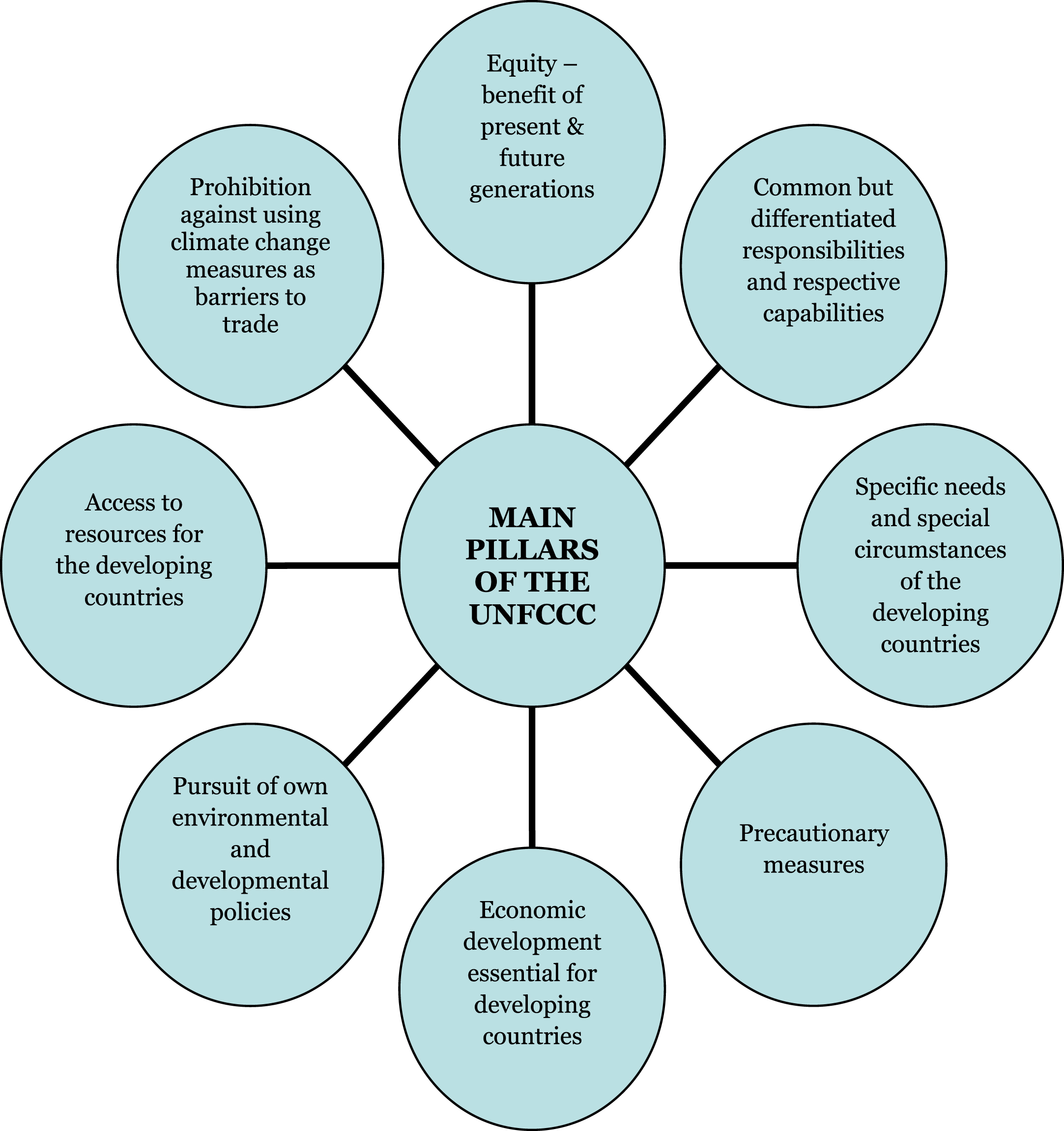
Main Pillars of the UN Framework Convention on Climate Change.
The inclusion of these pillars has played a vital role in ensuring participation of the developing countries in the climate change regime. They provide a unique framework to accommodate the developmental priorities of developing countries that are expected to be vulnerable to the adverse effects of climate change. The norm-setting process is premised upon scientific evidence. Hence, notwithstanding uncertainty about ‘cause and effect’, the UNFCCC has embarked upon a unique regulatory enterprise. It is prima facie based on precautionary approach.
The central thrust of the climate change regulatory approach is ‘precaution’ (rather than ‘prevention’). It is premised upon the bedrock of threat of potential irreversible damage resulting from climate change. As such the threshold for the states’ environmental behavior has been earmarked for taking anticipatory action that may cover placing restrictions upon activities and/or even prohibitions due to the threat of such damage. ‘Precaution’ as a regulatory tool has now come to the center stage with the advent of the 1992 Rio Earth Summit. The Rio Declaration (Principle 15) sought to endorse this emerging regulatory tool as:
Where there are threats of serious or irreversible damage, lack of full scientific certainty shall not be used as a reason for postponing cost-effective measures to prevent environmental degradation 54 (emphasis added).
An invocation of precaution has crystallized into regulatory activities that are science-driven and where science does not provide crystal clear evidence at the time of negotiating an instrument about the damage that may ensue in the absence of measures falling under the rubric of ‘precaution’. The level of threat can act as a trigger event as well as the content of precaution also remain uncertain as they will be determined by the exigencies of the situation and the political will of the UNFCCC contracting parties.
The precaution forming the basis of UNFCCC requires that in cases of threat of serious environmental harm, scientific uncertainty will not be used as a reason for postponing measures to prevent such harm. Existing multilateral environmental agreements and declarations contain various formulations of the precautionary approach. This principle, however, envisages policies and measures taken to deal with climate change as being “cost-effective so as to ensure global benefits at the lowest possible cost”. 55 To achieve this, such policies and measures could take into account different socio-economic contexts, be comprehensive, cover all relevant sources, sinks and reservoirs of greenhouse gases and adaptation, and comprise all economic sectors. The principle also endorses joint implementation.
As a threshold of the regulatory tool, the UNFCCC aims at “stabilization of greenhouse gas concentrations” (Article 2). This institutionalized process of engaging the sovereign states in the marathon treaty-making task is subject to not only availability of scientific evidence but also balancing of crucial socio-economic-political interests of key actors. Being a framework convention and a multilateral environmental agreement, UNFCCC has an institutionalized in-built law-making process to cater to the rights and obligations of the State parties. It has set up the Conference of the Parties (COP) as the ‘supreme body’ to steer the entire regulatory process (Article 7). The ambit of COP’s powers and functions comprise adoption of “any related legal instruments” 56 and “protocols” 57 and to take “the decisions necessary to promote the effective implementation.” 58 Accordingly, the COP adopted the 1997 Kyoto Protocol 59 and the 2015 Paris Agreement. 60 By replicating the creation of the regime-specific institutions, the Kyoto Protocol and the Paris Agreement both also have their own institutions known as Meeting of the Parties (MOP). However, the COP continues to serve as the MOP to the Protocol and the Agreement. 61
The COP has a responsibility to review the implementation of the UNFCCC as well as the Kyoto Protocol and the Paris Agreement as they are “related legal instruments”. Moreover, it has wide powers to discharge functions of periodical examination, promotion, facilitation, assessment, guidance, making recommendations, establishing subsidiary bodies and seeking cooperation from international, intergovernmental and non-governmental institutions as well as to “exercise such other functions as are required for the achievement of the objective.” 62 In the exercise of its powers and discharge of its functions, the COP is aided and assisted by the Secretariat, 63 Subsidiary Body for Scientific and Technological Advice (SBSTA), 64 Subsidiary Body for Implementation (SBI) 65 and other subsidiary and ad hoc bodies such as committees, working groups and expert bodies that may be established by the COP.
In order to achieve objectives of the UNFCCC, the COP will necessarily engage itself in the law-making process by making, elaborating and adopting the rules for the State parties on the matters of substance as well as procedure, whether or not explicitly and already covered, under the provisions of the UNFCCC. 66 For this purpose, the decision-making process in the COP becomes significant. Under the UNFCCC, the COP has to strictly adhere to the principle of consensus. 67 The consensus is so important that the COP has yet not been able to finalize its own rules of procedure 68 and continues to be governed by the draft rules of procedure with the exception of draft rule 42. 69 As the effectiveness of the climate change regulatory regime under the UNFCCC will depend considerably on the decision-making process in the COP, the principle of consensus may perhaps require reconsideration. It is now accepted that the COP is the supreme decision body to review and regulate the process of implementation of the UNFCCC in achieving its ultimate objective to combat global climate change. In fact, the General Assembly has started acknowledging, through its successive resolutions, that the UNFCCC as well as the Paris Agreement are “the primary international, intergovernmental forums for negotiating the global response to climate change.” 70
The flexibility mechanism under the UNFCCC included implementation of the climate change regulatory regime in the light of the present-day realities. Therefore, the flexibility mechanism is continuously evolving. 71 The UNFCCC had originally categorized the parties into annex-based countries (Annex-I specified the developed countries and the countries undergoing the process of transition to a market economy) and the non-annex-based countries (a large number of developing and least developed countries). It determined for the annex-based countries their specific treaty-obligations with regard to, inter alia, mitigation of climate change by limiting GHGs emissions, financial and technological assistance to the developing countries to meet implementation costs of their obligations and to adapt to the adverse effects of the climate change. 72 It is with regard to their mitigation obligations that the annex-based countries were given flexibility of implementing their obligations ‘jointly’ with other countries. 73 As mitigation obligations of the annex-based countries further crystallized under the Kyoto Protocol, 74 the flexibility mechanism available to them evolved to include: Joint Implementation (Article 6); Clean Development Mechanism (Article 12); and Emission Trading (Article 17). 75
The 2015 Paris Agreement has done away with the annex-based approach as originally envisioned under the UNFCCC for the GHGs emissions mitigation obligation and placed all the countries equally on the global climate chess board. In order to obtain this level of global participation, the Paris Agreement has introduced a new flexibility mechanism known as Nationally Determined Contribution (NDC). The flexibility mechanism process is significant in galvanizing global cooperation amongst the countries. Still, the question that remains is: How flexible the flexibility mechanism should be, in order to effectively combat the global climate change?
‘Differentiation’ for Common Concern
The principle of “equity” and “common but differentiated responsibilities and respective capabilities” (CBDR&RC) remain the cornerstones of the UNFCCC. It was explicitly formulated in the context of the 1992 Rio Earth Summit. It finds its origins in equity considerations and principle of equity in international law. Principle 7 of the Rio Declaration 76 endorsed the notion of common but differentiated responsibilities. In fact, the early indications of the emergence of the principle started coming from the resolutions of the General Assembly itself. Through its maiden resolution on environment in 1968, the General Assembly, having recognized the global effects of the problem of degrading human environment and the need for solving them through international co-operation and agreement, launched the preparation for the 1972 United Nations Conference on the Human Environment (UNCHE). 77
In 1971, just a year before the Stockholm Conference, the General Assembly had accepted the proposition that the world-wide pollution is being caused “primarily by some highly developed countries . . . therefore, the main responsibility for the financing of corrective measures falls upon those countries.” Moreover, it recognized that “the burden of the environmental policies of the developed countries cannot be transferred, directly or indirectly, to the developing countries.” 78 At the penultimate stage, the General Assembly firmly put on record that “the largest part of the current mission of pollutants into the environment . . . originates in developed countries, therefore have the main responsibility for combating such pollution”. 79 It further affirmed that:
[T]he responsibility for containing, reducing and eliminating global environmental damage must be borne by the countries causing such damage, must be in relation to the damage caused and must be in accordance with their respective capabilities and responsibilities. 80
Therefore, the CBDR&RC principle is anchored in the principle of equity. It sought to link responsibility of the developed countries with “pressures their societies place on the global environment” as well as “the technologies and financial resources they command”. The underlying rationale was explained thus:
“States shall cooperate in a spirit of global partnership to conserve, protect and restore the health and integrity of the Earth’s ecosystem. In view of the different contributions to global environmental degradation, States have common but differentiated responsibilities. The developed countries acknowledge the responsibility that they bear in the international pursuit of sustainable development in view of the pressures their societies place on the global environment and of the technologies and financial resources they command”. 81
Such a crystal differentiation in responsibility of the sovereign states includes the setting of differential standards, permitting grace periods in implementation, requiring flexibility in approach, and the provision of international assistance comprising funding and technology transfer. It has been based upon the bedrock of ‘historicity’ of different contributions of the countries in their developmental path to the global environmental harm. This novelty was a negotiating masterstroke that stood apart even in the euphoria of the 1992 Rio Earth Summit.
The explicit incorporation of CBDR&RC in the Preamble (para 3) as well as Article 3 of the UNFCCC established a legal linkage between the past economic exploitation of global commons and the responsibility to carry out actions that remedy or mitigate the consequences of such exploitation. It seeks to establish legal responsibility of the developed countries for past environmental harm or culpability. This aspect and the inequality of economic, social and institutional development conditions lead to different priorities and agendas across countries. They needed to be reconciled in the global forum where sovereign states embarked upon addressing an unprecedented challenge of climate change as one of their common concerns. In view of this, it can also be surmised that the principle entails a duty to participate in global efforts to address a global environmental problem. The principle is now widely recognized as one of the cardinal principles of international environmental law, duly supported by growing evidence of State practice as a legal obligation (opinio juris).
A close analysis of the principle shows that the differentiated responsibilities must be in consonance with the respective capabilities of various countries. The parties are to strive for the “ultimate objective” of the UNFCCC (stabilization of GHG concentrations in the atmosphere). The developed countries are to reduce their GHG emissions for the attainment of the stabilization targets. This goal was not to be applicable, in the foreseeable future, to the developing countries, especially since the UNFCCC obligated them to “address” (rather than stabilize) GHG emissions. 82 It was recognised that their net emissions must grow to accommodate their developmental needs. 83 The UNFCCC made a developed country to oblige by protecting and enhancing the carbon sinks while the developing countries needed only to address removal by sinks as well as to “promote and cooperate in the conservation and enhancement, as appropriate, of sinks”. 84
The most obvious reason for the existence of differentiated obligations has been the different contributions (GHG concentrations in the atmosphere) states have made to the present state of environmental degradation. Therefore, in view of contribution to the global environmental harm being unequal, responsibility was also to be unequal. It was to be commensurate with the differentiated contribution of respective countries. The state practice suggests that differentiation on the basis of a contribution to environmental harm has largely been used as a way of requiring the developed countries to ‘lead’ the way to mitigate the harm and as a means of treating them as a single category to meet certain treaty obligations. Article 3.1 does stipulate that “developed country Parties should take the lead in combating climate change and adverse effects thereof”. Thus, Annex I countries needed to effectively demonstrate that they would “(should) take the lead” (Article 3.1) to modify long-term trends in anthropogenic GHG emissions. Article 2 explicitly lays down the ‘declarative’ criteria to this effect.
By focusing on stabilization of GHGs as the threshold of the regulatory tool, the UNFCCC has institutionalized a long and arduous process. It entails the process of engaging the sovereign states guided by the availability of scientific evidence as well as balancing of crucial economic and political interests of key actors on the global climate chessboard. The 1997 Kyoto Protocol aimed at rolling back 5.2% GHG emissions from industrialized countries to the levels that prevailed in 1990. It required only the industrialized developed country parties had a legally binding obligation to reduce GHG emissions on the basis of their primary responsibility for historically accumulated GHG emissions.
The developing country parties’ commitments were restricted to voluntary participation in the Clean Development Mechanism (CDM) and to the general commitments under of the Protocol. With the developed countries reneging on their Kyoto commitments and in some cases GHG emissions of developed countries grew (instead of reduction). As the regulatory process faced a roadblock, it made inroads into the central pillar of ‘differentiation’. Even as Doha Amendment 85 (2012) brought about the second commitment period (2013-2020) of the Kyoto Protocol, it set the stage to push the developing countries for sharing the burden of GHG reduction. The 2015 Paris Agreement is the outcome of that process that has sought to gradually blunt the edges of principle of ‘differentiation’ around which the entire edifice of UNFCCC revolves.
Equity as a basis for Common Concern
In view of the principle of equity as well as their specific needs and special circumstances, enshrined in the UNFCCC, it explicitly provided that the “share of global emissions originating in developing countries will grow to meet their social and development needs”. 86 The rise in their emissions was especially factored into the framework convention and the climate change negotiations.
In view of this, an insistence by the industrialised countries for the inclusion of major developing countries (such as China and India) into the Annex I of the Convention was summarily turned down on the basis of per capita entitlement of emission rights. Similarly, the flexibility (on the basis of economic and social conditions) principle brought forward by the industrialised countries, did help them to distract from the deliberations concerning GHG reduction commitments. China, India and other developing countries had argued for compliance with the primary obligation of the developed country parties on the basis of ‘differentiation’ as a condition precedent for any discussion about their joining any future GHG reduction targets. They claim as not being irresponsible about the threat of global climate change. In fact, countries like India have been serious about using domestic energy saving techniques as well as initiatives that have far reaching implications in reducing the curve of GHG emissions. In due course, these measures could control and even cut down India’s GHG emissions (akin to the reduction obligation of an industrialized country). G-77 and China perceived the mischievous references to meaningful participation of the key developing countries as contrary to letter and spirit of the leadership role enshrined in the UNFCCC for developed country parties.
The full realization of the principle of CBDR&RC remained the key to attain stabilization goals in the foreseeable future since three-fourths of the emissions are contributed by the developed countries. In view of this, there appeared need for a formal UNFCCC assessment process as regards the criteria of judging the ‘lead’ to be taken by the developed countries. That has never been carried out during the last 30 years. It could have provided a vital key to the road map for the stabilization of GHG concentrations. The major problems with the UNFCCC are perceived to be unwillingness and lack of sincerity of the developed countries in fulfilling their part of the commitments to reduce GHGs emissions as well as providing financial and technological assistance in meaningful manner to the developing countries.
2015 Paris Agreement: Dilution of Differentiation?
The reduction limits of the GHGs emissions, specified in the Kyoto Protocol for the developed countries before 2012, was effectively grounded. Even the second commitment period of the Kyoto Protocol (2013-2020) did not augur well as some of the key countries such as Canada, Japan and Russia did not join the quantitative emission limitation and reduction commitment (QELAR) for the second commitment period. The US had already withdrawn from the Kyoto Protocol. Hence a sense of exasperation set the stage for bargain that went into the making of the 2015 Paris Agreement. 87
The Paris Agreement, often hailed as a “historic deal” 88 or “new hope” 89 was adopted on 12 December 2015 at the COP21 in Paris. It was registered with the UN Treaty Section and entered into force on 04 November 2016. 90 In legal parlance, it is an international treaty and, therefore, has a hard shell. Despite being one of the UNFCCC’s “related legal instruments” 91 or a “legal instrument or an agreed outcome with legal force”, 92 it has put into place a new international regulatory framework to address the challenge of global climate change. It is unusual treaty that creates both mandatory and non-mandatory provisions. 93 As compared to the 1997 Kyoto Protocol, 94 this new agreement is ‘global’ in nature. It applies not only to developed countries but also to developing countries. In a way, it specifies the same core obligations for all the countries. In doing so, it abandons the ‘segregation’ and ‘annex-based’ approach originally incorporated into the architecture of the UNFCCC and the Kyoto Protocol. As discussed earlier, the principle of ‘differentiation’ (CBDR&RC), principle of equity in international law, has been one of the cornerstones of the UNFCCC. It draws upon the cause-and-effect syndrome as laid down in the Trail Smelter arbitration. 95
It is in this context that the 2015 Paris Agreement can be said to have institutionalized a new paradigm shift in climate change regime by introducing a flexible ‘bottom-up pledge and review’ approach to reduce GHG emissions. The Agreement has inscribed this approach by setting forth a new operational tool called ‘Nationally Determined Contributions’ (NDCs). The NDC approach to reduce GHGs, is a built-in flexible system, which entirely relies on the self-determination of the State Parties to take adequate mitigation efforts. It could be subject to persuasive impact of peer-pressure, consultation and the global stock take.
The Paris Agreement seems to have indirectly set in motion back-door commitments of the developing country parties. As such it pushes them towards undertaking GHG mitigation that they were not required to undertake under the original UNFCCC legal framework. In effect, it could be seen as abandonment of ‘condition precedent’ approach, as laid down in Article 4 (7) of UNFCCC, requiring implementation of commitments of the developing countries to be conditional upon effective implementation of commitments of the developed countries. Thus, in view of contribution to global degradation being unequal, responsibility also had to be unequal and commensurate with the differential contribution to such degradation.
The State practice seems to suggest that differentiation on the basis of contribution to the environmental damage has largely been used as a way of requiring leadership from developed states as well as a means of treating them as a single category as regards certain treaty obligations. Article 4 (1) of Paris Agreement still stipulates that “[d]eveloped country Parties should continue taking the lead by undertaking economy-wide absolute emission reduction targets”. However, the so-called ‘lead’ remains shrouded in uncertainty. Ironically, the UNFCCC process has over past 30 years, never sought to specify characteristics of the illusory ‘lead’ that was to be taken by the developed country parties. Did it serve as proverbial Trojan horse to penetrate the formidable shield of ‘differentiation’ that hitherto guarded the developing countries?
From Common Concern to Planetary Concern
As per the practice, IPCC reports are prepared in a cycle that facilitates the UNFCCC Conference of Parties to take due cognizance of such a scientific view for its own decision-making process. The release of the IPCC Fourth Assessment Report (AR4) unleashed the debate and brought to the fore “threat of human-induced climate change” 96 and the need for “formulating and implementing appropriate responses”. systems.” The IPCC AR6 (2022), released in April 2022, has ominously taken a view that “Total net anthropogenic GHG emissions have continued to rise during the period 2010–2019, as have cumulative net CO2 emissions since 1850”. 97 On 27 October 2022, UNEP’s Emissions Gap Report has reinforced the global concerns and finds that “the international community is falling far short of the Paris goals, with no credible pathway to 1.5°C in place. Only an urgent system-wide transformation can avoid climate disaster”. 98 It set the stage for an appropriate consideration in time by the UNFCCC COP27 at Sharm el-Sheikh in Egypt (06-18 November 2022). 99
Thus, the three decades (1992-2022) of intergovernmental climate change regulatory has witnessed evolution of the basic raison d’être from a common concern to a planetary concern. As mentioned at the outset of this study, the opening address by the UN Secretary-General Antonio Guterres at the Stockholm+50 Conference, 100 brought a new dimension to the global climate change discourse by designating climate change as one of the “triple planetary crisis” 101 and observed:
We face a triple planetary crisis. A climate emergency that is killing and displacing ever more people each year. Ecosystems degradation that are escalating the loss of biodiversity and compromising the well-being of more than 3 billion people. And a growing tide of pollution and waste that is costing some 9 million lives a year. We need to change course –now –and end our senseless and suicidal war against nature. 102
Notwithstanding the placement of climate change on higher level of a common concern, as already seen, the regulatory approach hitherto followed susceptible to vagaries of ‘probabilistic’ climate science scenarios. It has been afflicted by dragging of feet by the developed countries reneging from taking an effective lead in addressing their historical responsibility for GHG emissions and narrow national interests of States parties. The hold-out flip-flops (withdrawal from the Paris Agreement in 2019 and rejoining it in 2021) by the world’s largest emitter, the United States, caused skepticism and dampened the global action. The Trump Administration decided to withdraw from the Paris Agreement on the ground of “unfair economic burden imposed on American workers, businesses, and taxpayers by U.S. pledges made under the Agreement”. 103 However, the new Biden Administration realized the folly and quickly reversed it on the ground that the “Paris Agreement is an unprecedented framework for global action . . . to help us all avoid catastrophic planetary warming and to build resilience around the world to the impacts from climate change we already see”. 104 This speaks volumes about the lack of seriousness and narrow national considerations holding the common concern to ransom even as the climate change has now assumed dimensions of planetary concern. Cumulatively, the global regulation of climate change faces the risk of floundering especially due to the side-tracking of the UNFCCC’s sacrosanct principle of CBDR&RC, grounding of the Kyoto Protocol applecart of Annex I legal obligations and the final legal trick of pushing the developing countries into the trap of NDCs through the 2015 Paris Agreement. It has generated the widely perceived impression that the developed countries have been “backtracking on almost every commitment made by them at the various Conference of Parties.” 105
Conclusion
The unfolding scenario of consistent “backtracking” by the developed countries flies in the face of the UNFCCC’s emphatic declarative criteria of “the developed country Parties should take the lead in combating climate change and the adverse effects thereof” [Article 3 (1)]. It was construed at sine qua non for the “ultimate objective” of the UNFCCC to achieve “stabilization of greenhouse gas concentrations in the atmosphere at a level that would prevent dangerous anthropogenic interference with the climate system to modify long-term trends in anthropogenic GHG emissions” (Article 2). This originally envisaged robust legal framework requires to work towards laying down the criteria and an appropriate verifying mechanism on the obligation of the developed country parties “should take the lead”. This has now assumed urgency in view of evolution of climate change from a common concern into a planetary concern. The onus is on the developed countries to show that the actions they claim to have taken amount to taking the lead i.e., full compliance with the commitments under Article 4 (2) (a) and (b), the UNFCCC process shall have to ensure that the developed countries do sincerely carry out their part of promised funding as well as funding and state-of-art technology transfer to the developing countries.
The developed countries’ failure to comply with a first commitment period of the 1997 Kyoto Protocol, followed by the bleak prospects for the second commitment period (2013-2020) have queered the pitch as regards sincerity of the new commitments including promised funding under the 2015 Paris Agreement. In the absence of a miracle and/or major trigger event, the words and actions of the leading GHG emitter developed country parties leave little prospects for decisive course correction in the 30th year of the UNFCCC and beyond. It will be the biggest irony and denial of the principle of ‘equity’ if the developing countries would soon realize that it was futile to undertake NDCs without the developed countries in effect carrying out their part of the legal ordained commitments hitherto undertaken at the COPs. The evolution of the global regulation of climate change, premised on a common concern of humankind, cannot be expected to shift into the higher trajectory of a planetary concern unless the developed country parties walk-the-talk by taking an effective leadership. It remains the cornerstone of the entire climate change regulatory juggernaut that has been institutionalized 106 during the last three decades 1992-2022.
Having been the original conductor of the climate change grand orchestra, it is high time the UN General Assembly rises to the occasion to exercise effective supervision by raising the bar to place the climate change into the realm of a planetary concern. It calls for an appropriate resolution on climate change as a planetary concern during the 77th session and beyond to provide future direction to the UNFCCC and the Paris Agreement. The 2022 UNEP study, The Closing Window 107 has vindicated the UNSG’s warnings at the Stockholm+50 (2022). As we look ahead, the future trajectory of the climate change regulatory process remains uncertain in the face of planetary level climate emergency. It presents an ideational and normative challenge for the international law scholars, the UN General Assembly and the UNFCCC regulatory process to earnestly work for expanding the ambit of climate change regulation as a planetary concern. The forthcoming Summit of the Future (UNGA resolution 76/307 of 8 September 2022) to be convened by the UNGA in New York during 22 and 23 September 2024, may provide an appropriate forum to decide on the future of the climate change regulation on the basis of a planetary concern.
Footnotes
1UN (2022), Secretary-General’s remarks to Stockholm+50 international meeting, 2 June 2022; available at: Secretary-General’s remarks to Stockholm+50 international meeting [as delivered] | United Nations Secretary-General (accessed on 8 November 2022).
UN (1992), Report of the United Nations Conference on Environment and Development; U.N. Doc. A/CONF.151/26/Rev.1 (Vols. I., II and III) (1992); 31 ILM 874 (1992U.N. Doc. A/CONF.151/26/Rev.1 (Vol. I) (1992), p. 3; 31 ILM 874 (1992); available at: UNCED, Earth Summit.:. Sustainable Development Knowledge Platform (accessed on 8 November 2022).
UN (1992), United Nations Framework Convention on Climate Change; 1771 UNTS 165 (1994); 31 ILM 849 (1992); available at: UNTC; conveng.pdf (unfccc.int) (accessed on 6 November 2022).
Desai, Bharat H. (1992), “Threats to the World Eco-system: A Role for the Social Scientists”, Social Science & Medicine, vol.35, no.4, pp.589-596 at 590.
Desai, Bharat H. (1990), “Managing Ecological Upheavals: A Third World Perspective”, Social Science & Medicine, vol.30, no.10, pp.1065-1072.
UN (1992), n.3, Article 1 (2).
IPCC (2022), Working Group III Contribution to the IPCC Sixth Assessment Report (AR6); available at: IPCC_AR6_WGIII_FinalDraft_FullReport.pdf (accessed on 16 October 2022).
The IMBIE team (2018), “Mass Balance of the Antarctic Ice Sheet from 1992 to 2017”, Nature, vol. 558, pp. 219-222; available at: The IMBIE team, 2018: Mass Balance of the Antarctic Ice Sheet from 1992 to 2017 —European Environment Agency (europa.eu) (accessed on 29 October 2022)
UN (2022), n.1.
UN (1992), n.3
It has drawn some aspects from the author’s previous publication: “Climate change as a common concern of humankind: some reflections on the international law-making process” in Chapter 10, in Jordi Jaria-Manzano, and Susana Borràs (2019), Research Handbook on Global Climate Constitutionalism. Cheltamham: Edward Elgar.
For early scholarly writings on the subject see, generally, Sinha, S.P. (1967), New Nations and the Law of Nations, A.W.Sijthoff, Leiden; Anand, R.P. (1972), Asian States and the Development of Universal International Law, New Delhi: Vikas; Lowe, Vaughan and Colin Warbrick (1994), The United Nations and the Principles of International Law: Essays in Memory of Michael Akehurst, London: Routledge; Pellet, Alain (1987), “A New International Legal Order: What Legal Tools for What Changes?” in Francis Snyder and Peter Slinn (eds.), International Law of Development: Comparative Perspectives, Abingdon: Professional Books
For scholarly analysis on this issue see, generally, F. Blaine Sloan (1948), “The Binding Force of a ‘Recommendation’ of the General Assembly of the United Nations”, British Yearbook of International Law (BYIL), vol. 25, pp. 7, 10; Rosalyn Higgins (1965). ‘The Development of International Law by the Political Organs of the United Nations’, ASIL Proceedings, vol. 59, p. 117; Preface by Wolfgang Friedmann in Obed Y. Asamoah (1966), The Legal Significance of the Declarations of the General Assembly of the United Nations (The Hague: Martinus Nijhoff), p. v; Stephen M. Schwebel (1979), “The Effect of Resolution of the UN General Assembly on Customary International Law”, ASIL Proceedings, vol. 73, p. 301.
Desai, Bharat H. (2004), Institutionalizing International Environmental Law, New York: Transnational Publishers, pp. 166-195; Desai, Bharat H. (2015), “The Advent of the United Nations Environment Assembly”, American Society of International Law Insights, vol. 19, issue 2; available at: The Advent of the United Nations Environment Assembly | ASIL (accessed on 31 October 2022).
UN (1988), Protection of Global Climate for Present and Future Generations of Mankind, General Assembly resolution 43/53; U.N. Doc. A/RES/43/53 (adopted, without vote, on 6 December 1988; available at: NR053032.pdf (un.org) (accessed on 6 November 2022). (accessed on 9 October 2022).
The idea of common heritage of mankind was mooted Arvid Pardo in a Maltese proposal. Article 136 of the United Nations Convention on Law of the Sea (UNCLOS) provides that: “The Area and its resources are the common heritage of mankind.” Article 1(1) of the UNCLOS defines Area as “the sea-bed and the ocean floor and subsoil thereof, beyond the limits of national jurisdiction.”; 1833 UNTS 397 (1994).
UN (1988), Letter dated 9 September 1988 from the Permanent Representative of Malta to the United Nations addressed to the Secretary General; U.N. Doc. A/43/241 (12 September 1988).
Summary Records of the 25th Meetings of the Second Committee, held on 27October 1988 in New York during 43rd Session of the General Assembly; U.N. Doc. A/C.2/43/SR.25 (27 October 1988)
The General Assembly resolution 43/53 of 6 December 1988 (U.N. Doc. A/RES/43/53) was based on the revised draft resolution sponsored by Malta (U.N. Doc. A/C.2/43/L.17/Rev.1) entitled “Protection of global climate for present and future generations of mankind”.
UN (1992), Preamble, n. 3. It states: “Acknowledging that change in the Earth’s climate and its adverse effects are a common concern of humankind”.
UN (1992), Convention on Biological Diversity, Preamble; It states: “Affirming that the conservation of biological diversity is a common concern of humankind”; 1760 UNTS 143 (1993); 31 ILM 822 (1992); available at: UNTC; cbd-en.pdf (accessed on 6 November 2022).
Kiss, Alexander (1997), “The Common Concern of Mankind”, Environmental Policy and Law, vol. 27, no. 4, pp. 244, 247
UN (1994), Agreement relating to the Implementation of Part XI of the United Nations Convention on the Law of the Sea of 10 December 1982; Agreement on Part XI UNCLOS (accessed on 6 November 2022).
UN (1988), Report of the Second Committee on Conservation of Climate as a Part of the Common Heritage of Mankind; U.N. Doc. A/43/905, 30 November 1988, pp. 1-4.
UN (1992), Article 3 (1), n.3.
UN (1969), Vienna Convention on the Law of Treaties, Article 31(2); adopted on 23 May 1969 and entered into force on 27 January 1980; 1155 UNTS 331 (1980); 8 ILM 679 (1969).
UN (1945), Charter of the United Nations, Article 92; adopted on 26 June 1945 and entered into force on 24 October 1945; available at: uncharter.pdf (accessed on 6 November 2022).
For a detailed study of contemporary international law-making process, see Desai, Bharat H. (2021), “International Environmental Law-making”, Chapter 5, in Bharat H Desai, Ed., Our Earth Matters: Pathways to a Better Common Environmental Future (IOS Press: Amsterdam, 2021), pp.43-62; Our Earth Matters | IOS Press (accessed on 6 November 2022).
Desai, Bharat H. (2004), n.14, pp. 135-145
UN (1992), Article 13(1)(a), n.3.
UN (1947), Establishment of an International Law Commission, G.A. Res. 174 (III), U.N. Doc. A/RES/174(III), 21 November 1947; for details on the role and works of International Law Commission; see  ; Nolte, Georg (2009), Peace through International Law: The Role of the International Law Commission, Dordrecht: Springer.
Hambro, Edvard (1968), “The Sixth Committee in the Law Creating Function of the General Assembly”, 21 R.E.D.I. 387; Berman, Franklin (2006), “The ILC within the UN’s Legal Framework: Its Relationship with the Sixth Committee”, 49 German Yearbook of International Law 107.
Shibata, Akiho (1993), “International Law-Making Process in the United Nations: Comparative Analysis of UNCED And UNCLOS III, 24(1) California Western International Law Journal 17
UN (1988), n.15
Ibid, paragraph 5
Ibid, paragraph 12
Bodansky, Daniel (1993), “The United Nations Framework Convention on Climate Change: A Commentary”, 18(2) Yale Journal of International Law 451, 455-462.
UN News (2022), “Rescue us from our environmental ‘mess’, UN chief urges Stockholm summit”, 2 June 2022; Rescue us from our environmental ‘mess’, UN chief urges Stockholm summit (stockholm50.global) (accessed on 7 November 2022).
Bodansky, Daniel (2022), “The United Nations Climate Change Regime Thirty Years on: A Retrospective and Assessment”, Washburn Law Journal, vol. 62 (2022); re-published in Environmental Policy and Law 52 (5-6) 2022.
For a detailed study of the process of institutionalization, see Desai, Bharat H. (2004), n.29.
UN (1987), International co-operation in the field of the environment, General Assembly resolution 42/184; U.N. Doc. A/RES/42/184 (11 December 1987).
UN (1990), Protection of global climate for present and future generations of mankind, General Assembly resolution 45/212; U.N. Doc. A/RES/45/212 (21 December 1990), para. 1 (emphasis added).
Ibid, paras 2 and 19
Ibid, para 10
Ibid, paras 12-14
Ibid, paras 20-22
Ibid, paras 5-7
UN (1992), n.2.
UN (1992), Protection of global climate for present and future generations of mankind, G.A. Res. 47/195; U.N. Doc. A/RES/47/195 (22 December 1992).
Ibid, para. 2
Ibid, paras. 6, 11
Desai, Bharat H. (2004), n. 29, p.117.
UN (1992), Rio Declaration on Environment and Development, Principle 15, n.2.
UN (1992), Article 3(3), n.3.
Ibid, Articles 2 and 7(2)
Ibid, Article 17
Ibid, Article 7(2)
UNFCCC (1997), Kyoto Protocol to the United Nations Framework Convention on Climate Change; UN Doc. FCCC/CP/1997/7/Add.1 (10 December 1997); 37 ILM 22 (1998).
UNFCCC (2015), Paris Agreement (12 December 2015) in UNFCCC, Report of the Conference of the Parties on its Twenty-First Session, UN Doc. FCCC/CP/2015/10/Add.1 (29 January 2016), p. 21; 55 ILM 743 (2016).
UNFCCC (1997), Article 13, n.59; UNFCCC (2015), Article 16, n.60.
UN (1992), Article 7(2), n.3.
UN (1992), Article 8, n.3.
UN (1992), Article 9, n3.
UN (1992), Article 10, n.3.
For the law-making functions of the COP see, generally, Desai, Bharat H. (2021), “International Environmental Law-making”, Chapter 5, in Bharat H Desai, Ed., Our Earth Matters: Pathways to a Better Common Environmental Future (IOS Press: Amsterdam, 2021), pp.43-62; Fitzmaurice, Malgosia (2014), “Law-making and international environmental law: The legal character of decisions of conferences of the parties” in Rain Liivoja and Jarna Petman (eds.), International Law-making: Essays in Honour of Jan Klabbers, London and New York: Routledge, pp. 190-210.
UN (1992), Article 7(2)(k) and (3), n.3.
UNFCCC (2018), Report of the Conference of the Parties on its Twenty-Third Session, see U.N. Doc. FCCC/CP/2017/11 (8 February 2018), p. 5; available at: 1801342 (unfccc.int) (accessed on 29 October 2022)
UNFCCC (1996), Draft Rules of Procedure of the Conference of the Parties and its Subsidiary Bodies, see U.N. Doc. FCCC/CP/1996/2 of 22 May 1996.
UN (2017), G.A. Res. 72/219, U.N. Doc. A/RES/72/219 (20 December 2017), preambular para. 2; UN (2016), G.A. Res. 71/228, U.N. Doc. A/RES/71/228 (21 December 2016), preambular para. 2; and UN (2016), G.A. Res. 70/205, U.N. Doc. A/RES/70/205 (22 December 2015), preambular para. 4
Cullet, Philippe (1999), “Equity and Flexibility Mechanisms in the Climate Change Regime: Conceptual and Practical Issues”, 8(2) Review of European Community and International Environmental Law 168, 172
UN (1992), Articles 4(2) to (6), 12(2), 12(3) and 12(5), n.3. For more details on the specific commitments of the annex-based countries, see Bodansky, Daniel (1993), “The United Nations Framework Convention on Climate Change: A Commentary”, 18(2) Yale Journal of International Law 451, 511-530
UN (1992), Articles 4(2) (a) & (b), n.3. Also see Cullet, Philippe (1999), n.71; Yamin, Farhana and Joanna Depledge (2004), The International Climate Change Regime: A Guide to Rules, Institutions and Procedures, New York: Cambridge University Press, pp. 136-43.
UNFCCC (1997), Articles 2 and 3, n.59.
For more details on the flexibility mechanism under the Kyoto Protocol, see Cullet (1999), n.71; Yamin and Depledge (2004), n.73.
UN (1992), n.2.
UN (1968), Problems of the human environment, G.A. Res. 2398 (XXIII), U.N. Doc. A/RES/2398(XXIII), 3 December 1968 (adopted, without vote); UN (1972), Declaration of the United Nations Conference on the Human Environment, Report of the United Nations Conference on the Human Environment, U.N. Doc. A/CONF.48/14/Rev.1 (1973), p. 3; 11 ILM 1416 (1972).
UN (1971), Development and environment, G.A. Res. 2849(XXVI), U.N. Doc. A/RES/2849(XXVI), 20 December 1971, preambular para 9 and para 4(2) (adopted with 85 votes in favor, 2 votes against and 34 absentees).
UN (1989), International co-operation in the field of the environment, G.A. Res. 44/229, U.N. Doc. A/RES/44/229, on 22 December 1989 (adopted without vote); UN (1990), Protection of global climate for present and future generations of mankind, G.A. Res. 45/212, U.N. Doc. A/RES/45/212, 21 December 1990 (adopted without vote).
UN (1989), United Nations Conference on Environment and Development, G.A. Res. 44/228, U.N. Doc. A/RES/44/228, 22 December 1989 (adopted without vote).
UN (1992), n. 3.
UN (1992), Article 4(1)(b), n.3
Ibid, preambular para 22
Ibid, Articles 4(1)(b) & (c) and 4(2)(a).
UNFCCC (2012), Doha Amendment to the Kyoto Protocol; It brought the changes that included: (i) new commitments for Annex I Parties to the Kyoto Protocol who agreed to take on commitments in a second commitment period from 1 January 2013 to 31 December 2020; and (ii) revised list of greenhouse gases (GHG) to be reported on by Parties in the second commitment period. During the first commitment period, 37 industrialized countries and the European Economic Community committed to reduce GHG emissions to an average of 5 percent against 1990 levels. During the second commitment period, Parties committed to reduce GHG emissions by at least 18 percent below 1990 levels during 2013 to 2020. However, the composition of Parties in the second commitment period is different from the first commitment period; available at: untitled (unfccc.int) (accessed on 8 November 2022).
UN (1992), Preamble, paragraph 3, n.3.
UNFCCC (2015), n.60
Vaughan, Adam and James Randerson (2015), “Paris climate talks: governments adopt historic deal”, The Guardian (International Edition), 13 December 2015; available at: Paris climate talks: governments adopt historic deal –as it happened | COP 21: Paris climate change conference 2015 | The Guardian (accessed on 8 November 2022).
Bodansky, Daniel (2016), “The Paris Climate Change Agreement: A New Hope?” 110(2) AJIL 288-319
UN Treaty Collection (2015), Status of the Paris Agreement (as on 7 November 2022); available at: UNTC (accessed on 8 November 2022).
UN (1992), Articles 2 and 7, n.3.
UNFCCC (2011), Establishment of an Ad Hoc Working Group on the Durban Platform for Enhanced Action in UNFCCC, Report of the Conference of the Parties on its Seventeenth Session, U.N. Doc. FCCC/CP/2011/9/Add.1 (15 March 2012), p. 2
Bodansky, Daniel (2016), “The Legal Character of the Paris Agreement”; available at: https://papers.ssrn.com/sol3/papers.cfm?abstract_id=2735252&download=yes (accessed on 3 October 2022).
UNFCCC (2015), n.60.
RIAA (1949), Trail Smelter case (United States v. Canada), Ad Hoc International Arbitral Tribunal, March 11, 1941, United Nations Reports of International Arbitral Awards, Vol. 3 (1949), p. 1938
IPCC (2022), Climate Change 2022: Mitigation of Climate Change. Contribution of Working Group III to the Sixth Assessment Report of the Intergovernmental Panel on Climate Change. Cambridge University Press, Cambridge, p.4; available at: Climate Change 2022: Mitigation of Climate Change (ipcc.ch) (accessed on 7 November 2022).
UNEP (2022), The Closing Window: Emissions Gap Report 2022; available at: Emissions Gap Report 2022 (unep.org) (accessed on 7 November 2022).
UNFCCC (2022), Sharm El-Sheikh Climate Change Conference 2022; Sharm el-Sheikh Climate Change Conference - November 2022 | UNFCCC (7 November 2022).
Stockholm+50 (2022), Stockholm+50: A Healthy Planet for the Prosperity of All –Our Responsibility, Our Opportunity; Stockholm, Sweden 2-3 June 2022; Stockholm+50 (accessed on 8 November 2022). Also see two key UNGA enabling and modalities: (i) International meeting entitled “Stockholm+50: a healthy planet for the prosperity of all –our responsibility, our opportunity”; 75/280 of 24 May 2021; UN Doc. A/RES/75/280 of 25 May 2021 (ii) UN (2021), Modalities for the international meeting entitled “Stockholm+50: a Healthy Planet for the Prosperity of All - our Responsibility, our Opportunity; General Assembly resolution 75/326 of 10 September 2021; UN Doc. A/RES/75/326 of 15 September 2021.
UN News (2022), n.38.
UN (2022), n.1
US Department of State (2019), “On the US Withdrawal from the Paris Agreement”, Press Statement by Michael R. Pompeo, Secretary of State, 4 November 2019; On the U.S. Withdrawal from the Paris Agreement - United States Department of State (accessed on 7 November 2022).
US Department of State (2021), “The United States Officially Rejoins the Paris Agreement”, Press Statement by Antony J. Blinken, Secretary of State, 19 February 2021; The United States Officially Rejoins the Paris Agreement - United States Department of State (accessed on 8 November 2022).
Tirumurti, T.S. (2022), “Backtracking on Climate Change Action by the Developed Countries: Some Reflections of a Negotiator”, Environmental Policy and Law, vol.52, no.5-6.
Desai (2004), n. 14.
UNEP (2022), n.98.
UNFCCC (2022), n. 99.