



Abstract
BACKGROUND:
The oral administration of Infliximab (IFX) antibody would ensure a direct action on inflamed intestinal tissues without side effects. Thus, investigations about its resilience within the intestinal environment are required.
OBJECTIVE:
Quantify the IFX recovery in a simulated upper intestinal environment.
METHODS:
IFX was incubated for different times until 120 min in simulated intestinal fluid (SIF) which differed (i) for pH (7.2 vs 6.8, Exp 1), (ii) for addition or not with pancreatin (Exp 2) and (iii) for addition or not with bovine serum albumin in presence of pancreatin (BSA, Exp 3).
RESULTS:
In Exp 1 the IFX incubated without pancreatin was degraded by about 15% by SIF pH change from 7.2 to 6.8 and after 120 min it was reduced by about 20%. In Exp 2 the presence of pancreatin determined an intense and rapid IFX degradation (recovery
CONCLUSIONS:
A discrete in vitro stability of IFX in the upper intestine environment was demonstrated, if food protein is available and competes with pancreatin proteases.
Keywords
Introduction
The pro-inflammatory cytokine tumor necrosis factor alpha (TNF
Pigs are often used as animal models to study the physiology of the human digestive tract [15, 10, 7]. In the present study we applied an in vitro digestion approach developed for pigs and already validated in vivo [12], aiming at the quantification of IFX recovery in the upper intestine tract. The IFX resistance in a biologically active form was assessed at progressive incubation times in simulated upper intestinal fluid (SIF) under different conditions (e.g. different pH, absence or presence of pancreatin, different IFX concentration, absence or presence of a food protein).
Material and methods
Therapeutic antibody and experimental design
The IFX (Inflectra
The research consisted of three experiments: IFX was incubated up to 120 min in SIF at different pH (7.2 vs 6.8, Exp 1); in SIF added or not with pancreatin (Exp 2); in SIF added with pancreatin and in presence or absence of BSA (Exp 3). In Exp 1 the 20
In vitro simulation of the upper intestinal environment
The in vitro digestion was carried accordingly with the method of Boisen and Fernández [12], with some modifications. The simulated gastric fluid was prepared into 125-mL conical flasks where 25 mL of 0.1 M sodium phosphate buffer solution and 10 mL of 0.2 M HCl (pH adjusted to 2.0 by using 1 M HCl or NaOH) were dispensed, without the inclusion of pepsin solution. Flasks were closed with a silicon stopper and were kept into a thermostatically-controlled heating bath to maintain the temperature of 39
In Exps 2 and 3 the pH was adjusted to 6.8 using 1 M HCl or NaOH and 1 mL of freshly prepared pancreatin solution (50 mg/mL, derived from porcine pancreas, 4
To measure the recovery of biologically active IFX by E.L.I.S.A., samples of the SIF (0.35 mL) were collected from each flask immediately before closing and at 30, 60, 90 and 120 minutes of incubation.
Example of standard curve obtained by E.L.I.S.A. of serial dilutions of IFX. The value of 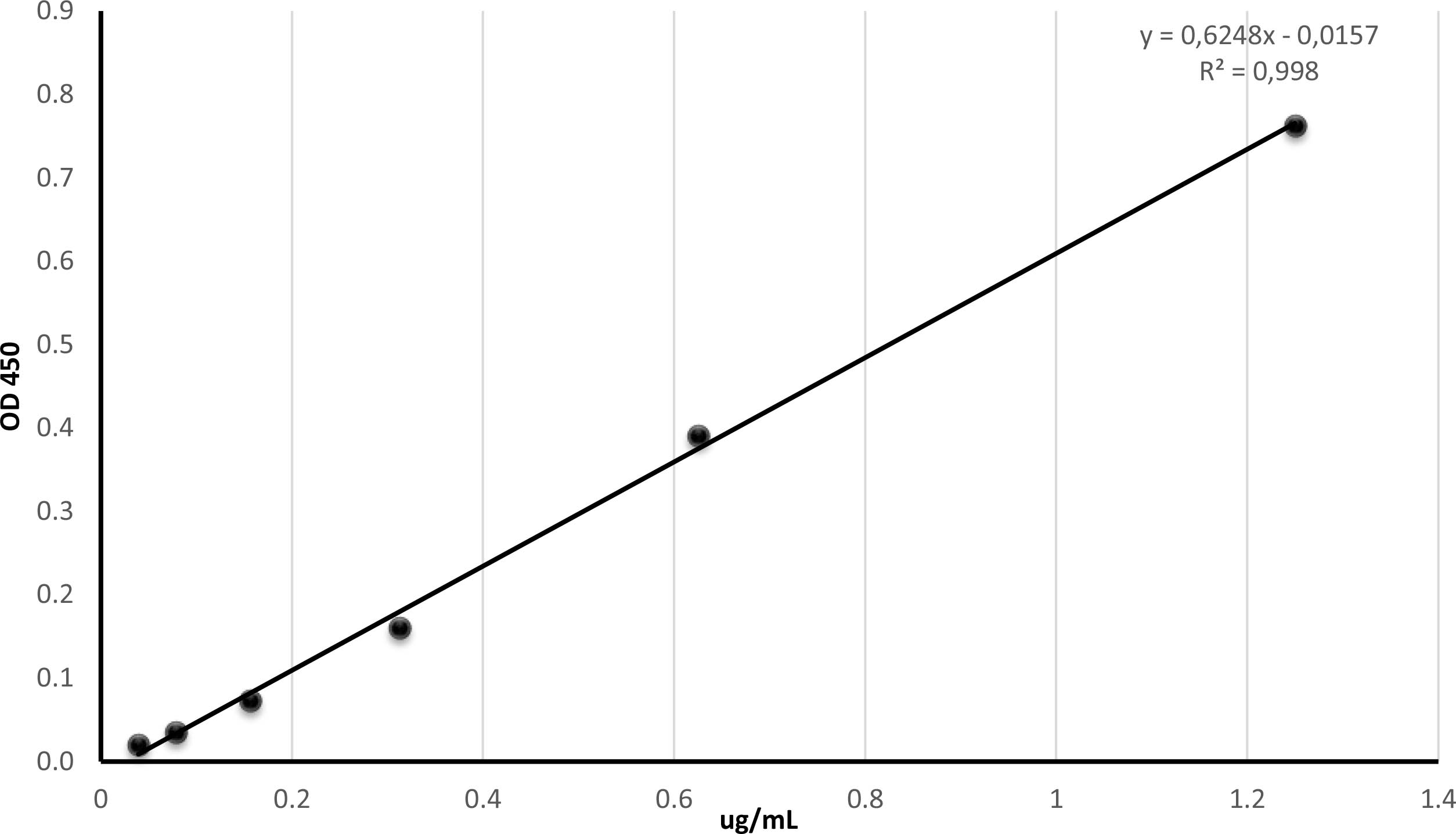
The IFX concentration of SIF samples was evaluated by indirect E.L.I.S.A accordingly with the method of Boscolo et al. [13], partially modified by the authors. Ninety-six well plates (Costar 3590) were coated with 100 ng/100 ul per well tumor necrosis factor alpha (TNF
Statistical analysis
The IFX amount in the SIF were statistically analysed as factorial designs with repeated measures according to the following model:
where
In Exp 3, the IFX amounts of each flask within each IFX dose were regressed on sampling time according to the following linear model:
where
The regression parameters and half-life values were were statistically analysed with the following factorial model:
where
Results and discussion
Recovery (ug) of IFX (20 ug added) throughout the incubation in the simulated intestinal fluid calibrated at two different pH around neutrality (6.8 and 7.2) without pancreatin (Exp 1)
Means with different letters are statistically different (
A rapid and complete degradation of IFX in the stomach environment has been already demonstrated in vitro [18], whereas the resistance of the antibody in the upper intestine is still not clearly stated. In the work of Yadav et al. [18], the recovery in the intestinal environment was lower than that in the cecum-colon tract (approx. 19 vs more than 90 min of half-life), but the in vitro study adopted a fixed ratio between intestinal enzymes/IFX antibody and did not considered the addition of a protein substrate. Also, another study [11] measured a low in vitro stability of IFX (around 10%), but at high concentration of porcine pancreatin (5–10 mg/mL), after a long incubation time (4 h) and without the addition to food proteins. Therefore, we focused our interest in the upper intestinal tract with an experiment aimed at testing increasing levels of IFX and at evaluating the effect of the presence of food protein.
The IFX dosages adopted in the experiments of the present study (10–40 ug/incubation flask) corresponded to an oral administration ranging from 4–5 to 16–20 mg for a person having an average intake of 400–450 g/d of dry matter, because the in vitro technique is established for an amount of 1000 mg of substrate. These dosages are consistent with those suggested by Maurer et al. [5], which range between 10 and 20 mg/d, in the light of an evaluation considering doses adopted for local injections.
Recovery (ug) and half-life of IFX added at different doses in the simulated intestinal fluid with pancreatin, not added (Exp 2) or added (Exp 3) with BSA
In Exp 1, the variation of pH of the SIF without pancreatin from 7.2 to 6.8 determined a reduction in the IFX recovery from 18.2 to 15.9 ug (
The effect of three dosages of IFX incubated for progressive times in the SIF containing pancreatin or pancreatin plus BSA is reported in Table 2. In both Exps 2 and 3 the interaction “time
Percentage of IFX recovery throughout the incubation in SIF in absence or in presence of bovine serum albumin (BSA, (a) without BSA; (b) with 100 mg of BSA/flask).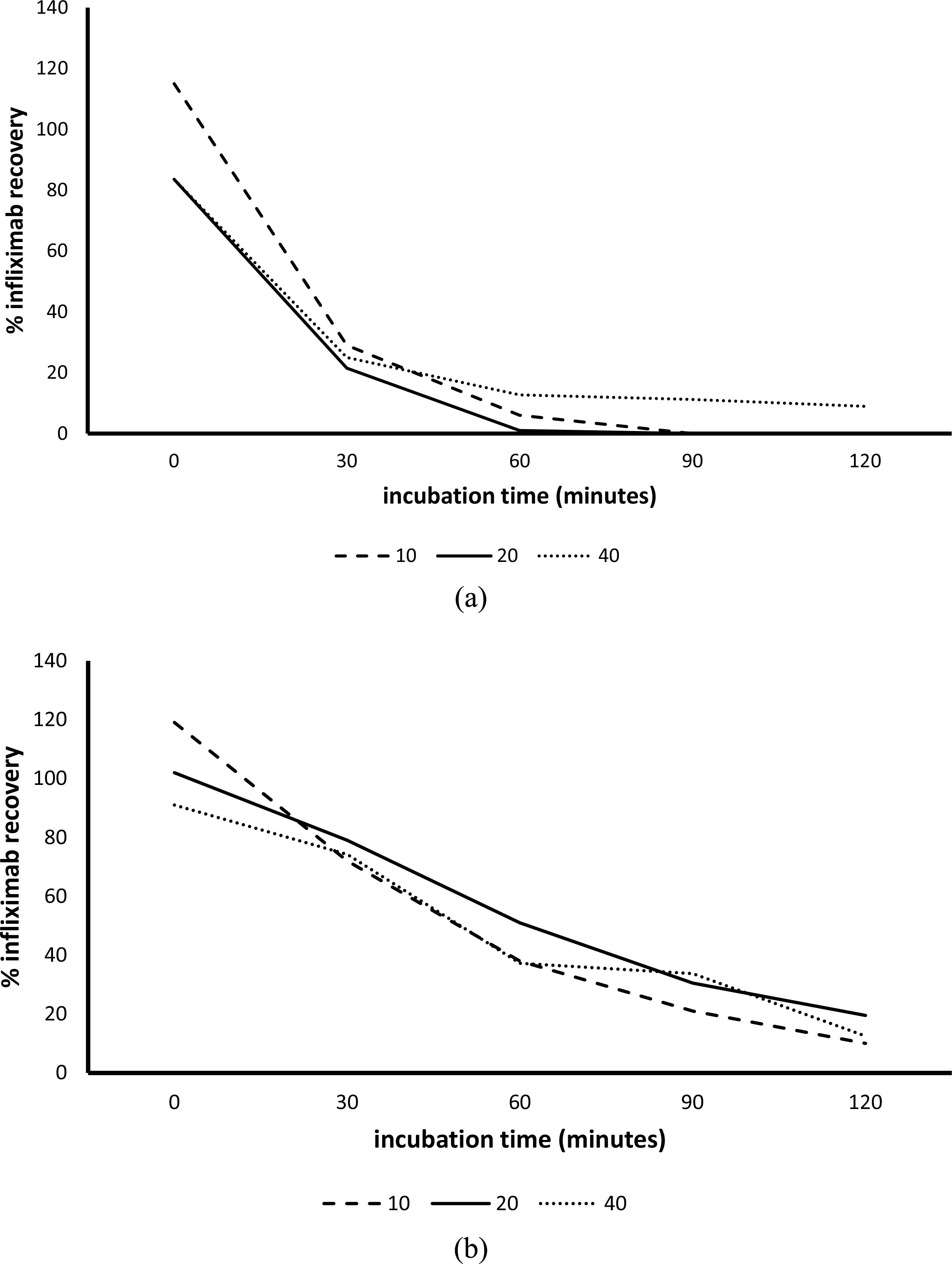
In the last experiment we added to the incubation flasks of the in vitro system also BSA to simulate the food protein. In fact, it might represent a suitable target substrate for the pancreatic enzymes, alternative to the administered IFX. The amount of BSA added was calculated on the base of the human food requirements: assuming a protein daily intake of 50 g for an adult person [1] it could correspond (at maintenance) approximately to the 10% of dry matter intake. We added an amount of 100 mg of BSA, which represents the 10% of the amount of protein, contained in 1000 g of the substrate in the [12] method. The results of the present research indicate a relevant role ascribable to food proteins on the IFX recovery because in absence of BSA the IFX recovery was very low within 30 min of incubation (less or equal than 1/3) while the IFX remained biologically active for longer time in the case of BSA addition (Table 2 and Fig. 2a and b). This is an expected consequence of the competition between added protein and IFX as target substrates for pancreatic enzymes and suggests that a possible strategy to increase the IFX stability is to include sacrificial proteins to the drug [2] aiming at neutralising in part the pancreatic enzymes. The coefficients of the linear regressions within each IFX dose in the Exp 3 (Table 2) differed according to the antibody dose (
In the conditions of presence of food protein and considering the loss of accuracy of E.L.I.S.A. when used to assess the IFX recovery at a 6.8 pH we observed a regular decline of IFX concentration, and the half-life was reached at about 59–70 min. This degree of resilience is set in between the low resistance at the intestinal level (approx. 19 min) and the value considered of great stability of 90 min in the colon, found by [18]. However, caution is requested in such comparisons because the two studies used different analytical methods for IFX recovery titration, which were based respectively on chromatographic determination (e.g. HPLC in Yadav et al. [18]) and on immune enzymatic detection (e.g. TNF binding E.L.I.S.A.).
Finally, our results did not demonstrate any effect of the IFX dose on the degree of recovery, because the antibody half-life, calculated from the linear regressions within each IFX dose, was very similar (ranging between 59 and 70 min) and not statistically significant between doses. This is probably the consequence of an excess of proteolytic activity in the SIF proposed in this study, irrespective to IFX concentrations. In such conditions, the IFX resilience is not dependent by the pancreatin concentration, but rather from the intrinsic structural resistance of the antibody.
In conclusion, we demonstrated a discrete stability of IFX in the upper intestine environment (half-life range 59–70 min) and therefore, IFX could be considered for the oral treatment by delivering it at the duodenum. A dietetic strategy to further increase IFX stability should combine its administration with buffer substances (to improve the intestinal alkaline conditions) and food proteins to enhance the competition with pancreatic enzymes for the degradation. Therefore, the oral treatment should be associated with suitable dietary prescriptions.
Footnotes
Acknowledgments
This work was supported by the Region Friuli Venezia Giulia (POS-FESR 2014–2020, attività 1.3.b.).
Conflict of interest
All authors have nothing to disclose.