




Abstract
Fanconi anemia includes a number of clinically and genetically diverse disorders all of them being associated with genomic instability. Some previous studies reported higher frequencies of certain HLA alleles in patients with Fanconi anemia. In the current study, we genotyped HLA-A/B/DRB1 alleles in 40 Iranian patients with Fanconi anemia. We also genotyped these alleles in the same number of Iranian sex-matched healthy individuals. The frequency of DRB1*11 was significantly higher in patients compared with controls (OR (95% CI)
Introduction
Fanconi anemia includes a number of clinically and genetically diverse conditions all of them being associated with genomic instability. This autosomal recessive disorder causes structural malformations, bone marrow failure and susceptibility to cancer [1]. Defects in the DNA repair system is the underlying cause of hypersensitivity of these patients to DNA crosslinking chemicals and high incidence of chromosomal abnormalities in these patients [1]. Based on the fatal complications of the disorder, bone marrow transplantation is indicated in patients. Gluckman et al. have performed hematopoietic cell transplantation in a 5-year-old boy with severe Fanconi anemia. Stem cells were obtained from cryopreserved umbilical cord blood of the HLA-identical unaffected sib [2]. Subsequently, Gerwal et al. have reported effective hematopoietic stem cell transplantation for another patient with the same disorder from a healthy HLA-genotype-identical sib [3]. Based on the importance of HLA alleles in the regulation of immune-responses [4], HLA genotyping has practical significance in hematopoietic stem cell transplantation. Thus, HLA genotyping is performed in patients with Fanconi anemia. Moreover, based on the possible role of dysregulation of immune responses in the pathogenesis of Fanconi anemia, HLA alleles might have role in this disorder [5]. Previous studies have suggested association between certain HLA alleles and this disorder [5, 6]. However, there is no comprehensive report of assessment of HLA alleles in these patients. In the current study, we genotyped HLA-A/B/DRB1 alleles in 40 Iranian patients with Fanconi anemia. We also genotyped these alleles in the same number of Iranian sex-matched healthy individuals.
Hardy-Weinberg equilibrium in Fanconi anemia patients group
Hardy-Weinberg equilibrium in Fanconi anemia patients group
Hardy-Weinberg equilibrium in control group
Frequency of common alleles in patients and controls
Schematic representation of HLA alleles in patients and controls.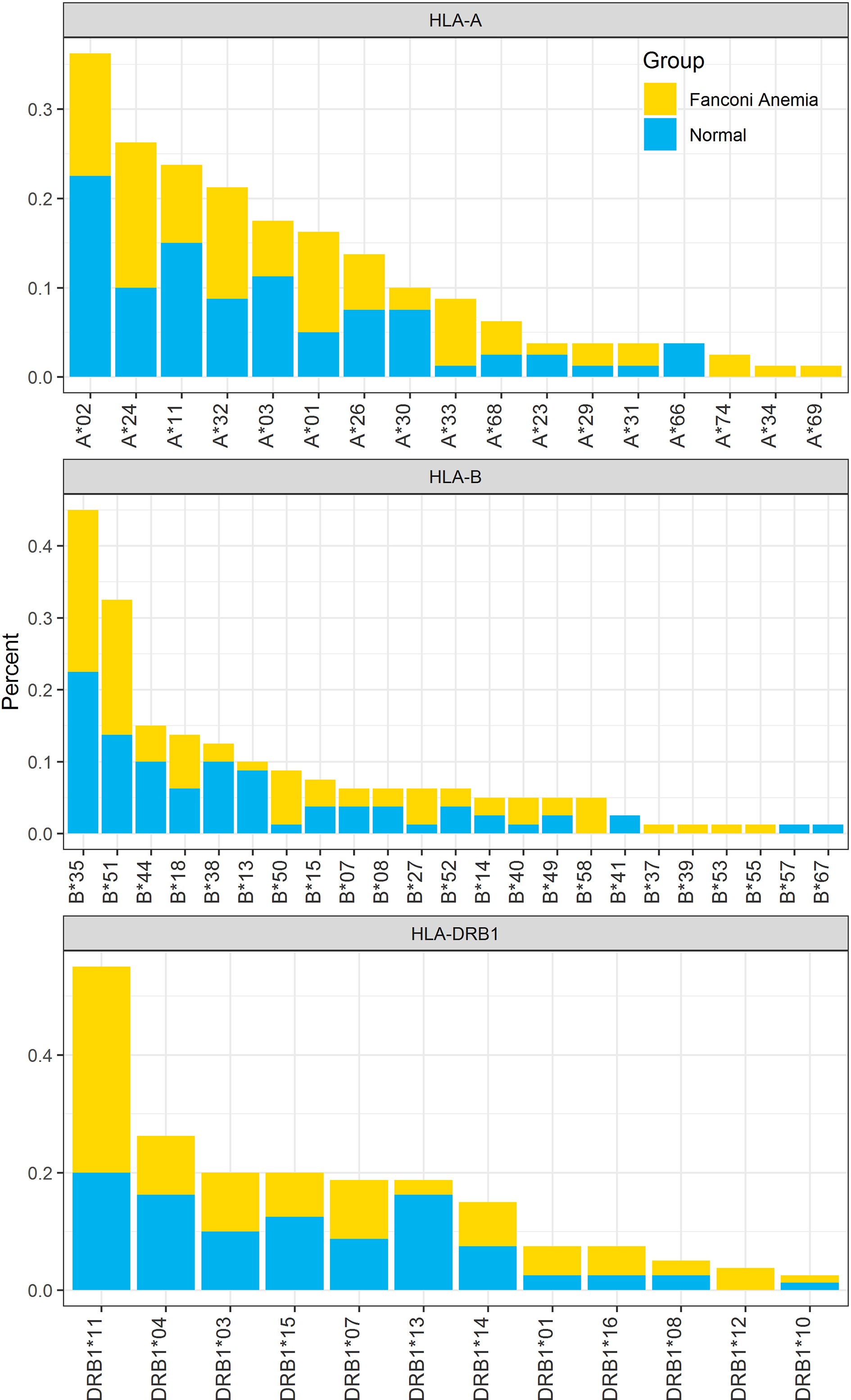
Frequency of common genotypes in patients and controls
Frequency of common haplotypes in patients and controls
Schematic representation of HLA haplotypes in patients and controls.
Patients
The current study was conducted on samples obtained from 40 patients with Fanconi anemia (29 males and 11 females, mean age: 10.65) and the same number of healthy individuals with the same sex ratio. Patients were diagnosed at Children’s Medical Centre, Tehran University of Medical Sciences during 2017–2019. Informed consent forms were signed by children’s parents. The study protocol was approved by the ethical committee of Shahid Beheshti University of Medical Sciences.
HLA genotyping
HLA genotypes were identified using the low-resolution HLAABDR SSP kit (HLA-A-B-DR SSP Combi Tray, Olerup Diagnostic Gmbh, Germany). The corresponding regions were amplified with sequence-specific primers and visualized under UV transilluminator after being electrophoresed on 2.0% agarose gel.
Statistical analysis
The allelic frequencies of HLA-A, HLA-B and HLA-DRB1 were determined by direct counting method. The deviations from Hardy-Weinberg equilibrium (HWE) and haplotype frequencies were obtained by Arlequin software package, version 3.5.2.2 [7]. The exact logistic regression and multinomial regression models were used to compare the allele frequency between study groups. The Fstat test was done to evaluate genetic divergence among the groups. The analyses included pairwise tests of genetic differentiation. The adjusted pairwise
Results
Assessment of agreement with Hardy-Weinberg equilibrium supposition
The frequencies of HLA genotypes were in agreement with the Hardy-Weinberg equilibrium supposition in cases (Table 1) and controls (Table 2).
Distribution of HLA alleles, genotypes and haplotypes in cases and controls
Tables 3–5 show distribution of HLA alleles, genotypes and haplotypes in cases and controls. Alleles, genotypes and haplotypes with no observed frequency in one study group were excluded.
Figures 1 and 2 show schematic representation of distribution of HLA alleles and haplotypes between study groups, respectively.
The frequency of DRB1*11 was significantly higher in patients compared with controls (OR (95% CI)
Distribution of HLA-A, -B, -DRB1 alleles in patients compared with controls
Distribution of HLA-A, -B, -DRB1 alleles in patients compared with controls
Assessment of genetic divergence using Fstat test showed complete divergence in HLA-A, -B, -DRB1 alleles and haplotypes between patients and controls (Table 7).
Results of assessment of genetic divergence in HLA-A, -B, -DRB1 alleles and haplotypes between patients and controls (Fstat test)
Fanconi anemia is a disorder with various complications and inevitable occurrence of hematologic abnormalities [8]. Allogeneic hematopoietic cell transplantation from an HLA-matched donor is the sole effective method to re-establish normal haematopoiesis at present [9, 10]. Thus, HLA genotyping is considered in these patients. In the current study, we genotyped HLA-A, -B and DRB1 in a population of Iranian patients with Fanconi anemia and healthy subjects to appraise association between these alleles and disease status. We reported higher frequency of DRB1*11 in patients compared with controls. On the other hand, the frequencies of DRB1*13 and B*13 were lower in patients compared with controls. HLA-DRB1*13 has been previously reported as the strongest risk factor for juvenile idiopathic arthritis [11]. Moreover, the HLA-DRB1*11 has been associated with risk of multiple sclerosis in Iranian population [12]. This allele has been associated with a number of other immune-related disorders such as systemic sclerosis and anti-DNA topoisomerase I antibody [13], the presence of anti-Ro/SSA and anti-La/SSB antibodies in neonatal lupus erythematosus [14] and occurrence of mite sensitive asthma [15]. HLA-DRB1*11 molecules might be involved in the dysregulation of innate immune responses and enhancement of production of proinflammatory cytokine [11], thus deteriorating the condition of patients with Fanconi anemia. Moreover, HLA-DRB1*11 alleles have glutamate residue at position 58. The side-chain of this residue proceeds outside of the peptide-binding groove and might exert a disease-associated role that is independent of antigen presentation [11]. Consistent with our results, HLA-DRB1*13 has been shown to have a protective role against a number of autoimmune disorders including systemic Lupus Erythematosus, psoriasis or psoriatic arthritis, rheumatoid arthritis, systemic sclerosis, multiple sclerosis and myasthenia gravis [16]. However, the role of HLA-DRB1*11 and -DRB1*13 in Fanconi anemia has not been reported previously. A previous study has reported higher frequency of HLA-A2 and HLA-A2 homozygotes in patients with aplastic and Fanconi anemias in French population [6]. However, we did not find any association between HLA-A alleles and Fanconi anemia in Iranian population. Yari et al. have previously assessed association between HLA-DRB1 alleles and Fanconi anemia in Iranian population and found higher frequency of HLA-DRB1*04 and lower frequencies of HLA-DRB1*03 and HLA-DRB1*15 alleles in patients, yet the differences between patients and controls were not significant possibly due to their small sample size [5].
Taken together, we reported different frequencies of two HLA-DRB1 alleles and one HLA-B allele between Fanconi anemia patients and healthy controls. These findings not only have practical significance in performance of hematopoietic stem cell transplantation for these patients, it might also imply a putative role for dysregulated immune responses in these patients. Future studies are needed to shed light on underlying molecular mechanisms of these findings.
Footnotes
Acknowledgments
The current study was supported by a grant from Shahid Beheshti University of Medical Sciences.
Conflict of interest
The authors declare they have no conflict of interest.