



Abstract
BACKGROUND:
Tuberculosis (TB) remains a universal health problem with significant morbidity and mortality. Understanding the genetic factors affecting TB susceptibility is crucial for effective prevention and treatment. Interleukin-10 (IL-10), a regulatory cytokine, may influence TB pathogenesis through genetic variations.
METHODS:
The PubMed, Embase, and Google Scholar databases were searched to find studies on the relationship between IL-10 gene variants and tuberculosis. Relevant studies from 2016 to 2024 were identified through database searches. The selected case-control studies met the inclusion criteria. Software such as Review Manager was used to analyze quantitative data, with statistical significance set at
RESULTS:
Nine studies examined IL-10 gene polymorphisms (rs1800871 and rs1800872) in TB susceptibility. The present study did not show a notable association between IL-10 gene polymorphisms and TB among all genetic models (allelic, homozygote, heterozygote, dominant, and recessive). The obtained
CONCLUSION:
Our meta-analysis revealed no significant association between IL-10 gene polymorphisms and TB susceptibility, suggesting that these variations may not significantly contribute to TB susceptibility. Further research with a larger sample size and diverse ethnicities is needed to explore additional genetic variations and their implications in TB pathogenesis.
Introduction
Tuberculosis (TB) persists as the most lethal infectious disease [1], resulting in 1.5 million deaths annually [2]. Each year, an estimated 8.9–9.9 million individuals contract a Mycobacterium tuberculosis (MT) infection. However, only 5–10% of those infected progress to clinical disease. While a minority of these cases are associated with known risk factors like diabetes or HIV infection, for many patients, a combination of genetic disposition and ecological influences may contribute to the onset of active TB [3]. India has a high prevalence of tuberculosis, an endemic disease, and recorded the highest number of new TB cases in 2021 [4]. Tuberculosis (TB) predominantly affects the lungs and is a pulmonary disease. When individuals with lung TB cough, sneeze, or expel saliva, transmission occurs through the air, and infection can occur through inhaling a small number of bacteria [5].
While tuberculosis (TB) typically affects the lungs, it can also manifest in various parts of the body, showcasing diverse symptoms. The primary transmission mode is inhaling aerosolized droplets containing the infectious agent [6]. The body’s ability to control or eradicate the infection depends on the individual’s immune status, genetic factors, and whether it’s the first or subsequent exposure to the bacteria. Mycobacterium tuberculosis has several virulence factors that hinder its elimination by alveolar macrophages. For instance, the high mycolic acid content in its outer capsule makes it challenging for macrophages to engulf the bacteria. Additionally, components like the cord factor can directly harm alveolar macrophages. Studies have demonstrated that M. tuberculosis interferes with forming an effective phagolysosome, impeding the elimination of the bacteria [7]. Upon initial exposure, the manifestation is termed primary tuberculosis, often localized in the middle part of the lungs, forming the Ghon focus. In many cases, the Ghon focus remains dormant, known as latent tuberculosis [8]. Latent tuberculosis can become active again when the host’s immune system is compromised. A small percentage of individuals develop active disease after the initial exposure, termed primary progressive tuberculosis. This form is more common in children, malnourished individuals, those with immunosuppression, and individuals using long-term steroids [9].
IL-10 is a versatile regulatory cytokine known for modulating inflammatory responses. A growing body of research indicates that IL-10 is a broad inhibitor of T helper (Th) 1 and Th2 cell proliferation and cytokine production in controlled laboratory and in vivo settings [10]. Stimuli can influence cytokine production in the local environment, as well as genetic factors. Both in vitro and in vivo studies have shown that polymorphisms in cytokine genes’ coding or noncoding sequences can affect transcription efficiency, thereby altering cytokine production [11]. Its anti-inflammatory effects are achieved by suppressing the synthesis of various cytokines in activated macrophages and interferon-gamma (IFN-
Recent studies have explored the influence of two common polymorphisms (
Methodology
The extraction approach and selection of relevant reports for meta-analysis
To identify qualified studies for meta-analysis, we conducted an automated search of published literature utilizing databases like EMBASE, PubMed, Google Scholar, Cochrane Library, and Web of Science. We only searched for articles published in English between 2016 and 2023 and used keywords such as “tuberculosis,” “interleukin 10 gene”, “IL-10 gene”, “SNP,” “association,” “polymorphism,” “rs1800872,” and “rs1800871” to retrieve the relevant full-text articles. We assessed articles according to predefined inclusion and exclusion criteria. Articles were eligible if they fulfilled the following criteria: i) employed a case-control study design and ii) provided genotype frequencies for both cases and controls. Articles were excluded if they met the following criteria: i) lacked control subjects; ii) involved animal models; iii) utilized cell lines or presented case reports; or iv) lacked sufficient genotypic data.
A Flow diagram shows the overview of the study selection.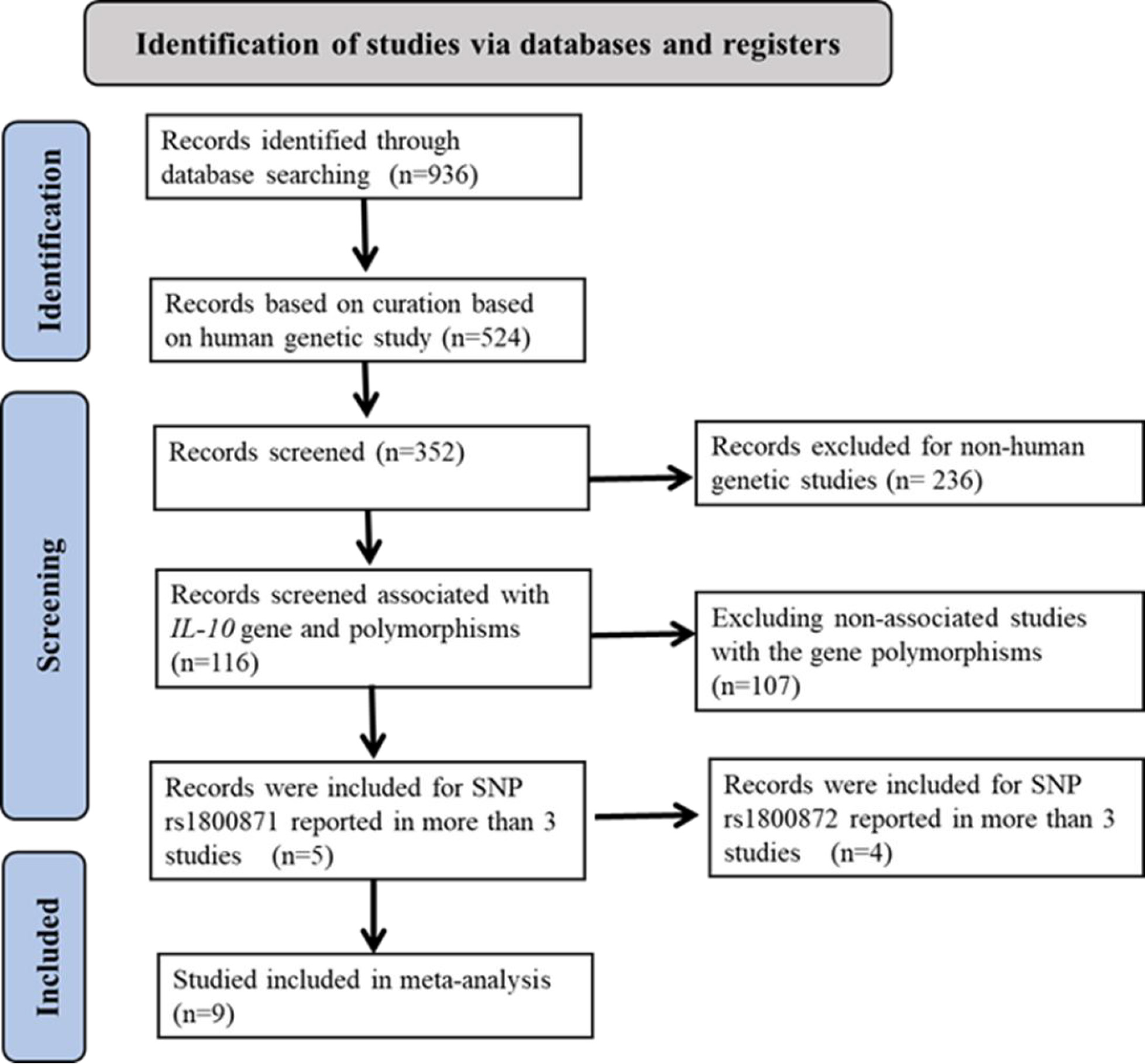
Data about study characteristics involving the first author’s name, publication year, nation, customs, sample sizes for both cases and controls, genotypic frequencies of each SNP, and the genotyping system employed were extracted from the chosen studies.
Assessment of methodological quality using HWE and NOS
The investigators evaluated the chosen analysis quality using two criteria: Hardy-Weinberg equilibrium (HWE) and the Newcastle Ottawa Scale (NOS). Control genotype allocation was required to adhere to HWE (
Characteristics of study IL-10 rs1800871 included in the meta-analysis
Characteristics of study IL-10 rs1800871 included in the meta-analysis
Characteristics of study IL-10 rs1800872 included in the meta-analysis
The odds ratio of individual studies associated with the IL-10 rs1800871 and tuberculosis
Data analysis was conducted utilizing the Review Manager 5.4 software, with statistical significance determined at
Results
In particular, this study is intended to assess the link between tuberculosis and peculiarities in the IL-10 gene. We conducted searches on various databases such as Google Scholar, NCBI, and Science Direct and found five studies with a total of 1127 cases and 1355 controls for the SNP rs1800871. Additionally, we found four studies with a total of 965 cases and 902 controls for the SNP rs1800872. Based on the data collected from all nine studies, we found an association between tuberculosis and IL-10 gene polymorphism. The study strategy for examining the IL-10 gene is shown in Fig. 1, and information about all the studies we included, including the characteristics of the cases and controls, can be found in Tables 1 and 2. The six studies included diverse ethnicities [18, 19, 20, 21, 22, 23, 24].
It was found that there is no significant link between the IL-10 rs1800871 gene polymorphism and TB. The results were obtained using the random effects model with an I2 value greater than 50%. In the allele model T vs. C (I2
The odds ratio of individual studies associated with the IL-10 rs1800872 and tuberculosis
The odds ratio of individual studies associated with the IL-10 rs1800872 and tuberculosis
The forest plot shows the heterogeneity in IL-10 rs1800871 in the random effects model.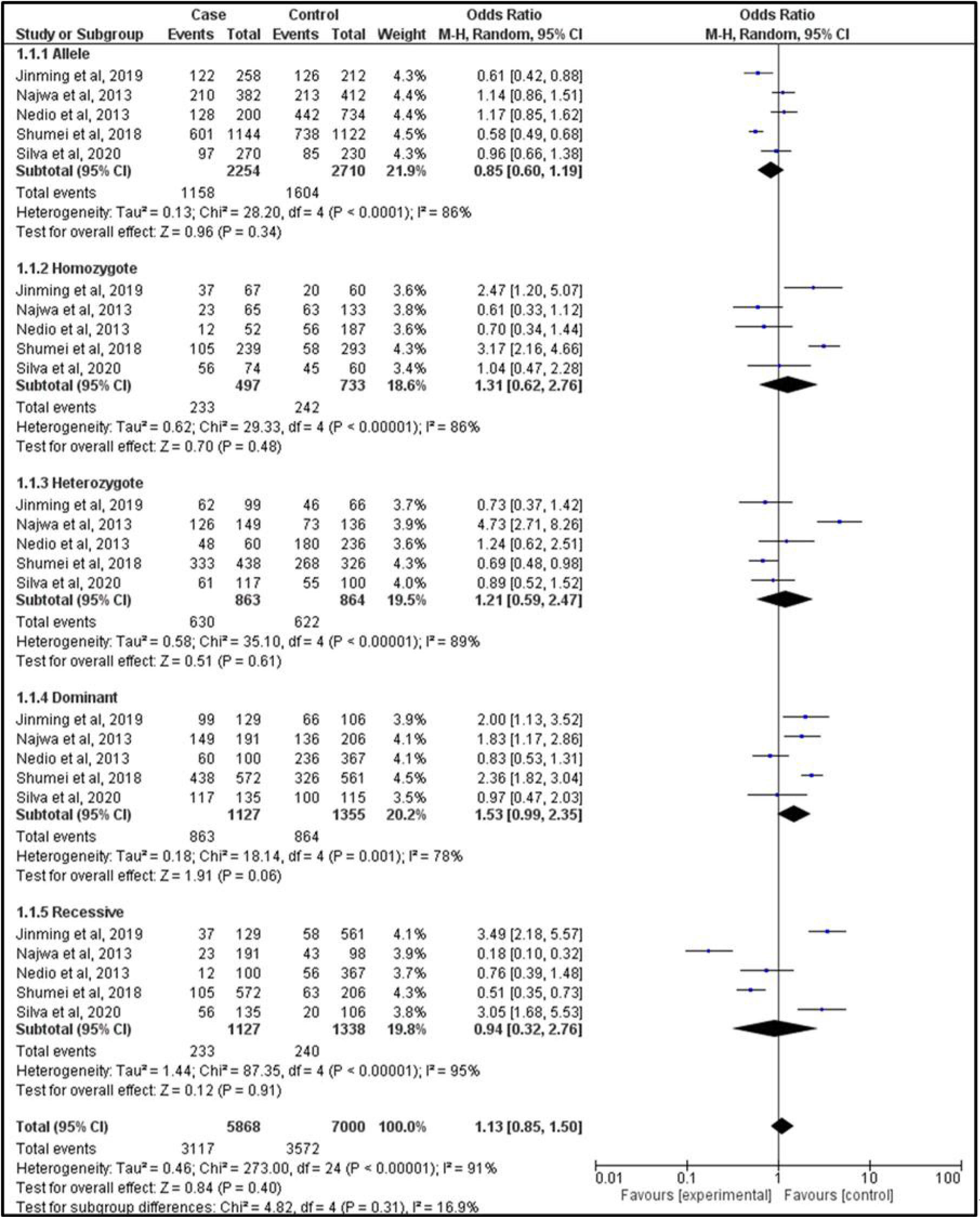
The forest plot shows the heterogeneity in IL-10 rs1800872 in the random effects model.
(a) and (b) The funnel plot shows the publication bias for the SNPs ((a) rs1800871 and (b) rs1800872) in the IL-10 gene.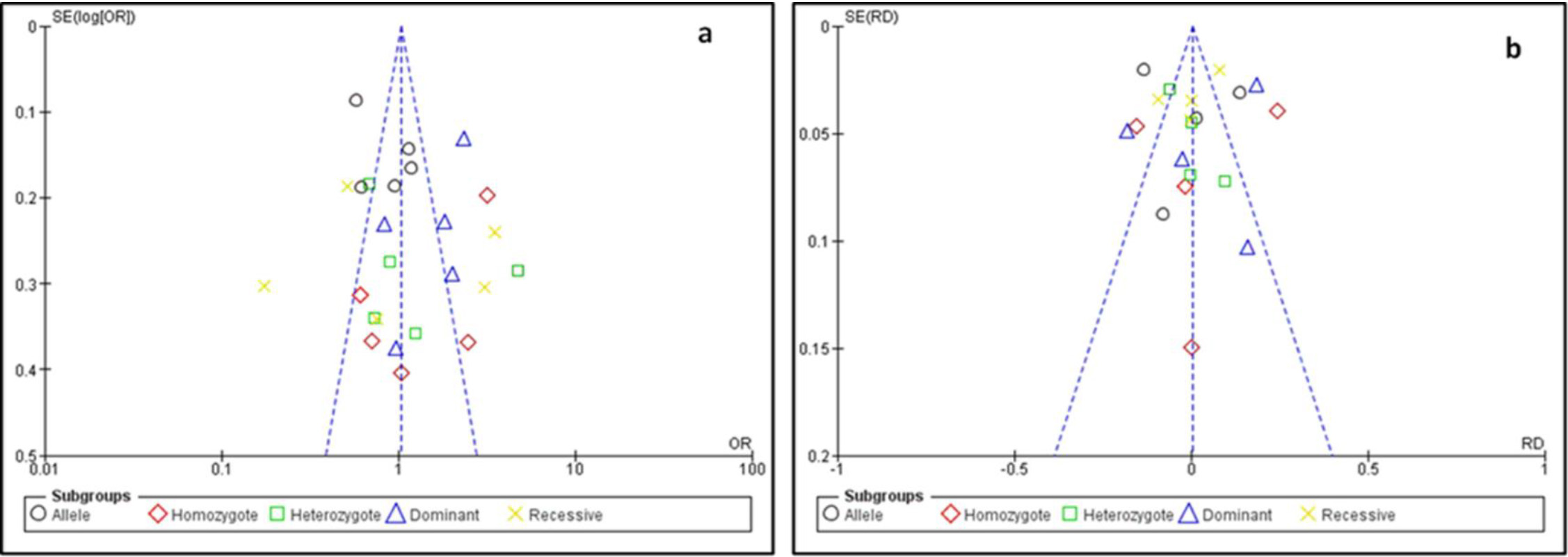
It was found that there is no substantial link between the IL-10 rs1800872 gene polymorphism and TB. The I2 value was greater than 50%, so random effects models were used. In the allele model A vs. C (I2
The Protein-Protein Interaction (PPI) network of differentially expressed genes (DEGs) among the selected genes associated with tuberculosis.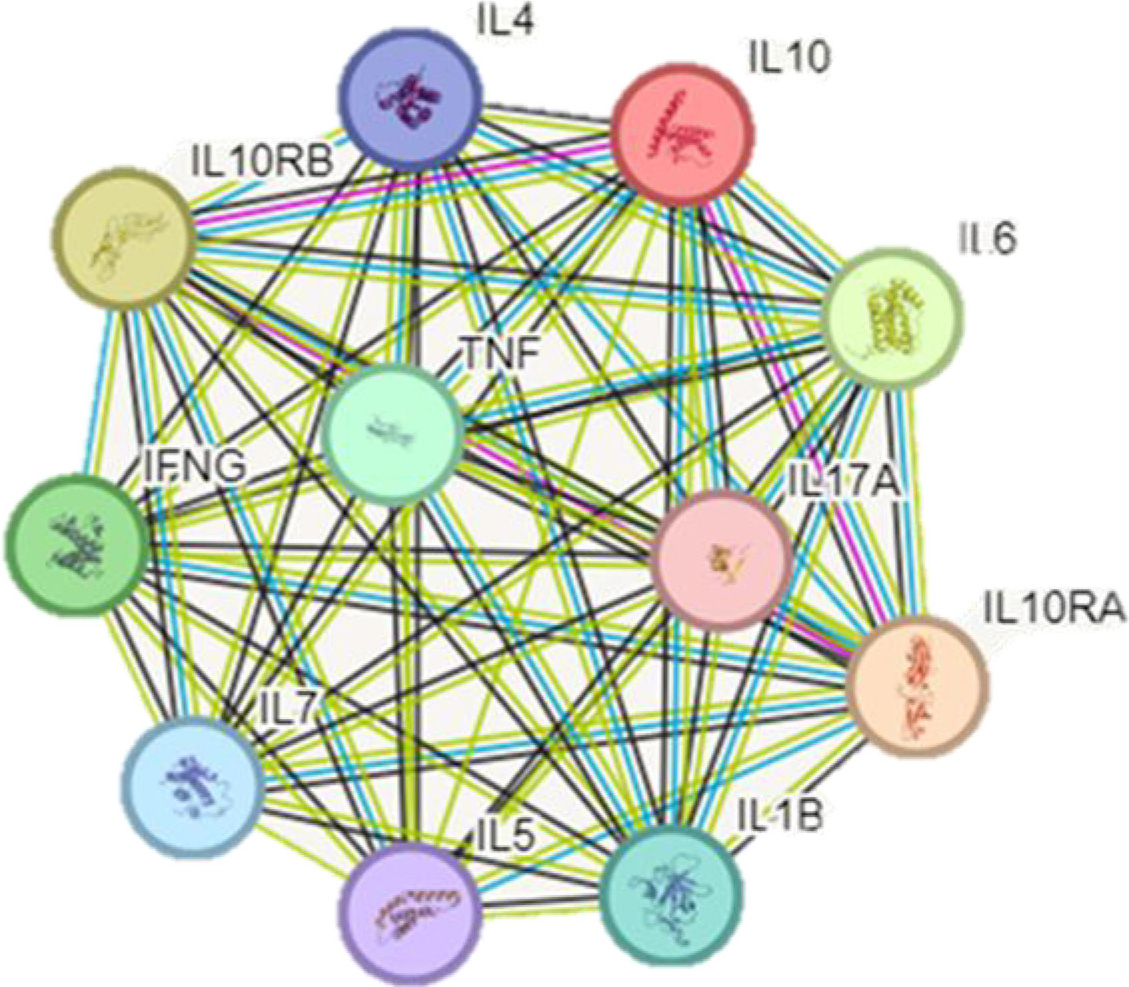
The Circos plot visualizes chromosomal interactions involving the rs1800871 SNP.
The Circos plot visualizes chromosomal interactions involving the rs1800872 SNP.
The e-search tool STRING database (STRING, V11.0; https://string-db.org/) can forecast functional protein interactions and PPI (protein-protein interaction) scores of
Cytokines are glycoproteins or immunomodulatory proteins generated by a wide range of cells and have intricate functions. They can positively or negatively influence a cell’s ability to divide, develop, differentiate, migrate, die, and produce cytokines and other cell products. The immune response’s equilibrium depends critically on a functioning cytokine network, and disruption of this network might result in an aberrant immunological response. Furthermore, the cytokine network may change in various diseases, complicating the pathogenic processes even more. As a result, genes that regulate the generation of cytokines have been the focus of recent research, particularly gene polymorphisms that might impact the expression levels and, in turn, the overall immune response [14]. IL-10, a significant Th2-regulatory cytokine, is crucial during the latent phase of TB infection and is identified as a cytokine synthesis inhibitory factor. Furthermore, IL-10 suppresses the function of monocytes and macrophages during inflammation by reducing the production of pro-inflammatory cytokines [16, 17]. The IL-10 gene is located on the long arm of chromosome 1, and it has recognized polymorphisms in the IL-10 promoter region, such as -819T/C and -592A/C. Additionally, IL-10 has been linked to TB across various ethnic groups [15].
This study specifically investigates the polymorphisms of the IL-10 gene, examining the relationship between IL-10 gene polymorphisms and susceptibility to TB. Recently, studies have explored a significant link between tuberculosis and IL-10 gene polymorphisms [18]. The study conducted by Shumei et al. (2018 in the Tibetan Chinese population showed an association of SNPs rs1800871 and rs1800872 of the IL-10 gene with tuberculosis based on the
The study conducted in 2013 showed an increased risk of developing tuberculosis due to the association of SNP rs1800872 with the IL-10 gene polymorphism in the Sudanese population [23]. The study conducted by Silva et al. in 2020 showed the high susceptibility risk of tuberculosis in association with two SNPs, rs1800871 and rs1800872, in the IL-10 gene polymorphism observed in the Brazilian population [24].
The IL-10 -819 T/C polymorphisms are associated with the Asian population, while the IL-10 -592 A/C polymorphisms show a significant association with the European population, which was confirmed in the study conducted by Liang et al. (2014) [25]. The meta-analysis study conducted by Gao et al. (2015) suggests that the IL-10 -819T/C polymorphism is linked to an increased risk of TB in Asians, while the IL-10 -592A/C polymorphism may be a risk factor for TB in Europeans [14].
The previous results do not align with the findings of the current meta-analysis. In the present study, neither of the IL-10 gene’s SNPs (rs1800871 and rs1800872) significantly correlated with tuberculosis. The study was conducted using NOS scoring to ensure the selection of high-quality studies with reliable methodologies, thereby minimizing the risk of bias. The study concluded that the IL-10 gene polymorphism was consistent with the principle of HWE value. To evaluate publication bias, both a funnel plot and Egger’s test were employed, neither of which showed any signs of bias. According to the PPI network, the proteins exhibit higher interactions than expected from a randomly selected group of proteins of similar size and distribution in the genome. This enrichment indicates a degree of biological interconnection among the proteins and the interconnected network of other genes and proteins with the IL-10 gene. Consequently, the statistical data strongly supports the conclusion. A rigorous protocol was followed to extract and analyze the data, ensuring reliable and satisfactory results for the study. Thus, our data provides solid evidence to support the conclusion. Our research enhances our understanding of the genetic factors involved in tuberculosis, potentially leading to improved detection and therapy. Our study emphasizes the ongoing need to understand the mechanisms of IL-10 gene variation despite conflicting results regarding the insignificant association between IL-10 gene polymorphisms and tuberculosis risk due to the insufficient and low sample size. Identifying genetic markers could aid in risk assessment, early detection, and personalized therapy. Ultimately, our study provides valuable insights into the relationship between interleukin gene polymorphisms and TB risk associations, enhancing our understanding and emphasizing the growing importance of unravelling these complexities.
Conclusion
In conclusion, our meta-analysis investigated the association between tuberculosis (TB) susceptibility and polymorphisms in the IL-10 gene. Despite previous studies suggesting a potential link between IL-10 gene polymorphisms and TB, our analysis did not identify an association between the IL-10 rs1800871 or rs1800872 gene polymorphisms and TB susceptibility across different genetic models. These results were consistent across various ethnicities and were not influenced by publication bias. These findings indicate that while IL-10 is a crucial cytokine involved in modulating inflammatory responses and has been implicated in TB pathogenesis, the specific polymorphisms examined in this study may not significantly contribute to TB susceptibility. Further research exploring additional genetic variations and their functional implications in TB pathogenesis is warranted to understand better the complex interplay between host genetics and TB susceptibility.
Overall, our study contributes to the growing body of literature on the genetic basis of TB susceptibility and underscores the importance of robust meta-analyses in elucidating the role of genetic factors in infectious diseases. Further investigations are needed to unravel the intricate mechanisms underlying TB pathogenesis and identify potential targets for therapeutic interventions and preventive strategies.
Limitations
The current study has limitations, as it does not consider the genetic environment or other demographic characteristics. Additionally, due to the limited sample size and lack of ethnic diversity, subgroup analysis was not performed. Consequently, future research should include a larger and more diverse sample size across various ethnicities. Further studies involving diverse populations are recommended to increase the relevance and applicability of the findings.
Author’s contributions
As authors of this manuscript, SM and JM have written the contents and edited the figures and tables; RV has designed the study, corrected and approved the final manuscript.
Disclosure statement
The authors report no conflicts of interest.
Ethics and consent to participate
This article is based on published data; hence, ethical approval is not required.
Funding
Not applicable.
Consent for publication
All authors have read and approved the manuscript.
Footnotes
Acknowledgments
The authors would like to acknowledge the unwavering encouragement and support of the Chettinad Academy of Research Education.