



Abstract
BACKGROUND:
Infertility is an inability to conceive after a reasonable period of time (12 months) without the use of contraception or due to a person’s incapacity to procreate, whether independently or with a spouse. Problems with the production and maturation of sperm are the most common causes of male infertility additionally; the motility is the major functional character that determines the fertilizing ability of spermatozoa. Therefore the goal of this study is to get better certain sperm function parameters in vitro of asthenozoospermic patient.
OBJECTIVE:
The World Health Organization (WHO) and many studies considered the infertility as a disease and so many couples complaining from unsuccessful assisted reproductive technologies (ART) procedures to overcome their problem. The goal of this study is to improve certain sperm function feature in vitro of asthenozoospermic semen patients by using combination of motility inducing namely; Maca, L-carnitine and Pentoxifylline that enhance the medium to improve certain sperm characters that might be utilized for ART centers.
METHODOLOGY:
Semen aliquots were collected from ninety patients with asthenozoospermia who participated in present study, the volume of semen samples with normal ejaculate when was ranged between 1.4-6ml and can be measured by using a measure pipette or conical graduated tube; Inclusion criteria was Asthenozoospermia, oligozoospermia and teratozoospermia men, Infertile idiopathic men also, fertile normozoospermic men. While Exclusion criteria was Azoospermic men, Alcoholic, Patients under treatment with antibiotics and men with Varicocele.
The samples split into two equal groups at random. Using Ham’s F12 medium, one portion served as the control group, and the other was the treatment group, which was mixing by combining the following ingredients, Maca powder extracts (Lepidium meyenii) (M) 1 mg/ml, 0.5 mg/ml of L-Carnitine (LC), and 10 mg/ml of Pentoxifylline (PTX). The data were analyzed using Statistical Package for Social Sciences (SPSS) version 23.0. The descriptive statistics including frequency, range, mean and standard error, Data from treated and control groups were expressed as mean
RESULTS:
The information showed a very large (
CONCLUSION:
The present work stated that novel combination medium (LC, maca and PXT) have potential effects to improve sperm characters in male infertility factors and suggested to be used for sperm preparation and activation in ART programs.
Introduction
Infertility is one of the most serious problems facing the countries. It is a disease of reproductive system defined by failure to achieve the clinical pregnancy after 12 months or more of regular unprotected sexual intercourse which is approximately 15% of couples [1]. A male factor is solely responsible in about 20% of infertile couples and informative in another 30–40% [2]. Male factor infertility may be explained by an abnormal seminal fluid analysis or by sperm dysfunction as well as functional male defects, additionally male infertility caused factors can be divided also into non-genetic and genetic factors [3, 4]. The integrity of the sperm axoneme and tail structures, additionally the mitochondria’s metabolic machinery and sperm morphology, are measured by sperm motility can be used as measure of the quality of spermatogenesis and the integrity of DNA packaging [5]. Therefore, one of the main reasons why men have lower fertility or are infertile is asthenozoospermia [6]. Furthermore, is considered as a multifactorial condition because of the widespread male infertility also known as subfertility or decreased fertility. Other problems related could be brought on by a variety of things such as infections, hormonal imbalances, or structural flaws, which would then result in male infertility [7]. And there are many causes of infertility related to age, 4% of couples in the first stage of their life was infertile and this ratio will increase to 20% at their 30 years [8].
Today with the emergence of in vitro fertilization techniques there are sperm preparation techniques currently available to precipitate progressively motile, morphologically and functional normal spermatozoa, also to release disturbed and sluggish sperms from seminal plasma [9]. Layering method is a technique used for normozoospermic and asthenozoospermic semen patients; it was first described by Bourn Hall Clinic, UK at 1992 which allow self-selection of motile sperm [10]. At the same time, various motility stimulant agents one of these is (Lepidium meyenii) maca extract. It used as food supplements and for medical beneficial for centuries in Peru because of its high nutritional value in addition to its effects on fertility and sexual performance, previously, aqueous extract maca had been indicated whether in vivo or in vitro studies as safe to use and do not cause hepatotoxicity [11]. The activity of the plant is located in the root which was recommended to overcome many abnormal physiological conditions like anemia and infertility because of its anabolic and aphrodisiac effects [12]. Pentoxifylline (PTX) is a tri-substituted xanthine derivative chemically designated as 1-(5-oxohexyl)-3, 7-dimethylxanthine that has received approval from the Food and Drug Administration (FDA). It is a hemorrheologic agent that affects blood viscosity and indicated for the treatment of patients with intermittent [13]. In addition, study L-carnitine is a conditionally essential nutrient, it obtained from dietary sources like foods rich in carnitines, [14] moreover, L-carnitine is a quaternary ammonium compound biosynthesize from the essential amino acids lysine and methionine; approximately 25% of total body carnitine is synthesized by the body [15]. L-carnitine facilitates the transport of long-chain fatty acids into the mitochondrial matrix for
Material and methods
Patients
The project was performed in the Assisted Reproductive Technologies and Infertility Unit at Al-Nahrain University’s Higher Institute for Infertility Diagnosis and Fatima Al-Zahra Hospital for women and children in Baghdad, about 90 sample were collected from men suffering from asthenozoospermia and related conditions through the period from Nov. 2023 till March 2024, with an average men age ranging between 20–45 years. The patient provided all informative history, which was then arranged into an informative, well-detailed questionnaire.
The clinical examination including existence or absence varicocele, cryptorchidism, hydrocele, hernia and others performed by the adviser urologist responsible for male infertility unit performs. The study was approved by the Ethical Approval Committee. All men received a full clarification of the goal of the study.
Seminal fluid analysis
After 3 to 5 days of abstinence the semen samples were collected directly into a clean, dry and sterile container supplied by the laboratory. At 37∘C the specimens were placed in an incubator to complete liquefaction after that, the specimens were examined by macroscopic and microscopic examinations using standardization [17, 18].
Preparation of Pentoxifylline stock solution
In 10 ml of phosphate buffered saline (PBS) dissolving 10 mg from PTX powder (sigma, USA). Every day, under sterile conditions, this concentration was generated with filtered through a millipore filter (0.45
Preparation of L-Carnitine stock solution
To prepare it, fill a plastic test tube with 10 ml of phosphate buffer solution and add 0.5 mg of LC powder (Pharmaciena, USA). After that, it was stored at 25∘C with a pH of 7.4–7.8 and filtered through a Millipore 0.45
Preparation of Maca powder extracts (Lepidium meyenii)
In sterile plastic test tube the solution was prepared by dissolve (1 mg) of maca powder in 10 ml of phosphate buffer solution (PBS), the media used for activation was contain about (0.0005 g) of maca then stirring until dissolve. Using millipore (0.45
In vitro layering method
Sample of human semen after it has been liquefaction applied for in vitro sperm preparation by using layering technique that described in the manual of WHO (2021). Each part of sample split in half. Using Hams F-12 medium (Sigma, Germany), one portion of the semen was used as a control, while the other portion was used as a treated group by adding medium. Content mixed combination of Maca powder extracts (Lepidium meyenii), Pentoxifylline (PTX) and L-Carnitine (LC). All prepared samples were maintained in CO2 5% incubator for half hour In accordance with WHO 2021 and 1999, Pre- and post-in vitro activation, a few sperm function measures were evaluated.
Assessment of DNA integrity using acridine orang stain
An acridin orang stain that is used to detect DNA fragmentation in sperm of semen sample must be prepared in order to assess DNA fragmentation. Acridine orange test (AOT) was prepared by mixing 10 mL of (AO) added to 40 mL of (0.1 M) Citric acid, and 2.5 mL of (0.3 M) Na2HPO4.7H2O. Then pH adjusted to (2.5) before staining. Also need prepared Carney’s Solution which considers fixative solution consists of three parts of Methanol and one part of Glacial Acetic acid. After preparing the 10
DNA fragmentation to determining fertility potential is as follows [19]
15–30% DFI – moderate/elevated level of DNA fragmentation.
Statistical analysis
To compare values between the experimental and control groups, the mean
Effect of a combination of L-carnitine, Maca, and Pentoxifylline medium on specific sperm function parameters and the DNA index of individuals with asthenozoospermy after in vitro activation by layering techniques
Effect of a combination of L-carnitine, Maca, and Pentoxifylline medium on specific sperm function parameters and the DNA index of individuals with asthenozoospermy after in vitro activation by layering techniques
*Values are expressed as mean
DNA fragmentation using acridine orange stain.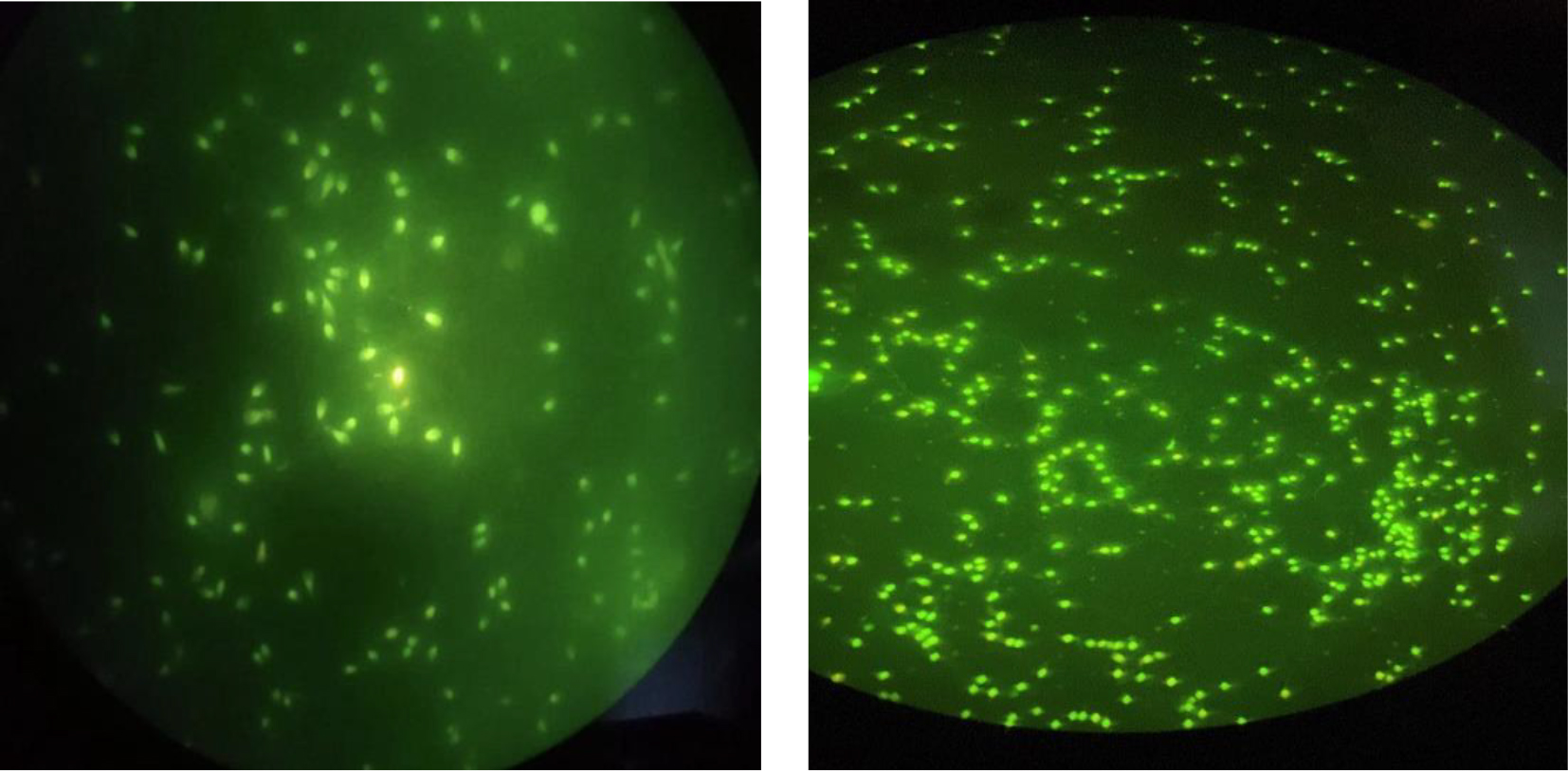
Impact of in vitro stimulation using mixed of L-Carnitine, maca and Pentoxifylline on sperm function parameters of infertile men using layering methods.
The results in Table 1 show highly significant (
Discussion
Current results observed improvement of all sperm features after activation by layering method than before activation with significant differences, with a notable decrease in sperm concentration after treatment with both Ham’s F12 medium alone and treated group compared to the pre-activation values. This decline in sperm concentration could be attributed to a successful application of layering method as sperm activation technique used to eliminate the immotile and dead sperms at the same time to actively increase the motility of sluggish sperm with maintained the active motility of progressive sperms [14].
The benefit of layering technique and culture medium was significantly noticed following in vitro activation. In addition to that, the sperm to activate required three main factors as physiological parameters are appropriate temperature of about 37∘C, CO2 concentration at 5%, and humidity [20]. That layering method required incubation of prepared semen samples in 5% CO2 [21]. This is what the layering technique relies on for the success of the activation process according to (WHO, 2021), which is developed to use for normozoospermic and asthenozoospermic semen, that allow self-selection of motile sperm [10].
Enhancement in most mean of sperm motility may relate to action of a combination contain mixed culture medium (Maca, LC and PTX) to in vitro activation medium. Therefore, when culture medium is supplemented with maca extract can make further improvement in sperm function parameters according to that positive action of maca as antioxidants reduces seminal oxidative stress and improves semen quality, particularly in sub fertile males. Maca is rich with numerous substances include amino acids, vitamins, alkaloids (macaines), and several microelements (Cu, Su, Mn, Al, etc.) [22]. Which has significant effect on sperm motility. Similarly [23] noticed an increase in sperm motility grades A and B that are active of treated mice given extract from maca. Moreover, sperm motility grade (A) and progressive motility (A
On the other hand, PTX is an inhibitor of the cAMP phosphodiesterase enzyme, which increases intracellular cAMP concentrations and sperm motility [27]. Present study agreement with other study that report the medium may be achieved by enhancing the expression and activity of enzymes with antioxidant properties [28, 29].
The data of this work notice an increased in MNS (percentage) post activation. It seemed that the layering technique used for activation and the medium containing a high density of neutral fluid that allow only for active sperm with high percentage of normal form to swim up through the zone of this mixture [30]. Whereas, the other cells like abnormal immotile sperm or unprogressive motile sperm cells, and sperms with abnormal morphology and /or sperms agglutinated with each other were prevented to reach the upper layer of the medium leading to have the enhancement of specific factors related to sperm function [29]. After activation, the aberrant DNA damage of the sperms in the infertile sample was significantly reduced due to the antioxidant activity of media, such as LC and PTX, which have the ability to scavenge oxygen-free radicals by reducing the generation of superoxide from human spermatozoa [17]. Both substance antioxidant property act to decrease ROS production and may also have an influence on sperm motility [14, 25]. Therefore, maca components are more active in DNA damage prevention [31].
Conclusions
Using mix of maca, LC and PTX following in vitro activation of asthenozoospermic semen samples act as a potent stimulator resulted in a significant improvement in certain sperm characters due to the positive effects of three substances within the media which all enhance the motility of asthenozoospermic semen also improve the sperm morphology and decrease the DNA fragmentation index of the sperm which allows the evaluation of sperm genetic integrity and it is inversely related to fertility and used in the ART centers.
Recommendations
The effect of LC, PTX and Maca extract medium on IUI outcome of semen samples suffered from infection and/or immunological factor.
Further investigation of the effect of LC, PTX and Maca extract medium on using other in vitro activation techniques e.g. Density gradient and glass wool techniques.
Ethical clearance
The study was approved by the Ethical Approval Committee (REF number: 19, 29/1/2023).
Source of funding
There is no financial disclosure.
Author contributions
SI, AS, AA: conceived and designed the study. SI: conducted research, provided research materials, and collected and organized data. SI, AS: analyzed and interpreted data. SI: wrote the initial draft of the article. AS, AA: wrote the final draft of the article and provided logistic support. All authors have critically reviewed and approved the final draft and are responsible for the content and similarity index of the manuscript.
Footnotes
Acknowledgments
The author (s) would like to thank Mustansiriyah University (
Conflict of interest
The authors declare no conflict of interest.