



Abstract
Predicated on B-schools’ recent bifurcation is a coherent unity of societal human-system knowledge and skills that, regardless of their specific discipline, B-school students could acquire easily, to enable their self-development into capable business professionals. As its tangible vignettes progress inductively, this article tidies up crucial B-school practices linked to truly societal human systems. Commencing with the alphabet, parameters and variables, the article culminates in a reciprocally-causal societal structure, which could be driving the dynamic societal process of B-school instructors firefighting societal human-system ignorance individually, just as innovative business enterprises vie to surpass their own tipping point, while they fire fight quality hurdles in new product development.
Keywords

Introduction
Seen as a benchmark for business-school or B-school quality, the Association to Advance Collegiate Schools of Business or AACSB International was founded in 1916 to advance business education quality worldwide, through B-school accreditation (www.aacsb.edu). Disregarding actual accreditation status, however, based on a set of 592 B-schools that respond to both the 2009-10 and the 2013-14 B-school questionnaires (BSQs) by AACSB International, Davis’ [11] data show two most interesting, diametrically opposed trends, forming B-schools’ current bifurcation or scissors effect (Fig. 1).
On Fig. 1, the horizontal, time axis shows the 2009-10 and 2013-14 academic years that correspond to the two BSQs by AACSB International. The vertical axis shows the raw headcount of self-reported MBA degree program disciplines and Master’s specialist degree program disciplines, respectively, at the collegially consistent set of 592 B-schools, over the two academic time periods.
According to Davis’ data, the 592 B-schools’ total MBA degree program disciplines show a decline, from a total of 1,386 disciplines in the 2009-10academic year, down to 1,272 disciplines in the 2013-14 year. Using the admissible in USA courts of law percentage change (%Δ) equation:
Meanwhile, the same 592 B-schools’ total Master’s specialist degree program disciplines escalate, from 1,390 disciplines in the 2009-10 academic year to a total of 1,532 disciplines in the 2013-14 year. Using Equation 1 anew, the increase in the Master’s specialist degree program disciplines corresponds to a positive change of 10.22 percent (Fig. 1).
Adding to the bifurcating B-school scissors effect on Fig. 1, Davis [11] shows that finance is gaining the most in the 592 B-schools’ total Master’s specialist programs, with 32 new programs added, while accounting shows a similarly favorable spike, growing by 22 programs, perhaps due to certain states now requiring a fifth year of education prior to certification. Other than finance and accounting, in percentage-change terms, the greatest increases are in general business, strategic management and quantitative methods, yet as overall MBA degree program disciplines do, e-business declines too, losing 3 programs.
The AACSB International senior research associate, Elliot Davis, ends his report with some challenging questions, concerning B-school disciplines expected to rise or to taper off into an icicle trickle in the near future, and seeking the true causes behind the changes in B-school disciplines. A few in-depth, confirmatory, empirical-research inquiries are probably required to expertly answer Davis’ [11] tough questions, yet this article does not even attempt to venture that far.
Its contribution rests principally on tiding up just a few areas of societal human-system knowledge and skills that, regardless of their specific disciplines, B-school students could acquire in the classroom, as B-schools try to facilitate capable business professionals’ self-development. Instead of looking at these areas of knowledge and skills deductively, the article follows an inductive approach, gradually progressing through scenarios or vignettes, whereby a newly hired B-school graduate negotiates, for example, with a specific number that pops up on the computer screen during a budget update.
Accordingly, the article is organized along crucial areas of societal human-system knowledge and skills, providing clarifying definitions and collegial praxis or action recommendations when needed. It culminates in a reciprocally-causal societal structure that could be driving the societal process of B-school instructors firefighting ignorance individually in the classroom, trying to balance top-down imposed curricula with teaching societal human-system knowledge and skills, just as innovative business enterprises vie to move past their own tipping point, while they fire fight quality obstacles in new product development (NPD) [35, 36].
Upon graduating from a top-ranked B-school, Francine or Francis lands a wonderful job at the cash-cow division of a world-class business enterprise, a most promising, brilliant business career lying ahead. Having successfully completed the division’s one-week long orientation program, less than a couple of hours on the actual job now, the dreadful numerical quantity 27 pops up on the computer screen, while working on the division’s budget spreadsheet, which urgently needs a quarterly update.
Francine/Francis is not afraid of numbers. Even though s/he always opted for courses with the word ‘leadership’ in their title, s/he managed to earn decent grades both in the quantitative prerequisites and in the quantitative, required core courses at B-school.
If only she could just figure out what on earth that horrid quantity 27 is. Doing so would help Francine/Francis tremendously, so s/he could complete the urgently required budget update in a timely fashion.
So what could number 27 be? Is it just a constant parameter or is it a variable?
What if number 27 is the fundamental solution to the division’s current problematic situation? Yet if number 27 is indeed the solution, then what exactly is the problem?
If number 27 is a constant parameter, then fine, a constant parameter is a constant numerical quantity after all? But what if number 27 is a dependent variable as, for example, the additive or cumulative sum of 3+24 or the multiplicative product of 3×9?
But if number 27 is indeed a variable, then what kind of variable is it? Is it a cumulative level or stock variable, with whole units, e.g., either people or US dollars, or could it be a flow or rate variable, its units divided by time, e.g., either people hired per time (people/t) or US dollars per time (US$/t)?
If, upon graduation from a top-ranked B-school, every Francine and Francis is going to spend so many hours a day working with numerical quantities on business spreadsheets, then would it not be practical to know what exactly a parameter is, and how that might be different than either a flow or a stock variable? Differently put, would it not be wonderful if every Francine and Francis that a top-ranked B-school graduates knew exactly what s/he is looking at during every minute, every hour and every day of her/his business career?
If you are a B-school administrator or instructor reading this article, how long has it been since the last time you checked if your students know exactly what they are looking at? In the user-friendly environment of a B-school classroom, it takes very little effort and no time at all to play fundamentals, checking once in a while, if students know the basics they absolutely need every single day of their business career.
If you feel a bit rusty, then fear not: just below are some handy definitions of such basic notions. Some of them are exactly the definitions that all B-school graduates wish they knew, each and every time that horrid number 27 pops up on a computer screen.
B-school conventions about the alphabet, coefficients or parameters and variables
Depicted by an end-of-the-alphabet letter, a ‘variable’ is a quantity that changes, taking different numerical values either through time or alongdifferent entities at the same time. Through-time changes are dynamic, and thereby alter a variable dynamically, while concurrent changes along different entities at the same time are longitudinal, and thereby alter a variable longitudinally.
Looking at a particular firm’s or industry’s quarterly profit performance through time, for example, entails assessing that company’ or industry’s profitability dynamically. Whereas looking at profitability along different firms or industries in a particular quarter or year involves evaluating profitability longitudinally.
Given each mess or problematic situation a business enterprise faces, in everyday practice, even simply trying to group the situations’ pertinent variables into ends and means or, alternatively, into dependent and driver variables [24, p. 44], often results in analyzing the relations among pertinent variables through overly simplified or heuristic procedures, which always lead to errors. Rudimentary techniques are easily obtainable, however, which allow grouping every problematic situation’s pertinent variables according to their overall causal exposure and influence [20, pp. 308–318][24, p. 38].
As causes are spoken of in many ways, most pertinent in this context is the adjective ‘ergodic’, which stems from the early 20th century, compound german word ‘ergoden’, itself rooted in the hellenic words 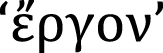 or érgon, meaning work, and
 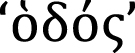 or hod ós, meaning way. Referring to each variable’s causal exposure and influence to other variables’ changes, their ergodicity or work-way property enables grouping each problematic situation’s pertinent variables into ‘singular’, ‘absorbing’, ‘dispersing’ and ‘linking’ [21].
Singular variables include isolated variables that only affect and are exposed to changes in a few other variables. Dispersing variables affect many but are exposed to a few, their own changes influencing other variables either directly or indirectly.
Depicting intentionality and purposefulness either explicitly or implicitly, and associated with performance variables known as ‘metrics’, absorbing variables affect a few but are exposed to many, making them vulnerable even to small changes in a problematic situation. Lastly, linking variables are both highly exposed and highly influential ones.
Such tidy groupings of problematic situations’ pertinent variables allude to business firms’ systemic leverage (SL), the integral concord of its direct, dynamic and structural leverage components (Table 1). Related to each firm’s competitiveness, knowledge of its business and partnering capability, its resources SL is a vital core competency in itself, enabling firms to meet their strategic imperatives, i.e., becoming customer driven and improving quality and service delivery to both current and future clients and customers.
SL is available to every business enterprise; yet most B-school graduates do not take advantage of it because high SL entails carefully balancing its three mutually interdependent and reciprocally interactive components (Table 1). Besides, each SL component requires problem-framing insight, combined with situation articulation skills.
AT&T, Federal Express and United Airlines are well aware of what SL takes: the mutual SL component interdependence requires working collegially on all SL components. Depending on a firm’s problematic situation, the initial SL component analysis and ensuing synthesis determine the feasibility of potential praxeis or acts, yet building high SL into corporate-, business- and functional-level strategies and tactics always yields an inimitable asset or edge, anticipating or changing the rules of the game, even the game itself [22].
Stemming from our human species’ discovery of the number, shape, size and structure notions,  , math
matik
tekhn
, ars mathematica or mathematical art sees variables as quantities that vary and get modified through calculations withal. Not every numerical quantity that changes is a variable, however.
, math
matik
tekhn
, ars mathematica or mathematical art sees variables as quantities that vary and get modified through calculations withal. Not every numerical quantity that changes is a variable, however.
In addition to the dynamic and the longitudinal variables, which B-school graduates see daily in our life, changing too are the ‘coefficient’ or ‘parameter’ quantities which, just as the variables do, also affect our personal and business decisions. These quantities coexist harmoniously with the variables in the ‘general form’ of each mathematical model, where beginning of the alphabet letters always represent pertinent coefficients or parameters, and end of the alphabet letters always represent pertinent variables.
The transition from a situation’s general form or GF model, such as the one that Equation 2 shows, to its ‘specific form’ model, where variables continue to vary, always requires either to determine or to estimate the actual coefficient or parameter values, using actual data. Chris’ shopping situation includes a fixed parking fee per shopping time, say a = $5/t, and a price tag shows the good’s unit price, say b = $27/unit.
Surely, it is not always as easy to determine or to estimate the coefficient or parameter values pertinent to a problematic situation. Complicated situations often arise, which require the use of equally complicated, sophisticated statistical techniques.
Yet that is not the case here. Having deterministically identified both values of the GF model coefficients or parameters, the specific form (SF) model of Chris’ situation is:
Now is feasible to attempt a tentative definition of the coefficient or parameter quantities, which affect B-school graduates’ daily decisions as well, just as variables do. Coefficients or parameters are those numerical quantities, which beginning-of-the-alphabet letters always represent in the general form or GF of a model, and which acquire constant values in the situation-specific form or SF model, through the use of coefficient or parameter calibration or estimation techniques, always based on actualdata.
Using the SF model that Equation 3 shows, Chris can decide what the x value is going to be, i.e., how many units of the good s/he is going to purchase this time. Given her/his fixed budget each time s/he shops, the total expense y Chris is willing to incur must always be either less than or equal to (≤) her/his budgetary constraint.
While Chris decides the quantity to purchase, let’s see how capable business professionals learn interactively, through every decision-making situation they face. High-level learning at B-schools entails the entity of three mutually interdependent and reciprocally interacting components or parts: namely language, model and picture (LMP) [5].
First is the language (L) part, which briefly and clearly summarizes the problematic situation at hand. Succinctly put, in Chris’ shopping situation, her/his anticipated total expense per shopping experience each time is the sum of the $5 fixed parking fee, plus the product of the $27 price per unit multiplied by the number of units purchased per time.
Second is the mathematical model (M) component, which shows both the general form GF (Equation 2) and the specific form SF of Chris’ shopping situation, along with pertinent variables defined and pertinent parameters already quantified as constant quantities (Equation 3). Third is the picture (P) part, diligently crafted on Fig. 2, with the help of Equation 3.
On Fig. 2, the horizontal axis shows the number of units purchased per time, ranging from zero to eight units/t, and the vertical axis shows Chris’ anticipated total expense per time, in US$/t. The marked, upward sloping line on the graph visually confirms that indeed, this is the mathematical model of a straight-line segment.
Worth noting in the high-level learning process at B-schools are: (a) the mutual interdependence of the three LMP components and (b) the reciprocal causality between any two of the three reciprocally causal language-model-picture components. Operationally, these two properties of the LMP trinity imply that the slightest change in any one of the three LMP components causes the other two components to change instantly.
Namely doubling the fixed parking fee in the L component, for example, instantly increases the parameter a from US$5/t to US$10/t in the SF-M component of Equation 3, and besides pushes the marked line in the P component on Fig. 2 vertically upward by US$5/t. Conversely, a 10 percent price discount in the situation’s language component, instantly reduces the parameter b from $27 to $24.3 per unit in the SF-model component of Equation 3, and on Fig. 2 concurrently decreases the upward slope of the marked line by 10 percent, down to 24.3 from its current value of 27, which loves popping up; does it not?
Most crucial to see within the LMP trinity of high-level learning at B-schools is the ‘habit’, a noun stemming from the latin verb ‘habere’ or to have, which capable business professionals develop. As a second nature, they always engage in the multiple translations required within each pair of the three LMP components, one translation at a time.
Most B-school students do not promptly see all the details involved each time either Chris does or you go shopping, even if that entails just a single commodity. Comprehending, however, exactly how all natural and particularly societal human systems work, works strictly as a contact sport and, anyhow, Aristotle insists: 
 or Little physical treatises: on memory and recollection, B 451a.18), namely because custom or habit is a [second] nature of human beings, and
 or T met t ph y sik, A 980a.21), namely all people desire knowledge by nature.
Etymologically, the word 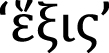 , hé xis or habit emanates from the hellenic verb
 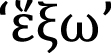 , hex
or shall have, namely the future tense of the verb
, hex
or shall have, namely the future tense of the verb 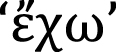 éh
or to have and the suffix
éh
or to have and the suffix  or cí s, which denotes a praxis or an act. Initially, the meaning of the word
  is to hold on continually to what an anthropos or a human being has already acquired.
Through Diotima of Mantineia, however, namely the teacher of Socrates, and thereby of Plato and Aristotle, the  or habit notion acquires its civic-, ethical- and moral-ideals content. Certainly, exactly the same applies to all virtues, which always entail knowledge, and which as permanent components of the character in us, each person acquires via the strenuous exercise and repetition of specific praxeis or acts.
Welcome to the cosmos of untidy business messes’ societal behavior and structure?
Within the insight and sagacity seeking ecology of self-developing capable business professionals, the LMP translations habit they acquire at B-school enables trilingual LMP translators to differentiate instantaneously between cumulative level or stock variables and flow or rate variables. The fleshliest examples of cumulative level or stock variables are: the cumulative level of water in a bathtub, and all the numerical quantities that the cumulative levels or stocks of money show on each balance sheet of a business enterprise.
The units of cumulative level or stock variables are whole units, such as, for example, gallons (gal) or liters (L or l) in the case of the cumulative level or stock of water in the bathtub, and dollars ($) or euros (€) in the case of the cumulative levels or stocks of money on the balance sheet of a business enterprise. The most tangible examples of flow or rate variables again involve the water, now flowing at a certain rate from the bathtub faucet into the bathtub, and all the numerical quantities on every income statement or profit-and-loss (P&L) statement of said business enterprise, namely numbers that always show the rate at which money flows in and out of the enterprise, over a specific time period.
The units of flow or rate variables are not whole, in the sense that each is a fraction, a proportion or a ratio. The numerator of a flow or rate variable unit contains the whole unit of a cumulative level or stock variable, while its denominator contains the unit of time, through which said flow or rate variable changes.
In the case of water, which at a certain rate flows from the bathtub faucet into the bathtub per minute, depending on where the bathtub is located geographically, the appropriate units of its flow or rate could be either gallons per minute (gal/min) or liters per minute (L or l/min). In the case of the annual income statement or P&L statement of the business enterprise, the numerical quantities of which always show the rate at which money flows in and out of the enterprise per year, again depending on geographical location, the appropriate units of said money flow or rate might be either dollars per year ($/year) or euros per year (€ /year).
Identifying exactly how a business mess’ auxiliary and stock variables, and its parameters collegially co-determine its flow variables always generates new insight into the behavior seen in each problematic situation at hand. Most fundamentally, however, it is absolutely vital for B-school students and graduates to see how every mathematical model, such as the one that Equations 2 and 3 show, always unveils the societal structure of the relations among a problematic situation’s pertinent parameters and variables, namely the societal structure that causes or drives the problematic situation’s dynamic societalprocess.
Jørgen Randers sees ‘societal structure’ as the tidy formation of a problematic situation’s deterministic cause and effect relations among its mutually interactive and reciprocally causal components, and the problematic situation’s ‘societal process’ as its dynamic behavior pattern evolving through time [34, p. 120]. Correspondingly, the problematic situation’s societal structure diagram shows its deterministic, reciprocally causal structure of relations, which causes or drives the problematic situation’s dynamic societal process, which concerns either you personally or your business.
When properly crafted, the societal structure diagram of a problematic situation superbly tells how the structure of the relations among its pertinent parameters and variables drives its dynamic societal process. Unfortunately, however, the ‘flat’ thinking of uninformed business amateurs, often leads to equally flat diagrams, which mainstream B-school academics eagerly adopt and triumphantly advocate as ‘non-recursive’ (sic!).
A perfect example of such a non-recursive diagram is the one on Fig. 3a. Forgetting Chris’ budget, this flat diagram does show the concurrent effects, of the units purchased per time variable, and of the fixed parking fee per time as well as the price per unit parameters, on the total expense per time, but also displays the number of units purchased as if it were a truly independent variable.
Given Chris’ fixed budgetary restriction, however, for the sake of which the total expense Chris is willing to incur must be either less than or equal to (≤) her/his budget, immediately renders variable x, namely the number of units purchased per time, a variable dependent on variable y. Taking Chris’ fixed budgetary restriction into account, the societal structure diagram on Fig. 3b now correctly shows the opposite polarity relation between variables x and y.
Ceteris paribus, an increase in variable x causes a positive (+) change in variable y, above what it would have been otherwise. Given Chris’ restriction, however, in the form of a budgetary or other pressure, with a small time delay or lag, an increase in variable y causes a negative (–) change in variable x, below what it would have been otherwise.
This is exactly what the balancing or negative (–) feedback coil, loop or spiral shows on Fig. 3b. Chris’ anticipated total expense does depend on the units purchased each time yet, given her/his fixed budgetary restriction each time, with a small time delay or lag, the number of units purchased also depends on Chris’ anticipated total expense.
Societal structure diagrams, such as the one on Fig. 3b, at once ameliorate, enhance and invigorate the picture or P part of the LMP high-level learning process at B-schools, yet is imperative that every single one of their feedback loops or spirals always incorporates a time delay or lag, on at least one of its arrows or links, even if said time delay or lag is merely a computational one. Uninformed business amateurs, who keep churning out feedback loops or spirals without time delays or lags, are committing— atleast from a cognitive science perspective— the terminal crime of infinite regress.
With the insight Fig. 3b totes into Chris’ shopping situation, back on Fig. 2, if Chris’ fixed budget this time is US$100/t, then the maximum number of units purchased is three, resulting in a total expense of US$86/t. And if Chris’ budgetary restriction is US$200/t, then the maximum number of units purchased is seven, resulting in a total expense of US$194/t.
Feedback and its proper representation
Depending on the context or subtext used, the meaning of the word ‘feedback’ could imply three different, yet not entirely unrelated things. First, the term usually means criticizing a person’s, a product’s or a task’s performance, and thereby this kind of feedback is both offered and requested toward future performance improvements.
In this context, talking of ‘negative feedback’ usually conveys criticism, while ‘positive feedback’ imparts praise. Second, in a purely technical sense, feedback refers to the sound distortion produced via the return of a fraction of the output signal from an amplifier, microphone or other electronic device to the input of the same device.
Third, in natural and social sciences, feedback expresses the control or modification of a process according to its effects or results as, for example, in the cases of a behavioral response or of a biochemical pathway. In this context, negative feedback designates the counteraction or diminution of an effect’s influence on the process that gives rise to it as, for example, when the result of a certain praxis or act inhibits further performance of that praxis or act, or when a high level of a particular hormone in the bloodstream inhibits further secretion of that hormone.
In the same context or subtext, positive feedback indicates the amplification or enhancement of an effect’s influence on the process that gives rise to it. It is precisely this, third meaning of negative and positive feedback, most crucial to comprehending the process and structure of the problematic situations, which all of us B-school graduates encounter daily in our personal, societal and professional spheres [42, pp. 12-13 and Ch. 5].
Feedback coils, loops or spirals define consciousness itself [29], yet our mental models often fail to properly fathom or grasp these elusive, mutually interdependent and reciprocally causal structures that always determine the dynamic behavior patterns, which each problematic situation we ever face shows. Within social sciences, even though not exclusively, practitioners and researchers who employ the system dynamics modeling method [2, 20 (Ch. 10 and pp. 326–335), 22, 42], do use multiple diagramming tools to portray the inherently invisible, incorporeal societal structures of mutually interdependent and reciprocally causal relations among parameters and variables, including causal loop or spiral diagrams and stock and flow maps.
In
Also known as ‘archetypes’ or ‘generic structures’ [38], when these frequently recurring societal structure diagrams are initially introduced, they tend to overwhelm people [2]. Yet there is absolutely nothing swampy about acquiring the habit of capable business professionals, who craft and study such archetypes or generic structures, showing the mutuallyinterdependent and reciprocally causal relations among each problematic situation’s pertinent parameters and variables.
As the notion of a business enterprise evolves since the renaissance era, first being thought of as a machine, later as an organism and then as a societal human system, a most profound reciprocal causality emerges between the way business enterprises are thought of and what they do, and how ⪡what they do affects the way they are conceptualized⪢ [1, pp. 32–33]. B-schools that care to facilitate capable business professionals’ development must integrate the mutual interdependence and reciprocal causation content of feedback’s proper representation into every course and degree program discipline they offer.
Development involves, however, both capability and will, so the only genuine development of capable business professionals ⪡is self-development⪢ [1, p. 46]. A person or organization can certainly encourage and facilitate others’ development as, for example, B-school instructors, who cannot learn for our students, yet must encourage and facilitate B-school students’ self-development into capable businessprofessionals.
Another area of knowledge and skills, related to mutual interdependence and reciprocal causation, in which B-schools misinform our students en masse, entails the conventional assessment of potential business profitability, i.e., break-even (BE) analysis, which hides many tacit assumptions. The erroneous ones in false BE analysis, which each potential business partner and government employee learns at B-school, and then carries in her/his head for a lifetime, always cause business and government blunders that both as current and as future clients and customers, as well as taxpayers, we end up paying dearly.
Is your break-even (BE) analysis true or false?
Unbeknownst to most B-school students and some instructors, BE analysis starts not in accounting, but in the required economics or financial environments courses that B-schools offer. That is where B-school students first encounter the GF phase or scatter plot of the rudimentary D: demand and S: supply model in economics (Fig. 4), which all B-school students must know, regardless of the preferred, specific discipline they choose.
There are no numbers next to the axes of this general form, market D and S model, which every economics textbook covers, unless is not a true economics textbook. Given the market demand and supply that a particular business enterprise faces for its goods or services, the horizontal axis on Fig. 4 typically shows the specific business firm’s rather convoluted variable P: price per unit (US$/unit), and the vertical axis shows its Q: units made and sold per time period t (units/t), clearly a rate variable as its units show.
Political economists and finance pundits and instructors are schooled for years, in order to tame a big secret: when two lines meet, then something momentous happens. So, secretly, on Fig. 4, at the firm’s market equilibrium point E, the D and S lines are equal.
Even without explicit numerical quantities on Fig. 4, the negatively sloped D: demand line means that Q is a negative function of P: price, i.e., Q = _ f (P), meaning that, ceteris paribus, an increase in P causes a negative (–) change in Q, below what it would have been otherwise, and a decrease in P causes a positive (+) change in Q, above what it would have been otherwise. To make the rather abstract, GF market D and S model concrete, most economics and financial environments instructors add numbers to it, thereby transitioning to a situation-specific form or SF market D and S model (Fig. 5).
Indeed, the numbers next to the axes do make things tangible on Fig. 5. As the market equilibrium point E now acquires actual coordinates: (P, Q) = (1,000, 1,000), Q, the negative function of P: price, also takes its situation-specific form or SF model: Q = 2,000 – P, yet P is also seen as a negative function of Q: P = 2,000 – Q.
Along with the related price elasticity of demand, i.e., the ratio of a parentage change in Q over a percentage change in P: price, this is something that all B-school students learn in the economics and financial environments courses. After they pass their required midterm and final exams, however, B-school students seem to completely delete or erase this vital information from memory, both individually and collegially.
Having conveniently forgotten that Q, namely the product or service units a firm produces and delivers per time period t (units/t), is a negative function of P: price, i.e., the average price the firm charges per unit for its good or service, B-school students eagerly accept some erroneous, overly simplifying assumptions in financial accounting courses. In effect, they master the triple-fault, false BE analysis, which Fig. 6 unveils.
On Fig. 6, the horizontal axis is Q: units made and sold per period t (units/t). The vertical axis shows the rate variables R: revenue, TC: total cost and G: profit, all in US$/t.
Failing to recall that Q and P: price are causally related, thereby making the R: revenue and gain or G: profit variables non-linear, quadratic functions of Q, B-school students are invariably taught to compute a firm’s allegedly only one, single BE point, by using the linear approximation formula:
It is really sad to attend a business presentation where, using a laser pointer, a B-school graduate directs an intense beam of coherently monochromatic light at point A, believing blindly that that is where the BE point is. To remedy this sad situation, B-school instructors, who teach BE analysis regularly, must take extra care to make their students aware of the fact that, on Fig. 6, all BE points are located on the horizontal axis; always?
The second error is a numerical one. Assuming that VC/U = US$400/unit and using the linear approximation formula of Equation 4 yields a BE point of 333.33 units/t, instead of the correct first BE1 point of 136.68 units/t. Equation 1 now yields a break-even percentage error of 143.89 percent (Fig. 6).
Starting with the initial BE percentage error on Fig. 6, a few more BE percentage error values are computed using Equation 1, while first decreasing and then increasing the quadratic, concave down G: profit function’s parameters, including the VC/U parameter on Equation 4, by two-percent increments, thereby yielding the 11 values of the marked-line graph on Fig. 7. This gives a rough idea how wrong a B-school graduate could be, if entrusted to compute a firm’s first BE point using Equation 4, which each student learns to apply at B-school, regardless of the specific degree program discipline s/he chooses.
The third error of the triple-fault, false BE analysis that B-school students are learning to make at B-school is that every business enterprise ostensibly faces not two, but only one, single break-even point. Even if linear BE analysis is seen merely as a managerial-accounting technique or tool, separated from long-term strategy questions, the implications of its third, misspecification kind of error, simply are enormous; indeed tremendous?
Can you recall, for example, as the economy of USA and the rest of the planet falters in 2008, the ‘too big to fail’ argument, asserting that certain firms, particularly financial ones, are so large and interconnected that their failure would be disastrous? Can you also look back on the famous counterpoint by former Federal Reserve chairperson, Alan Greenspan: “If they’re too big to fail, they’re too big”, and the equally caustic ‘Paulson Put’?
Administratively charged, these arguments are tightly coupled with the triple-fault, false BE analysis that people learnt at B-schools. As if the mental models of millions, if not already billions, B-school graduates have been hardwired to blindly and falsely believe that past a business enterprise’s supposedly one, single BE point, the bigger the firm’s Q gets, the more G: profit the firm makes, and thereby to always beg for more business growth.
This unlimited-market falsity breaks off once one looks at hard evidence, i.e., on the very first line on each income or P&L statement of every business enterprise. It always lists either its sales revenue or simply R: revenue (US$/t), as the product of P×Q or R = P×Q.
On Fig. 4, however, Q is already a negative function of P: price, i.e., Q =
Using the latter component of the quadratic R: revenue function on Equation 5, the firm’s variable cost per unit VC/U = US$400 /unit, and its overhead or fixed cost FC = US$200,000/t (Fig. 6), the firm’s also concave down, quadratic gain or G: profit function is:
The sinister algebra results on Equations 5 and 6 help to diligently craft the business firm’s true BE analysis phase graph on Fig. 8, which mostB-school students unfortunately seem to ignore long after they graduate. The standard algebraic formula for computing the two roots of a quadratic function or equation, on Fig. 8 yields the firm’s truly two BE points: BE1 = 136.68 units/t and BE2 = 1,463.32 units/t, respectively.
Moreover, computing the vertex coordinates of the concave or opening down gain or G: profit and R: revenue parabolas, on Fig. 8 yields points (Q*, Gmax) = (800 units/t, 440,000 US$/t) and (C, Rmax) = (1,000 units/t, 1,000,000 US$/t), respectively. Generally, points C and Q* do not coincide, so maximizing the R: revenue of a business enterprise does not necessarily maximize its gain or G: profit.
The business implications of true BE analysis are most didactic. Firstly, to survive and to prosper, each business enterprise must be fully aware of both its BE points, thereby discounting the deeply held conviction of B-school graduates that is facing only one. Just as the firm is in the L: loss area below BE1, it also enters the L: loss area above BE2 (Fig. 8).
Therefore, if they wish to be profitable, business enterprises must stay within the Q boundary that their not one, but two BE points define. Past its BE2, a firm’s losses per time grow big, much bigger than its losses below BE1 and, the more its Q grows past BE2 each time period, the more the business enterprise finds itself operating deeply in the red.
Secondly, to truly prosper, every business enterprise must try to collegially control its Q volume, in order to maximize its gain or G: profit, they continue producing the goods and delivering the services that help most of us human beings satisfy our basic needs and self-actualization desires; they provide employment, as a way of equitable income redistribution, without people falling prey to the gubernatorial collectivism of the left liberalism dogma; and by maximizing gain or profit, and thereby their tax participation, they contribute to our society’s collegial coffer, toward government investment in the aye-desperately needed sustainable development of cultural, economic and societal infrastructure.
Thirdly, these benefits that business enterprises impart to our human society have absolutely nothing to do with the colonization and distortion of B-schools by the destructive thinking and inadequate ideas that Sumantra Ghoshal and John Little so eloquently expose [23, 31]. To give but one example, under the radical movement of selfishly unrestrained individualism and subjectivity, the Chicago B-school might have so blindly adopted the right libertarianism dogma, as opposed to the extreme-center liberalitarianism one (sic!), that its notion of business firms’ societal responsibility is ⪡to make as much money for their stockholders as possible⪢ [31, p. 129].
The Enron scandal could be either the epitome or merely the beginning of wealth accumulation by any means, as opposed to profit maximization by collegially attaining a firm’s units made and sold each period t within the [Q*] neighborhood on Fig. 8. Fourthly then, once the employees and partners of a societally responsible business enterprise collegially decide to pursue profit maximization, as opposed to wealth accumulation by any means, thereby treating true BE analysis as their firm’s societal process (e.g., Fig. 8), they in effect activate the two bipolar, nested feedback loops or spirals on Fig. 9, which reflect the essential societal structure of the financial accounting discipline.
On Fig. 9, the bipolar arrow or link between G: profit and Q activates both feedback spirals, capturing the reciprocal causality between profit (US$/t) and units made and sold per period t (units/t), with the rate variable R: revenue (US$/t) intervening between Q and G: profit, on the nested Revenue bipolar feedback spiral. Within this nested spiral, if the firm’s price elasticity of demand does not change radically, then P: price continues affecting Q negatively yet, ceteris paribus, it positively co-determines the firm’s R: revenue (US$/t).
On the outer, Cost bipolar feedback spiral on Fig. 9, Q and VC/U: variable cost per unit (US$/unit) co-determine the firm’s VC: variable cost (US$/t). In turn, VC contributes to the firm’s TC: total cost (US$/t), along with its overhead or FC: fixed cost (US$/t).
Certainly, TC negatively affects G: profit which, with the time delay or lag of one financial-accounting reporting period, will affect next time period’s Q either negatively or positively, depending on Q’s current deviation from the [Q*] neighborhood on Fig. 8, and on the firm’s commitment, intentionality and purposefulness to pursue profit maximization.
It is not at all surprising that in a profit maximization situation, a positive (+) or reinforcing feedback spiral can cause the dynamic societal process of an aye-goal-seeking, balancing or negative (–) feedback spiral. Intuitively, is reasonable that, through the input of a dominant negative polarity, an initially positive feedback loop or spiral can cause the societal process of a negative feedback spiral.
Just as in the finance discipline, where the famous Black-Scholes-Merton formula for valuing common stock derivatives is based on the assumption that a stock price moves according to a geometric Brownian motion, i.e., a stochastic process with a drift and other noisy parameters. In this context, Cooke [10] shows that the illustrious Black-Scholes-Merton model entails just one, single positive feedback spiral that turns bipolar.
Namely, at a risk-free trade, a derivative is valued by discounting back to the initial or zero time, the positive part of the difference between the common stock’s price, minus the derivative’s exercise price, at which the derivative owner is entitled to buy or to sell the common stock. The feedback spiral that connects the common stock’s price to its change in price rate is initially positive, yet the financial markets’ stochastic inputs, through the model’s drift, noise fluctuations and unforeseeable volatility parameters, turn the Black-Scholes-Merton feedback spiral bipolar.
Kathryn Rudie Harrigan’s strategic flexibility notion [25] seems to mark business firms’ quest for organizational restructuring in each strategic business area (SBA) and strategic business unit (SBU). Next, the late 1980 s and early 1990s see the development of agile software-development principles [8], which quickly reach every business enterprise engaged in adaptive business planning, continual quality improvement and evolutionary development, encouraging flexible, rapid responses to changes in industry or task, and in other SBA and macro business environments.
Recent advances in business enterprises’ evolution through collaboration among cross-functional, self-organizing teams include holacracy, a new approach to management for a rapidly changing world [37], and reinventing organizations, a notion akin to recreating organizations inspired by the next stage of human consciousness [30]. Along exactly the same business strand is the prospect of locally recreating politeia’s spherically collegial decision-making structure [6], from which a naturally sovereign politeia emerges as a societally autopoietic [32, 44], high-technology human system of self-determination, self-organization and self-management [43], rendering each and every form of aye-unnatural authority and power obsolete, through true citizens’, and business enterprise employees’ and partners’ collegial control and responsibility [17].
Stemming from the hellenic words 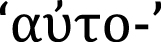 or auto-,meaning self, and
 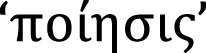 or poíesis, meaning creation, the term ‘autopoiesis’ refers to the specific capability that only a true system develops, which enables it to recreare and thereby to sustain its kind. Initially introduced by Chilean biologists, Humberto R. Maturana and Francisco J. Varela, in order to define the self-sustaining chemistry of living cells [32], the idea of autopoietic business enterprises quickly permeates social science and systems research [44].
The ubiquitous yet highly problematic, particularly nowadays, aye-unnatural authority and power dogma of the hierarchical-bureaucracy (HB) pyramid enforces the dictate, conspire and restrict loop (Fig. 10a), whereas the learning organization (LO) is a naturally organic business approach that requires improving business ideals and vision, and B-school graduates’ mental models [40]. Each LO involves self-developing capable business professionals working in self-managing teams, along the full learning cycle first conceived by the American educational reformer and pragmatist, John Dewey (1859–1952), so instead of dictating, conspiring and restricting la HB, LO employees and partners collegially engage in Dewey’s [12, 13] discover, invent, produce and reflect positive spiral (Fig. 10b).
American pragmatism’s ethical content can help even the finance discipline live amiably with others [41], yet B-schools mistakenly teach students that the aye-unnatural authority and power of the HB pyramid on Fig. 10a is the only choice a business enterprise has for its organization. The HB pyramid, however, which both Chandler [7] and Scholtes [39] link to militant train-wreck blame allocation, and to royal prussian army’s pyramidal hierarchy of aye-unnatural authority and power, is so acutely rgimental that, except the one on top, always divides and ranks the rest of its components or entities and people, one under the other, according to some aye-unnatural authority and power metric; so acutely rgimental it is, it is even highly unsuitable for today’s army, navy, air force and marines.
In the context and subtext of business firms’ quest for organizational restructuring, the HB construct is an entirely devious artifice, which emits the false perception, the illusion of organization. It absolutely destroys the biotic and naturally organic, tidy formation of a truly societal human-system’s collegially interacting components and entities, and of their reciprocally causal relations, namely the archetypal quality of true organization that business enterprises both need and seek actively, in order to survive and to prosper.
Indubitably infamous and highly problematic in our neo-postmodern temporality, the royal prussian army’s pyramidal HB of aye-unnatural authority and power is hard to eradicate. Uprooting it from the very depths of B-school graduates’ mental models will take years, as the pyramidal HB even lurks in, for example, the concentric-circles institutional construct of the much-vaunted recently, multilevel ‘pluricircle governance’ (Fig. 11a).
In three dimensions, however, the multilevel pluricircle governance (sic!), which supposedly distributes central authority and power, yields neither holacracy [37] nor politeia’s collegially spherical decision-making structure [6, 17], but unveils a tiered-conical pyramid’s hierarchy of aye-unnatural authority and power (Fig. 11b), i.e., Erebus’ gloom of the ⪡dynastic⪢ [38], totalitarian rgime’s ⪡absolute Despotism⪢ [28]. Besides, returning to two dimensions, the tiered-conical pyramid’s top-view projection yields the same concentric-circles’ pyramidal HB of aye-unnatural authority and power (Fig. 11a).
Another mistake that even top-ranked B-school instructors often make is confusing feedback’s reciprocal causation with truly societal human systems. In spite of its reciprocal causality, however, feedback is a necessary but insufficient condition to defining a truly natural, societal human system: just because HB relies on feedback (Fig. 10a), that does not make HB a truly natural system, as the one that each LO aspires to become (Fig. 10b).
The definition of what a true system is – and what is not – has not changed much since Aristotle attempts to think clearly about true civic or political thinking:

 (Politics, 1252b, 36-37), namely each polis is intrinsically natural, as the first communities or societies are;
 (Politics, 1253a, 3-4), namely polis is among things natural, and that anthropos or human being is by nature a political animal; and
 (Politics, 1253a, 24-25), namely because the whole is of necessity prior to the component or part.
Subsequently, Aristotle defines (Politics, 1289α, 15–18) and presents politeia as a truly natural, tidily formed societal human system, an 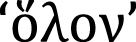 , hó lon or a whole, with reciprocally causal components that interact mutually in self-determination, self-organization, self-management and self-sufficiency or autarky, toward their common good, i.e., the conducive to happiness eudæ monia and prosperity entelechies [6, 17].
In defining what a true system is and what is not, prominent systems scientists and thinkers consistently use particularly specific words to differentiate a true system from an aggregation, a collection, a heap or a pile of stuff. The Austrian biologist, for example, a founder of general system theory (GST), Karl Ludwig von Bertalanffy (1901–1972), agrees with Aristotle’s whole notion and defines systems as complex entities ⪡consisting of parts “in interaction”⪢ [4, p. 19], later seeing each true system as ⪡an entity which maintains its existence through the mutual interaction of its parts⪢ [3, pp. xv and 2] and [2].
The American organizational-design advisor and pioneer in the social-science research areas of management science (MS), operational research (OR) and systems thinking (ST), Russell Lincoln Ackoff (1919–2009), defines a true system as ⪡a whole whose performance depends more on how its parts interact than on how they act when considered separately⪢ [1, p. 211]. And the American engineer and professor who, among his other pioneering achievements, is also the founder of the system dynamics modeling method [16], Jay Wright Forrester (1918-), sees a true system as a unity of parts that work together collegially, through their mutual interactions, toward their common interests [15, p. 1-1].
Ergo, in defining a truly natural system, B-school administrators, instructors and researchers, as well as practitioners, must always use one of the ‘complex’, ‘entity’, ‘unity’ and ‘whole’ notions, in reference to the system’s mutually interdependent and reciprocally causal components or parts; otherwise, B-school students come to falsely ⪡believe that a system’s performance can be improved by improving the performance of each of its parts taken separately⪢ [1, p. 211]. Another notion, most crucial to defining a truly natural, societal human system is that of human purposefulness [1, pp. 25, 27, 45, 54, 72].
Purposefulness is the self-determination capability that only a true system develops, though which its mutually interacting and reciprocally interdependent components collegially create: either different results in the same environment or similar results in different environments. As opposed to the despotic régime’s deviant goals and objectives, purposefulness is a requisite condition at work today, along with: autonomy, fair pay for work, so that money is not an issue, and providing the means to developing mastery. [14, p. 79]. Every reliable business enterprise affords these four work conditions to its employees and partners today, so that it attracts and retains capable business professionals.
B-schools still teach students to use goals and objectives, however, ideal perhaps for automata and robots, always programmed to produce identical results regardless of their environment, yet goals and objectives produce dysfunctional if not disastrous effects, once imposed on a human being or a societal human system, such as, for example, a business enterprise. A truly societal human system
It is tragically false to confuse the totality of the totalitarian rgime’s absolute despotism with a true system. After all, what today’s tyrannical particracy could possibly have to do with a true system, under its blindly restraining, collectivism– dire individualism heap of left liberalism, extreme-center liberalitarianism and right libertarianism dogmas?
B-schools can collegially prune back this ugly aggregation or collection of ‘isms’, the despotic régime’s left-center-right trinity pile, totally in discordance with the authentically pure, unadulterated liberty, the very one that radiates brilliantly in ⪡Life, Liberty and the pursuit of Happiness⪢, which Thomas Jefferson et al. [28] pencil inside ⪡The unanimous Declaration of the thirteen united States of America⪢ or USA’s Declaration of Independence? Prudently sensible B-school graduates in liberty never pretend to ostensibly create a true system; the only thing we actually create is the systemic societal structure, required for a truly societal human system to emerge through purposeful human interaction (Fig. 12).
Societal process and structure of firefighting ignorance individually
In our neo-postmodern temporality, business enterprises and other organizations are initially thought of as machines, simply because the entire cosmos is conceptualized as a machine. Later, past their tipping point of time-and-motion studies, business firms are thought of as biological organisms that can respond differentially to identical stimuli. Ackoff insists, however, that only conceptualized as societal human systems, business enterprises ⪡are best able to deal with turbulence ... convert[ing,] what to others constitute threats to their survival, into opportunities for “thrival”, continuous development⪢ [1, p. 33].
Responding in part to the concerns shared by AACSB International [11], this article’s contribution rests on tidily forming a coherent unity of just a few, pertinent areas of societal human-system knowledge and skills that, regardless of their specific disciplines, B-school students could acquire in the classroom, if B-schools aspire to facilitate capable business professionals’ self-development. Following an inductive approach, akin to the rudimentary scenario of a newly hired B-school graduate trying to negotiate with the horrid numerical quantity 27, when it pops up on the computer screen during a budget update, the article is organized along crucial B-school conventions regarding the alphabet, coefficients or parameters and variables, systemic leverage (SL), the LMP high-level learning process at B-schools, the societal behavior and structure of untidy business messes or problematic situations, the notion of feedback and its proper representation, true break-even analysis with the intentionality and purposefulness of the societally beneficial profit maximization, strategic flexibility, and the prospect of B-school students comprehending how the societal structure of a business enterprise drives its dynamic societal behavior through time.
This last, vital component of societal human-system knowledge and skills often comes gift-wrapped in the normative parcel of system dynamics’ core tenet, i.e., system structure drives system performance through time, urging B-school students, graduates and researchers to shift our focus from one-time events to through-time performance patterns and to system structure. The systemic structure of each true system entails those inherently invisible relations among pertinent parameters and variables that form feedback coils, loops or spirals, which drive system behavior through time [33, 42, p. 16].
Yet the pyramidal HB of the despotic regime’s absolute despotism (Fig. 10a and Fig. 11), under which all of us live and work, seems to always do precisely the opposite. Not only it requires teaching B-school students to ignore system structure and its dynamics, i.e., through-time performance patterns, thereby focusing on one-time events, but it also seems to transform time into ugly, punctuated disequilibria, as it creates sharp discontinuities in our business, government and society-specific cultures [18].
To Kensei Hiwaki, the despotic regime’s ideologies leave a bad aftertaste of brutally rampant antagonism, egotism, individualism, liberalism, liberalitarianism, libertarianism, materialism, reductionism and so on, largely imposed through unrestrained financial growth, greed for maximum wealth accumulation by any means, liberal, liberalitarian and libertarian pseudo-democratic dictatorships, market competition, selfish, individualistic self-interests and the ‘money-is-might-that-makes-right’ idea [27]. The aggressively macho, widespread vested interests in the lopsided, swanky-régime’s ideologies that reinforce self-seeking, financial wealth-oriented, growth-maniac and power-hungry human connections and relationships, under our planet’s economic, educational, governance and societal HB, are damaging the hoped for relational mutuality and causal reciprocity or the art of relational living in our respective society-specific cultures, a damage that can only be averted by perpetually enriching our respective cultures across the globe [26].
Can our B-schools make it so? Will they help avoid the potentially grievous catastrophe of our entire human species joining the dinosaurs in their resting place soon?
Figure 13 shows the dynamic reference mode or societal process that B-schools could be facing collegially, as they begin firefighting ignorance in the classroom, trying to avoid saturating business enterprises with percent defective or uninformed business amateurism. The horizontal, time axis on Fig. 13 shows the full- and half-semester or trimester terms, along which B-schools offer discipline-specific courses and seminars, and the vertical axis shows the percent defective or uninformed business amateurism, which B-school instructors could try to prevent either collegially or individually.
Compassionately acknowledging that an acceptable ignorance zone (AIZ) of societal human systems could be unavoidable on Fig. 13, above the AIZ, scenario A’s S-shaped solid line depicts the highly undesirable case of ignorance growing and remaining high within B-schools’ degree program disciplines. Assuredly, scenarios are not strictly forecasts of what will happen in the future, but merely show the potentialities of what might happen [19, 20].
In response to the highly objectionable potentiality of scenario A, however, some B-school administrators, instructors and researchers could begin firefighting ignorance in the classroom individually, sincerely hopping to see scenario B’s broken line play, whereby B-school student ignorance of societal human systems initially grows, yet eventually collapses down to the AIZ (Fig. 13), thanks to some people’s bold, relentless individual efforts.
Unless societal human-system ignorance is fought collegially, however, as opposed to individually, through substantial collaboration among cross-functional, self-managing and self-organizing teams of B-school administrators, instructors and researchers, then the potentially ugly, S-shaped, solid-line scenario A could end up playing anyhow. Adapted from innovative business enterprises’ efforts to move past their tipping point, where even small adjustments or incidents lead to large changes, as they fire fight quality pitfalls in NPD or new product development [35, 36], Fig. 14 shows a plausible, reciprocally-causal societal structure that could be driving the dynamic societal process on Fig. 13, as brave B-school instructors firefight societal human-system ignorance individually in the classroom.
Just as the nested feedback spirals on Fig. 9 convey the essential societal structure of the financial accounting discipline, on Fig. 14, the two feedback spirals are also nested, yet they are not bipolar. The inner, Rework feedback spiral has a negative (–) polarity and a time delay or lag strictly less than (<) an academic term, while the outer, Tipping-point feedback spiral has a positive (+) polarity and a time delay or lag of one academic term.
The societal structure on Fig. 14 encapsulates the mess that a fabled B-school instructor faces, Dr. Jill Sprightly, who senses lots of societal human-system ignorance among her students. Right now, in Jill’s current academic term, this ignorance forms a Quality gap, which Jill decides either to close completely or to reduce substantially, by giving her students some Remedial lectures and project assignments, trying to balance a top-down imposed core curriculum with teaching societal human-system knowledge and skills.
Enthusiastically, while still retaining considerable control over assessment in her classes, afterorganizing her lecture and research notes on the slides of a few PowerPoint® decks, Jill begins firefighting societal human-system ignorance alone in the classroom, by lecturing and assigning extra-credit class projects on crucial B-school conventions about the alphabet, coefficients or parameters and variables,the LMP high-level learning process at B-schools, true BE analysis toward business profitability and so on. Jill’s students respond favorably to her remedial lectures and to the extra-credit – and to all appearances – review assignments, yet four weeks into the term, Jill begins to realize that she is getting both her students and herself into big trouble.
She has already spent four full weeks of a core, required B-school course on what might be seen as extra curricular activities in the classroom. While effectively Firefighting ignorance now, in the current academic term, increasing her students’ societal human-system knowledge and skills, Jill is quickly running out of the time she needs to cover the Required course content knowledge and skills of the core class assigned to her.
Ceteris paribus, the more time Jill spends Firefighting ignorance now, the less effectively and thoroughly she can cover her core class’ Required course content knowledge and skills, below what it would have been otherwise. Anew ceteris paribus, the Required course content knowledge and skills variable of Jill’s core class adds to the Development of capable business professionals, above what it would have been otherwise.
Accordingly, the less time Jill spends covering her core class’ Required course content knowledge and skills, the less she contributes to her students’ developing into capable business professionals. Just one term later, her students will be suffering from increased Ignorance and a new Quality gap, since they will be lacking the Required course content knowledge and skills of Jill’s core class in the current term.
Flabbergasted by her stark realization, Jill quickly dumps most of her Remedial lectures and project assignments, returning to her regular, Required course content knowledge and skills material. Contractually or legally, Dr. Sprightly is making the ‘right’ decision, yet why does Jill feel she is actually betraying her civic, ethical and moral ideals?
In summary, this is how the highly objectionable scenario A on Fig. 13 could be playing across B-schools internationally, despite efforts by AACSB International to sequester its appallingly treacherous potential effects. Societal human-system ignorance must be fought collegially and systemically, not individually, through B-school societal cohesion and solidarity, and via substantial collaboration among cross-functional, self-managing and self-organizing teams of B-school administrators, instructors and researchers.
Only then can B-schools surpass our tipping point of firefighting societal human-system ignorance individually in the classroom, and thereby facilitate our students’ self-development into truly capable business professionals. Until then, good speed tous all!
References

 /
/