



Abstract
Efficient and safe transport by air, rail, road and sea plays a major role in countries’ economic and societal self-development. Transport’s role is pivotal in entire regions’ collegial prosperity and socio-economic capabilities. This case study investigates the perceived influence of the China-Pakistan Economic Corridor (CPEC), on the Pakistani educational sector. Data were collected from 505 questionnaire respondents, residing in the Hazara Division, of the Khyber-Pakhtunkhwa Province, in Northern Pakistan. Exploratory factor analysis (EFA), confirmatory factor analysis (CFA) and structural equation modeling (SEM) are used to analyze the empirical data. The study’s results show that CPEC’s perceived accessibility and employment opportunities might have significantly positive effects on educating the host communities. Besides, people’s increased remuneration can undoubtedly mediate the effect of accessibility and employment on their education. Those collegially responsible for CPEC can benefit from these results, particularly in their formulating educational development plans and coping with unforeseen issues. The article also provides useful guidelines for CPEC practitioners and researchers.





Introduction
Transport infrastructure is the main factor of regional prosperity and socio-economic development and considered a decisive factor to gauge the development in the current domain. The present work dwells upon the impacts that China-Pakistan Economic Corridor (CPEC) will have on the educational sector of Pakistan. CPEC is an integral part of the leading Chinese project “One Belt One Road initiative (OBOR)” started by the Chinese government in 2013 [1, 2]. The main purpose of the project is to link Asia with Europe and Africa under the vision of shared destiny [3]. OBOR is a mega project, which will connect more than 60 countries [3].
Currently, China’s 80% global trade is based on marine shipping across the Strait of Malacca, which is under the control of American authorities. China imports 83% oil, out of which 77% oil is imported through the strait of Malacca from the African and Middle East countries (about 12500 km route) taking 32 and 20 days respectively [4]. Strait of Malacca is weakness for China and can badly affect their economy in case of any inconvenience [4]. Moreover, 60% pirates attack happened in the Strait of Malacca. Furthermore, Indian and American troops’ combined naval trainings in Indian sea are also an obstacle to Chinese shipment. To address these issues and avoid any untoward situation, China has chalked out a plan to remove its dependency on the Strait of Malacca and to make an alternative route CPEC [4].
CPEC is an international project between China and Pakistan, which links Gawadar port, Baluchistan province, Pakistan with China’s Western region, Kashghar, Xingjiang. This project consists of 2700 km road, railway line, optical fiber, gas and oil pipeline [1] as shown on Fig. 1. The idea of CPEC is traced back to Chinese vice premier Zhu Rongji (1993) [4]. However, it was officially inaugurated by the Chinese government on 21st April 2015. CPEC will be completed in three phases: short term, midterm and long term in 2017, 2025 and 2030 respectively [5]. CPEC is very beneficial for both countries as it provides an easy, safe, short and reliable access of China to Arabian Sea. It will generate millions of jobs, business opportunities and enhance broken economy of Pakistan, which will improve living standard of the Pakistani people [2]. The present study empirically finds the perceived educational impacts of CPEC on the local dwellers of Pakistan.

Route map of CPEC [118] and study area.
Roads and transportation have a vital role in the development of an area. It provides access to basic amenities of life. Road and transportation network has been considered an engine for the economic growth [6]. It is a well-known fact that transport infrastructure promotes regional development and the same plan was adopted by different policy makers, International Monetary Fund (IMF) and World Bank [7]. Jefferson [8] stated that how transportations and mobility modernize the nation. Boarnet [9] carried out a study on California and explored that transport infrastructure is more beneficial for the people living in ribbon areas. Later on, Clark [10] exposed that transport is the manufacturer and breaker of the metropolitan areas and cities. Similarly, Cervero and Duncan [11] examine the commuter rail service and land value and found the same results. Road and transportation accessibility have an incredible positive impact on employment and economic growth [12–14]. While Ozbay, Ozmen-Ertekin [15] exposed the relations of road and transport accessibility and their impact on economic development and employment in the United States. Road and transportation have a pivotal role in the creation of different jobs. Moreover, better accessibility and transportation make the area attractive, which develops connectivity and resource allocation for the region. Similarly, Jacoby [16] used semi parametric approach to find out the impacts of roads accessibility on income and employment and noted that low income people are more beneficiaries of roads. He further added that transport infrastructure improves access to basic amenities of life.
Improvement of accessibility infrastructure reduces transportation cost, which indirectly increases income and enables them to travel easily. Farm to market roads improve accessibility where farmers can sell their agriculture products on good prices and purchase standard quality seeds and pesticides, which can increase their income [16, 17]. Kudasheva, Kunitsa [18] worked on accessibility and income inequality and found that access to education improve income and living standard of people. So, improvement in transport infrastructure can elevate school enrollment [17]. Hettige [19] examined how access to road helps poor people and children as they walk for many hours to avail schooling in rural areas of developing countries.
It is concluded from the above discussion that road and transportation has a significant impact on the improvement and development of an area. However, the direct effects of roads and transport infrastructure on education have never been investigated. The current study covers this gap in the existing literature. The main aim of this study is to investigate the perceived accessibility and employment effects of CPEC on the education of Pakistani people, which has never been explored in earlier research. Moreover, this research examines the mediating effect of income among perceived accessibility, employment and education. This study answers the following questions: firstly, does perceived accessibility affects the education of the study area? Secondly, does perceived employment affect the education of the local residents in the study area? Thirdly, does income mediate the positive effect of perceived accessibility and employment on the education of the local residents?
Previous research showed that transport infrastructure has positive impact on education of the local dwellers [20]. Road and transportation provide an easy access to basic services like education, health, banking and market etc. It improves local business and generate employment opportunities in the area [16, 20–23]. Existing literature revealed that road and transportation are the crucial factors of regional development [24] and are considered important for economic growth [6]. Road and transportation have significant role in improving education of the area [17]. Jacoby [16] said that transport infrastructure elevate school enrollment by reducing traveling time and transportation fares. Asomani-Boateng, Fricano [20] exposed that road and transportation provide an access to standard education and enhance school enrollment. Barrios [17] points out that efficient road and transportation enhance accessibility to basic services like education. Lack of transportation infrastructure constraints access to education [25]. Access to education is one of the deciding factors, which minimize inequality and improve living standard [18]. Roads and transportation facilitate the construction of basic education services, which improve education quality in the area [17]. It is concluded from the above discussion that roads and transportation positively affect the education of the host communities. Moreover, it increases income which indirectly effect education of the respondents. Based on the existing literature, this study examines the following hypothesis:
H1: Perceived effect of CPEC on accessibility has a direct positive impact on the perceived education of the local people in the study area.
H1a: Income mediates the positive effect of accessibility on education of the local people.
It is well founded knowledge that unemployment leads to low income and weak future [26]. Parent employment directly affects children schooling and their outcomes. Better employment enables an individual to purchase quality food, good housing and standard education, which provide a good learning environment and better growth for the youngsters [26]. The decisive factor behind ignorance of children schooling and their negative development is unemployment and low income [26, 27]. Parental job directly affects children outcome and education [28] specifically university and college education [27, 29]. As Page, Stevens [30] examined the effects of parental job on income and education attainment and witnessed that employment has a significant influence on education attainment of the children. Parental employment has direct impact on children’s studies and schooling [27, 29]. Job losses reduces income, which causes unaffordability of children’s tuition fees, books and other charges that directly affect children education. Parental income becomes important in case of unavailability of scholarship and student’s loan [27]. Job loss reduces income from 10% to 15% per year which indirectly effect outcome and education of the youngsters [29, 32]. Stevens and Schaller [32] explored that income reduction enhance 15% chances to repeat grad. Kim and Sherraden [33] reported that high investment on children education lead to high outcome in future. Similarly, Erola, Jalonen [31] studied the relations of parental income on the achievement of children and exposed that educated family has a strong effect on children profession and income. In the context of existing literature it is concluded that transport infrastructure generate different employment opportunities and increase income which affect education of the children; hence this study hypothesized that:
H2: Perceived effect of CPEC on employment has a direct positive impact on the education of the local people in the study area.
H2a: Income mediates the positive effect of employment on education of the local people
Economic growth is the main objective of every road and transportation investment [34]. Road and transportation accessibility enhance the income of host communities. As Ozbay, Ozmen-Ertekin [15] studied the relation of road and transport accessibility on income in the New Jersey/New York and explored that transportation has a positive significant effect on income. Accessible, well established, reasonable and swift transportation trigger income opportunities [35]. Road and transportation increase productivity of the region as Yu, De Jong [24] investigate study on twenty-eight provinces and municipalities of China and found that transportation has an incredible role on productivity. Jiang, He [39] investigated the association of transportation and economic development of China and explored that road and transportation directly increase income. Similarly, Allen, Liu [36] pointed out that road and transport accessibility has an incredible effect on economic growth. Moreover, existing literature proved that ribbon areas have rapid income growth [9, 14]. It also elevate land and property values as Beyazit [38] examined the impact of Istanbul metro and witnessed a considerable increase in property values. She further added that transport infrastructure improves businesses in the area. Besides, road and transportation reduced shipping cost up to 90% which indirectly boost income of regional people [37]. As access of farmer to market, minimum products shipping cost, purchasing of input at reasonable prices and selling of products at high prices in urban market cause a significant increase in his income [16, 17]. Roads and transportation have positive relation with economic growth [40–44]. It is concluded that the existing literature shows that road and transportation accessibility have direct significant impact on income. This study examines the following hypothesis:
H3: Perceived effect of CPEC on accessibility has a direct positive effect on income of the local people of the study area.
Employment has direct positive and significant effect on income of an individual [27–29]. On the other hand, unemployment leads to low income and weak future [26]. Oreopoulos, Page [29] and Stevens and Schaller [32] examined the effect of employment on income and found that 10% to 15% per year income is minimized due to employment loss. Roads and transportation play main role in the creation of different jobs, which minimize crime and poverty in the area. Ozbay, Ozmen-Ertekin [15] found in the United States that accessibility has constructive role in growing employment in the region, which improves the income and living standard of the local people. Starkey, Tumbahangfe [45] revealed that regional road and transportation increase 25% average income. Similarly, Barrios [17] exposed that road and transportation generate employment opportunities in the area which directly affect an individual’s income. It is obvious from the existeng literature that employment has a direct positive impact on the income of an individual. This study hypothesized the following:
H4: Perceived effect of CPEC on employment has a direct positive effect on income of the local people of the study area.
Literature shows that income plays a vital role in children education, socialization and future achievements [46]. They further added that poor family child is 1.36 times less intelligent than rich family owing to lower investment in their education. Existing literature shows that parental income effect the attainment of education [27, 33]. Moreover, they added that reductions in income via job loss significantly affect university and college education [27, 32]. Family assets play a vital role in the education of children and as predicted better education, and socio-economic development [33]. Economic status of the family has a significant role in education. Only 11% children in low-income families enter to degree education owing to their poor economic conditions [47]. Kim and Sherraden [33] stated that more investment on children’s education brings more outcome in the future. Melguizo, Sanchez [48] mentioned that income and education has a significant association and pointed out that financial aid program encourages enrollment rates and reduces dropout rate with improvement in education performance. Moreover, this study added that poor students get more benefits from this program. Erola, Jalonen [31] studied the relation of parental income on the achievement of children and exposed that educated family has a strong effect on children profession and income. Economic status of the family has a significant role in education. Chatman and Noland [35] explored that accessible, stable, benign, reasonable and fast transportation increase employment and income, which plays a significant effect on their children’s education. Education and income has a significant causal relation [28, 49–57]. The hypothetical model of this study is shown on Fig. 2. Based on existing literature discussed above, this study hypothesizes:
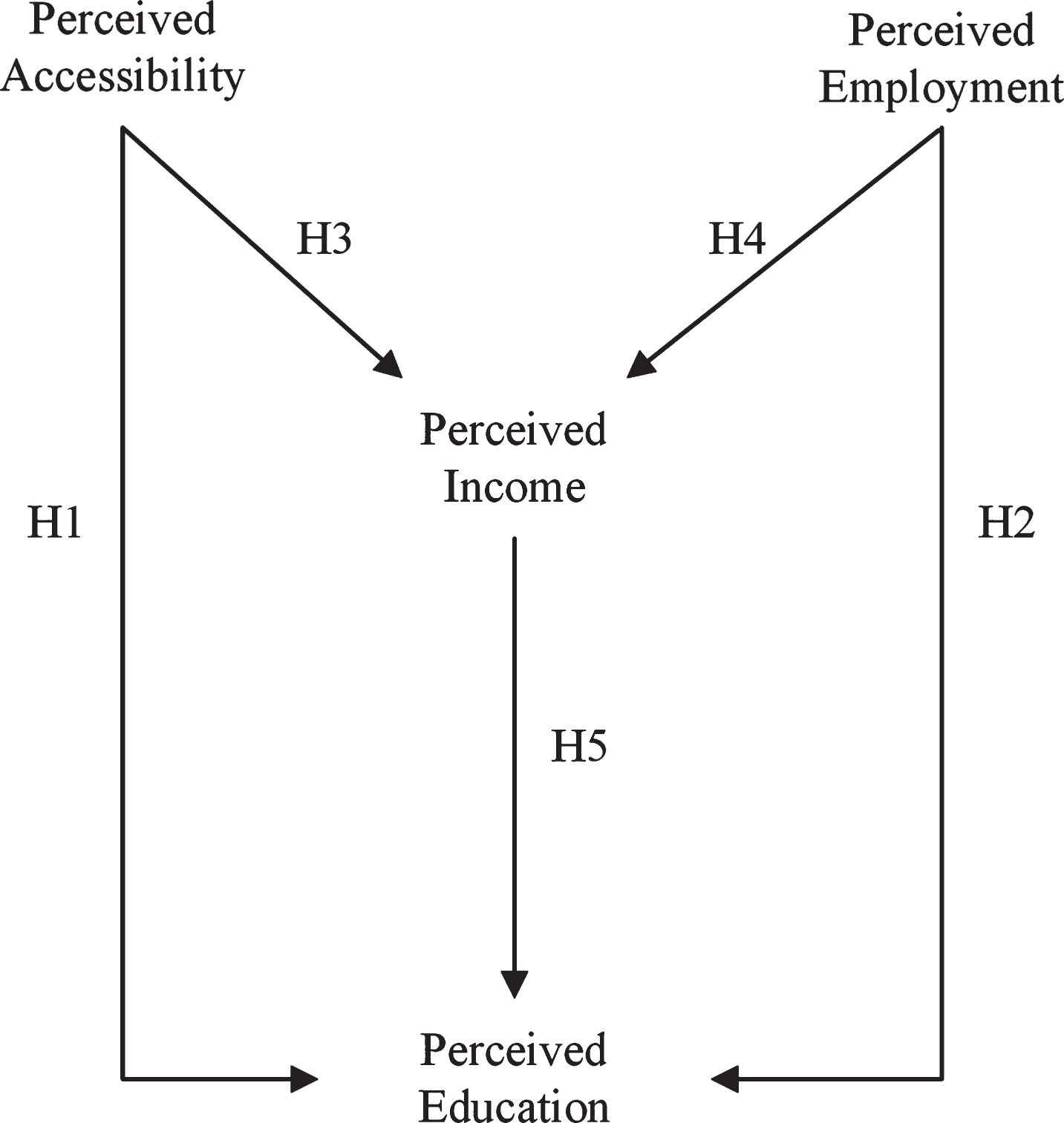
Hypothetical Model of the study.
H5: Perceived effect of CPEC on income has a direct positive effect on the education of the local people of the study area.
Questionnaire of the study and measurement method
To accomplish the objective of this study, a comprehensive questionnaire was designed under the supervision of experts. Based on the literature, numbers of indicators were adapted for each variable and changed their wordings according to the purpose of the study. Items for perceived accessibility were adapted from the studies of Barrios [17], Ap and Crompton [58], Venkatesh, Zhang [59], Viviers and Slabbert [60], Milman and Pizam [61], Zhu, Kraemer [62], Tanriverdi, Konana [63], Quinn [64], Woo, Kim [65], McGehee and Andereck [66], Stylidis, Biran [67]. The observed indicators for gauging percieved employment were adapted from the studies of [17, 68–74]. Items of perceived effect on income were improved from the studies of Barrios [17], Ap and Crompton [58], Viviers and Slabbert [60], Milman and Pizam [61], Stylidis, Biran [67],
Pilot study
By following the work of Kim and Walker [79], a pilot study was conducted to check the validity, clarity, simplicity and level of understanding of the respondents. The questionnaire was filled from 53 respondents in the area. The validity and reliability were checked using Cronbach’s alpha test [80]. Total 34 indicators were retained for further analysis.
Study area and data collection
This study was conducted in the seven districts of Hazara division (Mansehra, Bata gram, Haripure, Upper Kohistan, Lower Kohistan, Torghar, and Abbottabad), Khyber Pakhtunkhwa (KPK) province, Pakistan. After validation and verification from the experts panel, the questionnaires were administered in 720 native respondents (aged above than 18 years) in the study area. A total of 505 valid responses were received with a response rate of 70.13%. The demographic characteristics of the respondents are demonstrated by Table 1. The Questionnaire was filled by male (66.3%) and female (33.7%) respondents. 57.4% respondents were bachelor while the remaining 42.6% were married. Data were collected from the educated people including 47.1% master, 39.8% M.Phil. and 8.1% Ph.D. professors. Moreover, Joint family structure (73.3%) was dominant in the area as compared to the nuclear family structure (19.4%).
Demographic characteristic of the respondents
Demographic characteristic of the respondents
The analysis was carried out in three steps: exploratory factor analysis (EFA), confirmatory factor analysis (CFA) and structure equation modeling (SEM). Firstly, EFA was carried out to reduce the dimension of indicators and to make constructs. EFA using principal component (PC) method of extraction with promax (Oblique) rotation was performed on items to identify factors based on eigenvalue >1. Secondly, CFA was performed to examine the validity, reliability and unidimensionality of our measure. Thirdly, SEM was performed with maximum likelihood method to find the linear relation and effect between observed and latent variables. SEM is a technique which simultaneously investigates the relations between the observed and latent variables. Statistical program for social Sciences (SPSS) and analysis of moment structure (AMOS) were used for the analysis and evolution of the model.
Results
Four factors were identified in EFA, explaining 63.51% variance. The Bartlett’s Test of Sphericity was statistically significant at p < 0.001 and Kaiser-Meyer-Olkin measure sampling adequacy (0.933 exhibit good sample size) demonstrating that the variables are uncorrelated and suitable for factor analysis [81, 82]. Pattern matrix of the dataset is shown in Table 2. Reliability analysis was performed to examine the internal consistency among indicators [83]. Cronbach’s alpha, the most common using approach for gauging reliability, was used for reliability. Cronbach’s alpha values of 0.90, 0.94, 0.92, and 0.90 were obtained from the analysis for perceived accessibility, employment, income, and education respectively, which are above the threshold value of 0.7 as shown on Fig. 3 [84].
Pattern matrix, communalities, explained variance and standardized loading (n = 505)
Pattern matrix, communalities, explained variance and standardized loading (n = 505)
* = Coded name of the observed items see appendix, PM = Pattern matrix, AVE = Average Variance extracted, EV = Explained variance, SL = Standardized loading.
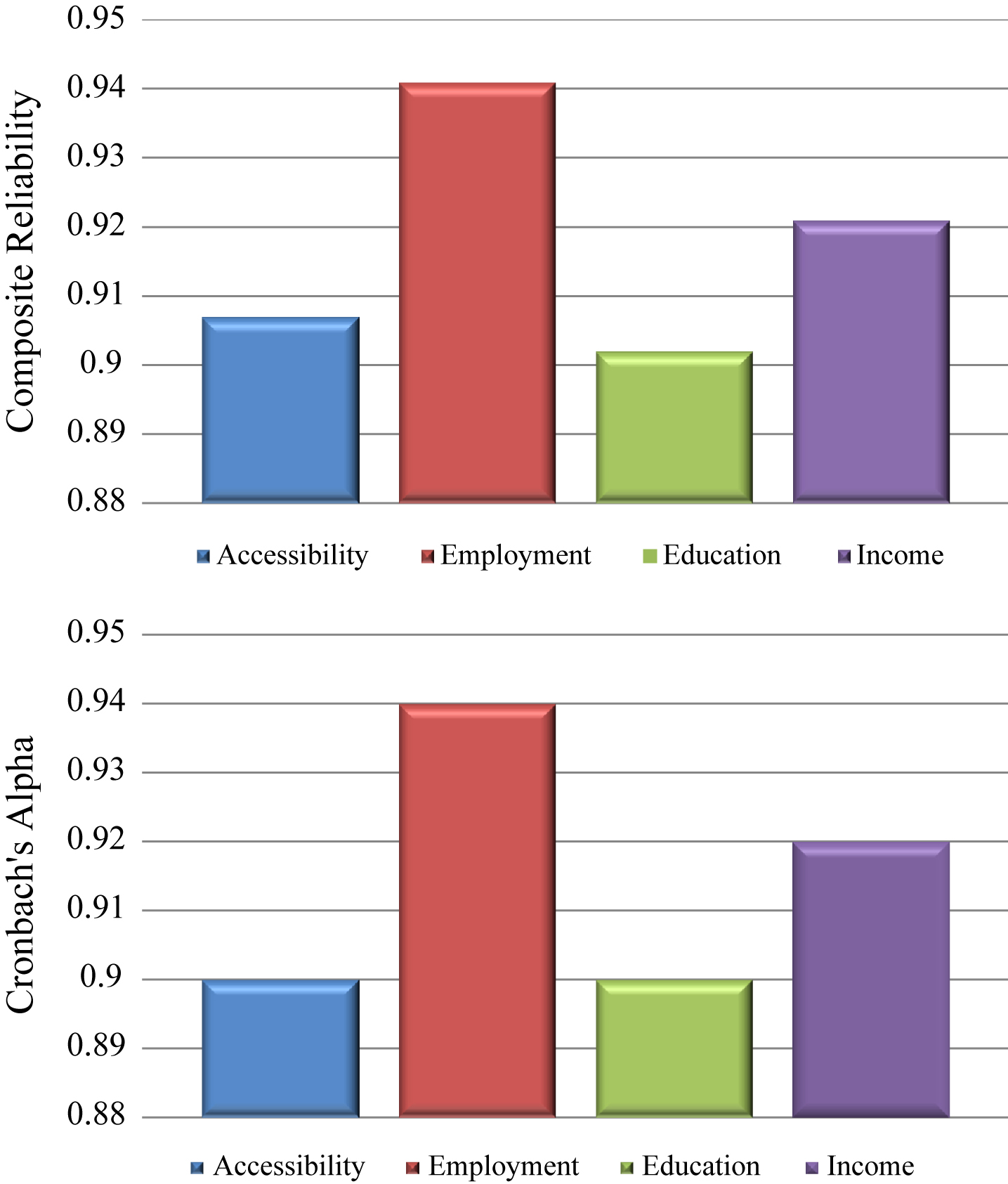
Cronbach’s Alpha and Composite Reliability.
CFA was performed on in-hand data and found that all the coefficient values were above the threshold value of 0.3 [85]. The model fitness was evaluated using Normed chi square χ2/df = 2.01 < 3 [86], Root mean square error of approximation (RMSEA) = 0.04 < 0.06 [87], Standardized root mean square residual (SRMR) = 0.020 < 0.05 [88], Comparative fit index (CFI) = 0.956 > 0.95 [87, 89] and Tucker-levis index (TLI) = 0.951 > 0.95 [87, 89] as demonstrated by Table 4. Furthermore, Fig. 3 summarize the composite reliability (CR) and Cronbach’s alpha of the construct which makes an evidence that all values are above threshold value of 0.7 ranging from 0.90 to 0.94 [90, 91].
Moreover, to check the validity and reliability of the measurement model and observed variables, convergent validity was checked for employment, accessibility, income, education and health. All average variance extracted (AVE) values ranging from 0.519 to 0.639 which are above the threshold value of 0.5 [90] as shown in Table 3. We have discriminant validity based on square root of AVE being greater than any inter factor correlation, which is good [90]. It is concluded from the above results that according to Hu and Bentler [87], Bagozzi and Yi [91], Klin [92] and Thompson [93] recommended values for the appropriateness of observed indicators and their generalization were suitable and valid for assessing factors.
Average variance extracted and factor correlation
Average variance extracted and factor correlation
AVE = Average variance extracted. Note: Bold numbers are AVE value square root of each factor.
Goodness of fit for measurement model and structure model
RMSEA = Root Mean Square error of approximation, RMR = Root mean square of residual, CFI = Comparative Fit Index, TLI = Tucker Lewis.
SEM two steps approach was used with 4 variables having five direct paths. The results indicate that the overall model is technically correct as obvious from Chi square χ2/df = 2.01, RMSEA = 0.045, RMR = 0.020, CFI = 0.956, and TLI = 0.951 which are above the threshold value of 0.95 [87, 94] as shown in Table 4. Structure model hypothesized that significant association exists among the variables. The hypothesis was examined and found that H1: complete standardized loading = 0.484 (t-value = 9.49, p > 0.001). It means that perceived accessibility has a positive effect on education of the local people. H2: completely standardized loading = 0.120 (t-value 2.70, p < 0.05) and in other words, perceived effect of employment has a direct positive significant effect on perceived education of the local people of the study area. H3: completely standardized loading = 0.215 (t-value = 4.53, p > 0.001), which means that perceived accessibility has direct positive significant effect on the income of the local dwellers of the study area. H4: completely standardized loading = 0.383 (t-value = 7.73, p < 0.001), which represents that the perceived employment has direct significant effect on the income of the local people. H5: completely standardized loading = 0.269 (t-value = 5.60, p < 0.001), which means that perceived income has positive significant effect on education of the local residents of the study area.
Mediation effect
Hypothetical model was tested using bootstrap and found that income partially mediates the relations of perceived accessibility and education (H1a) as obvious from the results where p < 0.001, β= 0.496, t-value = 9.62 [119]. Thus the hypothesis is acceptable and concluded that accessibility has strong positive effect on the education of the local residents through income. Furthermore, our findings explored the positive mediating effect of income on perceived employment and education (H2a). The hypothesis supported by our results as we have good model fit, significant R square, p < 0.001, β= 0.174 and t-value = 3.47 as shown in Table 5. So, income partially mediates the positive effect of perceived employment on perceived education [119].
Hypothesis testing
Hypothesis testing
*** = p < 0.001, ** = p < 0.05.
Figure 4 demonstrates the overall SEM model with standardized estimate.
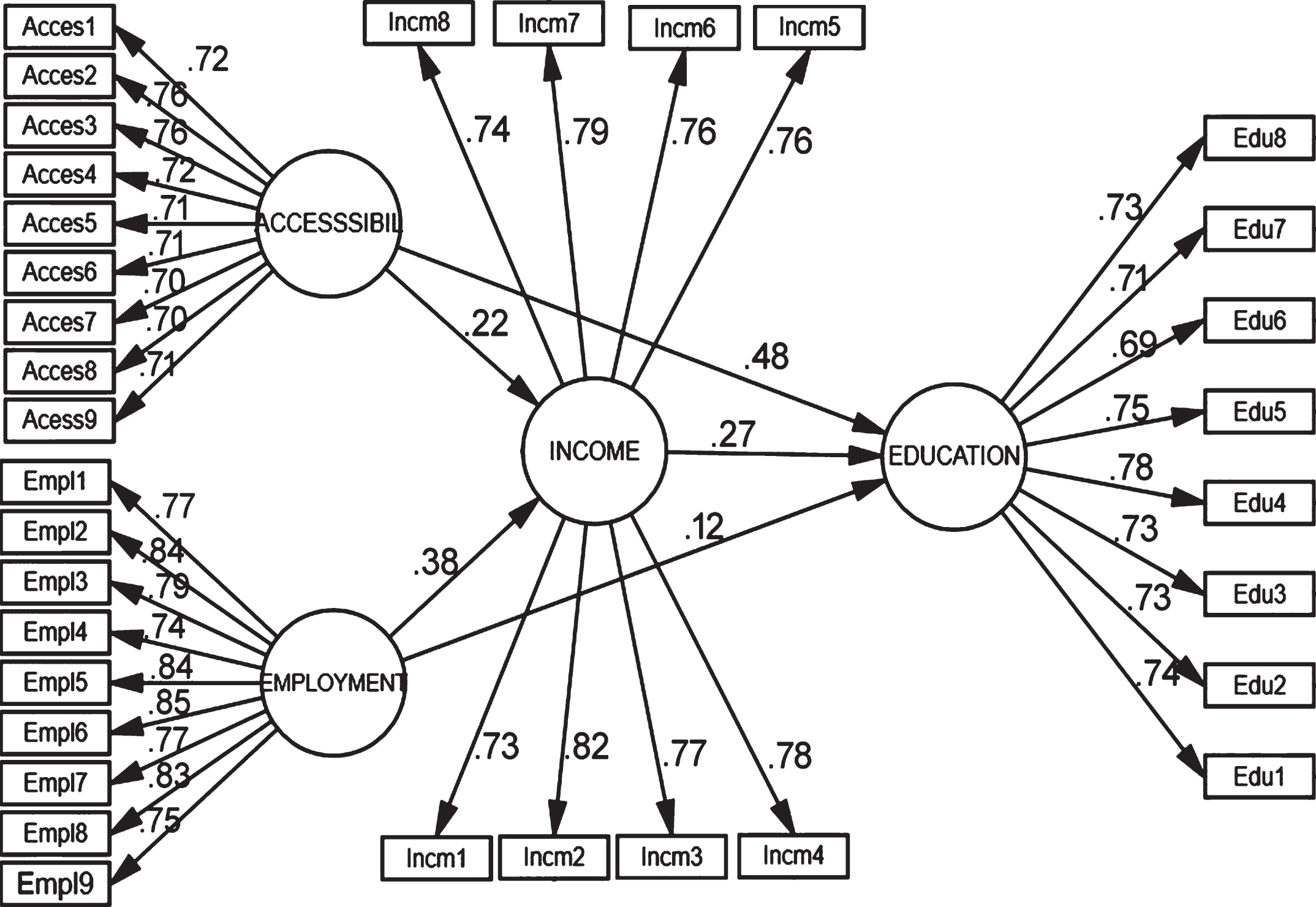
SEM Structure Model.
Transport infrastructure is an important factor to improve education of the area. This study investigates that perceived accessibility has a positive impact on the education of the local dwellers in the study area. Our result is consistent with the existing literature that road accessibility has positive effect on the education of host community [20]. It is concluded that accessibility has direct significant positive relation with education. It makes sense that in rural and remote areas mostly parents did not send their children to schools particularly female children, which may be due to lack of access to academic institutions, unaffordability, less importance of education or rigid culture [95, 96]. Transportation infrastructures trigger the enrollment ratio in the region which may be attributed to easy access, low fares and less time consumption [20]. Majority of Pakistani people are living in rural areas, where educational facilities are either unavailable or poor. They ignore children’s schooling which can be improved through road and transportation. It enables the local dwellers to get education from the nearby town or cities [17]. Road and transport increase 300% female enrollment at basic level [97]. CPEC will enhance the quality and ratio of education through easy, fast and reasonable access to education in the region.
This study found that perceived employment has a direct positive impact on the education of the local people of the study area. Findings of this study are parallel with the recent studies which revealed that parental job has a casual effect on the education of children [26, 98–100]. Parental job loss reduced 10–15% annual income which directly effects on children’s education [29, 32]. Moreover, parental job loss increases chances to repeat grade [32]. It is employment and good income that secures the whole family and enable them to provide standard education to children. CPEC will generate millions of jobs opportunities [2] which will improve the income of the poor families and enable them to educate their children in a most favourable environment.
This study discovered that perceived accessibility has direct positive effect on the income of the local people of the study area. Our findings are supported by the existing literature [101–104]. Road and transport accessibility increase 25% of income [45]. It reduces transportation cost, save traveling time, provides easy access to the market and raw materials, which boosts income of the host community [102]. Road and transportation reduces shipping cost up to 90%, which indirectly boosts the income of local people [37]. Pakistan is an agricultural country as majority of the people are engaged in this profession [105]. CPEC will provide easy access to market where farmers will sell their products and will be able to purchase good quality seeds, pesticides and fertilizer which will increase crop yield [16, 106]. Moreover, it is expected that CPEC has the ability to improve the income of the local tenants by providing access to different jobs opportunities and may generate chances to start new business [17, 106]. It will improve the current trade of the local people which will give help in eliminating poverty and improve the living standard of the local residents [2].
We found that employment has a direct positive impact on the income of the local residents, which is in line with the previous literature [27, 107]. It is obvious that road and transportation create different jobs and business opportunities by giving accessibility to city and market where the local people can find good job and earn more wages. Employment increase household resources which improve the living standard of the local people [15]. Road and transport accessibility generate different activities, employment and business opportunities, which increase 25% of income [45]. 10–15% per year income reduction was witnessed due to job loss [29, 32]. It is expected that CPEC may generate millions of employment in the area which improve the income of the local people. CPEC will heal the badly effected industries and skill labor by overcoming the current energy crises in Pakistan [108]. CPEC will also generate revenue, which will economically strengthen the area. Furthermore, new industries and economic zone is the part of CPEC which will minimize the current crises and poverty in the Pakistan [2].
This study explored that perceived income has a significant direct positive effect on the education of the local resident which is consistent with the existing literature as Brooks-Gunn and Duncan [109] mentioned that an increase of 10% family income boosts the education in number of schooling year completed from 0.2% to 2%. Family income plays a crucial role in education [46, 110–113]. Children of a poor family are less intelligent than rich owing to lower investment in their education [46]. Income has a causal relation with education and achievements [28, 114]. The more the investment in the education, the higher and better will be the education [33]. Education plays a pivotal role in the development of the country while better and quality education directly depends on the income of the family and economy of the area. Some new academic and professional skills institutions are also a part of CPEC, which will produce professionals to improve skills and income, and minimize poverty in the region which is a step for the development of the area.
Moreover, our findings explored that income mediates the positive relation of perceived accessibility on education. Income has a dynamic role to access quality education [46]. Family income plays a great role to offer access to quality education and other basic amenities of life through roads and transportation [20]. It makes sense that income plays an important role to cover educational expenses of an individual by enhances income via employment and business. Road and transportation effect income of the people which significantly affect the education of the children. Poverty is one of the great reasons that badly affects the education of youngsters [109]. Only 11% poor children enter to degree education due to poor financial sources [47]. We can say that income makes it possible to access quality education. Furthermore, the mediating effect of income was evaluated and our results support the hypothesis that income mediates the positive effect of employment on education. The findings of Oreopoulos et al. [29], and Stevens and Schaller [32] support our results that employment has a significant effect on education. According to Baron and Kenny [119] approach, income partially mediates the relation of perceived employment on education. It is concluded that CPEC will provide billion of opportunities for the local people in Pakistan as it will pass from all provinces of Pakistan which will provide access to different amenities of life with safe, low cost and less time-consuming medium.
Conclusion
The main aim of this study was to find the impacts of CPEC on the education of the local people. Four perceived variables including accessibility, employment, income and education were used to accomplish the objective of this study. This study discovers that CPEC will be very beneficial for the local residents as perceived accessibility directly affect the education of the local residents. As lack of access to education in the rural areas is one of the main obstacles toward schooling. Road and transportation encourage enrollment while discourage drop out ratio in the region. Moreover, this study discovers that perceived employment has a significant effect on the education of the people of the area. Parent’s employment plays a vital role in the education of their children. Due to poverty and unemployment, the parents are sometime unable to educate their children. CPEC has the ability to provide employment opportunities to local people which will improve the income and education of local dwellers. Furthermore, this study explored the effect of income, accessibility and employment on the education of the local area. Income plays a significant role in the education and socialization of the children. Road and transportation positively affect education, however, increase in income trigger the effect of accessibility and employment on education. It is expected that CPEC will provide access to basic amenities of life like education, health, banking and market, and will generate thousands of jobs in the study area, which will improve the living standard of local people. Simply we can say that CPEC will be a fate changer project for Pakistan.
This study dwells upon the importance of road and transportation (CPEC) and their impacts on education. Some of the people in the area are against CEPC due to some personal or political reasons. This study will create awareness among them as to how CPEC will change their future by promoting their education, and how it is beneficial for the region. CPEC has the ability to change the future of the country. This study explored that how education can be improved in the area specifically in the remote areas, where access to education is very difficult. Government authorities and policy makers can get guidelines from the current research for the formulation of educational development plans and coping of related issues. The current study has few limitations: firstly, less number of variables used for this study and secondly, limited region was selected for this research. Future research should be conducted at country level covering all provinces which will provide detailed responses of residents and will observe the effect on provincial basis. Moreover, this study investigate the positive impacts of CPEC while in future researchers can examine the negative economic, societal, cultural and environmental impacts of CPEC on the local people.
Footnotes
Appendix
| Perceived Accessibility |
| 1. CPEC will increase easy access to quality health care center (Acces1) |
| 2. CPEC will provide access of farmer to the big cities through building chain roads/routs. (Acces2) |
| 3. CPEC provide access to quality education (Acces3) |
| 4. CPEC will provide access to the remote area (Acces4) |
| 5. CPEC will Provide access to quality of public services (fire, police etc. (Acces5) |
| 6. CPEC will reduce shipping cost and provide access to a high quality mode of transportation. (Acces6) |
| 7. CPEC will reduce travel time to destination (Acces7) |
| 8. CPEC will provide good and safe public transportation (Acces8) |
| 9. CPEC will generate opportunity to meet people from other cultures(Acces9) |
| Perceived Employment |
| 1. CPEC will generate employment opportunities in the area (Empl1) |
| 2. CPEC will create chances for a person to find a good job (Empl2) |
| 3. CPEC will generate new business opportunities in the area (Empl3) |
| 4. A subsequent decline in poverty is imminent in light of CPEC (Empl4) |
| 5. Employment Wages will become better in CPEC jobs (Empl5) |
| 6. CPEC will provide employment and skills for improved livelihood opportunities (Empl6) |
| 7. More employment opportunities mean less crime (Empl7) |
| 8. CPEC will minimize societal problem due to employment (Empl8) |
| 9. Career opportunities will be better than old job (Empl9) |
| Perceived Income |
| 1. CPEC will increase the household income (Incm1) |
| 2. CPEC will generate revenue in the local economy (Incm2) |
| 3. Feeder roads along CPEC will increase the economic activities which lead to increase in income (Incm3) |
| 4. CPEC will improve the economic conditions of the area (Incm4) |
| 5. CPEC will improve living standard of the common people (Incm5) |
| 6. CPEC will Cover Current energy crises in the country which lead to increase in family income (Incm6) |
| 7. Long term, investments have positive economic consequences (Incm7) |
| 8. CPEC would mitigate the poverty across its lines. (Incm8) |
| Perceived Education |
| 1. CPEC will provide opportunity to get a quality education (Edu1) |
| 2. Access to big cities through CPEC would create greater opportunities for quality Education (Edu2) |
| 3. Betterment of family income with CPEC is ensured through getting education (Edu3) |
| 4. New Educational institution are expected to be established under CPEC (Edu4) |
| 5. Road improvement encourage school enrollment especially amongst females (Edu5) |
| 6. The most fundamental societal needs like education are the main component of CPEC (Edu6) |
| 7. CPEC will play a positive role in the improvement and development of education (Edu7) |
| CPEC will Improve the quality of existing education (Edu8) |