



Abstract
Traditionally, education emphasizes on the use of textbooks for the acquisition of knowledge. However, educational settings around the world are now emphasizing on digital curricula that promote competences and performance. The purpose of this article is to examine the impact of use of Information and Communication Technology (ICT) on students’ performance. Knowing the importance of ICT for education, the private schools of Pakistan emphasize the use of ICT; however, public schools lag behind in the ICT infrastructure, thereby producing a digital divide. This research conducted a survey with 150 public and private school students of Peshawar District, in the KP province of Pakistan. The results show that the use of ICT acts as a catalyst for improving the quality of education and the students’ performance. The study’s findings can benefit policy makers who design ICT-based curricula and provide ICT infrastructure for public schools. Moreover, the study’s results can help narrow the current digital divide, by providing a high-quality education to public school students.





Introduction
These days, in a globalized economy there is a high degree of competition among countries and the success of a nation depends upon the educational standard of its workforce. Knowing the importance of education, developed countries around the world worked hard to promote the education sector while developing countries are lagging behind in the promotion of education sector. There is an urgent need for the developing countries to take necessary steps for the development of education sector to ensure that all citizens receive quality education to participate effectively in the global economy. Outdated curricula practiced in many schools of developing countries tend to accumulate knowledge but fail to train students in digital literacy. Education reform is essential to provide learners with twenty-first century technological skills that is, those competencies and values needed to become responsible citizens in a learning society and sustain efficiently in a knowledge economy. The development in the education sector is facilitated by the diffusion of digital technologies; new opportunities have emerged to integrate technological resources, to increase flexibility across the learning process, to enhance communication between teachers and students and to reinforce the interaction between different educational resources. The desired result of this changing process is the improvement of students’ achievement and performance [1].
Adopting the e-learning policies in the education sector are important drivers for quality improvement and strategic planning promotion. This will result in the provision of high quality education based on the use of digital technologies [2]. The desired result of this modification process is the enhancement of students’ performance which is a direct outcome of technology used and more importantly the teaching and learning methodology adopted because these two factors may explain how students and teachers make efficient or inefficient use of digital devices [1].
In the current study the used term ICT has been defined by the author in [3] as technology is a tool to alter inputs into commodities while high technology allows its users to perform the same tasks but faster, in large amounts and in a more reliable way. New technologies based on internet and social interactions are changing the nature of business, work and social interactions by increasing the productivity of digital workforce, in services, business and governmental sectors. Moreover, each profession is discerning the importance of modernizing its ICT services to keep pace with demands of technological advances in its fields. The integration of ICT in education is entrenching the customary layout of pedagogy into novel development and altering the way of teaching and learning [4].
Many researchers have tried to explain the effective impact of these technologies on students’ achievement and on the returns of education. They faced two problems. On one hand, it is hard to define students’ performance. On the other hand, ICT is growing technologies and their effects are hard to isolate from their environment [2]. The biggest challenge in assessing ICT impact on students’ performance is to identify the distinctive influence of ICT use on it. As mentioned earlier, students’ performance is a vague concept and even difficult to define and measure. Moreover, various characteristics of learners and complicated features of the external environment might affect their performance. However, there is an urgent need to measure and to make interpretations in order to promote their performance [1]. Usually, performance is defined as comprehension of curricula and completion of degrees. However, nowadays an extensive definition of performance deals with digital competences, skills and attitudes learned through education. As there is no set definition for students’ performance, so usually people focus on the achievement of degrees or students’ marks and the comprehension of their curricula. However, a widespread definition deals with students’ competences, skills and attitudes learned through their education comprehension. The above discussion formulates the research question for this study as, “does the use of ICT in public and private schools influence student performance?”
Problem statement
Provision of basic education up till secondary level is the responsibility of the government of Pakistan. But it is difficult for the government to meet the educational demands of the growing population. For this reason, private sector shared the burden and started providing quality education with English as a medium of instruction, foreign curricula and more importantly the use of ICT for teaching and learning. As a result, private schools are gaining popularity among masses and flourishing rapidly. While on the other hand, public schools are declining in their standard of education because they are lagging behind in the use of digital devices for teaching and learning. This results in the production of qualified and skilled workforce by the private sector and private school students are grabbing highly paid and attractive jobs in various organizations as compared to the public school students who are unable to compete with the private school students. Therefore, there is a need to highlight the factors influencing the effectiveness of both types of schools.
The impact of the use of ICT on students’ performance is not clear. It needs to focus on a more complex strategy of observation. This study will focus to measure students’ performance through motivation, knowledge, skills and satisfaction of students towards the use of ICT in the class.
Literature review
Public vs. private schools
Quality is a major factor adopted by various institutions to compete with each other as quality makes an institution distinctive from others. Students’ satisfaction is analyzed based on the quality of education that they receive from these educational institutes, that’s why these institutes are constantly under pressure to outperform their competitors in the name of upholding service quality [5]. The difference between the productivity of public and private schools varies in magnitude from country to country. In the developed countries, there is a minimal difference while in developing countries like India and Pakistan, this difference is high [6]. School quality, and public/private school choices was analyzed by [7] and their analysis show that even the poorest households send their children to private schools and this utilization increases as the income of households increases. The reasons behind this choice are the better location, use of resources and better achievement in Mathematics and language (English). Private schools struggle hard to maintain their educational standard as pointed out by [8] that students of private schools may leave at any moment, in search for better option, either for public or any other private school, without decreasing or increasing the financial burden of their education so this competition among the private schools makes them more receptive to customers’ demand and obliges them to utilize resources in the most efficient way possible to achieve high level of quality education and to magnetize students. These competitive pressures are not present in public schools as they are secured by governments and are not obliged to attract students.
Researchers around the world compared the performance of public and private schools by taking different factors. School administrations, leadership style, management of resources, parents’ cooperation are such factors that have a positive impact on school performance. In this regard private school principals have a great vision for their school performance as compared to public school principals [9]. Parents in Ghana with high educational level and high socio-economic status prefer the private schools over public schools for the provision of quality education to their children. Moreover, with regards to the teaching capabilities of both public and private schools, the author in [10] argued that public school teachers were well educated and well trained but due to lack of facilities like libraries and computers, they do not use resources in their classrooms while on the other hand, private schools are well resourced with new technologies.
School choice for the provision of quality education is a major concern for parents. Income of household, education of parents, distance of public schools from houses, use of resources and English as a medium of instruction in private schools boosted up the tendency of private schooling in Pakistan [11]. With regards to school management, teaching methodology, availability of physical facilities and students’ results private schools outperformed the public schools in Pakistan [12].
A study about the effectiveness of public versus private schools was carried out in Kenya by taking the labor market earning as a measure of effectiveness. The findings show that private schools have an advantage of better performance as compared to public schools [13]. Private schools are producing skilled workforce by providing quality education to the students. Students of private schools receive high earnings in the labor market as compared to public school students. Private school students outshine in various fields due to their technological skills and proficiency in English. Therefore, it is necessary for policy makers to take necessary measures for providing quality education in the public schools not only to reduce the knowledge gap between public and private schools but also to compete globally [14].
Importance of ICT in education
ICT plays a vital role in enhancing a person’s skill of collaboration, information retrieval, social interaction and civic participation [15]. In the context of twenty-first century technological changes, the use of ICT is one of the key competencies for lifelong learning that is a competence that people need for personal fulfillment, active citizenship, social cohesion and employability in a knowledge society [16]. ICT competences are related to the degree to which people benefit from the use of computers. Consequently, the disparity in digital competence might exacerbate existing social inequalities.
ICT has the potential to empower teachers’ and learners’ motivation, transforming teaching and learning process from being highly teacher- dominated to student-centered, and that this transformation results in increased learning gains for students, creating and allowing for opportunities for learners to develop their creativity, problem-solving activities, informational reasoning skills, communication skills and abstract thinking skills. Since students’ performance is mainly explained by students’ characteristics, educational environment and teachers’ characteristics, ICT may have a positive impact on these determinants and consequently the outcome of education [17].
ICT has been touted as potentially powerful tools for educational change and reform. When used appropriately, different ICT are said to help expand access to education, strengthen the relevance of education to the increasing digital work place, and raise educational quality by helping make teaching and learning into an engaging active process connected to real life [18].
Conceptual model
ICT has the potential to innovate, accelerate, enrich and deepen students’ skills, to motivate and engage students, enhance students’ knowledge and create economic viability for tomorrows’ workers. This in turn would better prepare the learners for lifelong learning as well as to improve the quality of learning. ICT can be used to prepare the workforce for the information society and to meet the challenges of global economy. Returns of education using ICT are changing. The adoption of digital innovation is affecting students’ performance and achievement. Public schools of Pakistan are lagging behind in the use of digital technologies as compared to private schools that result in creating the digital divide among students of both schools. In order to probe further about the impact of the use of ICT on students’ performance, this study is conducted in the public and private schools of Peshawar District of KP province (Pakistan).
Figure 1 shows the conceptual model for this study. It also highlights the relationship of dependent and independents variables. The model has been formulated on the basis of relevant studies of different developed and developing countries. Students’ performance is categorized into motivation, knowledge, satisfaction and skills and their details are described below.
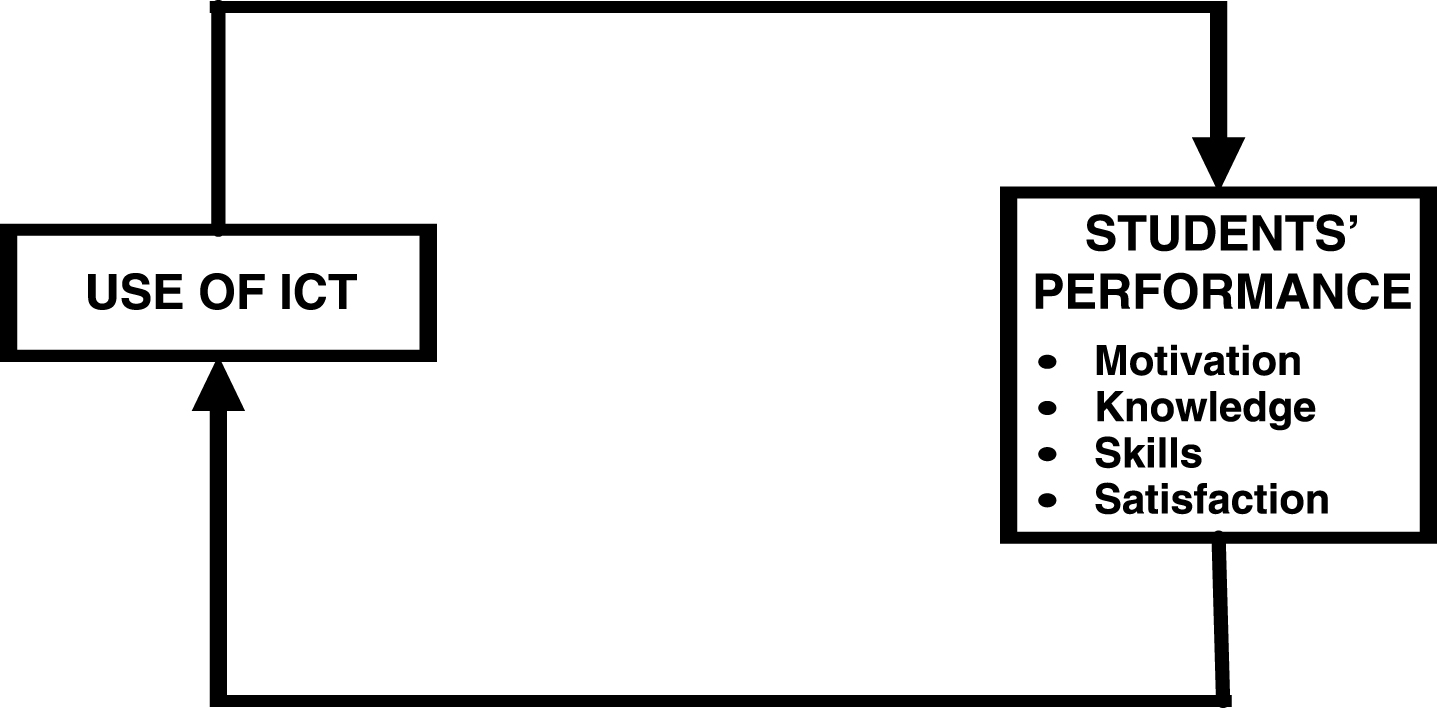
Impact of use of ICT on students’ performance.
The above discussion about the variables derived the hypothesis as “there is no significant difference between public and private schools’ students’ performance on account of use of ICT.”
Use of digital technologies help students to enhance their knowledge, improve the quality of learning, prepare them for lifelong learning and also to compete with the challenges of twenty first century global economy. As public school students are deprived of the use of digital technologies in their classes that is affecting their performance and also developing a knowledge gap and digital divide compared with the private school students. For this purpose, this research is carried out in Peshawar District of KP province of Pakistan to ascertain the impact of use of ICT on students’ performance.
The questionnaire is divided into two sections. Demographic profile of students was included in the first section. Questions related to students’ knowledge of ICT, the perception about using digital technology in their respective subjects and its impact on their performance was included in the second section. Five point Likert scale was used for all questions. Questionnaires were given directly to students in their schools and were received back once they filled it.
This survey was carried out in September and October, 2016, for a period of two months. Total 150 questionnaires were distributed among the ninth and tenth grade students of secondary and high secondary public and private schools of Peshawar district of KP province, Pakistan.
Findings
Students’ demographic profile
Table 1 indicates that among the 150 participants there were 73 (48.3%) male students and female students were 77 (51%) total 30 schools were selected, out of which 15 were public and 15 were private schools. Among the 30 public and private schools, 81 (53.6%) students were from high school and 69 (45.7%) were from high secondary schools. Regarding the use of ICT in schools, there were only 3 (20%) public schools where IT laboratories were present but these laboratories were used only for computer science students of grade nine and ten, other students or classes were not allowed to use the IT laboratories. So computers in these laboratories were for teaching the computer science subject. On the other hand, there were 13 (86.6%) private schools where ICT was used effectively in all classes and in IT laboratories. Separates resource rooms were also provided for using ICT tools, if IT laboratories are occupied. Teachers of private schools were obliged to use ICT frequently in their classes and they were also properly trained. Students of private schools were also satisfied with the use of ICT in their classes. There were only 2 (13.3%) small private schools where ICT was not used because the school strength was low and their principals found it costly for the provision of ICT tools for small strength of students.
Students’ demographic profile
Students’ demographic profile
The purpose of this study was to find out the impact of the use of ICT on students’ performance. It is difficult to measure performance so four factors were taken as tools to measure the improvement in students’ performance. These factors are motivation, knowledge, skills and satisfaction. With the help of these factors, this study explored the impact of the use of ICT on students’ motivation towards learning, enhancement of knowledge, learning digital skills and satisfaction of students towards their studies and their institution. In order to analyze the data statistical measures were used to test the assumption. The empirical investigation will examine the relationship between dependent and independent variables.
To find out the relationship between dependent and independent variables, linear regression was used. Before applying linear regression, the normality has been measured regarding the data outliers to confirm that the data is suitable for applying regression analysis.
Table 2 shows the output of the model summary between independent and dependent variable. It indicates that the adjusted R2 of our model is 0.584 with the R2 = 0.588 which means that the linear regression explains 58.4% of the variance in the data. The reason behind this change is that the use of ICT enhances students’ motivation towards learning by taking interest in the relative subjects, acquiring advanced digital skills, getting additional knowledge other than the textbooks that satisfies their urge for obtaining digital competences and updating their comprehension according to the requirement of the digital age.
Model summaryb
Model summaryb
aPredictors: (constant), Use of ICT. bDependent variable: Performance.
Table 3 presents the fitness value F = 93.8 and 149 degree of freedom, showing that the test is highly significant and there is linear relationship between the variables in our model. Table 4 shows the beta value to express the relative importance of independent variable, (β= 0.990), which indicates the use of ICT has a profound effect on the performance of students by motivating them towards their studies, enhancing their abstract thinking, giving confidence to acquire digital skills, make them able to coordinate in group tasks, moreover access to digital tools satisfies the learning capabilities of today’s’ learners. The overall result of our linear regression rejects the null hypothesis and clearly shows that there is a positive impact of the use of ICT on the performance of students. Table 5 Mean, Standard deviation and T-Test of use of ICT on students’ performance in public and private schools (N = 150).
Anovaa
aDependent variable: Performance. bPredictors: (constant), Use of ICT.
Coefficientsa
aDependent variable: Performance.
Group statistics
Independent samples test
Table 5 shows that the mean value of the performance of private school students is 7.24 with standard deviation 2.03 and the mean value of the performance of public school students is 5.82 with standard deviation 1.52. The value of ρ is less than 0.05 level of significance which means that null hypothesis of our research is rejected. There is a significant difference in the performance of public and private school students on account of use of ICT; t (148) = 4.8, (ρ< 0.000) (see Table 6).
The rapid growth in the use of ICT has brought remarkable changes in the field of education. Therefore, many educational institutions in the world today are using ICT to teach the skills and enhance the knowledge of their students that is needed according to the demand of technological era. Some researchers focused one major distinction between studies on the use of ICT stressing computers as a subject from a technological perspective and some studies focused on the use of computers as an educational tool to teach other subjects [23]. However, [24] mentioned three types of ICT use; 1). ICT as an information tool 2). ICT as a learning tool and 3). Learning basic ICT skills. Different uses of ICT in the class will result in differences in students’ ICT competences. ICT capability is based on sets of relevant knowledge, skills, behavior and dispositions.
Conventional education sector emphasizes on knowledge acquisition and centers on textbooks. educational settings around the world are now emphasizing curricula that promote competence and performance. ICT based curricula are concerned with how the information will be used rather than what the information is. Moreover, learning is an active process of constructing knowledge rather than acquiring knowledge. Globally, ICT helps to improve the perception and comprehension of students. Consequently, ICT can be used to prepare the workforce for the information society and the new global economy.
The appropriate use of digital technologies in education has a significant positive effect on students’ attitude towards learning and moreover it enhances the students’ performance. ICT act as a catalyst for improving the quality of education and the students’ achievement. It helps deepen students’ content knowledge, motivate them in developing abstract thinking skills and satisfies them with the improvement in their educational achievements. The results of the study of comparative analysis of public and private schools with the impact of the use of ICT on students’ performance, reveals that the private school students are satisfied with the use of ICT for various subjects in their classes. Moreover, use of ICT motivates them to acquire advanced knowledge, improve their thinking skills and consequently, it affects their performance in studies. However, the situation is different in public schools of Peshawar District of KP province (Pakistan) where lack of ICT opportunities affecting not only the students’ performance but also increasing the digital gap. Most of the public school students belong to low income households and they do not have the opportunity to use digital technologies at their homes so schools are the places where they can get benefit from these technologies. Based on the findings of current study, it is concluded that use of ICT enhances student performance of private school students, consequently, public school teachers should be motivated to make use of ICT in their teaching practice to enhance student’s knowledge, skills and motivate them towards learning not only to satisfy the need of today’s learners but also help them in making the digital competent workforce to compete well with the private school students. Hence for the improvement of quality of education in public schools and also for the provision of equal education to all the masses of the country, it is suggested that policy makers should revise the education policy by introducing ICT based curricula, provide opportunities for the professional development of teachers and moreover, provide ICT infrastructure in all primary and public schools so as to reduce the digital gap and help the public school students to acquire the technological competences and to compete well in the digital economy.