



Abstract
A system dynamics (SD) simulation model, of the interactions among business enterprises that compete in the entertainment industry, integrates ideas from organizational and strategy design, and new-technology adoption. The model describes exactly how the new-technology’s diffusion process of hardware and software clusters alters syndication-firms’ strategic postures, and TV networks’ investment opportunities in infrastructure and production capacity. Building on transaction cost economics (TCE), the model contributes to the merger and acquisition (M&A) literature and provides insight into the emergence of corporate-governance forms.
Keywords


Introduction
What makes firms succeed or fail has preoccupied the strategy field since its inception, a few decades ago. Inextricably bound up in questions, such as, for example, why firms differ, how they behave, how they design strategy and how they are managed, the reasons why firms succeed or fail are often raised.
Yet despite the considerable progress in developing models that explain the static complicatedness of competitive success, far less developed is our insight into the dynamic complexity by which firms perceive and attain superior competitive positions through time [13]. Moreover, strategy-research answers to why firms succeed or fail embody crucial assumptions about the nature of business enterprises and their business and contextual environments.
Ghemawat [6] posits that the analysis of strategic decisions ought to begin with cross-sectional models but, in choosing competitive positions, he stresses the need to examine their sustainability through time as well as the effect of uncertainty on chosen investments. Sustainability is relevant to system dynamics (SD) because of its proximity to scenario-driven planning, which allows assessing resource investment decisions from a strategic perspective while, at once, bounding strategic uncertainty [2].
Changes in the environment, technology and in strategy prompt firms to seek sustainable cooperative relationships with other firms, while mergers and acquisitions (M&As) represent expeditious ways to keeping the pace, particularly when firms need new assets and competencies [1]. Alternatively, pursuing cooperation because of reciprocal dependencies may cause firms to opt for contract-based governance.
The contract-based governance forms that firms use because of reciprocal dependencies include strategic alliances, partnerships, coalitions, franchises, research consortia and network organizations [9, 18]. These governance options are best explored by building on transaction cost economics (TCE), a branch of organizational economics, resting on the conjunction of bounded rationality, asset specificity and opportunism [20, 21].
Namely TCE explores governance options, such as discrete market contracts, recurrent contracts, relational contracts and hierarchies. TCE extensions view M&As as a hierarchical response to market imperfections, positing that it is more economical for firms to overcome impediments to market exchange by establishing internal markets, as opposed to incurring the prohibitive transaction costs of the external one.
TCE suffers, however, from several weaknesses. TCE analysis tends to be static [18], paying little attention to the dynamic effects of a firm’s internal cost of control on its governance choice. And by focusing on the transaction cost implications of different governance modes, TCE research overlooks the effects of each on revenue and profitability.
The dynamic M&A model, developed during the action- or praxis-research intervention project described here, partially overcomes these flaws. The SD model incorporates organizational innovation and internal control costs, the primary determinants of M&A activity in the TV-related segment of the entertainment industry. Ergo, this article also contributes to the post-merger dynamics research [12].
The following section briefs our praxis-research intervention in two syndication firms, emphasizing the divergence-convergence sequence of a dialectical-inquiry (DI) interchange. This DI’s dialogues let participants’ attention shift from individual cognitive biases (CBs), so they could re-perceive the structure and implications of their strategic situation.
An overview of the intervention process follows. Computed scenarios allow assessing the sensitivity of syndicator profitability to M&As.
The simulation results show the dynamic evolution of corporate governance forms that might create alternative futures for independent syndication firms that compete in the TV-related industry. These results point to the potentially rich contribution of system dynamics to exploring alternative governance forms, beyond the ideal type forms of markets and hierarchies, which tend to dominate the TCE literature.
Intervention process
Eight managers volunteered to participate in this project. They collegially willed to refine and to jointly formulate the strategic situation of the TV-related industry.
The study’s participants were assigned to two teams. Initially, each team worked separately to ease the development of two alternative formulations of the situation. To provide a mental space for participants to exchange ideas about the industry, we juxtaposed Porter’s [15] five forces and the industry’s political and legal events, and socio-economico-technological trends (Fig. 1).
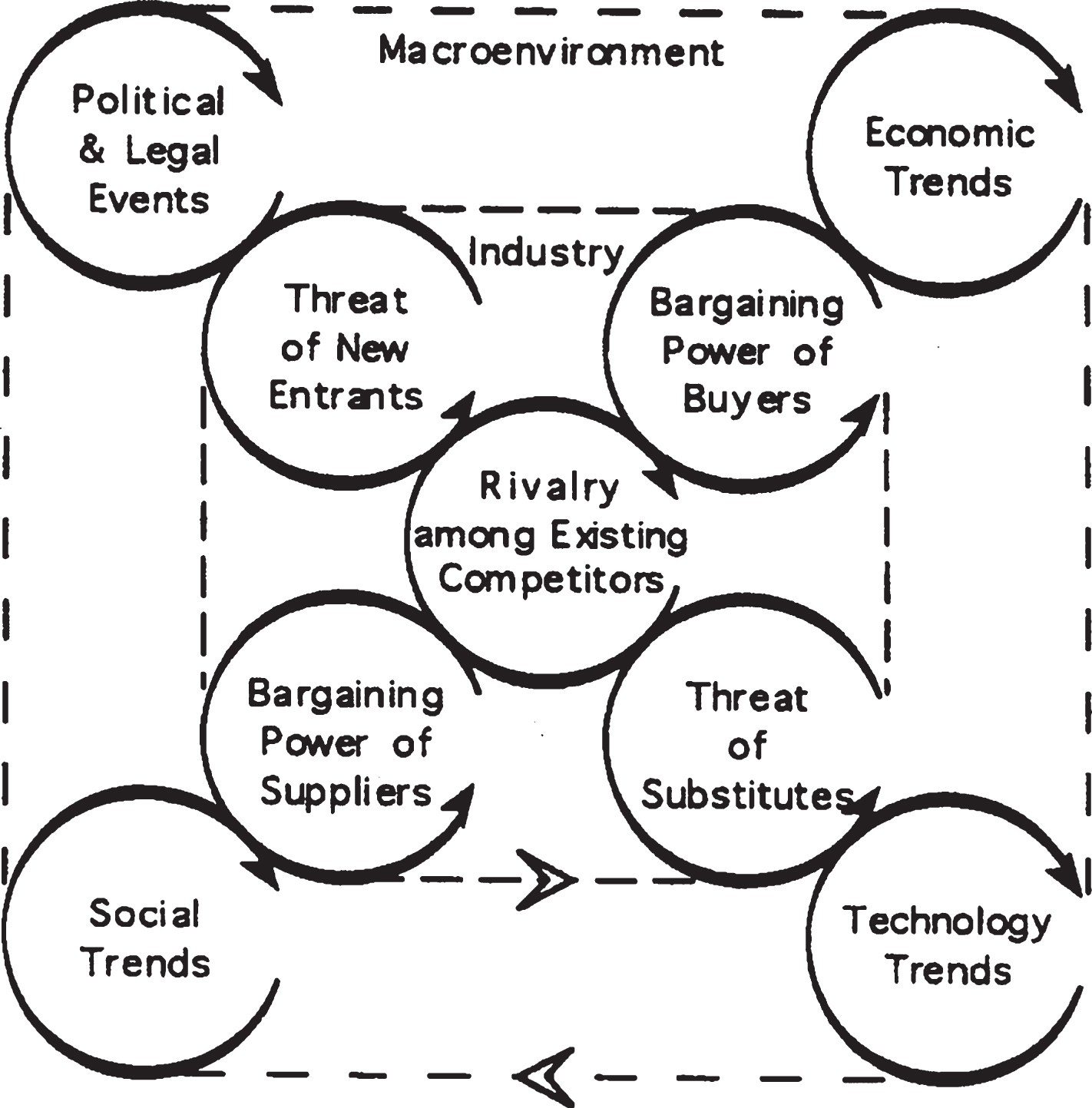
The dynamically complex interactions through time, among industry forces, and the events and trends in business enterprises’ contextual or macroenvironment.
During these divergence sessions, the accounting and finance team built a causal map that we termed ‘syndicator-centered view’. In a second round of divergence, we worked with the marketing and planning team. We called the map that this team contributed ‘M&A-centered view’.
Each team’s reference scenario [2] or reference behavior pattern [17] served as a tangible manifestation of dynamic behavior portrayed by the smallest possible set of cause and effect relationships among the variables pertinent to the situation. The two alternative formulations contained several common variables, but the relationships among the variables were different.
The two diagrams looked more complementary than similar. Each view of the situation focused on one of the two basic determinants of profitgrowth.
The M&A-centered perspective focused primarily on environmental variables associated with revenue generation. The syndicator-centered view looked more closely at internal variables conducive to streamlining syndicator operations.
In the convergent sessions, we worked with both teams. During these sessions, each team first presented its causal map to the other. Once the initial presentations were over, reflections reinforced and thereby preserved the divergences or plural rationality in interpreting various elements on each map.
Next, we walked the entire group through a series of scenarios computed by the SD models built from each team’s causal map. This first generation of computed scenarios gave the group a good sense of the long-term implications of each alternative view.
Said scenarios captured the behavioral patterns of profit growth, showing the potential synergy among syndication services, while exploring the relation between syndicator profitability and M&As in the TV-related industry. The planning teams thereby started to anticipate the dynamic implications of their divergent mental models.
We reaped the benefits of nurturing plural rationality [19] when we engaged all participants in a dialectical form of group dynamics. We asked the members of the marketing and planning team to interpret the model of the accounting and finance team to the satisfaction of the latter, and vice versa.
This dialectical-inquiry (DI) interchange aimed at unearthing critical assumptions and prominent cognitive biases (CBs). It enabled participants’ attention shift from individual CBs to re-perceive the structure and implications of their strategic situation. The DI interchange moved participants closer to a shared view of the system structure underlying the situation. Georgantzas and Acar [2] give a comprehensive treatment to the consensus building DI interchange process.
Our project participants exchanged creative thoughts and used many examples to clarify their perceptions of their strategic situation. The underlying dynamic within the combined team and the natural dialectic between the two alternative views led to a synthesis.
Namely an aggregate map (Fig. 2) and a system dynamics model (Figs. 3 and 4) captured the convergent view of the project participants. Our intervention helped translate, refine and jointly formulate a strategic situation from the managers’ own mental models. Also, it provided training in strategic-situation formulation to everyone involved.
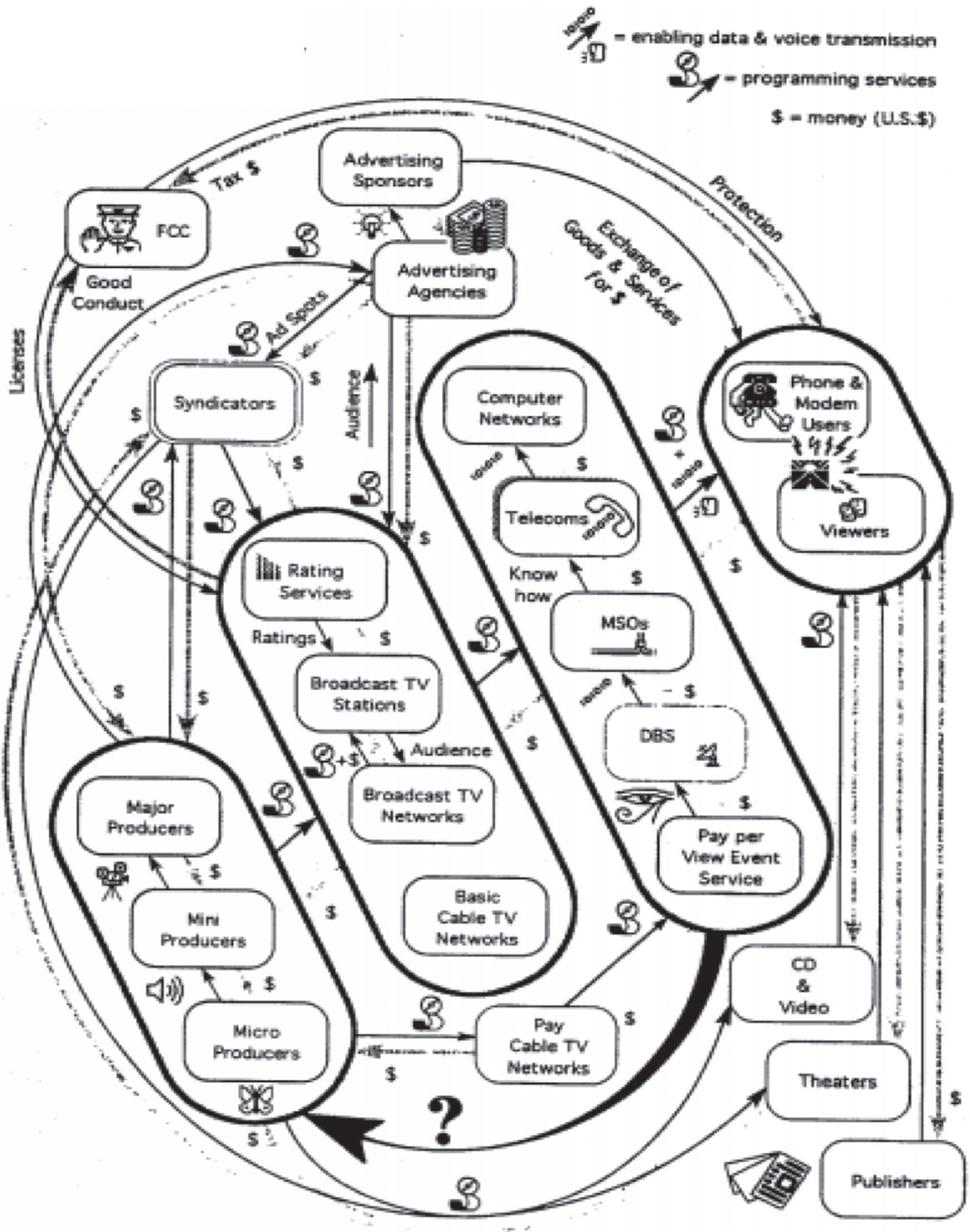
Conceptual and economic concerns among stakeholder groups in the motion pictures, telecommunication and TV-related industries.

The content (C), distribution (D) and computer M&A activity in the TV-related industry, affecting syndicated-title distribution.

A typical syndicator’s profitability situation.
The economic organization and regulation of the TV-related industry may vary from country to country, yet a mixture of public and private enterprises, supervised by a government agency is most common. Additionally, strong technology-related ties exist between this industry and other communications services (Fig. 2).
Seeing the TV-related industry players as collegial value-added activities between customers and suppliers allowed applying TCE ideas rigorously to activities within organizational functions and their subcomponents. Porter’s [14] value-chain framework decomposes the firm into distinct activities, while TCE makes the specific kind of repeated activity the unit of analysis.
In the SD model, firms integrate an activity if the external supplier charges plus the transaction cost exceeds the internalization cost. If, however, a firm lowers its transaction cost down to a point where the internalization cost exceeds the external supplier charges plus the transaction costs, then the firm does not integrate the activity to remaincompetitive.
Porter [13] finds the connection between resources and activities fundamental because, within reality, resources represent an inherently intermediate position in the cross-sectional perspectives chain of causality. Through time, resources arise either from performing activities, acquiring them from outside, or some combination of the two. Both reflect prior managerial choices.
Performing an activity or group of linked activities creates competencies and routines that accumulate through time. It also can create external assets.
A firm’s reputation, for example, could be a function of the history of its marketing and customer service activities. Assets and technology depreciate, however, unless reinvigorated through organizational technological and administrativeinnovation [4].
Moreover, the rate of depreciation appears to vary widely across different types of assets and technology, and it can be rapid. Firms, then, have accumulated differing resources because of differing strategies and configuration of activities. In a pragmatic sense, resources and activities coincide with each other.
Williamson [20] contends that: if strategic management is to unlock the sources of long-term competitive advantage, then it ought not to rely so uncritically on market power as the source of competitive advantage. Williamson’s economizing firm differs from Porter’s low-cost producer, the economizer not being necessarily efficient at production, but in a broad range of business functions.
Williamson’s position on this issue is at variance with the common economics assumption that firms are on their cost curves. If firms are assumed to be technically efficient, the problem is simply to determine their output rate. Contrastingly, Williamson sees the fundamental challenge as one of self-governing, self-organizing and self-managing activities, so as to eliminate waste. Payoff (Fig. 3) stems from overcoming impediments to market exchange, including the transaction cost of (a) drafting, negotiating, monitoring and enforcing comprehensive claims contracts, and (b) firm-specific knowledge dissemination attributed to opportunism bylicensees.
Computed scenarios
Six computed scenarios capture the dynamic evolution of alternative governance forms that create alternative futures for independent syndication firms. The shaded area on Fig. 5 represents the difference between the payoff of overcoming impediments to market exchange and the internalization cost, associated with controlling the expanded organization after a M&A.
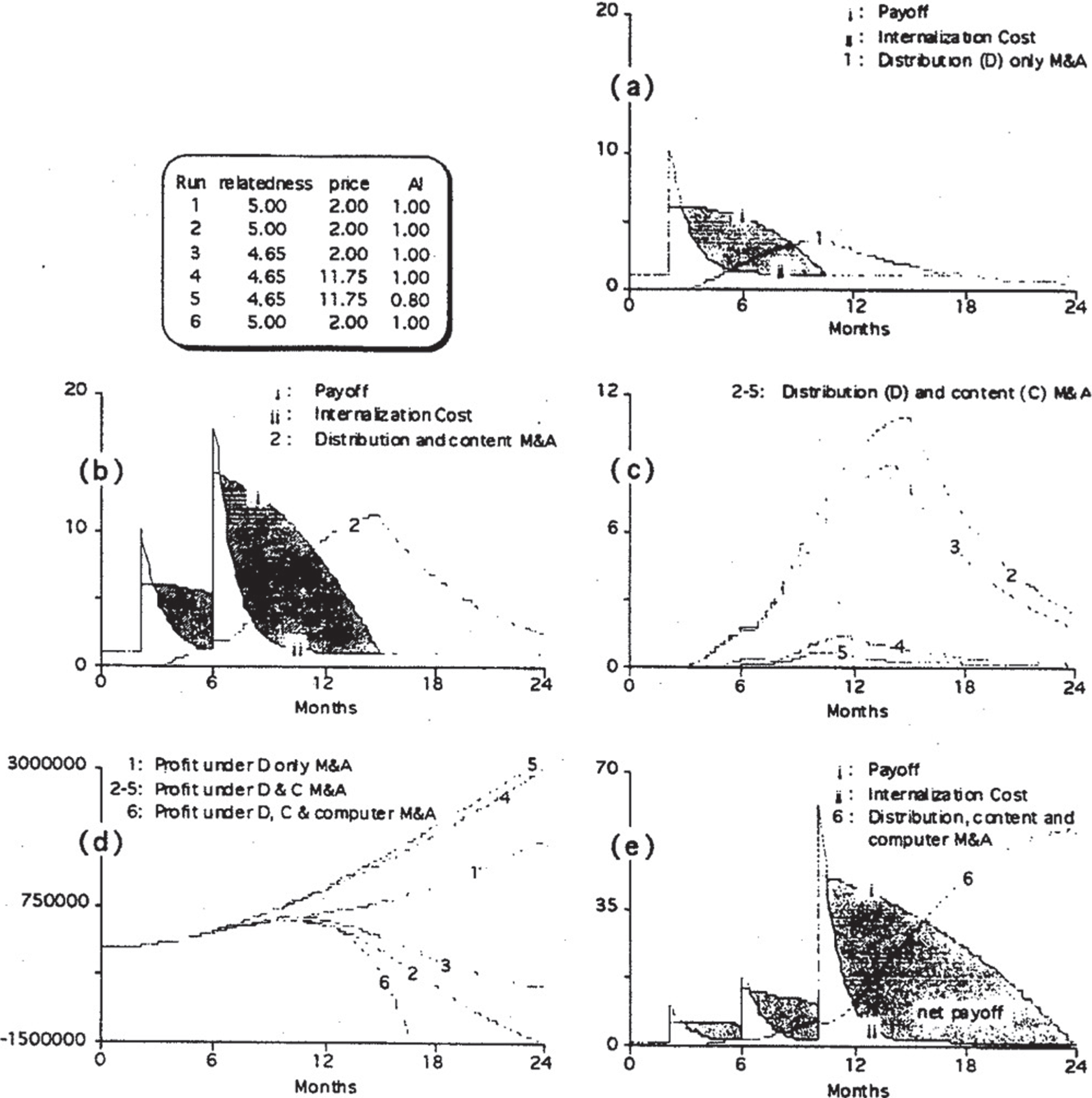
(a) Distribution (D) only M&A activity. (b) Distribution (D) and content (C) M&A activity. (c) M&A sensitivity to relatedness, price and administrative innovation (AI). (d) Syndicator profitability sensitivity to M&As. (e) Distribution (D), content (C) and computer M&A activity.
Through time, technological diffusion drives M&A payoff down, while administrative innovation reduces internalization cost. As long as net payoff is positive, three waves of M&As occur, with dire consequences for independent syndicationfirms.
The system-dynamics M&A model built during this intervention partially overcomes TCE’s shortcomings. The model incorporates organizational innovation and internal control costs, the primary determinants of the M&A activity in the TV-related industry.
The research contributes to mentally grasping the role that technological change and IT play in M&As, a topic that remains rather tacit in the IS literature [7, 8]. And it does so via a dynamic approach, as [3] recommends.
The SD model gave new insights into syndication firms’ alternative futures, the dynamic changes in the extant production capacity of TV networks, and the investment opportunities in basic cable networks and cable system operators. Moreover, its simulation results point to the potentially rich contribution of system dynamics to exploring innovative governance forms [5, 11], beyond the basic forms of markets and hierarchies.