



Abstract
This article conveys the competitive priorities of manufacturing companies, with different strategic thrusts. Supported by the 2009 International Manufacturing Strategy Survey, the reported empirical research uses multivariate testing methods. The results show four competitive priorities, namely price, quality, delivery and service, which are important for European manufacturers to win orders. Besides, business enterprises’ different strategic thrusts influence their selection of competitive priorities, namely the ordering of quantity, flexibility, innovation, environmental protection and social responsibility. Dependent on European manufacturers’ strategic thrusts, crafted is a chart that depicts their competitive priorities. The chart shows the important differences among said manufacturers’ competitive priorities, according to their strategic thrusts. The article concludes with recommendations for manufacturing enterprises that intend to extend their business to Europe, depending on: parent-subsidiary relations and relationships, the competitive priorities of European competitors, and their own competitive priorities, transferred through their evolving strategic thrusts.


Introduction
Manufacturers’ subsidiary development is of great importance in the internationalization strategy context. Currently, countries’ globalized economies are tightly coupled through businesses worldwide [1]. Building overseas subsidiaries has become crucial to business enterprises’ internationalization process [2]. Multinational corporations have large capital, appropriated technology, modern management and worldwide sales networks, rendering them active and influential in international activities. The establishment of subsidiaries by multinational companies entails multiple diffusion and adoption processes of organizational practices. Using their own advantages, and capability to leverage potential overseas resources, international subsidiaries have become critical to corporate growth.
However, subsidiaries need to have a clear strategic role. Strategy is the deliberate effort to create a future that is materially different from what would ensue if prevailing conditions were allowed to run their course. Tactics blend together opportunity and strategy to enhance the odds that intended changes will be successfully implemented [3]. Enterprise strategy is the result of balancing existing competitive resources and new opportunities. The strategic behavior taken by an enterprise is its response to the general norm in the environment [4]. Combs and Ketchen believe that enterprises strategy is the process of taking advantage of window of strategic opportunity [5]. Multinational subsidiaries are embedded in the internal network with their parent company and other subsidiaries. In the external network, subsidiaries’ strategies are affected by local customers, suppliers, competitors and resources. In the process of globalization, multinational companies need to constantly adjust their internal resource allocation and organizational structure in order to seize market opportunities. The strategic role of subsidiaries will also be adjusted [6]. In the global manufacturing network, the initial role of overseas subsidiaries is decided by the parent company [7]. However, a subsidiary’s autonomy and environmental changes can also affect the role of subsidiaries [6]. A company with high autonomy has a greater opportunity for growth [8]. That means the level of management and ownership control for subsidiary responds to so many factors, such as the parent company, the institutional quality of the host country and the internal and especially external isomorphic pressures. At the same time, it is easy for a company to lose its status in the market [9, 10]. I A company must implement an appropriate competitive strategy in order to obtain a strong initiative and a long-term, stable competitive advantage [11]. Because subsidiary knowledge is embedded in idiosyncratic host country locations [12] subsidiaries often transfer knowledge or employ different strategies from multinational business enterprises [13]. It can be seen then that a strategy creates a competitive advantage for enterprises, and there is an urgent need for a subsidiary to have a clear strategic role.
Manufacturers with different strategic roles need to adopt different competitive strategies. In order to obtain a strong initiative, companies must implement appropriate competitive strategies to get a long-term, stable competitive advantage. Active support from parent firms is particularly crucial for subsidiaries to improve operational efficiency [14]. As Hayes points out, strategy creates a competitive advantage for enterprises, and competitive priorities precisely reflect the competitive advantage and strategic focus in a particular market [15].
This article analyzes competitive priority characteristics and differences of enterprises under different strategic roles from the perspective of competitive priority, taking European manufacturing enterprises as the case to examine. Most existing empirical research focuses on firms’ choices between producing at home and investing overseas [16]. However, competitive priority as an element of manufacturing strategy is an important means for manufacturing enterprises to achieve a competitive advantage [17]. Therefore, the article will also give suggestions for the competitive strategy decisions of other regions’ manufacturing enterprises when entering the European market.
Literature review and research proposition
Strategic role of enterprise
With the rapid development of the Internet and communication technologies, the world’s manufacturing paradigm is changing. Enterprises in developed regions such as Europe, the United States and Japan begin a global layout, and they set up companies and joint ventures, and make mergers and acquisitions overseas [18]. In order to achieve an organization’s strategic non-financial and economic intention, a business enterprise strategy is developed within context of enterprise governance [19], overseas subsidiaries consume internal and external resources from their multinational network, in order to accumulate required capabilities [20]. The strategic categories of multinational subsidiaries vary due to the differences in standards. Therefore, the development of a subsidiary’s functional capabilities varies among subsidiaries, depending on their headquarters’ global strategies and the nature of their interactions with external players [21].
Based on three variables – product, market and added value – White and Poynter establish a strategic model of five roles of subsidiary companies: satellite-like marketing, small duplicator, rationalized manufacturer, product expertise and strategy independence [22]. Based on two latitudes, namely “location competition” and “the main driving force of location election”, Ferdows divides manufacturing enterprise into six strategic roles: overseas factories, resource-type factories, leadership-type factories, contribution-type basis, service-type factories and research-type factories [23, 24]. According to the resource capacity of subsidiaries and their regional strategic positions, Bartlett and Ghoshal categorize enterprises into four strategic roles: leaders, contributors, performers and the black hole [25]. Strategic leaders have excellent core ability in a strategically important market, and have a core competitive advantage. Strategic leaders pursue favorable market opportunities and respond to market threats. Contributors have strong technical capabilities and rich resources. However, contributors are not so important for the market, and the benefits of their output are applied to other subsidiaries by the parent company. Market importance, resources and the capacity of performers are relatively low, so the task of performers is to maintain the local operation of the company. A black hole, whose market position is very important, is characterized by a lack of core competence and resources of its own. When the parent company finds the importance of the local market, competition often becomes very fierce [25].
Competitive priorities
Nigel Slack and others think that enterprises should consider two aspects of pressure, external market and internal resources, when making strategic decisions; these pressures provide sustainable ability of innovation and competition for the enterprise’s future. Among them, elements from enterprise resources include operational resources and processes, both of which determine the ability level of the enterprise. Factors from the market include customer demand and competitor behavior, both of which determine the kinds and priorities of performance intention [26]. On the one hand, as an economic entity, subsidiaries shoulder the responsibility of competing with other companies. On the other hand, subsidiaries hope to gain more support from their parent company by developing themselves. Subsidiaries under a high control level fare better than subsidiaries under a low control level in a stable environment. But when the environment jolts, the performances of these two kinds of subsidiaries is just the opposite. Therefore, enterprises in different strategic roles need to consider how to set up their own competitive advantage under the three pressures of group strategy, market environment and their own ability.
Competitive priorities reflect the competitive advantage of an enterprise in a certain market and are criteria for the enterprise to win orders. For enterprises, it is vital to be fully aware of which competitive advantage should have priority. Competitive priorities provide evaluation for managers to compete [27]. Kroes and Ghosh outline five competitive priorities: cost, quality, flexibility, innovation and time. They report the consistency relationship between outsourcing motivation and the competitive priority of business enterprises, and its impact on the supply chain performance and corporate performance [28]. These five factors are traditionally and widely recognized as competitive priority factors. The operating frontier is affected by many factors, including environmental forces such as business costs, competition intensity, and market and institutional dynamism. The operating frontier affects competitive priorities such as cost, quality and delivery. The asset frontier exerts direct effects on delivery and flexibility, but also indirect effects on cost and quality through the operating frontier. Environmental factors also exert various effects on the priorities [29]. At present, the basic connotations of competitive priorities in literature include cost, quality, flexibility, delivery, innovation, service, environmental protection, social responsibility and other factors.
Research proposition
The above literature shows how to determine competitive priority, which needs to be considered by business enterprises with different strategic roles. But due to the limited resources of business enterprises, manufacturing enterprises need to establish their own competitive advantages for their own situation; that is, they need to choose different competitive priorities [30]. Priorities as strategic capabilities give support for organizations in creating and sustaining a competitive advantage [31]. It is difficult for business enterprises to pay attention to all competitive priorities at the same time. Business enterprises under different strategic roles have to face the problem of weighing competing priorities because of their resources, ability, responsibility, and mission. European manufacturing enterprises, as a part of a global manufacturing network, naturally have their own individual strategic roles and can’t escape the contradiction between competitive advantage developing and having limited resources. The research propositions are: selected competitive priorities are not the same for European manufacturing enterprises under different strategic roles. In order to validate the research proposition, the article needs to explore the following two research questions:
Question 1: What are the characteristics of the competitive priorities of European manufacturing enterprises under different strategic roles?
Question 2: Are there significant differences between the competitive priority characteristics of European manufacturing enterprises under different strategic roles? If so, what are the different factors?
On the basis of the above analysis, this article proposes a competitive priority graph of European manufacturing enterprises based on strategic roles. In addition, with the rapid development of economic globalization nowadays, a business enterprise’s survival and development is inevitably connected with the process of economic globalization and competing with international counterparts. Therefore, this article will explore a third question:
Question 3: When manufacturing enterprises develop towards Europe in the internationalization process, what kind of competitive strategy should they adopt?
Research method
Research project of international manufacturing strategy
The research data mainly comes from the International Manufacturing Strategy Survey (IMSS). The project was launched by Professor Chrisvoss of London Business College and Professor Perlindberg of Camels University in Sweden in 1992. Its purpose is to convey the effects of each country’s economy, culture, politics and business characteristics on manufacturing strategy, and the basic characteristics of each country’s manufacturing strategy in the global sphere. In total, there are over 20 business schools and thousands of business enterprises participating globally. The article uses survey data on the European area in 2009 of IMSS V. The data contains a total of 388 samples from 12 European countries. After deleting the samples with serious deficiencies, there are 360 samples left.
Pertinent variables
IMSS 2009 uses 12 main variables to describe different competitive priorities, and Table 1 shows these pertinent variables. In terms of strategic roles, the article mainly uses the opinions of Bartlett and Ghoshal, specifically their opinions on dividing business enterprises into four strategy roles: leaders, contributors, performers and black holes [25]. Because the selected samples of the IMSS investigation project are all locally well-performed business enterprises, this article mainly involves the first three strategic roles: leaders, contributors and performers.
Variables of competitive priority and strategy role
Variables of competitive priority and strategy role
The reliability analysis is used to evaluate the stability and reliability of the questionnaire. The IMSS survey was conducted by international experts with outstanding achievements in the field of production management and strategic management, as well as experts in related fields who translated the questionnaire into native languages and conducted the research. Their expertise ensures that every item of the questionnaire has measuring function. After several international studies, the IMSSV questionnaire is relatively mature. In addition, before each survey, there is a small pre-survey sample. According to the research results and business interviews, the questionnaire is then corrected. This article also uses internal consistency analysis to calculate the reliability coefficient of competition priority index (Cronbach’s α). It is better for Cronbach’s α to be greater than 0.5 in practical application. This article uses SPSS software to calculate Cronbach’s α, which is 0.737. The reliability coefficient completely meets the requirement.
Validity refers to the degree of accuracy, namely the accuracy of variables measured by the measuring tool. The higher the validity, the better able is the measurement result to show the real characteristics of the measured object. IMSS requires that respondents are the highest manager in charge of manufacturing activity; in this way, we can see the manufacturing strategy situation of the whole unit. The article also uses factor analysis method to examine the structure validity of the questionnaire. The analysis results show that the cumulative variance contribution ratio of the competitive priority index’s common factor is 61.10%, reaching the minimum requirement of 40%, which indicates that the questionnaire has good structure validity.
Data analysis
Analysis of basic characteristics
IMSS mainly investigates the importance degree of each competitive priority index in a business enterprise’s ability to win orders. The higher the score, the more important it is to business enterprises. Table 2 gives the mean value of each competition priority index in European manufacturing enterprises under three strategic roles.
Competitive priority Means of European manufacturing enterprises
Competitive priority Means of European manufacturing enterprises
For performers and contributors, the indicators of highest competitive priority (the mean is more than 4) include: X2 (manufacturing oriented quality) and X3 (customer oriented quality). Indicators with higher scores (the mean is more than 3.50) include: X4 (delivery reliability), X1 (price), X5 (delivery speed) and X6 (service). This shows that quality, price, delivery and service are important for performers and contributors to win orders, especially quality factors.
For performers and contributors, the indicator of highest competitive priority (the mean is more than 4) is X2 (manufacturing oriented quality). Indicators with higher scores (the mean is more than 3.50) include: X1 (price), X4 (delivery reliability), X3 (customer oriented quality) and X6 (service). Compared with performers and contributors, leaders scored slightly lower on X5 (delivery speed).
Based on the above analysis, it can be found that four factors – price, quality, delivery and service – are all very important for business enterprises under the three strategic roles to win orders in the market (the delivery speed scores a little lower for the leaders). In this article, these four kinds of factors include six indexes: price, manufacturing-oriented quality, customer-oriented quality, delivery reliability, delivery speed and services (after-sale service or technical support). The analysis results are in accordance with the development process of competitive priority. Although there are different views regarding the competitive priority, people’s opinions on the four basic components of competitive priorities are the same: cost, quality, flexibility and delivery [32]. In addition, service, which was added as a competitive priority after the 1990s, is important for winning orders of European manufacturing enterprises [33, 34]. The analysis results also show that the importance degree of X10 is higher for contributors to win orders, and the factor of innovation is listed as the fifth competitive priority. Figure 1 is a radar chart of the competitive priority means of European manufacturing enterprises under three strategic roles. Figure 1 can more clearly illustrate the above analysis results. Problem 1 is solved.
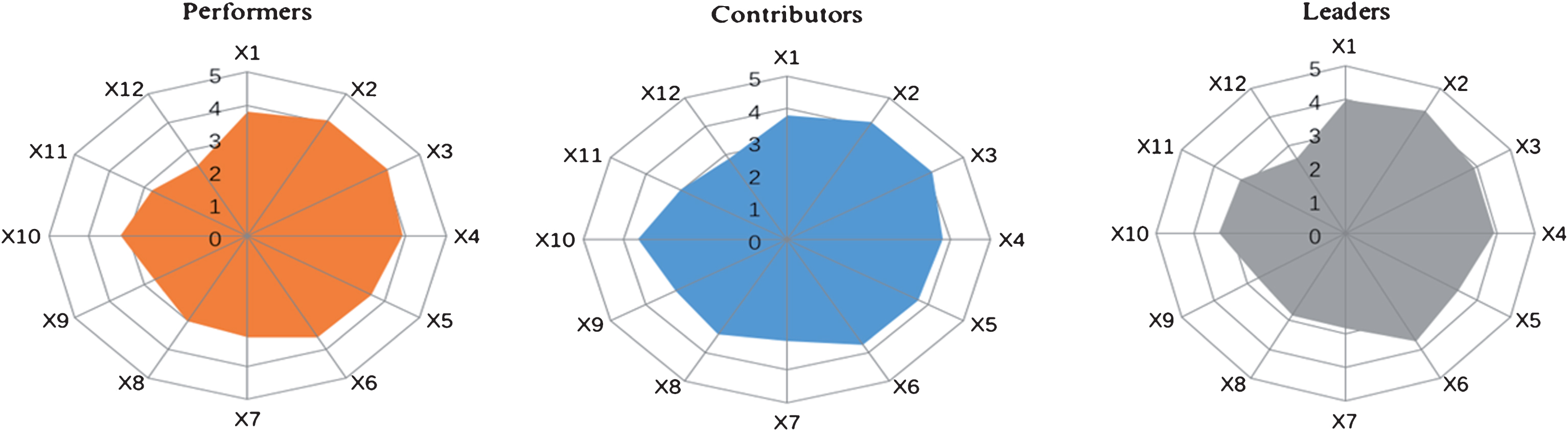
Radar charts depicting competitive priority profiles.
It can be seen from Fig. 1 that the importance degree of X9 in winning orders for contributors is higher than for leaders and performers. This means that although the competitive priority selections of European manufacturing enterprises under three kinds of strategic roles are similar, there are still some differences. The above is only one example, and a specific analysis will be offered below of the differences and the significance of these three kinds of European manufacturing enterprises’ competitive priorities.
Table 3 shows the tested results of the multivariate test. From the value of Sig., it can be seen that the European manufacturing enterprises’ competitive priority selections have significant differences under three strategic roles. Because the results of the multivariate test show that the differences are significant, it is necessary to further examine the specific difference index. The tested results are shown in Table 4. From the table, it can be seen that there are five indexes that have significant differences under the significance level of 0.05: X8, X9, X10, X11 and X12. The article further compares in pairs generally difference–significant five indexes of manufacturing enterprises under three strategic roles. The results of the comparison are shown in Table 4.
Multivariate tests
Multivariate tests
Note: aAccurate statistics; bThis statistic is the F limit; **Represents sig. value less than 0.01, ***Represents sig. value less than 0.001.
Main effect tests
Note: *Represents sig. value less than 0.05;**Represents sig. value less than 0.01.
The competitive priority differences between contributors and performers are mainly reflected in four indexes: X8, X9, X10, and X12. As well, from performers to contributors, the importance degree of these four indexes significantly increases for the European manufacturing enterprises to win orders. This is because contributors have strong technical capability and rich resources, and their main responsibility is to develop key components, products and production processes for other factories, or to develop and provide technical knowledge for the entire company. Compared with performers then, or even leaders, contributors pay more attention to innovation. In addition, because the market of contributors is more important than that of the performers, contributors need to make more effort to deal with the local market. Therefore, quantity flexibility and social responsibility are more important for contributors to win orders (Table 5).
Comparison of competitive priority based on different strategic roles
Note: *Represents sig. value less than 0.05; **Represents sig. value less than 0.01.
The competitive priorities difference between leaders and performers is mainly reflected in index X11, and the importance degree of this index in winning orders is significantly greater for leaders than for performers. By a comparison of the average, it can be found that in the environmental protection index, leaders also score higher than contributors. This is because leaders are in the highest strategic position and environmental protection has attracted the wide attention of modern society. For the benefit of the social image of business enterprises and the protection of leadership status, leaders should pay more attention to environmental factors. The competitive priorities differences between leaders and contributors are mainly reflected in two indexes: X8 and X9. From the contributors to the leaders, their importance in winning orders for the manufacturing enterprises declines significantly.
In summary, the above five indexes have significant differences for business enterprises to win orders in the market under the three types of strategic roles. Thus, problem 2 has been solved.
By making a comprehensive analysis of data, the article finds that in the European area, the competitive priorities of manufacturing enterprises under different strategic roles are generally similar but there are significant differences in the details. According to the results of the data analysis, the article puts forward a competitive priority graph of European manufacturing enterprises based on their strategic roles (see Fig. 2). In the graph, the abscissa represents different competitive priorities factors; the ordinate represents the importance degree of competitive priorities for European manufacturing enterprises to win orders; and squares represent different strategic roles. This graph can provide suggestions for European manufacturing enterprises to make competitive strategy decisions.
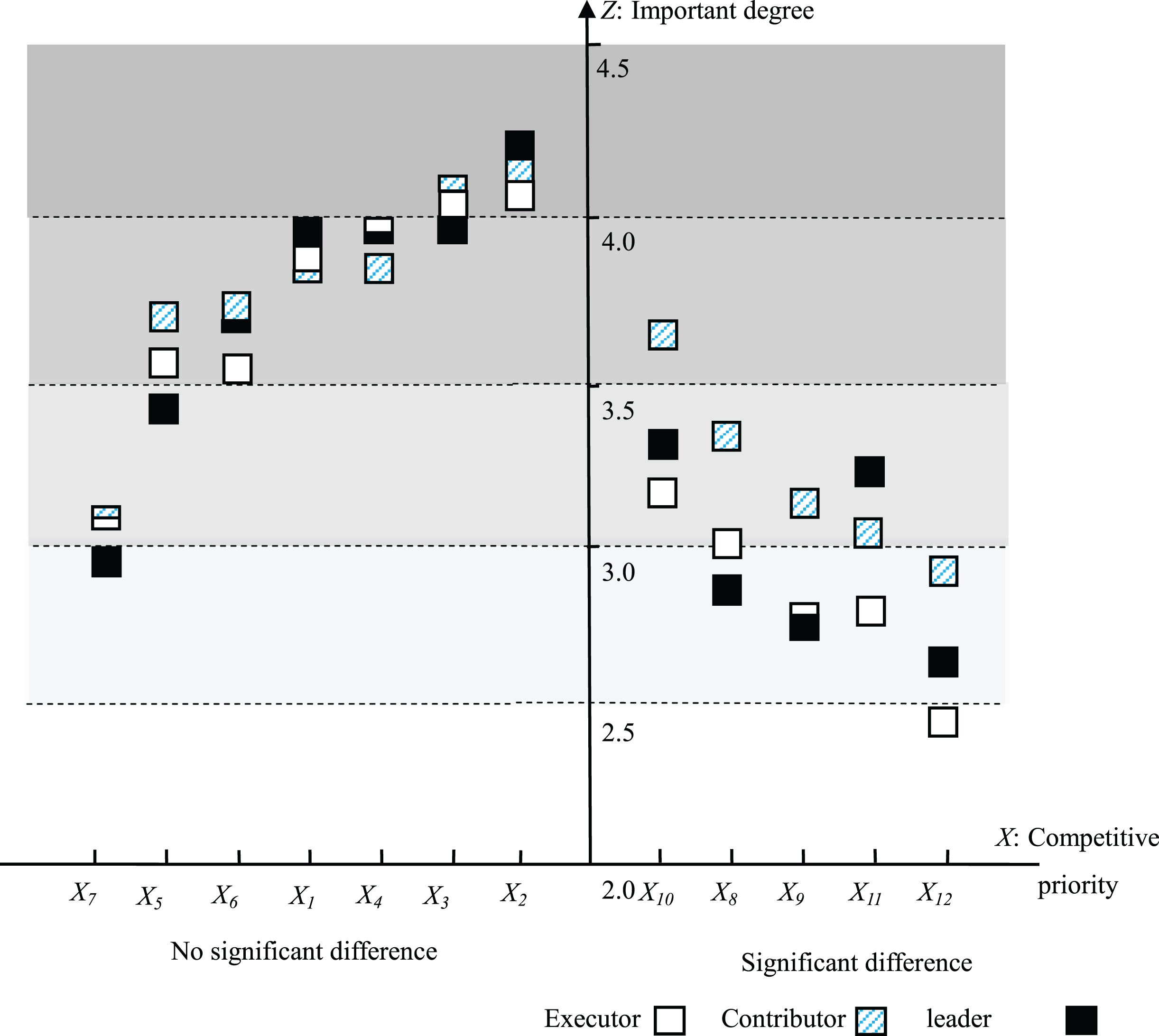
Competitive priority based on the strategic role.
First, three kinds of European manufacturing enterprises all pay high levels of attention to the first six indexes (the involved competitive priorities factors include price, quality, delivery and service), and there is no significant difference between the three types of business enterprises. Quality is especially important for the three kinds of manufacturing enterprises to win orders.
Second, in terms of the significantly different indexes between the three kinds of business enterprises, the importance degree for business enterprises to win orders is generally not high. The difference is mainly reflected in quantity, flexibility and innovation, and the importance of contribution is higher. The importance of environment to leaders is higher than it is to performers. The importance of social responsibility to contributors is also significantly higher than it is to performers. On the whole, performers have scored less on these differences, meaning they lack adequate capacity for innovation and have lower degrees of concern for environment protection and social responsibility.
Third, what we should especially notice is that the difference in the environment index between contributors and performers is less than 0.l. According to the above analysis, from the performer to the contributor and then to the leader, environmental protection is becoming more and more important for business enterprise to win orders. As mentioned earlier, this is inseparable from the global economic environment. Ecological, environmental and resource consumption issues are becoming increasingly prominent, and countries all over the world (especially European countries) have grown increasingly environmentally consciousness. Many countries have set up rules and regulations to guide business enterprises and promote energy conservation and reduce the emissions of residents. The environmental awareness of consumers has gradually taken shape. For many people, whether the product is environmentally friendly is an important factor in choosing goods. For manufacturing enterprises with the leadership status, keen attention to changes in environmental trends can help them more easily absorb emerging competitive priorities factors.
In addition, the results can also provide decision support regarding international competition strategy for manufacturing enterprises that are developing or ready to develop internationally towards the European region (Fig. 3).
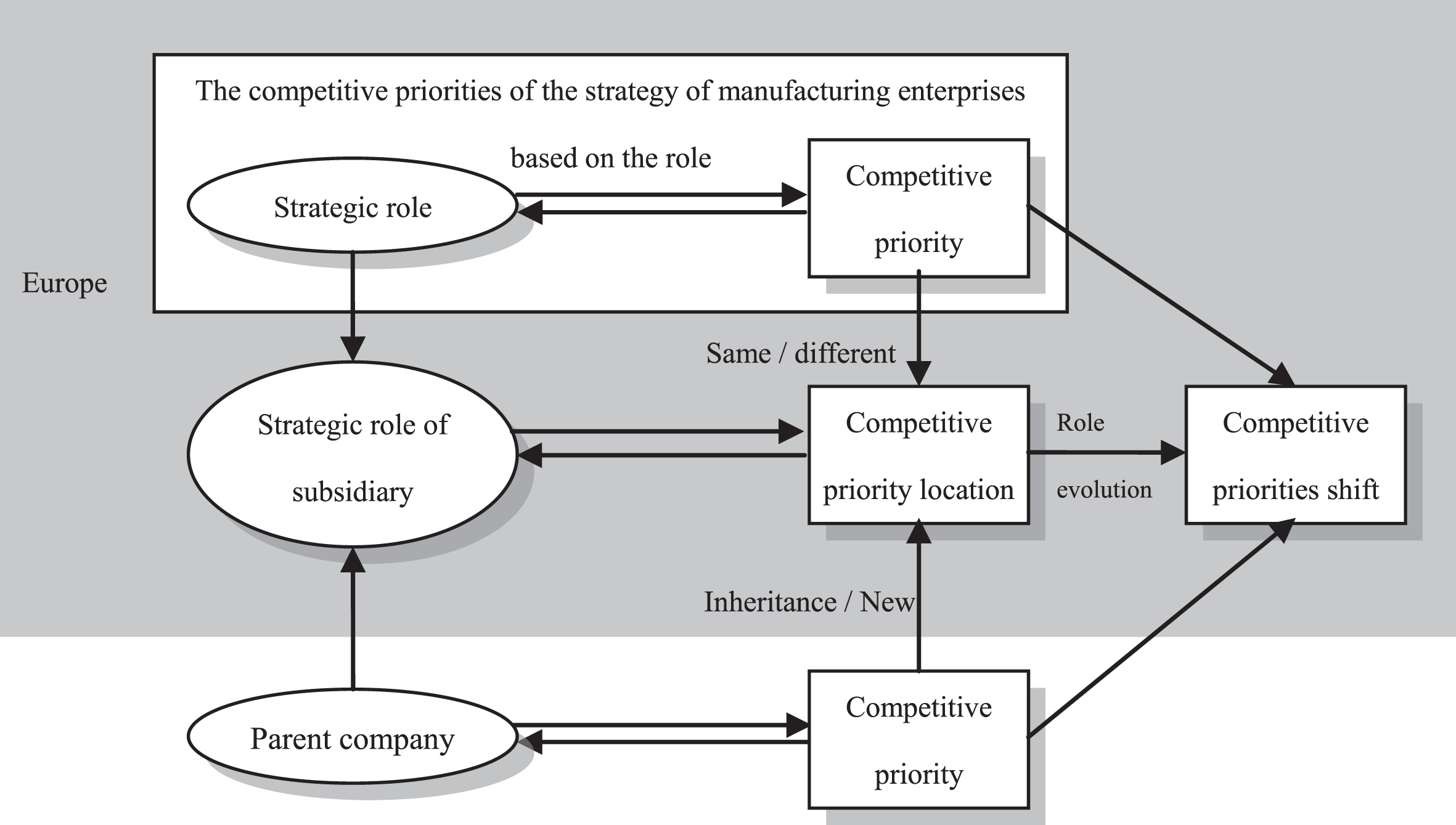
Competitive priority selection model of international business to European.
First, there is a need to rethink the relationship between the subsidiary company’s competitive priorities and the parent company’s competitive priorities. The parent company’s competitive priorities reflect not only its core competitive advantage, but also the key market demand of the local region. Therefore, if business enterprises want to enter the European area, they first need to consider whether the subsidiary company should inherit the competitive priorities of the parent company, or develop its own competitive priorities. The advantage of inheriting is that it can continue making use of the original competitive advantage of the parent company; the disadvantage is that the original advantage may not be applicable in the new region (because there are new competitors), and the market demand characteristics in new regions may be different from that of the parent company’s regions. The advantages of cultivating new competitive priorities is the ability to develop according to local conditions, but the disadvantage is that the business enterprise needs to build a new capacity and quickly reach or exceed the ability level of local rivals unless finding the new region’s blue ocean [35].
Second, it is necessary to rethink the relationship between the subsidiary company’s competitive priorities and European local rivals’ competitive priorities. Similarly, on one hand, the local business enterprise’s competition’s priorities reflect their core competitive advantage; on the other hand, it reflects the local market’s demand characteristics. Therefore, there are two competition strategies new companies may adopt.
The first kind: the positioning is the same as the competitive priority of local business enterprises. Faced with this situation, it is necessary to adjust to the target area to consider whether the business enterprise’s explaining of competitive priorities’ specific variables is the same as that of the local enterprises. For the different points in the explaining, there is need to adjust in order to adapt to the target area. Otherwise the enterprise may encounter competition priorities’ maladjustment. For example, Haier makes its famous “five stars free” for its core competitiveness in China, but the mainstream home appliance service model is not “free service” in the international community. Most cases are based on the number of years, and customers voluntarily purchase a “membership fee model”. The idea behind the fee model is that consumers focus on high quality products rather than on low quality products. This shows that the contents of service elements are inconsistent with each other inside and outside the country, and cannot be blindly replicated. In addition, business enterprises should consider the ability difference among local competitors. If their ability level is lower than that of competitors, it is necessary to consider improving their capability level or positioning new competitive priorities.
The second kind of competition strategy new companies may adopt is different positioning from the competitive priority of local business enterprises. In this situation, the business enterprise needs to combine the practice and consider two methods: one is to make use of the advantage, namely, to consider the parent company’s competitive priorities factors that are not in use by the rivals, because these factors reflect the core competence of business enterprises (although they are related to the circumstances of the original market). Another is to seek a blue ocean; that is to say starting from the market characteristics of the European area, consider the competitive priority that both sides don’t use but on which the new company can build a core advantage after efforts
Third, business enterprises’ strategic role is not unchangeable. When the two premises “the importance degree of local market strategy” and “quantity of local resources” change, subsidiary company’s strategic role must adjust accordingly.
Ferdow argues that the evolution of strategic roles among factories is primarily achieved by improving location competitiveness [20, 21]. Not only should business enterprises consider the priority of competition in a prior strategic role and the competition priority of parent company, but they should also get some information from the competition priority map when determining business enterprise competition priority under the new strategic role: from performers to contributors, enterprises should pay more attention to quantity flexibility, innovation and social responsibility factors; from performers to leaders, they should pay more attention to the environmental factors; from contributors to leaders, they should strengthen the importance degree of environmental factors.
The article studies the competitive priorities characteristics and the differences of European manufacturing enterprises under different strategic roles. According to the results of the data analysis, the following conclusions can be drawn.
First, for European manufacturing enterprises, there are no significant differences in competitive priorities factors such as price, quality (including customer-oriented quality and manufacturing-oriented quality), delivery (including delivery reliability and delivery speed), service and product range flexibility for business enterprises under three kinds of strategic roles. Price, quality, delivery reliability and service are very important for European manufacturing enterprises under three kinds of strategic roles to win orders. Delivery speed is very significant for performers and contributors to win orders.
Second, there are significant differences in competitive priorities factors such as orders’ quantity flexibility, innovation (including innovated product quantity and product creativity), environmental protection and social responsibility for business enterprises under three kinds of strategic roles. Product creativity is particularly important for the contributors to win orders. At the same time, a phenomenon that should be paid attention to is that from the performers to contributors and leaders, the importance degree of environmental factors has become increasingly greater for business enterprises to win orders.
Third, according to the results of the data analysis, the article constructs a competitive priorities graph based on manufacturing enterprises’ strategy roles. The graph reflects competitive priorities characteristics and differences of manufacturing enterprises under different strategic roles; this provides decision-making support for manufacturing enterprises in the European area to determine their competition strategy. Based on the competitive priority graph, the article builds a competitive priority selection model for developing internationally towards the European area, providing decision-making support of competition strategy for other regions’ manufacturing enterprises to develop internationally towards the European area.
Footnotes
Acknowledgments
We thank Tian Yezhuang for comments on earlier versions of this manuscript. We thank Professor Chrisvoss of London Business College and Professor Perlindberg of Camels University in Sweden for their help with data collection. This research was supported by National Natural Science Foundation of China (71372089). We thank the Editor, Nicholas C. Georgantzas, for their thoughtful comments concerning this manuscript.