



Abstract
This research article assesses the role that ingenuity and organizational learning play in companies’ adopting innovative entrepreneurial projects. To test a pertinent set of proposed hypotheses, empirical data were collected from 250 industrial companies in Tunisia, via a questionnaire survey. Across all entrepreneurial acts or praxis in the sample, the results show that, ingenuity’s two dimensions: extrapolation and interpolation, and organizational learning’s additional two dimensions: exploration and operating, can potentially have a significant positive effect on companies’ adoption appropriation and opportunity creation for innovative business enterprises. Taking these salient notions into consideration can be crucial to both exploiting and generating successful innovative business projects.


Introduction
Crossan and others [7] indicated that organizational learning occurs through [1] a continuous identification and interpretation cycle of new knowledge at the individual level, [2] the integration of individual knowledge at the collective level and [3] the organizational knowledge application. Thus, tools, process and established practices are essential to enable innovation within a firm to move from individual innovation attempts to well established company knowledge [8].
The opposition between learning through exploration and exploitation is a classic literature topic introduced by March [23]. Exploitation consists of inquiring a limited area of organization knowledge in the purpose of improving already approved way of doing things. In opposition, exploration consists in inquiring a larger area of organization knowledge in the purpose of finding other promising ways of doing still to be discovered. Exploitation creates reliability in experience while exploration creates variety in experience [16].
If we consider entrepreneurial innovation as a process requiring ownership or creation of business opportunity, ingenuity and organizational learning in a company are favorable organizational factors for innovation. Therefore, a company willing to develop by exploiting or creating an innovative entrepreneurial opportunity should consider ingenuity and organizational learning.
This study aims to describe and explain the importance of ingenuity and organizational learning as two favorable predisposition to innovation. For this purpose, we conducted a questionnaire survey in 2013 and 2014 on a sample of 250 Tunisian industrial companies.
Ingenuity and organizational learning: The foundations of innovation
Innovation is considered as a crucial factor for adding business value ‘[12, 29]’. To be innovative, a company has to create a favorable climate for internal development of new activities and new knowledge. Indeed, innovation is realized through a learning organization ‘[6, 18]’ and ingenuity [19] which are needed to operate and explore new business opportunities.
The fundamental nature of exploitation learning is the improvement and expansion of existing skills, technologies and methods of dissemination of traditional information [23]. Its outcomes are positive, relative and predictable [24]. Knowledge exploitation provides for analysts basic financial tools to innovation and exploration of new opportunities [31].
Exploratory knowledge can be considered as the adoption of a new idea or behavior by the organization [10]. Knowledge diversity is essential to solve complex problems. Organizations use this knowledge in accordance with well-established purposes [15]. In mathematics, interpolation is defined as a generalized response to new entries that are inside the dynamic data range [11]. Extrapolation is defined as a generalized response to new entries that are outside the dynamic data range [11]. In knowledge management, refined interpolation architecture emphasizes the combination of specialized human construct, social construct and cooperative organic organizational construct. Disciplined extrapolation is an architecture where ingenuity is based on general human construct, entrepreneurial share construct and organizational mechanistic construct [19].
Interpolated and extrapolated ingenuity as well as exploratory and exploitation learning are all factors affecting the organizational praxis for innovative business development. This is related to a process of appropriation or creation of an entrepreneurial opportunity.
Conceptual framework
Our theoretical development shows that interpolated and extrapolated ingenuity as well as exploitation and exploratory learning levels, are all factors having a significant impact on the adoption of both appropriation and creation of an innovative business opportunity at the organizational level. In this section, these organizational variables are presented before introducing the research hypotheses.
The appropriation of innovative business opportunity
To measure the appropriation of innovative business opportunities, six items were chosen after a literature review. These items measure exploitation degree for an innovative entrepreneurial opportunity through technology impacting on the corporate business development [32]. We also measured the degree of consistency between customer needs and innovation [5]. Koellinger [22] measures innovation appropriation by the degree of consumers’ lack of knowledge about intrinsic and extrinsic features of a new product. This must be appropriate with innovation originality and adapted to the social demand of local consumption [4].
Creating an innovative business opportunity
To measure the creation of innovative business opportunities, six items were chosen. These items measure the identification of new resources to create new products [14]. Indeed, exploration of new way of production is an entrepreneurial opportunity for business creation [3]. This is shown by the introduction of new social consumption demands [4]. Creating an innovative business opportunity for an entrepreneur is related to his personal guidance and his experience in the design of new socioeconomic solutions [25]. These personal guidelines are sources of innovation following the identification of entrepreneurial opportunities [21].
Interpolated ingenuity
Interpolated ingenuity is the result of introducing new knowledge in an organization. Employees with general knowledge tend to be polyvalent in any situation. The corresponding entrepreneurial archetype is characterized by the weakness of relational networks among employees. Trust is developed through personal experiences that are technically and operationally shared [19]. Eisenhardt and Sull [13] showed that organic processes are linked to prior rules and traditional expectations about work. These coordination mechanisms allow, not only establishing more flexible behavior, but also generating creative and interpretive arrangements [9]. Therefore, organizations escape regular routines at the benefit of the integration of new knowledge associated with exploratory learning [19]. Accordingly, we believe that the more a company adopts an interpolated ingenuity to introduce new knowledge, the more it is able to create an innovative business opportunity.
Therefore, we can develop the following hypothesis:
H1: Interpolated ingenuity is positively correlated with the appropriation/creation of an innovative business opportunity.
Extrapolated ingenuity
In the context of organizational learning, the number of specialists employed in relation to the number of general practitioners is an important indicator of its ingenuity. Specialists, generally, have a deeper knowledge localized and invested in some particular areas [19]. Cooperative archetype is an important element in an intellectual extrapolated. This network is based on the membership degree in social unity and a common comprehending of how knowledge can be combined and distributed amongst the organization [19]. Katila and Ahuja [20] showed that the knowledge embedded in a mechanistic organization is generally perceived as the most reliable among employees. Organizational Learning in this case seeks to improve and recombine existing knowledge.
Consequently, we believe that the more a company adopts an extrapolated ingenuity to share knowledge between employees, the more it is able to the appropriation of an innovative business opportunity.
H2: Extrapolated ingenuity is positively correlated with the appropriation/creation of an innovative business opportunity.
Operating learning
Adaptive learning implies a sequential and progressive learning in the traditional activities of organizations [26]. Exploitation opportunities therefore require organizational learning that must align individual learning with the search for new activities [17]. This requires dissemination of common values for a collective behavior [30]. Thus, a common organizational culture can help for the convergence of individual decisions and allow people to focus their efforts on achieving business opportunities [30].
We believe that the more an organization operating in an adaptive learning operating ensemble, the more it is able to the appropriation of an innovative business opportunity. Indeed, such learning ensemble is based on encouraging employees to seek new opportunities for existing business. Based on these arguments, we put forward this hypothesis:
H3: The appropriation/creation of an innovative business opportunity is higher when it evolves into an organizational operating ensemble of learning.
Exploratory learning
Exploratory learning is a generative learning requiring an organization that must learn to have a long-term vision of its mission, customers, capabilities and project [26]. Therefore, exploratory learning encompasses the creation of new knowledge that deviate from existing knowledge within the organization [30]. Divergent exploratory learning focuses on the diversification and reconfiguration of organizational skills to promote creativity. Consequently, divergent learning process allows individuals to find more alternatives to resolve a given problem [30]. The nature of business opportunities exploration requires a greater level of intuitive learning based on individual [17].
We believe that, the more an organization gets improved in an exploratory learning ebsemble, the more it tends to create an opportunity for innovative business. Indeed, this learning ensemble is based on of employees’ creativity. Taking these arguments into consideration, we put forward this hypothesis:
H4: The of appropriation/creation of an innovative business opportunity is higher as it evolves in an exploratory learning organizational ensemble.
The conceptual framework presented on Fig. 1 shows different organizational variables used in our research.
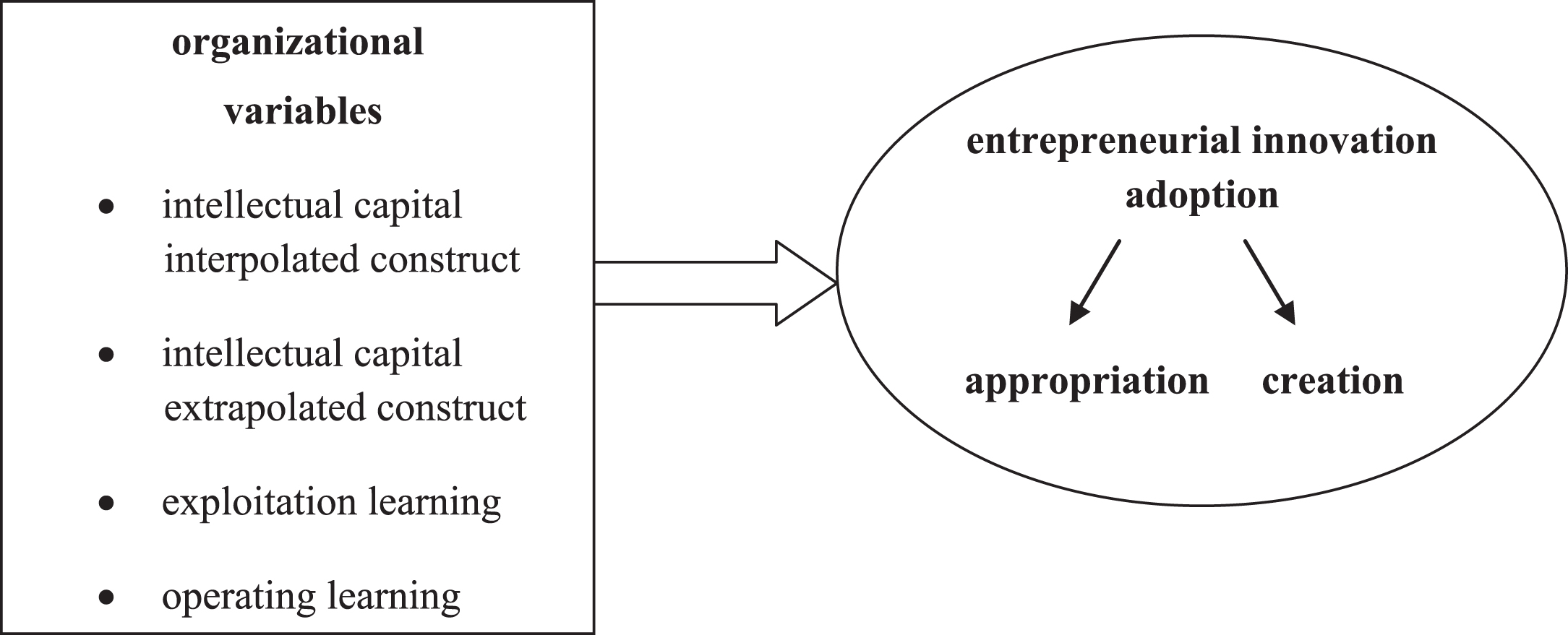
Conceptual framework of organizational guidelines for entrepreneurial innovation adoption.
This research aims to explain and describe the importance of ingenuity and organizational learning as prerequisites for the adoption of innovation (Appropriation or creation). In order to achieve this purpose, we conducted a survey to explain these phenomena. We opted for a descriptive and explanatory research. Indeed, it is descriptive because it allows observing and describing the impact of ingenuity and organizational learning on the appropriating or creating an innovative business opportunity. Our research is explanatory because it aims to explain the links between different elements of the conceptual model. We chose a self administered questionnaire survey based on the technique of “home delivery and recovery” to collect data.
Our survey targeted respondents who are corporate leader of innovative project. Out of a total of 1,000 Tunisian industrial companies that have been contacted, 250 companies have completed our questionnaire. Response rate is 25%. Survey was conducted during the years 2013 and 2014. Data analysis was performed under IBM SPSS Statistics 19 software. The questionnaire we used includes a set of items for each studied variable. Typically, each item corresponds to a characteristic associated to the related variable. Level of agreement of each statement was measured through a 5 degrees Lickert scale ranging from 1 (Strongly Disagree) to 5 (strongly agree).
“Opportunity appropriation by innovative business” has been measured by a set of six items. Internal consistency test shows a satisfactory level (Cronbach α= 0.834 >0.5). Principal Components Analysis (PCA) was applied on the set of items (meaning Bartlett <0.001). We have identified a single factor allowing to measure the level of appropriation of innovative business opportunity. The factor explains 54.876% of the initial total variance.
In a similar way, the variable “Creation of innovative business opportunities” has been measured by six items. Internal consistency test shows a satisfactory level (Cronbach α= 0.792 >0.5). PCA performed on the set of items (meaning Bartlett <0.001) resulted in a single factor. This factor “level of creation of an innovative business opportunity” whose own value is 2.983 >1 and explains 49.714% of initial total variance.
Organizational variables encouraging the adoption of an entrepreneurial innovation (appropriation and creation) are the following: interpolated ingenuity, extrapolated ingenuity, operating organizational learning and exploratory organizational learning. These organizational variables were measured by 16 items: 4 items measuring interpolated ingenuity, 4 items measuring extrapolated ingenuity, 4 items measuring organizational and operating learning and, finally, 4 items measuring exploratory organizational learning. PCA was applied to reduce the number of items in a single factor. Table 1 summarizes the results.
Variables measurement of ingenuity and organizational learning of an entrepreneurial innovation adoption
Variables measurement of ingenuity and organizational learning of an entrepreneurial innovation adoption
In all the cases, reliability analysis showed a Cronbach’s alpha>0.5. Accordingly, we obtained two organizational variables related to ingenuity and two organizational variables related to organizational learning that can explain all entrepreneurial innovation activities adopted by Tunisian industrial companies.
A correlation analysis has been performed to comprehend the effect of organizational variables on the two innovation adoption parxies. The influence of each organizational variable on each praxis of innovation adoption corresponds to a hypothesis of our model. The results are presented on Table 2.
PEARSON correlation coefficients between the ingenuity variables and those of organizational learning and the degree of a creative adoption and that of innovative business opportunity appropriation
PEARSON correlation coefficients between the ingenuity variables and those of organizational learning and the degree of a creative adoption and that of innovative business opportunity appropriation
According to our first hypothesis, interpolated ingenuity is positively related with the creation of an innovative business opportunity. Our results assert this hypothesis. In fact, Table 2 shows a positive and significant relationship (α= 0.01) between the creation of an innovative business opportunity and interpolated ingenuity. So the more the company establishes an intellectual framework for the introduction of new knowledge within the organization, the greater the creation of innovative business opportunity is high. Indeed, we can consider that interpolated ingenuity is a factor supporting creation of entrepreneurial innovations. This result emphasizes the importance of intellectual culture within companies as a basic element to create and develop new knowledge leading to the creation of new/products on market.
In our second hypothesis we asserted that extrapolated ingenuity is positively correlated with the appropriation of innovative business opportunity. Results of correlation test presented on Table 2 show that the relationship between the appropriation of innovative business opportunity extrapolated ingenuity is positive and significant. So, hypothesis H2 is confirmed. Thus, we can think that the extrapolated ingenuity results in a new existing knowledge. Such knowledge leads to the identification of an opportunity related to existing innovative business and subsequently the adaptation of this innovation to its socioeconomic context.
For the third hypothesis, appropriation of innovative business opportunity is expected to be positively influenced by operating organizational learning. According to correlation test results shown on Table 2, it appears that there is a strong positive correlation between appropriation of innovative business opportunity and operating organizational learning. Thus, hypothesis H3 is confirmed.
Finally, our last hypothesis asserts that creation of innovative business opportunity is positively influenced by the existence of an exploratory learning organizational ensemble. Our results show a positive and significant relationship (α= 0.01) between creation of innovative business opportunity and organizational exploratory learning. In fact, an exploratory learning project can lead to discover new ideas which is an important step to create a company based on an innovative business opportunity. Thus, the more a company runs a learning arrangement based on the exploration of new knowledge (ideas), the more the creation of an innovative business opportunity is likely to happen.
Entrepreneurial skills have a significant impact on identifying innovative business opportunities. Sternberg and Lubart [27] believe that development of individual creativity of individual entrepreneurs is based on six resources: knowledge, intellectual skills, ways of thinking, motivation, personality and environment. For Amabile [2], entrepreneurial skills creativity can grow by learning and applying techniques designed to increase entrepreneur’s cognitive flexibility and intellectual independence. Sternberg et al. [28] stated that entrepreneurs do not apply all their intellectual abilities in the same way in their projects. Each one has his own method of thinking or his own way of acting.
Importance of ingenuity and organizational learning for entrepreneurship led us to study these two variables at the organizational level when launching innovative business. We think that every company should check for its ingenuity and organizational learning ability before developing an innovative business. These factors can be broken down into interpolated ingenuity promoting the discovery of new ideas from particular situations and extrapolated construct promoting the deduction of new ideas from well known elements as well as both operating organizational learning and exploration organizational learning.
This research has described and explained of the adoption of an innovative project by a company and, especially, how ingenuity and organizational learning can affect appropriation and creation of a new business opportunity. We found a significant and positive relationship between these two entrepreneurial praxies and four organizational variables that are: interpolated and extrapolated ingenuity as well as operating learning and exploratory learning. Accordingly, induction approach (interpolation) and deduction approach (extrapolation) can be considered as two tools for identifying innovative business opportunities. On the other hand, organizational learning promotes the use of existing knowledge to find new socioeconomic solutions (operating learning). It also promotes new knowledge exploration and creation, factors indeed crucial to entrepreneurial innovation.
The four organizational factors studied in the process of both appropriation and creation of entrepreneurial innovation are primary factors innovative business development. Each company seeking to identify new business activities should have policies and practices promoting the ingenuity of its members in order to induce or infer new knowledge. Likewise, every company needs to focus on a learning ensemble based on exploitation or exploration of innovation.