



Abstract
This study assesses the relation between the diffusion of information and communications technology (ICT) and the environmentally sustainable development (SusD). The generalized method of moments (GMM) is used for analyzing the dissemination of ICT in South Asian countries, during the 2005–2015 time period. A panel cointegration test examined five variables pertinent to ICT diffusion. Said variables coalesce, providing conclusive information about the relation between the ICT and SusD constructs. The study’s empirical results affirm the positive relation between ICT and environmentally sustainable development, with minor disparities among the pertinent variables in the long term. These findings indicate that ICT and SusD are proportional to each other unless other considerations drastically change, such as the environment, culture, human behavior and education. Lastly, in the context of future policy design and research, ICT circumstances can be seen as significantly shifting an entire region’s sustainable development and economic growth.
Keywords





Introduction
In the 20th century, human beings have seen unprecedented developments in information and communications technology (ICT). During the last decade of the 20th century, advances in ICT were coupled with rapid economic growth and self-development. Recently, the ICT sector has been adopting «appropriate technology» [1] or «sequestered techniques» [2], along with presumably cutting-edge applications toward a transnational economy. These applications initiate new technological advancement, economic restructuring, innovative behavior, and increase the productivity performances in all sectors of the economy [3]. The main features derived from ICT applications are the popularity of ICT in all sectors of an economy, rapid technological improvement, and active innovation-enabler. Basically, ICT removes the trade and economic barriers among countries and provide a close linkage between customers, suppliers, their partners and different firms [4]. Moreover, ICT creates new opportunities for technological knowledge, resultantly, it accelerates the diffusion process of information transformation, both globally and domestically [5].
The Sustainable development was first introduced by Brundtland Commission in 1987, later on, the idea has been modified by the triple-bottom-line (TBL) approach [6]. This commission categorized sustainable development into three parts: social, environmental and economic, which later became the purposes of SusD. World Commission on Environment and Development (WCED) defines SusD as follows: Sustainable development will occur if it meet the needs of the present without compromising the ability of future generations to meet their own needs [7]. The sustainable development notion is supposed to meet humanity’s self-development needs, while concurrently sustaining the natural environment’s capability to provide the natural ecosystems and resources, upon which the human economies and societies depend. Yet the term sustainable development is often used out of context, in order to propagate the sustainability of the bureaucratically-hierarchized authority and power artifice, imposed on business enterprises and other societal organizations, local, regional and national governments included, of the totalitarian régime’s «absolute Despotism» [8].
In the last few decades, ICT has changed the living standard of people and societies around the globe now are more connected to each other ever before [9]. Access to digital media like cell phones, the internet, and social media has recently significant influence not only the social aspects of everyday life but also it is an effective tool for sustainable development [10]. International Telecommunications Union (ITU) reported that “ICT can be a suitable tool for the sustainable development if ICT diffusion is clearly linked with its potential sustainable development of a country [11]. In this research study, we present possible relation between ICT diffusion and sustainable development in South Asian countries.
The paper has the following sections: Literature review is given in Section 2. The next section gives the contribution of the study. The empirical model is given in Section 4. The econometric results are conferred in Section 5. The final section gives conclusions on the basis of our analysis. Figure 1 shows a direct relation between ICT and sustainable development.

ICT and Sustainable development possible relation.
Figure 1 illustrates the possible direct and indirect links between ICT and sustainable development.
In a first step, we judge the link between ICT and economic growth from literature (It is a sub-variable of SusD). During the last two decades, different studies have been carried out on the nexus of ICT diffusion and economic growth. In which number of empirical studiesconfirmed the positive effect of ICT on economic growth taking the examples of different countries of the world in a panel data [12]. On the other hand, there are some studies that have ambiguous and uncertain effects of ICT diffusion on economic growth [13]. Some studies presented negative effect of ICT with respect to employment and labor market, these studies elaborated that the poor people have no such resources to adopt the modern information technology, so resultantly, poverty and income inequalities occurred.
The studies conducted on the relation between ICT diffusion and FDI can be seen in the work of [14]. These studies elaborate that the higher level of ICT investment guide towards increased flow of foreign investment. Few latest studies also give a positive relation between ICT diffusion and FDI [15].
The term education means the basic education because our target countries are the developing and underdeveloped countries, so in most of the countries, the education level is lower. The available literature on the relation between ICT and education can be found in the research studies of [16, 17]. Besides these, some research studies are conducted on the indirect effect of ICT on education. The following studies summarize the indirect relation between of ICT with education [18], these studies find out the response of teachers in the adoption of ICT technologies.
In this perspective studies of [19] show a positive relation between ICT diffusion and employment, these studies established the hypothesis that leads to unemployment reduction.
This study contributes to the existing ICT-SusD literature. It is a systematic research on identifying the nexus between ICT and sustainable development in South Asian countries. There is an index which measures the ICT development and diffusion universally which is called as ICT development Index (IDI). The IDI ranking of South Asian countries is given in Table 1. During the year 2016, the Maldives become on the top in regional IDI ranking, while Afghanistan ranked the lowest (see Table 1).
South Asian countries with ICT Development Index (IDI) index
South Asian countries with ICT Development Index (IDI) index
Source: ITU (2016).
The selection of South Asian countries is based on the fact that these countries have almost similar culture, economic, social and geopolitical conditions, they are sharing common boundaries via land and water, and most of them remained the colony of British Empire during the 19th and 20th century. Looking into these factors, we can easily acquire the desired data for these countries. The South Asian region is densely populated having 1/3rd of the world population, thus possessing a fertile land for ICT dissemination and excel. India, Pakistan, Sri Lank and Bangladesh have privatized their ICT sectors in order to attract foreign investment and ensure economic growth. In this respect, India, Pakistan, Bangladesh and Sri Lanka are the most favorite investment hubs for multinational ICT companies. India has IT or Silicon city (Bangalore) and recently, the government decided to develop 100 cities including Mumbai, Gujarat, Chennai, Jaipur and New Delhi into smart cities to create opportunities for people and improving their living standards, as well as to strength enstate’s ‘s economy [20]. Similarly, Pakistan, Sri Lanka and Bangladesh are also striving for ICT development on modern lines and trying to convert their cities into smart cities. These initiatives lead towards the growth and sustainable development of these countries through information technology [21].
In the first step, we examine the nexus between ICT diffusion and SusD. Here we consider all the variables of ICT and investigate the possible link between the variables. In the second step, we use a sample of 8 South Asian countries over a span of time. In the third step, we apply econometrics technique and critical-empiricalapproach in order to define the nexus between the two variables ICT diffusion and SusD both in short and long run.
Theoretical framework
Variable description
ICT sector got unprecedented fast growth during the last couple of decades among the other service sectors of the economy in both developing and developed countries. It turned the sector a favorite topic among the scholars and researchers both from academia and industry [22]. The rapid innovations in ICT sector day by day made it a useful tool for measuring the development of a country economy and investment. Recent day innovations in the shape of big data, cloud computing and the internet of things are the obvious examples of the ICT sector popularity and effectiveness.
The framework consists of a multiple indexes of ICT consists of five sub-variables: landline telephone, mobile phones, Internet users, Internet services, and fixed broadband; and a complex index of SusD, consists of percentage change in real per capita gross domestic product (PGDP), Foreign Direct Investment (FDI), Education (EDU), and Employment (EMP). Annual data for analysis were taken from World Development Indicators (WDI) from 2006 to 2015 for 8 South Asian countries.
In order to obtain the two indexes, we use Principal Component Analysis (PCA) in our study. We measure sustainable development as a proxy of per capita GDP, FDI per capita, employment and education. The description of underlying variables is reported in Table 2.
Description of variables used for our composite index of ICT
Description of variables used for our composite index of ICT
The Descriptive statistics of all the variables are shown in Table 3, which consist of mean, median, maximum, minimum, standard deviation, skewness, kurtosis, and JarqueBera. The probability value indicates that all the variables lead towards normality, so we can pursue regression model for this study.
Analysis of descriptive statistics
We have two main variables in our studies, one is multiple indexes of ICT, the second one is a composite index of SusD (see Fig. 2).
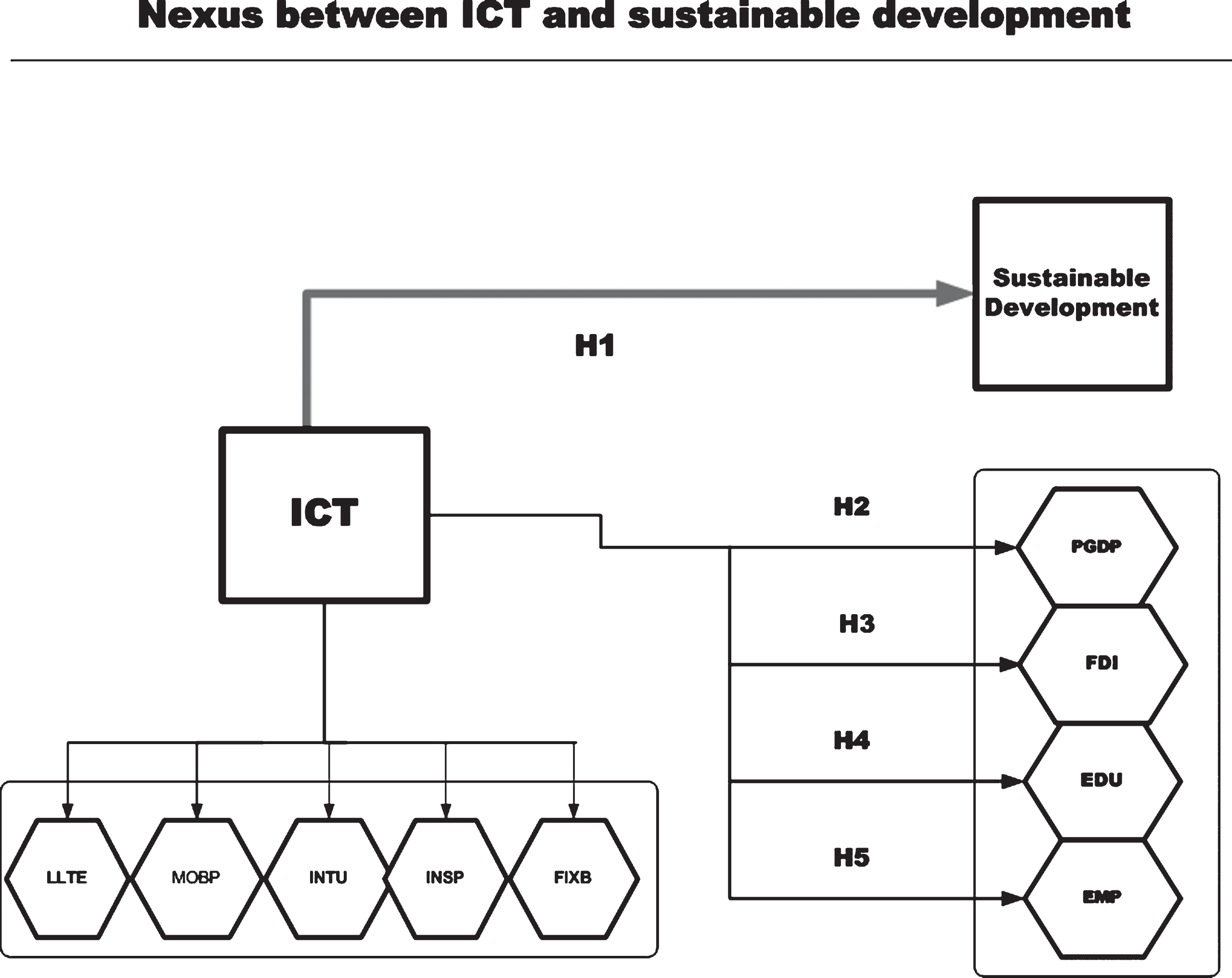
Proposed model for the study.
The study’s purposefulness is, by using panel data, to delineate the relation between ICT diffusion and sustainable development in South Asia’s economies. We use the following econometric equation:
Where ∝it and δit are fixed effects for each country in the panel. Now, to examine how these two parameters are joined in a long-run, also we have to check the short-run fluctuations. Several econometric techniques have been suggested in the literature. In this study, we used generalized method of moments (GMM) to analyze the relation between the ICT and sustainable development. The generalized method of moments is commonly used for panel data estimation and to find the relation among certain variables. GMM estimation technique is used to deal with the problem of endogeneity for set of instrumental variables. This technique provides efficient and consistent estimate in the presence of arbitrary heteroscedasticity. Diagnostic tests can be cast in GMM model. To test over identifying limitations we used Hansen’s test to offer evidence for instrumental validity. For this study we cannot reject the null hypothesis that the instruments are appropriate [23].
Before measuring the panel data analysis, it is essential to find out the stationary variables to avoid spurious regression. For identification of these properties, we have number of tests available in literature, but in our study we use three panel route tests, i.e. Levine-Lin-Chu; LLC and Fisher-types; AF and PP tests, used before [24]. The tests are often used for economic analysis in order to carry out the panel data measurement. The results reported in Table 4 indicates that all variables are integrated of order one [1(1)], so we can pursue GMM model for underlying variables of the study.
Panel unit root test
Panel unit root test
Note: a, b and c shows the level of significance at 1%, 5%, and 10% respectively.
After confirmation of cointegration next we move to find the impact of ICT on sustainable development. The results of Table 5 indicated that FIXB does not affect the sustainable development of the South Asian economies.
Results of panel GMM model
Note: a, b and c shows the level of significance at 1%, 5%, and 10% respectively.
In this context, previous studies present similar results, indicating that FIXB might not contribute effectively to the achievement of sustainable development [25]. Both these studies analyzed that there are some factors which decreased the effect of fixed broadband role in achieving the development. Both studies highlighted the political, social and economic factors that can affect the SusD. In our study, most of the South Asian countries have low purchasing power so they cannot pay for the monthly charges of FIXB; also these countries have weak political and economic institutions and poor law and order situation that affect the relation of FIXB and SusD. Similar results can be found in the study of [26], which indicates the socio-technical problems in case of Korea’s broadband sector. It summarizes that due to the conventional way of FIXB, this sector has a minimum effect towards the development of Korea. Moreover, we have few studies that show the negative impact of FIXB but have a positive effect on wireless access network (WLAN) on sustainable development [27]. Furthermore, studies of [28] investigated a positive impact of broadband towards sustainable development in Canadian rural areas. Moving towards INSS, it has a positive and significant effect on sustainable development, this means that with the increase in INSS there will be an increase in sustainable development. The internet servers or internet providers play an important role in the penetration of internet users, both in developed and developing countries the internet service providers are the tools having the specific bandwidth to provide services to the people in urban and rural areas. Consequently, reshaped the ICT and create many opportunities in for the people. The similar studies carried out on INSS and development were presented by [29]. These studies present almost similar findings over the relation of INSS and SusD. INTU has a negative significant impact on sustainable development in South Asia. Within increase INTU the sustainable development will start a decline. The similar results are found in previous studies [30]. These two studies present the decline of internet users and point out the two main aspects, one is the satisfaction of users and the second one is a lack of technology education. Some scholars consider the internet as “double-edge-sword”, and it depends on the users, how they use the internet [31]. Moreover, the internet users used the internet for different crimes that decrease the development ratio [32]. Due to political weak institutions, there is no affective department for the screening of cyber related crimes. In this regard, during the past few years, the internet and mobile network were extensively used in Pakistan, Afghanistan, and India for terrorism. Few studies analyzed a negative effect of internet users on development due to security and interruption issues [33]. Turn onto LLTE, it has a positively significant impact on sustainable development. The LLTE is a basic and core tool of modern ICT. Before the start of the 21st century, the ICT sector mainly consisted on LLTE, and it was the only voice medium of transmission for most of the people in developed and developing countries. Most of the South Asian countries including Pakistan, India, Sri Lanka and Bangladesh liberalized their telecom sectors during the last decade of the 20th century. With these arrangements, the respective countries received the bulk of investments by providing the voice transmission facilities all over the region. LLTE consists of a landline phone, long distance interface (LDI), calling cards etc. Before the advancement of information technology, LLTE affected the living standards, norms of the people very much. In this regard, previous studies indicate a positive relation between the landline telephone subscription and SusD [34]. Similarly, MOBP has a significant positive impact on sustainable development. The first decade of the 21st century with no doubt was the decade of mobile phones advancements, particularly in the South Asian region. Due to the deregulation policies, the mobile phone users increase very rapidly, resultantly, these countries develop the ICT infrastructure and received huge investment in the respective sector which creates employment opportunities and strengthen the economy by receiving foreign direct investment. The One Belt, One Road project is an example of improving of ICT infrastructure for whole Asian region that contribute in strengthening the technology among the member countries [35]. The previous studies support the results of our studies [36–38].
This study assessed the relation between ICT and sustainable development in South Asian countries, over the 2005–2015 time period. In order to unveil said relation, we modeled sustainable development as a function of FIXB, INSS, INTU, LLTE and MOBP, and applied the GMM model. In the present study, we are able to conclude that all samples of ICT variables in South Asian countries are significant and strengthening the sustainable development. Few minor differences among the variables have been observed in the long-run analysis, which is due to differences in environment, culture, human behavior and education across South Asian countries. The findings of the study indicate that ICT and SusD are directly proportional to each other unless and until other factors such as environment, culture, human behavior and education remain constant.
Countries including Pakistan, Afghanistan, India and Sri Lanka have been badly suffered due to the poor law and order situation and terrorism, particularly, Pakistan and Afghanistan undergone the worst chaos conditions. Also, the South Asian countries share the common problems of weak policy institutions and corruption, which affect all the service sectors in these countries. ICT sector, like the very few other service sectors, has the ability to attract the foreign investment in huge amount. As more foreign investment provide basis for raising the living standards of the people of the region, the development in ICT sector can be believed as to be the game changer for the entire region sustainable economic growth. The empirical analysis suggests that there is a close linkage between ICT diffusion and sustainable development, with reinforcing each other (see Fig. 1). ICT has sophisticated and user friendly applications that in turn wider the population segment and resulting in higher economic growth in the South Asian countries.
Lastly, the following points are suggested for policy makers in the South Asian region: Compile ICT policies for up-to-date ICT applications, producing trained ICT skilled labors and promoting e-culture in the region, Improve the quality of infrastructure and connectivity, while China Pakistan Economic Corridor (CPEC) will become a game changer for Pakistan in terms of digital technology [39]. Reduce the cost of different ICT equipment and applications.
In summary, the global economic scenario is undergoing speedy transformation powered by new innovations in ICT sector. Increase in ICT platforms is having a deep impact on long-term economic growth. So for this purpose, development strategies should be formulated to increase ICT penetration rates which further ensure the sustainable economic growth.