




Abstract
This article expands current knowledge by assessing how employee engagement is transformed into corporate image and customer satisfaction. Unexplored in earlier studies, the article undiscloses the role that service quality plays in this transformation. Developed through an extensive literature survey, the conceptual model is empirically tested, with survey data collected from 261 customers and 261 managerial employees. The results show that, first, focusing on employee engagement can both lead to a favorable corporate image and enhance customer satisfaction. Second, service quality has a significant positive effect both on customer satisfaction and on corporate image. Third, service quality positively mediates the relations among employee engagement, customer satisfaction and corporate image. The article concludes with the study’s qualification, plus some practical and theoretical implications, suggesting future research directions.





Introduction
The services sector works as a backbone of the world economies and it is a fastest growing sector in the world. This sector contributes the largest share in total output and employment worldwide. The banking sector is the core of the services sector and one of the utmost growing sectors in Pakistan. The prominence of the banking sector in the economy and a rapidly changing business environment has changed the role of employees from teller to seller [1], which alarmed banks to put additional focus on their workforce to survive and gain competitive advantage. Employees are considered as an engine of growth, since last decade banks have started to focus on engaging their employees because focusing on employee engagement enhances the employee commitment toward the bank. Employees are corporate representatives who are actively visible and favorably shape the corporate identity of the firm [2, 3]. Engaged employees work with commitment and their quality of service can be enhanced that can further lead toward better corporate image and customer satisfaction. However, research has not paid much attention to the transformation of employee engagement into corporate image and customer satisfaction in a banking context.
Today’s consumers are well informed and they pay attention to the visual orientation of the firm [4]. Consequently, the corporate image is the voice of organization that can be communicated with consumers and it is independent of verbal information [5]. Banks spend millions of funds to develop a favorable corporate image in the mind of consumers because it is considered as a corporate identity of the bank which works to mold the image positive or negative. But, no study has measured the role of employee engagement in developing a favorable corporate image within a banking context. Scholars and practitioners in financial services marketing have a consensus on the role of the corporate image in creating sustainable competitive advantage for the bank. The study of [6] highlights that the corporate image plays a vital role in customer perceived value toward banks in Pakistan.
To create and maintain a competitive environment, banking sector organizations need to put great emphasis on employees, specifically on their behavior during interaction with customers. This new landscape resulted banks to change their structure and empower their workforce so that they can work harder and help banks to survive in a competitive environment [7]. In the business world, common knowledge suggests that customers are the lifeblood for any organizations. Being a lifeblood for organizations, customers strongly believes that they have power to demand a better service quality [8]. Moreover, customer satisfaction is a challenge for organizations operating in the financial services sector, to meet this challenge organizations need to focus on employee engagement [9]. Employees’ behavior during service delivery is an important factor and it can significantly influence customer satisfaction. However, the question, does employee engagement play a role in shaping the corporate image and enhancing the strength of customer satisfaction? Still need to be answered. In this competitive environment, the customer is a king [10]. Financial service sector organizations can’t afford negative behavior of employees during interaction of employees with customers [11, 12]. Therefore, we believe to meet the customers’ expectations in the term of service quality, banks need to focus on engaging and empowering their workforce which will enable them to focus on customers. As a result, a higher quality of service and greater customer satisfaction will be conceivable.
The search data from PsycINFO/Business Source Elite, using term employee engagement for decade 2001–2011 shows more than 1000 results and the decade from 1990–2000 indicate only 112 results, more than 80% studies are non-empirical papers [13]. Additionally, most of the studies have only focused on employee engagement from the internal perspective by focusing on employee performance, satisfaction and their commitment [14–22]. According to best of our knowledge there is no empirical study available that address the employee engagement from the internal and external perspective in the context of the banking services sector of Pakistan.
Therefore, purpose of this study is to emphasize on employee engagement from both internal and external perspectives, to empirically explore the role of employee engagement in enriching corporate image and customer satisfaction in the context of the banking sector of Pakistan. Further, this study also explores the relation between internal and external stakeholders of banking sector organizations by using the mediating role of service quality in the impact of the employee’s engagement on corporate image and customer satisfaction. Moreover, authors believe that service quality and employee engagement as vehicles through which corporate image is translated and it can also provide a pivotal explanation for customer satisfaction. Authors believe that this study will provide a valuable guideline for decision makers in banking sector organizations to develop their strategy for employees to enrich the corporate image and customer satisfaction. Further, this study will highlight the role of service quality in the relation of employees and customers in the context of banking sector organizations of Pakistan.
Literature review
In the context of a banking sector, employees have direct interaction with customers and these customers serve as lifeblood of the bank. Employees are the backbone of banking services organizations, the importance of employees and customers has motivated scholars in financial services marketing to focus on employees and customer together. Moreover, employees also work as brand ambassadors for the bank. So, success can be accomplished by focusing on the employees in the bank, which will in a result put emphasis on customers and also spread a positive word of mouth about the bank in the society; these all factors are drivers of success. On the organization side employee engagement has become the hot topic during the last decade. Many scholars have focused on the importance of employee engagement to achieve organizational success and competitiveness. Theoretically, few studies have revealed that engaged employees can create satisfied customers. And also, employees can spread a positive word of mouth about the bank that can be useful in shaping favorable corporate image. Additionally, employees’ involvement in their task performance controls the power of their service quality and customer experience during service delivery.
In financial services organizations the customer experience and employee behavior are vital factors, these can significantly enhance organizational outcomes [23]. Excellent employees’ performance is vital in all industries but in the high labor intensive financial services sector, the most important factor is employee behavior in service experience [24, 25]. Employees in service sector organizations can convey competitive advantage in the term of building and maintaining the internal-external stockholder relation [26]. Engaged employees are highly important for service sector organizations [27]. In a case if employees are disengaged, their negative mindset can be contagious and affect the mode they interact with customers. Previous studies have found that employee commitment has significant relation with service quality [28, 29]. Moreover, the study of [6] highlighted that service quality has association with corporate image and customer satisfaction in the context of the banking sector of Pakistan.
However, the role of employee engagement in shaping corporate image and improving customer satisfaction is missing in the literature. Thus, to bridge the knowledge gap in the literature, the purpose of this study is to use the employee and customer’s data together to unfold the role of employee engagement in shaping favorable corporate image and improving customer satisfaction. Based upon the earlier discussion, the conceptual model has been drawn to examine the number of relations. We used four constructs in the context of banking services organizations to check how internal factors influence external factors. Our hypothetical conceptual model indicates that (1) employee engagement has a significant impact on service quality, corporate image and customer satisfaction (2) service quality has an effect on corporate image and customer satisfaction and (3) further, our study also unfold the role of service quality in the transformation of employee engagement to corporate image and customer satisfaction. By summing-up our discussion we developed the following conceptual model (Fig. 1).
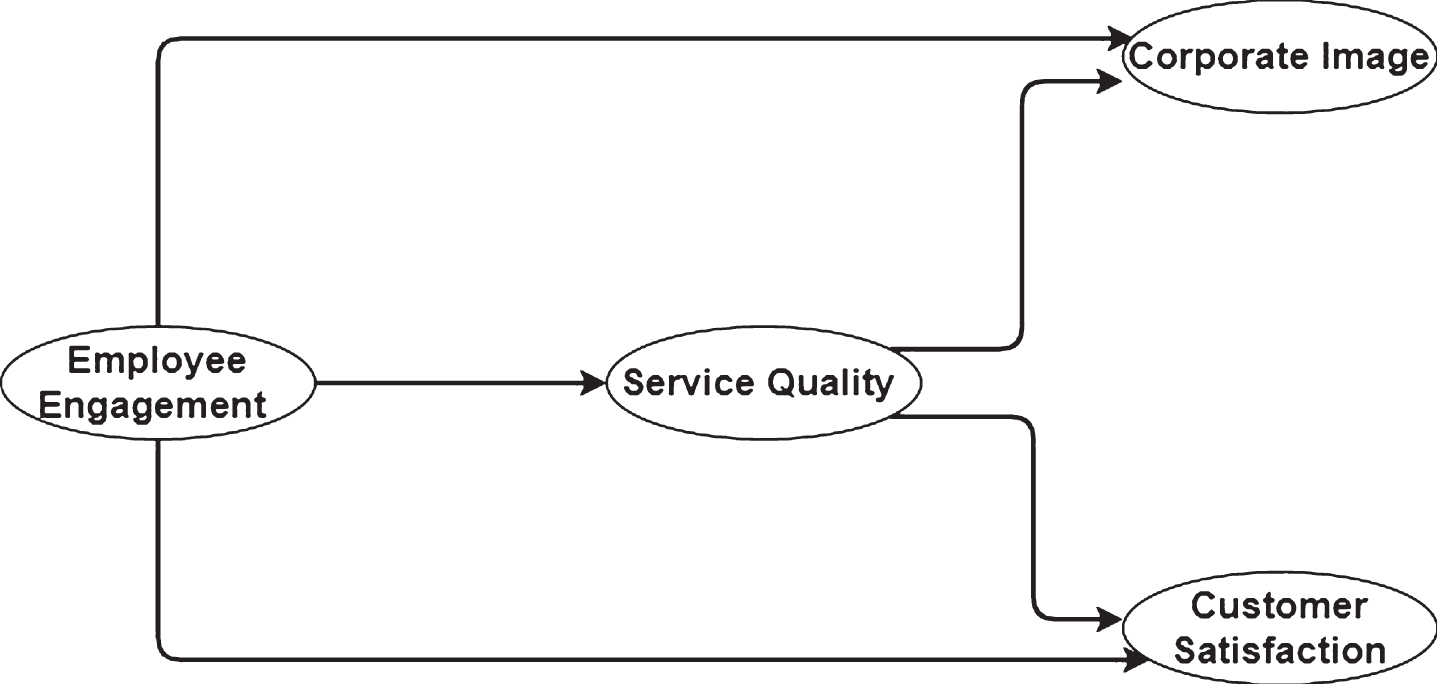
Conceptual model.
The employee engagement concept is based on the earlier concepts like employee commitment, organizational citizenship behavior and job satisfaction [30]. However, employee engagement is defined as the extent to which people invest their cognitive, physical, and emotional energy in their task performance [31]. According to Kahn, the engaged workforce involved in task performance is psychologically present, attentive, connected, integrated and focused on their task performance. In contemporary management literature, the definition of employee engagement is almost similar to the Kahn’s concept. According to the definition of contemporary management literature, the engagement is the positive state of mind at task performance composed of vigor, dedication and absorption [32, 33]. Vigor refers to the higher energy, the willingness to put great effort in task performance [34]. Dedication is the feeling of involvement at task performance, passion at work, inspiration to achieve organizational goals and feeling of pride [35]. Lastly, absorption is a state of being engrossed in the organization [36]. The time passes quickly and it becomes difficult to oneself to detach from the organization.
Corporate image
The concept corporate image was emerged during the era of 1950 s when Boulding described it as an organizational construct with “emotional” and “functional” meanings [37]. According to recent studies, the corporate image is a tangible and intangible associations interconnected with the concept of corporate reputation [38]. Basically it is the sum of knowledge, belief, feelings, ideas, impression and values toward a corporate entity [39]. From different interactions and experiences, the corporate image is shaped to create effect on the perception of stakeholders [40]. The study of [41] describe corporate image as an association shaped from personal experience, advertising and word-of-mouth. In addition, the corporate image is an important element of corporate brand with the focus on external factors by considering how external stockholders view and perceive corporate entity. According to [42] the corporate image is a mutual demonstration of organizations past activities and outcomes that demonstrate organization capability to deliver valuable results to several stockholders. It is a measure which determines the relative standing of the bank among internal and external stakeholders, in both its institutional and competitive environments.
Service quality
Service quality is the comparison of customer expectations about service and the actual service provided by employees [43, 44]. According to [45] service quality is a customer’s judgment of its superiority and excellence in service delivery. Service quality has become a significant paradigm due to its influence on organizational performance, customer satisfaction and customer loyalty [46]. In the context of a banking sector, the service experience determines the power of customer satisfaction [47]. To build and maintain strong relation with customers, banks need to make service experience with customers as a wonderful experience by involving and engaging the customer and also with innovative services [48]. In today’s competitive and an interconnected world, service quality has been considered as a significant determinant of quality because service quality elements collectively are the elements of the service marketing mix, and these are considered as the point where a product originates and delivered [49].
Customer satisfaction
Customer satisfaction is defined as a measure of how services provided by the bank meet customer expectation. Lovelock [50] argues that customer satisfaction is a subjective evaluation about a situation which produces a result in positive emotional response. Customer satisfaction is a significant factor in the banking context which plays an important role in sustainable bank performance and higher profitability [51]. To ensure the higher customer satisfaction, the quality of service provided during service delivery is very important because higher service quality leads toward greater customer satisfaction. To develop and maintain a long term relation with customers the role of employees is highly significant [52]. Several studies found that employee satisfaction has a positive relation with customer satisfaction and employee performance in the context of a service sector [48, 52]. Satisfied employees can create satisfied customers, therefore to achieve the higher customer satisfaction, banks need to focus on their employees [52]. Customer satisfaction is highly significant construct in service marketing literature because service sector organizations can’t survive without satisfied customers [51, 53].
Hypothesis development
The management literature from the past decade indicates that employee engagement is a strong predictor of employees and organizational performance [54–56]. Engaged employees feel emotionally attached to their organization and work with enthusiasm which leads them to perform a task beyond their contractual agreement [57]. Employee engagement has been explored by many researchers as a critical factor of organizational success and it plays a vital role in employee retention and also for achieving competitive advantage over rivals [58, 59]. Engaged employees significantly contribute toward organizational effectiveness to earn greater profitability and more shareholder return. According to [60] it’s very hard to survive for organizations in this competitive world without doing well for their employees. Therefore, building trust in employees and empowering them for betterment of the bank can bring favorable results for banks, while, diminishing trust in managers can shape negative perceptions toward the bank.
Stakeholders evaluate and scrutinize organizations on the regular basis to determine their authenticity and trustworthiness [61]. The corporate image plays a vital role to build perceptions of all stakeholders toward these organizations [62]. Kennedy [37] has emphasized the significance of employees as external communicators and the important role they can play in creating a favorable corporate image. Macias & Pirinsky [3] believe that “employees are corporate representatives who are actively visible and can favorably shape the corporate image”. According to [63] the strong and distinctive corporate image is a significant factor for organizations to gain competitive advantage and sustainable growth. Thus, a strong and differentiated corporate image is a powerful tool which can be used to attain competitive edge specifically among financial services organizations. Based upon our discussion we postulate the following hypothesis:
Now a day’s service quality management is a competitive weapon in the services sector organizations [64]. Managing service quality needs banks to emphasize on the better service experience for customers that will add excellent perceived value in the mind of customers [53]. Generally, a higher service quality leads toward higher perceived value. However, the perception of service quality is formed during the interaction of employees and customers [7]. Therefore, for a better service quality, the role of employees is vital in today’s business environment. The study of [65] indicated that employee engagement can significantly improve the service quality. Moreover, [66] also found that employee engagement has a significant positive association with service quality. And also, the study of [67] revealed a relation among employee engagement and customer satisfaction in context of restaurants. So, the positive behavior of employees in service delivery can increase the perceived value in mind of customers. Due to these associations, assessing service quality perception and customer satisfaction has been widely acknowledged within a service context. Because in the context of a service sector, the good quality of service is considered as an effective strategy which can increase customer base and also boost profitability [68]. Thus, based upon the aforesaid discussion, we postulate the following hypothesis:
The corporate image is also a significant construct that is influenced by service quality [38]. Accordingly, banking sector organizations needs to emphasize on their marketing strategies, specifically by differentiating their services from their competitors by creating, maintaining and promoting their corporate image. The study of [63] also argued that service quality has a significant positive effect on the corporate image. According to [69] service quality and corporate image are significantly related to each other and they are useful to promote long-term business growth. The study of [70] highlighted the causal relation among service quality and the corporate image. Hence, it can be presumed that service quality has a significant effect on the corporate image which plays a strong role for the corporate identity of the bank. Therefore, it is crucial for banking services organizations to improve the service quality, which in turn will significantly contribute toward the favorable corporate image. Based upon the proceeding discussion, we formulated the following hypothesis:
In addition, excellent service quality and a higher customer satisfaction are significant challenges banking services organizations are facing now a day. Several research studies have shown that banks need to put their great emphasis on creating and maintaining the high customer’s base, it can be achieved by providing excellent service which in turn will increase customer satisfaction [12, 25]. The significant positive relation among customer satisfaction and organizational performance has increased the importance of customers, specifically in services sector organizations [71]. The studies of [72, 73] found that service quality has a significant positive impact on customer satisfaction. Hence, we believe, it is crucial for banking services organizations to ensure the improved service quality, which will significantly contribute toward the higher customer satisfaction. Thus, to test our argument in the context of a banking sector organization of Pakistan, we formulated the following hypothesis:
In summary, the banking sector plays a vital role in the economy of Pakistan; now a day every organization has their service divisions which perform an important role for organizational success. However, the main part of any service organization is its employees. Therefore, to achieve organizational success focusing on employees is crucial for banking services organizations. Based upon the subsequent discussion, we can assume that engaged employees can in turn create satisfied customers. And also, being a corporate representative of the bank employee can provide support in shaping favorable corporate image. Moreover, service quality and customer satisfaction has been widely studied because in service sector organizations, service quality plays a vital role to satisfy customers. Past studies have found that the strategy to provide excellent service quality is highly effective to increase customer base and profitability [72, 75].
Banking services organizations can differentiate their services from their competitors by creating, maintaining and promoting their distinguished corporate image. A strong and differentiated corporate image is a powerful tool which can be used to attain competitive edge specifically among banking sector organizations. Further, scientific literature suggests that service quality has a relation with corporate image [6]. Therefore, it is important for service sector organizations to focus on employees to ensure the better service quality, which in turn will significantly contribute toward the higher customer satisfaction. Thus, we believe that service quality can work as a bridge among employees and customers by playing the role of mediator. To test our argument, whether it is true or not, we developed the following hypothesis:
Research methodology
Measurement
Variables used in this study were measured on the 5-point Likert scale where 1 = strongly disagree, 2 = disagree, 3 = neutral, 4 = agree and 5 = strongly agree. Corporate image was measured using four items, three items were retained from the scale of [39] (item#1 communication used by this bank helped me to form opinion about it, item#2 I like bank as compare to other banks in same sector and item#3 in my opinion other customers also like this bank) and one item was adopted from [76] (item#4 the logo of this bank enriches its image). To measure customer satisfaction we also used four items (item#1 I am satisfied with the services knowledge of staff, item#2 this bank always meets my expectations, item#3 the overall quality of services provided by this bank is excellent. And item#4 after considering everything, I am completely satisfied with the services provided). These items were developed based on the studies of [77, 78].
Service quality was measured using [79] scale; we retained 10 items (item#1 this bank provided me fast and quick service, item#2 the waiting time in this bank is reliable as it is given by the staff, item#3 employees are well dressed and appear neat and clean, item#4 this bank has convenient working hours based on my schedule, item#5 whenever I visit this bank I feel relaxed, item#6 varieties of services are offered by this bank to me, item#7 staff and management of this bank behaved with me in friendly manner, item#8 the bank keep record accurately, item#9 this bank provided me convenient parking place for my vehicle and item#10 staff here always behave professionally).
Employee engagement items were developed based on the studies of [32, 80]; we developed six items (item#1 I feel personally responsible to my work, item#2 being a member of this bank is very captivating to me, item#3 sometimes I am so into my job that I lose track of time., item#4 it is difficult to detach myself from my job, item#5 how well I perform my job it greatly matters to me and item#6 I am highly engaged in this bank).
Employees have provided information about employee engagement and customers about service quality, corporate image and customer satisfaction. In addition, participants of this study also reported demographic information on categorical scales. Employees have shared demographic information about their age, education, gender and current job in the bank while customers shared demographic information about their age, gender and number of visits to the bank. The separate questionnaire was designed for employees and customers. Two experts related to academic research reviewed the instrument to ensure the relevancy of items used in the instrument. Questionnaires were distributed among 18 employees and 18 customers of banks for pilot testing.
Sampling and data collection
The sample used in this study consists of managerial employees and customers of banking sector organizations of Pakistan. Initially, the list of banks and bank branches has been developed. Subsequently, using convenience sampling approach more than 445 bank branches were contacted, however, 269 agreed to participate in this study. Likewise, separate survey questionnaires were designed for employees and customers that were given to them and we asked them to fill it about the extent to which they agree or disagree with the statement.
Using a structured questionnaire method, the data was collected from 269 employees and 269 customers of banks from 8 major cities of Pakistan. From 538 questionnaires those were completed by employees and customers, 16 out of them were considered as incomplete and were removed from the data. The 522 responses (261 employees and 261 customer’s responses) those are completed in all aspects were used for further analysis.
Data analysis and results
After data screening and evaluation, the useable responses have been filtered to further analyze them to get required/useful results. Therefore, we used SPSS version 21.0, AMOS version 21.0 and the partial posterior p-value calculator statistical packages to analyze the empirical data of this study.
Demographic profile of respondents
Participants of this study consist of 50% employees of banking sector organizations and 50% customers of these organizations. The demographic profiling of employees indicates that 71% are male and 29% are female respondents. The majority of employees participants (66%) are categorized in age group from 25–35, 21% participants are categorized in age group of 35–45 and 13% participants of this study are in the age group of 45–55. Education of respondents comprise of 65% holds a master degree while 25% hold a bachelor degree and other 10% intermediate, diploma certificates. Most of the employees (66%) are working at a middle management.
The demographic profiling of customers indicates that 67% male and 33% female respondents. The majority of customers (58%) are categorized in age group from 25–35, 9% participants are categorized in the age group of 35–45, 27% participants of our study are in the age group of 45–55 and very few participants (6%) are in the age group of 55–65. Most of the customers visit the banks more than two times in a month.
Reliability and validity analysis
To assess the convergent and construct validity of measures, initially we used confirmatory factor analysis (CFA). The confirmatory factor analysis (CFA) was used with four factors measurement model (service quality, corporate image, customer satisfaction and employee engagement). Hair [81] suggested that factors with loading lower than 0.4 must be deleted from the model to get good model fit. Thus in initial screening authors have deleted some items due to their factor loadings less than 0.4. Few other items were also deleted because of their errors were highly correlated with other items; these items were reflecting error covariance of construct [81]. The factor loading is shown in the Table 1. These factor loadings are significant at p < 0.01. The measurement model shows that CFI (0.914), TLI (0.901), IFI (0.915), GFI (0.867), RMR (0.046), RMSEA (0.071), RMSEA HI 90 (0.080) and CMIN/DF (2.351), these results are acceptable and meets the goodness-of-fit criteria of model [82, 83]. Therefore, authors believe that there is a reasonable overall fit between observed data and model.
Factor loadings of constructs and reliability statistics
Factor loadings of constructs and reliability statistics
Note. All factor loadings are significant at: p < 0.01.
Following this, we also measured the reliability of the scales based upon Cronbach’s alpha and composite reliability. Results are shown in the Table 1 given above. Results indicate that the Cronbach’s alpha value for all four constructs is above the minimum acceptable threshold of 0.7 [84] that indicate scale is reliable. Similarly, the composite reliability also shows the value greater than the minimum threshold of 0.6 that also indicate the acceptable reliability. These findings suggest that scale present good reliability.
We also measured convergent and discriminant validity using the average variance extracted (AVE) analysis for all four factors. The values of average variance extracted (AVE) for all four factors are above the minimum threshold of 0.5. These results suggest the adequacy of convergent and discriminant validity.
Hypothesis testing is a statistical measure that is used to determine/conclude whether the data is providing enough evidence to infer that the proposition is true or false. This study used to measure the direct relation of variables along with indirect effects.
To measure the indirect relation of dependent and independent variables the scholars in marketing and organization behavior have great interest to explore the role of mediating variable. To measure the role of mediating variable, tests introduced by [85, 86] are most commonly used methods. According to [87, 88] these methods have low power to measure mediation effects as compare to modern techniques and these methods are no more recommended. The study of [88] introduced a partial posterior method and they believe it has strong power to measure the role of mediating variable, but this method is not widely used. However, the widely used method is structural equation modeling, [89] argued that the version of partial posterior approach has been also used in the context of SEM (structural equation modeling). Therefore, authors believe structural equation modeling as a most advanced and most powerful method to test our model. The measurement model shows that CFI (0.993), TLI (0.974), IFI (0.996), GFI (0.993), RMR (0.022), RMSEA (0.073) and CMIN/DF (2.436), these results are acceptable and meets the goodness-of-fit criteria of model [82, 83].
In summary, based on model iteration and test performed, we got the evidence of reliability and validity of our constructs. Also, we got the evidence for model goodness of fit. Therefore, we believe that results from structural equation modeling can be used to test the proposed hypothesis of this study.
The hypothesized associations shown in Fig. 1 were tested concurrently using structural equation modeling (SEM). Figure 2 is representing the path diagram from the estimated model with their standardized estimates (β). These standardized coefficients are considered as a good basis for testing the hypothesized paths.
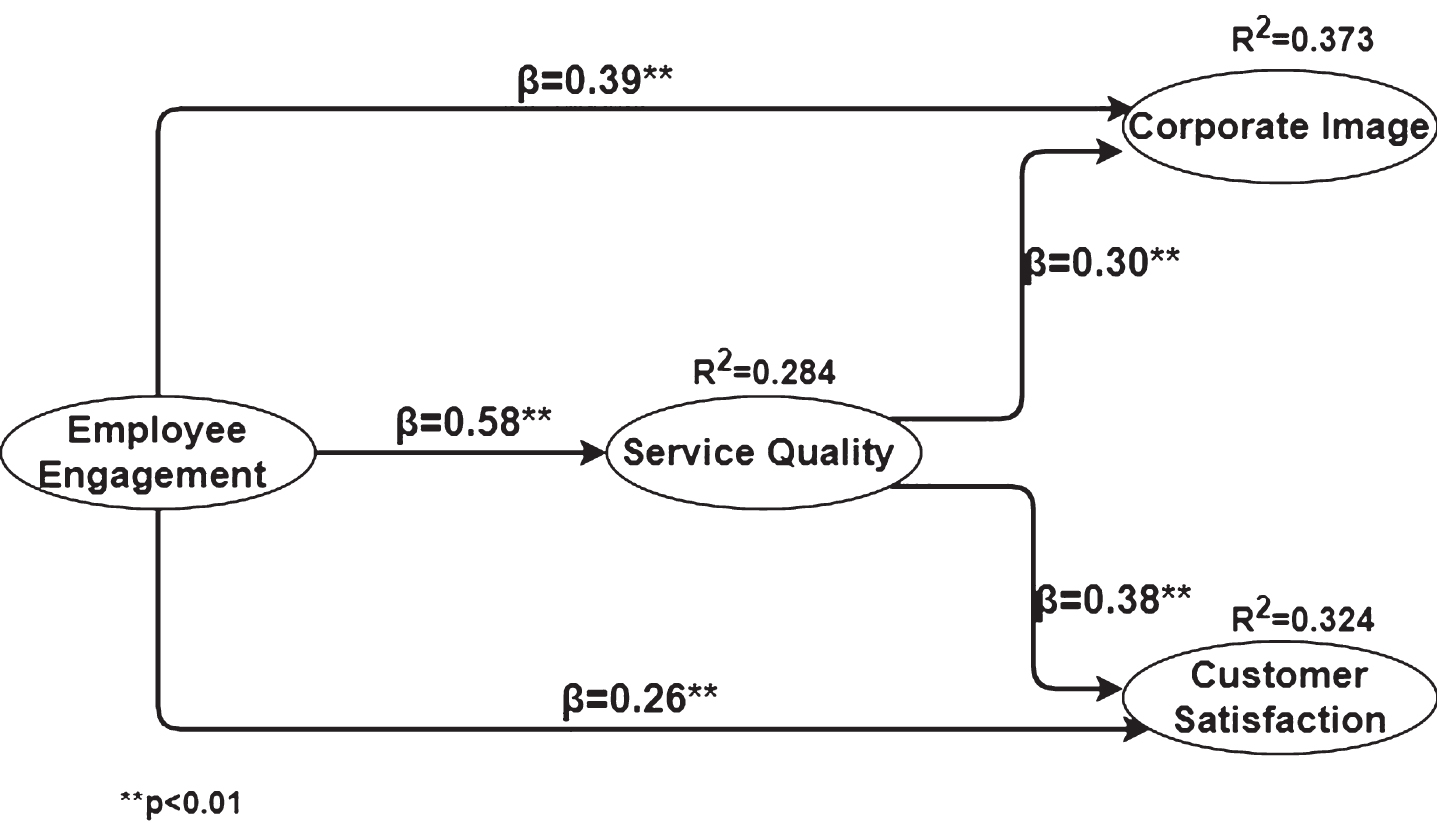
Path diagram of research model.
The argument from the earlier part indicates that the model has been fitted appropriately. The study of [90] suggest that once model fitting is appropriate, results from the structural equation modeling can be used for hypothesis testing. Therefore, after the appropriation of the model we used results from the SEM to test the above-mentioned hypothesis. Figure 2 demonstrates results of path analysis from SEM with standardized estimates (β). Based on results, 7 proposed hypothesis of this study are being tested. Table 2 indicates the direct effects of constructs and summarizes the results for the hypothesis 1–5. Findings suggest that employee engagement has a significant direct impact on corporate image, service quality and customer satisfaction, hence, hypothesis 1, 2 and 3 are accepted. It signals that employee engagement significantly influences corporate image, service quality and customer satisfaction in the context of banking sector of Pakistan. Therefore, banking sector organizations need to emphasize on employee engagement to significantly improve service quality and customer satisfaction and also to shape a favorable corporate image. Likewise, the results are also providing support for hypothesis 4 and 5. These results highlight that service quality has a significant direct impact on corporate image and customer satisfaction in the context of the Pakistani banking sector.
Standardized direct effects
Furthermore, this study measured the role of service quality as mediating variable; to estimate the mediation, the test introduced by [85, 86] are commonly used methods. But, the studies of [87, 88] criticize the tests and argue that these methods have low power to measure mediation effects as compare to modern techniques, so these methods are no more recommended. The study of [88] introduced a partial posterior method and they believe it has strong power to measure the role of mediating variable and it is also used in SEM. In this paper we estimated mediation using structural equation modeling and we reconfirmed our results using partial posterior approach. The results from mediation analysis are shown in Table 3 given below.
Standardized indirect effects
This study postulates the hypothesis 6 and 7 by assuming that service quality plays a positive role of mediator in the impact of employee engagement on corporate image and customer satisfaction. Results from Tables 3 are being used in this context, indicating the support for hypothesis 6 and 7. It validates the mediating role of service quality. Thus, engaged employees can deliver better service quality which will in turn improve corporate image and customer satisfaction. Similarly, it can be argued that employee engagement in banking sector organizations can be useful for favorable corporate image formation and enhancing customer satisfaction. To further validate the results of mediation analysis, the partial posterior approach suggested by [88] has been used. The results are consistent from both approaches i.e. structural equation modeling and the partial posterior approach. Therefore, it can be argued that in the impact of employee engagement on corporate image and customer satisfaction, service quality plays an important role as a mediator.
Previously, it has been theoretically discussed that employee engagement has significant influence on customer satisfaction [91, 92]. This study empirically confirms the relation among employee engagement and customer satisfaction. Therefore, we believe this study not only validates the theoretical basis but it also extends the body of knowledge on the empirical basis. We also found that employee engagement has a significant direct impact on the corporate image. According to best of our knowledge there is no empirical study available in the context of financial services marketing which examined the direct relation of employee engagement and corporate image. First time, this study revealed the relation of employee engagement with corporate image. In the past, scientific studies have revealed that employees are the corporate representatives and they work as a celebrity for the organization [3]. However, this study extends the scientific knowledge and provides new insights on the role of employee engagement in corporate image formation. Further, this study validates the relation of employee engagement and corporate image on the empirical basis. These findings provide new insights for banking sector organizations of Pakistan.
Moreover, service quality is the most important determinant for success of banking sector organizations; results indicate that employee engagement has a significant direct impact on service quality. These results are consistent with previous studies [93–95]. Therefore, we believe that banks need to focus on their employees by engaging them in planning and other organizational decisions to improve service quality. Additionally, improved service quality can contribute in constituting favorable corporate image along with improving customer satisfaction. These results are also consistent with previous studies [72, 75]. Thus, we believe that banks can shape favorable corporate image and increase customer satisfaction by delivering and maintaining the excellent service quality.
Furthermore, this paper unfolds the role of service quality as a mediator in the impact of employee engagement on corporate image and customer satisfaction. Standardized estimates from the path diagram (Fig. 2) shows that employee engagement has the most powerful influence on service quality then on the corporate image followed by customer satisfaction. On the other hand, the value of the standardized estimate (β) of employee engagement on customer satisfaction is lower as compare to the impact of service quality on customer satisfaction. Thus, for customer satisfaction, the role of service quality is also important. However, the influence of employee engagement on the corporate image is stronger as compare to the influence of service quality on corporate image. So, we believe in the transformation process of employee engagement into corporate image and customer satisfaction, the role of service quality is more important for customer satisfaction as compare to corporate image. Thus, banks operating in Pakistan need to engage their employees in a way that they could provide better service quality to customers which will turn in the higher customer satisfaction.
Conclusion and implications
Conclusion
The purpose of this study was to explore the role of employee engagement in shaping favorable corporate image and improving customer satisfaction. Therefore, this study used the data from employees and customers together to check the relation of employee engagement with customer satisfaction and corporate image. Using extensive literature survey, we postulated that employee engagement has a significant role in shaping favorable corporate image, and it also plays a vital role in customer satisfaction. The result validates the propositions that employee engagement has a significant positive impact on corporate image and customer satisfaction. Thus, here it can be concluded that to shape favorable corporate image and to enhance customer satisfaction the role of employee engagement is important. Accordingly, banking sector organizations can emphasize on employee engagement to shape favorable corporate image and higher customer satisfaction.
Moreover, based upon the scientific literature we anticipated that service quality positively mediates the relation among employees, customers and corporate image. From empirical results, we confirmed that service quality positively mediates the relation among employee engagement, customer satisfaction and corporate image in the context of the banking sector of Pakistan. Although, employee engagement has direct impact on corporate image and customer satisfaction, but our results indicate that service quality strengthen the relation among employee engagement, corporate image and customer satisfaction. Therefore, we can conclude that employee engagement in a banking context will improve customer satisfaction, and it also contributes in shaping favorable corporate image. Engaged employees remain mentally present during their task performance that can be useful for better customer experience which finally leads toward a higher customer satisfaction.
Additionally, employees being a corporate representative of the bank can spread a positive word of mouth to shape favorable corporate image. So, it can be concluded that focusing on employee engagement will enhance employee pleasure toward banks which encourage them to spread a positive word of mouth in the society that will help to improve the corporate image of the bank. Also, employees work as a celebrity of the bank and they are highly visible in the market, high visibility of employees and their positive attitude can improve the corporate image of the bank. Accordingly, banks can put great focus on employees to make them happy and loyal toward the bank which in turn motivate employees to perform their task with high involvement that will increase their service quality.
Finally, summing up our discussion, we can argue that banks operating in Pakistan grasp on engaging their employees in decision making, give them autonomy and authority so that they may feel fully attached to the bank. Such kind of decisions will improve the corporate image of the bank because results have shown that employee engagement directly influences the corporate image. Further, it will help banks to achieve the higher customer satisfaction in the context of the banking sector of Pakistan. Lastly, this study has concluded that service quality plays a positive role of a mediator among employee engagement, corporate image and customer satisfaction within the context of banking sector organizations of Pakistan.
Theoretical contribution
A first contribution of this paper is to present new study that extends the current knowledge by examining the direct impact of employee engagement on corporate image and customer satisfaction. Our results support both hypothesis and concur with past studies published in scientific journals. The study of [3] also found that employees are corporate representatives of the firm and they are actively visible and can shape favorable corporate image. Moreover, corporate image plays a vital role to build perceptions of stakeholders toward these organizations [62]. Our results are also similar to the studies of [67, 96] that indicate employee engagement can significantly influence customer satisfaction. Further, this paper also reveals that service quality has significant impact on corporate image and customer satisfaction. These findings are also concur with previous studies [12, 38].
In this paper we found that employee engagement and service quality collectively explain 37.3% variance in corporate image (R2 = 0.373) and 32.4% variance in customer satisfaction (R2 = 0.324). However, employee engagement explains 28.4% variance in service quality (R2 = 0.284). Similarly, based upon the findings, this study shows that banks need to communicate favorable words to external stakeholders concerning important characteristics of the bank corporate identity. However, it can be achieved by engaging employees that will shape favorable corporate image and it will also improve customer satisfaction. Given the paucity of past studies exploring the impact of employee engagement on corporate image and customer satisfaction, we consider this theoretical contribution an important one.
The second contribution of this paper is to present integrated conceptualization that links the employee engagement with corporate image and customer satisfaction. Several studies in the past have theoretically indicated that firm internal decisions can influence the external factors [91, 92]. However, this study provides a validated framework that not only unfolds the relation of employee engagement with corporate image and customer satisfaction, but it also highlights the role of service quality in this context. This paper indicates that service quality positively mediates the relation among employee engagement, corporate image and customer satisfaction. Thus, we believe banking sector organizations need to emphasize on their employees in a way that they must deliver better service to the customers. So, in this way at one end focusing on employees will significantly improve corporate image and customer satisfaction. Further, the better service quality will strengthen the aforesaid relation.
Managerial implications
The core intention of this study was to empirically test several hypotheses drawn from literature regarding the transformation of employee engagement into corporate image and customer satisfaction and also modeling the role of service quality in this transformation process. The empirical results from this study offer several managerial implications for decision makers in the banking sector of Pakistan who wish to comprehend whether and how employee engagement influence corporate image and customer satisfaction.
The creation of favorable corporate image is costly and challenging for banks and top management tries to make every effort to build one that is auspicious and reliably communicates corporate identity to the market. Based on the direct and significant relation between employee engagement and corporate image, this study provides implications for banks to emphasize on employee engagement to shape a favorable corporate image. In particular, banks can expect a synergy effect of employee engagement on the corporate image. Thus, banks endeavor to reinforce their corporate image by focusing on employee engagement.
Further, the real asset for the banking sector organizations are the customers, to retain existing customers and attain new customers, the role of customer satisfaction is also important and top management have real concerns on improving customer satisfaction. The direct and significant relation between employee engagement and customer satisfaction shows that banking sector organizations emphasize their efforts on customers returning to the bank and a long term relation with customers through improving customer satisfaction. Using the aforesaid results, banks can emphasize on employee engagement to improve customer satisfaction. In other words, customer satisfaction can lead better service feedback, customer loyalty and positive-word of mouth. And also, the results show that service quality significantly and directly influences customer satisfaction. Given the importance of service quality, this study also provides suggestions and managerial implications for banks. It shows that managing customer satisfaction is a strategically critical task for banking sector organizations in Pakistan. So, banks grasp on employee engagement and service quality to maintain their current customers and attracting more new customers.
Moreover, the findings of this study suggest that to achieve a competitive advantage, banks make sense of the role of employee engagement to constitute a favorable corporate image and improve customer satisfaction. The empirical results indicate the relative influence of employee engagement on corporate image and customer satisfaction along with the role of service quality in this whole process. Employee engagement has the greatest influence on service quality followed by the corporate image and then on customer satisfaction. However, service quality has a strong role among employee engagement and customer satisfaction as compare to its role among employee engagement and corporate image. So, we can argue that for favorable corporate image banks need to focus on engaging their employees while for the higher customer satisfaction banks also need to ensure the better service quality along with the employee engagement. Thus, the findings of present study are extremely significant for the decision makers.
Limitations and suggestions for future research
This study present a first foray into the conceptualization of the role of employee engagement in building favorable corporate image and a better customer satisfaction, and addressing the role of service quality within a banking context. However, the finding of this study should be interpreted in the light of some limitations that are pertinent for future research. This study has been carried out in Pakistan and the only banking sector has been taken as a sample, whereas in a different country and multiple sectors, the finding may not be same. Although, authors developed the survey instrument and its items based on the qualitative analysis of previous studies formed in different settings, the distinguish culture and environment in Pakistani banks could affect higher or smaller degree, of constructs used in this study. Therefore, authors recommend that a future study may be carried out to repeat this study in other countries to test the generalizability of the results.
The research design could be a further limitation of present study. This study used structured questionnaire method for data collection; survey instrument consists of close ended questions. However, the close ended questions have probably limited opportunities to generalize the measurement items. Further study is recommended with different methods of data collection and having qualitative and open-ended questions. Moreover, the lack of financial resources and access to the whole sampling framework led present study to use convenient sampling. Ideally, the probability sampling method should be used that enable research to approximate the sampling error and eliminate probable bias in the term of generalizability and validity of scales [97]. This study used only one variable for data collection from employees i.e. employee engagement, in the future more variables can be incorporated to extend this study. Moreover, this study has explored the relation of employee engagement with corporate image and customer satisfaction and ignored the reciprocal causations. Further study is recommended to check the reciprocal causations of constructs.