



Abstract
Business enterprises and organizations exist to serve their past, current and future customers, therefore customer satisfaction is very crucial to their performance. Well aware of goods and services quality, customers oblige companies to cater to their needs. This article examines what the implications of dissatisfied customers are, and why business diligence is necessary for maintaining a vibrant customer base. Extant research on customer satisfaction does not delve into the way dissatisfied customers can become co-creators of value, so the present study closes that gap by identifying how and why customers with awful experiences can enhance the relation between customer satisfaction and co-creation intentions. By empirically testing a set of hypotheses on 403 users of Xiaomi phone in China, the results confirm that the interaction term of business diligence can increase both customer satisfaction and value co-creation intentions. The practical and theoretical implications of these results are discussed.



Introduction
Customer satisfaction has become a very important subject of discussion in recent researches because of the interesting nature of the topic. However, not all areas of the subject matter have been exhausted. It is very important to find out if customers who are not satisfied with a product or service can be of any importance to the company. If dissatisfied customers can become co-creators of value, then they are worth studying. In this regard, this paper sets to find out how dissatisfaction can result in customer co-creation intentions and if it is even possible.
It is the intention of every business in this 21st century who has the client as the center of business, to be anxious about how to satisfy, make profit as well as maintain customers [1]. Apart from profit making companies and enterprises, non-profit organizations equally care about satisfying and maintaining their clientele. To be able to achieve this, every company should be able to discreetly investigate into the needs of every customer [2]. According to the research of Romeo & Molina, customers play the role of “co-designers, innovators, marketers and socially responsible actors” [3]. This means that customers play a very important role in every company, therefore, it is to their own advantage if customers are satisfied because they add up to value creation, which is the heart of marketing [4].
As Vargo and Lusch reaffirms, the customer is always perceived as a co-producer [5]. Therefore the likelihood that less satisfied customers will desist from co-production or co-creation activities is very high, and such a decision eventually becomes a loss to the company. As far as customers are concerned, they hope to have actual benefits for the time and effort they spend with companies, especially as they engage in co-creation activities [6].
Dabholkar and Sheng emphasized that companies should be more interested in ascertaining why purchasers engage in company activities in the first place and the reason they remain despite not being satisfied [7]. As and when customers become dissatisfied with a product or service, their actions depend on a lot of factors. In some cases, they just switch products without the company’s knowledge. But with the influx of the internet and social media, most would want the world to know of their dissatisfaction after an experience with a product or service. However, they might prove their loyalty by complaining to the company in which they expect to receive a reply. As long as the company responds to their grievances, their perceptions and emotions goes to a new level which makes them feel accepted and very important to the company. Because the customers has experience, they are likely to engage in co-creation activities as it gives them the opportunity to contribute their experience [8], due to the fact that value comes with experience [9]. Usually, customers would want to interact with companies to explain to them the reason for their incompetence in satisfying their needs, and again as an opportunity to interact with other customers of the same product or service.
Generally speaking, assessment is every essential in the marketing literature. This paper dwells on the response of company to its clients who are not satisfied with their products or service. Most customers expect companies to react to their satisfaction one way or the other by transforming their experience outputs as their input to make the product or service much better. This is because whenever people purchase goods and services, they offer their criticisms regarding their experience after usage and in most cases compares it to their prior expectations. Thus it is expected that companies use the comment output from clients with experience to improve upon their products and/or services. To this effect, business diligence is explained as customers’ expectation from companies to address their bad experience of using a product or service. Business diligence involves what often referred to as company and customer feedback.
Svensson & Grönroos sums it all as their research emphasizes that the customer might choose to invite a firm to participate in the co-creation of value [10] but actually, the customer is solely in charge of the process of value creation. Therefore, as customers bring on board co-creation and/or co-production ideas which create more value to the company, it is ideal that every company does everything possible to keep their clientele satisfaction high enough to prevent competitors from setting in to give customers better experiences. In this regard, to contribute to existing literature on customer satisfaction, it is very appropriate to emphasize that dissatisfied customers are worth studying as they are of great importance to the company. The main purpose of this study (Fig. 1) is to empirically find out if: Customer satisfaction can result in co-creation intentions Companies can find a way to reverse and make co-creators out of customers who are least or not at all satisfied Business diligence can positively affect dissatisfaction in customers
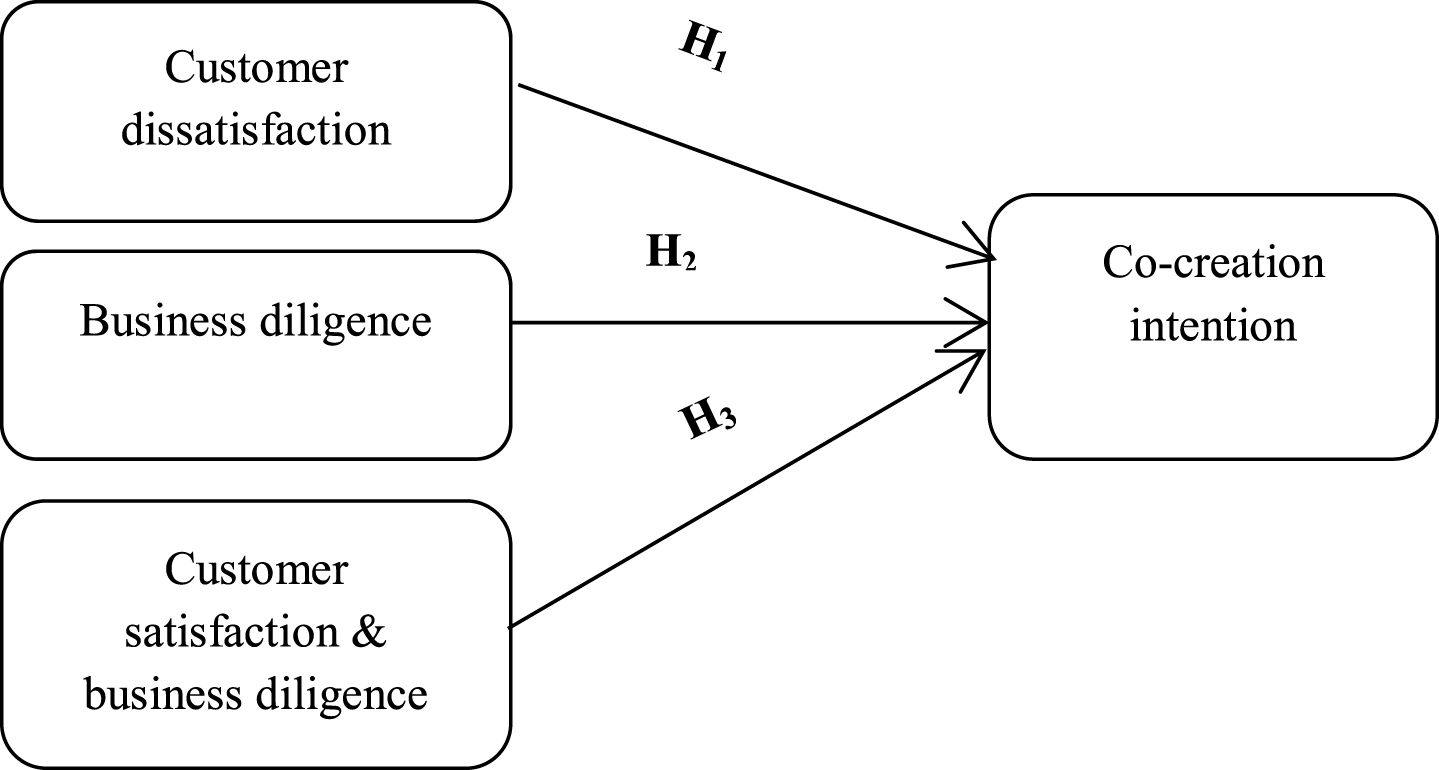
Research model with interacting effect.
Xiaomi was chosen as a case study. Xiaomi is a company who creates hardware, software and internet services, and the world’s 4th largest maker of smartphones [11], (Fig. 2) In the year 2010, a Chinese entrepreneur Lei Jun founded Xiaomi. The company is expanding in order to become a global brand. Currently, Xiaomi has launched its products in Taiwan, Hong Kong, Singapore, Malaysia, Philippines, India, Indonesia and Brazil. Some of their products include Mi Note Pro, Mi Note, Mi 4, Redmi 2, Mi TV, Mi Band and other accessories. The company has a culture of “Just for fans”. In this regard, they engage customer ideas and sees customers as part of the team to create the best experience for their users. The name Xiaomi ( ) in Chinese literally means ‘millet’. The “MI” in the logo of the company stands for “Mobile Internet”. It also stands for “Mission Impossible” to represent the challenges the company faced in the early stages. Co-creation activities are performed on the MIUI platform available at
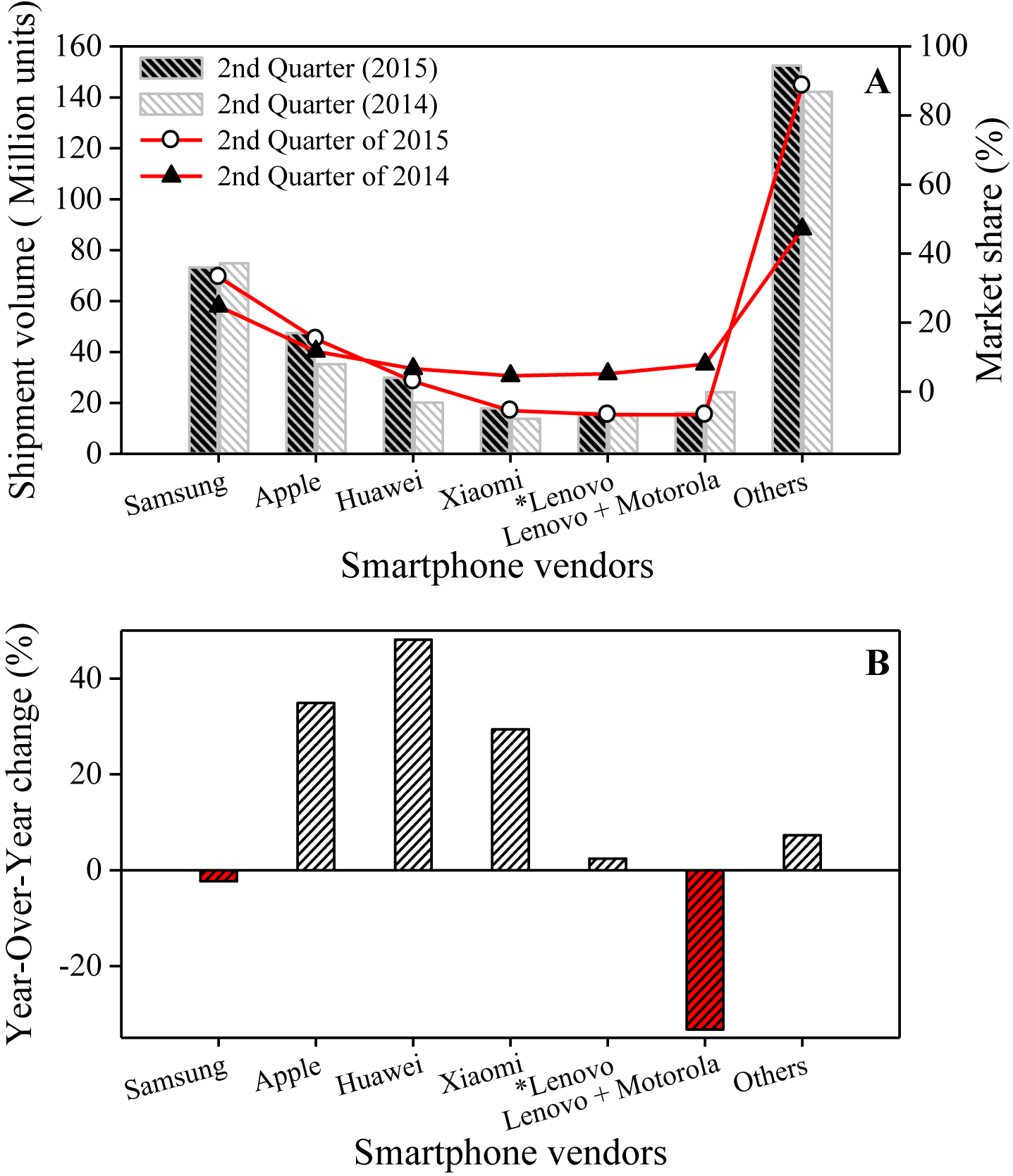
Global top five smartphone vendors in the 2nd quarter of year 2014 and 2015: worldwide shipments (
Customer satisfaction and co-creation intentions
In simple terms, dissatisfaction can mean discontent. Though it is very difficult or nearly impossible to satisfy everyone, companies have a task to make sure that all their customers are in a way content with their products and services. Therefore, if a customer’s prediction in terms of satisfaction is not met, then they are least or not at all satisfied [12]. Several researchers have suggested several dissatisfactory behaviors that customers exhibit such as complaining, exit, negative word-of-mouth, voice etc. [13–16]. To add to existing literature, this paper proposes that when customers are not satisfied, they are not likely to engage in any co-creation activities. For as long as customers are not convinced with the options offered by companies, there is bound to be dissatisfaction along the line [17]. For the purpose of this paper, co-creation is defined as the process whereby customers partner with companies to suggest ways to improve products and services to benefit both parties. To this effect Czepiel suggests that as long as the customer is involved in the production process, there is bound to be satisfaction [18]. In the process of co-creation, customers are actively involved so as to analyze their levels of satisfaction, however, customer satisfaction requires a certain level of “tolerance” on the part of customers [19], if not, it is highly possible that customers who are dissatisfied will not be willing to engage in co-creation activities. From this, the first hypothesis can be postulated as:
H1 Customer dissatisfaction has a negative impact on co-creation intentions.
Effect of business diligence on customer satisfaction and co-creation
Interaction with customers should be the purpose of every individual. Therefore, companies should be able to provide the platform for such interaction. When customers express dissatisfaction, it is very essential that companies respond so as to make customers feel attended to. Customers can react to a product or service and give information to the company through their assessments [20]. After this stage, it is expected that the company responds to such customers. Much attention has not been given to the concept of evaluation to the extent that Verhoef, Reinartz, & Krafft did not include it in their model at all [21]. Customer evaluations allows a company to know where and when its dealings are misguided [22]. Communication should be two-way; customers to business as well as business to customers [23]. From the literature, it can be hypothesized that:
H2 Business diligence has a positive relationship on co-creation intentions.
H3 business diligence moderates the relationship between customer satisfaction and Co-creation intentions.
Methodology
Participants
In August 2016, a questionnaire was administered by random sampling to users of Xiaomi phone in China on the MIUI platform. The total of respondents was 403 (N = 403). The distribution of males was 233, which represented 57.8% as compared to 170 females, representing 42.2%. Statistical Package for Social Sciences (SPSS) version 22 was used to assess and confirm the hypotheses. A multiple regression analysis was conducted to estimate the linear hypotheses in order to analyze how customer dissatisfaction can lead to co-creation intentions.
Measures
The variables were measured by means of a quintet gradient Likert-type descriptions that runs on a five-point scale from 1 (“strongly disagree”) to 5 (“strongly agree”) and modified, where applicable to fit the contents of the study. The questionnaire consisted of three major sections to measure demographics, customer dissatisfaction level, Co-creation intention, and business diligence. All the items were selected from relevant literature and adjusted to suit the study. To measure customer dissatisfaction, three items were adopted and modified from the measures used by Keaveney & Parthasarathy (Keaveney and Parthasarathy, 2001) Co-creation intention was measured by two items, adopted and modified from (Füller et al., 2011). Business diligence was measured using constructs from Brock, Blut, Evanschitzky, & Kenning (Brock et al., 2013).
The results
Descriptive statistics
The descriptive statistics is made up of the mean, standard deviation and bivariate correlation of all the variables in the study as presented in Table 1. Customer dissatisfaction and co-creation intention were negatively correlated (r = –0.965, p < 0.001) and this affirms the 1st hypothesis. Business diligence had a positive correlation with co-creation intention, as hypothesized. Business diligence and co-creation intention yielded a positive correlation (r = 0.976, p < 0.001).
Means (M), standard deviations (SD) and correlations among study variables
Means (M), standard deviations (SD) and correlations among study variables
Note. N = 403 CD = customer dissatisfaction, COINT = co-creation intentions, CF = business diligence, *p < 0.05; **p < 0.01.
Effect of customer satisfaction on co-creation intentions
The main focus of this study was to assess whether dissatisfaction has any effect on customer co-creation intentions. In this paper, age, gender and education were set as the control variables. Thus, they were first used in the analysis and then followed by the independent variable, customer satisfaction. The next was the moderating variable, which is business diligence and how it affects the relationship between satisfaction and co-creation intention. The results of the regression analyses are presented in Table 2. In model 1, we tested the effect of the control variables on the dependent variables. The results proved a very minimal effect. As we envisaged in hypothesis 1, the outcome of our model yielded a negative effect on co-creation intentions, which means hypothesis 1 was backed by our model. (β= –0.966, p < 0.001). In hypothesis 2, we proposed that business diligence has a positive effect on co-creation intentions. This is seen in model 3, (β= 0.632, p > 0.05). Therefore, our model supports this hypothesis.
Results of hierarchical regression analyses that examine the main and moderating effects
Results of hierarchical regression analyses that examine the main and moderating effects
Note. N = 403 CD = customer dissatisfaction, COINT = co-creation intentions, CF = business diligence, *p < 0.05; **p < 0.01.
To test for the moderating effect we first put in the control variables; age, gender and education. We then followed it by customer dissatisfaction as the independent variable, then the moderating variable. This led to the interaction term customer dissatisfaction and business diligence. This step was crucial and followed that order so as to decrease the problems associated with multicollinearity [24]. The result is displayed in model 4 (β= 0.029, p < 0.001). The results affirmed a positive reciprocal action between customer dissatisfaction and co-creation intentions with the presence of business diligence, which explains 29% (ΔR2 = 0.29, ΔF = 0.256, p < 0.001) which reflects that business diligence has a moderating effect on the relationship between customer dissatisfaction and co-creation intention. This means that hypothesis 3 was duly supported.
Discussions
Results discussion
The main focus of this paper was to examine how companies can benefit from customers with lower levels of satisfaction by incorporating business diligence as a moderating variable. Our results showed a negative relationship between customer dissatisfaction and co-creation intention, but a positive relationship between business diligence and co-creation intentions. And finally, a positive effect between customer satisfaction and co-creation intentions when moderated by business diligence. Ideally all the hypotheses, 1, 2 and 3 were buttressed by empirical testing.
From this study, we established that when customers are not content with a product or service, they choose not to engage in any co-creation activities or any interaction with the company as long as the company is adamant to their dissatisfactory experiences. However, when companies interfere, offer some comments on their exasperation, and promise to offer solutions to their problems, they are likely to engage in co-creation activities. It is without a doubt that companies benefits from co-creation and scholars have affirmed to this posit [25–27]. Nambisan and Baron stressed how co-creation can help companies to receive experiences from their customers in the form of their creativity, knowledge as well as their evaluation of the product and/or service [28]. We can therefore conclude that, even though it is very difficult to satisfy all customers, companies can interact with their customers and address their concerns in the best possible way that they can. By so doing, they can turn offended customers into co-creators.
Limitations and future research
Despite the findings of this study, certain limitations cannot be overlooked. First of all, customer satisfaction and co-creation intentions were measured using data from the Chinese users of Xiaomi phone and did not include users in the western part of the world. The results would reflect better if applied in a cross-cultural dimension so that our findings can cut across. Again, our study was based on users on the MIUI platform only. Other studies can consider users of other brands of phones such as Samsung and IPhone. Lastly, this study focused on how to reverse low satisfaction levels of customers into co-creators. Imminent studies can consider how to curb or avoid customer dissatisfaction in the first place.
Theoretical implication
This study eventually contributes to customer dissatisfaction literature in 3 ways: first, this study empirically proves that customer dissatisfaction result in a decline in customer co-creation intention. Albeit several literature on customer dissatisfaction, none has delved into the effect on co-creation intentions. The second contribution is that by observation, this study extends the customer satisfaction and co-creation literature by introducing the role that business diligence plays in the relationship between the two variables. The results validate our hypothesis and confirmed a positive relationship between customer dissatisfaction and co-creation intention as and when business diligence was introduced to moderate the relationship. Lastly the study contributed to the customer satisfaction and co-creation literature by exploring customer satisfaction in the users of Xiaomi phone in the Chinese context.
Managerial implication
Practically, this study is relevant for companies and organizations in the following ways: first of all managers should be conscious of customer displeasure and find ways to curb or eliminate it, as it can have a very negative impact on their activities and eventually affect their profit margin. In the context of Xiaomi phone users in China, the company can set up a platform for customer complaints and make sure provide the opportunity for evaluation as and when it is needed. This will go a long way to reduce dissatisfaction in their products which will result in an increase in purchases and patronage, thereby, increasing the profit margin. Xiaomi can offer compensation to customers who are vexed in the form of discounts, money back guarantee, low prices and assurance of improvement. To increase co-creation, Xiaomi should interact more with users on the MIUI platform and respond to their dissatisfactory experiences. As affirmed by Gupta & Dhillon, the company faces several impediments in its operations, especially in the area of maintenance and repairs [29]. Their research suggested recruiting more experts in this area so as to facilitate their activities.
Footnotes
Acknowledgments
This study was supported by funding from the National Natural Science Foundation of China (Grant No. 71272173 and 71490722).