



Abstract
Although employee management research has established significant relations between high performance work systems (HPWSs) and financial and market performance, few studies have considered the important role of HPWS in other organizational functions such as learning and innovation. Whereas, according to literature, both innovation and learning which are of the most important factors for firm’s survival, generally result from employees’ behavior. Therefore, the purpose of this study is to explore potential impacts of HPWSs on organizational learning (OL) and innovation. A set of research hypotheses are tested using sample data collected from 112 employees of electricity distribution companies of Isfahan province. The proposed HPWS consists training and development, pay for performance, career development, participation in decision making, and job security, while innovation includes product, process and administrative innovation and OL is a four dimensional construct of knowledge acquisition, knowledge distribution, knowledge interpretation, and organizational memory. Partial least squares structural equation modeling (PLS-SEM) reveals that HPWS positively affects OL and innovation. Moreover, the research results show that there is an indirect effect of HPWS on innovation through OL.




Introduction
For the last two decades or so, management scholars and practitioners have been declaring the arrival of a new conceptual approach to the ways in which some certain employee related practices have a significant impact(s) on different organizational aspects. Unlike traditional employee management researches, which have focused on the impact of individual employee management practices, the new approach which is from a strategic perspective, examines the effects of bundles of employee management practices, often referred to as HPWS. In fact, these practices consist of a set of coherent practices that enhance employee skills, participation in decision making and motivation to put forth discretionary effort. In this regard, with taking a resource-based view, organization’s employees can be a source of competitive advantage [1] and HPWSs can be assumed as a mean to gain a competitive edge [2, 3].
On the other hand, despite the numerous studies showing positive relations between employee management practices and various measures of firm performance [4, 5] and employee attitudes and behaviors [6–8] some scholars have noted a surprising lack of attention to the impact of HPWS on other critical factors (e.g. innovation, OL and etc.) within the firm [3, 10]. Since in today’s knowledge society, OL and innovation are main key capabilities that enable the firm to identify, create, exploit, renew, and apply knowledge flows in new ways to obtain improvement in organizational performance [11]. Moreover, the turbulence of the business environment has spurred increased interest in learning and innovation as a critical driver of competition [11]. Firms with greater learning attitudes and innovative capabilities will be more successful in responding to a changing environment and improving their competitiveness [12]. Employee management has been highlighted as one of the most influential factors in a firm’s innovative and learning behaviors in innovation theory. Therefore, past studies on innovation have tried to determine which employee management practices affect a firm’s capabilities of learning and generating innovation. However, to date, these studies have seldom treated employee management practices as systems, which is labeled as HPWS in the literature [1, 12].
Thus, the primary objective of this paper is to develop and examine a conceptual framework that provides a better understanding how HPWS influence OL and innovation. Such a framework could help us better comprehend the role of HPWS and its influence on an organization. For this purpose, first we review the literature on the impact of HPWS on OL and innovation alongside with discussing their possible relations. In Sec. 2, we discuss our research model and formulate hypotheses. Section 3 elaborates on the research methodology. Section 4 presents the results of our empirical analysis and it ends with conclusions and suggestions for further research.
Literature review
HPWS
Traditional literature on employee management has focused on the analysis of employee management practices and performance from different perspectives. One of the most outstanding approaches is the system approach [6]. Under this viewpoint, the joint consideration of some sets of employee management practices results in superior performance than other alternative perspectives [1]. Because, scholars generally agree that the impact of system or bundle of connected employee management practices on competitive advantage can be greater than the cumulative impact of all of the individual practices comprising the bundle, the past two decades have witnessed a shift from a practice-oriented view to a bundle-oriented perspective in the employee management literature [12]. These sets or configurations of practices have been labelled as HPWS in the specialist literature and are designed to promote employees’ skills and behaviors to achieve organizational strategic goals [2, 13]. Current perspectives on HPWS are closely aligned with research on high involvement work practices (HIWPs) and high performance employee management practices. In fact, researchers frequently note that various naming preferences are often used interchangeably and refer to the same phenomena of interest (i.e., a system of employee management practices rather than isolated practices) [14].
The core business of the HPWS function is to develop the employees in accordance with the business strategy, select and hire people, train and develop the staff, evaluate their performance, reward them and create a culture of learning [15]. Though, HPWS refers to a set of employee management practices that positively affect employee attitudes, motivation, and performance [1]. Grounded in resource-based view of the firm (RBV), HPWS proposes that firms can build competitive advantages by developing unique employees. RBV explains how specific internal resources contribute toward a firm’s achieving sustainable competitive advantage [7].
Although scholars do not agree on a specific set of practices comprising an HPWS configuration, practices can be summarized into five broad categories; (1) selection, (2) training, (3) career development, (4) motivation practices, (5) job security. The goal of each practice is either to select, develop, and retain employees, or to motivate them to produce employee output that enhances competitive advantage [6, 16].
HPWS and innovation
Innovation implies the adoption of an idea or behavior which is new for the organization [17]. Literature distinguishes different types of innovation. An innovation can be a new product or service, a new production process technology, a new structure or administrative system, or a new plan or program pertaining to organizational members [18]. Since the purpose of this article is to analyze how HPWS and OL influences the whole innovation activity of the firm, the present study adopts a broad concept of innovation that includes the adoption of any new product, process and administrative innovation. Innovation helps the company to deal with the turbulence of external environment and, therefore, is one of the key drivers of long-term success in business, particularly in dynamic markets [19].
The literature highlights employee management as one of the determining factors in the firm’s innovative behavior [20–22]. Innovative organizations support creativity and pioneer productive change through affording individual employees or members of the organization the freedom to work independently in the pursuit of new ideas and autonomous actions [23]. When firms develop new products and improve management processes, they require the motivation and ability of employees to produce creative ideas, develop innovative approaches, and exert new opportunities [19]. Employee management function can influence and modify the attitudes, capacities, and behaviors of employees to achieve organizational goals and it plays a crucial role in nurturing the necessary conditions for catalyzing and channeling individuals towards the development of innovation activities [6].
On the other hand, HPWSs have been found to be positively associated with organizational performance [2, 14]. In explaining the above link, researchers mostly use the Ability-Motivation and Opportunity (AMO) framework. The AMO framework suggests that effective employee management practices can improve employees’ knowledge, skills and abilities (A), motivation (M) and the opportunities (O) to express their talents [1, 22]. Similarly, it can be used to explain the link between HPWS and organizational innovation. HPWS improve employees’ knowledge, skills and abilities to innovate, i.e. by building their expertise and talent [22]. Considering the arguments in the above paragraphs, we put forward the following hypothesis:
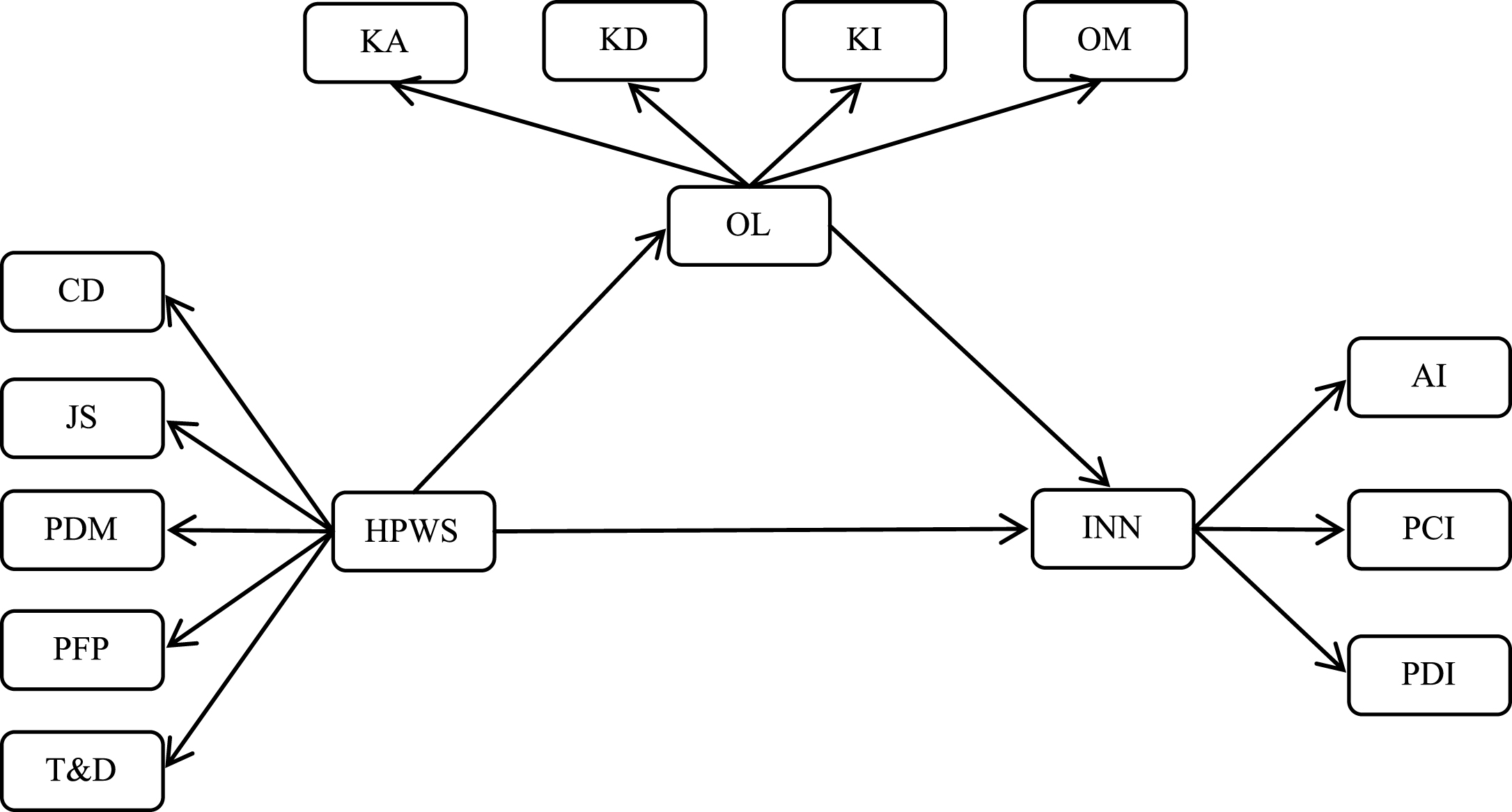
H1: HPWS positively affects innovation.
HPWS and OL
Organizations can be described as continuous learning systems, and OL has been defined as a process of coordinated systems change, with mechanisms built in for individuals and groups to access, build and use organizational memory, structure and culture to develop long-term organizational [19, 25]. OL is also the organizational capability to continuously enhance, the collective capacity to reflect, to learn how to learn, to unlearn old ways of doing things and abandon old habits [26]. Moreover, there is an assumption about OL which propose that the learning process has identifiable stages thou it’s a multidimensional concept. In this regard, it’s broadly accepted that OL is a process consisting four dimensions: knowledge acquisition, knowledge dissemination, shared interpretation and development of organizational memory [19, 28]. Knowledge acquisition refers to acquisition of new knowledge internally and externally, while knowledge distribution refers to transferring or sharing of the acquired knowledge, knowledge interpretation to incorporate significant aspects of knowledge through shared understanding and coordination for effective decision-making and finally organizational memory relates to storing knowledge for future use either in the form of designing organizational system or in the form of rules, procedures, etc. [28].
An organization has many tools to manage the process of learning, but in principle, the learning ability of an organization depends on its ability to accumulate invisible assets [29]. As invisible assets such as knowledge are embodied in people, policies regarding employees are critical to OL [30]. Individuals play a fundamental role in the development of OL [27, 28]. Researchers generally agree that organizations learn only through individuals who learn [6, 26–29]. Adult learning theory tells us that people learn primarily by being encouraged to tackle challenges, experiment, fail and correct failures and reflect on their experiences [31]. Thus, it is suggested that some of the more traditional personnel functions of employee management practitioners may be tailored to encourage a focus on learning and thus to help achieve organizational goals [10]. Employee management systems have accordingly been expanded in some companies to encompass the facilitation of individual, group and OL [10, 27]. Using literature relevant to HPWS and OL, it can be assumed that there are a number of evidences showing HPWSs are particularly relevant to the promotion of learning [6, 28]. Therefore, the following hypothesis is proposed:
H2: HPWS positively affects OL.
OL and Innovation
Innovation is often characterized as a kind of “capital” for the organization [17] and it requires that individuals acquire existing knowledge and that they share this knowledge within the organization [19]. Recently, one major stream of innovation studies focuses on human aspect that lead to innovation [6, 33]. Based on the RBV, an organization’s innovation performance is rooted in the personnel embedded in it that cannot be replicated and transferred [1]. In other words, an organization with the most advanced technology but one that is lacking talented employees still cannot perform and conduct innovative projects. The concept of OL stresses that organizations are systems that support learning and performance improvement at multiple levels of an organization. Therefore, the term innovation performance is connected with OL practices [19].
In addition, OL is understood as the organization ability to absorb and transform new knowledge and apply it to the development of new products with competitive advantage and high production speed [32]. The foundation of organizational knowledge through which new knowledge is gained from existing knowledge (OL) stimulates organizational innovation [17, 33]. Innovation also needs the transformation and exploitation of existing knowledge [34].
Recently, some empirical studies have started to demonstrate that an OL capability has a positive effect on the organizational innovation performance [6, 32–34]. According to these studies, innovation requires that employees share information and knowledge and it occurs when employees share their knowledge with the organization and when this shared knowledge generates new and common insights. In short, OL allows the development, acquisition, transformation and exploitation of new knowledge that enhances innovation [34]. Thus, the hypothesized relation between OL and innovation is stated as follows:
H3: OL positively affects innovation.
The aforementioned hypotheses can be illustrated with Fig. 1.
Research model.
Data collection and sample
This study employs a questionnaire survey method for testing the hypotheses and data were collected from electricity distribution companies of Isfahan province. The participants were executives and employees whose career were related to knowledge repositories of those companies. A total number of 155 employee included in the research and a number of 112 of them were proposed as sample according to Cochran’s sampling techniques. After excluding questionnaires with missing data, 100 usable questionnaires (89 percent) obtained for final analysis. The summary of demographic information is shown in Table 1.
Sample characteristics
Sample characteristics
The constructs utilized in the study are measured by a five-point Likert scale. Respondents were asked to indicate their agreement to these statements on five-point Likert scale with anchors ranging from “1 = disagree strongly” to “5 = strongly agree”. All constructs are measured using items based on the literature.
HPWS
The scale consisted of 17 items and was validated with our sample. These included five sub-scales referring to five key HR practices: training and development (T&D) (four items), pay for performance (PFP) (four items), career development (CD) (three items), participation in decision-making processes (PDM) (four items) and job security (JS) (two items). This measure was based on the scales developed by Escribá-Carda N., Balbastre-Benavent F., and Canet-Giner MT. [6].
OL
This study measures OL as a single construct, made up of the four behavioral dimensions: knowledge acquisition (KA) (three items), knowledge distribution (KD) (three items), knowledge interpretation (KI) (three items) and organizational memory (MO) (four items). This measure was based on the scales developed by Jiménez-Jiménez D, Sanz-Valle R. [19].
Innovation
This study uses three items for each type of innovation — product (PDI), process (PCI) and administrative (AI) — covering the number of innovations, the proactive or reactive character of those innovations, and the resources the firm invests on innovation. This measure was based on the scales developed by Jiménez-Jiménez D, Sanz-Valle R. [19].
Data analysis
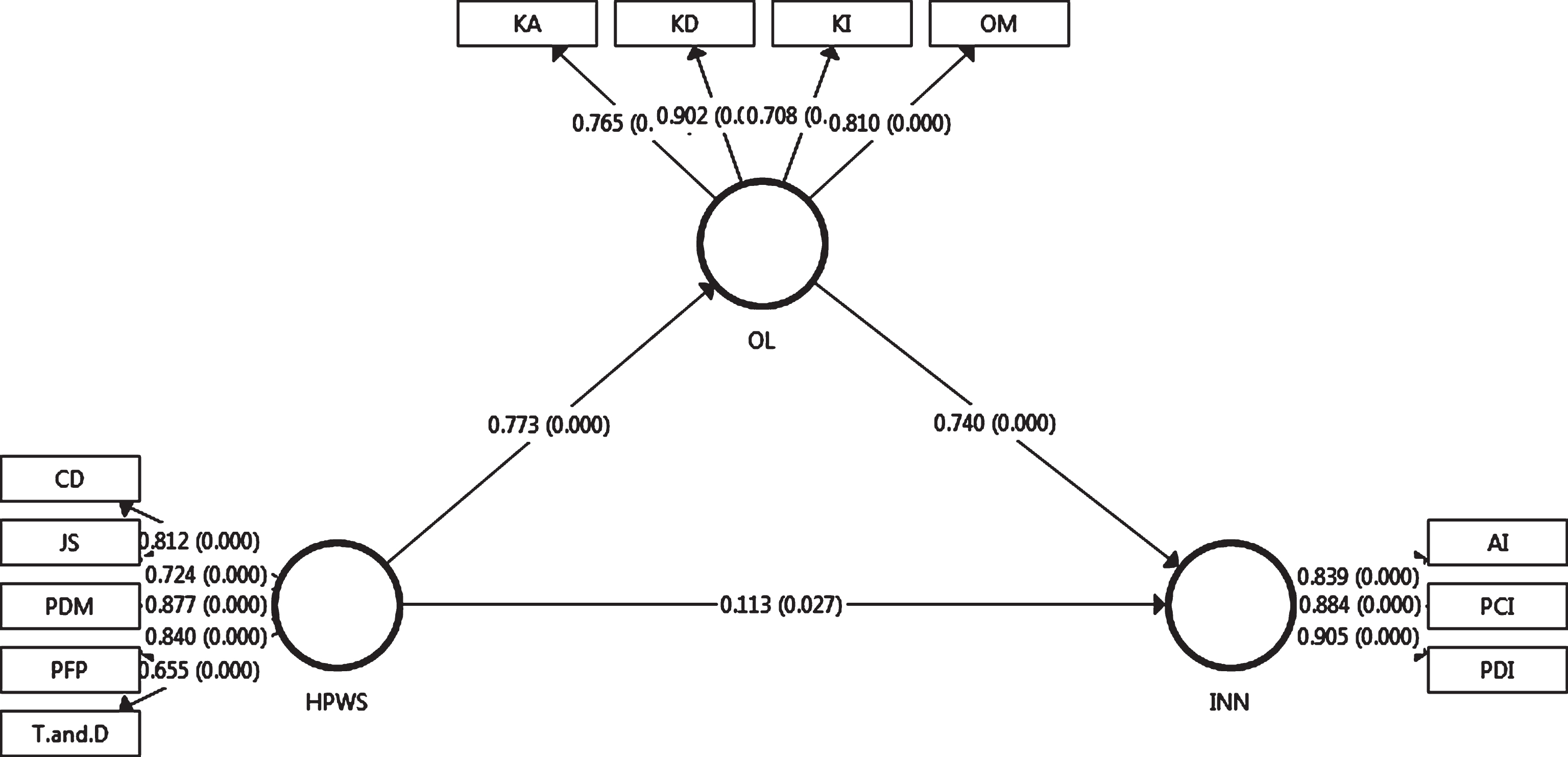
Data analysis was completed with Smart PLS 3.2 software [35] through a two-stage PLS-SEM technique. At the first stage, the measurement model was examined for construct validity and reliability whereas in the second stage, the structural model and by implication the research hypotheses were tested (Fig. 2). The use of PLS-SEM technique derives mainly from its robustness with small and medium samples and it suitability for making predictions with non-normal data [35]. In addition, it has been noted that the PLS-SEM procedure is the most appropriate for exploratory-confirmatory studies because it is the suitable SEM technique for making predictions [35]. PLS-SEM technique is therefore helpful for building and testing causal theory. Since a sample of medium size was employed for the purpose of conducting exploratory-confirmatory analyses leading to the testing of a causal theory in this paper, the PLS-SEM was considered as the most suitable technique that will guarantee the stability of the model estimation. Additionally, since priority was placed on prediction rather than covariation, PLS-SEM is the most appropriate [35].
Structural model analysis.
Of particular relevance to this study, PLS-SEM incorporates both formative and reflective constructs as well as Hierarchical Component Models (HCMs). In HCMs a general construct is defined that consists of several sub-dimensions. Thus, while the more general construct becomes part of the structural model, additional information can be found on the sub-dimensions by using a second-order model. By using HCMs, we are able to reduce the number of relations in the structural model, making the PLS path model more parsimonious and easier to grasp [35]. Since all constructs in our structural model were multidimensional, they were operationalized as ‘reflective–formative’ higher-order components. Each dimension was measured by its reflective indicators, while their relations with the constructs were indicated as formative. Finally, in establishing the final HCM measurement model, we followed the ‘repeated indicators approach’ combined with the ‘two-step approach’.
As it is shown in Table 2, the results of the measurement model are presented. All item loadings are above the recommended value of 0.70, composite reliability (CR) and Cronbach’s alpha are above 0.80 and average variance extracted (AVE) values are above 0.50, which prove that there is convergence among the research constructs. By computing the CR and Cronbach’s alpha values, the results demonstrate an efficient internal consistency for the items and constructs. We also tested the formative factors for multicollinearity by calculating the Variance Inflation Factors (VIFs) of the items in the formative construct. In our case, all of the VIFs of the indicators were below 3.3, indicating sufficient construct validity for our formative indicators.
Construct validity
Construct validity
In order to assess the construct validity in this research, Fornell and Larcker’s [36] method was used to determine the discriminant validity via the criterion of cross-loading which existed among research constructs. As it is illustrated in Table 3, the correlations that exist among the study’s latent constructs are outlined as off-diagonal values. Moreover, the diagonal values are depicted as square values of AVEs (bold values in Table 3). Hence, as it established by Fornell and Larcker [36], there is discriminant validity among the research’s constructs [36].
Fornell-Larcker criterion
Also, as it is pointed out, cross-loading proves the existence of discriminant validity among the study’s constructs. As it is portrayed in Table 4, comparing the loadings across the columns demonstrates that each indicator’s loadings (by itself) are higher (shown as bold values) than all of its cross-loadings with other constructs in all observed cases. Finally, discriminant validity was also established in Table 5 based on Heterotrait-Monotrait Ratio criterion within which all values are below the threshold of 0.90 [35].
Cross loadings
Discriminant validity – Heterotrait-Monotrait ratio
After assessing and validating the study’s measurement model, the structural model was also assessed. We evaluated the quality of the structural model by using the R-square of the dependent variables and the Stone-Geisser Q-square test for predictive relevance. Results are shown in Table 6.
Structural model assessment
Moreover, Hair et al.’s [35] method was utilized to measure the study’s reflective constructs in a structural model. In parallel with measuring the structural relations that entailed the path coefficients, the research further examined the significance that existed among the relations via running bootstrapping with samples of 2,000 [35]. As it is shown in Table 7, t-statistics were used to evaluate the significance level of the path coefficients that existed among the variables. Also, the relations they represent, as hypothesized in this study, was studied. Table 7 illustrates the structural relations identified by the present research along with results derived from hypothesis testing. All hypotheses were proven to be significant. It can be concluded that HPWS can be declared as a mean to enhance innovation and OL among electricity distribution companies of Isfahan province. Furthermore, the results show that OL does indeed mediate the relation between HPWS and innovation. Since the β value of the indirect path of HPWS-OL-Innovation, which is the multiple of two direct β value of the HPWS-OL and OL-Innovation paths, is greater than the β value of the direct path of HPWS-Innovation (0.572 > 0.113), then it can be concluded that HPWS has a significant indirect effect on innovation through OL (P < 0.001, T-value = 15.655). In other words, OL mediates the HPWS-Innovation relation and enhances the innovation of electricity distribution companies of Isfahan province.
Result of hypothesis testing and structural relations
*P < 0.05. **P < 0.01.
The impact of HPWSs on organizational performance has received a great deal of attention in recent years [2, 22]. However, a related area that remains relatively uninvestigated is how these effects occur. Many previous studies aiming to demonstrate a direct relation between HPWSs and some measure of organizational effectiveness fail to take into consideration those intervening firm capabilities that are enhanced by HPWSs and that are the true facilitators of performance enhancement. We propose that HPWSs can contribute to achieving sustainable competitive advantage to the extent that they impact on the knowledge, skills, attitudes and behaviors that form the basis of OL and innovation. The results of this study support our hypotheses and make a contribution to employee development and management by providing additional insights into how employees may be utilized to leverage OL in order to influence innovation. The study found solid support for a range of practices (training and development, pay for performance, career development, participation in decision-making processes and job security) highlighted in the extant literature as being supportive of OL.
A second related contribution of our study is to the emerging OL perspective, which posits that OL improves innovation through better knowledge and understanding. While the importance of OL has been recognized in the literature [10, 33], empirical work on OL and its impact on innovation is still very limited. Managerial implications follow directly from the foregoing discussion. The adoption of learning as a central competence of the company is a collective responsibility and it will occur only as a result of a carefully designed strategy and shared management objectives. The role of the employee development specialist is to promote and facilitate these processes. Results from this research suggest personnel professionals must drop their traditional insistence upon their prerogative for direction and control and assume a new ‘softer’ style of management that encourages employee commitment to core organizational values, since this will be the basis for knowledge creation and OL. However, it should be emphasized that learning orientations are based on the development of shared aims and values and that learning in such organizations is the focus at all levels from the shop floor to senior manager. Learning cannot be solely the responsibility of employee practitioners.
Implications for future research
Some limitations exist in this study and need to be addressed by future studies. Previous studies have suggested that the alignment of a firm’s employee systems with its business strategies is also critical to better performance and innovation [37]. Thus, further exploring how the alignment of employee systems and business strategies can facilitate various types of innovation may help to advance the consideration of HPWSs as important mechanisms of innovation.
As is common in the field of employee management, we should acknowledge that the selected employee practices may not represent the whole picture of HPWSs. We refer to the related literature for our HPWS practices although employee management researchers do not agree as to which practices are HPWSs. However, because we were restricted by the length of our questionnaire, we selected several generally implemented employee practices as the components of our HPWSs. The restriction renders our results incommensurable with those of other studies.
Finally, our results might be biased because of the limitations of SEM. Although this approach has multiple advantages, such as the ability to simultaneously assess the fit of measurement models and structural models or handle two or more dependent variables at the same time, the potential statistical power of SEM is constrained by the complexity of the theoretical model and the sensitivity to the sample size. This statistical power is far from being in the range of acceptability, especially if the theoretical model is complex and if the sample size is relatively small. As a result, we employ the item parceling approach to reduce the complexity of the model. However, when measuring items, this approach tends to lead to the loss of information, which decreases the validity of our results to some degree.