



Abstract
Based on a study of Isfahan’s Mobarake Steel Company in Iran, this article presents a framework for viable environmental-sustainability or ‘green’ education and training. The study used an admixture of qualitative and quantitative methods, with twenty managers and steel experts interviewed, and the proposed framework quantified and ratified by means of structural equation modeling. A survey helped collect quantitative data, gleaned from 440 employees and managers. The survey was tested for its external validity, while Cronbach’s alpha coefficient allowed assessing its internal consistency. The quantitative results show the need to prioritize cultivating an environmental-sustainability culture, and building a prerequisite infrastructure that both supports and is supported by the effective and efficient implementation of green education and training. To render environmental-sustainability education-and-training programs viable, their design must be grounded in situation-specific frameworks that reflect the work entailed in protecting nature. The qualitative results show that such programs must also be: co-aligned with the intentionality of human-development resources, kept up to date and synchronized with international environmental-sustainability standards. Besides the study’s qualifications, also tentatively explored are a few policymaking guidelines and future research directions.



Introduction
The natural environment and its protection are crucial topics since the beginning of humanity’s economic, societal and political situation. Nowadays, the necessity of paying attention to environmental protection is a prerequisite for sustainable economic growth and development. Owed to business enterprises’ intense competition in manufacturing, trade and other services, and their mutation from the local and national to the international sphere, humanity’s needs and problems are ever expanding, including, for example, environmental pollution, industrial-waste disposal, energy crisis etc. Arising from environmental problems and their promulgated fixes, such as pollution, recycling and probable changes in the planet’s climate, new challenges and dimensions are added to the effectiveness, efficiency and quality of organizational decision-making. These challenges are already visible in all human societies and firms are engaging all their employees in contributing viable solutions. Company-wide, each and every employee must mentally grasp that her or his firm is but a critical component of the human society and they need to protect its natural environment. The environmental-sustainability topic is increasingly considered in business theories and is creating a revolution in modern management.
The concern about environmental problems has intensified in the 21st century [1]. Increasing of concerns and appearance of international environmental standards have obliged firms to accept strategies and hence, implementation of green management in all organizational affairs and topics [2] and includes decisions which emphasize protection of natural resources for life quality improvement. Its intent is to maintain the resources and improve the physical environment and process [3]. The so-called green management is a new concept, a combination of environmental-protection ideals with firm intents, product design, product development, marketing, finance and other variables in business management. It refers to doing perfect actions across the business process [4].
Multiple firm components, such as human-development resources, can actively encourage employees to engage in environmental-sustainability intents and purposes [5]. Human-development resources in fact seek both to optimize the use of scarce natural resources and to protect them [6]. According to [7], human-development resources refer to the use of policies, philosophies and acts of human-development resources in business field of the firm to enhance sustainable use of resources and prevent environmental harms [7]. This approach is directly responsible to train a labor force who grasps the environment and values it [8]. Human-development resources is an approach which satisfies needs of the society and firm without any harm to the society [9].
Training has always been considered as one of the most certain ways to improve performance quality and solve the problems in a firm. Lack of it is also one of the basic problems in any firm. Training is applied to all attempts toward enhancement of knowledge level, technical, professional and job skills as well as creating favorable behavior in employees to perform job duties and responsibilities [10]. In line with training of employees and managers, strategies of the firm should be determined. Strategy is determining the basic ideals and intentionality of a firm in long-term, adopting action paths and allocation of essential resources to fulfill such intents [11].
Among different functions of human-development resources, training assists managers in doing environmental activities [1] so that [12] believes that success of management and thus, human-development resources depends on training [6]. Despite the ever-increasing importance of environmental issues in activities of human-development resources, few studies have already been carried out in this regard and especially the role of training. Results of previous research [13, 14] reveal that more studies should be conducted on training.
With regard to paying attention to the issue of environment in Iran, article 190 of the Fifth Development Plan has obliged all executive bodies and non-governmental public institutions to act based on the enacted regulation by the Department of Environment and its deputy and other related bodies which will be approved by council of ministers in order to reduce cost credits of the government, apply optimal consumption policies for basic resources and the environment to implement environmental protection plans including energy consumption management, water, raw material and equipments (including paper), decrease solid waste and their recycling (in buildings and vehicles). Isfahan’s Mobarake Steel Company is one of the major industries in steel industry and economy of Iran. This company has been one of the pollutants of environment in recent years and has recently taken actions to propose a strategy in the environment scope. One of the main tasks of human-development resources at Mobarake Steel Company with regard to execution of its strategies in the environment sector is to propose and implement trainings in order to enact environmental-sustainability strategies and tactics. A pertinent education model has not been proposed in this company and training courses are sparse. To help the company improve, this praxis- or action-research project thereby intended to formulate an education-and-training framework and to assess its possible consequences. Similarly, some suggestions will be provided for managers of the steel industry and other managers such as the use of education and training to reinforce employees’ skills and creating behavioral competencies about environmental problems. Research limitations and suggestions for future researchers will be presented in the concluding section.
Theoretical principles
Human-development resources
Now, there is an ever-increasing need to combine management with human-development resources and these attempts are known as initiatives of human-development resources [15]. Researchers believe that the environment management system is effective if a firm has appropriate personnel with appropriate skills and competencies. Success and efficiency in every innovation depends on accessibility and capability of humans [16]. Increasing of vitalism directs the firms towards developing their employees’ competencies for manufacturing of products which are consistent with strict environmental rules [17]. Human-development resources plays a vital role in establishment and development of firms through activities which enhance environment-friendly performance [18]. Human-development resources approach satisfies needs of the society and firm without any harm to the society [9]. Similarly, human-development resources is directly responsible to train a labor force which grasps the environment and values it. These activities include training employees about climate changes and other environmental issues, energy consumption decrease and using vehicles which are consistent with the environment [8].
Human-development resources is responsible for awareness, information and interaction among the employees about the environment and environmental factors. It creates social responsibility among them via policy making and determining policies and directs them in doing their tasks and obligations. Human-development resources means to use the employees for enhancement of environmental actions of a firm and increased awareness and commitment of employees about environmental problems. In other words, it is the use of policies of human-development resources for sustainable use of sources in a firm. Human-development resources is responsible to create a workplace in which employees grasp the importance of environmental actions [1].
Human-development resources refer to all actions that are performed in changing, pursuing and continuance of a system in order that members of a firm have intelligence in their professional and private lives. It means doing strategies for being aware of the acts for promoting and pursuing sustainable business activities that help firms direct a friendly environment [19].
Human-development resources is led to higher efficiency and lower costs at individual, organizational and environmental levels [6]. Firms design their systems toward environmental protection for some reasons. For instance, it creates jobs and new job opportunities, provides opportunities for innovation, and finally they are led to more welfare and convenience [2].
The relationship between human-development resources and environmental management in an organizational space will be resulted in better environmental and financial performance. It can be proposed at both strategic and operating levels. At the strategic level, it will be led to a better image for the firm which will have an effective role in attraction of talents. Jeffrey [20] believes that firms which implement the programs of human-development resources take advantage of it and their employees have better spirit. Increased sales, tax exemptions, reduction of waste, improvement of work environment, increased customer satisfaction, sustainability and improvement of organizational brand are the advantages of paying attention to environmental problems. According to [21], higher joy of employees due to getting involved in environment-friendly activities and reduction of stress and diseases are the consequences of human-development resources. Besides, employees will have a meaningful sense and identify with it via getting involved in an original intent. Through this sense of joy and meaningfulness, employees participate in environmental acts voluntarily and without any coercion and they will show organizational citizenship behaviors. Execution of human-development resources will have some advantages such as higher motivation of employees, lower job rotation, higher spirit and morality of labor force, creating environmental entrepreneurships [8], and more innovation of the firm [9].
Training
Human-development resources is an extensive scope and covers all functions of resources for human development. However, importance of some functions of human-development resources is more salient and determines success of other environmental management programs. For instance, training is one of the most important functions which directly makes employees familiar with environmental problems.
Importance of training was proposed in 1990 when the necessity to enhance awareness of employees and the resultant behaviors were considered and emphasized [13]. The results of studies reveal that training and development facilitate human-development resources [20]. Some authors believe that not only the role of training is beyond the role of human-development resources but also it is one of the basic pre-requisites [23]. Among the techniques of human-development resources that seem necessary for environmental management success, training is salient [13] so that firms will have a low share in sustainable development of environment without training [23]. In other words, training is one of the most important tools of human-development resources which facilitates passing to a more sustainable society [14].
Training has been accepted in different countries. In England, 42 percent of firms hold environmental training. In the US, 300 million Euros has been invested in environmental sustainability [24]. The results of studies demonstrate ever-increasing growth of training adoption with the intent of environmental sustainability. The number of firms that have accepted training has been increased from 48% in 2001 to 67% in 2006 [14]. There is a deep relationship between training and firm development. Increased motivation of employees, enhanced innovation and realization of innovation are basic intents that are followed in firms [25].
Sammalisto et al. [26] argues that training follows two basic intents. They include training of environmental policies to employees and trying to change their individual behavior to create more awareness and more sustainable relations with the environment [13]. The intent of training for managers is to encourage and motivate them to encourage employees to show constructive behaviors. Another intent is to guarantee their cooperation about the issues of environmental sustainability. Generally speaking, it can be stated that preparing employees to perform environment-friendly activities, improvement of the training process, enhancement of awareness, developing skills, improvement of employees’ performance as well as organizational performance are other intents of training [14].
Training and development is an activity that is focused on developing environmental skills, knowledge, and attitude. It provides information about environmental values, energy saving, waste reduction and increased environmental awareness. It reinforces employees’ skills. Researchers believe that training and development should be accompanied by establishment of organizational culture. In other words, employees have to know themselves as one part of the management system [1].
Effective training programs are not only focused on environmental problems but also on how to deal with the existing challenges and problems [27]. Every training program requires a proper planning which contains identification of the cause of training, definition of intents and development of educational programs [25]. Training should be short, simple, relevant and informal and cover all employees and sectors. Employees should be participated in planning and implementation of training; firm values should be considered; and mechanisms of assessment and feedback must be defined [13].
Afshari, Moghadam, Borujeni and Bagherian [28] concluded that despite the necessity of training for all levels, differences of training for various levels must be considered when they are designed. They are designed in three classes, i.e. strategic training, tactical training, and operating training. At the top level, trainings on preparing environmental strategies and determining future needs are presented. At tactical level, trainings are about assistance of managers of units to perform activities and at the operating level, they are about finding solutions to decrease undesirable environmental effects [13]. Training of environmental problems allows employees to be able to reach the intents of the designed programs for environmental sustainability [14]. Training courses are held to create behavioral competencies, teamwork, change management, and cooperation in environment-friendly activities. Steps of training include controlling activities and resources of the existing training system, establishment of the environmental committee, job analysis, job description, environmental awareness or using performance management system to investigate productivity, quality and wastes [24]. Finally, firms should be able to evaluate the results of training [29]. Firms should evaluate educational needs before implementation of training programs. Managers can create teams and design educational needs in order to explore the needs. It is notable that such programs should be online. That is to say, such training is presented via media which reduce consumption of resources (especially paper). The results of studies reveal that training is led to value creation in a firm. But the important point is that firms should design and implement certain trainings given the type of their firm [6].
Headlines of training
Generally, the performed activities include training employees about climate changes and other environmental issues, energy consumption decrease and using vehicles which are consistent with the environment [8]; but researchers have mentioned other headlines for training: Job training [24]. Introduction of training Developing employees’ skills and competency about environmental problems Socialization of values [30]. Main topics of training including energy saving, waste management and recycling management [6]. Institutionalization of teams (Kodak, Xerox, Apple, and Merck use teams) [27]. Training employees for environmental eases of workplace Development of individual skills [30].
Obstacles of training
Implementation of training programs is faced with some obstacles. For instance, lack of support of senior managers and the gap between industry and academia about training are some obstacles in this regard [6]. Harvey, Williams and Probert [31] concluded that managers of human-development resources have had a vital role in execution of environmental actions. There are, however, some challenges and training is not an exception. On the other hand, attaching little importance to training, inadequate training programs, and not encouraging the employees are some reasons for the failure of training [25]. Also, training may be failed due to lack of adequate analysis of educational needs, transferring the concepts weakly, and lack of commitment [30]. It is notable that competencies are accessible if proper and suitable educational programs are designed and execute implemented [22]. Moreover, encouragement and motivation of employees in the process of learning and training must be emphasized [28]. Rangarajan and Rahm [33] concluded that income, training, environmental awareness and previous experience have a positive effect on implementation of human-development resources.
Methodology
The study relied on an anasynthesis of qualitative and quantitative methods, with twenty managers and steel experts interviewed, and the proposed framework quantified and ratified by means of structural equation modeling. Drawn from the statistical population of Isfahan’s Mobarake Steel Company, sample interviews were employed in the study’s qualitative module and structural equation modeling was indentured for its quantitative segment. The interviews were analyzed via the Kvale [34] model shown on Fig. 1.

Steps of performing a qualitative interview according to the Kvale [34] model.
Determining of intents and explaining the concepts related to the topic (content) was the first step in the interview process. In the next step, planning for design began. Then, questions of interview were proposed based on the research literature and 20 experts of steel industry and managers of Mobarake Steel Company were being interviewed. The criterion for selecting these people in the steel industry was familiarity with the environment topics, familiarity with human-development resources, and work experience in the field of training at the steel industry. Each interview was then converted into written form and in the next step, the findings of interviews were analyzed. Reliability of content analysis was measured via Scott coefficient. To this end, 10 to 20 percent of total sample size should be selected randomly and given to another person for re-coding. Degree of agreement of two coders indicates reliability of content analysis. The obtained Scott coefficient (0.786) shows high reliability of content analysis.
According to the findings of interviews, a questionnaire containing 34 questions was designed in the quantitative section. The statistical population in this section included 440 employees from staff, human-development resources, HSE unit, and roll production line sectors. The sample size was determined using Krejcie and Morgan Table. It was obtained equal to 205. Having distributed the questionnaires, 200 questionnaires were returned. Validity of the questionnaire was determined through content validity based on experts’ opinions. Cronbach’s alpha coefficient was used to determine reliability of the questionnaire. In the quantitative section, structural equation modeling was employed to confirm the model and Kolmogorov-Smirnov test was used to explore data normality.
Having analyzed the interviews, 65 primary codes were extracted. They were classified into seven categories and seven main subject matters. Table 1 shows content analysis of interviews with experts and managers of Isfahan’s Mobarake Steel Company.
Results of analyzing the interviews
Results of analyzing the interviews
Implementation of training is not possible without the required substructures and an appropriate culture should be cultivated for training. To this end, trainings are needed and most experts believed that training to form attitude should be offered and finally, employees’ life style will be changed. The most part of training at Isfahan’s Mobarake Steel Company is related to the environment that intends to decrease energy consumption and waste. It indicates that this company has understood the importance of such trainings. Similarly, the experts believed that training courses should be held for all employees and managers’ training program should especially be considered. It was believed that the training method should be consisted of class presentation, case study, and showing film. The steel experts maintained that trainings must be proportional to international standards and in cost-benefit language. Given the content analysis of interviews, an education model was proposed that is shown on Fig. 2.
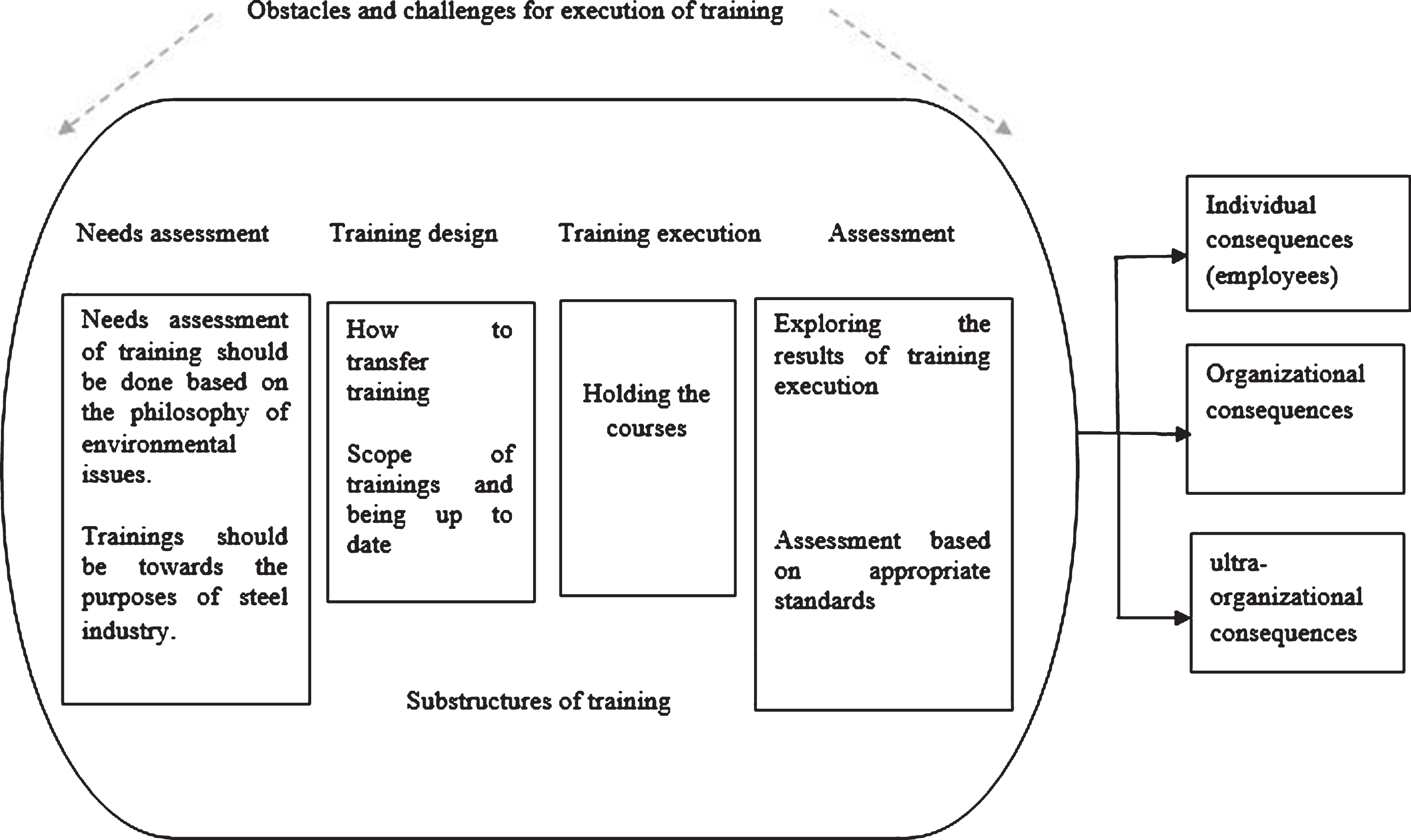
Education model.
Having proposed the education model at Isfahan’s Mobarake Steel Company, a questionnaire was prepared to confirm the model and it was distributed among the employees. Reliability of the questionnaire was approved through Cronbach’s alpha coefficient that showed appropriate reliability of the questionnaire based on table of coefficients. Normality of data was tested via Kolmogorov-Smirnov test. The results are shown in Table 2.
Results of Cronbach’s alpha coefficients and data normality
Data normality was approved by means of structural equation modeling and AMOS20 software. Now, the proposed model is tested. This is shown on Fig. 3.

Structural equation modeling.
Goodness indices were employed to confirm structural equation modeling. The most importance indices are presented in Table 3. According to this table, goodness of fit indices are desirable and the model is confirmed.
Goodness indices for structural equation modeling
Two partial indexes, i.e. critical value (CR) and P were used to confirm the effect of training on individual, organizational and ultra-organizational consequences. Critical value is obtained from the result of “estimating regression weight” divided by “standard error”. According to significance level 0.05, critical value should be greater than 1.96. Parameters with values less than it are not important. Also, values less than 0.05 for P-value indicate significant difference of the calculated value for regression weights equal to zero at confidence level 0.95. The results are displayed in Table 4.
Results of confirmation of the effect of training on its consequences
According to the table, the effect of training on individual, organizational and ultra-organizational consequences is confirmed.
The current research intended to explore education and training for human-development resources at Isfahan’s Mobarake Steel Company. This company has an important status in the economy and industry of Iran. Activities of this company as one of the biggest industries in Iran are highly effective on the environment and unfavorable effects of these activities should be reduced by means of training. In the event that training is implemented properly, it will be one of the pre-requisites for implementation of human-development resources and will create value for beneficiaries. This result is similar to Daily ‘s research [12] but it should be considered that training must be towards the firm intents and it should be designed and implemented based on international principles. Likewise, special attention should be paid to managers’ training. On the one hand, experts believed that the required culture must be cultivated before training is implemented. The results of Ahmad’s study [1] are similar to results of this research. The interviewees believed that the department of education and security and heath unit are responsible to design training. Security and heath unit is responsible to make policies for training and does not have an executive responsibility. The results disclosed that one part of this training is currently implemented at Mobarake Steel Company, but more professional training should be designed proportional to every sector for the preservation of the environment. These findings are similar to the ones by Goswami & Ranjan [6]. There must also an applied view to such training and it should not have just an external aspect or is done perfunctorily. They should not be viewed as expense. For successful realization of human-development resources as well as education and training, status of human-development resources must first be defined. Respondents believed that training should be held for all organizational levels. This is similar to findings of Jabbour et al. [13].
Other results revealed that competencies should be considered as the main factor in proposing training courses. According to the findings, positive results in individual, organizational and ultra-organizational scopes can be obtained via implementation of training. Consequences in the individual dimension include reduction of stress and disease, increased joy, etc; in organizational dimension include gaining social legitimacy, improving social responsibility, reduction of costs; and in intra-organizational dimension include lower pollution and health of the society. These consequences are consistent with the results in Mohammadi Shourkani et al.’s research [21].
It is suggested to keep the purposes of education and training up to date and coordinate the programs with international standards. Economic view to training programs is not sufficient, because this type of view impedes the firm from reaching higher intents. On the other hand, attracting managers’ support and allocation of the required budget by them, cultivating culture for implementation of training and proper designing of them considering the special conditions in Iran are other suggestions of this research.
Managerial implications
Training is one of the best ways for cultivation of culture in various scopes of life including the environment. Using training and appropriate policy making in this field, managers can cultivate an environmental-sustainability culture through changing of employees’ attitude, as Jabbour [27] has argued in his survey. Likewise, managers are able to reinforce employees’ skills in environmental-sustainability issues via education and training and thus, improve productivity and decrease waste. Ahmad [1] has mentioned this point in his study. Paying attention to training can reinforce the required behavioral competencies for environmental protection among the employees and managers of companies as Renwick [24] has emphasized on establishment of behavioral competencies through education and training. Besides reinforcement of employees’ skills and attitude, managers can realize economic benefits such as sales increase and reduction of crimes in various institutions like the government and noneconomic benefits such as creating social legitimacy, brand improvement, and acting to social responsibility by focusing on training. If managers invest in education and training, they will have employees who pursue environmental protection. Moreover, their firm will become pioneer in the industry. As shourkaei et al. [21] have mentioned, managers need employees who support environmental policies in order to enjoy the advantages of paying attention to the environment such as reduction of tax exemptions. Through education and training, managers are able to improve organizational citizenship behaviors and use the advantages of paying attention to environmental problems. One of the uses of training in a firm is human-development resources, that is, training is led to growth of human-development resources and their maturity in environmental protection and observance of it is achieved [13]. Finally, the topic of education and training will be added to educational discussions of Iranian firms by doing this research. Also, the present research will help similar firms to perform similar studies and support them in the field of human-development resources.
Research limitations and suggestions
As the current research has been carried out at Isfahan’s Mobarake Steel Company, the proposed model cannot be generalized to other companies given the different organizational culture and policies and strategies of this company with other companies. The model must be changed according to the organizational culture and environmental strategies of other companies. In the same vein, this research has been conducted in Iran and it probably cannot be generalized to other countries due to their various cultures. Considering this limitation, it is suggested to explore the education model in other countries if possible and compare the models in terms of various cultures. Given Figs. 2 and 3, there are one-way relations among the variables. In the real world, these relations might be mutual. Hence, it is suggested to future researchers to consider mutual relations among the variables if they conduct any research in this regard. Also, given some limitations such as having access to some senior managers of the steel industry as well as the sample size who participated in the present research, other variables may be involved in education field which have been ignored here. It is, therefore, suggested to future researchers to identify deficiencies of this model and improve it.
Footnotes
Acknowledgments
We are grateful to Zeynab Amiri who has had a significant role in the development of the work presented here.