




Abstract
This article presents an overview of the specific roles that business knowledge transfer, indigenization and human-development resource management (HDRM) play in the People’s Republic of China. By comparing American, Japanese and Soviet business and management theory and practice, the article analyzes exogenous and indigenous influences through time on China’s HDRM, in terms of their historical roots, as well as by presenting possible explanations for national adaptations to cultural, institutional and legal norms. The study views the impact of business-knowledge transfer on Chinese HDRM theory and practice as a dynamic process, leading to the evolution of a ‘hybrid’, indigenized national HDRM framework, still unfolding. Despite the study’s qualifications, the article offers recommendations for future research.
Keywords


Introduction
The People’s Republic of China (PRC, subsequently to be referred to as China) has seen great changes since the introduction of Deng Xiaoping’s economic reforms (jingji gaige kaifang) in 1978 [16]. To date, many researchers have documented the ways what we dub as Human Development Resource Management (HDRM) in this article, has diffused into Chinese practice (see reviews in [8]). Modern people-management, known in Chinese as laodongli ziyuan guanli, emphasizes this human dimension. However, whilst many have endeavoured to discover historical origins of such changes, very few studies have explored the transfer of business management ideas across frontiers and particularly with respect to the field of human development (see [9] for an exception).
Since studying the transmission of management theory and practice can, we would argue, help to better see the history of HDRM in the Chinese context, we present an ‘overview’ of how we think new management knowledge has triggered the evolution of people-management and associated labour/personnel practices, particularly within the relevant literature in China in the CNKI database.
For instance, what is known as ‘path dependence theory’ might see this progression into six historical stages, as follows: – Opium Wars era (before 1840) Pre-Republican era (1840–1911) Republican era (1911–1949) Maoist era (1949–1979) Early Reform era (1979–1990) Deeper Reform era (1990-present).
However, we largely concentrate on the later stages of this periodization since the main strands of our study, namely the influence of Scientific Management (SM), Human Relations (HR) and Human Development Resource Management (HDRM), occurred within that time-frame. Such periodization, we must also note, is not necessarily mutually exclusive however and that a degree of overlap can be evidenced. How much is involved may be evident from the findings we present. Our division of exogenous influences on management models also by geographical origin, in turn places the American and Japanese in stages 3, 5, and 6), the Soviet in stage 4. Given the constraints of space in the article, however, we are unable to include more national examples.
For centuries, the ‘Middle Kingdom’ (Zhongguo) stood apart from foreign influences but imperialist incursions forced it to enter the international marketplace. To better analyze the business management knowledge-transfer which accompanied the modernization process of the last century or so and adaptation to cultural, legal and institutional norms, this study draws on the dialectic of what we will dub as exogenous (Western) ‘usefulness’ (yong) versus indigenous (Chinese) ‘essence’ (ti) [16].
Research questions
The specific research-questions we ask are as follows: To what extent has Chinese HDRM been influenced by exogenous management knowledge-transfer? Which exogenous management models were predominant in this transfer process vis a vis HDRM? How did these exogenous influences integrate into an indigenized national Chinese HDRM model?
In the following sections, we first introduce our theoretical framework, describe our research methodology and set out evidence from our database search. Next, we discuss the implications of these developments. Next, we explain the business management transfer process in terms of the five stages of knowledge-transfer we delineate. Last of all, we summarize our conclusions.
Theoretical framework
Our analytical framework focuses on a view of knowledge-transfer [1] that encompasses China of both imported theory and practice. This is a design based on our own conceptualization of the stages involved in what we see from empirical observation over many years of research as five distinct key stages as set out in Fig. 1. We later go on to identify the above stages of such knowledge-transfer, both direct and indirect (in turn, sequentially, importation, adaptation, acculturation, differentiation, integration), each of which we will deal with later in terms of the historical and contemporary data we have collected.
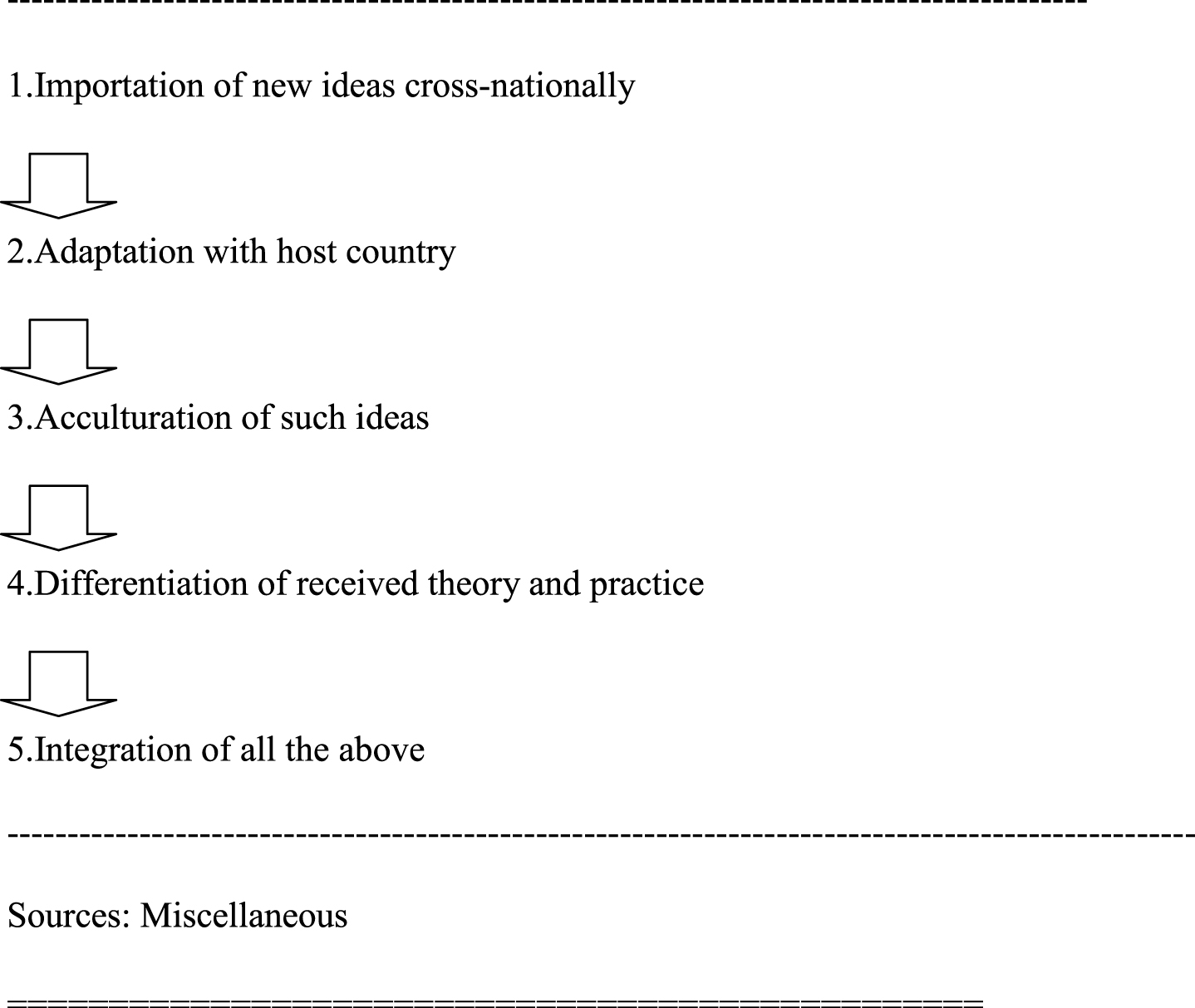
A Five-stage schema of management knowledge-transfer.
This study has researched in the relevant fields concerned vis a vis the literature, mostly but not exclusively, using the database of the China National Knowledge Infrastructure (CNKI) ‘Scholar Engine’, the largest academic one now available for scholarly studies by Chinese and foreign researchers, set up in 1996 by Tsinghua University. This database is the largest and continuously updated Chinese journal database in the world, with entries from approximately 1950 onwards (sometimes earlier) but may have gaps as many archives did not survive over the years and not all new journals were included until recently. We carried out searches for the key ‘management’ and associated phenomena featured in this study using key-terms relating to country, topic, author, dates and so on in the CNKI Academic Journal Full-Text Database, covering more than 10,000 Chinese journals, although not including books as it does not cover them. We then made an evaluation of the relevance of such data to the periods we were studying vis a vis the research questions we asked earlier regarding the role of exogenous versus indigenous factors shaping the evolution of Chinese HDRM. A good number of the ideas we offer are citations from English language journals and books. A number of relevant articles and books in both Chinese and English are, however, listed in the references to this article.
Key-term entry data
Using the key-terms selected for the study, the data we derived from the CNKI Academic Journals Full-Text Database are set out below, albeit given the limitations of such a methodology. We start with a key-term search to generate a number of articles in Chinese journals with such entries – and where available - list the first date of their inclusion. Most of the substantive quanta of data but not all, however, only appear after 1978. We did the research to show the diffusion of management knowledge into the indigenous canon of publications, that is to say how Chinese language journals reflected the importation of ideas.
Background
With Mao Zedong’s (1893–1976) takeover of power after the ‘Liberation’ (jie fang) in 1949, a Soviet-influenced Personnel Management (PM) (renshi guanli) model was soon set up in China. In 1978, Deng Xiaoping (1904–1997) launched the ‘Four Modernizations’ (sige xiandaihua) and ‘Open Door’ (kaifang) policies. In doing so, he took the PRC towards a ‘socialist market’ economy (shehuizhuyi shichang jingji) and a new labour and personnel configuration (see Fig. 2). Early HDRM was to slowly emerge, soon appearing in significant numbers in the CNKI database and starting in 1980, (see Table 1) of which more details later.

Evolution of HDRM in China.
Key-term Entries from the CNKI Full-Text Academic Journal Database
Source: CNKI Database, end of 2017. [Note: * Human + Resource + Development, for search].
In 1992, the personnel reforms (sanxiang renshi zhidu gaige) initiative specifically introduced new individual and collective labour contracts, with performance-linked rewards and contributory social insurance. Soon after, the new 1994 Labour Law (laodong fa) was to transform Chinese Industrial and Labour Relations (ILR) (laodong guanli guanxi) and its trade union practices but this law did not receive sufficient support in the enforcement process. The union recognition-rate had once declined in the late 1990s but now has risen to an all-time high number.
As the problem of income inequality became severe with a rising Gini-coefficient and the number of labour strikes increasing in China, the status of trade unions needed to be strengthened. China Labour Bulletin, a Hong Kong based NGO, noted a rising trend of strikes from 1,300 in 2014 to 2,600 in 2016. Labour disputes have also seen a sharp increase. In 2007, for instance, there had been around 350,000 labour disputes but this number had risen to 700,000 in each following year. These statistics most likely show only the tip of the iceberg. Further Labour Law reforms had been introduced in 2008 and after [15], to be noted later in Table 2. We must report, however, that ‘Labour Law’ as a search term featured sparsely in the CNKI database.
Selected legislation and regulations relating to labour relations in the PRC
Source: [16].
The new exogenous management ideas, we have sketched out above, we will argue, influenced China through essentially three distinct channels, both direct and indirect, each of which has a ‘back story’ which we will present for the three international sources, namely the American, Japanese and Soviet.
First, management theory was to enter China through an ‘academic’ route by which Chinese scholars accessed Western publications during the interwar years and after 1978 in the reform period. But these were mostly not about China as such but on more generic topics of which details are presented in the next section. Second, new management practice diffused via an ‘organizational’ route, in cases where Western and Japanese multinationals (MNCs) had been set up in China in the early decades of the last century and then again in these later years. Third, new ways of managing in terms of both theory and practice spread via a ‘professional’ route, where Chinese students went overseas to learn [19].
The reform of the above in the 1980s witnessed a move from the older to a newer ‘hybrid’ (hunhe dongli) genre. The ‘new-style’ HDRM, as indigenized ‘with Chinese characteristics’ (juyou Zhongguo tese), was, however, slow to emerge. It initially mainly appeared in large firms, such as Chinese joint ventures (JVs) and wholly owned foreign enterprises (WOFEs), as well as in the more go-ahead SOE [8]. HDRM related items appear, we have noted above, for the first time in the CNKI database, only in 1980 (see Table 1).
Exogenous influences
(a) The American influence
The initial American (we prefer to use this term rather than U.S.) influences on management in China date from around the beginning of the 20th century [5]. ‘Modernity’ came to the ‘Middle Kingdom’ a little later than to Japan, where it had first arrived in the mid-nineteenth century [19]. China was to prove as receptive to new Western ideas of doing things, including those of Frederick [Winslow] Taylor (1856–1915) known as Scientific Management. As early as the 1880s, Chinese translations of new Western works on economics, management and social science were in wide circulation. Taylor’s book Principles of Scientific Management (published first in 1911) was translated into Chinese by Mu Xiangyue (1876–1943), a Shanghai business tycoon, as early as 1916. A translation of Marx’s Capital into Chinese, by contrast, did not appear until much later, in 1938 [18]. In the 1920s and 1930s, ‘Taylorism’ (taile zhuyi) was to spread globally. A Special Issue of the journal Renshi Guanli (Personnel Management) appeared in 1931, entitled Kexue guanli zhuan hao. However, Taylorism continued to play a role in a new form in revolutionary decades to follow, namely in its Soviet version after 1949, more of which later and its influence persists till the present day. Leading Shanghai industrialists co-sponsored the Chinese Industry and Commerce Management Association (Zhongguo gongshang guanli xiehui) (CICMA). Scientific Management first appears as reference in the CNKI database as in 1932, Taylorism as late as 1956 and Frederick Winslow Taylor only in 1981 (see Table 1).
The Human Relations School followed on from Taylor’s in the inter-war years but we found this had a less profound impact on the PRC than expected. It was associated with the works of [George] Elton Mayo (1880–1949). If known to academics and consultants in the West, Mayo appears not to have had much that influence in China in the early days. In this context, human relations, renji guanxi deals with the interpersonal relationship or personal relationships. Depending on its context, the term renshi might also be used, but the exact meaning of this latter term is ‘human affairs’ as in ‘personnel affairs’. HRS in Chinese may also be referred to as renshi guanxi, or renyuan guanxi. Renshi may be also used in phrases to refer to the ‘office of human resources’ or ‘personnel office’. Before 1949, people often used the term of guyuan (employed staff) or gugong (employed worker), rather than personnel. Human Relations appears in the CNKI database as late as 1981, Hawthorne Effect in 1982 and Elton Mayo only in 2002 and are eclipsed by Peter Ferdinand Drucker, with a weak number of entries for the latter two (see Table 1).
Just as there is only a limited corpus of sources on work-related relations in China in the 1930s and 1940s in the databases consulted, we have also been unable to trace much impact of HR on Chinese theory or practice from the 1950s in indigenous or Soviet sources in such databases [3]. One Hong Kong academic expert on Chinese psychology concluded that: ‘There were no [Chinese] studies of “Human Relations”. Although psychologists at one point got interested in Industrial Psychology, they lacked the laboratories to carry out studies of the kind done by Elton Mayo and there was no reference made to the ‘Hawthorne Effect’ [at the time] [4].
The first American-influenced textbook in the field, A General Introduction to Industrial Psychology (gongye xinlixue gailun), was written by a Chinese psychologist Chen Li in 1935. However, his attempt at fieldwork appears to have been pre-empted by the outbreak of war. Another expert, H. H. Hsiao, set up a so-called Personnel Psychology Research Bureau in 1941 and published his book Problems of Personnel Psychology (renshi xinlixue wenti) in 1944, now long forgotten.
As far as China’s development of social science, the eminent Chinese scholar in the field of anthropology and sociology, Fei Xiaotong, (1910–2005), later to be President of Peking University, had met Elton Mayo and his colleagues at the Harvard Business School, when he visited the US in the early 1940s. The American psychologist school suggested that China should not neglect the ‘human factor’ (ren de yinsu) in its industrialization. Mayo and his wife helped with the translation of the work of another colleague of his, namely, Kuo-Heng Shih, entitled China Enters the Machine Age: A Study of Labour in the Chinese War-Industry (zhongguo jinru jiqi shidai: zhongguo zhanzheng gongye laodongli yanjiu), published in the U.S. during World War 2. The American impact on Chinese management, although noteworthy from the 1920s to the 1940s in the Republican era, was, however, largely in abeyance in the sources for the 1950s and 1960s [2].
Western, largely American, influence re-emerged again in the late 1970s via both theory (i.e. foreign publications) and practice (via the MNCs), blending SM, HR and the emerging HDRM. An early study was published by Wang Tongxun (Chinese Academy of Personnel Science in Beijing) entitled The General Study of Talents (rencaixue tonglun) on the selection and recruitment of qualified personnel [13]. Later, Zhong-Ming Wang (Zhejiang University Management School, Hangzhou) made a key contribution to the field with his book Psychology of Workforce and Labour (laodongli xinlixue) in 1988 [14].
A new work specifically came out in the early 1990s, written by a then young academic, Shuming Zhao (Nanjing University Business School). During the period 1987–1990 he had gained a PhD from the Claremont Graduate University, publishing in 1992 his textbook [20] - now in its 5th 2016 edition. This may be seen as the very first book specifically on what we would recognizably call ‘HDRM’- related theory and practice to be published in China and in Chinese. The text introduced to a Chinese audience many Western people-management authors, such as Wayne F. Cascio, Peter F. Drucker, Douglas McGregor, Theodore W. Schultz and Frederick E. Schuster. The Chinese textbook initially sold over 10,000 copies in the 1990s - and over 40,000 in all its editions to date. Many of these US authors just noted scored zero entries in the Chinese journals cited in the CNKI database we searched in, however. From the 1990s onwards, a profusion of academic and practitioner articles, monographs and texts on HDRM began to appear in both English and Chinese languages. After 2000, published articles on HMRD-related issues became highly frequent (see Table 1).
(b) The Japanese influence
Japanese management came to China in the first decades of the last century in the early cotton mills there [6]. The Japanese ‘golden rice bowl’ (jin fan wan) said to precede the ‘iron’ one (tie fan wan) in Chinese SOEs later had first been introduced into the ‘Japanese National Railways’ and ‘Japanese Post Office’ in Occupied Manchuria [16]. Japanese translations of Taylor’s Shop Management (out in English in 1903) and his Principles (out in 1911) had appeared in Tokyo as early as 1912 and significant knowledge transfer took place through Japanese MNCs in Shanghai in the interwar period.
Between 1949 and 1976, relations with Japan, however, were very much in the shadow of the ‘Cold War’. After 1978, there was a revival of substantial Japanese investment with Deng’s ‘Open Door’ policy, before China turned to the US [11]. Parallels between Chinese and Japanese management practices have been noted. By this time, the All-China Federation of Trade Unions (ACFTU) (Zhonghua Quanguo Zonggong Hui) appeared to be ‘partners’ of the SOEs’ management, although claiming to be ‘representatives’ of the employees’ interests. The ACFTU is the world’s largest trade union, with around 303 million members in 2.82 million grassroots trade unions, at least on paper, according to official figures as offered by the CLB in 2017. In reality, many of these union members either do not know that they are enrolled as union members or have doubts about the ability of the union to represent their interests.
Japanese management later became visible in China in a number of ways by the late 1970s. First, this Japanese influence was via an ‘academic’ route, for example, when Japanese publications became available in Chinese translations after 1978 [11]. Second, it diffused via an ‘organizational’ route where Japanese MNCs had set up joint ventures in China, hence enabling ‘isomorphic’ emulation. Third, it spread via a ‘professional’ route via training centres opened in Tianjin and elsewhere in North-East China. Many Chinese also went to study and work in Japan from the early 1980s onwards, accounting for over 85, 000 students in recent years [12].
(c) The Soviet influence
A number of Five-Year Plans (FYP) in due course were copied by the Beijing planners but only in a limited way and adapted to local Chinese circumstances. The Soviet model was, however, emulated rather approximately and frequently misinterpreted. The Soviet-inspired ‘iron rice bowl’ lifetime-employment model was soon institutionalized in the Chinese workplace after 1949, based on a ‘cadre management’ (ganbu guanli) model and with the ACFTU as a pillar of this industrial regime [10]. Specifically, the wages of factories and enterprises were fixed under an 8-level mode, whilst that of the government remained under the original 13-level mode. These were incorporated into the wider Chinese economy, and finally, a new Soviet-inspired Labour Law was passed in 1950. An indigenous version of Scientific Management originally based on a Stalinist version of Taylorism, was also widely promoted. An iconic slogan was said to be popular at this time, namely ‘Let’s be Modern and Soviet!’ (rang women chengwei xiandai yu sulianshi) [10].
Amongst other paths, Soviet management influence had passed into China via an ‘academic’ route, for example in translations of articles and books in Russian, with many Chinese managers being taught Russian. Second, it passed into use via an ‘organizational’ route in the Soviet-Chinese JVs after 1948 in the newly emerging SOEs. Third, it advanced via a ‘professional’ route, with study and/or work in the Soviet Union, where a number of Chinese managers and engineers were sent in the 1950s. In all, China then sent over 2,500 students to the Soviet Union, compared with nearly 10,000 in the Russian Federation more recently [12].
Although Soviet work psychologists knew a little about HR in the interwar years, there is only a meagre trace of Mayo’s work being influential in the Soviet Union. The study of Industrial Psychology (gongye xinlixue) in China in the 1950s, by contrast, adopted a Soviet modus operandi. By 1958, an Institute of Psychology (xinli yanjiusuo) became a part of the Chinese Academy of Science, (zhongguo kexueyuan). The journal Acta Psychologica Sinica was regularly published over the period (and still exists), with a number of articles about worker behaviour. Soviet psychology became the main influence on Chinese psychology [7]. Around this time, Chinese engineers worked in the USSR. They soon came back with copies of factory plans to set up ‘clones’ of such enterprises in China. A revival of Taylor’s Scientific Management ideas took place in China after 1978, with the creation of the Chinese Enterprise Management Association (CEMA) (zhongguo qiye guanli xiehui), renamed as the China Enterprise Confederation (zhongguo qiye lianhehui) in 1999, which is still active [16].
Indigenous influences
Based on what we may dub as the ‘yong-ti’ syndrome noted earlier in this article, we must recognize the important role of indigenous influences on management in general - over the longue duree - including traditional Confucian ideas and practices [17]. The historical continuity of Confucianism has been a consistent theme in the Chinese narrative, including the revival of Neo-Confucianism in the ‘Self-Strengthening Movement’ (zi qiang yun dong) (c. 1861 – 1895).
In the early years of the 21st Century, some commentators asked if a revival of interest in Confucius was a search for an ideological replacement for Mao Zedong and whether ‘Neo-Confucianism’ was an almost official endorsement of Confucius as a ‘founding father’ of modern Chinese society. Others viewed this phenomenon as filling a ‘moral vacuum’ in society and the government—as an attempt to promote Confucianism as a pillar of social stability Others suggest that such older Chinese values, including Legalism and Daoism, may have an influence, whatever management Chinese firms had adopted anyway.
Over time, ‘national’ indigenous Chinese business influences originating from the Republic of China between 1911 and 1949 were to blend with American and other imported ones, such as Japanese. We also here acknowledge a number of studies by business historians on the role of the Bank of China (Zhongguo yinhang) and the Chinese National Railways (Zhongguo guojia tielu) in the interwar period [9].
Additionally, industrial structures and practices which had evolved in the pre-1949 China Communist Party (CCP) Occupied Areas during the ‘Long March’ (changzheng) may be also invoked as in the shaping of Chinese HDRM. Many of the managers who took over industries in the 1950s gained their experience in Communist occupied locations, being ‘red’ (hong) rather than ‘expert’ (zhuan) (1966:97) [10].
By the 1950s, the CCP was to introduce a ‘Chinese’ model of people-management, over the decade, eventually becoming institutionalized and entrenched, notwithstanding the vagaries of the ‘Cultural Revolution’ in the mid-1960s. With Deng’s policies after 1978, the ‘status quo’ was to change once again, with the importation of the more recent American and Japanese influences.
Scholars have argued that once the ‘Chinese context’ is invoked, the interaction between Western and local practices can be looked at more clearly in terms of the evolution of people-management ‘with Chinese characteristics’. However, these ‘characteristics’ may arguably be only approximate ‘family resemblances’ but this is an issue to be debated further.
Whilst some companies may remain in the traditional personnel management mode, most large enterprises are now in the process of evolving a distinctive and differentiated stage of Strategic HDRM development. China has in fact experienced a series of changes in its people-management modes, from an operational active strategy to the end of 1980s, through a strategic reactive one in the 1990s and on to a strategic proactive one since 2000.
We would regard Labour Law, noted earlier in the article (see Fig. 2), as a ‘constraint’ in the adaptation process. As part of China’s transition, the State has established a number of new framework laws, albeit not without opposition [15]. This legislation includes the Labour Law (1994), Labour Contract Law (2008), Employment Promotion Law (2008), Mediation and Arbitration of Labour Disputes Law (2008), Regulation on Work-Related Injury Insurance Law (2011) and the Social Insurance Law (2011) amongst others (see Table 2). On December 28, 2012, the National People’s Congress adopted the Revision of the Labour Contract Law of the People’s Republic of China (’Amendment’), to provide better protection of workers employed by labour-dispatching agencies. Labour Law receives significant but not overwhelming mentions in the CNKI database.
Many of indigenous MNCs, of which we give a few examples below of the leading ‘flag-ship’ practitioners, emphasize what they call ‘talent management’ (rencai guanli). Today, Huawei’s ‘virtual limited stock ownership policy’ (huawei yuangong xuni chigu jihua), China Vanke’s ‘career partner scheme’ (zhongguo wanke zhiye shengya huoban zhidu) and Alibaba’s ‘human partner plan’ (Alibaba renli ziben huoban zhidu) are illustrative cases of Chinese ‘best practices’ (zuijia shijian) with an international reach [16].
In Huawei, for instance, they set out to increase the value of human beings employed by them. Haier has adopted different indigenous business development strategies since its founding in 1984. Zhang Ruimin who runs Haier, a fan of Peter Drucker’s ideas, proposed that organizations should combine their ‘platform-like’ enterprises with ‘distributed management’ and ‘maker-like’ employees - with decentralized leadership. The firm supports the employees trying to enhance their abilities to meet the needs of their clients. Both companies, as has Legend, have implemented people-management innovations.
In 2006, Beijing Bright China Management Institute (BCMI) was officially renamed as the Peter F. Drucker Academy (DA) of China, the only one authorized by Drucker and his family. The academy sets out to continue its mission of spreading his management philosophy and dedicates itself to helping Chinese knowledge workers in their study and practice of Drucker’s theories. Most of Drucker’s books in English had been published in Chinese and were well known in Chinese business and academic circles. Over 80 works by or on the author are available in Chinese, according to ‘WorldCat’, a database of all books in major university libraries across the globe. Drucker was ranked third of the top 12 managerial masters who had had the biggest influence on Chinese managers.
Discussion
Based on the above analysis, we can make the following major points. First, taking the evidence presented above, we can now go on to identify five distinct stages of transfer (set out in Fig. 1), both direct and indirect, (in turn, sequentially, importation, adaptation, acculturation, differentiation, integration) which were set out earlier, as relevant to the narrative in hand. Each stage may be set out as follows: Importation: The importation of management ideas into China per se occurs, as have seen, at the beginning of the twentieth century. ‘Scientific Management’ was to spread in Shanghai during the interwar years, as did Japanese Management in Manchuria but a Soviet version of ‘Taylorism’ only embedded itself in Chinese industry in the 1950s [10]. Western and Japanese management knowledge-transfer soon re-appeared on the scene in the mid- to late 1980s. By the early 1990s, new approaches to people-management, mainly based on American influences, began to appear in China via both theory and practice, as the mainly Western MNCs extended their activities [8]. Adaptation: There is a recurrent evolutionary adaptation of new exogenous influences into Chinese management and this sees a fusion between traditional cultural norms and the latest new theory and practice, on an ongoing process of indigenization. Exogenous practices, for example, were adapted ‘with Chinese characteristics’ to local circumstances in JVs and WOFEs during the early 1990s and later in larger SOEs. The past and ongoing exogenous influences from American, as well as Japanese management practices (and the Soviet ‘residuals’) were in their respective ways to blend with the new ‘Chinese’ indigenized model emerging after 1978 [20]. Acculturation: Acculturation (i.e., fusing with cultural norms) followed adaptation in the 1980s and 1990s, with the implantation of the newly blended version of people-management in China. There is indeed evidence above that such acculturation took place and of its continued evolution since the late 1990s. Furthermore, the ‘Confucian legacy’- noted above - more than others, has been a continuing force in this acculturation process - as new and old norms are absorbed into the culture. In this context, the term ‘Confucian Management’ may well be seen as a ‘catch-all’ for many streams of thought on administration, business, and the like. The term ‘Confucian’ has also been invoked here for people-management [17]. Differentiation: Acculturation may then lead to differentiation. According to a view expressed almost a decade ago, differentiated influences in Chinese companies would soon appear in local guise. HR in China may differ only in specific content, subject to the organizational strategy, structure and culture [16]. Integration: Much research has been carried out in the field in China over the past three decades, especially on how integration of the new ‘hybrid’ influences has taken place. Furthermore, strategic practices have spread to SOEs and SMEs, with global-oriented management styles blending with traditional Chinese management ideologies, leading to newly differentiated ones in such enterprises but this is still a work in progress. China has entered the phase of a ‘New Normal’ (xin changtai) in a number of spheres.
Since Deng launched the economic reforms in 1978, China has undergone a transition from the old-style personnel management to the new HDRM models, from the 1990s onwards. More recently, the ‘China Dream’ (Zhongguo meng), as promoted by the present President, Xi Jinping (1953-), posits that China should seek its own path which suggests that an indigenous model should prevail [8].
China’s HDRM, we would argue, has been in a ‘closed loop’ (fengbi huan) between three of the five stages of exogenous influences, both direct and indirect, noted above, namely, importation, adaptation, acculturation, with new leadership strategies in play. It is possible that China will in time advance towards the other two stages, with greater differentiation and integration but this remains problematic. The past ‘residual’ influences, let alone the latest importations, may still keep HDRM in a ‘hybrid’ state. Theory and practices may be adapted, but their legacy is never necessarily effaced.
Conclusions and implications for future research
Our study, we would suggest, provides several important contributions to the current literature on Human Development Resource Management in the PRC vis a vis our initial research questions regarding the role of exogenous management ideas. First, it adds to our knowledge of the evolution of HDRM in China by focusing on the very transfer of management ideas. Studying the transmission of management ideas in the publication history can help us better look at this development in greater depth. However, as far as we know, few sources have adopted a rigorous business management knowledge-transfer perspective to date. In this study, we have tried to fill this lacuna and have employed a detailed search using the CNKI database to demonstrate the weight of such influences on the evolution of Chinese people-management. But we realize the limitations of this approach in that we can see that presenting the number of publications on this and that topic can only reveal a partial view of the transfer that took place. As noted earlier, further research is needed which might include books as well as articles, indeed with both comparing inputs from Western English language sources in China, as well as those in the Chinese CNKI database.
Second, this study has also extended the analysis of the transfer of management ideas by identifying five stages of transfer, including importation, adaption, acculturation, differentiation and integration. We have argued that the first three stages brought new leadership strategies into play in the development of contemporary Chinese practice. We have put forward an argument that Chinese people-management would evolve into an indigenized ‘hybrid’ model - with all of the five stages in their turn taking effect.
Third, we have argued that Labour Law has acted mainly a ‘constraint’ on how Chinese practice has been implemented or that Industrial Relations (or as labelled Labour Relations) have been mainly ‘reactive’ to changes arising from the management knowledge-transfer adopted at the time.
Fourth, we have found that there is a discrepancy between the emphases on Western management in the English language literature and those in the CNKI database, such as a neglect of writers like Elton Mayo, for example, and more broadly Human Relations can be seen as having only a moderate degree of influence in China.
Last, we see that future research may need to examine the cultural, institutional and sociological factors that boost or retard the multi-stage management knowledge-transfer in China, or extend this model, in order to explore such transfer in other countries. The story of the knowledge-transfer we have discussed above will, no doubt, remain an unfolding narrative.
Footnotes
*
References (those marked *are in in Chinese)
Acknowledgments
The authors would like to thank the National Natural Science Foundation of China for the Key Research Project supporting this research (Project No.71332002).