



Abstract
This study assessed the effects on product design, of the so-called ‘information technology’ or IT, embodied in its societal human-system components, i.e., brainware, hardware, software, and support network or net, and the business capability of embedding knowledge management or KM in IT. By itself, IT does not provide any competitive advantage in the goods and services market, as without embedding KM in IT for capable product design, business enterprises cannot truly satisfy their customers. Ergo, the mediating effects must be examined of the KM embedded in IT. Based on 220 questionnaires distributed to industrial business enterprises in China, the proposed-model data were scrutinized through linear and multiple regression analyses. The results reinforce the need to analyze the effects of IT on new product design, while concurrently exploring the relations among IT components and IT capability, embedded KM and product design. These pioneering research results provide insights into IT components and their sensible effects on IT capability, along with the KM embedded in IT, which in turn affect the design of products that do conform to customer specifications, an issue that has received minimal attention until now. Despite the study’s limitations, the article also offers future-research directions and policymaking recommendations.



A critical review
Worldwide, economic, political, technological and industrial-development changes lead to fierce market competition, rendering short the life of products (goods and services) [1]. In order to survive and to prosper, on the one hand, business enterprises must keep up with these developments. On the other hand, business companies must become aware of the fact that technology is a statically complicated and dynamically complex societal human system. It has a lot to do both with or Art and with or Logos [2, p. 95]. Technology is neither a thing, nor a tool or logical design, but is a societal human system and only as such it can be properly interpreted, discussed and handled [3, p. 111]. The most prominent manifestations of the development of IT are emphasized by most researchers in hardware and software networks [4, 5]. according to [3] the brainware societal-structure cluster concerns the overall design, the evaluation and the implementation of a technology’s entire societal structure that achieves its purposeful defining function, through its hardware, software and support-net clusters. Within said technology’s societal structure, its brainware cluster pertains to the knowledge of the ‘what’ and the ‘why’ or know-what and know-why, namely what resources must be leveraged, when, where and why. although most companies adapt to environmental changes by developing IT, these companies do not offer products with quality on a par with other companies and they do not meet market differentiation. The present study’s purpose is to clarify the reason industrial companies vie to meet competitive advantage in their products, despite the fact that most companies use IT and knowledge management in designing their products.
Yin and Yang [6] show that most companies use the same IT resources, but not all companies offer products that meet competitive advantage. IT resources alone cannot give sustainable competitive advantages. As Bhatt et al. [7] point out to that IT plays a role in achieving competitive advantage and market differentiation. However, earlier studies show that these results are not attributed to IT but in the capability of using IT effectively. Similarly, these results are not attributed to gaining and sharing proper knowledge to help companies design their products in line with customer requirements and meet high customer satisfaction. Researchers verified the importance of the capability of using IT to acquire basic knowledge, design products that meet the needs of customers, and meet competitive advantage in the market. One of the reasons for the success of a company is its ability of use IT. However, hardware, software, and networks influence IT capability. Early studies proved that IT components alone are insufficient to meet a competitive advantage in offering products that meet the needs of consumers and get high customer satisfaction [1, 9].
Ma et al. [10] echoe the views of researchers of information systems, who assume that IT enhances knowledge management and supports companies. Moreover, organizational theories and strategists point out that knowledge management provides a competitive advantage and increases the performance of companies. Ray et al. [11] who adopted the same viewpoint, presented a field study that examines the effect of IT on customer service operations and concluded the lack of correlation between IT infrastructure and company performance. Knowledge management affects customer service. The median element shows the effects of explicit IT resources on a company’s performance.
The prevailing belief is that IT supports and enables the management of knowledge and product design depends on knowledge management. However, existing research did not explain this relation nor discussed this linkage theoretically and practically. IT does not necessary effect product design, directly. Thus, research should be conducted on the role of IT components and the capability of using IT with knowledge management in designing products to meet competitive advantage. This study is organized as follows. This study is organized as follows. After the introduction, comes the theoretical description of the variables and hypotheses of the study. The research method, data analysis, and results are then discuss. The last part presents the conclusions of the study, its limitations, and recommendations for future research.
Research model and hypotheses
Figure 1, presents the search path, which includes five major variables (hardware, software, networks, Capability to use information technology, knowledge management, and product design) and explains the nature of the relation between these variables, represented by the arrow.
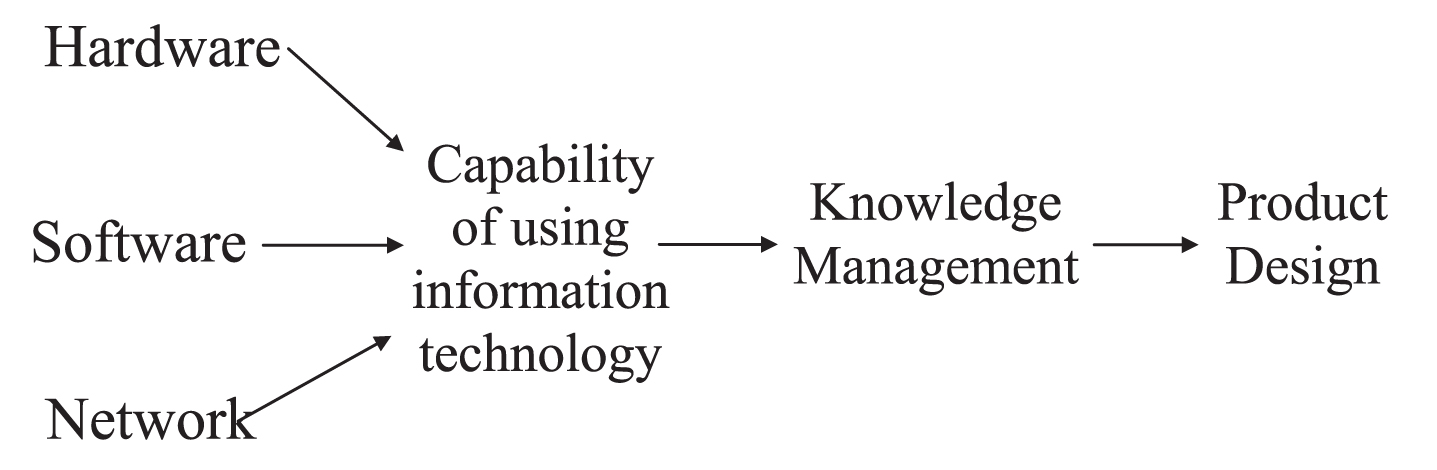
Proposed research mode.
IT components are one of the basic foundations of IT capabilities [8]. Studies on these components are lacking; however, IT resources are implicitly related to IT capabilities, which positively affect the performance of companies [12]. According to Wade and Hullan [13] IT components are classified as tangible and intangible. Most researchers agree on the three IT components, hardware, software, and network [14]:
Hardware
Nowadays, companies shift from central computing to grid computing, where internal customers are connected with each other and to external customers to make right decisions to benefit a company and meet customer requirements. As a result, products conform to specifications because internal operational efficiency improves [15]. Hardware is used by users to easily access applications and programs [6]. Bharadwaj [8] showed that hardware is considered the basis of IT capability. In addition, Marakas and O’Brien [16] urged companies to expand their computational operations, integrate new technologies, and increase efficiency to maintain competitiveness. Hardware includes machines, such as computers, as well as all media for data. Hardware represents all physical devices and materials used in information processing.
The best representation of data is that they ring communication between a server and a user. Hardware is an excellent means to speed work, increase performance, and enhance the ability to communicate. Without software or hardware, communication to networks cannot be established [17]. Lee et al. [18] noted that hardware is responsible for data input, processing, storage, and output with the help of software.
Thus, the following hypothesis can be drawn.
H1: There will be a positive relation between Hardware and capability of using information technology.
Software
The software is instructed working on information processing and procedures, Software not only includes sets of operating instructions called programs, which guide and monitor computer hardware, but also a set of information-processing instructions called procedures from users [16]. Software that disclose data and comprehends previously encountered knowledge gaps. Aman and Nicholson [19] were designed; Yin and Yang [6] Show software can be easily transferred and used across multiple systems. A developed software can help companies easily deal with standards and different forms of data because software can be reused on a large scale and for prolonged periods. Software may also include significant and new functionalities at speeds designated by users. This software feature was confirmed by [20]. Software must be developed and existing versions must be updated because of environmental developments. Software cannot function without hardware, whereas hardware is useless without software. Venkatesh et al. [21] proved that software influences the use of IT. Software-based computers increase educational capability and functions to improve and expand the usability of IT. Examples include CAD and data logging. The effectiveness of IT depends on the organization of IT components, which are integrated with activities. The capability to use IT to access to resources directly depends on the quality of hardware, software, networks, and other elements [22]. Bharadwaj [8] adopted the same viewpoint and determined that software influenced the ability to use IT, which is one of the basis of the capability of IT.
Thus, the following hypothesis is inferred.
H2: There will be a positive relation between software and capability of using information technology.
Network
One of main technologies that largely depends on network is computer technology and its convergence and interaction with communication and media technology [23]. Networks, which are associated with global supply chain, help companies in continuous development [24]. Companies should determine appropriate network for their businesses (intranet, extranet) [25]. Users can send and capture data using different formats through networks, which contain vast number of documents. in order to become an effective network system the user can benefit from network when sharing the software and hardware and the ability to coupling a computer with network [26].
Access to networks can be established using hardware and software. These components can be utilized to access external users and remotely access central data strain, which is considered one of the sources of the capability of using IT. A technical connection may be established from a sender to a recipient, or information can be transferred from an input link to an output link. Information received from an input link may be returned and sent to a certain set of output links. Moreover, ideas and information can be exchanged quickly and accurately and made available to end-users at a specific time [27]. IT assets are essential to work systems [28] when these assets maintain an inventory. IT assets Jiao and Helander [29] work primarily based on the increased interaction and cooperation between partners both internally and externally as these assets own web-based solutions. Networks reduce investments in additional infrastructure through compatibility in the platforms of diverse technology information across software solutions and based on the web to provide easy adoption and implementation. Companies can adopt networks that rapidly respond to diverse needs, requests, and orders within the bounds imposed by quality, scheduling, and cost and where these companies contribute and interact directly with each other. The link between companies and networking activities is divided into three categories, External link is the public information that is openly available. The acquisition of rights benefits the domestic and foreign companies by using knowledge to inform other companies, brands, competitors, and official research institutions. Products, machineries, software, and components benefit from external sources and the cooperation between local and foreign companies. The internet, intranet, and extranet have an effect on the capability of using IT; therefore, companies should determine the appropriate network to be used for their business. Thus, networks are also a basic aspect of IT capability [14, p. 134]. although networks are much in vogue lately, most of them are ineffective, as they are subjugated under the bureaucratically-hierarchized authority and power artifice, steeped and probably rooted in shamanistic ritualism. To be effective, a network must be self-organized and self governed as a collegially-humane structure, from which emerges by or of itself a societal human system, wherein collegial control and responsibility flow at Liberty, in lieu of the authority and power chicanery.
The following hypothesis is then proposed.
H3: There will be a positive relation between network and capability of using information technology.
Capability of use information technology
IT capability is the ability to mobilize and use resources based on IT by combining resources and other capacities in a company [30]. IT capability is also the ability of a company to acquire, develop, and guide IT resources to identify and support business strategies and activities in the value chain. Bharadwaj [8] examined the extent of the use of IT in improving the collection, transfer, and distribution of knowledge, which is useful in decision-making. The working capability of the use of IT can capture data and make it available to any individual in real time. Chuang et al. [31] verified that IT support is essential for the initiation and implementation of knowledge management in a company. IT support enables existing knowledge to be easily re-used, reduce maintenance and monitoring costs, and immediately address new needs of a company.
Singh et al. [32] clarified the role of IT in knowledge management. IT provides a database, saves information, helps transform tacit knowledge to explicit knowledge, and reduces the effort of acquiring knowledge and information for interested individuals.
Thus, the following hypothesis can be drawn.
H4: There will be a positive relation between capability of using information technology and knowledge management.
Knowledge management
According to Jaime et al. [33] knowledge management is the systematic process of applying procedures to direct and control assets of knowledge to use internal and external knowledge for companies to create new knowledge. Knowledge may be tangible or intangible. According to Matsumoto et al. [34] knowledge is an asset that needs to be handled effectively to create wealth. Knowledge is considered an important element in determining success in a competition and in achieving competitive advantage. Thus, achieving effective knowledge management is crucial. Knowledge is an important resource to obtain competitive advantage. Effectively using the flow of knowledge improves products by providing valuable information about customers and markets that are indispensable in product design [35]. Product managers realize the importance of knowledge as a means to gain or maintain a product’s success in the market. Knowledge management is an essential process in product management because knowledge is the most fundamental aspect in all competencies. In other words, the acquisition, development, transfer, codification, and application of knowledge are critical to achieving effective product management. However, most companies do not comprehend what they must know and how knowledge should be handled [1].
Thus, the following hypothesis is deduced.
H5: There will be a positive relation between knowledge management and product design.
Product design
Holtshouse [36] noted the ongoing discussions on the role of IT in knowledge management. IT is widely used in companies. Thus, IT facilitates the flow of knowledge. A recent study on a quality and productivity center in the United States showed that successfullyadapting knowledge management is crucial to achieving company purposefulness and providing products that satisfy consumers. However, IT components must be prepared properly. Melville et al. [12] assume that IT capability not only improves operational performance, such as productivity, but also provides competitive advantage. In other words, IT improves efficiency and competitive advantage, which are significant for companies in the network era. Electronic linkages within and between organizations change the way companies obtain input (product elements) and transform this input into products and services, which are distributed to customers and satisfies them. Wang and Lee [37] confirmed the need to change the orientation of workers and modify the concept of product design process by integrating important information in the product design process. Wade and Hulland [13] proved that companies that own advanced hardware and software are capable of utilizing new infrastructure to improve their efficiency and effectiveness, thereby enhancing competitiveness. Rai et al. [38] stressed that integrated IT components enable companies to develop theircapability and allow machines to maximize performance. Chandrasegaran et al. [39] demonstrated a product design process of building an information model through linkages (formal and informal networks) and personal experiences with computer support. Networks have a main role in product design and knowledge models. Networks enable access to product models, re-use of existing design knowledge, exchange of knowledge across multiple projects, and development of disciplines. Designers depend on transmitted information to carry out special tasks in product design. Product design is a participation process and often involves a complex and an interactive process, which requires certain features to increase accuracy during the design process to reach a certain intentionality. Effective hardware helps designers make informed decisions that need efficient knowledge representation schemes. Knowledge representation is critical in considering the availability of raw data to designers because knowledge exists in all stages of design.
Moreover, competitiveness must be maintained and the time needed to develop products through collaborative design and concurrent operations must be reduced. Product development depends on the effective transfer of knowledge between teams and the use of hardware, software, and networks. Awareness in decision-making in the early stages of the product design process significantly influences energy, cost, and sustainability.
Thus, the following hypothesis can be deduced
H6: There will be a positive relation among H, CIT with KM on PD.
H7: There will be a positive relation among S, CIT with KM on PD.
H8: There will be a positive relation among N, CIT with KM on PD.
Data and sample
The sample in survey includes specialized industrial companies in China. The sample was randomly selected to obtained accurate data. A total of 220 questionnaires were distributed to right people because the sample dictates the success and failure of the study. The percentage of returns of the questionnaire was 100%. A description of the study sample was made based on the results of the questionnaire. Table 1 shows that.
Describes the research sample
Describes the research sample
One of the important sources of data collection is the questionnaire must be carefully designed, to keep up a reliable and high-quality data, it has relied in this article on the questionnaire, was used Likert scale Quintet, where it relies on five weights, and the weights are as follows: (it was the weight 5 strongly agreed, weight 4 agreed, while the neutral was the weight 3, while taken, not agree the weight 2, Finally, do not strongly agreed the weight 1) to data collection, questionnaire was designed based on various literature and measurements accredited and expert opinion.
Questionnaire consists of two parts the first part was a competent general information about the company and workers, while the second part is specialized by research variables included ten Major variables (Hardware, Software, Network, Capability of using information technology, Knowledge Management and product Design) and every variable that has a number of questions and Table (2) illustrates the Major variables, and questions and code specific to each variable and The References.
Major variables, and questions and code specific to each variable and the references
Major variables, and questions and code specific to each variable and the references
In order to verify the reliability and validity of the scale structure, they have relied on the factor analysis and reliability to verify from validity and reliability, has been the adoption of the same statistical methods that have been adopted by some statisticians and researchers [49–51] As reminded them [52] to prove the reliability and validity of the scale. Where was evaluated the sincerity scale for each variable by factor analysis (FA) focusing on the KMO, the factor loading, Eigen values and Variance while depended on the stability of the scale on Cronbach’s alpha coefficient. Where the sincerity of the scale accepted in case that the value of the KMO is greater than 60%, factor loading is not less than 50% and the Eigen values is greater than 1, while the reliability of the scale is acceptable when coefficient of Cronbach’s alpha is greater than 70%, and in comes describes the results of validity and reliability scale for each variable.
After that has been validity and reliability of variables measure, it proves validity and reliability the measure of structure, where we note that the less value of Eigen for variables amounted to 2.015, were CIT variable, which is higher than the acceptable and so were all the factor loading is greater than 50%, in addition to the KMO was for all variables not less than 60% and finally, the variance for each variable is more than 70%, means variable explains more than 70%, and all these results are acceptable, which shows the validity of measure.
In terms of reliability, we note that all the variables in the Cronbach’s alpha coefficient greater than 70 and this proof of the reliability of the scale. To reach to these of results, we delete the two items, through these results and after proof of reliability and validity of measure that we can carry out a data analysis, statistically to test hypotheses.
After viewing the metadata and analysis of the results been the use of simple linear regression and multilateral, to clarify the validity of the hypotheses from non validity, the Table 4, shows the method used for each hypothesis.
Validity and reliability for the latent constructs for hardware variable
Validity and reliability for the latent constructs for hardware variable
The method that is used for each hypothesis in model
The first hypothesis tested the relation between hardware and capability of using information technology.
Table (5) reflects regression results of the independent variable (hardware) and the dependent variable (capability of using information technology), that significant positive relation between hardware and capability of using information technology, where refers for that, the correlation of coefficient (R = 0.559) when the level of significance 0.01, The value of the explanation coefficient (R2 = 0.313) for the regression model, This shows that the effect of hardware variable on capability of using information technology by 31%, and the rest due to other elements. And the acceptance of the hypothesis and significance of regression model that confirms the value of F-calculated is greater than value of F-scheduled, when the degree of freedom (1, 218) and the level of significance 0.01.
Hypothesis 1, Summary regression model
In addition, the regression coefficient to the hardware (β= 0.749), as in Table (6) and the level of significance 0.01, and the degree of confidence of 99%, and this is confirmed by the value of T-calculated (9.959) greater than T-Scheduled (2.601), This proves the acceptance of the hypothesis that statistical significance hardware have effect on the capability of using information technology.
Hypothesis 1, sample liner regression results
To prove the validity of the hypothesis or not, note the results obtained from Table (7) showing correlation coefficient reached (R = 0.806), when the level of significance 0.01, And the results also showed a strong positive correlation between the software and capability to using information technology, and reason for changing the capability of using information technology variable (65%) is due to the independent variable (software) and that explained us (R2 = 0.650). And the rest gives it to other elements, and this is evidence of the effect of the software variable on the capability of using information technology, also significance of the regression model, F-calculated (405.464) at the degree of freedom (1, 218) and the level of significance 0.01, is the largest than F-tabular (6.76) and this confirms the validity of the hypothesis.
Hypothesis 2, Summary regression model
And also note in Table (8) that T-calculated at the level of significance 0.01, is greater than T-tabular, which proves a significance of regression coefficient for software (β= 0.794) and the regression model is significance, meaning that a statistically significant effect between software and capability of using information technology at a significant level of 0.01, and the degree of confidence 99%. Can not be a decision to reject the hypothesis, but to accept the hypothesis. There are a positive relation between software and capability of using information technology.
Hypothesis 2, sample liner regression results
To test the validity of the hypothesis we can see that there is a strong positive a correlation between the independent variable (networks) and dependent variable (capability of using IT), the R2 explains that 70% of the change in the dependent variable is due to the independent variable, and the rest is the results of other elements, and this confirms the effect of networks on the capability of using IT, and we note that the proper measures to test effect of the independent variable on the dependent variable is the F test, where F-calculated (386.942) is greater than F-scheduled (6.76) when the degree of freedom (1,218) and the level of a significance of 1% and thus accepting the hypothesis is that there is a positive relation between network and capability of using information technology. Table (9) show that.
Hypothesis 3, Summary regression model
However, we can be demonstrated the regression coefficient for the networks (β= 0.666) at level of a significance 1%, and T-test proves that the T-calculated (19.671) is greater than T-Scheduled (2.601) when the degree of confidence is 99%, shows that Table (10) according to the results proved the hypothesis is There will be a positive relation between network and capability of using information technology.
Hypothesis 3, sample liner regression results
Table (11) highlights validity of the regression model, where the F-calculated is greater than F-Scheduled at 99% degree of freedom, and the level of significant of 1%, And the results also indicated a strong positive correlation a significant between capability of using information technology (independent variable) and knowledge management (dependent variable), is (R = 0.780), and the value of R2 is (0.609), this means that the change rate is 67% in the dependent variable (knowledge management) because of the independent variable (the capability of using information technology), which is the effect capability of using information technology for the best 67% in knowledge management, thus the decision to accept the hypothesis.
Hypothesis 4, Summary regression model
The results in Table (12) confirms validity of the hypothesis (There are a positive relation between capability of using information technology and knowledge management) were T-calculated (18.410) is bigger than T-Scheduled (2.601) at significant of level 1%, and the degree of confidence of 99%, and confirmation significance of regression coefficient to capability of using IT, is (β= 0.796).
Hypothesis 4, sample liner regression results
Table 13, shows the results of regression of the independent variable (knowledge management) on the dependent variable (product design), where the value of the correlation coefficient is (R = 0.857) at the level of 1% which indicates that there is a positive relation a significant strong, and the value of R2 is (0.735) indicates that the independent variable (knowledge Management) change the dependent variable (product design) by (74%) and the rest of the change that occur to the product design is due to other elementss. This emphasize the effect of knowledge management on product design, and through support for measuring validity of the effect of the independent variable on the dependent variable, test was used in the degree of freedom (0.99) and the level of significant of 0.01, F-calculated of (605.438) is greater than F-scheduled(6.76), From the above it has been proven that acceptance of the hypothesis of positive relation between knowledge management and product design.
Hypothesis 5, Summary regression model
As well as proof that the significance of coefficient of regression to product design is (0.734) at a level of significance 1% as in Table (14) and supports so that the T-calculated (24.606) is greater than T-scheduled (2.601) at significance level of 1%, and the degree of confidence of 99%, this means validity of the hypothesis that the independent variable (knowledge management) has an effect on the dependent variable (product design) at the significance level of 1% and the degree of freedom 99%.
Hypothesis 5, sample liner regression results
This hypothesis is designed to find any possible interactions of variables (H, CIT and KM) as an independent variable on the product design as the dependent variable, where multiple regression analysing and results used in Table (15) proved validity of multiple regression model where F-calculated (220.202) is greater than F-scheduled when the degree of freedom (3, 216) and the level of significance of 1%.
Hypothesis 6, ANOVAa
aDependent Variable: Product Design; bPredictors: (Constant), Knowledge Management, Hardware, CIT.
In light of proven the regression model validity, correlation coefficient, interpretation coefficient and cumulative extraction shows that Table (19), which supports the hypothesis accepted at the significance level of 1% and the degree of confidence of 99%.
Through the above results, it shows that the variables (H, CIT & KM) are very important in the variation that occurs in product design.
This hypothesis is designed to find any possible interactions for variables (S, CIT and KM) as an independent variable on the product design as the dependent variable, where multiple regression analysing and results used in Table (17) proved validity of multiple regression model where F-calculated of (240.611) is greater than F-scheduled (3.88) when the degree of freedom (3, 216) and the level of significance of 1%.
Hypothesis 6, Model summary
aPredictors: (Constant), Hardware; bPredictors: (Constant), Hardware, CIT; cPredictors: (Constant), Hardware, CIT, Knowledge Management.
Hypothesis 7, ANOVAa
aDependent Variable: Product Design; bPredictors: (Constant), Knowledge Management, CIT, Software.
In light of proven the regression model validity, correlation coefficient, interpretation coefficient and cumulative extraction shows that Table (18), which supports the hypothesis of that (There are a positive relation among S, CIT and KM on PD) at the level of significance of 1% and the degree of confidence by 99%.
Hypothesis 7, Model summary
aPredictors: (Constant), Software; bPredictors: (Constant), Software, CIT; cPredictors: (Constant), Software, CIT, Knowledge Management.
Through the above results, it shows that the variables (S, CIT & KM) are very important in the variation that gets in the product design.
This hypothesis was also designed to find any possible interactions for variables (N, CIT and KM) as an independent variable on the product design as the dependent variable, The multiple regression analysis and results used in Table (40) showed validity of multiple regression model, where F-calculated of (270.950) is greater than F-scheduled (3.88) when the degree of freedom (3, 216) and the level of significance of 1%.
Given the proven validity of the regression model, correlation coefficient, interpretation coefficient and cumulative extraction shows that Table (20), which supports acceptance of the hypothesis at the level of significance of 1% and the degree of confidence by 99%.
Hypothesis 8, ANOVAa
aDependent Variable: Product Design; bPredictors: (Constant), Knowledge Management, CIT, Network.
Hypothesis 8, model summary
aPredictors: (Constant), Network; bPredictors: (Constant), Network, CIT; cPredictors: (Constant), Network, CIT, Knowledge Management.
Through the above results, it shows that the variables (N, CIT & KM) are very important in the variation that gets the product design.
Several aspects were discussed in this study. First, we described IT using IT components and the capability of IT, which is considered vital in knowledge management. IT components positively influence capability of IT. These components are one of the foundations to show capability of IT. This assumption is similar with the views of researchers [6, 8]. Capability of IT plays an active role in databases and promotes the exchange and re-use of knowledge. IT facilitates the sharing and use of knowledge in product design. IT can give support to knowledge management in accomplishing tasks efficiently, as indicated by the results on the capability of IT incentive towards efficient knowledge base, and ease knowledge management. This result supports the outcomes of other studies, thereby proving that IT supports knowledge management [35]. The explanation on the relation of knowledge management and product design is limited, and the role of administrators of tasks in production and operations management is often overlooked. Thus, all stages of product design must be supported. This assumption is consistent with opinion of [48], who determined that various companies are interested in IT but not in knowledge management. Hence, these companies face competition to stay in the market. Companies must focus on knowledge management to meet efficient knowledge management. Knowledge management is crucial. However, knowledge management that can deal with a vast amount of information and knowledge is vital to design products that meet the needs of customers and meet customer satisfaction, which results in the competitive advantage for companies. In a nutshell, interest in knowledge management, which is supported by IT, is important because it affects product design. However, not necessary that IT does directly influence product design as some individuals assume, as shown (Fig. 1). This confirms acceptance of all hypotheses.
Conclusions
The results show that IT components effects development of capabilities. These three components (hardware, software, and networks) have equal importance. Each component complements each other and plays an active role in improving capability, which influences knowledge management and product design. Satisfactory results cannot be Access without interaction is vital in performance. Any management type can’t run separately from another management, particularly in product and operations management, which depends on the design of their products from other departments in general, and knowledge management, to offer products that meet the needs of customers. and thus we draw the following conclusions: Hardware has a statistically significant positive effect on capability of using information. Software has a statistically significant positive effect on capability of using information. Network has a statistically significant positive effect on capability of using information. Capability of using information has a statistically significant positive effect on knowledge management. Knowledge management has a statistically significant positive effect on product design. H, CIT with KM have a statistically significant positive effect on knowledge management. S, CIT with KM has a statistically significant positive effect on knowledge management. N, CIT with KM has a statistically significant positive effect on knowledge management.
Limitations and future research
The study did not consider factors such as public information, the enterprise type, period of enterprise development and age categories that may influence the relation between KM and PD.
Knowledge management is not clarified in terms of influential classification in the field of product design. And that the brainware societal-structure cluster of technology is excluded from this research. this study focused on specific technologies, the purposeful defining function of which is capable product design. Also the analysis was one-way and applied in industrial companies, as indicated by the results.
Research questions and avenues for future research can be raised. How can some companies develop knowledge management and make it effective and efficient in product design? What are the necessary classifications in knowledge that affect product design management? Does a reciprocal relation exist between information and knowledge management technology to design products? Does a reciprocal relation exist between knowledge management and product design? Does a reciprocal relation exist between IT and product design? Researchers and scientists must focus on the role of information and knowledge management technology, which is crucial to the investigation.