



Abstract
Indentured to trends emerging worldwide in business-enterprise organization, this article relays the transformation that ensued from the process of building a system dynamics (SD) model, intended to provide decision-support for a firm competing in high-sulfur fuel oil (HSFO) industry. The SD modeling process helped the client firm see a considerable increase in its daily revenue, with a potential increase in accounting profit of 62 percent per day. These benefits accrued from transforming the firm’s value chain of HSFO marketing and sales processes and operations, while facilitating the self-development of its internal capability to rely on the SD modeling process for strategy design and implementation tactics. Despite the study’s limitations as an action or praxis research, the article offers future research directions and policymaking recommendations, toward transforming business enterprises and other societal organizations into the high technology of self-organizing and self-governing societal human systems.
Keywords

Nicholas Constantine Georgantzas is Professor, Operations – heretofore Management Systems, and Director, System Dynamics (SD) Advisory, Gabelli Business School, Fordham University, New York, NY, USA. Currently the Editor-in-Chief, Human Systems Management, has also worked both as Associate and as Guest Editor, System Dynamics Review, and as Guest Editor, Human Systems Management. Dr. Georgantzas is advisor to senior managers and partners of advisory firms as well as a forensic economist, specializing in SD simulation modeling for crucial insight into strategy, production and business process redesign. An author of Scenario-driven planning: learning to manage strategic uncertainty (Quorum/Greenwood, 1995), Politeia in person: a civic Eros cookbook for human beings’ economic prosperity (LAP LAMBERT Academic Publishing, 2017), and Authentic democracy to restore our prosperity that austerity disrupts (LAP LAMBERT Academic Publishing, 2017), has published expansively in refereed scholarly journals, conference proceedings and edited books. Mostly transdisciplinary, his action- or praxis-research, publications and advisory services entail systems thinking, knowledge technology and strategy design, focusing on the necessary ideas and tools for learning, both under the ubiquitous, yet highly problematic in our epoch, bureaucratically-hierarchized authority and power artifice, and in and about the statically complicated and dynamically complex, natural and societal human systems we all live.
—A system is a whole that cannot be divided into independent parts.
This hardly seems revolutionary, but its implication are.
—Plan or be planned for.
Russell Lincoln Ackoff (1919-2009)
Introduction
With change surely being the greatest constant on the surface of planet Earth, this action- or praxis-research intervention is allied to two noteworthy trends, emerging worldwide in business-enterprise organization. Pioneering the first trend, business enterprises and other societal human organizations are advancing their full-time employees to business partners.
To give but one example, a representative case of this first trend in business-enterprise organization is Chobani LLC, the well-known strained-yogurt brand, named as a variation on the turkish term ‘çoban’, itself derived from the persian word ‘čupân’, meaning shepherd [5, 7]. By distributing ownership stakes to its full-time employees, Chobani LLC has created an energetic work environment, focused on fostering tight-knit teams that feed off innovation and creativity.
The second noteworthy trend is a dual one and entails the manifestation of autopoietic dynamics in modern business enterprises, via Holacracy®, transactional-exchange governance (TEG) forms and the high-technology, self-organizing and self-governing, virtual-enterprise network or net (VEN) phenomena, within equally autopoietic company value- and industry supply-chains. Owed primarily to technological advancements in such chains, previously subordinated company divisions and suppliers are also promoted to business partners, respectively [4, Section 8.4].
In this worldwide dual context of autopoietic company value- and industry supply-chains, pioneering business enterprises and other societal organizations – in diverse industries–are indeed transforming themselves into the high technology of self-organizing and self-governing decision-making structures, wherein flow collegial control and responsibility. Here are just a few examples [4, Section 8.2]: AES Corporation, Virginia, USA. ESBZ, ‘Evangelische Schule Berlin Zentrum’ or Evangelical School of Central Berlin, Germany. FAVI S.A., Hallencourt, France. RHD or Resources for Human Development, Philadelphia, PA, USA. Buurtzorg, meaning ‘neighborhood care’, The Netherlands and USA. Heiligenfeld, Bad Kissingen, Bavaria, Germany. HolacracyOne, LLC, Spring City, PA, USA. The Morning Star Packing Company, Woodland, CA, USA. Patagonia, Ventura, CA, USA. Sun Hydraulics Corporation, Sarasota, FL, USA. Zappos.com, Inc., Las Vegas, NV, USA. DAC or David Allen Company, Ojai, CA, USA. INET Oxford or the Institute for New Economic Thinking, Oxford Martin School, Oxford, UK. PN or Precision Nutrition, Inc., Toronto, Ontario, Canada. Conscious Capitalism®, Inc., San Francisco, CA, USA. Medium, San Francisco, CA, USA.
Supporting both trends is the fact that, since 1945, it has become apparent to business and other organizational researchers that the only possible form of human and organizational development ⪡ self-development⪢ [1, p. 46]. Evidently, all business enterprises and other societal organizations can do is facilitate their employee, customer, division and partner self-development, just as educational institutions facilitate the self-development of students and faculty members.
Concurrently, just as evident has become that improving the components and members of a business enterprise, i.e., individual employees, departments or distinct economic sectors and industries, does not necessarily improve its arrangement or setup as a whole, i.e., an enterprise or other societal organization, such as, for example, a nation or state. And within the business reality, most dysfunctional and even disastrous behavior is owed to the top-down imposition of the aye-unnatural, inhumane and faulty, bureaucratically-hierarchized authority and power artifice. Probably rooted in mongolian shamanist rituals, and in lieu of the high technology of a decision-making structure, wherein collegial control and responsibility flow at liberty, historically, this deceitful delusion of organization subjugates and enslaves people [4].
The word ‘technology’ denotes a statically complicated and dynamically complex societal human system that consists of its mutually-interactive hardware, software, brainware and support network or net components [9]. Intended for the collegial, common or general good of its components, members and users, technology is often misused in business research, particularly when what is actually researched is ⪡ appropriate technology⪢ [9], a notion that Georgantzas and Zarifopoulou ascribe to ⪡sequestered technique⪢ and its resultant ⪡technocracy⪢, as technocracy is founded not on technology per se, but on sequestered technique [4, Section 7.3].
Pertaining to company value- and industry supply-chain transformations, i.e., the second business-enterprise organization dual trend, a latent trend has also been realized in the marketing and sales processes and operations of firms involved in the high-sulfur fuel oil industry. Typically engaged in maritime freight and oil transport, HSFO users revamp their internationalization-strategy archetypes, i.e., from international, multinational and global to transnational [6], precipitating projections of a declining growth in the demand for high-sulfur fuel oil. And that reinforces rivalry among extant competitors in the HSFO industry.
To render the situation even more strenuous than before, many supply-chain participants in the HSFO industry rush to upgrade their oil refineries, thereby reducing the availability of equity HSFO, in some cases from 75 to 25 percent. This drastic decline in HSFO supply causes high-sulfur fuel oil marketing and sales firms to redesign their processes and operations, incorporating, for example, futures and spot-trading activities in their HSFO sourcing.
Working in tandem, said environmental, supply-chain and organizational changes increase uncertainty about strategy design [3, 4], regarding even the adequacy of HSFO firms’ intentionality or purposefulness. Prior to the praxis research relayed here, for example, the process and operational focus of the HSFO client firm’s profit centers — each multi-domestically trying to maximize its own sales revenue and accounting profit—yielded a rather poor fit between the firm’s international business environment and its internationalization-strategy design.
The process of building a system dynamics (SD) simulation model helped the client firm turn around its problematic strategic situation toward a beneficial upshot. In marketing and selling high-sulfur fuel oil to customers with an international spread of activities, and with multi-flag freight- and tanker-fuel needs, a sustainable competitive advantage emerged from blending transnational activities, collegially shared among the firm’s multiple service regions worldwide.
The following section presents the influence diagram of a decision-making clockwork, showing how the SD modeling process supports continual improvement in business enterprises and other societal human organizations. Equally instrumental to this praxis research is a comprehensive internationalization-strategy framework, linked to a cost-benefit analysis (CBA), subjoined to this framework.
Next comes a brief description of the stock-and-flow diagram of the actual system dynamics model, along with a causal-spiral diagram. The latter influence diagram is critical to grasping the client firm’s HSFO marketing and sales processes and operations, within two of its international regions: United States East Coast (USEC), and Latin America and West Africa (LAWA).
Given the capability of SD models to compute strategic scenarios, not as straight forecasts of what will happen in the future, but as potentialities of what could possibly happen [3], the simulation results follow, showing the HSFO client firm’s performance potential. Lastly, despite the study’s limitations peculiar to the praxis research recounted, the article offers future-research directions and policymaking recommendations.
These pertain to the way the system-dynamics modeling process enhances clear thinking and, thereby, offers the requisite insight into both the effective and the efficient design and redesign of business operations and tactics, and processes and strategies. Included are suggestions hinged on the pragmatically practical organizational chart or organogram of a collegial, high-technology decision-making structure, which helps propel business enterprises and other societal organizations in diverse industries – either with or without a SD modeling capability–into the high technology of self-organizing and self-governing societal human systems.
Continual improvement via the SD modeling process
As shipowners worldwide keep looking to fuel their freight- and tanker-ships, a unique opportunity arises for the coordination or ‘servitization’ of customers’ HSFO ‘liftings’ away from home. This is precisely the service that high-sulfur fuel oil marketing firms must provide and, in so doing, turn their core business around to an exceptionally profitable one.
Making it so requires comprehending the process of transitioning from a firm’s global or multi-domestic strategy archetype to the transnational gestalt of internationalization strategy [6]. Pertaining to the transformation of HSFO marketing processes and operations through continual improvement, Fig. 1 shows a generic framework pertinent to relying on the SD modeling process, in order to continually improve a firm’s processes and operations (Fig. 1), in this case, of course, HSFO marketing processes and operations.
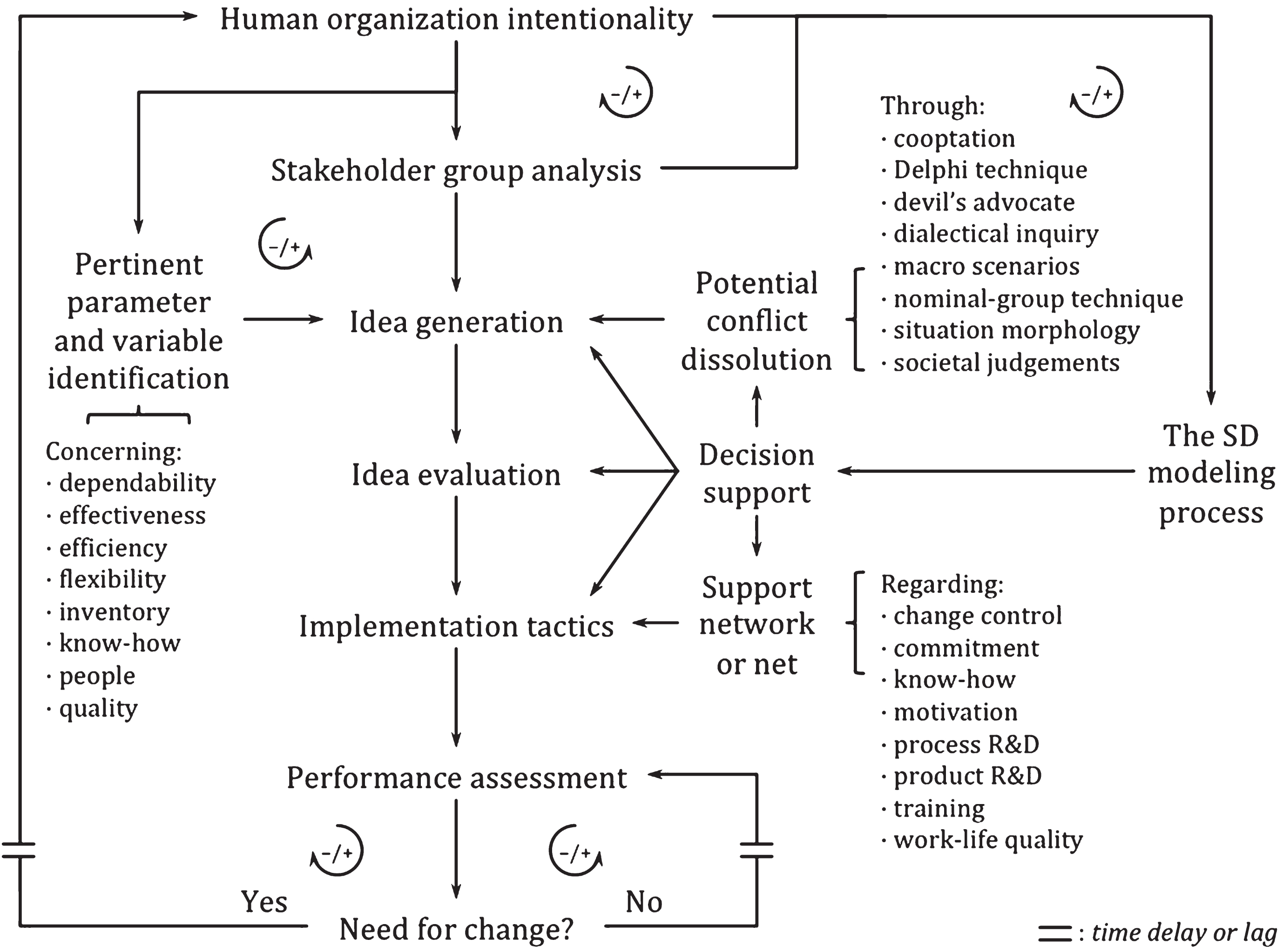
How the system dynamics (SD) modeling process supports continual improvement.
Regarding operations and tactics, and processes and strategies [4, Section 4.4], on the one hand, each and every business enterprise consists of operational work, its operations arranged along procedures or processes, based on well-defined inputs for the production and delivery of distinct outputs, i.e., tangible goods and intangible services that satisfy the particular desires and needs of peculiar clients and customers, in specific market segments or niches. It is therefore necessary to let a business enterprise collegially self-organize, wherein each human being’s work is instrumental to an operation, which in turn contributes to a procedure or process.
On the other hand, coalesced and coaligned through time, along each strategy’s societal structure with a customer-centric purposefulness, the four kinds of collaborative and competitive tactics, which mix pure action and pure communication, both effectively and efficiently enable the self-realization of the high-leverage strategies they implement. And the inherently invisible societal structure of each customer-centric, purposeful strategy covers the entire strategy-design path or trajectory of its requisite implementation tactics.
Transforming a business enterprise or other societal human organization into the high technology of self-organizing and self-governing decision-making structure with collegial control and responsibility entails enabling the self-emergence of a truly societal human system. The emergent enterprise or organization thereby becomes an entity or unity of components and members that act collegially, within a societal structure of mutual interactions and reciprocally interdependencies, with the humane intentionality or purposefulness always to promote their collegial, common or general good.
Whether practitioners or researchers, capable business professionals do not ever pretend to ostensibly design a societal human system — or any other system for that matter. Be it agile or dull, the only thing we actually design is the societal structure required for a system to emerge by or of itself, each and every time human beings, with our intentionality or purposefulness, interact with said requisite societal structure [2, 4, Section 2.2].
The self-determination capability – that only a true societal human system self-develops–hinges on our human intentionality or purposefulness, though which the reciprocally interacting components and members of a true system collegially create either different results in the same environment or similar results in different environments. As opposed to deviant, top-down imposed aims, goals and objectives, human intentionality or purposefulness is a requisite condition at work today, along with: autonomy, fair pay for work, so that money is not an issue, and providing means to developing mastery in what capable business professionals do. Every reliable business enterprise already affords these four conditions to its employees and partners, so that it attracts and retains capable business professionals [4, Table 1].
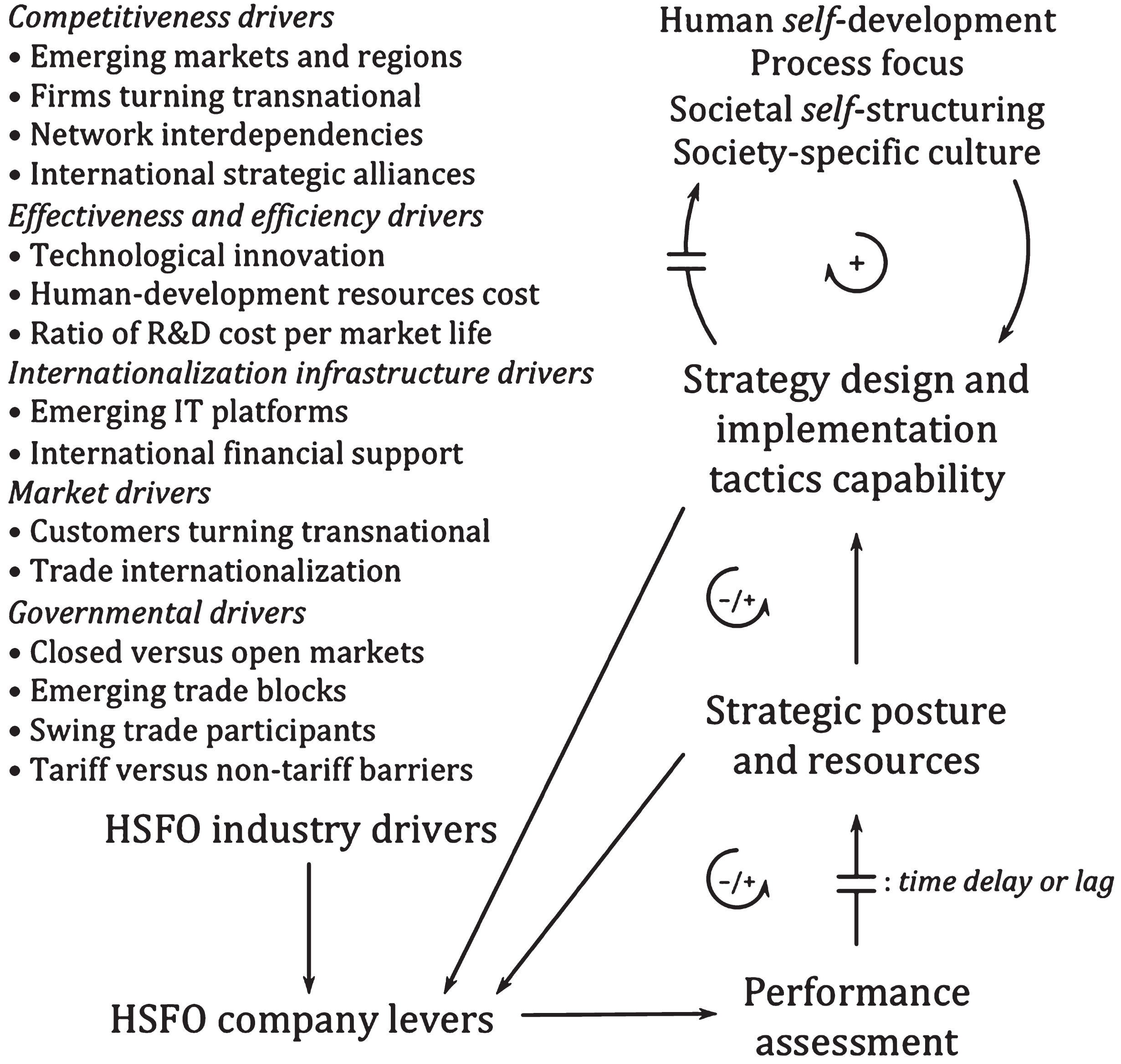
A comprehensive internationalization-strategy framework; adapted from [8, pp. 4–17].
Aims, goals and objectives are still acceptable for programming automata and robots, yet business enterprises and other societal human organizations function effectively only with human intentionality or purposefulness. It is precisely this human organization intentionality on top of Fig. 1 that, along with the analysis of pertinent stakeholder groups, collegially drives the system-dynamics modeling process, providing decision support for the continual improvement of a firm’s processes and operations as well as its strategies and tactics.
Many SD modeling applications appear as ‘atheoretical’ consulting interventions, yet extant strategy-design clockworks and frameworks can help elicit practitioner knowledge, about a specific firm’s problematic or strategic-decision situation. These conceptual dynamic clockworks and static frameworks often are too general and vague, while custom-built SD simulation models enable clear thinking, about the situation-specific decisions behind strategy and business-process (re) design.
If properly used, however, said clockworks and frameworks help practitioners identify parameters and variables pertinent to their situation-specific problematic or strategy-design challenge. For this reason, pertinent parameter and variable identification appears on the left panel of Fig. 1, separately from the SD modeling process on the right panel of Fig. 1, even though final parameter calibration and variable specification eventually become embedded within the system-dynamics modeling process.
The process of collegially building the system dynamics model on Fig. 3 helped the extended team of HSFO marketers grasp the crucial relation between an articulated internationalization-strategy design and their firm’s capability to implement that design. This peculiar insight into a firm’s problematic or strategic-decision situation often leads to sustainable improvements in sales revenue and accounting profit, as opposed to the inhumane wealth accumulation by any means.

Stock-and-flow diagram of a SD simulation model, pertinent to HSFO logistics and marketing processes and operations, within the client firm’s United States East Coast (USEC), and Latin America and West Africa (LAWA) geographical regions.
Adapted from Yip [8, pp. 4–17], the comprehensive internationalization-strategy framework on Fig. 2 is linked through a cost-benefit analysis (CBA), subjoined to the comprehensive internationalization-strategy framework on Fig. 2, to the potential benefits of galvanizing multi-domestic HSFO marketing processes and operations (Table 1), initially into the global and, eventually, into the transnational internationalization-strategy archetype [6]. The two frameworks shown on Fig. 1, and on Fig. 2 — the latter in conjunction with the Table 1 subjoined CBA—provide the context and subtext of this praxis-research intervention, intended to continually improve both the effectiveness and the efficiency of the client firm’s HSFO marketing and sales processes and operations.
Figures 1, 2, 3 and 4, all contain multiple parameters and variables, pertinent to the problematic situation at hand, which co-determine the firm’s performance potential (Fig. 5). Georgantzas and Zarifopoulou provide the necessary canons of correctly crafting and reading such societal-structure diagrams [4, Section 1.3]. Briefly, however, note that next to its head (∂), each negative arrow or link bears a negative ‘–’ sign that explicitly shows its negative polarity.
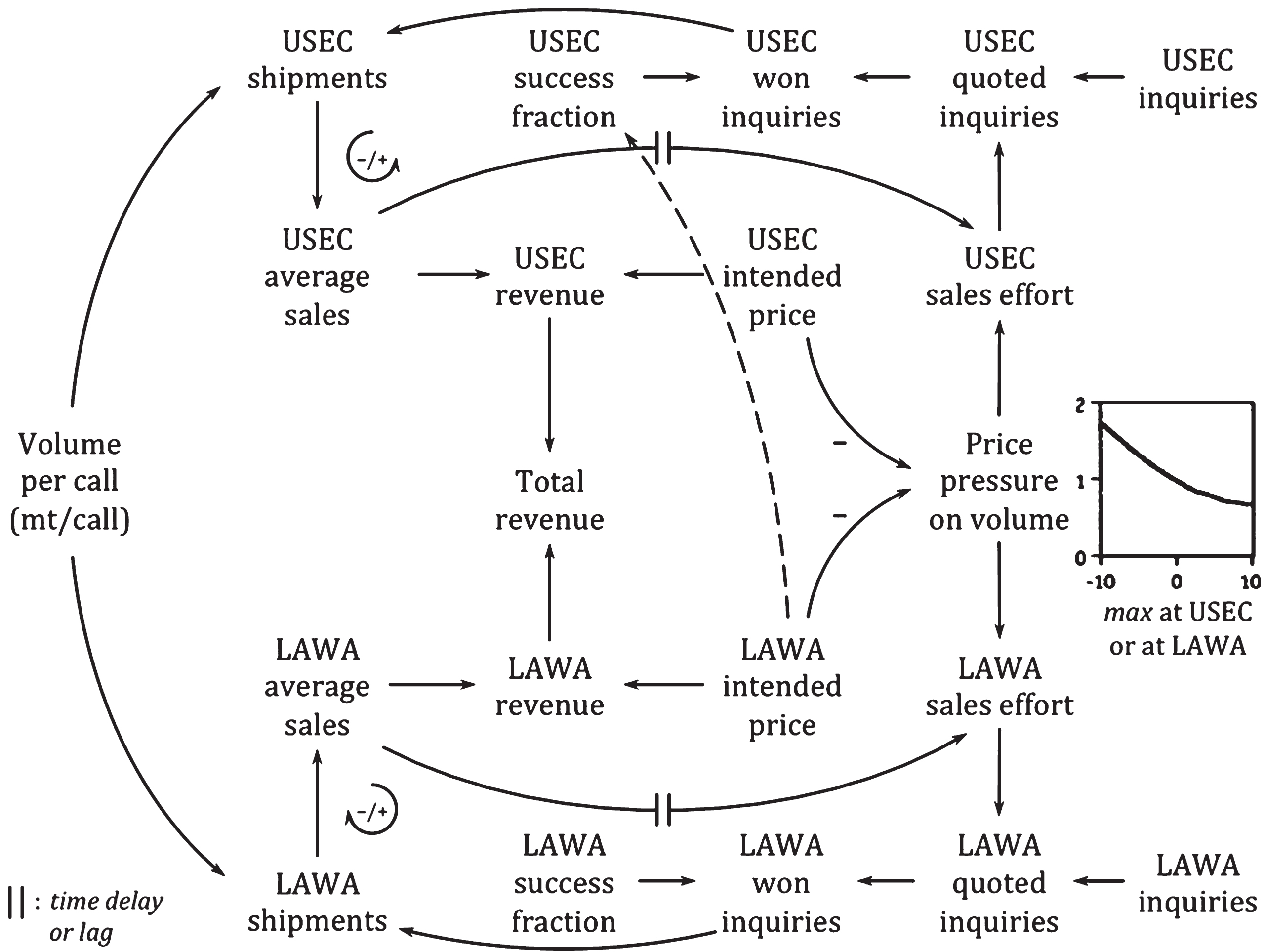
Within the reality of the client firm’s HSFO marketing and sales processes and operations lurks a causal-spiral structure, pertinent to its international USEC and LAWA regions.
Ordinarily, each and every arrow’s polarity is either negative or positive, showing how the parameter or variable after or on the head of the arrow changes, when the parameter or variable before or at the tail of the arrow increases; ‘how’ generally means either down (–) or up (+), but exercise caution here! Whether explicitly shown or not, all feedback loops or spirals on Figs. 1, 2, 3 and 4, inside them contain a small, identifier loop or spiral, showing whether that particular feedback spiral is balancing or negative, drifting, piling, positive or reinforcing and, occasionally, bipolar (–/+).
Usually, a bipolar feedback spiral is the result of a piling or positive feedback spiral that amplifies a bipolar input, as explicitly shown on Figs. 1, 2 and 4. And inside every feedback spiral, its small, identifier spiral always matches the spin of the feedback spiral that encloses it.
On Fig. 1, for example, as long as there in no need for change, the only active feedback spiral is the bipolar, connecting – always with a time delay or lag–performance assessment to the need-for-change decision (lower panel Fig. 1). Once the need for change is collegially decided, however, depending on performance assessment, the entire network or net gets activated, i.e., with all its bipolar, nested feedback spirals on Fig. 1.
Figure 2 depicts the way Yip [8] sees performance assessment, i.e., embedded in two counterclockwise bipolar feedback spirals. Accordingly, the external HSFO industry drivers, along with the client firm’s strategy design and implementation tactics capability, and with its current strategic posture and resources, co-determine the client firm’s internal HSFO company levers. Following Yip’s line of reasoning, a firm’s strategy design and implementation tactics capability is at once determined by and, with a time delay or lag, reinforcingly determines its: human self-development, process focus – as opposed to operational focus, societal self-structuring – as opposed to bureaucratic hierarchization, and society-specific culture.
In the context and subtext of the HSFO industry, the collegial effort to assess the client firm’s strategic posture and resources culminated in the system dynamics model shown on the stock-and-flow diagram of Fig. 3. The SD model focuses on the HSFO logistics and marketing processes and operations, as they occur within two of the client firm’s geographical regions: United States East Coast (USEC), and Latin America and West Africa (LAWA).
Even though the system-dynamics modeling process specifically intends to build insight about the way a societal process performs through time, SD models do depend on stock-and-flow diagrams that depict societal-structure relations, among the parameters and variables pertinent to a system. The working hypothesis behind every SD model is that the societal structure of relations among parameters and variables pertinent to the simulated system gives rise to its dynamic, i.e., through-time, behavior or societal process.
Figure 3 shows the stock-and-flow diagram of the client firm’s HSFO logistics and marketing processes and operations, within the value-chains of its United States East Coast (USEC), and Latin America and West Africa (LAWA) geographical regions, respectively. Namely the upper half of the stock-and-flow diagram on Fig. 3 depicts the logistics inventory process, the sales process and the price setting operations in the client firm’s USEC region.
Analogously, the lower half of Fig. 3 again shows the logistics inventory process, the sales process and the price setting operations, now in the client firm’s LAWA region. The entire stock-and-flow diagram is reproduced directly from one of the SD simulation software packages employed in this praxis research.
There is a one-to-one correspondence between the stock-and-flow diagram on Fig. 3 and its underlying system of difference equations. Building the model entailed first drawing the model’s stock-and-flow diagram on the glass of a computer screen and then specifying the algebraic equations and parameter values for each one of its elements. SD simulation software enforces consistency between model diagrams and equations, while built-in functions help quantify parameters and variables pertinent to each particular firm’s decision problematic or strategic-decision situation.
On Fig. 3, the rectangles represent stocks or level variables that accumulate, such as, for example, Backlog USWC and Backlog LAWA. Emanating from cloud-shaped sources and ebbing into cloud-shaped sinks, the double-line, pipe-and-valve-shaped icons represent flows or rate variables that cause the stocks to change, as inflows fill the stocks and outflows drain them.
For example, the discrepancy USEC auxiliary converter on Fig. 3 is the gap between the HSFO inventory coverage targeted at USEC or ‘target USEC’ and the actual finished-goods inventory in the USEC region or ‘FG USEC’. This HSFO inventory discrepancy in the firm’s USEC region in turn co-determines, along with the average sales at USEC or ‘avg sales USEC’ auxiliary converter, the ordering flow that USEC activates, every time the firm renews its Backlog USEC stock.
Custom-built by all participating HSFO marketing people at the client firm, the SD simulation model on Fig. 3 tracks changes in pricing tactics that exploit the firm’s competitive advantage in the LAWA region. Given the static complicatedness of the stock-and-flow diagram on Fig. 3, however, not to speak of its dynamic complexity, the causal-spiral or influence diagram on Fig. 4 enhanced decision-making conversations at the client firm’s headquarters.
This latter diagram on Fig. 4 unconceals the causal-spiral structure, lurking behind the client firm’s HSFO marketing and sales processes and operations, within its international USEC and LAWA regions, respectively. Said facilitated conversations or dialogues among the participating HSFO marketing people revolved around many possible strategic scenarios, all computed with the SD simulation model on Fig. 3.
Although initially counterintuitive, one particular strategic scenario showed an unexpected increase in the sales revenue of the LAWA region resulting, of course, from the number of lifting inquiries won at LAWA. This unexpected increase in lifting inquiries can be attributed in part to the graphical table function of the price pressure on volume at LAWA (right panel, Fig. 4).
Namely the price pressure on volume, i.e., a change that affects the LAWA sales effort, is itself affected by the change in the intended price at that particular region. Owed to the inverse relation that the negative sign shows on the arrows that connect intended price to price pressure on volume, a discount offered to customers in LAWA, not only causes the USEC success fraction to increase, depicted by the positive broken-line arrow on Fig. 4, but also increases price pressure in the LAWA region.
As a result, the firm’s sales people at LAWA sell more that before to the client firm’s customers there, thereby causing the quoted LAWA inquiries to rise. This increase in turn causes the LAWA won inquiries to rise too, leading to more LAWA shipments than before, and thereby increasing LAWA average sales, LAWA revenue, and total revenue (lower and middle panels, Fig. 4).
The additional inquiries won, however, both at USEC and at LAWA, can bring about an increased risk exposure, a phenomenon frequently seen in trading statically complicated and dynamically complex financial instruments, as their respective markets mature. This potential hazard of a high exposure to credit risk was accounted for in the SD model, through the creditworthy fraction or ‘fr creditworthy’ auxiliary converter, both in the USEC and in the LAWA regions (right panel, Fig. 3).
Simulation results of the client firm’s performance potential
Figure 5 shows the simulation results of the aforementioned strategic scenario, computed with the SD model on Fig. 3. Initializing SD models at steady state, i.e., in this case between time t = 0 and t = 15 days on Fig. 5, always helps prevent possible transient-time artifacts.
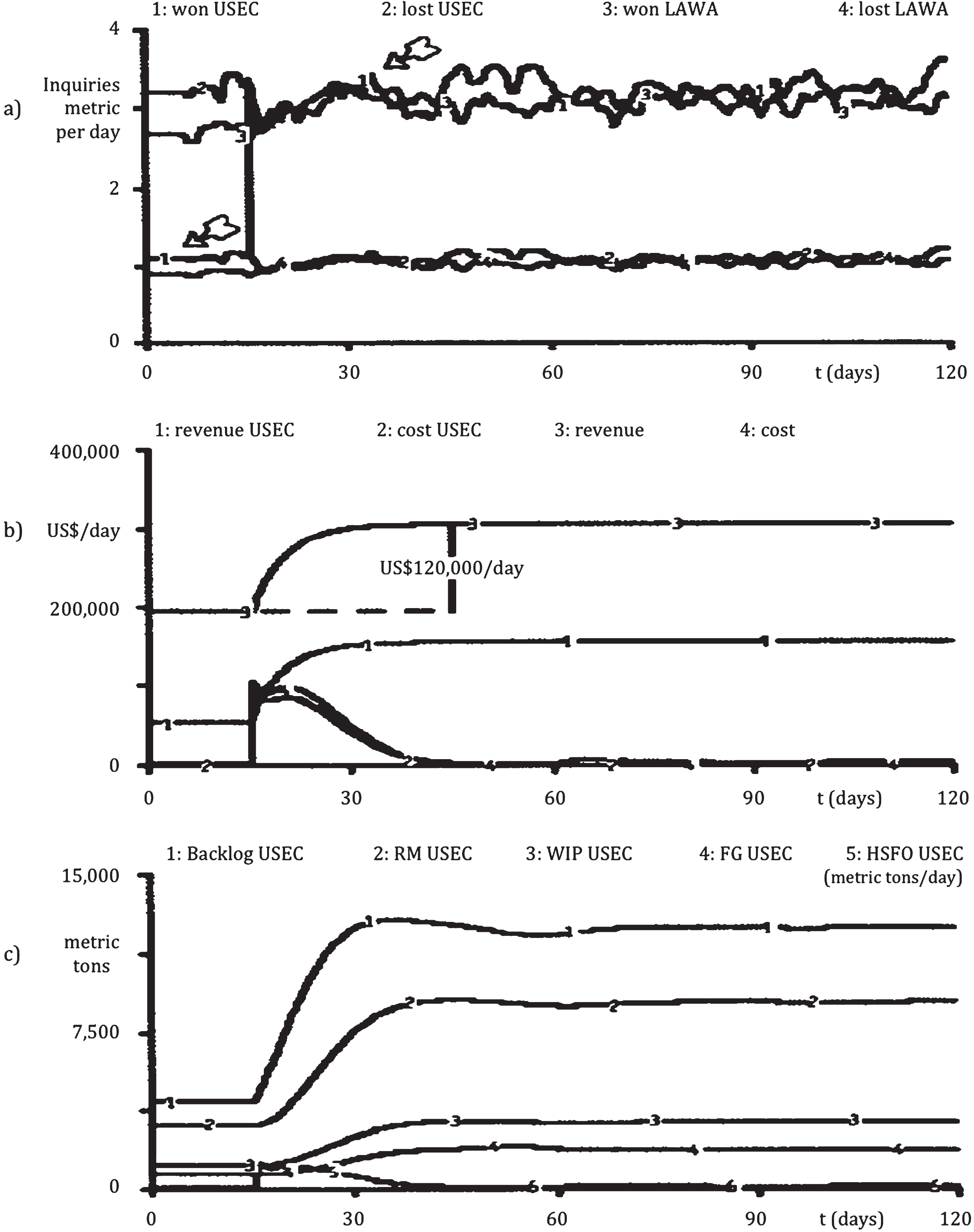
Simulation results showing multiple metrics of the client firm’s performance potential.
On all time-series graphs of Fig. 5, the horizontal axis is time t in days. The units on the vertical axes vary, including inquiries metric per day on Fig. 5a, US dollars per day on Fig. 5b, and metric tons on Fig. 5c, yet in the case of the HSFO USEC inflow on Fig. 3 and 5c, the correct unit is metric tons per day.
Technically speaking, Fig. 5a shows the simulation results computed with the standard-deviation parameters on Fig. 3 active. Said statistical measures represent variation in: customer calls in USEC and LAWA: ‘sd cc USEC’ and sd cc LAWA, respectively, metric tons of HSFO per customer call: ‘sd mt USEC’ and ‘sd mt LAWA’, respectively, and Platt’s worldwide spot oil prices: ‘sd Ps USEC’ and ‘sd Ps LAWA’, respectively.
All these parameters were set to their statistically estimated values, for the simulation results shown on Fig. 5a. Figure 5b and 5c show, however, simulation results computed with these standard-deviation parameters set to zero.
In order to assess its robustness and validity, extensive statistical-estimation tests enabled the SD model to accurately reproduce historical behavior patterns. Yet turning off the Lognormal and Normal distributions of customer calls and Platt’s worldwide spot prices, respectively, and using their respective degenerate functions, i.e., their average values or the ‘μ’ parameters on Fig. 3, allowed for a clean assessment of the benefit that could potentially result from the effective and efficient redesign of the client firm’s internationalization strategy.
Specifically, at time t = 15 days, a US$2.50 per metric ton quantity discount offered to customers in the LAWA region can rapidly increase the inquiries won in the USEC region, as line #1 shows on Fig. 5a. Within 30 days after its implementation, at t = 45 days, this single change causes sales revenue both in the USEC and in the LAWA regions to rise by US$120,000 per day, translated to a sustainable increase in accounting profit of 62 percent per day (middle, Fig. 5b). By then the cost of sourcing HSFO from competitors at spot prices has dropped to zero (lines #2 and #4, Fig. 5b), yielding the sustainable increase in accounting profit of 62 percent per day.
As line #3 shows on Fig. 5a, the inquiries won in the LAWA region can also potentially increase after t = 15 days. Initially, the participating HSFO marketing people at the client firm’s headquarters anticipated sales revenue in LAWA to drop, as a result of the US$2.50 per metric ton price discount offered to their customers in that region. The SD modeling-team members were willing to collegially trade off a few sales-revenue dollars at LAWA, in exchange of a buoyantly large gain in sales revenue and accounting profit in the USEC region. The simulation results on Fig. 5 show, however, how the redesign of the client firm’s HSFO marketing processes and operations can potentially bring about a tradeoff-free, win-win outcome.
Whilst counterintuitive at first, the unanticipated increase in sales revenue in the LAWA region is caused by the increase in the number of sales inquiries won in that region. The latter increase can also be attributed to the graphical table function of the sales price pressure at LAWA, shown as the ‘price pressure LAWA’ converter, marked with the tilde punctuation mark or ‘∼’, on the lower panel of Fig. 3, which contains the actual graphical table function shown on the middle-right panel of Fig. 4.
The sales price pressure on volume that affects the sales effort at LAWA is itself affected by the change in the intended sales price in that region. Owed to this inverse relation, shown by the negative signs next to the arrows or links connecting intended price to price pressure on volume (right panel, Fig. 4), the US$2.50 per metric ton sales price discount offered to customers in LAWA, not only causes the USEC success fraction to increase (broken-line-arrow, Fig. 4), but also causes the sales price pressure on volume at LAWA to increase.
Ergo, the client firm’s sales people at LAWA sell a higher volume than before to potential customers locally. And this increased sales effort in turn causes the sales inquiries won at LAWA also to increase, while the associated hazard of a high exposure to credit risk is again accounted for by the creditworthy fraction or ‘fr creditworthy’ auxiliary converter, both in the USEC and in the LAWA regions (right panel, Fig. 3).
Still necessary is the sourcing of HSFO fuel from local competitors within each region, at spot prices, a common industry practice, which allows for a smooth adjustment in the client firm’s Backlog (USEC and LAWA), raw material or RM, work-in-progress or WIP and finished goods or FG inventory stocks. Without said sourcing from local competitors, i.e., the HSFO USEC and HSFO LAWA inflows on Fig. 3, the long time delays or lags associated with: the HSFO inbound logistics, i.e., the time to negotiate the purchase of HSFO or ‘t:negotiate’, the time it takes to ship HSFO or ‘t:ship’, the time to blend HSFO in order to assure its consistent quality, would rapidly amplify an abrupt or drastic change in HSFO marketing, causing the client firm’s inventory stocks to oscillate violently, forming a catastrophic vortex.
Line #5 on Fig. 5c, i.e., ‘5: HSFO USEC’ in metric tons per day, shows the inflow of sourcing HSFO at USEC, at spot prices from local competitors. This collaborative tactic helps to elastically or viscously absorb oscillatory tendencies, owed to the aforementioned lengthy time delays or lags, and allows for a smooth transition in the client firm’s HSFO Backlog, RM, WIP and FG inventory stocks (lines #1 through #4, Fig. 5c).
This article relays a continual-improvement praxis-research intervention that culminated into a system dynamics simulation model, the stock-and-flow diagram of which appears on Fig. 3. Figure 4 subsequently unconceals two bipolar feedback spirals or loops, most critical within the reality of the client firm’s HSFO marketing and sales processes and operations, manifested in its United States East Coast (USEC), and Latin America and West Africa (LAWA) regions.
An obvious limitation of this praxis-research intervention concerns the generalizability of its results, as the study relied on the knowledge and skills of capable business professionals within only one business enterprise, within the HSFO industry. Neither is generalizable the peculiarity of sourcing HSFO inventory from competitors (right panel, Fig. 3 and line #5, Fig. 5c).
Surely this collaborative tactic smoke-screened the client firm’s strategic tack or trajectory change from its competitors, at least for a while. It is inconceivable, however, in the beer industry, for example, that Anheuser-Busch starts selling the MillerCoors brand inside its Budweiser beer bottles, cans and kegs, in order to ward off the lengthy time delays or lags in malting, fermenting, filtering or pasteurizing, packaging and distributing beer.
Moreover, despite the extensive statistical-estimation tests performed, the pseudo-random numbers generated per the Lognormal and Normal distributions of customer calls and Platt’s worldwide spot prices, respectively, through which the SD model’s robustness and validity was established, were based on small data samples, compared to the client firm’s long history. In the final presentation of the SD model and its results at the conglomerate oil company’s headquarters, the ‘μ’ parameters on Fig. 3 prevailed, yet these too were gleaned from relatively small samples.
Anyhow, of particular interest is the positive feedback spiral, formed by the negative effects of USEC intended price and LAWA intended price, respectively, on Price pressure on volume, in conjunction with the also negatively-sloped graphical table function of Price pressure on volume (Fig. 4). One cannot overemphasize the virtuous circle ensuing from this positive feedback spiral.
It is precisely this kind of positive feedback spiral that often is particularly difficult to detect or sense in business enterprises and other societal human organizations, as is frequently formed by two negative-polarity effects, either close or distant in space and time.
Indeed, the SD modeling process proves itself most useful, when is difficult even for capable business professional to contemplate similar societal structures, comprised of positive feedback spirals that contain an even number of negative arrows or links. That is especially perplexing without comprehending the way feedback loops or spirals work, formalized through cybernetics by the American mathematician and pioneer thinker, Norbert Wiener (1894–1964).
Figure 5 shows the potentially beneficial simulation results that motivated the swift implementation of the action- or praxis-research intervention’s policymaking recommendations. As a result of this praxis-research intervention in the client firm’s HSFO business-enterprise organization, for example, a tight-knit team was formed of 23 capable business professionals, with the explicit purposefulness to identify additional opportunities for continual business-process and strategy-design improvements, not just locally, but worldwide.
Splendidly, within the conglomerate oil firm’s value-chain, the previously subordinated HSFO marketing division was also promoted to an equally active business-partner, with its own assets to own and to self-govern. These assets include a multitude of HSFO storage tanks and related facilities worldwide.
It truly was beneficial then, facilitating the self-development of the client firm’s internal capability to rely on the SD modeling process, in order to support its strategy design and implementation tactics. Indeed, the SD modeling process is a valuable capability that business enterprises and other societal organizations in diverse industries must use to facilitate the self-development of their capable business professionals.
Future research directions and policymaking recommendations often entail parting ways with mere descriptiveness and entering the normative realm. With the intent of spurring business enterprises and other societal organizations, either with or without the SD modeling capability, to the high technology of self-organizing and self-governing societal human systems, Fig. 6 shows the pragmatically practical organizational chart or organogram of a collegial, high-technology decision-making structure. Adapted from [4, Fig. 7.5.1], the proposed organogram on Fig. 6 pertains to the (a) process, (b) business and (c) corporate spheres of a business enterprise or other societal human organization, favoring the collegial, common or general good of its people.
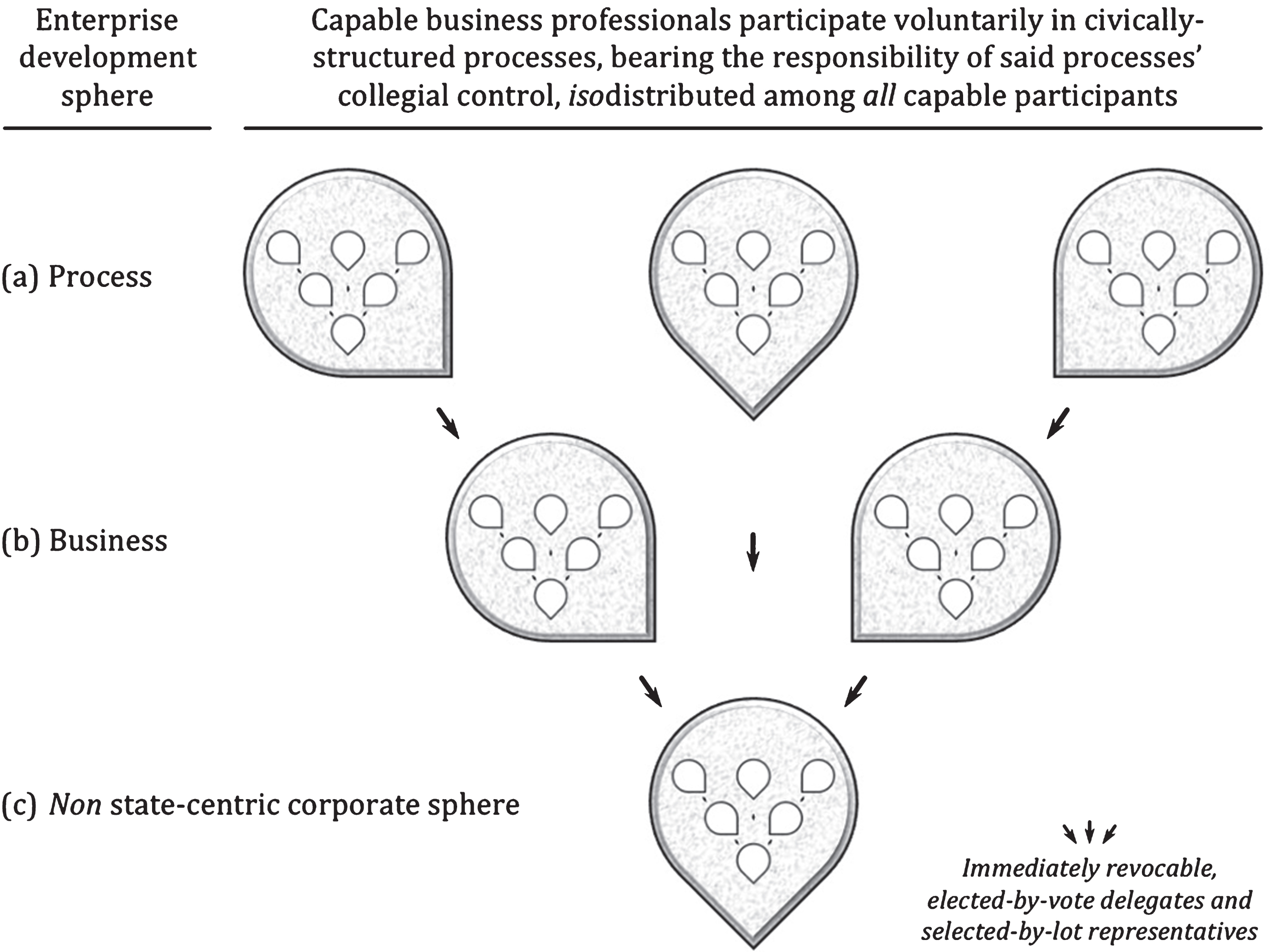
The pragmatically practical organizational chart or organogram of a collegial, high-technology decision-making structure, encompassing the (a) process, (b) business and (c) corporate spheres of a business enterprise or other societal human organization, and favoring the collegial, common or general good of its corporate citizens; adapted from [4, Fig. 7.5.1].
In the internationalization-strategy context and subtext [6, 8], one particular future research direction might entail promoting formerly subordinated transnational active subsidiaries, which Jarillo and Martínez [6] exalt, to equal active partners in the transnational gestalt. If the system dynamics modeling method is correct, so that, within the business reality, societal structure does cause societal behavior, then the organogram on Fig. 6 can drastically improve the performance of business enterprises and other societal human organizations, pursuing the internationalization-strategy archetype of the transnational gestalt [6].
Inspired by Ackoff’s systems-thinking work [1], which Georgantzas and Zarifopoulou expand [4, Section 7.1], and resembling a David Bohm rendition of a futuristically holographic business enterprise, each component on Fig. 6 contains an exact depiction of the whole organogram that the diagram on Fig. 6 shows. Such a thoroughgoing business-enterprise re-organization commences once capable business professionals embark on voluntarily participating in the civically-structured processes of their business enterprise, taking on the responsibility of these processes’ collegial control, isodistributed among all participating professionals.
Administratively speaking, on Fig. 6a, each goods-production and service-delivery process is organized exactly as the entire business enterprise that process is a component of. And on Fig. 6b, multiple replications are required of the whole organization’s collegial decision-making structure, to match the number of different business sectors said enterprise is engaged in as a whole.
The enterprise’s processes collegially install, to every business sphere they participate in, their immediately revocable, elected-by-vote delegates and selected-by-lot representatives. The process delegates collegially implement the collegial decisions of their distinct process, in the particular business sphere they have been consigned to, while said process representatives collegially assist and control the delegates of their respective process.
Similarly, as Fig. 6b and 6c show, each business sphere collegially installs, to the business enterprise’s corporate sphere, its immediately revocable, elected-by-vote delegates and selected-by-lot representatives, with rôles homologous with the ones just described. Consequently, each goods-production and every service-delivery process of a business enterprise has an actual presence, partly procuratorial and partly representational, both in the business spheres and in the non state-centric corporate sphere of its business enterprise.
This is how such a truly societal organizational structure achieves a value-added, superb coordination of a business enterprise’s diverse activities. No top-down imposed, bureaucratically hierarchized authority and power artifice, no matter how elaborate and costly, as a fixed or an overhead expense, can even come close to achieving the value-added of such effective and efficient business self-coordination and self-governance.
Note that the organogram on Fig. 6 is sketchy, missing the requisite time delays and lags, as well as the multiple feedback spirals that actually interconnect its respective societal-structure clusters. All these have been designedly omitted, to keep the societally humane structure diagram on Fig. 6 conceptually clean and free of clutter.
These future-research directions and policymaking recommendations conclude the current praxis research on a successful HSFO business-enterprise re-organization. Last but not least, if you ever feel compelled to talk of pockets of success, please do not. Remember that in societal human systems, success emerges in the nude, bearing no pockets.