



Abstract
This study investigates the moderated relation between perceived fairness in organizations and employee innovativeness, in the service sector of Pakistan, a developing country in south-east Asia. Also assessing perceived organizational support, quantitative and cross-sectional survey data were collected from 548 randomly-selected service employees in Karachi, Pakistan. The study’s purpose was to examine the relation between perceived fairness and employee innovativeness, and also to evaluate whether perceived organizational support moderates this relation. Using the PROCESS macro to test for two-way interactions, the empirically assessed hypotheses show a distinct moderating role, played by perceived organizational support in the relation between fairness and innovativeness. These results are highly context specific, i.e., they pertain to south-east Asian developing countries, and also to organizations operating in the service sector only. Yet the study has significant implications for policymaking, and opens up several, potentially fruitful avenues for future research.


Introduction
According to Herr et al. [1], fairness in context of organization is defined as individuals’ perceived fairness in workplace. This notion consists four vital aspects such as fair distribution of resources, fairness in decision making process, adequacy of the explanation and treating employees with respect and dignity. The two aforementioned aspects are pertaining policies and procedures within organization for progress of employees, with the latter pertaining specifically to immediate supervisor. In contrast to these specific aspects, Lind [2] discussed that employees make holistic judgement. Similarly, Ambrose and Schminke [3] and Holtz and Harold [4] also discussed that overall fairness represents the elementary concept of fairness in more parsimonious manner and is strong predictor of behavioral outcomes (i.e. employee innovativeness) than different sub-dimensions. Quantifying fairness is a delicate task, as it requires mentally grasping its tight coupling to the justice notion. The business literature tends to marginally differentiate between fairness and justice, yet it often uses these notions interchangeably [54]. Indeed, it is hard to separate the definitions of these two constructs. For example, Colquitt and Rodell [54] define justice as the “perceived adherence to rules that reflect appropriateness in decision contexts”, in which case business people might presumably be drawing on bracketed events when assessing fairness or justice. In contrast, according to [3], fairness also entails a “global perception of appropriateness”, hence business researchers must be extremely cautious, when attempting to spuriously postulate ⪡hierarchy⪢ on the notional pathways linking fairness and justice.
Employee innovativeness is defined as employees’ propensity to innovate. It conceives complex behaviors consisting idea generation, idea promotion and idea realization with the intention of achieving organizational desires [5]. The factors that influence employee innovativeness are commonly divided into broad categories, i.e. individual, team and organizational, as they influence at different levels, sometimes individual but most often in interaction [6]. Similarly, innovativeness also requires certain level of drive that can push individuals to take challenges and risks [7], such as organizational support, which enables employees to take extra-role behaviors [8].
Organizational support is described as a general perception of employees concerning the extent to which organization cares about their well-being and values their contribution. The perceived organizational support initiates exchange process i.e. an increased desire to help organization succeed in exchange of greater rewards [8].
Fairness in organization has occupied a substantial portion of the human-development resource management (HDRM) literature for more than three decades, and continues to draw the attention of contemporary researchers [9, 10]. One reason for this popularity is the empirical evidence suggesting that fairness is a vital predictor of positive organizational outcomes, such as innovative work behavior [9, 11]. Such outcomes can sustain competitive advantage, so they are attractive to many organizations [12]. As the role of human-development resources has become more vital, several studies have focused on innovation at the organizational level [13]. However, less attention has been given to individual-level innovation [12], even though individuals originate and process innovative ideas [14] and it is known that the only possible form of human and organizational development is self-development, i.e. nobody can develop another human being or organization, ever! Yet all business enterprises and other societal organizations can do is facilitate their employee, customer and partner self-development, just as educational institutions can only facilitate their faculty and student self-development. Foregrounding the role of individuals in innovation, in this study we conceptualize employee innovativeness as innovative work behavior (IWB) in terms of the capacity for individual innovation [12, 16].
While many studies have empirically investigated the relation between perceived fairness and organizational outcomes and have discussed various dimensions of fairness [9, 17], this study stands out by taking a comprehensive measure (overall fairness) into account [3, 19]. The literature also shows that fairness has been extensively studied in developed countries, but it is regarded as culturally sensitive. Like, principles and values change continually through time, depending on prevailing circumstances. Conversely, owed to their peculiarly unattainable nature, civic, ethical and moral ideals do not change through time, no matter how insistently a society-specific culture pursues them, so cultural variables may affect its relation with outcome variable [10]. Therefore, it is necessary to research fairness’ effects in developing countries. Similarly, as most studies on employee innovativeness were conducted in the manufacturing sector, this study responds to a call for individual innovativeness research in the service sector [20]. Overall, this study attempts to link perceived fairness in organization with employee innovativeness at individual level through the moderating effects of perceived organizational support (POS) in the service sector of a south-east Asian developing country, Pakistan.
The study comprises two purposes. First, we examine the link between overall fairness perception and employee innovativeness at individual level, and second, we investigate whether perceived organizational support moderates relation between them. The results of our study will contribute in three ways. First, the findings will direct the focus of research to overall fairness perception from individual dimensions. Second, our findings will contribute to the literature regarding perceived organizational support as a moderator to individual innovativeness. Lastly, it will enhance the negligible studies in developing south-east Asian countries i.e. Pakistan. However, the results of the study will be limited to service sector organizations operating in south-east Asian developing countries.
Theoretical background
Individual innovativeness
IWB entails several interrelated behavioral tasks (idea generation, idea promotion, and idea realization) which surround the concept of “ideation leadership” [16] and link the creative process with generating, developing, and communicating new ideas [21]. Ideation is a continuous thought cycle which is particularly associated with innovation, development, and actualization [22].
The literature discusses these IWBs not as explicitly defined roles but rather as “discretionary behaviors” [22]. For example, Janssen [16] discussed how these behaviors are not prescribed in job descriptions. Similarly, Ramamoorthy et al. [23] noted that since the application of discretionary behaviors is not assured, these behaviors are often not recognized. However, engaging in these behaviors enhances the performance of the organization [17, 23]. Previous studies show how IWBs contribute positively to work outcomes, particularly in terms of how organizational and individual factors promote IWBs [16, 25]. However, despite many studies of IWB in the manufacturing sector, it is rarely studied in the service sector [12, 20].
Fairness
Fairness in organization is an important phenomenon contributing to organizational effectiveness, efficiency, and survival in the field of organizational and industrial psychology [19]. The literature has mostly discussed two schools of thought regarding fairness; the first represents employees evaluating different dimensions of fairness in an organization while the second involves examining overall fairness. For example, Holtz and Harold [4] have examined the perception of employees regarding overall fairness, while Hsu and Wang [17] and Demir, Guney, Akyurek, Ugural, and Aslan [26] measured fairness in three dimensions: fairness in distribution, fairness in procedures, and fairness in interaction. Fairness in distribution is a fair ratio between outcomes by the organization and input by employees [27], fairness in procedures concerns methods and policies in determining outcomes [28], and fairness in interaction is fairness in interpersonal treatment from one’s supervisor when assessing performance [29]. Additionally, Colquitt et al. [30] discussed informational and interpersonal aspects of fairness in interaction. The second school of thought criticizes focusing on specific types of fairness, by arguing that overall fairness provides a better insight of how employees experience fairness in an organization [2, 3]. This study also considers subsequent convention and defines fairness based on employees’ whole experience in an organizational setting [19, 31].
Fairness is also sensitive to culture. Studying fairness in different cultures results in different perceptions [32]. Fairness perception varies among cultures, as it may exhibit different meanings and may cause differences in relation based on dissimilar cultures. For example, Adler and Graham [33] showed that in a variety of situations, people living in different countries hold dissimilar values, views, interpretations, and preferences. Other studies reported that employees from diverse countries are influenced differently by fairness perceptions, based on differences in their values [34, 35]. Moreover, studying the antecedents and consequences of fairness in different cultures will enhance cross-cultural insight of fairness [36]. Therefore, this study fills a vital gap by studying fairness in the South-East Asian culture of Pakistan.
Perceived organizational support
Perceived organizational support (POS) is employees’ that the organization cares for their well-being and their contributions are recognized [37]. POS serves as a felt obligation that enables employees to help the organization reach its purpose [38]. POS minimizes the negative perceptions (losing one’s job, wage cuts, etc.) when employees cannot show up to work, and aids them in becoming psychologically strong and relieving stress [39]. Additionally, support from the organization increases the work capacity of employees and produces a productive workforce, as it generates a sense of expectation that sufficient job resources will be provided to make work better when needed [40]. As a result, when employees perceive support they enhance their extra-role performance, which is helpful for the organization [8]. This can be defined as taking risks and working beyond job descriptions to increase organizational performance.
The POS may possibly be explained by norm of reciprocity and social exchange theory. The basis of POS are formulated by reciprocal nature of social exchange in a way that behavioral expectancies for contributions are increased [41]. Additionally, Organizational support theory also invokes social exchange theory and defines POS as exchange process between organization-employee relation where organization supports employees and vice versa. In return, organization expects escalation in performance which will be noticed and rewarded, consequently, employees perceiving high POS will seek balance in relationship with organization by developing favorable attitudes and behaviors [8]. Like, Eisenberg et al. [37] mentioned that employees with high POS will engaged in greater job related efforts by enhancing in-role job performance and espousing extra-role performance helpful to organization.
Framework and hypotheses
Based on the literature review, this study proposes the following research framework and hypotheses to study IWB from the perspectives of several significant variables in the service sector of developing country. This framework uses fairness as the independent variable. This independent variable is related to the dependent variable IWB, whereas POS and acts as moderating variables for the fairness-IWB relation (Fig. 1):
H1. Fairness has a positive relation with IWB in service sector.

Research framework.
H2. POS moderates the influence of fairness on IWB in service sector, in a way that, positive relation between fairness and IWB is stronger with POS.
Procedures, participants, and sample
This study used a quantitative research strategy and a cross-sectional survey method for data collection. The questionnaire was e-mailed to graduates holding a Master’s degree in business from schools in Karachi. Initially, the alumni offices of randomly selected business schools in Karachi were contacted to acquire graduate directories. The alumni office was made aware of the purpose of the research. Using these directories, 1000 randomly selected MBAs were contacted via email and were invited to participate in this research. The email contained an invitation to participate in the research, explained of the purpose of research, addressed concerns related to confidentiality and anonymity, and explained to potential participants how and why they were contacted. We received 738 positive responses from MBA graduates who were willing to participate.
Next, we generated an online link to the questionnaire and emailed each respondent individually. Each email contained an online link to the questionnaire, a statement of the research purpose, a confidentiality and anonymity statement from the researchers, and instructions for filling out the questionnaire. The respondents were provided with one month to respond, and on the 21st day an email reminder was also sent to the respondents. During the specified time we received 623 responses, representing a response rate of 84.4% (623/738). Responses were excluded from respondents who were: (1) not full-time employees, (2) were employed abroad, (3) were self-employed, (4) were working in family-owned business, (5) were not employed in the service sector, or (6) failed to submit a complete data set, as these respondents may have influenced the results inappropriately. The final useable dataset consisted of responses from 548 respondents, of whom 54.37% were male (n = 298), 24.81% (n = 136) had completed further education after their MBA, and 76.45% (n = 419) were married.
Measures
This study used all previously validated items to measure the focal constructs. Perceived fairness in organization is a unidimensional construct consisting of six items. The scale was developed and validated by Ambrose and Schminke [3] and Greenberg and Colquitt [18], and was also recently employed by Jihad et al. [19]. POS was measured using an eight-item scale [37, 42], as utilized by [43]. IWB was measured using nine items, divided among three dimensions: idea generation, idea promotion, and idea realization [16]. We used a five-point Likert scale for all measures, ranging from 1 = strongly disagree to 5 = strongly agree. All four scales were found to be reliable, having Cronbach’s alpha values of 0.80 (fairness), 0.90 (perceived organizational support, and 0.93 (innovative work behavior), and thus were considered appropriate for statistical analysis [44].
Data analysis and results
Common method bias, reliability, and multicollinearity
This study gathered responses on a self-reporting basis, so common method bias (CMB) issues may exist [45]. In order to reduce this potential bias, Podsakoff et al. [46] recommended employing certain procedures and statistical remedies. Ensuring the respondents’ confidentiality and anonymity helps reduce such bias, even when respondents are asked for sensitive information where personal characteristics are assessed [47]. Incorporating valid scales, which the study does, also makes the results less sensitive to CMB [48]. Furthermore, we used a Harman’s single factor test [49] as a statistical remedy. All items related to fairness, organizational support, and innovative work behavior were subjected to an exploratory factor analysis (EFA). The results showed that CMB was not a major issue because the variance explained by a single factor is 30.02%, which falls below the threshold of 50% [50]. In order to diagnose multicollinearity, a variance inflation factor (VIF) test was conducted (Fairness = 1.327 and POS = 1. 338). The VIF test indicated that there is no significant multicollinearity, as the largest VIF was 1.338 which is below the threshold of 5 [51].
Analytic plan
This study conceptualized innovative work behavior as a one-dimensional construct [12], with three innovation stages addressed in a single construct. Confirmatory factor analysis was carried out for two competing model to determine if it was true [52]. Initially, a second-order three-factor model was tested with items loaded in the proposed innovation stages (CFI = 0.939, GFI = 0.915, RMSEA = 0.083). Next, all items were loaded onto a single factor (CFI = 0.952, GFI = 0.931, RMSEA = 0.078). The threshold is that CFI and GFI should be greater than 0.90 and RMSEA should be less than 0.08 [12, 52]. The RMSEA value for the second-order three-factor model was below the threshold, so innovative work behavior was confirmed as a one-dimensional construct.
In SPSS (V.22), the researchers used PROCESS [53] to test moderation. Analysis of simple moderation model (interaction between organizational support and fairness) was examined independently. Also, interactions were plotted using +/–1 standard deviation for conditional effect(s). Furthermore, to test the hypotheses, all interaction terms were mean centered to enhance the interpretability of the interacting effect within the range of data.
Results
The descriptive statistics presented in Table 1 summarize the means, standard deviations, and correlational matrices for all variables. The main effect of fairness is summarized in Table 2, followed by the simple moderation analysis (PROCESS) in Table 3 using perceived organizational support as a moderator.
Descriptive statistics
Descriptive statistics
**Correlation is significant at the 0.01 level.
Main effect of overall fairness on IWB
aPredictor: Overall fairness, bUnstandardized coefficient. Dependent variable: Innovative work behavior. ***p < #x003C;< #x200A;0.001.
Moderating effect of POS on relation between overall fairness and IWB
aPredictor, bUnstandardized coefficients, cModerator, dMean-centered interaction. **p < #x003C;< #x200A;0.01, ***p < #x003C;< #x200A;0.001.
H1 proposes that fairness would positively relate to IWB in a developing country. Table 2 indicates that H1 (b = 0.591, p < #x003C;< #x200A;0.001) was accepted. Also, the overall model with the predictor is statistically significant, F(1, 546) = 145.696, p < #x003C;< #x200A;0.001. As shown in Table 3, the results also indicate that POS had a moderating effect on IWB, as the overall model is statistically significant, F(3, 544) = 166.3290, p < #x003C;< #x200A;0.001. Similarly, the interaction between POS and fairness has accounted for more variance than just fairness and POS themselves, ΔR2 = 0.0066, F(1, 544) = 11.2264, p < #x003C;< #x200A;0.001. Hence, H2 (b = 0.0895, p < #x003C;< #x200A;0.001) is also accepted, and the two-way interaction is plotted in (Fig. 2) (fairness×perceived organizational support).
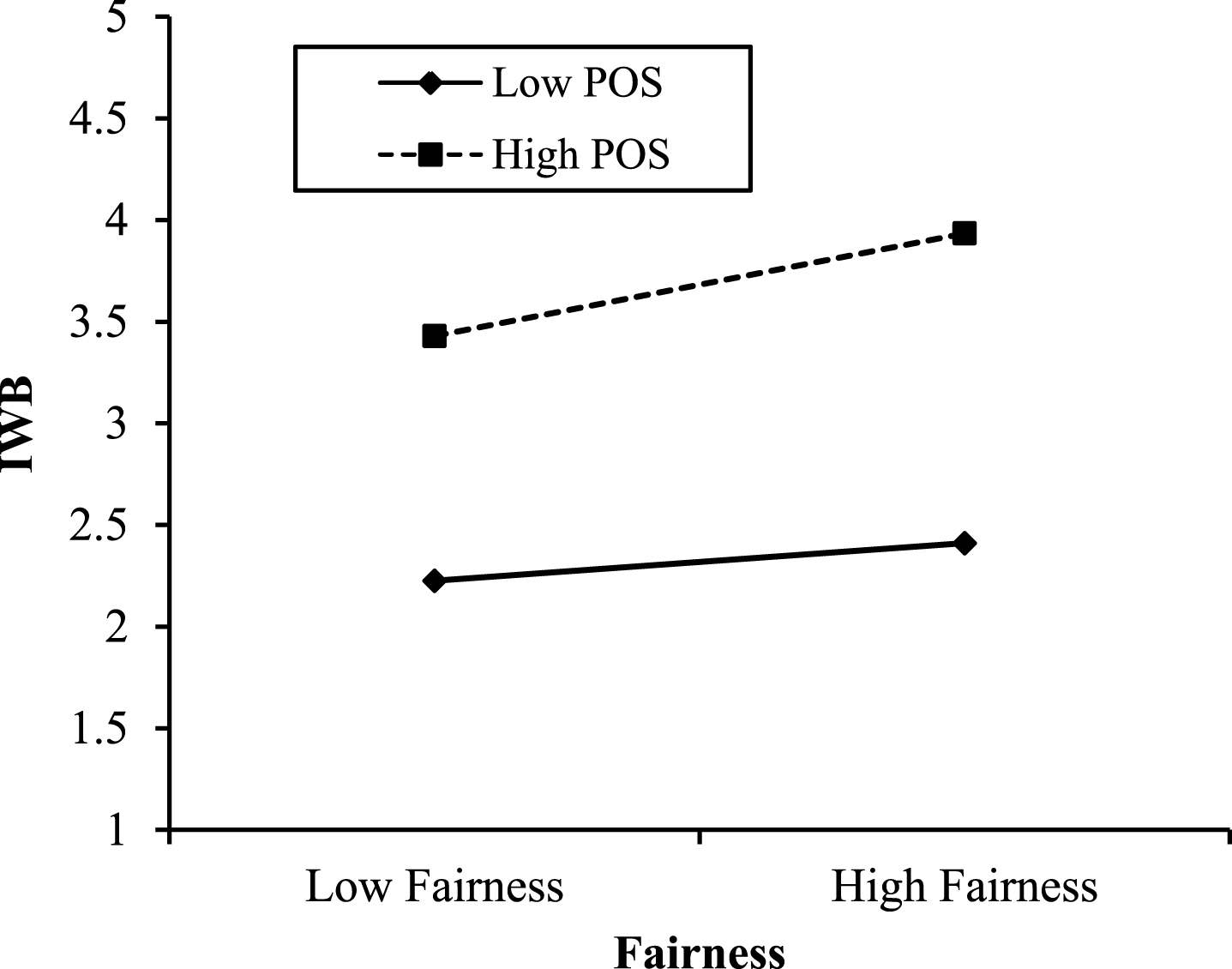
Conditional effect of overall fairness on IWB at levels of POS.
This study empirically analyzes the relation between overall fairness in organization and employee innovativeness at individual level, and the moderation between the fairness- IWB relation by POS in a south-east Asian developing country. The study was conducted in the service sector of Pakistan, and the results support all two hypotheses. Firstly, while the relation between fairness and IWB has been covered extensively in the literature [17], these variables are scantly covered in developing countries or in the service sector. The results of the study show that there is a positive relation between fairness and IWB, which is consistent with the studies in other developed countries [9, 17].
Secondly, POS moderates the relation between fairness and IWB. The result shows that POS moderates the relation between fairness and IWB in a way that high POS gives rise to fairness and IWB (Fig. 2). This result empirically illustrates that in the service sector of south-east Asian developing country, employees perceiving high organizational support tends to perceive greater fairness and increase IWB. A prior study conducted also supports these results, showing that a high POS enhanced the positive effect of fairness on IWB [17].
Practical implications
The findings of the present study have number of potential implications for management. The results shows that overall fairness perception plays a vital role in promoting innovativeness at individual level in service sector. The leaders of the organizations are suggested to maintain an environment of fairness in organization by conducting performance reviews timely, explain procedures, share expectations, design and discuss reward patterns explicitly, and provide feedback on performance. This study also suggests trainings for managers; (1) effective listening and (2) effective communication. These trainings will help managers to remain open for new ideas from employees and help providing candid feedback and suggestions respectively.
The study also shed light on possible potential effects of POS, which strengthen the positive relation between fairness and IWB at high POS. Therefore, this study emphasizes to promote perception of greater organizational support by providing tangible assistance (such as, equipment and personnel) when needed, acknowledge employee contributions and care for their socioemotional needs. Consequently, this will increase their job-role performance particularly extra-role performance and help organization achieve its purpose.
This study also delivers insights to assist multi-national enterprises planning to invest in Pakistan due to the China-Pakistan Economic Corridor (CPEC), a One Belt and One Road Initiative. Companies with plans for foreign direct investments should gain better insight of workforce preferences in particular context of Pakistan, a south-east Asian developing country. Similarly, policymakers at innovation-focused service organizations should consider role of overall fairness and organizational support to make better policies for workers in this region.
Limitations
Like other studies, this empirical analysis is not free from limitations. The study only incorporates organizations from the service sector, so the results are not generalizable to other sectors (i.e. manufacturing) and are limited to organizations operating in the service sector only. The study is also highly context-specific (i.e. south-east Asian developing country), so is not generalizable to other developing countries in some other region. Future research should intent at analyzing similar trends in the diverse manufacturing sector or at examining similar model to other south-east Asian developing countries.
Conclusion
This study documents the importance of overall fairness, perceived organizational support, and their effects on employee innovativeness at individual level. Service sector organizations in south-east Asian developing countries are encouraged to devise policies pertaining to enhance fairness in organization and organizational support required at different levels of organization. This will help trigger discretionary behavior in reciprocity among employees, to enhance organizational performance through innovation.
Declaration of conflicting interests
The author(s) declared no potential conflicts of interest with respect to the research, authorship, and/or publication of this article.
Footnotes
Acknowledgments
The authors would like to thank the journal editor, N. C. Georgantzas, for his very constructive feedback and recommendations that helped in strengthening this paper.