



Abstract
In today’s uncertain and ambiguous business reality, both business enterprises and other societal human organizations strive for competitive advantage. To attain it, they develop the capability to pursue innovation, while exploiting other existing capabilities pertinent to their organizational ‘ambidexterity’. This article investigates the role that organizational ambidexterity plays in the relation between intellectual capital (IC) and competitive advantage (CA). Tested is a set of research hypotheses, using sample data gleaned from 233 textile firms in Pakistan. Partial least squares structural equation modeling (PLS-SEM) unconceals a significant mediately effect that organizational ambidexterity interposes between intellectual capital and competitive advantage, i.e., IC helps firms become ambidextrous in attaining competitiveness. Noted too are the significant effects of all three IC components on competitive advantage, whereby the highest effect is attributed to human-development capital (HDC), followed by structural capital (SC) and relational capital (RC). These results contribute to much-needed comprehensive-strategy designs that, based on both intellectual capital and ambidexterity, yield a sustainable competitive advantage. Despite the study’s limitations and small sample size, the article offers both future-research directions and policymaking recommendations.
Keywords



Introduction
In today’s competitive economic world, intellectual capital is an apogee among the determinants of competitive advantage. Extant literature shows the crucial role that intellectual capital plays in leveraging organizational performance [1–3]. Although the term “intellectual capital” (IC) was coined by Galbraith [4], its roots can be traced back to the time of industrial revolution. The classical literature (e.g. Galbraith [4]) on IC defines it as the employees’ knowledge and abilities that can be instrumental in elevating the competitiveness of an organization. It is an invisible value of a business represented by three interrelated threads: namely human development capital (HDC), structural capital (SC) and relational capital (RC). Human development capital represents employees’ attitudes, skills and competence. Structural capital comprises organizational procedures and processes, whereas relational capital entails relations with customers, suppliers, employees and other stakeholder groups [5].
It is often claimed that, besides directly contributing to the competitive advantage, an organization’s IC can be instrumental in gaining organizational ambidexterity, i.e., the right balance between organizational efforts of exploitation and exploration. According to Soo et al. [2], however, in the pursuit of new business opportunities, most organizations compromise their exploration ability. Yet, the capability of exploiting existing assets and position in a profit-producing way is central to the firm’s ability to survive and explore new technologies and markets.
Organizations that can successfully configure and reconfigure their resources to capture existing as well as new opportunities are called ambidextrous organizations [3, 6]. IC has the potential to improve competitiveness by making organizations ambidextrous; however, thirst-quenching scholastic work is missing in this conception. Similarly, less scholastic work has been steered toward elucidating the role of ambidexterity in the intellectual capital-competitive advantage relation, requiring researchers’ attention [7–9].
Nevertheless, anecdotal evidences show ambidexterity as a business capability that helps to attain sustainable competitive advantage by equally influencing all three functional, business and corporate-strategy spheres [10]. However, a few studies have empirically analyzed the IC-led-ambidexterity as a business capability, instrumental in attaining sustainable competitive advantage.
Against this backdrop, this study examines the role of organizational ambidexterity in the relation between IC and competitive advantage, as well as to explore influence of IC on competitive advantage by examining the evidence from Pakistan. The study’s results contribute in two ways. First, our findings contribute to the literature regarding organizational ambidexterity as a mediating variable between intellectual capital and competitive advantage. Secondly, it enhances the negligible studies in IC and organizational ambidexterity in a South Asian (Pakistan) context. Nevertheless, certain kinds of limitations are often associated with any research and this article is not an exception. First, this study used the cross sectional data, collected from 233 organizations from textile sector of Pakistan, which are static in nature. If longitudinal data are collected from the same organizations in the form of panel data, then they can provide comprehensive, in-depth findings. Likewise, the second limitation arises from the issue of generalizability of our results due to the focus on single country and single industry. Future researchers may consider replicate the findings of this study using data from other countries and industries in order to confirm and enhance generalizability.
The remainder of the article is divided into three sections, whereby a brief review of extant literature is presented in Section 2. Section 3 briefly discusses the data and methodology whereas Section 4 covers the findings. Discussions and conclusion are given in the last section of the article followed by limitations and suggestions for future work.
Literature review
In the 21st century, reliance of businesses has shifted from tangible assets to intangible assets, such as intellectual capital (IC). Although the concept of IC was formalized in 1969, it did not capture the interest of researchers at the time. However, owing to the cost cutting pressure in the early ’90 s, both scholars and practitioners started looking for alternatives. In this pursuit of cost reduction, IC came under limelight and researchers undertook the task to substantiate this concept. Sveiby [11] purported that IC is an indicator used to determine the worth of a business.
Table 1 gives a brief taxonomy of IC definitions. Resource-based view [12] emphasizes the four qualities that must exist in order for any process/factor to serve as a major source of competitive advantage. These are valuable, rare, inimitable, and non-substitutable (VRIN). Interestingly, the IC has the potential to have all these elements, thus making it a potential source of competitiveness and ambidexterity [8, 13]. Likewise, in the context of dynamic capability approach, IC is considered one of the essential elements helping an organization to build and reconfigure its capacities in order to adapt to its changing environment [3, 14].
Definitions of intellectual capital
Definitions of intellectual capital
It is observable from literature that all IC definitions incorporate three essential components: namely human development capital (HDC), relational capital (RC), and structural capital (SC). Therefore, in order to better comprehend the IC, it is important to examine these three components, which are briefly described below.
Literature on intellectual capital explains human development capital (HDC) as the basis of competitive advantage (CA). Although there is no unanimous definition of HDC, employees’ skills, knowledge, experience, and abilities are considered important strands of human development capital. The concept of human development capital, as introduced by Becker [15], primarily focused on the macro level. However, in the ’90 s, study of HDC at the firm level gained attention of researchers worldwide. It was the era when, besides quantitative aspects of HDC, such as education and experience, the qualitative aspects of HDC (e.g., attitudes, motivation, problem solving abilities, etc.) were also widely explored. This shift in focus not only refined the concept of HDC at the micro level but also made it possible to develop policies for elevating the level of HDC. Mubarik [16] defined HDC as the employees’ knowledge, skills, abilities, and attitudes instrumental for attaining sustainable competitive advantage.
Other researchers (e.g., Subramaniam and Youndt [17], Kostopoulos et al. [7], and Hsu and Wang. [18]) posited that the main factors of organization’s human development capital are workforce ability sets, and breadth of their skills. Many researchers (e.g., Hsu and Wang [18] and Soo et al. [2]) believe that HDC encompasses capabilities, problem-solving potential, and leadership patterns. Human development capital, along with the other two components of IC—structural capital and relational capital—helps organizations obtain an optimal fit between present operations and future plans. Having high level of HDC enables organizations to capitalize on the existing business opportunities while innovating. Against this backdrop, we have developed the following hypothesis:
H1: Human development capital has a positive influence on organizational competitive advantage.
Structural capital
Structural capital (SC) is defined as an organization’s structures and processes, which the employees follow to execute business transactions. It represents an accumulation of organization’s knowledge that includes standard operating procedures, business processes, strategies, leadership and management style, organizational culture, and supportive infrastructure [19, 20].
Available evidence indicates that novel and efficient organizational processes for performing tasks can be a major source of competitive advantage. Moreover, SC supports employees’ productivity, yet remains in the company even when employees leave an organization [21]. Thus, SC can be organization-specific processes devised by the organization itself to perform its business tasks.
This helps the organization to exploit and explore business opportunities. SC also enables human development capital to function properly for attaining business targets. This implies that weak structural capital of an organization not only directly affects its business processes but also hampers the efficiency of human development capital and relational capital. We thus hypothesize the relation between structural capital and competitive advantage as follows:
H2: Structural capital has a positive influence on organizational competitive advantage.
Relational capital
According to Donnell and Regan [22] and Chuang et al. [23], relational capital (RC) comprises knowledge in all relations that an organization establishes with its competitors, customers, trade associations, suppliers, or governments. Relational capital includes all relations that exist within and among the organizations. These individuals and organizations comprise suppliers, agents’ customers, regulatory authorities, employees, communities, investors, creditors, etc.
The relational capital associations are separated into two groups on the basis of their purpose: the first group comprises formal relations defined by obligations and contracts with suppliers and customers or main stakeholders whereas the second group comprises informal relations [24]. According to Tatiana and Tatiana [21], relational capital has expanded the previous concept of relational capital and, now, it includes the knowledge of relations that an organization establishes with competitors & customers, trade associations, suppliers, and the government. Customer capital is considered as a bond for and arranger of intellectual capital processes, and works as a determining factor in converting intellectual capital into market value or worth. This capital consists of the loyalty and strength of customer relations. The following hypothesis has been developed to test the influence of relational capital on competitive advantage:
H3: Relational capital has a positive influence on organizational competitive advantage.
Role of organizational ambidexterity
Organizational ambidexterity is an organizational capability which enable an organization to embark on the journey of exploring new opportunities through innovation while effectively exploiting the current opportunities [6, 26]. In short, it is the ability of an organization to attain groundbreaking innovations while steadily improving the existing business. It requires an organization to focus on both exploring and exploiting simultaneously, yet keeping these efforts separate from each other. This separation allows new exploratory units to follow different processes, procedures, structures, and cultures from those adopted by their exploitative counterparts.
Nevertheless, organizational separation is managed by a tightly integrated senior executive team [6, 27]. As competition is becoming increasingly fierce, the survival of a firm over time greatly relies on its degree of ambidexterity [6]. Organizational ambidexterity is widely recognized as a prerequisite for attaining sustained competitive advantage, as it provides a firm ability to devise its existing business competencies in ways that are valuable to the customers but difficult for competitors to imitate.
As ambidexterity has a strong connection with intellectual capital, it can have a profound influence on competitive advantage. In this regard, Kang and Snell [28] noted that all three elements of IC can have a profound potential to contribute to organizational ambidexterity. On the other hand, Subramaniam and Youndt [17], Swart and Kinnie [29], Aribi and Dupouët [30], Tatiana and Tatiana [21], and Chuang et al. [23] posited that human-development capital, structural capital, and relational capital enable an organization to attain a fit between exploiting and exploring opportunities. These studies provide the basis to expect a strong mediating role of organizational ambidexterity in the relation between IC and competitive advantage, resulting in the following hypothesis:
H4: Organizational ambidexterity mediates the relation between IC and competitive advantage.
This hypothesis has been divided into the following sub-hypotheses to examine the role of ambidexterity in the relation between each IC dimension and competitive advantage.
H4a: Organizational ambidexterity mediates the relation between HDC and competitive advantage.
H4b: Organizational ambidexterity mediates the relation between RC and competitive advantage.
H4c: Organizational ambidexterity mediates the relation between SC and competitive advantage.
Based on above discussion, we have derived following conceptual framework for analysis Fig. 1.
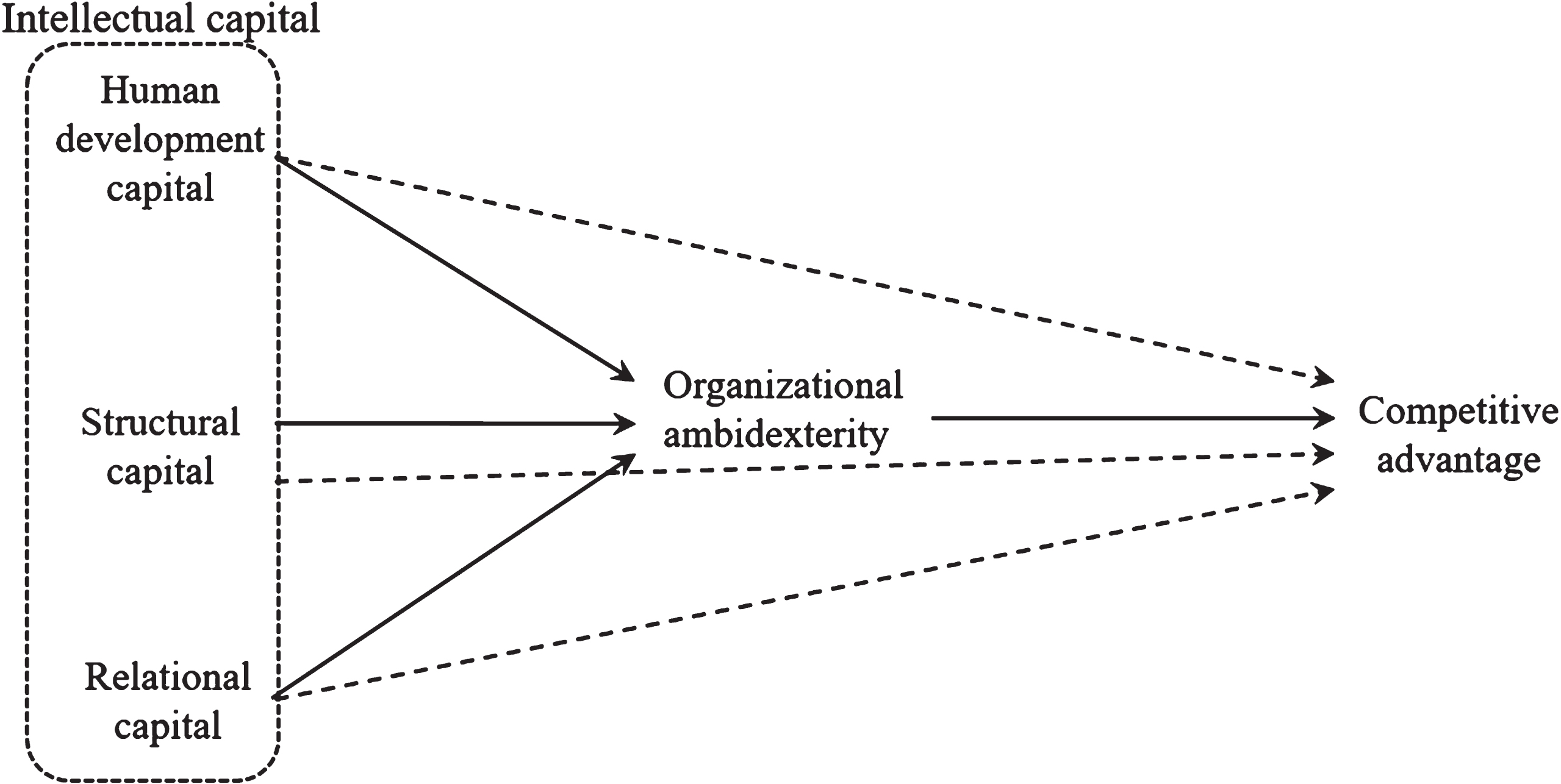
Conceptual framework.
Population and sampling
Population of interest for the present study included all medium- and large-sized Pakistani textile firms. According to the definition provided by the SMEDA [31], firms with the workforce of 100–250 staff are in the medium category, while those with more than 250 employees are large firms. According to the APTMA [32] records, around 390 textile mills fall under the category of medium and large firms. Majority of these firms are located in four major cities, namely Karachi, Lahore, Faisalabad, and Gujranwala.
A close-ended questionnaire was developed to collect the data, whereby items pertaining to the study constructs were adopted from previous literature. The items related to the intellectual capital dimensions (i.e., human development capital, relational capital, and structural capital) were adopted from Amiri et al. [33], Chaudhary and Rubin [34], and Chahal and Bakshi [35]. The items of competitive advantage were adopted from O’Shannassy [36] and Ram et al. [37]. Further, the construct of organizational ambidexterity was adopted from Gibson and Birkinshaw [38] and Li [8].
We distributed 580 questionnaires among 290 firms (2 questionnaires for each firm) selected through random sampling. Population list of firms was obtained from the Chamber of Commerce directory and Jamal Yellow pages. The data for the study were collected with the help of government of Pakistan. The questionnaires were completed by individuals holding the director, general manager, HR manager, or planning manager titles.
Analytical techniques
PLS-structural equation modelling was adopted for testing the framework. This methodology was chosen because of its ability to model multiple relations simultaneously and control the endogeneity problem.
Results and analysis
Respondents’ demographic characteristics
Since the study data were collected with the assistance of Pakistani government, the response rate remained quite high, whereby we received 487 completed questionnaires out of 580. After checking for anomalies, 32 questionnaires were excluded, leaving 455 for analysis. Table 2 shows the demographic characteristics of the respondents. Respondents from 233 firms filled the questionnaire. All of the respondents were from upper level management and had role in the decision making and planning in their respective firms. Respondents were mostly from strategy, planning, production, and personnel departments.
Demography of respondents
Demography of respondents
The analyses of data were performed in two stages. In first stage, we determined the reliability and validity of the measurement models. It was ascertained through checking convergent and discriminant validity based on the three criteria suggested by Fornell and Larcker [39]. Table 3 shows the results of factor loading, AVE and CR, indicating that the factor loadings are in the 0.70–0.88 range. This shows that all items load well on their respective constructs. Likewise, the CR and AVE values of all constructs exceed 0.70 and 0.50, respectively.
Discriminant and convergent reliability
Discriminant and convergent reliability
We checked the discriminant validity of the scales by comparing the square root of the AVE with correlation, as suggested by Fornell and Larcker [39]. Table 4 lists the correlations among the constructs, with the square root of the AVE given on the diagonal. All the diagonal values of square root of AVE are higher than the correlation values of the corresponding construct. This confirms discriminant validity of the constructs.
Descriptive statistics
Note: The bold diagonal values are square root of AVE. * and ** show significant at 5 percent and 1 percent respectively.
After ascertaining the validity of the constructs, the relations among variables were analyzed. Two models were estimated, the first of which was used to analyze the overall impact of IC on competitive advantage (CA) and through organizational ambidexterity. In the second model, we analyzed the effect of individual elements of IC—namely HDC, RC, and SC—on CA directly and through ambidexterity. The results of hypotheses testing of both models are presented in Table 5 below.
Hypotheses testing
Hypotheses testing
**and ***show the level of significance at 5% and 1% level respectively.
The analysis of results show that, overall, IC (β= 0.52, p < 0.000) exerts a significant positive effect on organizational competitive advantage (CA). The high magnitude of the IC coefficient showed its substantial impact on CA. These results concurred with those yielded by a number of empirical studies, such as Sharabati et al. [40], Hitt et al. [41], and Bontis and Fitz-Enz [24]. For example, Mubarik et al. [5] noted that IC directly contributed to the competitive advantage, as it can be inimitable and non-substitutable, which are the basic requirements for competitive advantage. Similarly, results also revealed a significant role of organizational ambidexterity (β= 0.45, p < 0.000) in channeling the effect of IC toward attainment of competitive advantage.
From these results, it could be inferred that IC helps an organization to achieve a fit between its exploitation and exploration activities, which in turn becomes instrumental for attaining competitive advantage. These findings also concurred with those reported in pertinent literature. For example, Hervas-Oliver et al. [42] mentioned that stock of IC is an important contributor to firm’s ambidextrous ability, which created point of difference for the firm. Similarly, Kaplan and Norton [43] suggested that firms need to be ambidextrous for channeling the impact of IC on CA.
Findings pertaining to the three IC components are of particular interest. While the results showed a significant effect of human development capital (β= 0.32, p < 0.000) and structural capital (β= 0.27, p < 0.005) on competitive advantage, the effect of relational capital (β= 0.19, p = 0.15) was not statistically significant. Although findings on effect of HDC and RC on competitive advantage concurred with those reported by Sharabati et al. [40], Aandrevski et al. [44], and Eklinder-Frick, et al. [45], those related to the SC–CA relation did not. The importance of this relation was less understood in majority of Pakistani textile firms. The interviews with the textile mill owners, firms’ top leadership, and textile ministry officials substantiated the findings in this context. Majority of the respondents opined that the relation management is less understood in most of the textile firms in Pakistan. In particular, relations with suppliers are not well developed, as they are considered competitors instead of stakeholders. Yet, such relations are maintained due to price consciousness and lack of trust [46]. Despite this contextual explanation, the contradictory results demonstrate the need to conduct similar studies in other industries.
In order to check whether organizational ambidexterity is a full or a partial mediator in the relation between IC and CA, we followed the approach proposed by Baron and Kenny [47]. First, the effect of IC on organizational ambidexterity was tested, followed by the effect of organizational ambidexterity on competitive advantage, and finally the effect of IC on competitive advantage. Our results showed that IC significantly affected ambidexterity, which in turn had a significant effect on competitive advantage. When the direct relation of IC was added to the model, the indirect relation of IC reduced but was still significant. Thus, organizational ambidexterity is a partial mediator (β= 0.45, p < 0.000) in the relation between IC and competitive advantage. Similar approach was adopted to check the degree of mediation of organizational ambidexterity in the relation between three elements of IC (SC, RC, and SC) and competitive advantage (CA).
Interestingly, results showed that relational capital played the role of a partial mediator in all three elements of IC. These results are consistent with those reported by Huang and Jim. [48], Zhang and Zhang [49], and Hewapathirana [50]. In sum, it can be concluded that organizational ambidexterity plays an apex role in attaining sustained competitive advantage. Similarly, these results also allow us to highlight both direct and indirect contribution of IC in attaining competitive advantage.
The purpose of the present study was to provide empirical evidence on the effect of IC as a whole and its components on competitive advantage. Similarly, our intention was to examine the role of an organizational ambidexterity in the IC–CA relation. Our findings indicate that organizational ambidexterity is instrumental in channeling the effect of IC toward CA. Further, our results also reveal a significant effect of HDC and RC on CA but an insignificant effect of relational capital (RC). Overall, these results concur with extant literature.
Nevertheless, some of the results diverge from the mainstream literature due to contextual factors. In condensed form, this study suggests that IC and organizational ambidexterity are important requisites for attaining competitive advantage. Among the three IC components, HDC emerged as a major direct and indirect contributor. These results call for organizations to reexamine their strategies to deal with IC.
We have some profound implication drawn from the findings of the study. First, findings identify “IC-led ambidexterity” as an organization capability instrumental in attaining sustainable competitive advantage. This gives central role to IC for building the organization’s ambidexterity. It implies that each dimension of IC needs to be systematically built through crafting the organization’s strategies. For customer-centric functional, business- and corporate strategies, notion “IC-led ambidexterity” can be built by organizations on a typology of three groups: sequential, structural, and contextual ambidexterity [9, 51]. The different types of ambidexterity actually reflect the different capabilities of an organization, such as ambidexterity and punctuated equilibrium [52]. Punctuated equilibrium argues that organizations mitigate these tensions by temporarily separating these activities [53]. In other words, exploration follows exploitation or vice versa. In contrast, the ambidexterity literature argues that organizations can undertake both these activities simultaneously [54, 55]. However, a paradoxical view was applied to inspire the idea of “leadership ambidexterity” [25]. Paradox refers to the “contradictory yet interrelated elements, which exist simultaneously and persist overtime” [56]. This approach encourages managers to embrace or “live with” paradox, and find a means of accepting them simultaneously. Thus, it is connected to the cognitive pattern or the decision-making style of top management teams. In short, ambidexterity can be consumer driven rather than resource or technology driven, and IC can play a pivotal role in building it.
There is a consensus on the point that building Intellectual capital leading to ambidexterity is not easy to achieve due to the requirements of different organizational architectures and processes [57], and different organizational learning models [58], which leads to tensions and trade-offs in organizations. Hence, there is a need by the top management to balance the resource allocation between exploitation and exploration [59]. In addition, it is more likely to occur under conditions of environmental dynamism that means when the firm’s environment is more dynamic, higher is the likelihood of ambidexterity (e.g., Lee and Lee [60]).
To build the “IC-led ambidexterity” capability, the first and foremost point is the need to have systematic relation development with suppliers, customers, and employees. Companies invest to improve relation with customers and to some extent with employees, but they neglect their relations with suppliers. In order to have an effective relational capital, textile firms in Pakistan needs to work on the supplier relations and develop a suitable relation management strategy. Firms also have to come out from traditional customer relation management by adopting a comprehensive long-term plan for customer relation development.
Secondly, for attaining and sustaining competitive advantage, firms need to invest into their workforce and upgrade their human development capital. This can be done by conducting training and development. In this vein, top management can devise comprehensive policies for continuous development of HDC.
Thirdly, firms should evaluate the efficiency and effectiveness of their business processes. During interviews, a number of redundant business processes were identified, adding inefficiencies, which required serious attention of top management. Textile firms should establish their processes (structural capital) in a way that is unique and inimitable.
Finally, ambidexterity is the most important element for organizations aspiring to attain competitive advantage. The results yielded by this study indicate that organizations have to develop a strategic fit between exploring and exploiting efforts.
Every research work has some limitations and this study is not an exception. The first concerns the issue of generalizability of our results due to the focus on single country and single industry. The second limitation is related to type of data used for analysis. This study used cross sectional data, collected from organizations at a specific time. Third, the study takes IC as the major factor influencing the firms’ performance, ignoring other factors like the financial strength of the company, the quality of physical assets and the market reputation of the company.
Keeping in view these limitations, we have some suggestions for future studies. First, future researchers should consider replicating the findings of this study using data from other countries and industries in order to confirm and enhance generalizability. Second, future researchers should consider using panel data for analyzing IC and competitive advantage relation. Such analysis can provide an in-depth and stable findings for organizations to craft their business strategies. Third, in addition to intellectual capital, researchers may include other variables like financial strength, physical assets and the goodwill of the company to check whether IC sustains its effect on the performance in the presence of these factors or not.