



Abstract
This paper presents a theoretical analysis based of virtue ethics. We examine the individual internal predispositions related to non-virtuous behavior in the context of an ethical dilemma. For Aristotle, the virtuous state of being requires certain dispositions, but the difficult context of a “genuine dilemma” can generate interference and obstacles to achieving a virtuous state. The genuine dilemma is a symptomatic situation that disrupts our ethical identity by the potential biases that affect our personality traits and moral acts. These disturbances cause a phenomenon described by philosophers as “akrasia”. We propose that this “weakness of will” influences the ethical decision-making process, thereby leading to non-virtuous acts. Within the empirical literature, we identify three types of disturbances that feed akrasia: bounded ethicality, denial, and moral cowardice. These ethical biases disrupt one’s moral conscience by moving the individual away from the pursuit of virtue. Understanding these ethical errors contributes to enhancing ethical decision-making models, especially in terms of examining the failure of one’s will to act according to one’s values. We propose a conceptual model that explains non-virtuous attitudes to ethical dilemmas in management.



Introduction
Increased ambiguity and complexity in today’s organizations has caused managers to address how ethical situations lead not only to a loss of work meaning, but how these situations can harm employee well-being [1]. These dilemmas represent critical situations that challenge a human resources manager’s values and conceptions of ethics [2]. An ethical dilemma will often involve an apparent conflict between moral imperatives, such that by obeying one imperative could result in transgressing another [3]. From a dilemma, an individual’s identity is challenged by pressure towards one choice or another, thereby presenting a higher risk of losing one’s individual integrity. In business environments, a manager is confronted with decisions on how to cope with maintaining their integrity when facing an ethical dilemma.
An ethical dilemma can be understood as a difficult issue to solve not only because it may require an immediate or temporal outcome, but the dilemma also presents multiple challenges and ambiguities for its resolution. During the decision-making process, ethical decisions are affected by many biases. These biases, under certain situations, may result in a kind of weakness of the will. In this article, we explore how the context of ethical dilemmas impact a manager’s moral conscience and conceptions when facing this phenomenon.
The work of Aristotle and moral philosophies are of particular interest to us because they offer helpful perspectives on human characteristics and psychology, vital information that attributes to an immediate normative effect [4]. We offer an original contribution by exploring a contemporary version of Aristotle’s work and ethical system. The latter focuses on moral action from reflecting on the conditions of a “good life.” Happiness is the purpose of this good life, but it should be obtained from the individual’s development through the use of reason and temperance of desire [5]. For Aristotle, ethics as a discipline aims at determining the correct and balanced behaviour in a specific context or situation [6]. These foundational ideas offer an opportunity to examine best practices and explore appropriate ethical approaches that may lead to virtue. This vision of good by the use of reason - virtue - gave birth to several moral perspectives in philosophy, among which the empirical work of David Hume, utilitarianism in England and pragmatism in the United States [6].
Virtue ethics offer a need to revisit Aristotle’s view of morality and consists of an individual having predispositions of “doing good”; in other words, being virtuous. To be ethical or moral is to become virtuous. Morality is not reduced to the application of a categorical or universal standard (e.g., utility), but rather lies within a person who decides according to his moral qualities [7]. Virtue ethics is therefore a reexamnation of Aristotle’s thought, differing significantly from utilitarianism, thereby placing individuals at the heart of the moral system.
This article seeks to contribute to the advancement of research into virtue ethics appliedto complex and ambiguous ethical situations. Our objective is to understand those elements and how they influence a manager’s moral conscience and subsequent virtuous behaviour. Our primary research question is the following: can a manager be virtuous within the context of an ethical decision-making dilemma? To answer this conceptual challenge, we adopt a specific method, namely speculative theoretical research. Although this type of research is not often highlighted in methodology manuals ([8] and [9]), it is useful for our purpose. In this article, we first introduce and examine virtue ethics applied in the ethical decision-making process. In our second section, we discuss the methodology used in our research. The third section focuses on how character traits may negatively influence moral consciousness (akrasia). The fourth and final section will raise important theoretical and managerial implications stemming from our analysis. We conclude with potential research insights and future work.
Literature review
Virtue ethics is considered as one of three major approaches in normative ethics. It differs from conventional approaches because as it is “agent-centered” rather than “act-centered” [10]. Specialists in this approach focus on the question of being instead of doing, often asking “What sort of person should I be” rather than “What should I do?” [10]. Virtue ethics channel these concerns towards the virtuous agent and more specifically his character traits. Virtue ethics offers an explanation of the value of the act (good or evil) as follows: an action is good when it is what a virtuous actor does or would do [10]. From this perspective, the approach is exploratory, as it seeks to understand how a good moral action is performed; what are the elements that make a good or evil action possible? Proponents of this view are almost unanimous in opposing the idea of a coherent system of absolute and universal moral principles dominating our rationality and behavior. They prefer the conception of the individual as a moral agent using specific considerations and contextualised practical judgment [4]. Virtue ethics is therefore not interested in one’s actions but in one’s moral personnality and the means to attainment. This ethic is centered on the subject’s predispositions and considers character as the main object of moral evaluation [4].
Virtue ethics addresses three central concepts: arête (excellence or virtue), phronesis (practical or moral wisdom) and eudaimonia (flourishing). The first concept refers to the result of one’s actions and the third concept refers to the consequence of one’s virtuous character. This article focuses on the second concept, phronesis or “practical wisdom”. Phronesis is viewed as an intellectual virtue, which reflects on contingent factors. We can distinguish this concept from others by its explanatory power of achieving virtue. The absence of this moral wisdom – or its obstruction thereof - may also help explain one’s failure to adopt virtuous behavior.
According to Aristotle [5], a virtuous act is dependent upon a person’s internal conditions: “It is also necessary that the agent itself be in a certain disposition when he acts.” He must first “know what he is doing; the person must then freely choose the particular action and choose it for himself, and lastly, he must accomplish the act in a firm and unwavering state of mind” [5] (NE, II, 3). Aristotle further states that moral virtue “is the middle ground between two faults, excess or shortage, its nature is to aim at balancing both passions and actions [...] it is therefore difficult to be virtuous” (NE, II, [14]). Aristotle defines a virtuous person as a state of character, an attitude when facing choices. The rationality principle serves as a means for the individual to choose the act that will provide happiness. However, a virtuous individual has a difficult balance to achieve, a balance between maintaining a form of consciousness while independently expressing free choice. To achieve this state, one must prevent any character loss and one’s choices should not be subjected to the influence of external factors. Aristotle understood that virtuous behavior would be exposed to a multiplicity of internal and external passions that are difficult to overcome. One must therefore seek balance between various passions. Moreover, if being virtuous means getting rid of all excess from the outside, it implies that an individual’s ability to recognize anxiety-producing situations and those instances that carry important ethical issues can have dramatic consequences if ignored.
From a virtue ethics perspective, being virtuous is to excel at actualizing our own potentialities in order to achieve balanced thoughts and acts that are free from all external pressures [7]. Being virtuous is part of a process of self development and of being oneself. Ethics becomes a science that enables man to move from “as-he-happens-to-be” to “as-he-could-be” if he realised his essential nature [11]. Achieving happiness is only possible therefore through the excellence of being oneself. The premise of virtue ethics is confirmed by Aristotle, for whom the wise man “takes advantage of circumstances to always act with as much nobility as possible, in the same way a good general uses his forces in the most efficient way in war, or a good shoemaker makes the best possible shoes of the leather he has been given” [5] quoted by [7]. If virtue is the condition of a good life, then what are the circumstances leading to its achievement? Understanding the “circumstances of virtue” is a central point associated with the potential failure of virtue, and the subsequent lack of being fulfilled as a virtuous person [7].
With phronesis, or “practical wisdom,” we recognize that circumstances may arise that cause the failure. The main risk is ontological. Not to fully realize one’s morality can result in various negative consequences. One of these consequences, moral suffering, is of an existential nature. Considering that “moral suffering is the realization that one cannot make a choice of existence”, then situations where ambiguities and hesitations arise may produce mental suffering [12]. Thus, instead of expressing freedom through making informed choices, the individual remains passive when faced with the undecidable. Mental distress is dependent on the sorrow that prevents the individual from reaching his full realization, his happiness. Sorrow then becomes “darkness” and “indetermination” [12]. Abdication of moral conscience is, and remains, the main obstruction to the full expression of virtue. The initiator of a decision must ensure that his conscience remains free and that it is in a “good internal disposition” for virtuous behavior to emerge.
The problem is that many obstacles will arise in today’s businesses and organizations. There are various management mechanisms obstructing one’s conscience through practical wisdom – phronesis – and much research has been performed on these issues [13–15]. This article is part of that research stream. In the following section, we examine the elements that may hinder individual expression of virtue and cause the failure of practical wisdom through a discussion of a specific situation where circumstances of virtue were jeopardized.
The issue of context in ethical decision-making
What criteria are necessary for a decision to be described as virtuous or excellent? If the purpose of a decision is to achieve a virtuous act, then it is reasonable to examine the attitude that guides the decisional process. It is worth mentioning at this point that ethical decision-making is conceived as a process resulting from the interaction between an individual and a situation [16]. Numerous empirical models of decision-making in recent decades agree on this hypothesis [16, 19]. There is also consensus around the need for the individual to have a conscience that is capable of dealing with an ethical situation. The conscience is central to ethical decision-making [20] as shown by Aristotle’s thoughts on the need to be in “a good disposition” to be virtuous.
Models of ethical decision-making reproduce the ways managers address ethical issues and generally propose decision models consisting of several stages: sensitivity, judgment, intent, and actions [16]. These models analyze ethical behavior through the prism of a rational process in which the ‘good deed’ is considered not only by its consequences, but throughout the process [18]. However, none of these models provide clear guidelines as to the role of context in the process. These models, some of which were developed for psychotherapy, consider moral dilemma as the beginning of ethical deliberation [16, 18]. In their meta-analysis on the process of ethical decision-making, O’Fallon and Butterfield [21] found that the influence of the environment or context is abundantly supported in the empirical literature. We should note that context is of central importance for the beginning of ethical deliberation. The ethical climate, code of ethics, or organizational ethical culture are among those contextual factors.
The study of contextual factors demands more attention from specialists, including facts surrounding awareness and ethical issues in a particular context. The addition of the conscience as a factor in models of ethical decision-making would provide a better account of the elements influencing the decision-making steps that are prescribed by these same models [18]. Introducing context into the analytical framework of decision models would enhance our way of conceptualizing and perceiving ethical problems by bringing into focus certain specific aspects. In doing so, we would develop “a greater awareness of the context of ethical issues, which in turn would help us make better decisions” ([18], p. 502).
In our view, the first step in integrating context into the process of ethical decision-making is to examine the initial instance of the phenomenon that triggers an ethical reflection: the ethical dilemma. Specifically, we are interested in exploring conscience manifestation in ethical dilemmas to uncover the source of a possible failure of virtuous behavior.
The ethical dilemma as a backdrop to test the virtuous
At this stage, we assume that the expression of virtue (or virtuous potential) can be obstructed in the context of an ethical dilemma. An ethical dilemma influences our decision-making process [16, 22] by disrupting it and clouding our choices based on values. A dilemma highlights our moral and ethical character [23]. The current conception and debate on ethical dilemmas is inspired by work of the British philosopher, Bernard Williams. His work [24] profoundly influenced the field of contemporary ethical reflection by inviting us to rethink ethical and moral dilemmas outside the “sacrosanct impartiality” of Kantian and utilitarian ethical approaches [25].
In his essay, Williams [24] suggests that moral conflicts - such as dilemmas - consist primarily as conflicts between desires rather than conflicts between options or beliefs. For example, when we must choose between two moral duties, we may opt for one, but the other still exists in our minds. We choose a desire while the other abandoned desire triggers regret [24]. If one must categoricaly choose one duty over another, it “seems impossible to stick to a logical representation in which the conflict will necessarily result in the total rejection of a duty” ([24], p. 121). For Williams, the idea of choice in a moral conflict is equivalent to completely evacuating the non-chosen duty, which is impossible. Williams [24] argues the existence of what he terms ‘moral residue’; regret for not being able to fulfill all obligations in the selection of a duty when faced with a moral conflict. It is from these thoughts that the idea of genuine dilemma emerged.
Geva [26] provides a definition of a genuine dilemma expressed by Williams [24] that may be transfered into business ethics: “a genuine ethical dilemma arises when two or more valid ethical requirements or legitimate interests conflict and consensus do not exist as to how it should be resolved” ([26], p. 136). The genuine dilemma features consists of: 1) a person is required to act on two (or more) conflicting actions; 2) a person may take such actions simultaneously; 3) none of the conflicting obligations can be prioritized or ignored [27]; and 4) a person is therefore doomed to moral failure [24]. This vision of genuine dilemma illustrates the difficulty of being virtuous when facing dilemmas. Even if one wishes to exercise virtue, being virtuous is complex and laborious because the genuine dilemma is of an insoluble nature. For Bagnoli [28], “I would even say that moral dilemma is a deliberative trap with no way out. Moral agents who experience moral dilemma feel lost and confused, not because they are unsure about their duties, but because it is impossible to choose a way out of the dilemma” ([28], p. 17). The insoluble aspect of dilemma exposes certain conditions under which the individual moral equilibrium – so highly recommended by Aristotle - can be attained.
This issue is raised by the example of an individual manager’s ethics put under pressure by collective organizational ethics [29]. It is important to keep in mind that individual and collective ethics are respectively experienced in a reciprocal constitutive activity that is constantly renewed. Individual and collective ethics are not distinct; they are two moments of an identical and unique reality [30]. The genuine dilemma serves as a good example of this reality in which corporate ethics confront and initiate individual ethics, creating a context in which the virtuous person must act. Managers are continuously confronted with some dilemmas that leave them “lost and confused” and with a relative sense of achievement composed of moral residue [31]. Many such ethical issues have been noted in recents years. For example, many managers find it difficult to balance organizational and individual needs in addition to coping with financial or efficiency objectives of a team, all the while attempting to preserve their well-being or job security. Another example may center around how to consistently ensure the same level of produt or service quality in the midst of budget reductions. Managers may begin to think they have to shoot two rabbits that run in opposite directions at the same time; an impossible and maddening task [29]. To cope with this situation, some managers develop strategies to avoid the necessity to choose, hence an ethical cowardness [29]. Above all, this appears as meaningless professional ethics. The dilemma raises the question of context as an element that disrupts one’s virtuous dispositions within an organization.
We argue that the presence of a dilemma may cause disruption and modification of the virtuous agent’s dispositions by placing him in an almost unsolvable situation, thereby causing an imbalance. An ethical dilemma, for example in human resources, is multifaced as it involves personal, professional and organizational duties that can be in conflict with each other [32]. Many dilemmas can provoke a weakness of will because traditional ethical paradigms, such as Kantian or utilitarism, do not provide concrete guidelines for navigating the decision-making process.
Methodology
We favour speculative theoretical research [8], although this type of research has been poorly present in methodology manuals [9]. The “relative silence” stems from the complexity of delimiting this essential form of research. The “brainstorming” of concepts produces original works fuelled by both imagination and intuition. This method can also be supported by rational arguments and rigorous interpretations of articles and models ([9]). This subjective and objective attraction seems to be coherent with our exploration of new meanings of ethical decisions on dilemmatic situations. Moreover, this type of approach is quite common in moral philosophy, where ethical analysis is often done through theoretical reflection and thereafter tested through practical cases [33]. Theoretical research then appears to us as a creative process, imagination being the most important benefit of the conceptual analyst [8]. For example, Dewey, the father of modern pragmatism, used only deduction and imagination in formulating his theory, which led to significant reforms in both society and Western philosophical thought [8].
From the authors’ experiences in various MBA courses, research interviews, and didactic reflection, we identified a weakness in ethical decision-making models and the underlying moral philosophies used in their designs. Those models focused mainly on utility value or on deontological logic [16, 17]. We have also noted the difficulty of maintaining individual values while providing solutions in certain moral situations. The challenge was to question whether another way existed for understanding virtuous behaviour within a complex situation. Could there be another way of explaining human behaviour in the face of moral dilemmas? This question is in line with the comments of other researchers: “There ought to be a better way, a safe passage between the Scylla of deontology and the Charybdis of utilitarianism.” ([34] p. 614). It is therefore this intuition that underlies our present article; a personal intuition that we wish to examine and thereby structure by giving it meaning [35].
The initial insight behind this research was to explore the character traits that damage the willingness to be virtuous. This intuition is subjective, but we believe that it has an objective relevance. To this end, we have established a speculative analysis in interpreting, comparing and critiquing the texts on this subject. We conducted this interpretation exercise on virtuous behaviour and the risks it entails [9]. Our strategy was to open up new avenues for interpreting non-virtuous behaviour using a philosophical approach [36].
We built our research question around a surprising fact, in Peirce’s (1974) [37] sense. We also noted a gap between normative models and the aspirations of HRMs [38]. This surprising fact led us to formulate theoretical conjectures to provide new elements of analysis, such as the first step in a deductive reasoning process. In order to do so, we start with ethical dilemmas as the critical incident that challenges a human resources manager’s conceptions of ethics [2]. An ethical dilemma will often involve an apparent conflict between moral imperatives, in which obeying one would result in transgressing another [3]. Thus, we will explore the causes of these paradoxical attitudes, which become obstacles to virtuous behaviour. We adopt an upstream position from the deductive loop (theoretical conjectures on the surprising fact), with a predominantly comprehensive and explanatory focus. This positioning allows a return to practice (continuation of the deduction loop) to shed light on its nature [39]. Our reflection is meant to produce academic contributions in this field of research as well as provide input for HR practitioners.
Discussion
Our research review asserts that we should examine moral principles in relation to the subject’s dispositions and psychological faculties. We believe however, that psychological factors can, to the contrary, confuse these dispositions. Aristotle already considered this problem, akrasia, which he translated as a moral cowardice or weakness of will. For Aristotle, akrasia is a problem of moral reasonning, or rather, whether one controls hisdesires to be susceptible to aim for virtue [40]. Akrasia is one’s inability to do what he must. Aristotle reflected on this inability that can be likened to “moral ignorance” and considered akrasia as a state of ignorance. The person subjected to akrasia “certainly acts ignorant, but not out of ignorance, since he is the cause of his ignorance” ([40], p. 262). “It is ignorance of the action’s distinctive characteristics, its circumstances and purpose” [5] (NE, III, 2) that weakens the search for excellence of virtue. Moral cowardice is a genuine Aristotelian contribution for explaining the failure of the virtuous. Nevertheless, Aristotle only briefly discusses the phenomenon, “but he does not explain it” [40].
Akrasia represents a real challenge for rational choice theories [41] and for philosophers interested in aberrations of moral actions [42]. This “weakness of will” negatively influences leadership. In ‘bad’ leadership, akrasia is expressed as a poor assessment of one’s choices, implications and consequences [43]. To the authors’ knowledge, only one empirical study explored the akrasia phenomenon in managerial decision-making [44]. Based on 4 out of 20 interviews, the article’s author concludes that the akrasia phenomenon explained irrational decisions in ambiguous situations. The protagonist’s naivety and carelessness favored akrasia [44]. Interest in this concept should logically grow as it provides insight into the semi-conscious impossibility to act against our intentions and values. We propose a different approach to trace its origins, starting with the facts, and in this case, with the attitudes that generate faults or moral errors that feed akrasia.
Aristotle [5] opposes “moral failures” to “technical errors”. The former are evil actions in the context of a doctrine of “excellence of life”, while the latter are based on specific objectives favoring some form of utilitarianism [45]. In this perspective, the “real” or authentic moral fault is wisdom failures that have nothing to do with technical faults. Aristotle eudaimonia philosophy requires moral judgment. The fundamental question of ethics and virtue ethics is to understand the meaning of this “lack of judgment” or to explain the presence of “blindness” in the success of life conditions [45]. These two traits, at the source of moral errors, are based on the failure of an authentic self- consciousness as a condition of “excellence of life,” and not on self-definition based on reality [45]. In short, conscience of one’s values and self-awareness are the most important features of moral character for the success of one’s life. Poor self-awareness - including a bad conscience - morally paves the way to ethical errors that lead to non-virtuous behavior.
The following secton presents three types of faults related to character traits that lead to ethical errors, or in other words, to the failure of virtue. This list is not exhaustive, but reflects the latest research on ethical errors [46]. This may complement other research or generate ideas for future studies. A diagram summarizing the elements and traits affecting a virtuous decision are found in Fig. 1. These elements were inspired by empirical research in the field of ethical behavior.
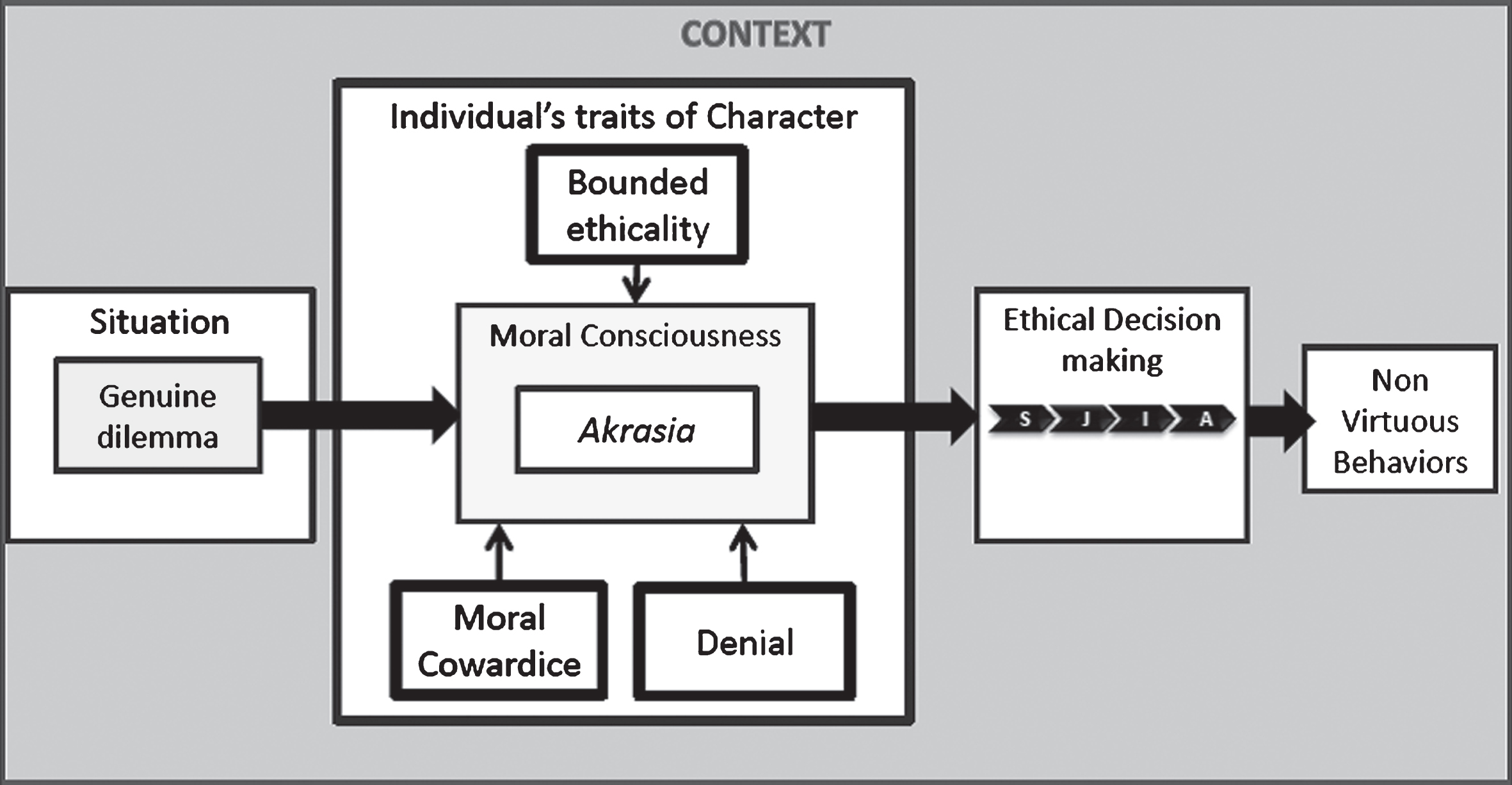
Circumstances of non-virtuous behaviors.
When asked about the ethical issues and dilemmas they have experienced, senior managers mention authenticity and freedom as salutary values in their decision-making process [31]. However, some managers demonstrated a utilitarian view in their explanation. They confessed to having ignored certain ethical and moral duties in their search for managerial effectiveness: “I try to put aside the moral and ethics and make a decision that will profit the company” ([31], p. 316). This finance manager’s words suggest that the dismissal of a person who was considered a difficult employee did not represent a problem to her as long as she felt she was reducing the company’s costs. She saw the dismissal as an economic opportunity rather than an ethical issue. In prioritizing the organizational effectiveness at the expense of ethics (including the value of justice), this manager’s actions demonstrate a denial of moral standards that good management practices seem to promote [31]. This denial capacity is distinctive and its form is characteristic.
But first, what is denial? Several definitions exist and we use one that is generally accepted in management as the refusal to grant the truth value - or fact - that seem and is apparent to others [47]. This can be both a defense mechanism and an attitude. Like Tedlow [47], our interest is in the phenomenon of denial, as an attitude, for its preventable nature and because we consider it a failure. Although the denial phenomenon is often unconscious, it can be mobilized in a controlled situation as well as circumstances where the individual exercises “selective attention” [47]. Denial is not entirely unconscious, but rather “semi-conscious” as it implies the refusal to take certain facts into account [47]. From the previous example, we can conclude that the manager was in denial of her managerial responsibilities for refusing to consider the injustice of her decision by prioritizing the financial efficiency of the company over the well-being of the employee.
Cohen [48] offers an interesting typology of denial [48, 49]. For him, there are three types: literal denial, interpretive denial and implicative denial [48]. The first two types are found predominately in psychology and relate to the denial of a fact’s existence and to the refusal of its meaning. Because of its characteristics, implicative denial is of the most interest in the case of ethical error. Implicative denial integrates facts and their conventional meaning, but these facts are “denied or minimized in their psychological, political or moral implications that conventionally ensue” ([48], p. 8). Thus, one agrees that the facts exist and understands their meaning, but refuses to see them as ethical or moral issues that carry consequences. Referring back to the example above, the finance manager refused to see the situation as an ethical or moral issue because ‘everyone does it’ and it is considered part of business practices. She demonstrated an implicative denial by disregarding the ethical implications of her decision.
Individuals use implicative denial for the sake of self-protection and to maintain an illusion of balance. This denial necessarily involves denying the idea of freedom, asserting lack of choice and strict adherence to organizational values. As Cohen [48] points out, the basis for such denial is one’s refusal of freedom through assumed blindness about the future consequences of his choices. Denial of moral responsibility has an important role - that can be avoided - in the failure to assume one’s values and personal ethics in favor of organizational values. We are avoiding our ethical self by automatically adhering to the organization’s normative standards. This is an important mistake because its psychological impacts can be pernicious. Aristotle would call this disposition an ignorant state.
In another example, a manager justified his decision in collecting evidence and building a case against an employee that would lead to the employee’s dismissal. “When we have used everything we can in terms of regulation, the only way to end the situation is to build a case on the individual. You monitor all his comings and goings.” ([40], p. 316). This insistent observation of the employee whereabouts can be likened to harassment techniques. In this example, we see that the end - although it may be legitimate - justifies the means, which are less so. To achieve his end, this manager - who sess himself as “concerned with ethics” – denied his responsibility in the promotion and observance of basic ethical rules as well as for the employee’s dignity [31]. Should one forget fairness in order to fight injustice? The ethical error in this case is the denial of one’s duties, which is a common form of ethical error and perverse behavior in organizaions. This first trait, denial, is typical of non-virtuous behavior.
Moral cowardice
Aristotle invites us to consider an individual’s will to achieve good, because by definition the will wants good. For Aristotle, the intellectual virtue of desiring to achieve good unfortunately encounters obstacles in the earthly world. Exercising caution in the art of deliberation can be a way to achieve good. Note that the concept of freedom is inherent in the word “deliberation”, “deliberate choice”, that is to say, acts of caution. Freedom for Aristotle is an effort of deliberation aimed at caution. Caution and freedom remain difficult efforts to achieve towards a state of virtue. According to psychoanalyst Fromm [50], individual freedom is often seen as a burden. Human beings have a tendency to surrender some of their freedom in order to relieve themselves from the “burden of freedom” [50].
Existential philosophy examined the presence of fear and anxiety related to freedom in decision-making processes [51]. Researchers should recognize the importance of tolerating ontological anxiety in our lives (in general) and in our decision-making process (in particular) [52]. The inevitability of ontological anxiety or guilt in the decision-making process is related to the fact that one chooses solutions that are inspired by the past and characterized by psychological or philosophical determinism [53a, 52]. Human error is defined as the lack of deliberation between options in a contingent situation and by systematic application of a procedure based on the past [53a, 54]. Moral error thereafter comes from one’s inability to assume an essential virtue of one’s existence: freedom.
Since one is always free, the weight of various responsibilities becomes an unbearable burden [55]. Sartre commented that consciousness of one’s own freedom is not easy to assume and so one tries to flee in fear or bad faith [56]. This flight in anxiety is a way to become aware of a demanding existence and that is why people invest in various predefined roles to alleviate their existence [56]. To avoid this anxiety of freedom, one sometimes acts in “bad faith”. Acting in bad faith becomes a consequence when one considers himself first and foremost as an object - professional roles are more important than one’s own needs - instead of acting as a free individual [51, 57]. Ultimately what the individual is fleeing is himself. Note the beginning of moral cowardice.
This avoidance of freedom has received little attention from experts, as most models suggest the presence of moral courage and less often its absence, moral cowardice [58]. Moral cowardice - or unconscious cowardice from an ethical point of view - could receive more interest if the prescriptive view of ethical behavior undertook empirical research. However, most cases remain in the academic and organizational worlds.
This leads us to address a more controversial case which is, in our view, emblematic. This case concerns an experiment led by Professor Zimbardo [59] of Stanford University, in which students were divided into two groups; that of prisoners and prison guards in a ‘fictitious’ setting. We will not dwell on the psychological concepts illustrated in this experiment, but rather on a fundamental ethical mistake commited in the course of the experiment by Zimbardo himself, which exemplifies moral cowardice [59].
Professor Zimbardo [59] surrendered his freedom of thought and therefore critical examination of himself and of his experience. Just as some students serving as guards, he played the role of warden out of fear that pseudo-prisoners acting out a riot would cause the experiment to fail. This illusory perceived risk caused him to seek police assistance for the transfer of students/prisoners) into a real county jail instead of the University basement where the experiment was initially begun. The police officers were, however, different in their ethical attitudes because they continued to hold their autonomous deliberation and freedom of thought. They refused to participate in this situational delirium. Zimbardo remained unawares and his bizarre request to authorities was an indication of moral cowardice. Even the sight of prisoners who were in a state of psychological and physical distress did not impress upon him to stop the experiment [59]. In addition to the denial of the students’ suffering, he not only demonstrated moral cowardice but bad faith as well. Zimbardo, as a psychologist, was more obsessed with the pursuit of his experience as a prison warden (thus the transfer into a real prison) than with the psychological well-being of his students/prisoners. The fact that he forgot his psychologist identity and responsibilities in favor of his role as prison warden responsible for the experiment, symbolizes his moral cowardice. It took the intervention of his girlfriend (also a psychologist) for him to become aware of the ethical issues at play and to exercise his responsibilities. His belated realization thereafter symbolizes the return of moral courage by mobilizing his freedom and free will. This expression of will in the decision-making process is less automatic than it may seem especially when facing ambiguous and emotional situations. Managers are confronted daily with the fear of assuming their freedom and responsibilities within the ethical decision-making process when encountering ethical dilemmas [29a, 46].
Bounded ethicality
Traditional approaches to ethics lack a thorough understanding of certain involuntary cognitive patterns that accompany unethical behavior. Cognitive processes can lead people to act against their own ethical systems and make their decisions ethically questionable and at odds with their own moral judgment. These processes derive from cognitive anemia where consciousness is described as “ethically limited” [14]. This state makes one unable to be aware of the ethical and moral implications of his choices. They remove a person from core ethical responsibilities. This inability, an ethically limited attitude, is derived from a restricted view of ethical risks because “bounded awareness”, a failure to seek, use or share important and relevant information that remain easily visible or shared by others. [60]. These two phenomena, “bounded awareness” and “bounded ethicality”, are inspired by the work of Herbert Simon [61] and his concept of “bounded rationality”. The relationship between these phenomena is causal; our limited consciousness causes ethically limited decisions and actions. In both cases, individuals are alienated by biases that lead them to ethical blindness [62].
Ethical blindness thus arises in a quasi similar manner [62]. Ethical blindness shares two features of these psychological attitudes mentioned above: they are unconscious events and they divert people from their own values and principles [63]. The difference - although debatable - is the temporary nature of blindness. However, severe ethical blindness seems to be within the family of unconscious ethical attitudes. Therefore, the question arises as to how ethical blindness can be explained and how does it emerge.Tenbrunsel and Messick [64] show that under certain circumstances, the ethical aspects of a decision slowly fade away to the point where the decision-maker becomes gradually blind until he becomes completely unaware of his moral blindness. Several triggers explain the long ethical slip that some have called “moral disengagement” [62, 65]. We will now explore the forces that drive this blindness or moral disengagement.
The first factor of moral disengagement is termed framework rigidity, also referred to as cognitive schema. For example, the use of a rigid form of logic application regardless of the organizational situations, even as ambiguous as the ethical dilemma may be considered to constitute this factor [64]. This framework rigidity - or thought rigidity - makes it difficult to transcend or modify one’s point of view. The individual fails in his deliberations as he is unable to consider other ways of thinking. The person sees no choice, just one unique solution. By making his operating and analysis modes mechanical, he becomes limited in his judgments and actions. He is therefore ill-suited for the diversity of situations that require the application of appropriate solutions. This causes “blind spots” of consciousness, and from ethical and moral standpoints, these “blind spots” produce important sources of ethical error, only partly agreeing with one’s conclusions [46].
The second factor is “motivated blindness” that consists in turning a blind eye on the unethical behavior of a third party [14], where one wants to look away from the immoral behavior of his colleagues or boss. This does not make the person immoral, but it transforms his ethics into adopting a mode of either complicity or tolerance. A source of error thereafter results from “indirect blindness” [14], summarized by the outsourcing of ethical costs. This is a delegation of one’s moral and ethical obligations to external partners. The ethically limited attitude places the individual onto the slippery slope of behavior towards immoral acts [14] through a slow degradation of ethical beliefs. This descent led some accounting firms, such as Arthur Anderson, once a flagship model of ethical training, to ultimately sign rigged accounting documents and commit a host of illegal actions [31]. The slippery slope towards unethical behavior is a slow and insidious process that transforms one’s judgment into a passive stance with a secondary role [13, 63]. It is the logic of small steps that slowly but surely separates an individual from ethical standards and moral convictions [13]. In short, these biases cause errors that mutate into expression, always present to affect one’s ethical behavior by limiting the ability to identify and understand ethical situations. These risks of limited ethicality will remain as long as people remain unaware of their own limited ethical attitudes.
Implications
The three ethical risks we have just presented are elements that weaken - even annihilate - virtuous behaviours as described by Aristotle’s work. These elements come from our successive research and do not hold the pretense to be exclusive [38, 64 and 65]. The theoretical conceptualization in this article is the result of our field observations and discussions. Our work is built on discussions with managers in organizations who are dealing with ethical issues. Sometimes an analysis is provided, sometimes an explanation is followed by a description of the manager’s mistakes and the measures they took to reduce risks in the future is discussed. We present them as managerial implications because they not only inform us about the ethical decision-making process employed by practitioners, but they also constitute potential research avenues towards offering managerial solutions about ethical issues.
First, we hypothesize that managers can oppose the value of authenticity in the face of akrasia [65]. As described by Sartre, “to be authentic is to fully realize one’s being in a situation”([56], p. 244). Being authentic to one’s self can only be done through a precise and concrete situation and therefore relies on a pragmatic and contingent conception of being. In doing so, a manager is authentic when he transcends the situation to other possibilities. By acknowledging different situational factors, he therefore assumes his freedom of choice in that situation. Authenticity as a value allows an individual to develop his identity towards something he is not yet instead of seeing his ethical self owned by internal or external determinism [56, 66].
In this way, authenticity can become the remedy for a weakness of will and can be expressed through certain forms of leadership. For several years now, we have seen a clear interest in discussions of authentic leadership based on existentialist theories [67, 68] and Sartre’s philosophy [69]. This perspective focuses on the subjective experience in this leadership relationship [70]. The Sartrean authenticity leadership approach attempts to include inter-subjective dimensions; its practice focuses upon freedom and responsibility values while rejecting bad faith or alienation attitude [68, 70].
Authentic existentialist leadership could appear as a bulwark against denial or limited ethics and is evidenced in our previous study with human resources managers regarding their ethical dilemmas [65]. One manager stated that the value that helped him to remain himself was “Authenticity towards myself first and rigor second. We must be as neutral and legal as possible” (HRM 8; [65]). Another stated: “If you don’t listen to your deep values you lie to yourself, you have less pleasure and even less success, you become less and less credible” (HRM 4; [65]). Authenticity for these managers was therefore the means of expressing their way of managing, a part of their moral self. Concerning authenticity as a continuum value, another manager stated: “Our code of ethics is refined with work experience, by listening to others, by trying to have an open mind; difficult situations allow us to develop our ethical sense, people can question us and coach us too” (HRM 28; [65]). According to these managers, to be authentic leader or even virtuous meant not lying to themselves, fully fulfilling their responsibility to themselves and to others, being in alignment with their values and ethics as well asevolving their integrity to meet moral situations was the essence of managing..
The second implication of our conceptual model can shed light on issues of unethical behaviour. If we consider that “unethical behaviour” is an action that does not belong to generally accepted norms and values, we can conclude that cheating, lying or theft are unethical acts [71]. Thus, unethical behaviour can be seen as acts outside a set of values accepted by the vast majority of people or by a system of norms. We find this point among researchers in moral psychology who advocate that unethical behaviour is an illegal or morally unacceptable practice for a community [17]. This perceptive has multiple origins and relies primarily on on both individual and contextual attributes [72, 73]. In a well-known article, Treviño and Youngblood [74] pointed out that the individual remains the main agent of unethical behaviour and developed their theory of “the wrong apple”. The of “bad apple” concept has found a favorable response, but it places the burden of guilt on the individual and not on the organization. This type of logic has been associated with the notion of ‘impulse perspective’ in which an individual determined response overlaps all other explanations on unethical behaviour [73].
With our model, we realize that individual unethical behaviour comes from an interaction between a person’s moral development and his work context. Thus, we propose an interactive model between a moral construction and a non-neutral environment. This point of interaction is often the weakest link in moral development models [75] or ethical decision-making stages [76]. The implication is that unethical behaviour such as denial, limited ethics or moral cowardice are certainly the result of an individual’s nature but also - and not the least - a result of one’s experience, past and present in a particular or hostile environment. Individuals face dilemmas with personal predispositions but with also expectations from their work environment. This is likely to have a significant impact on their behaviour within the organization [74, 77]. We understand that these ethical risks do not come only from a failure of willingness, but to an alienating situation as well. In this regard, one manager stated: “As an HR manager, you sometimes have to put the ‘well-being’ of the administration at the expense of the employee’s job security and in such a way it looks good” (HRM 3, [65]). In this statement, the notion of managerial pressure is clearly evident as the cause of unethical action. The company strategy distorts the very meaning of his job, which he recalls is to develop “human potential”. This pressure defines employees as a simple resource at the service of organization wealth.
By alienating the very purpose of their HRM work, the organization even alienates a manager’s personality: “[the situation] was that I have to live a lie every day... In the public square, everyone talked it [Factory closure and subsequent dismissals]. My whole family and the world feel that the factories are going to close. And I said that I didn’t know... I was wearing a corporate suit and I became a liar...” (HRM 6, [65]). For managers, character traits can influence ethical decision-making. It is therefore imperative to fully understand what is at stake, especially in terms of ethical behaviour. If one is in ethical denial or cowardice by focusing on organizational imperatives, their process is biased from the beginning and virtuous behaviour impossible. Studying these aspects is likely to have some output for minimizing this mental burden and other negative impacts on managers’ well-being (or on their “ethical health”, if we dare to formulate it).
The third implication concerns moral courage. We have noted that ethical cowardice may arise from an ambiguous situation where ethical issues are not clearly defined or exploited. In contrast, we believe that the study of moral cowardice can help us develop a better understanding of its counterpart, moral courage. The concept of moral courage is frequently perceived as a physical and psychological attitude in which bravery, persistence, integrity and vitality are essential [78]. However, several forms of courage exist, such as psychological courage or social courage [79]. Our interest is in moral courage as it is defined as action against threats to our morals or ethical integrity [80]. Aristotle gives courage a major importance in risky or difficult decision-making as the courage to behave ethically. Aristotle suggested that courage is both an end and a means of creating common good [5]. The ability to act according to one’s convictions in the face of fear, doubt, uncertainty, and even management pressure characterizes the conceptions of courage found in the literature [81, 82]. In previous research, a manager mentioned: “The real courage is to say no to the directives that lead us to corruption. It’s not easy because to ignore it would be less complicated for me. In the morning when I get up, I must be able to look at myself in the mirror” (HRM 7, [65]). Another manager described the notion of courage in another way: “The dilemma was between the values of liability to my employer versus the sense of justice towards a human situation. Keeping the person in his job was the right thing to do, in my opinion! And I know that in the eyes of the employer it was a professional error... it was a cognitive dissonance for me. The dilemma can be expressed as follows: a professional error or a moral error... I discussed it with my HRM colleagues in the other sites and they told me that they were all doing the same thing as me. That reassured me. It was a consensus among my HRM colleagues to break certain rules collectively” (HRM 15, [65]). The challenge of moral courage can be explained by our ability to respond to requests on both emotional states (fear and anxiety) and motivational states (willingness to overcome fear) [58]. This moral courage – as an overcoming of ethical cowardice or fear - could receive greater attention in the prescriptive vision of the field of ethical behavior.
Conclusion
In this paper, we proposed a theoretical conceptualization with the objective of coupling virtue ethics with recent empirical results on ethical behavior. We have integrated this relationship into decision-making models to explain the disruption of a person’s dispositions when ethical dilemmas emerge. We emphasize their impact on traits and their potential influence throughout the decision-making process.
These conclusions invite us to anticipate solutions to the causes of the akrasia phenomenon or weakness of will, in the ethical decision-making process when facing a dilemma. It appears that only the force of a person’s reason could reverse this negative influence in order to find virtuous character traits such as courage, humanity and wisdom [83]. For Aristotle, courage is the attitude of the wise in morality: “Thus, the cowardly, the reckless and the brave relate to the same objects; the difference between them is limited to how they behave in relation to these objects. The first two err on the side of excess or default, and the third is in balance, at the golden mean, as he should be” ([5], III, 15a,).
Courage as an antidote to akratês attitudes and expression of one’s “ethical self” or “moral self” appears to be an interesting alternative. Ethical courage can be seen as an opportunity to express of our freedom within a conflictual situation as the moral dilemnma [84]. How does one achieve this courage? The notion of awareness offers the basic attitude to accept the existence of dilemmas and the ambiguity they generate. An ethical dilemma doesn’t have to be a barrier to acheve one’s own moral personality or a path to weakness of will. Actually, it can be quite the opposite. Ethical dilemmas can place stress on our ontological structures and reveal – if one attempts to be authentic - the ethical system in our consciousness. This may offer us an idea as to how the structure may be revealing our moral courage when facing a ambiguous situation. On the contrary, with moral courage we can assume our freedom and refuse determinism of any kind, which often creates anguish or ethical dissonance [46]. For example, Sherron Watkins, an Enron employee, publically exposed her company’s corruption; at great personal and financial risk to herself, she spoke up when others remained silent. Whether she was confronting a bully, challenging their culture, or simply seeking truth, she demonstrated a type of moral courage which refused to fail. Even more significant is that her actions were performed even before whistle-blowing became more accepted as moral behavior. This example demonstrates how moral courage can be an antidote against weakness of will and the biases previously described. By doing so ourselves, we can generate personal ethical systems based on freedom, consciousness, responsibility, and engagement toward ourselves and others. Between our professional and organizational responsibilites, we still have some room to build on our own sets of values.
This work has some limitations inherent of its choice of methodology. The conceptual model is essentially based on the researcher’s subjective insight acquired through their teaching and research experiences. The model presented has not yet been empirically validated, either qualitatively or quantitatively. Our model also invites of the consideration of how different organizational cultures or ethical climates might foster traits that create lack of goodwill, moral cowardice, denial and bounded ethicality. What forms of ethical leadership could prevent inappropriate decisions emerging from these attitudes? Future research could pursue the study of these dispositions and further explore aspectsof virtuous behavior on an empirical basis. We believe an exploratory analysis of managerial narratives would be an effective start in studying the different relationships that might exist. Future exploratory research could also help confirm or reject some of our assumptions. Conversely, exploring the possible sources of failure can lead us to discover and comprehend those factors of success for virtuous behavior.